
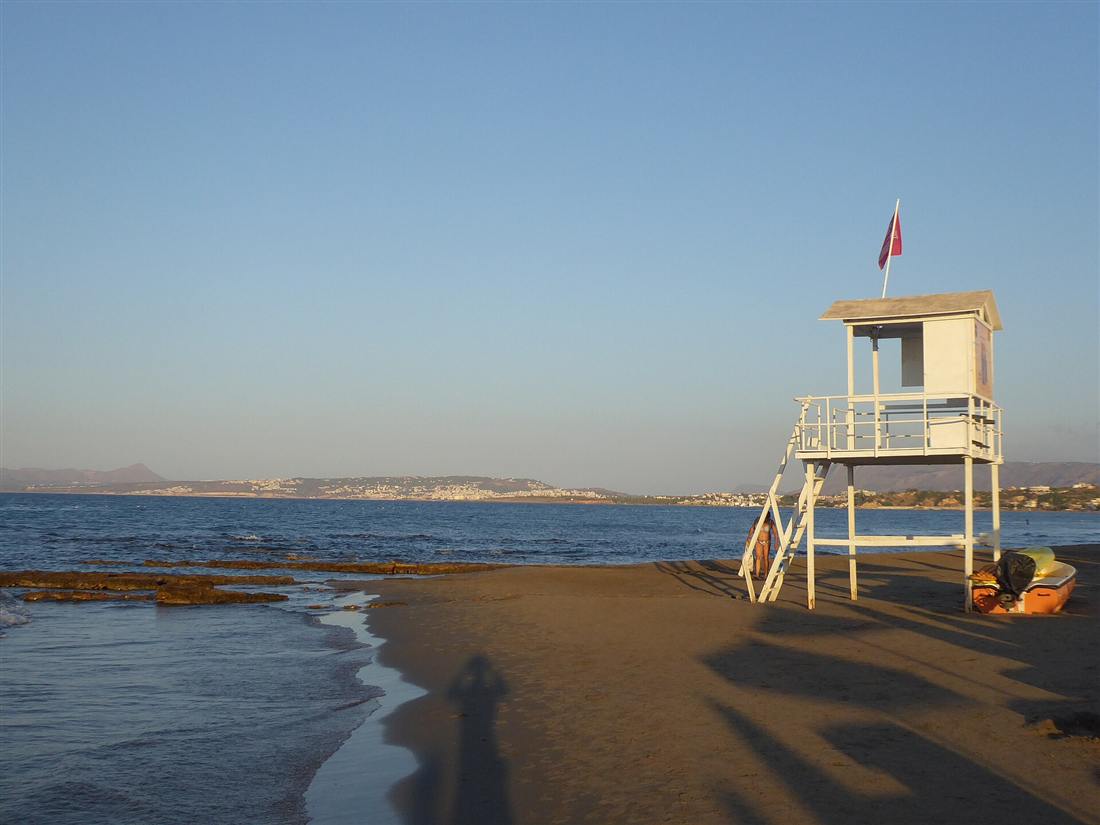
To get from Chania to Agia Marina, drive west on the old coastal national road or the E75/A90, about 9 kilometres in 15 to 20 minutes, reaching the beach resort between Stalos and Platanias, facing the Thodorou islet. The trip from Chania to Agia Marina is one of the shortest beach runs on the coast. Plan the whole trip with Greece Tours.
This guide covers the trip from Chania to Agia Marina in full: where it is, how to get there by car and by bus, the resort and its long sandy Blue Flag beach, the watersports, the Thodorou islet and its kri-kri reserve, the Limnoupolis water park, the neighbouring resorts of Stalos and Platanias, and whether this short west-of-Chania trip is worth it or a resort base.
Where is Agia Marina and how far is it from Chania?
Agia Marina sits on the north-west coast of Crete, 9 kilometres west of Chania town in the Chania regional unit. It lines the shore between Stalos to the east and Platanias to the west, a 15 to 20 minute drive from the centre of Chania.
The route from Chania to Agia Marina runs the same way whether you drive or take the bus. The distance from Chania to Agia Marina is covered on a single, well-built road. The time from Chania to Agia Marina holds steady outside the peak-season traffic. The drive from Chania to Agia Marina is direct enough to slot into a wider day out. The resort occupies a broad stretch of the Cretan Sea coast that runs west from Chania city toward the Rodopou peninsula. Chania is the second city of Crete and the capital of the western part of the island, and its old Venetian harbour is the fixed point from which the coastal resorts are measured. Agia Marina is the first true beach resort of scale as the coast road heads west, following the smaller settlement of Stalos and preceding the long line of Platanias. The distance of 9 kilometres is short enough for a taxi transfer, a rented car, or a public bus, and the journey stays on the coastal plain the whole way without climbing into the hills.
The name Agia Marina attaches to two connected places. The lower part is the coastal resort strip, a ribbon of hotels, apartments, tavernas and beach frontage that developed for tourism. The upper part is the old village of Agia Marina, which sits on the slope above the coast road, an older agricultural settlement with a church, narrow lanes and views down to the water. Visitors book the coastal strip; the old village rewards a short detour uphill for a quieter, more traditional face of the same community.
Geography makes the trip simple to picture. Chania lies at the head of the Gulf of Chania, and the coast curves gently west-north-west toward Agia Marina. The islet of Agioi Theodoroi, known locally as Thodorou, floats just offshore directly in front of the resort, a landmark visible from the beach and from the road as you approach. Because the terrain between Chania and Agia Marina is flat coastal plain, the two places sit within easy reach of each other, and day-trippers move between them in both directions throughout the season. For a wider set of ideas along this coast, the guide to day trips from Chania maps the resorts, beaches and villages that fan out from the city.
How do you drive from Chania to Agia Marina?
Drive west out of Chania on the old coastal national road or join the E75/A90 national highway, then exit toward the coast at Agia Marina. The route runs 9 kilometres and takes 15 to 20 minutes, staying on flat, well-signed roads the whole way.
Anyone weighing the journey from Chania to Agia Marina finds the distance short by Cretan standards. Setting out early on the Chania to Agia Marina run beats both the heat and the crowds. Fitting Chania to Agia Marina into a morning leaves the afternoon free for the coast. Travellers who plan the trip from Chania to Agia Marina reach it comfortably in the times given. Two parallel roads connect Chania to Agia Marina, and both end at the same resort. The old national road hugs the coast, threading through Nea Chora, the western suburbs and Stalos before reaching Agia Marina; it is slower, busier with local traffic and lined with shops, but it delivers the scenic version of the drive with the sea on your right. The E75/A90 national highway runs slightly inland as a faster dual-carriageway link, and drivers who want speed take it west and drop down to the coast at the Agia Marina exit. From the centre of Chania, either choice lands you at the resort inside 20 minutes outside the peak summer rush hours.
Parking at Agia Marina follows the pattern of a Greek beach resort. Free roadside spaces line the streets that run down to the beach, hotels hold their own guest parking, and the busiest stretches fill by late morning in high summer. Drivers who arrive before midday find spaces near the sand; those who come in the afternoon park a few streets back and walk down. The flat layout of the resort keeps every parking spot within a short level walk of the beach and the tavernas.
Car hire is the easiest way to make the trip, and it opens the whole coast west of the city. With a car you reach Agia Marina in a quarter of an hour, then continue to Platanias, Maleme, Kolymbari and the Rodopou peninsula on the same road, or turn inland to the Keritis valley and the villages behind the coast. Taxis run the route as a fixed short transfer from Chania town and from the airport at Souda side of the city. The drive itself demands nothing technical: it is a straight coastal run on paved main roads, signposted for Platanias and Kissamos, with Agia Marina marked as you pass Stalos. A base in Chania puts every one of these roads within a few minutes of your door.
How do you reach Agia Marina by bus?
Chania urban buses and the KTEL coastal service run west to Agia Marina on frequent departures, a ride of 20 to 25 minutes. The buses leave from the Chania town centre and the KTEL station, stop along the resort strip, and continue west to Platanias and Kolymbari.
The short run from Chania to Agia Marina keeps the village within easy reach of the city. The Chania to Agia Marina route is served by frequent buses through the season. The road from Chania to Agia Marina is paved and well signed the whole way. The route from Chania to Agia Marina runs the same way whether you drive or take the bus. The public bus is the cheapest and simplest way to travel between Chania and Agia Marina without a car. The blue-and-white Chania urban buses cover the western coastal suburbs and resorts, and the green KTEL intercity buses run the longer coastal line toward Kissamos, both passing through Agia Marina. Departures come thick through the day in the summer season, thinning in the evening and in winter, so the resort stays connected to the city from early morning until late. A single ticket costs a few euros, bought from the driver or at the kiosk, and the same line links Agia Marina onward to Platanias, Gerani, Maleme and Kolymbari.
Boarding in Chania is straightforward. The urban buses depart from stops in the town centre near the market and the main squares, while the KTEL coastal buses leave from the central KTEL station a short walk from the old town. Ask for Agia Marina and the driver marks the fare; the bus tracks the coast road west, calling at stops through Nea Chora and Stalos before pulling in along the Agia Marina strip. Bus stops in the resort sit on the main road, and from each one the beach is a short walk downhill toward the sea.
The bus suits travellers who base themselves in Chania and want the beach for the day, and those staying in Agia Marina who want an evening in the city without driving. Because the service is frequent through the day, you build a flexible plan: a morning bus out to the sand, lunch at a taverna on the strip, and an afternoon or evening bus back into town. The ride of 20 to 25 minutes is a little longer than the drive because the bus stops along the way, but it removes parking from the equation entirely and drops you in the heart of the resort.
What is Agia Marina like as a resort?
Agia Marina is a family-oriented beach resort with a long sandy shore, a strip of hotels, apartments and tavernas, and a calmer pace than the Platanias nightlife strip next door. It blends a developed tourist front on the coast with the older village of Agia Marina on the slope above.
On a map, Chania to Agia Marina traces a clear line that the road follows closely. A car makes the Chania to Agia Marina trip flexible, but the bus covers it too. Drivers on the Chania to Agia Marina route follow the national road for the fast section. Anyone weighing the journey from Chania to Agia Marina finds the distance short by Cretan standards. The character of Agia Marina is set by its beach and its families. The resort grew along the coast road as a destination for relaxed seaside holidays, and the tone stayed gentle: parents with children, couples after a quiet week, and returning visitors who prize the sand and the sunset over the late-night scene. Hotels range from large beachfront complexes with pools to small family-run apartments a few streets back, and the tavernas serve Cretan grills, fresh fish and mezes at tables that look out to Thodorou islet. The strip carries the practical machinery of a resort \u2014 mini-markets, bakeries, car and bike hire, pharmacies, beach shops \u2014 packed into a walkable band between the road and the sea.
Agia Marina and Platanias sit shoulder to shoulder, and the two resorts share one continuous sweep of sand, yet they keep distinct moods. Platanias, immediately to the west, holds the loud heart of this coast: the bars, the clubs and the after-dark energy that draw a younger crowd. Agia Marina stays the quieter neighbour, closer in feel to a family beach town, so guests who want the nightlife walk or drive the short distance west, while those who want calm stay put. This pairing lets a visitor tune the holiday, with the beach shared and the volume dialled up or down by choosing which end to sleep at.
Above the coastal strip, the old village of Agia Marina keeps the resort honest. Its lanes, its church of Agia Marina, and its hillside houses show the farming settlement that stood here before tourism, and the short climb up delivers views over the rooftops to the sea and the islet beyond. Between the modern beachfront and the old village, the resort offers two faces within one name: a sunbed-and-taverna coast for the daytime holiday, and a slower, greener slope for a quiet evening walk away from the crowds.
What are the beach and watersports of Agia Marina like?
Agia Marina has a long sandy Blue Flag beach that merges into the Platanias beach to form one uninterrupted shore. It is lined with sunbeds, umbrellas, hotels, tavernas and watersports operators, with clean shallow water that suits families and swimmers of every age.
The trip from Chania to Agia Marina pairs well with the neighbouring stops on the same road. The Chania to Agia Marina drive rewards the effort with the sights at the end of it. The Chania to Agia Marina trip is one of the more rewarding short runs from the city. The short run from Chania to Agia Marina keeps the village within easy reach of the city. The beach is the reason Agia Marina exists as a resort. The sand runs in a broad, flat band along the coast, wide enough for rows of sunbeds and umbrellas with room to spare, and the Blue Flag award marks water quality and beach management that meet the international standard. The seabed shelves gently, so the shallows stay warm and safe for children while stronger swimmers strike out toward deeper water. Because the Agia Marina sand joins the Platanias sand without a break, walkers stroll for kilometres along the shore, moving between the calm family end and the livelier western stretch on foot at the water’s edge.
Watersports line the beach through the summer season. Operators on the sand run jet skis, banana and ringo rides, pedal boats, stand-up paddleboards, canoes and parasailing, and beach-side kiosks rent the gear by the session. The resort also holds diving centres that lead scuba trips and courses for beginners and certified divers, exploring the reefs and the waters around Thodorou islet, and boat operators run excursions along the coast and out toward the islet. Between the swimming, the paddling and the organised trips, the beach fills a full day of activity for those who want more than a sunbed.
Facilities keep pace with the crowds. Sunbeds and umbrellas rent by the day, beach bars and tavernas sit steps from the sand for lunch and cold drinks, and showers and changing points serve swimmers. The tavernas that back the beach set their tables to face the water and the islet, turning a meal into a view, and the sunsets over the Cretan Sea draw people back to the shore each evening. For a beach holiday built on swimming, family time and easy watersports, the Agia Marina shore delivers the length, the sand and the services to fill day after day.
What is the Thodorou islet and the kri-kri reserve?
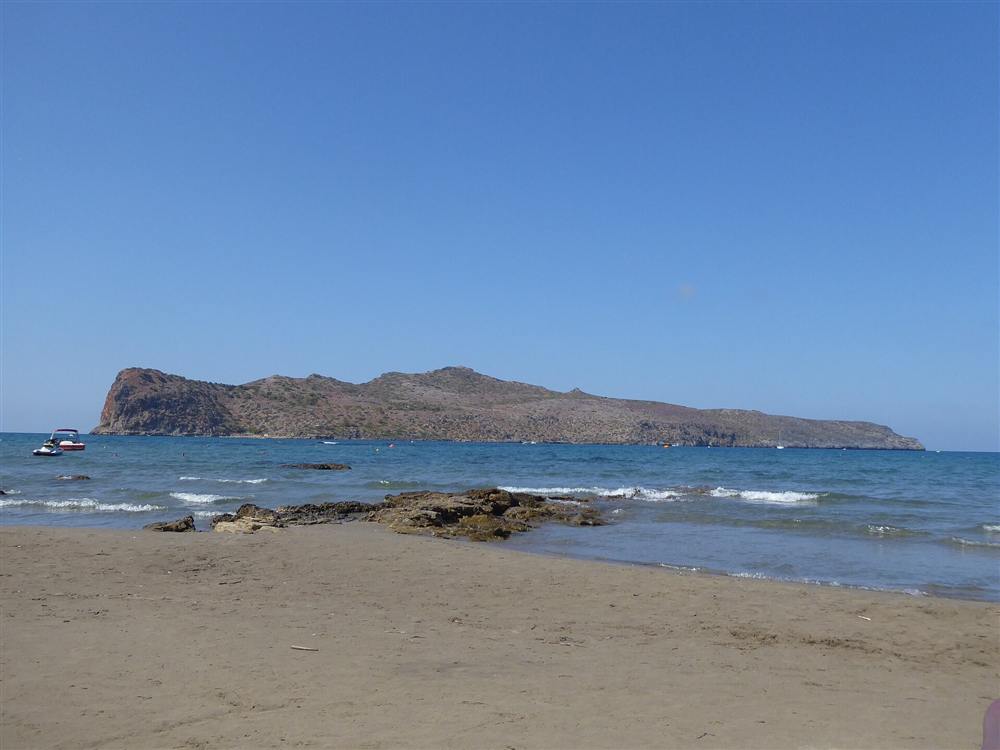
Thodorou, formally Agioi Theodoroi, is an uninhabited islet that floats offshore directly in front of Agia Marina and Platanias. It is a protected nature reserve for the Cretan wild goat, the kri-kri, and holds a large sea cave that legend names the petrified mouth of a sea monster.
Both the car and the bus make Chania to Agia Marina a simple leg of a west-Crete plan. Every itinerary that includes Chania to Agia Marina gains an easy, scenic leg. Planning Chania to Agia Marina around the light and the meals makes the most of the visit. On a map, Chania to Agia Marina traces a clear line that the road follows closely. The islet is the defining landmark of the Agia Marina seascape. Set a short distance out from the shore, Thodorou fills the middle of the view from the beach, the tavernas and the road, a green-brown hump of rock rising from the blue water with a Venetian-era fortification on its flank. Its protected status keeps it uninhabited and closed to casual landing: the island serves as a refuge for wildlife rather than a destination for sunbathers, and access is restricted to guard the reserve. From the resort you watch the islet across the water, its outline shifting colour through the day from bright morning stone to deep evening silhouette against the sunset.
The kri-kri is the reason for the protection. The Cretan wild goat, an endemic animal of the island with sweeping backward-curving horns, lives on Thodorou as one of the safe populations kept away from the pressures of the mainland mountains. The reserve status shields the goats and the island’s plants and birds from disturbance, and conservation authorities manage the site as a wildlife sanctuary. Boat trips from Agia Marina and Platanias circle the islet so visitors see it up close from the water, and sharp eyes pick out the goats on the slopes without setting foot on the protected ground.
Legend wraps the islet in a story that fits its shape. The great sea cave that opens on the seaward side is told, in the old tale, as the mouth of a monster that rose from the sea to swallow the coast and was turned to stone by divine hand before it struck, leaving the island as the petrified beast with its jaws frozen open. The cave mouth, dark against the pale rock, gives the story its anchor, and the tale travels with every boat that rounds the island. Between the wildlife, the fortification and the myth, Thodorou turns the view from Agia Marina into more than scenery.
What is there to do near Agia Marina \u2014 Limnoupolis, Stalos and Platanias?
The Limnoupolis water park sits inland behind Agia Marina, a large summer-season park of slides and pools. Stalos and its beach lie toward Chania to the east, the Platanias strip and its nightlife run to the west, and the Chania old town and harbour are a short drive east.
The time from Chania to Agia Marina holds steady outside the peak-season traffic. The drive from Chania to Agia Marina is direct enough to slot into a wider day out. The Chania to Agia Marina journey ends at a place that repays an unhurried stay. The trip from Chania to Agia Marina pairs well with the neighbouring stops on the same road. Limnoupolis is the headline attraction behind the resort. The water park spreads across the plain inland from Agia Marina, a summer-season complex of water slides, wave and lazy-river pools, splash zones for small children and sunbathing terraces, with bars and food outlets on site. Families make a full day of it, and the park draws visitors from across the western Chania coast; a short drive or a local shuttle links the beach resorts to the gates. Open through the hot months and closed in winter, Limnoupolis pairs naturally with a beach holiday at Agia Marina, giving children a second kind of water day away from the sea.
The neighbouring resorts extend the range close at hand. Stalos, the settlement between Agia Marina and Chania, holds its own beach and a quieter cove-like feel, an easy stop on the way to or from the city. Platanias, immediately west, is the entertainment engine of the coast: its strip carries the bars, clubs and restaurants that come alive after dark, and its long beach continues the sand from Agia Marina. Walking or driving the short hop west turns a calm family base into a night out, then back again, without changing hotels. West beyond Platanias the coast runs on to Gerani, Maleme with its wartime history, and Kolymbari at the foot of the Rodopou peninsula.
Chania city itself is the great draw a short drive east. The Venetian harbour, the lighthouse, the old town lanes, the covered market and the waterfront restaurants sit 9 kilometres away, close enough for an evening visit and back to the beach the same night. From Agia Marina you build days that mix sea and city: a morning on the sand, an afternoon at the water park, an evening in the old harbour. The old village of Agia Marina on the slope above adds a quiet local walk, and the diving centres and boat trips fill the water side of the itinerary. Base, beach and city interlock inside a few kilometres of coast.
Is the trip from Chania to Agia Marina worth it, and when to go?
The trip is worth it for a long sandy Blue Flag beach 15 to 20 minutes from Chania, backed by watersports, a water park and the offshore Thodorou reserve. Go from May to October for warm sea and full services, with June and September the balance of heat and calm.
Travellers who plan the trip from Chania to Agia Marina reach it comfortably in the times given. For a first visit, the Chania to Agia Marina drive is the straightforward choice. Both the car and the bus make Chania to Agia Marina a simple leg of a west-Crete plan. The value of the trip rests on how much Agia Marina packs into 9 kilometres of coast. A visitor based in Chania reaches a Blue Flag beach in under 20 minutes by car or 25 by bus, and finds there a full resort rather than a bare strip of sand: sunbeds and tavernas, jet skis and paddleboards, diving centres and boat trips, the Limnoupolis water park inland, and the islet of Thodorou filling the view. The family pace keeps it calm, and the Platanias nightlife waits one short walk west for anyone who wants it. Set against the short distance, the range on offer makes the journey pay for itself for a day trip and for a longer stay alike.
Season shapes the experience sharply. The resort runs at full strength from May to October, when the sea is warm for swimming, the beach services are open, the water park operates and the boat trips run. July and August bring the hottest weather, the fullest beaches and the highest prices, with the strip at its busiest and the sunbeds filling by mid-morning. June and September hold the sweet spot: warm sea, long days, and thinner crowds than the peak, with the tavernas and watersports still working. May and October offer quieter beaches and lower prices, with warm days and a cooler sea, though the water park and certain services wind down at the edges of the season.
Timing within the day and the week helps too. Mornings on the Agia Marina beach are calmer and cooler, with parking easy and the sand uncrowded, while afternoons heat up and fill. Sunset over the Cretan Sea, with Thodorou dark against the glow, is the moment the tavernas fill for dinner. A day trip from Chania works best begun early \u2014 beach in the morning, lunch on the strip, water park or boat trip in the afternoon, and the old harbour in the evening. For a beach that is close, clean, well-served and framed by a protected islet and a good story, the short run west from Chania to Agia Marina earns its place on the itinerary.
Frequently Asked Questions
How do you get from Chania to Agia Marina?
From Chania to Agia Marina, drive west on the old coastal national road or the E75/A90, 9 kilometres in 15 to 20 minutes. The Chania urban and KTEL coastal buses run west to Agia Marina on frequent departures, a ride of 20 to 25 minutes, continuing to Platanias and Kolymbari.
How far is Agia Marina from Chania?
Agia Marina lies 9 kilometres west of Chania town on the north-west coast of Crete, between Stalos and Platanias in the Chania regional unit. The drive from Chania to Agia Marina on the coastal road takes 15 to 20 minutes.
Is the trip from Chania to Agia Marina worth it?
The trip from Chania to Agia Marina rewards visitors with a long sandy Blue Flag beach, calm family swimming and watersports, the Thodorou kri-kri islet offshore and the Limnoupolis water park, 15 minutes from the city. The short distance makes Agia Marina an easy day out and a resort base.