
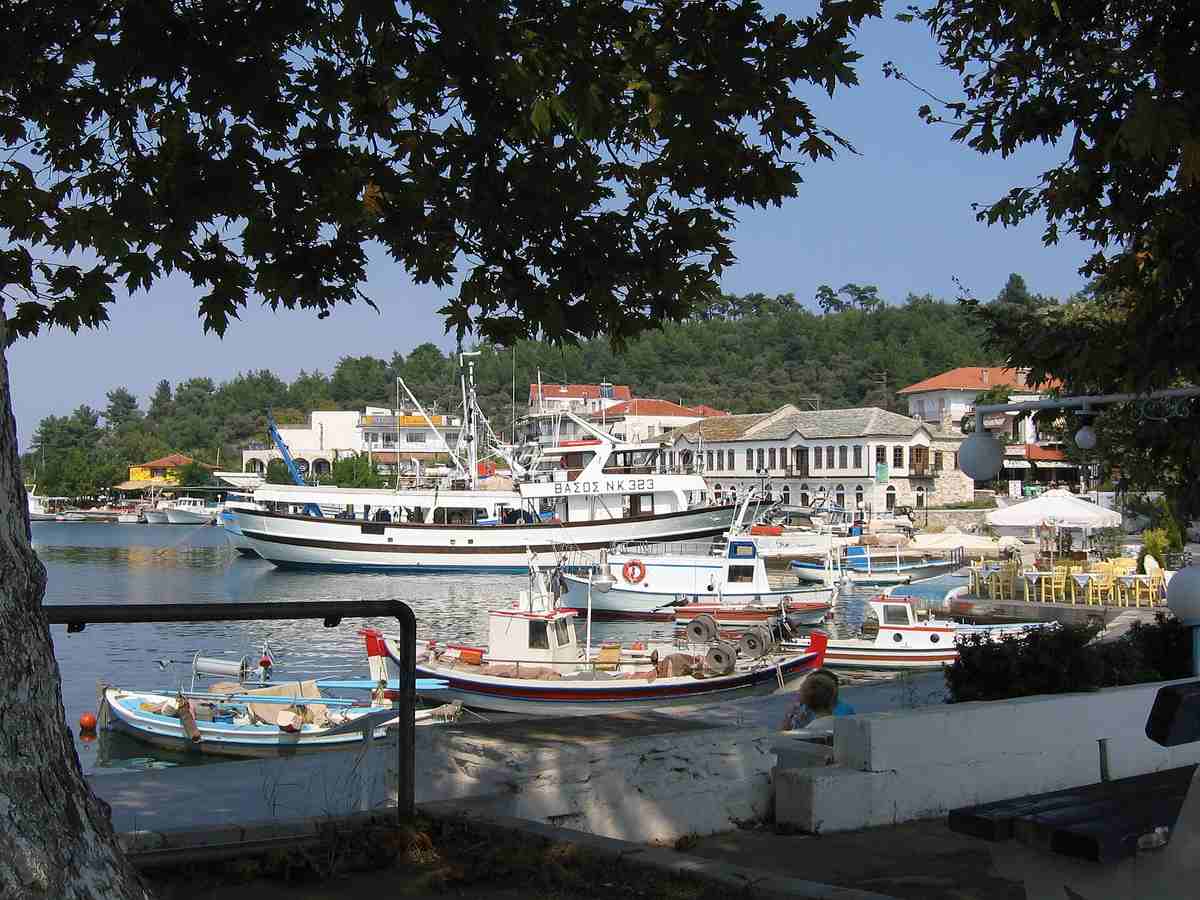
The ancient harbours of Thassos are the twin ports of Limenas, the island’s capital, where the sea power and wealth of the classical city once concentrated on the water. Two basins served the town: an open commercial harbour, still busy beneath the modern quay, and a smaller closed harbour built for warships behind marble breakwaters. Together they handled the marble, gold and wine that made Thassos rich across the northern Aegean. Their moles, quays and ship-sheds survive as low ruins on land and as submerged walls just offshore. A short walk links them to the ancient town above. Travellers reach the site easily on a wider island tour with Thassos specialists.
Seafaring shaped Thassos from its earliest days, and the two harbours were the engine of that story. The open port faced the mainland and drew merchant ships from across the Aegean, while the closed naval basin sheltered the triremes that guarded the island’s trade routes. Stone moles reached into the water to break the northern swell, and warehouses lined the quays behind them. The sections below explain what the harbours were, where they sit, how the military port worked, how they drove the export trade, how they joined the city walls and agora, and how to see them today. Planning stays simple with the range of tours across Thassos.
What are the ancient harbours of Thassos?
The ancient harbours of Thassos are two linked ports at Limenas, an open commercial harbour beneath the modern quay and a closed military harbour ringed by marble moles, that carried the sea power and export trade of the ancient city.
Two separate basins made up the ancient harbour system at the foot of the city. The larger of the pair was the open or commercial harbour, a broad anchorage where trading vessels tied up to load and unload. The smaller was a closed harbour, walled off from the sea by artificial moles and reserved for the navy. Both lay directly below the ancient town, so goods and crews moved quickly between quay and street. Their combined capacity let Thassos act as both a trading hub and a naval base. This pairing of a working port and a protected war harbour was a mark of the leading maritime cities of ancient Greece.
Ancient writers and modern excavation together explain how the harbours worked. The geographer Skylax and later authors noted the strength of the Thasian fleet, and inscriptions record the officials who managed the docks. Archaeologists have traced the lines of the moles, the quay walls and the foundations of storehouses along the shore. Marble blocks from the breakwaters still lie where they fell, both on the beach and under shallow water. The naval harbour kept its shape because its heavy stone walls resisted the waves for centuries. This blend of written record and standing ruin lets historians reconstruct a port that few visitors would otherwise recognise beneath the modern town.
Marble gave the harbours their distinctive character. The moles and quays were built from the same white stone quarried across the island, cut into massive blocks and set without mortar. Waves have since scattered many of these blocks, yet their pale mass still shows clearly through the water offshore. Bronze clamps once tied the stones together against the pull of the sea. The builders raised the walls high enough to shelter ships from the strong northerly winds that sweep the strait. This use of local marble on such a scale linked the port directly to the quarries and to the export trade, since the stone that built the harbour was also the island’s chief cargo.
Position explains why the harbours grew where they did. Limenas sits on the north coast of Thassos, the side that faces the Thracian mainland only a short sea crossing away. Ships bound for the rivers and mines of Thrace, or for the cities of the northern Aegean, found a safe stop here. The bay offered natural shelter that the moles then improved. Behind the shore the land rose quickly to the walled town and its acropolis, giving defenders a clear view of any approaching fleet. This combination of a sheltered north-facing bay and a defensible height made the site the obvious home for both the merchant and the war harbours of ancient Thassos.
Where do the two ancient harbours sit within Limenas?
Both ancient harbours lie on the north shore of Limenas, the modern capital. The open commercial harbour survives beneath today’s ferry quay and fishing port, while the closed military harbour sat just to the east, its moles now partly submerged offshore.
The open harbour lies exactly where the ships still dock today. The modern port of Limenas, with its ferry berth and fishing quay, sits on top of the ancient commercial anchorage. Boats tie up in the same sheltered water that classical traders used, a rare case of a port in continuous use for well over two thousand years. The old inner basin is now called Palio Limani, the old harbour, by local people. Cafes and tavernas line its curved edge. This overlay of living port on ancient one means you can stand on the quay of modern Limenas (Thassos Town) and look out over the very water that carried the wealth of the classical city.
The closed harbour sat a little to the east of the commercial basin. Its walls once enclosed a small, near-circular pool reserved for warships, cut off from open water except through a narrow guarded entrance. Silting and later building have hidden most of this basin, yet the lines of its moles can still be traced offshore. Divers and surveyors have mapped the submerged stonework running out from the shore. The naval harbour lay right below the eastern wall of the ancient town. This close spacing of the two ports, one open and one sealed, packed the whole maritime strength of Thassos into a single stretch of the northern shore beneath the city.
Landmarks on the modern seafront help fix the ancient plan. A small chapel and a cluster of fishing boats mark the curve of Palio Limani, the heart of the old commercial port. The long modern jetty runs out roughly along the line of an ancient mole. To the east, low rocks and shallows betray the drowned walls of the war harbour. Behind the shore the excavated ruins of the ancient town begin only a few steps inland. Reading these clues turns an ordinary harbour view into a map of the classical port. This survival of the old shape beneath the new makes Limenas one of the clearest ancient harbours to picture anywhere in the Aegean.
Distances within the site are short and easily walked. The ferry quay, the old harbour, the war-harbour shallows and the ruins of the ancient town all lie within a few hundred metres of each other. A slow stroll along the waterfront links them in a single walk. From the quay you look inland to the acropolis rising behind the town and out to sea toward the Thracian coast. Benches and tavernas give places to pause and study the view. This compact layout lets you take in both harbours, the modern port and the edge of the ancient city in one easy morning beside the water.
What was the closed military harbour and its moles?
The closed military harbour was a walled naval basin at Limenas, sealed from the open sea by marble moles and a narrow entrance. It sheltered the Thasian war fleet and protected the triremes that guarded the island’s trade routes across the northern Aegean.
A closed harbour, known in Greek as a limin kleistos, was a basin walled off from the sea so that its entrance could be shut with a chain or boom. The Thasian example enclosed a small pool behind two curving marble moles that almost met at their tips. Warships passed through the narrow gap and lay safe inside from both storms and enemy raids. The moles rose well above the waterline and carried a walkway along their crest. Towers most likely guarded the entrance on either side. This design, shared with harbours such as those of Carthage and the Piraeus, marked out a city that took its naval defence seriously.
Ship-sheds lined the inner shore of the naval basin. These were long, roofed slipways where triremes could be hauled out of the water to dry and to shelter over winter. Wooden warships rotted quickly if left afloat, so a covered berth protected the city’s costly fleet. Rows of stone footings for the shed columns have been recognised along the ancient waterline. Each shed held a single hull, drawn up a gentle stone ramp. The count of sheds gives a rough measure of the fleet’s size. This provision for hauling and housing warships shows that Thassos maintained a standing navy, not just a handful of ships raised in emergencies.
The marble moles are the most striking survival of the war harbour. Built from squared blocks of island marble, they reached out from the shore to enclose the basin against the northern swell. Storms and earthquakes have since toppled much of their length into the sea. Divers today swim over long lines of pale stone lying on the sandy bottom just offshore. Some blocks still stand in courses, showing how the walls were laid. The clarity of the water makes the ruined moles easy to trace from the surface on a calm day. This underwater masonry ranks among the finest ancient harbour works visible anywhere along the coast of the northern Aegean.
Naval power rested on the shelter these works provided. A protected harbour let Thassos keep triremes ready to escort merchant convoys and to fight for control of the sea lanes. The island’s wealth in marble, gold and wine made it a tempting target, so a strong fleet paid for itself. Rowers and marines drawn from the citizen body manned the ships. The war harbour also gave the city leverage within the alliances and rivalries of the classical Aegean. Curious visitors can trace the deeper story of that sea power in the wider history of Thassos. This link between a walled basin and real political strength defined the closed harbour’s purpose.
How did the harbours drive the export trade in wine, gold and marble?
The harbours turned Thassos into a major exporter. Merchant ships carried island marble, gold from Thracian mines and famous Thasian wine out of the commercial port, while imports of grain and luxury goods flowed back across the quays that lined the shore.
Wine was the most famous export to leave the Thasian quays. Vineyards across the island produced a strong, sweet wine prized throughout the ancient Mediterranean. Potters stamped each amphora with a seal naming the magistrate and the year, so a Thasian jar could be checked for origin and date. Thousands of these stamped handles have turned up from the Black Sea to Egypt, tracing the reach of the trade. Loaded onto ships in the commercial harbour, the jars sailed out under strict legal control. The city even passed wine laws to protect its brand. This tightly regulated wine trade turned the harbour into the export gate for one of the ancient world’s most sought-after products.
Gold and silver gave Thassos a second source of harbour wealth. Mines on the island itself, and richer deposits on the Thracian mainland opposite, poured metal into the city’s treasury. Herodotus described the Thasian mines and the huge revenues they produced. Ships carried refined metal and coin out of the port, while the fleet guarded the sea route to the mainland workings. This metal wealth funded the city walls, the temples and the war harbour itself. Control of the mines made Thassos a power far larger than its size suggested. This flow of precious metal across the quays explains why the island could afford a navy and the marble defences that protected its ports.
Marble left the harbour both as a raw block and as finished art. Quarries across the island cut the fine white and grey stone that built the city’s own temples and moles. Surplus marble sailed out through the port to buyers around the Aegean, where Thasian stone was valued for building and sculpture. Half-worked column drums and statue blanks travelled beside the finished cargo. The quays that shipped the stone had themselves been built from it. Many of the finest carvings that stayed on the island now stand in the Archaeological Museum of Thassos. This double role, as both harbour material and export cargo, tied the marble trade tightly to the port.
Imports balanced the outward flow of island produce. Ships returning to the commercial harbour brought grain to feed a population that grew more vines than wheat. Fine pottery, textiles and luxury goods arrived from the workshops of Athens, Corinth and the east. Timber and pitch for shipbuilding came down from the forests of Thrace. Customs officials on the quay taxed and recorded each cargo, feeding the city treasury. Warehouses behind the waterfront stored goods before they moved up into the town. This steady two-way traffic, exports out and necessities in, kept the harbour busy year-round and made it the true economic heart of ancient Thassos.
How did the harbours connect to the city walls and the agora?
The harbours joined directly to the city’s defences and civic centre. Massive marble walls ran down to the shore and enclosed both ports, while gates opened onto quays linked by paved roads to the agora, the marketplace where harbour goods were traded and taxed.
City walls tied the harbours firmly into the defences of Thassos. The great marble circuit that ringed the ancient town ran right down to the sea and wrapped around both ports. Sea-gates pierced the wall where the quays met the water, letting cargo pass while keeping the harbour defensible. Towers stood at the corners and beside the harbour mouths. The war harbour in particular lay tucked inside this protective line. Long stretches of the wall still stand among the ruins and along the shore. This integration of harbour and rampart meant an attacker had to break the city’s stone defences before ever reaching the ships sheltered within the basins.
Gates controlled the flow between the harbours and the town. The ancient wall carried several monumental gateways, some carved with reliefs of gods who guarded the passage. One gate opened from the commercial harbour toward the market, so unloaded goods moved straight into the trading centre. Guards at these gates watched both people and cargo entering the walled city. The gates fixed the points where sea traffic became land traffic. Their marble jambs and lintels survive at spots around the circuit. This ring of guarded openings turned the wall from a simple barrier into a managed frontier, channelling the wealth of the harbours through known and defensible points into the heart of Thassos.
The agora received much of what the harbours landed. A short paved road climbed from the commercial port to the great civic square, the marketplace and government centre of the city. Goods unloaded at the quay were carried up, taxed and traded among the stoas and temples of the ancient agora. Officials recorded cargoes and set prices in the same square. Statue bases and inscriptions there name the merchants and magistrates who grew rich on sea trade. The port and the market worked as two ends of one system. This direct link between quay and agora shows how completely the life of ancient Thassos depended on its harbours.
Sanctuaries near the water blessed the work of the port. Sailors and traders gave thanks at shrines set close to the harbours before and after a voyage. A major sanctuary of Herakles, the city’s protecting hero, stood a short walk inland from the quays and drew offerings from seafarers. Processions moved between these holy places and the ships on festival days. The gods of the harbour and the gods of the town shared the same crowded shore. Pilgrims today can still trace the ground of the Sanctuary of Herakles near the port. This weave of worship, defence and trade around the water gave the harbours their full ancient meaning.
What can visitors see of the ancient harbours today?
Visitors can see the curved old harbour of Palio Limani, still full of fishing boats, the line of the ancient moles running offshore, and the submerged marble blocks of the war harbour lying clearly beneath the shallow water near the eastern shore.
Palio Limani is the obvious starting point for a harbour visit. The old commercial port curves gently behind the modern town, its water still crowded with brightly painted fishing boats. Tavernas and cafes line the quay, so you can sit at the water’s edge where ancient cargoes once landed. A small chapel marks one arm of the bay. The modern jetty follows roughly the line of an ancient mole out into the strait. Ferries and day boats come and go from the same sheltered basin. This living harbour, busy with boats and diners, gives the clearest sense of how the ancient commercial port once looked and worked beneath the classical town.
Submerged ruins reward anyone willing to look into the water. Off the eastern shore, beyond the old harbour, the drowned moles of the war harbour lie just below the surface. On a calm, clear day the pale marble blocks show plainly against the sandy bottom. Snorkellers and divers can swim along the ruined walls and read their courses. Even from the rocks above, the lines of stone are easy to pick out in the shallows. Boats on a coastal trip pass directly over the ancient works. This chance to see a classical harbour underwater, rather than only on land, sets the Thasian ports apart from most ancient sites in Greece.
Ruins on land fill out the picture the water begins. The excavated edge of the ancient town runs close behind the shore, with foundations, walls and gates open to view. Sections of the marble city wall still stand near the sea, marking where the defences met the harbour. Storehouse footings and quay walls survive at the waterline in places. Information boards along the route explain what each ruin was. The whole ancient shore can be walked in an unhurried hour. This spread of visible remains, from wall to quay, lets you trace the outline of the working port without needing to enter the water at all.
The acropolis above gives the finest overview of the harbours. A climb up the fortified hill behind the town opens a wide view down over both ancient ports, the modern quay and the strait toward Thrace. From the height the curve of Palio Limani and the line of the drowned moles read like a map. Ancient walls and the theatre line the route to the top. Curious walkers can reach the summit and its defences by way of the Acropolis of Thassos. This bird’s-eye view ties the two harbours, the walls and the town into one clear plan, exactly as an ancient commander would have seen it.
How do the ancient harbours fit a wider tour of Thassos?
The ancient harbours anchor a walking tour of classical Limenas. From the old port, visitors reach the agora, museum, city walls and acropolis within a short stroll, joining sea, market and citadel into a single half-day exploration of the ancient city.
A harbour visit opens naturally onto the rest of ancient Limenas. From the old port a few steps inland bring you to the excavated agora, the civic heart of the classical city. From there paths lead to the museum, the city gates and the climbing walls of the acropolis. Each site lies within a short, level walk of the water. The harbours make a logical first stop, since sea trade explains why the whole city grew here. Basing a day around the port therefore covers the entire ancient town. This tight grouping of quay, market and citadel makes Limenas one of the easiest classical cities in Greece to explore on foot.
The museum turns the bare harbour ruins into a full story. Finds lifted from the port and the town fill its galleries, from coins and amphora stamps to sculpture and inscriptions. Stamped wine-jar handles on display show the very trade that filled the commercial harbour. Reliefs and statues explain the gods worshipped at the harbour shrines. Seeing these objects gives faces and dates to the empty quays outside. The gallery sits only a short walk from the old port. This pairing of open harbour and indoor collection lets you match the stone moles and quays to the goods, coins and art that once passed across them.
Boat trips let you meet the harbours from the sea, as the ancients did. Day cruises leave the modern port and follow the coast the classical fleet once patrolled. From the water you look back at the line of the drowned moles and the walls climbing the shore. The approach by sea shows why sailors valued the sheltered northern bay. Some trips pause over the clear shallows where the ancient stonework lies. Coastal craft still work the same waters that carried marble and wine. This view from offshore completes the land tour, letting you read the harbours from the very direction that ancient ships once used to reach them.
Limenas rewards travellers who give the ancient city real time. A full day joins the two harbours, the agora, the museum, the walls and the acropolis into one connected walk. Each layer, from quay to summit, adds a chapter to the story of Thasian sea power. Comfortable shoes, water and an early start make the walking easy in the summer heat. A guided tour fills in the detail that bare foundations hide. The old capital keeps rooms, tavernas and transport close at hand near the water. This blend of harbours, ruins and easy access keeps the ancient port at the centre of any serious visit to Thassos.
Frequently Asked Questions
What are the ancient harbours of Thassos?
The ancient harbours of Thassos are two linked ports at Limenas, the island’s capital on the north coast. The larger was an open commercial harbour, a broad anchorage for trading ships that survives beneath the modern ferry quay and the old fishing port called Palio Limani. The smaller was a closed military harbour, a walled basin reserved for warships behind marble moles that almost met at their tips. Together they made Thassos both a busy trading hub and a naval power in the classical Aegean. Marble, gold and wine sailed out from the quays, while grain and luxury goods flowed back. The moles, quay walls and ship-sheds survive today as low ruins on land and as submerged stone lying clearly beneath the shallow water offshore.
Where are the ancient harbours of Thassos located?
The harbours lie on the north shore of Limenas, the modern capital and main port of Thassos, which faces the Thracian mainland across a short sea crossing. The open commercial harbour sits exactly where boats still dock, beneath today’s ferry berth and the curved old port of Palio Limani, ringed now by cafes and fishing boats. The closed war harbour lay just to the east, and its moles run partly submerged offshore. The excavated ruins of the ancient town begin only a few steps inland, with the marble city walls reaching down to the water. Everything stands within a few hundred metres, so both harbours, the modern quay and the edge of the classical city can be seen in one easy walk along the seafront.
What was the closed military harbour?
The closed military harbour was a walled naval basin at Limenas, sealed from the open sea by two curving marble moles and a narrow entrance that could be shut against storms and raiders. Warships passed through the gap and lay safe inside, drawn up in roofed ship-sheds along the inner shore to dry and shelter over winter. The moles were built from massive blocks of island marble laid without mortar and raised well above the waterline. Storms and earthquakes have since toppled much of their length into the sea, where the pale stone lies clearly beneath the shallow water. This design, shared with harbours such as Carthage and the Piraeus, let Thassos keep a standing fleet to guard the routes that carried its marble, gold and wine.
What did the ancient harbours of Thassos export?
The harbours turned Thassos into a major exporter across the ancient Mediterranean. Wine was the most famous cargo, shipped in amphorae stamped with the magistrate’s name and year, and Thasian jars have turned up from the Black Sea to Egypt. Gold and silver from mines on the island and the Thracian mainland opposite poured wealth through the port and funded the city’s walls and fleet. Marble quarried across the island sailed out as raw blocks and finished sculpture, the same stone that built the quays and moles. Ships returning to the commercial harbour brought grain, pottery and shipbuilding timber. Customs officials on the quay taxed and recorded each incoming cargo. This steady two-way trade made the harbour the economic heart of ancient Thassos.
Can you see the ancient harbours today?
Visitors can see a great deal of both ancient harbours. Palio Limani, the curved old commercial port, still fills with painted fishing boats and is lined with tavernas, so you can sit where classical cargoes once landed. Off the eastern shore the drowned moles of the war harbour lie just below the surface, and on a calm day the pale marble blocks show plainly against the sandy bottom for snorkellers and divers. On land, sections of the marble city wall, quay footings and gates survive close behind the shore. A climb to the fortified acropolis above opens a wide view over both ports and the strait toward Thrace. This mix of living harbour, underwater ruins and standing walls sets the Thasian ports apart from most Greek sites.
How do the harbours connect to the rest of ancient Thassos?
The harbours anchor a compact walking tour of classical Limenas. A short paved road once climbed from the commercial port to the agora, the civic and market square where harbour goods were traded and taxed, and that same square lies only steps inland today. From the port, level paths reach the archaeological museum, the marble city gates, and the walls climbing to the acropolis. The museum holds the coins, stamped wine-jar handles and sculpture that give faces to the empty quays outside. Sanctuaries near the water, including that of the hero Herakles, once blessed departing sailors. A full day joins the two harbours, the agora, the museum, the walls and the citadel into one connected walk. This tight grouping makes Limenas easy to explore on foot.