
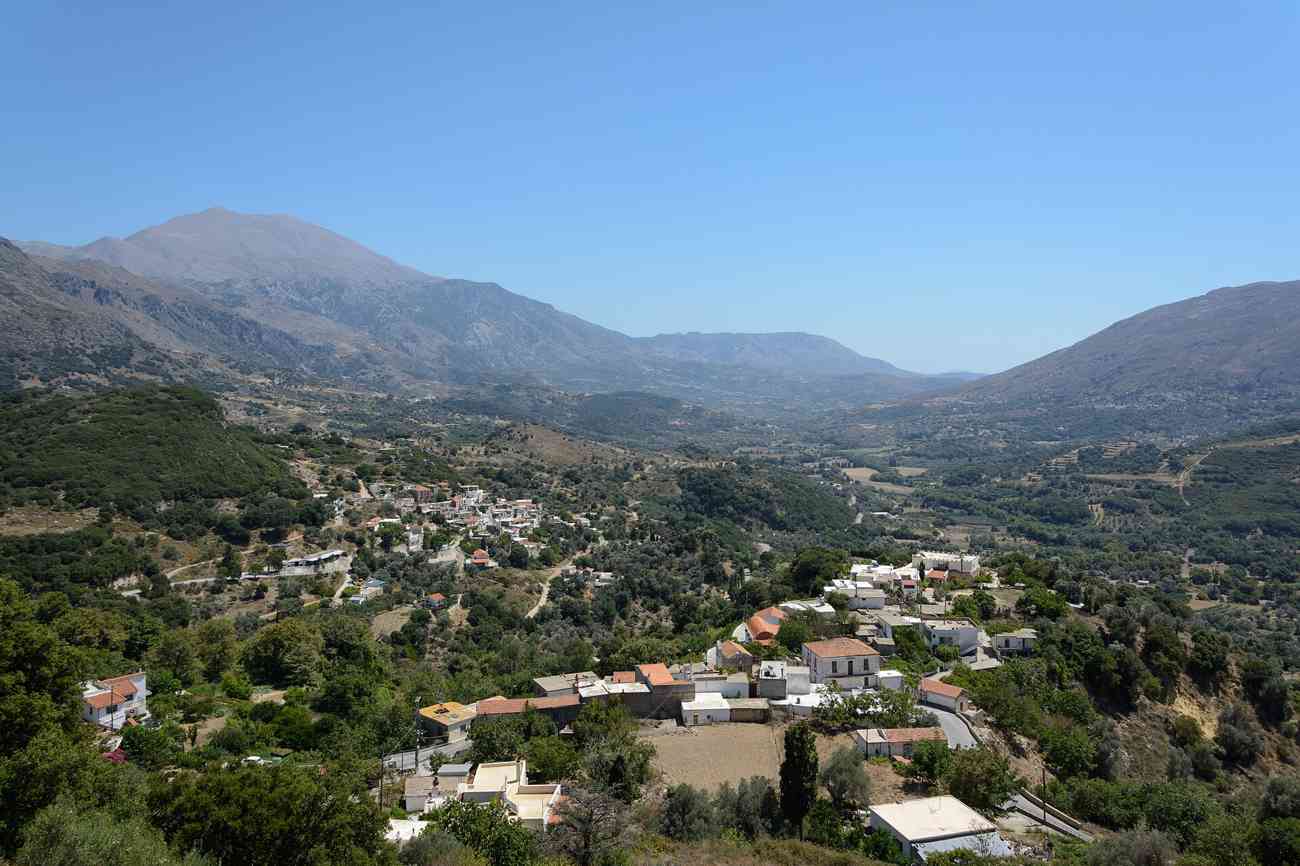
The Amari Valley is the green traditional heartland of central Crete, a fertile basin spread beneath the south-western slopes of Mount Ida in the Rethymno region. Stone villages sit among olive groves, orchards and vineyards, holding small Byzantine churches painted with old frescoes. The valley keeps a slow pace, built around village tavernas, local cheese and honey, and wide views up to the mountain. Quiet roads wind between the settlements, making the area a calm base away from the coast. Spring turns the fields brilliant green and fills the orchards with blossom. Plan this peaceful corner of the island with My Greece Tours.
The Amari Valley rewards travellers who want a quieter, more rooted side of the island, far from the busy northern beaches. Thronos, Meronas, Amari and Fourfouras carry centuries of village life, wartime memory and mountain tradition in a compact scenic drive. The sections below cover the villages, the frescoed churches, the food, the resistance monuments, the walking routes onto Mount Ida, and the Asomatos monastery, alongside practical advice on using the valley as a base. Read this guide together with our wider Crete travel guide to build a full plan for the region.
Where is the Amari Valley in Crete?
The Amari Valley lies in the Rethymno region of central Crete, a fertile green basin spread beneath the south-western slopes of Mount Ida. Quiet roads wind between its stone villages, away from the northern coast.
The valley opens south of Rethymno town, reached by a road that climbs inland from the northern coast toward the base of Mount Ida. Drivers leave the busy shoreline behind within half an hour and enter a landscape of terraced olive groves, orchards and vineyards. The route connects a chain of stone villages, so the drive itself becomes the attraction rather than a single fixed stop along the way. Anyone planning wider things to do in Crete can slot the valley neatly between a coastal base and the high mountain interior. Start in the Venetian port town before turning south into the hills, then let the tarmac narrow and slow.
The contrast between busy harbour and silent orchard makes the transition genuinely memorable for first-time visitors.
The geography of the valley shapes its whole character, with the mass of Mount Ida rising directly above the fields and villages below. Fed by steady mountain water, the soil stays fertile and the orchards fruit heavily, which explains the honey, cheese and produce sold across the district. Roads here run narrow and slow, following old routes between settlements rather than cutting straight lines across the fertile land. Travellers approaching from the west can pair the valley with the shepherd villages on the mountain’s northern flank. Those districts share the same peak but face different slopes, giving each its own distinct light, air and weather through the day.
Distances stay short throughout, so a full driving loop fits comfortably into one relaxed and unhurried day between the coast and the mountain.
What are the main villages of the Amari Valley?
Thronos, Meronas, Amari and Fourfouras anchor the valley, each a cluster of stone houses among olive groves and orchards. Village tavernas, small squares and frescoed churches give every settlement its own quiet, lived-in character worth a stop.
Thronos sits on a rise with wide views across the basin, keeping a small church and the traces of older settlement beneath its lanes. Meronas holds a handsome Byzantine church and a square shaded for long lunches, the kind of place where the whole day slows to a gentle crawl. Amari lends its name to the entire valley and centres village life around a compact core of stone houses and narrow lanes. Fourfouras stretches along the road toward the mountain, its tavernas serving as a natural pause before the walking routes climb higher. Travellers hunting hidden gems in Crete find the valley delivers exactly that unhurried feel across every one of these settlements.
Each village keeps a working population rather than a tourist facade, so daily rhythms carry on around visitors who choose to linger and watch.
Life in the villages still turns on the farming calendar, with the olive harvest, honey and cheese shaping what appears on taverna tables each season. Elderly residents greet visitors warmly from their doorways, and the squares fill slowly through the evening rather than at any single fixed hour of the day. Each village guards its own church, its own spring and its own long memory, so moving between them feels like reading the chapters of one continuous story. The valley pairs naturally with the wider massif of Psiloritis, the mountain range whose green slopes cradle these fertile fields and heavy orchards.
Stopping in three or four villages across a single quiet afternoon gives the clearest sense of the whole district, since no two squares look or feel the same despite their shared traditions and their shared mountain backdrop above.
Why are the Byzantine churches of the Amari Valley important?
The valley holds small Byzantine churches painted with old frescoes, hidden in villages such as Thronos and Meronas. These modest stone chapels preserve centuries of religious art, marking the district as a quiet stronghold of medieval Cretan painting.
The churches here are small, low and easy to miss, yet their interiors carry frescoes that survive from the medieval centuries in remarkable condition. Painted saints, biblical scenes and dedication inscriptions cover the plaster, dimmed by candle smoke and passing time into deep, earthy tones. Thronos guards one of the district’s notable churches, built over the remains of an older basilica whose ancient floor mosaics still show through the surface. Meronas keeps another chapel, tied to a leading Byzantine-era family and rich in fine painted detail across its walls. Visitors interested in the island’s sacred art can read these chapels as a living gallery, free and open in a way that crowded city museums rarely match.
The valley rewards slow, respectful looking rather than a quick photograph and a fast return to the car. On its western edge, the Patsos gorge hides a cave-church among plane trees.
Reaching the churches takes patience, since keys sometimes sit with a neighbour and opening hours follow no printed schedule at all. That small effort is part of the experience, turning each visit into a genuine encounter with village life rather than a ticketed transaction. The frescoes matter beyond their beauty, recording how remote mountain communities kept faith and artistry alive through long, hard centuries. A church tour pairs well with a taverna lunch and a tasting of Cretan food, grounding the medieval art in the same soil that still feeds the villages. Photography without flash protects the fragile pigment, so travellers should always ask before shooting inside.
The reward is a direct, unhurried view of medieval painting standing exactly where its makers first intended it to be seen and honoured.
How did the Amari Valley shape wartime resistance in Crete?
The valley was a centre of wartime resistance in Crete, sheltering fighters in its mountain folds. Monuments today remember villages burned in reprisals, so the district carries a heavy memory beneath its peaceful orchards and quiet squares.
The steep terrain and tight-knit villages made the valley a natural refuge for resistance during the occupation, hiding people and supplies in the deep folds of the mountain. Reprisals fell hard on the district, and whole settlements were burned in punishment for that stubborn defiance. Memorials now stand in and around the villages, listing names and dates so the loss stays visible to every visitor who passes through. The stone monuments sit quietly beside squares and roadsides, asking travellers to pause and reflect rather than hurry straight through. Reading these memorials alongside the churches gives the district a depth that pure scenery cannot supply on its own.
The valley wears its grief openly, and the effect stays with visitors long after they leave the green basin and drive back toward the coast.
The memory shapes how residents speak about their home, with older villagers linking family stories to the events marked plainly on the stones. Rebuilt houses stand next to survivors of the fires, so the architecture itself records exactly what happened here decades ago. Travellers who take time to read the inscriptions leave with a far fuller understanding of why the valley feels both beautiful and solemn. A respectful visit means treating the monuments as living memorials rather than photo backdrops, and giving them the same quiet attention the frescoed churches deserve. The district near Rethymno carries this history openly, and its people warmly welcome visitors who arrive genuinely willing to listen.
That balance of grief and hospitality defines the true and lasting character of the Amari Valley today.
What outdoor activities does the Amari Valley offer near Mount Ida?
Walking routes climb from the valley onto Mount Ida, and the historic Asomatos monastery lies within it. Quiet roads suit a scenic drive, while spring fills the orchards with blossom, giving hikers and drivers a green, unhurried landscape.
Walking trails leave the valley floor and climb the south-western slopes of Mount Ida, rewarding hikers with wide views back across the orchards and villages below. Routes range from gentle village-to-village strolls to demanding ascents toward the high summit ridge, so walkers of differing stamina each find a match. Fourfouras serves as a common trailhead, its tavernas offering a solid meal before or after the long climb up the slope. The historic Asomatos monastery sits within the valley, well worth a visit for its architecture and its role in the district’s past. Drivers who prefer to stay on wheels can trace the quiet roads between settlements, pausing at churches and viewpoints along the way.
The scenic loop ties walking, driving and village stops together into one satisfying and varied mountain day. Higher up the valley, the orchard village of Fourfouras climbs the slopes of Psiloritis.
Spring is the standout season, turning the fields brilliant green and filling the orchards with blossom that scents the whole basin below the peak. Cooler mountain air keeps walking comfortable even as the coast begins to heat, so late-season hikers gain a clear advantage inland. Autumn brings the olive and grape harvest, adding fresh activity to the villages and new produce to the taverna tables. Cyclists share the quiet roads with drivers, drawn by the low traffic and the steady, rewarding mountain climbs. The shepherd village of Anogeia makes a natural extension for anyone circling the massif on foot or by car.
Combining a morning walk with an afternoon drive gives the fullest picture of the valley, matching mountain effort with the ease of village squares and long, slow lunches.
Frequently Asked Questions
Is the Amari Valley worth visiting on a Crete trip?
The Amari Valley suits travellers who want a quieter, more traditional side of Crete than the northern beach resorts offer. Stone villages, frescoed Byzantine churches, honey, cheese and wide mountain views reward a slow, unhurried visit through the green basin. Drivers can trace the scenic road between Thronos, Meronas, Amari and Fourfouras in a single relaxed day, pausing at squares, chapels and viewpoints along the route. Walkers gain access to trails climbing onto Mount Ida, while food lovers find honest local produce on every taverna table. The valley also carries a solemn wartime memory, marked by monuments to burned villages, which adds real depth beyond the scenery.
Anyone building a broad Cretan itinerary can pair the valley with coastal Rethymno and the high mountain interior for balance. The district rewards patience rather than a rushed drive-through, so travellers who slow down and stay for a long lunch leave with the strongest impression of this green heartland.
How much time do you need in the Amari Valley?
A single relaxed day covers the core of the Amari Valley, allowing time for the scenic drive, two or three village stops, a church visit and a long taverna lunch in the shade. Travellers who slow down further can spend a night in a village guesthouse and use the valley as a peaceful base away from the crowded coast. That overnight approach opens the early mornings and quiet evenings, when the squares empty and the soft light spreads across the orchards. Hikers heading onto Mount Ida should budget extra hours, since the ascent from Fourfouras and neighbouring villages demands a proper half day or more.
A church-focused visitor may need patience, as keys sometimes rest with a neighbour and opening follows no fixed schedule. Combining the valley with Rethymno town works well over two days, giving one day to the coast and Venetian harbour and a second to the green inland villages, chapels and mountain trails.
What food and local products define the Amari Valley?
The Amari Valley builds its table around mountain farming, with local cheese, honey and olive oil forming the backbone of every taverna meal. Fed by fertile soil and steady mountain water, the orchards and vineyards yield fruit, grapes and produce that appear fresh in village kitchens. Honey ranks among the district’s clearest signatures, drawn from the wildflowers and mountain herbs that scent the bright spring fields. Cheeses range from soft fresh varieties to harder aged wheels, served alongside bread, wild greens and slow-cooked meat. Village tavernas cook simple traditional dishes rather than resort menus, so the flavours stay firmly rooted in the surrounding land.
Travellers who tour the churches and monuments can break the day with a long lunch, tasting the same produce the villages have made for generations. Buying honey, oil or cheese directly from a village supports the farming families who keep the valley alive, and carries a genuine piece of the mountain home.