
The ancient gates of Thassos pierce the marble defensive walls that once ringed the harbour city of Limenas on the northern Aegean island of Thassos. Builders cut these monumental doorways into a circuit of pale local stone in the late sixth and early fifth centuries BC. Sculptors carved gods and heroes onto the flanking blocks, turning each gate into a guardian portal. Five named gates survive along the wall line, each honouring a different deity. Travellers today trace the same thresholds that ancient citizens, traders and soldiers crossed on foot. A walk along the walls joins the town, the acropolis and the sea into one clear circuit of stone.
Marble quarried on the island gave the walls of Thassos their bright, durable face and their fame across ancient Greece. Each gate carried a relief of a protecting god, from Silenos to Herakles, set to ward off enemies and evil at the weak point of the circuit. The panels blend defence, art and religion in a single stone frame. This page walks the wall gate by gate, from the Gate of Silenos to the Sea Gate of Parmenon, and sets each carving in its date and purpose. Planning stays simple with the guided trips in this Thassos travel guide, which pairs the ancient walls with the beaches and villages beyond.
What are the ancient gates of Thassos?
The ancient gates of Thassos are five monumental doorways cut into the marble city walls of Limenas, each carved with a protecting deity. They combined defence, sculpture and religion, guarding the ancient port from the late sixth century BC onward.
Ancient Thassos guarded its harbour city with a continuous wall of pale marble and grey gneiss, broken at intervals by gates. Each gate was a controlled opening, the one point where a road, a person or a cart passed the defences. Masons framed these openings with large squared blocks that carried carved reliefs. The five best-known gates take their modern names from the gods and heroes shown on those panels. Silenos, Zeus and Hera, Hermes and the Graces, Herakles and Dionysos, and the sculptor Parmenon each mark a threshold. This naming turns a defensive line into a gallery of open-air sculpture that still rings the ancient town.
Relief carving raised each gate above simple engineering. Sculptors of the early fifth century BC cut gods in shallow marble panels beside the passage, where every visitor would pass beneath their gaze. The figures faced outward, toward the approaching road, so their protection met arrivals first. Silenos brandished a drinking cup, Herakles drew his bow, and Hermes led the Graces in procession. The style is severe and calm, typical of the years just after the Persian wars. These carved guardians tie the walls of Thassos to the wider story of Archaic and early Classical sculpture across the northern Aegean and mainland Greece.
Defence and worship met at every threshold in the ancient mind. A city gate was the weakest link in a wall, so builders reinforced it with towers and with the power of the gods. Placing a deity at the opening asked that god to stand watch where the stone was thinnest. Herakles held pride of place as the chief protector of Thassos, honoured across the island. The gods on the walls repeated the cults kept in the sanctuaries within the town. This overlap of stone and faith explains why the gates read as shrines as much as fortifications to anyone who studies them closely today.
Modern names help visitors keep the five gates apart along the wall circuit. Archaeologists label each threshold by its carving, since the ancient names have not survived on stone. The Gate of Parmenon is the exception, since its own inscription records the maker rather than a god. Scholars date the gates and walls to the decades around the Persian wars, when Thassos rebuilt its defences. The panels have weathered on the marble, yet their outlines remain clear in raking light. This clear labelling lets you follow the walls gate by gate, matching each carved block to the deity that once guarded that stretch of the town.
Why did the marble walls of Thassos carry sculpted gates?
Marble walls ringed ancient Thassos for defence, and its gates carried sculpted gods to guard the vulnerable openings. The reliefs served an apotropaic purpose, warding off enemies and harm, while the pale local stone displayed the island’s wealth and quarrying skill.
Marble quarried in the hills above Limenas gave Thassos a building stone of rare quality across the region. Crews cut the walls from this bright rock and from harder gneiss, raising a circuit that ran for roughly three and a half kilometres. Towers strengthened the line at corners and gates, and the wall climbed from the shore up onto the heights of the Acropolis of Thassos. The pale stone signalled the riches that marble, gold and wine brought the island. This grand circuit framed the whole ancient town, from the harbour quays up to the temples crowning the hill behind.
History records that Thassos lost and rebuilt these walls within a single generation. The Persians forced the islanders to pull down their defences early in the fifth century BC, after a revolt against Persian power. Citizens rebuilt the circuit once the threat passed, cutting fresh marble and raising the sculpted gates anew. The reliefs belong to this rebuilding, carved in the severe style of the age. Herodotus preserved the story of the demolition in his history of the Persian wars. This documented cycle of ruin and repair gives the walls of Thassos a firm place in the recorded events of ancient Greece.
Apotropaic power lay at the heart of the sculpted gates. Greek builders believed a carved god at a threshold could turn away enemies, disease and ill fortune before they entered. The grinning Silenos, the armed Herakles and the striding Hermes all served this guarding role. Their outward gaze met anyone approaching the wall, marking the boundary between the safe town and the wild land outside. The gate thus worked on two levels, as a barrier of stone and a barrier of divine will. This double defence shaped how the citizens of Thassos understood the edge of their own city.
Gates opened toward the roads and the sea that fed the ancient port of Limenas (Thassos Town). One threshold faced the harbour, another the land route inland, and others the tracks toward the quarries and farms. Each opening matched a real need for movement, then dressed that need in sculpture. The wall bound these gates into a single defensive plan around the lower town and up the acropolis slope. Traffic in marble, ore and grain passed daily beneath the carved gods. This link between practical routes and protective art let the walls serve trade and faith in one continuous line of stone.
What is the Gate of Silenos at Thassos?
The Gate of Silenos is a city-wall gate at Thassos carved with a large relief of Silenos, the wine spirit, striding forward with a drinking cup. Its bold apotropaic figure guarded the eastern approach to the ancient town.
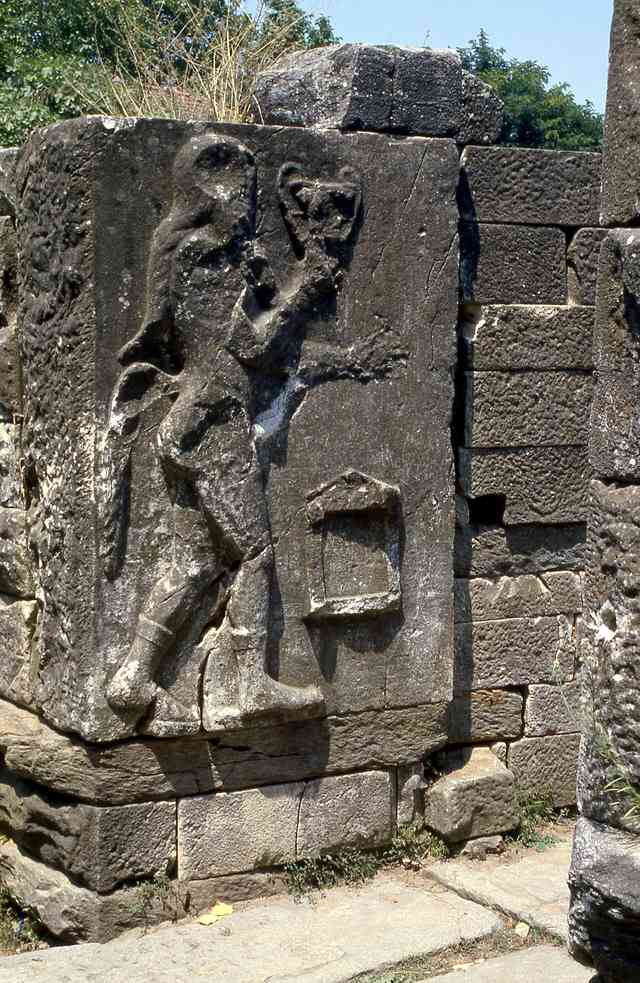
Silenos gave his name to one of the most striking gates in the wall. The relief shows the bearded wine spirit in mid-stride, nude and powerful, holding a large drinking cup called a kantharos. Carved almost life-size on a marble block beside the passage, the figure faces outward at anyone who nears the gate. The pose is broad and heavy, full of the earthy force linked to Dionysos and his followers. Sculptors of the early fifth century BC cut the panel in the severe style of the day. This commanding image made the gate a landmark on the eastern stretch of the circuit.
Silenos served the wall as a guardian rather than a mere decoration. Companions of Dionysos carried a wild, boundary-crossing power that Greeks used to frighten off harm. The oversized figure, the fixed stare and the raised cup all worked to unsettle an approaching enemy. Wine and its spirit also tied the gate to one of the island’s great exports, since Thassian wine sold across the ancient world. The god of the vine thus stood guard over the city that grew rich on grapes. This blend of threat and trade packed real meaning into a single carved block of marble.
Weathering has softened the Silenos relief across the centuries of open exposure. Rain, salt air and frost have blurred the surface, yet the outline of the striding god still reads clearly on the stone. Conservators record and protect the panel where it stands, and related finds sit indoors at the Archaeological Museum of Thassos. Photographs and drawings from earlier study preserve details now lost to erosion. A cast can show the carving as it looked when sharper. This careful record lets scholars read the gate today even as the marble slowly yields to the weather on the wall.
Visitors reach the Gate of Silenos along the eastern line of the ancient wall, a short walk from the modern town. The threshold sits among low marble courses that trace the old circuit through scrub and olive trees. Morning light rakes across the relief and lifts the worn figure from the block. A quiet path links this gate to the next stretches of wall and to the acropolis climb above. Sturdy shoes help on the rough ground and loose stone. This accessible spot rewards a slow look, since the striding wine spirit remains one of the clearest carved guardians left standing on the walls of Thassos.
What do the Gate of Zeus and Hera and the Gate of Hermes and the Graces show?
The Gate of Zeus and Hera shows Hermes leading Hera toward an enthroned Zeus, while the Gate of Hermes and the Graces carves Hermes escorting the three Graces. Both reliefs place processions of gods at the wall to bless and guard the city.
The Gate of Zeus and Hera takes its name from a relief of a divine procession. Hermes, the messenger god, leads the goddess Hera toward Zeus, who sits enthroned to receive her. The scene reads as a sacred welcome, a moment of order among the ruling gods of Olympos. Carved on the marble beside the passage, the panel greeted anyone entering the town at this gate. The subject links the threshold to the highest powers of the Greek pantheon. This royal gathering set a dignified tone at the entrance, matching the standing of a wealthy island city that traded across the northern Aegean.
Kingship and marriage bound the two gods shown at this gate. Zeus and Hera ruled as the divine couple at the head of the Olympian order, so their image spoke of authority and lawful union. Placing them at a city gate asked that same order to protect Thassos and its people. The enthroned Zeus faced the visitor with the calm power of a ruler receiving guests. Hera, led forward by Hermes, brought the promise of a settled household and a stable state. This weighty subject gave the gate a meaning beyond defence, tying the city’s edge to ideas of rule, order and sworn agreement.
The Gate of Hermes and the Graces carries a lighter, kindlier procession in marble. Hermes again takes the lead, this time escorting the three Graces, the goddesses of charm, beauty and goodwill. The Graces stood for the grace of gifts freely given and favours returned, qualities prized in a trading port. Their presence at the gate wished welcome and fair dealing on everyone who passed. Hermes, patron of travellers and merchants, made a fitting guide for a threshold used by traders. This gentler scene balanced the fierce guardians elsewhere on the wall, offering courtesy and exchange rather than raw threat to the arriving stranger.
Both reliefs share the restrained, dignified manner of early Classical carving on Thassos. Draped figures move in quiet, measured steps, their gestures clear and their faces calm. Sculptors cut them in the same decades as the other gates, in the years around the Persian wars. The panels tie the fortifications to the cults kept within the town, since Hermes, Hera and the Graces all held worship at Thassos. Weather has worn the surfaces, and study relies on casts and early records alongside the stones. This pairing of processional gates shows how the walls carried welcome and blessing, not only warning, along their sculpted line.
Who guarded the Gate of Herakles and Dionysos?
Herakles and Dionysos guarded this gate, carved as the twin protectors of Thassos. Herakles, the island’s chief patron, drew his bow beside the passage, while Dionysos, god of the vine, matched him. Their reliefs warded the threshold with the city’s leading cults.
Herakles held the rank of chief protector across ancient Thassos. Islanders worshipped him at a great precinct in the lower town and set his image on the wall at his own gate. The relief showed the hero as an archer, kneeling or braced with his bow drawn against any enemy of the city. His club, lion skin and bow marked him at once to every passer-by. Pilgrims honoured the same god at the Sanctuary of Herakles nearby. This tie between the guarded gate and the hero’s temple bound the defences of Thassos to the strongest cult on the whole island.
Herakles as an armed archer suited the guarding role of a city gate. The drawn bow aimed outward, toward the road and any enemy approaching the wall. Greeks across the Aegean set the hero at gates and boundaries as a ward against harm. On Thassos his presence carried extra weight, since the city claimed his protection above the other gods. The image joined the hero’s mythical strength to the real stone of the fortifications. This union of myth and masonry told every arrival that the greatest of heroes stood watch over the marble threshold and the town within it.
Dionysos shared the gate as the god of wine, theatre and release. The vine ruled the economy of Thassos, whose stamped wine jars travelled to markets across the ancient Mediterranean. Setting Dionysos on the wall honoured the source of the island’s wealth and linked the gate to festival life. His worship also filled the seats of the ancient theatre on the acropolis slope, where drama played in his name. The god of the vine thus guarded both the harvest and the pleasures it funded. This pairing with Herakles set raw heroic force beside the fruitful power of wine at a single threshold.
Herakles and Dionysos together summed up the character of ancient Thassos. One stood for the martial strength that defended the walls, the other for the wine and trade that paid for them. The two reliefs framed the passage on facing blocks, so a visitor walked between strength and plenty. Their combined watch made the gate a statement of what the city valued and feared to lose. Erosion has worn the marble, yet the heroic and divine forms remain legible on the stone. This double guardianship marks the gate as one of the richest in meaning along the entire sculpted circuit of Thassos.
What makes the Gate of Parmenon the famous Sea Gate of Thassos?
The Gate of Parmenon, the Sea Gate near the harbour, is famous for its carved inscription reading that Parmenon made it. This signature ranks among the earliest sculptor’s signatures in Greek art, naming the craftsman rather than a god.
Parmenon signed his work on the stone, a rare act in the ancient world. The gate carries an inscription in early Greek letters recording that Parmenon made it, naming the maker instead of a deity. This signature counts among the oldest artist’s signatures known from Greek art, cut in the fifth century BC. The wording turns the block into a record of a real craftsman’s pride. No other gate on the wall names the hand that shaped it. This personal mark lifts the Sea Gate above its neighbours, giving a voice to one of the sculptors who built the walls and gates of ancient Thassos.
The Sea Gate opened onto the harbour that made Thassos rich. Ships from the mainland and the wider Aegean tied up a short walk from this threshold, unloading trade beside the walls. Marble, gold and wine passed out through the gate toward waiting vessels at the quay. The opening linked the fortified town directly to the water and the sea lanes north to Thrace. Traffic between ship and market crossed this stone daily in the ancient port. This working link to the sea gave the gate its name and its central role in the commerce of the island city.
Roads from the Sea Gate ran inland toward the civic heart of the town. A short walk led to the ancient agora, the square where trade, worship and government met. Goods landed at the harbour moved through the gate and into that market to be taxed and sold. The gate thus stood at the join between the sea and the public life of Limenas. Porters, sailors and officials crossed it in a steady stream through the day. This position at the meeting of quay and city made the Sea Gate one of the busiest thresholds in the whole marble circuit.
Parmenon’s name survives where the images on other gates have worn away. The inscribed letters, cut deep into hard stone, have outlasted most of the softer relief carving elsewhere on the wall. Scholars read the signature as evidence that named artists worked on public defences, not only on temples and statues. The gate stands near the shore where the ancient and modern harbours nearly meet. Its blocks mark the old sea entrance for anyone walking the waterfront today. This durable inscription makes the Sea Gate both a monument of engineering and a signed piece of early Greek sculpture on the walls of Thassos.
How do visitors walk the ancient gates and walls of Thassos today?
Visitors follow the marble wall circuit around Limenas on foot, tracing the five gates from the Sea Gate to the Gate of Silenos. The walk links the town, the acropolis and the museum, and takes a couple of hours at an easy pace.
The wall circuit begins near the harbour and runs right around the ancient town of Limenas. A marked path follows the marble courses through olive groves, gardens and quiet lanes on the edge of the modern streets. Signboards point out each gate and the gods once carved beside its passage. The full loop covers roughly three and a half kilometres, the length of the ancient defences. Stout shoes and water make the walk easier over rough ground in summer heat. This continuous route lets you meet all five sculpted gates in sequence, reading the walls of Thassos as one connected monument rather than scattered ruins.
A visit to the walls pairs naturally with the town’s other ancient sites. The path climbs from the lower gates up onto the acropolis, past the theatre and the hilltop temples that crowned the city. Finds lifted from the gates and walls fill the galleries of the local museum, a short walk from the harbour. Seeing the carved panels indoors and then the gates outside joins the two halves of the story. Foundations of the agora lie between the wall and the sea. This grouping of gates, hill and gallery makes Limenas one of the easiest ancient cities in Greece to grasp on a single day on foot.
Early morning and late afternoon suit the wall walk best in the warmer months. Raking light at those hours lifts the worn reliefs from the marble and cools the open ground. Spring brings wild flowers among the ancient blocks and the clearest air over the strait. The route stays quiet even in high summer, since most travellers head straight for the beaches. A hat, water and a paper or digital map help on the less-marked stretches. This simple planning turns a walk along the gates of Thassos into a calm half-day among the finest marble fortifications left in the northern Aegean.
Staying in or near Limenas puts the ancient gates within an easy stroll. The town offers rooms and tavernas a short walk from the harbour and the wall circuit, so history sits on the doorstep. A guided tour adds the dates, myths and details that unlabelled marble hides. Travellers who prefer the coast can still reach the gates on a short drive from the resorts. Buses and hire cars link every part of the island to the capital. This choice of base lets you weave the sculpted walls of Thassos into a wider trip that takes in the villages, quarries and beaches of the island.
Frequently Asked Questions
What are the ancient gates of Thassos?
The ancient gates of Thassos are five monumental openings cut into the marble defensive walls that ringed the harbour city of Limenas. Builders raised the circuit in the late sixth and early fifth centuries BC, over a length of roughly three and a half kilometres. Sculptors carved a protecting god or hero onto the blocks beside each passage, giving the gates their modern names. The Gate of Silenos shows the wine spirit, the Gate of Zeus and Hera a divine procession, and the Gate of Herakles and Dionysos the island’s twin patrons. The Gate of Parmenon, the Sea Gate by the harbour, carries a sculptor’s signature instead of a deity. Together these thresholds combine defence, sculpture and religion along the walls of Thassos.
Why were the gates of Thassos carved with gods?
Greek builders carved gods on the gates of Thassos to guard the weakest points in the city walls. A gate was the one break in the defences, so masons reinforced it with towers and with the protective power of a deity set in stone. This apotropaic purpose asked the carved god to turn away enemies, disease and ill fortune before they crossed the threshold. Their choice reflected the cults of the city: Herakles as chief patron, Dionysos as god of the vine that made Thassos rich, and Hermes as guide of travellers and traders. Zeus and Hera brought the authority of the ruling Olympians, while the Graces wished welcome on arrivals. This blend of defence and worship turned each gate into both a fortification and a shrine.
What is the Gate of Parmenon at Thassos?
The Gate of Parmenon is the Sea Gate of ancient Thassos, set near the harbour on the northern edge of Limenas. Its fame rests on a carved inscription in early Greek letters recording that Parmenon made it, naming the craftsman rather than a god. This signature ranks among the oldest artist’s signatures known from Greek art, cut in the fifth century BC. The gate opened directly onto the port, where ships loaded marble, gold and wine for markets across the Aegean and the coast of Thrace. Roads from the threshold ran inland to the ancient agora at the heart of the town. Deep-cut letters have outlasted most of the softer relief carving on the other gates, so Parmenon’s name survives clearly today.
Where are the ancient gates of Thassos located?
The ancient gates of Thassos stand along the marble wall circuit that surrounds Limenas, the island’s main town and port, also called Thassos Town. The Sea Gate of Parmenon sits near the harbour on the shore, while the Gate of Silenos guards the eastern stretch of the wall a short walk inland. Other gates open toward the roads that once led to the quarries, farms and the acropolis behind the town. The whole circuit runs for roughly three and a half kilometres, climbing from the waterfront up onto the hill that carried the theatre. A marked path lets walkers follow the walls from gate to gate through olive groves and quiet lanes. Finds from the gates now sit in the town’s Archaeological Museum, near the harbour.
When were the walls and gates of Thassos built?
Builders raised the marble walls and sculpted gates of Thassos in the late sixth and early fifth centuries BC, in the decades around the Persian wars. The Persians forced the islanders to demolish their defences early in the fifth century BC, after a revolt against Persian power, and Herodotus recorded the event in his history. Citizens rebuilt the circuit once the danger passed, cutting fresh marble and raising the carved gates anew. The reliefs belong to this rebuilding and show the severe, restrained style of early Classical sculpture. The Gate of Parmenon’s inscription also dates to this period, placing a named sculptor at work on the walls. This documented cycle of demolition and repair anchors the fortifications firmly in the early fifth century BC.
How long does it take to walk the gates of Thassos?
A walk around the full wall circuit of ancient Thassos takes roughly two hours at an easy pace, covering the three and a half kilometres of the ancient defences. The route runs right around Limenas, linking the five gates from the Sea Gate of Parmenon to the Gate of Silenos through olive groves and quiet lanes. Adding a climb to the acropolis, the theatre and the hilltop temples fills a relaxed half-day on foot. A visit to the town’s Archaeological Museum, where carved panels from the gates are kept, adds another hour indoors. Early morning or late afternoon suits the walk best, since raking light lifts the worn reliefs from the marble. Staying in or near Limenas keeps the gates within a short stroll from the harbour.