
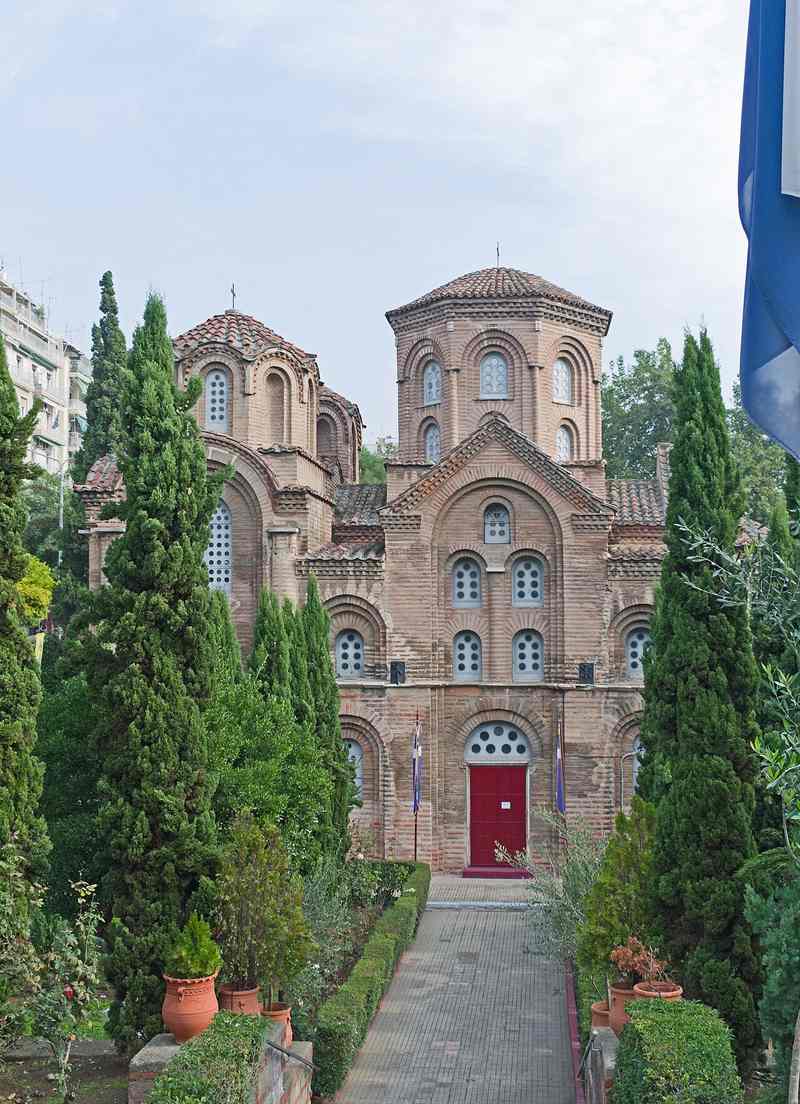
The Byzantine churches of Thessaloniki form the richest span of early Christian and medieval church building to survive in one Greek city. They run from the fifth-century basilicas of the early empire to the domed churches of the last Byzantine age, raised in brick over the Roman streets and the martyrs’ tombs. Fifteen of these monuments carry a UNESCO World Heritage listing for their mosaics, their frescoes, and the arc of church design they record. Read the basilicas, the cross-in-square churches, and the gold mosaics of the domes, and set them within the fabric of the city with My Greece Tours.
The churches reward a walk through the old streets rather than a single stop, since they sit scattered from the seafront up to the walls of the upper town. Their brick walls carry the finest mosaics and frescoes in northern Greece, from the vision of Christ at Osios David to the Ascension in the dome of Hagia Sophia. The sections below cover what the Byzantine churches are, how their architecture reads, which early basilicas survive, and what their mosaics and frescoes show. The later parts turn to the middle and late Byzantine churches, the UNESCO listing, and a walking route on the guided Thessaloniki tours.
What are the Byzantine churches of Thessaloniki?
The Byzantine churches of Thessaloniki are a group of early Christian and medieval churches raised across the city between the fourth and fifteenth centuries. Fifteen of them hold a UNESCO World Heritage listing granted in nineteen-eighty-eight.
The churches record the whole life of Byzantine faith in one place, from the age of the early empire to the fall of the medieval city. Thessaloniki ranked as the second city of the Byzantine world after Constantinople, and its wealth paid for churches in every century of that long reign. The earliest are broad basilicas built for crowds of pilgrims. The latest are compact domed churches of the Palaeologan age, the final flowering of Byzantine art before the Ottoman conquest.
The UNESCO group gathers fifteen monuments under one listing, the Palaeochristian and Byzantine Monuments of Thessalonika. The list runs from the Rotunda and the great basilica of the patron saint to small chapels tucked into the upper town, and it takes in the city walls as well. The mosaics and frescoes inside these buildings trace the growth of Christian art through eleven centuries. That span is the reason the group earned a place on the World Heritage List.
The churches stand within a compact core, most of them a short walk apart on the slope between the sea and the acropolis. The great basilica of the church of Agios Dimitrios anchors the group beside the ancient forum, and the domed Rotunda marks its oldest link. A visitor can read four centuries of church design in one morning on foot. The cluster heads most guides to things to do in Thessaloniki for the depth of history it holds.
The buildings share a common thread beyond their faith and their brick. Ottoman rule turned each of them into a mosque after the conquest of the fifteenth century, and the whitewash of that age preserved the mosaics and frescoes beneath. The churches returned to Christian worship in the early twentieth century, when the city passed to Greece. Their layered use of Roman ground, Byzantine church, and Ottoman mosque marks them as a record of the whole history of Thessaloniki, not the Byzantine centuries alone.
What defines Byzantine church architecture in Thessaloniki?
Byzantine churches in Thessaloniki are built of brick, plain on the outside and rich within. Two plans dominate: the broad early Christian basilica and the later cross-in-square church roofed by a central dome.
The building material sets the tone across the whole group. Brick and rubble form the walls, laid in bands that pattern the surface without carved stone ornament. The exteriors stay austere, their beauty held for the interior of mosaic, fresco, and marble. This restraint marks the Byzantine church against the columned temples of the Greek and Roman past that stood in the same streets.
The early churches follow the basilica plan, a long hall split by rows of columns into a nave and side aisles. Panagia Acheiropoietos and the basilica of the patron saint keep this fifth-century form, wide enough for the pilgrim crowds of the early empire. A raised gallery, the gynaeconitis, runs above the aisles in the larger examples. The plan came from the halls of the Roman world and turned to Christian worship.
The middle and late churches turn to the cross-in-square plan, a compact square crowned by a dome on four piers. Panagia Chalkeon of the eleventh century marks the shift, and the Palaeologan churches of the fourteenth century refine it with extra domes and decorative brick. The dome carried the image of Christ over the congregation below. This form spread across the Byzantine world and shaped Orthodox church design that followed.
The interiors held the true art of the church, sheathed in gold-ground mosaic and painted fresco. The walls carried saints, feasts, and the figure of Christ in the dome, set to teach the faith to the people gathered below. The finest survive at Osios David, Hagia Sophia, and Agios Nikolaos Orfanos. The record of that art fills the Museum of Byzantine Culture near the seafront, which frames the churches for a visitor.
The plans also mark the passage of time through the city itself. The early basilicas rose in the lower town near the ancient forum, on the flat ground of the Roman street grid. The middle and late churches climbed the slope toward the acropolis, into the walled quarter that became the upper town. This drift up the hill tracks the growth of the medieval city behind its walls. A walker reads the change of plan and the change of ground as one connected story.
Which early Christian basilicas survive in Thessaloniki?
Three early Christian churches survive from the fifth to eighth centuries: Panagia Acheiropoietos, a fifth-century basilica; Hagia Sophia, an eighth-century domed basilica; and Osios David, a small fifth-century church of the Latomou Monastery.
These three buildings carry the oldest Christian architecture in the city after the Rotunda. They mark the passage from the long basilica hall to the domed church, and each keeps mosaic or fresco from the early Christian centuries. The three sit within a short walk of one another on the slope of the old town. A visitor reads the birth of the Byzantine church in this cluster.
Panagia Acheiropoietos
Panagia Acheiropoietos is a three-aisled basilica of the fifth century, one of the oldest churches in continuous use in the world. Builders raised it over a Roman bath complex, and three layers of floor mosaic from the bath lie beneath the church. Mosaics of birds, fruit, crosses, and geometric bands run across the soffits of the arcade arches. Thirteenth-century frescoes of the Forty Martyrs of Sebaste survive on the south aisle. The Ottoman conquerors turned it into the first mosque of the city.
Hagia Sophia
Hagia Sophia is a domed basilica of the eighth century, named for the Holy Wisdom like its great sister in Constantinople. Its plan crosses the basilica hall with a central dome, a hinge between the two Byzantine forms. The dome mosaic shows the Ascension of Christ, ringed by the Virgin, two angels, and the twelve apostles. The apse holds a mosaic of the Virgin enthroned with the Christ child, set over an earlier jewelled cross. The church served as a mosque through the Ottoman centuries before its return to Christian worship.
Osios David, the Latomou Monastery
Osios David is the small fifth-century church of the former Latomou Monastery, hidden in the lanes of the upper town. Its apse holds one of the finest early Christian mosaics to survive, a vision of the young beardless Christ seated in a mandorla of light. The four living creatures of the prophets surround him, and the rivers of paradise flow at his feet. Frescoes of the twelfth and fourteenth centuries cover the walls around the mosaic. The building passed through use as a mosque, which plastered and preserved the mosaic beneath.
What mosaics and frescoes can you see in the churches?
The churches hold gold-ground mosaics of the fifth to eighth centuries and painted frescoes of the eleventh to fourteenth. The mosaic vision at Osios David and the Ascension dome at Hagia Sophia rank among the finest in Greece.
The mosaic art peaks in the early churches, where gold glass and coloured stone form the images. Osios David keeps the earliest and the most complete, its apse vision of Christ Emmanuel drawn from the prophecies of Ezekiel and Isaiah. The tesserae catch the light of the small apse and lift the young Christ from a ground of blue and gold. This mosaic ranks with the work of Ravenna for its age and its craft.
Hagia Sophia carries the great mosaic of the middle age, the Ascension that fills its dome. Christ rises in a circle of light borne by angels, while the Virgin and the twelve apostles stand on the ring below against a gold ground. The apse adds the enthroned Virgin and Child. The dome reads as a single scene of the heavens opened over the congregation.
The fresco tradition carries the later churches, painted rather than set in glass. Agios Nikolaos Orfanos keeps frescoes that cover almost the whole of its interior, a full Palaeologan cycle of feasts, saints, and the passion of Christ. The hand behind them worked with the depth and the movement of the last Byzantine age. The cycle counts among the best-preserved fresco programmes in the city.
The mosaic and the fresco served the same end for the people who filled the church. The images taught the faith to a congregation that could not read, setting the feasts of Christ, the ranks of saints, and the vision of heaven on the walls above. The dome carried Christ, the apse carried the Virgin, and the walls below carried the calendar of the church year. This ordered scheme runs through the churches of the city, early and late. A reading of one interior opens the reading of the rest.
The early basilicas add their own mosaic in the vaults and arches rather than the dome. Panagia Acheiropoietos keeps birds, fruit, vines, and crosses across the intrados of its arcade, close enough to study the cut of each cube. These panels read as the fruits of paradise, a theme that runs through the early Christian art of the city. The wider record of this art fills the halls of the Byzantine museum by the shore.
Which middle and late Byzantine churches complete the group?
The later group runs from Panagia Chalkeon of the eleventh century to the Palaeologan churches of the fourteenth: Agioi Apostoloi, Profitis Ilias, Agia Aikaterini, Taxiarches, Agios Nikolaos Orfanos, and the Vlatadon Monastery.
These churches carry the cross-in-square plan through the last centuries of Byzantine rule. They are compact, domed, and built of patterned brick, a marked shift from the wide early basilicas. The finest cluster in the upper town within the old walls. Together they mark the final age of Byzantine art before the city fell to the Ottoman Turks.
Panagia Chalkeon
Panagia Chalkeon is a cross-in-square church founded in the eleventh century, near the ancient forum in the lower city. Its warm brick and red-tiled roofs earned it the name of the Red Church among the people of Thessaloniki. The plan sets a central dome over four piers, with a second pair of domes above the west end. Frescoes of the founding age survive within, and carved marble frames the doors.
Agioi Apostoloi
Agioi Apostoloi is an early fourteenth-century church of the Palaeologan age, built as the catholicon of a monastery. Five domes crown its cross-in-square core, and the outer walls carry the richest decorative brickwork in the city. Mosaics and frescoes of the founding age survive under careful restoration. The brick patterns of its facades stand among the high points of late Byzantine building.
Profitis Ilias, Agia Aikaterini and Taxiarches
Profitis Ilias rises in the upper town as a fourteenth-century church of the Athonite type, its triple-apsed core drawn from the monasteries of Mount Athos. Palaeologan frescoes survive on its walls. Agia Aikaterini stands lower on the slope, a five-domed church of the late thirteenth or early fourteenth century, wrapped by an ambulatory and keeping fragments of its frescoes. Taxiarches, a small fourteenth-century church in the same quarter, holds remnants of painted saints on its interior walls.
Agios Nikolaos Orfanos and the Vlatadon Monastery
Agios Nikolaos Orfanos is a small three-aisled church of the early fourteenth century, prized for the frescoes that sheathe its interior. The Vlatadon Monastery crowns the upper town as the only Byzantine monastery of the city still active, founded in the fourteenth century and held by the Ecumenical Patriarchate. Its terrace opens the widest view over the roofs to the gulf below. Both stand in the lanes of Ano Poli, the Upper Town, above the medieval walls.
Why are the Byzantine churches a UNESCO World Heritage Site?
The churches are inscribed on the UNESCO World Heritage List as the Palaeochristian and Byzantine Monuments of Thessalonika. The listing of nineteen-eighty-eight covers fifteen monuments for their mosaics, frescoes, and church architecture.
UNESCO added the group for the record it holds of Christian building across a span of eleven centuries. The monuments show the growth of church design from the early basilica to the domed cross-in-square church. This unbroken sequence in one city gave the listing its value. The mosaics and frescoes within stand as a landmark of Byzantine art that spread from Thessaloniki to the wider Orthodox world.
The fifteen monuments take in the churches, the Rotunda, and the medieval city walls that ringed them. The list gathers the fifth-century basilicas, the domed churches of the middle and late ages, and the small painted chapels of the upper town. Each earned its place for the art it keeps or the stage it marks in the story of the Byzantine church. The group reads as one heritage rather than a set of separate buildings.
The protection that comes with the listing shapes the care of the mosaics and the pace of restoration. Conservators work to hold the frescoes and mosaics against damp and time, and the churches open under rules that guard the fragile surfaces. The status lifts Thessaloniki onto the map of world heritage travel. It draws visitors who follow the art of the Byzantine centuries across the eastern Mediterranean.
How do you visit the Byzantine churches on a walking route?
The Byzantine churches sit within a compact walk between the seafront and the upper town. A route that starts at the basilica of the patron saint and climbs to the Vlatadon Monastery links the finest of them in a half-day on foot.
The walk opens well at the basilica of the patron saint on the northern edge of the ancient forum. From there the route drops to Panagia Acheiropoietos and Panagia Chalkeon in the lower city, both a short walk from the main avenue. Hagia Sophia stands between the two, midway on the slope. This lower loop gathers the earliest churches within three streets of one another.
The climb to the upper town rewards the second half of the walk. Osios David, Agios Nikolaos Orfanos, Profitis Ilias, and the Vlatadon Monastery cluster within the old walls above, on lanes that kept their Ottoman houses through the fire that razed the lower city. The terrace of the monastery closes the route with a view over the whole descent to the gulf. A steady walk links the upper churches in under two hours.
The churches keep the hours of active places of worship, so a check of current times rewards the plan before setting out. Most stay open in the morning and again in the later afternoon, with a break in the middle of the day. Modest dress serves at the working churches, and the frescoes read best with a small torch in the darker interiors. A guide draws out the meaning of the mosaics and the saints that the bare walls keep quiet.
The route folds cleanly into a wider day through the historic core. A walker can tie the churches to the Roman Forum below the basilica, the Arch of Galerius on the old imperial axis, and the seafront where the White Tower anchors the promenade. This shape follows the order a compact Thessaloniki itinerary tends to take. The churches read best across a half-day, before the light hardens on the mosaics.
Frequently Asked Questions
How many Byzantine churches are UNESCO listed in Thessaloniki?
Fifteen monuments carry the UNESCO World Heritage listing, inscribed in nineteen-eighty-eight as the Palaeochristian and Byzantine Monuments of Thessalonika. The group takes in the churches, the Rotunda, and the medieval city walls. It gathers the fifth-century basilicas, the domed churches of the middle and late Byzantine ages, and the small painted chapels of the upper town under one listing.
Which is the oldest Byzantine church in Thessaloniki?
The Rotunda is the oldest, raised in the early fourth century and turned to a Christian church in the late antique age. Among the churches built as churches from the start, Panagia Acheiropoietos and Osios David date to the fifth century. These early buildings mark the start of the Christian architecture that fills the city.
What are the best mosaics in the Byzantine churches?
The apse mosaic at Osios David, a vision of the young Christ in a mandorla of light, ranks as the finest and the earliest. The Ascension of Christ that fills the dome of Hagia Sophia stands close behind, with the Virgin and the twelve apostles on the ring below. Panagia Acheiropoietos keeps early mosaics of birds and fruit across its arcade arches.
Where are the Byzantine churches in Thessaloniki?
The churches spread across the slope between the seafront and the acropolis, most within a short walk of one another. The early basilicas cluster in the lower city near the ancient forum. The late churches and the Vlatadon Monastery sit higher, in the lanes of Ano Poli within the old walls. A half-day on foot links the finest of the group.
Can you go inside the Byzantine churches?
Yes. The churches open to visitors as active places of worship and protected monuments. Most keep hours in the morning and the later afternoon, with a midday break, so a check of current times rewards the plan. Modest dress serves at the working churches, and the frescoes and mosaics read best with the aid of a small torch.
How long does it take to see the Byzantine churches?
A focused walk of the finest churches takes about half a day on foot. The lower loop of the early basilicas fills a morning, and the climb to the upper-town churches and the Vlatadon Monastery fills an afternoon. A visitor with one day can pair the churches with the Rotunda, the Roman Forum, and the seafront in the same circuit.