
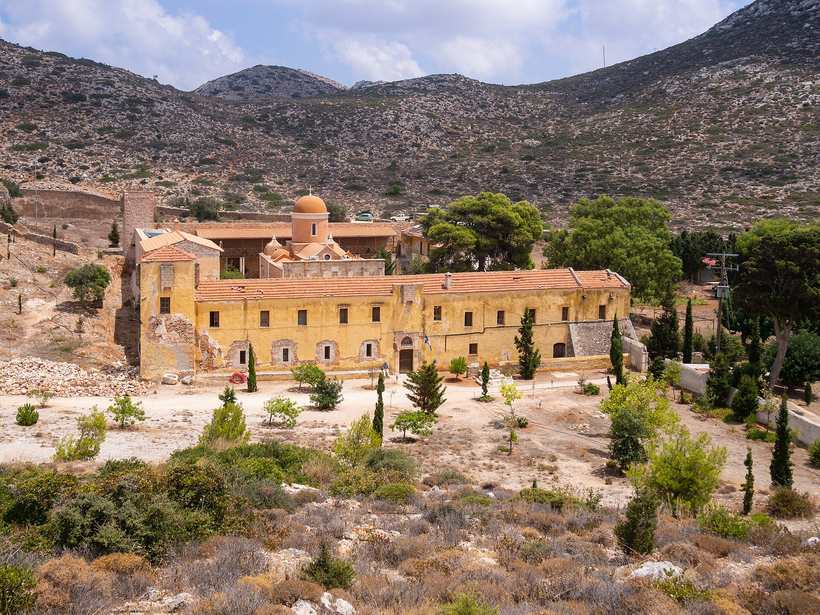
Gouverneto Monastery rises like a fortress on the wild northern edge of the Akrotiri peninsula, commanding the rocky headland near Chania in western Crete. Known also as Our Lady of the Angels, this working monastery blends Venetian military architecture with Orthodox spirituality—corner towers, thick walls and a sheltered courtyard speak to centuries of isolation and resilience. Below the monastery, a steep stone path descends through a dramatic gorge past the cave of Saint John the Hermit and the haunting ruins of Katholiko, eventually reaching the sea. Visitors drawn to remote sanctuaries, coastal trails and the quiet rhythms of monastic life find all three here, easily accessible with My Greece Tours.
The monastery sits close to the larger Agia Triada complex, yet its stark setting among thyme-scented scrub and limestone cliffs offers deeper solitude. Opening hours restrict access to certain times of day, and modest dress remains mandatory. The sections below cover the monastery’s history, its fortress design, the dramatic hike to Katholiko and the sea, practical visitor details, and its place among Crete’s sacred sites. For broader island context, consult our Crete travel guide before planning your journey to this remote corner of the Akrotiri peninsula.
What is the history of Gouverneto Monastery in Crete?
Gouverneto Monastery, dedicated to Our Lady of the Angels, ranks among Crete’s oldest continuously active monasteries. Its fortress-like structure reflects centuries of vulnerability to pirate raids and occupation, blending Venetian defensive architecture with Orthodox monastic tradition across generations of monks.
The monastery occupies a site steeped in ascetic tradition, perched on the barren northern tip of the Akrotiri peninsula where hermits sought solitude long before formal monastic communities took root. Its fortress design—thick stone walls, corner towers and a single defended entrance—testifies to the constant threat of corsair raids that plagued Crete’s exposed coastlines through the medieval and early modern periods. The Venetian influence visible in the facade and defensive layout speaks to the island’s complex history under Latin rule, when Western architectural forms merged with Eastern Orthodox spirituality. Monks maintained their liturgical life within these protective walls, cultivating small gardens in the courtyard and drawing water from cisterns carved into the bedrock.
The monastery’s survival as a working community into the twenty-first century distinguishes it from the abandoned Katholiko ruins below and underscores the resilience of Cretan monastic tradition. Visitors today encounter a living institution where a small brotherhood continues the daily cycle of prayer, work and hospitality that has defined Orthodox monasticism for more than a millennium. The building itself serves as a chronicle of adaptation—successive generations reinforced walls, repaired earthquake damage and added modest cells while preserving the core layout. This continuity of purpose, anchored in a landscape that has changed little over centuries, offers a rare window into the enduring rhythms of contemplative life on Akrotiri.
What makes the architecture of Gouverneto Monastery unique?
Gouverneto’s architecture fuses Venetian fortress design with Orthodox monastic layout. Corner towers, crenellated walls and a single gate form a defensive perimeter, while the interior courtyard shelters a domed church, monks’ cells and cisterns for self-sufficiency.
The monastery’s exterior presents an austere, almost military face to the surrounding wilderness. Four square towers anchor the corners of the rectangular compound, their massive stonework rising above the perimeter walls to provide vantage points over the approaches from land and sea. The main entrance, set into the western wall, passes through a vaulted gateway designed to be barred and defended, opening onto a paved courtyard that forms the heart of monastic life. The church occupies the center, its dome and bell tower visible above the roofline, while two-story ranges of cells line the inner walls, their small windows and simple doors facing inward to preserve the enclosure’s contemplative quiet.
This inward-looking plan, common to fortified monasteries across the eastern Mediterranean, creates a microclimate of shade and stillness even on the hottest summer days. Rainwater channels carved into the paving direct runoff to underground cisterns, ensuring the community’s independence from external water sources. The stonework, dressed from the local limestone that dominates the peninsula, weathers to a pale gold that glows in the slanting light of morning and evening. Architectural details—arched doorways, carved lintels, the proportions of the church facade—reveal the hand of Venetian masons working within Orthodox liturgical requirements, a hybrid style that defines much of Chania and its hinterland.
How do you hike from Gouverneto to Katholiko and the sea in Crete?
A steep stone path descends from Gouverneto through a rocky gorge, passing the cave of Saint John the Hermit and the ruins of Katholiko monastery built into the ravine, then drops to a small cove.
The trailhead begins just below Gouverneto’s walls, where a cobbled path drops into a narrow limestone gorge carved by seasonal runoff. The descent is steep and uneven in places, requiring sturdy footwear and attention to footing, especially on the return climb. Partway down, the route passes the cave of Saint John the Hermit, a natural grotto that served as a hermitage for centuries and remains a pilgrimage site marked by icons and votive lamps. The air inside stays cool and damp year-round, a stark contrast to the sun-baked rock outside.
Continuing downward, the path reaches Katholiko, an older monastic complex abandoned in the seventeenth century and now open to the sky, its roofless church and cells clinging to the gorge walls in picturesque decay.
The final section of the trail descends through thyme and wild herbs to a rocky cove where the gorge meets the sea. The water here is clear and deep, inviting a swim for those willing to navigate the stones. The round-trip hike takes three to four hours at a moderate pace, with most of the effort concentrated on the return ascent. Early morning or late afternoon offers the best light and cooler temperatures, and carrying water is essential. This walk ranks among the most rewarding hiking in Crete for those seeking a blend of natural beauty, historical ruins and spiritual atmosphere in a single outing.
What are the visiting hours and dress code for Gouverneto Monastery?
Gouverneto restricts visitor access to morning and late afternoon hours, closing midday for monastic rest. Modest dress is mandatory: long trousers or skirts, covered shoulders and no sleeveless tops. Ask permission before photographing the church.
The monastery operates on a schedule that prioritizes the community’s liturgical and contemplative life over tourism. Visitors can usually enter during a morning window and again in the late afternoon, but these hours shift with the season and the community’s needs, so confirming times in advance is wise. The gate remains closed during the midday hours and throughout certain feast days and fasting periods when the monks observe stricter enclosure. Respectful behavior is expected: voices lowered, mobile phones silenced, and movement through the courtyard conducted with awareness that this is a living place of prayer, not a museum. The small shop near the entrance sells candles, icons and monastery-made products, with proceeds supporting the community’s upkeep.
Dress requirements are enforced at the gate. Men must wear long trousers, and women must cover their legs and shoulders; scarves or wraps are often available for loan to those unprepared. The monks appreciate visitors who approach the monastery with genuine interest rather than casual curiosity, and a few words of Greek or a respectful nod go a long way. Photography inside the church is generally discouraged, though the courtyard and exterior walls are usually permissible subjects. The monastery’s remote location means amenities are minimal—no cafe, no toilets beyond basic facilities—so plan accordingly.
This austerity is part of the experience, aligning visitor expectations with the ascetic values that have shaped things to do in Crete for those seeking spiritual and historical depth.
Why visit Gouverneto Monastery compared to other monasteries in Crete?
Gouverneto offers a rare combination of active monastic life, fortress architecture, a dramatic hiking trail and deep solitude. Its remote Akrotiri setting, the nearby Katholiko ruins and sweeping sea views distinguish it from busier monasteries.
Crete shelters dozens of monasteries, each with its own character and history, but Gouverneto stands apart for its untamed setting and the journey required to reach it. The drive from Chania airport or the old town takes less than an hour, yet the final kilometers along narrow roads through scrubland and olive groves feel like a passage into another era. The monastery’s continued function as a working community, rather than a museum or ruin, lends authenticity to the visit—you witness monks at their daily tasks, hear the call to prayer, and sense the weight of centuries in the worn stone and faded frescoes.
The adjacent hike to Katholiko and the sea adds a dimension of physical engagement and natural beauty that few other monastic sites can match.
Compared to the more famous Arkadi Monastery in central Crete, Gouverneto receives fewer visitors and retains a quieter, more introspective atmosphere. The fortress design, while functional, also creates a striking visual contrast with the wild landscape—a human-made bastion of order and faith set against the chaos of wind, rock and sea. For travelers compiling a list of hidden gems in Crete, Gouverneto delivers both the tangible rewards of architecture and trail and the intangible gift of solitude, a chance to step outside the rhythms of modern tourism and into a slower, more contemplative cadence shaped by prayer, stone and the enduring presence of the peninsula’s edge.
Frequently Asked Questions
Can you stay overnight at Gouverneto Monastery?
Gouverneto Monastery does not offer formal guesthouse accommodations for casual tourists. The monks maintain a strict enclosure and limited facilities, focusing their hospitality on pilgrims with a genuine spiritual purpose or researchers with prior arrangements. Travelers seeking overnight lodging near the monastery will find better options in the nearby town of Chania, where hotels, guesthouses and rental apartments cater to visitors exploring the Akrotiri peninsula. The drive from Chania to Gouverneto takes less than an hour, making day trips entirely practical. Those interested in extended monastic retreats should contact the monastery well in advance, explain their intentions and be prepared for a simple, austere environment governed by the community’s liturgical schedule.
Respect for the monks’ way of life and flexibility with arrangements are essential for anyone hoping to experience Gouverneto beyond a brief visit.
Is the hike to Katholiko suitable for children or older visitors?
The trail from Gouverneto to Katholiko and the sea involves steep, uneven stone paths and a significant elevation change, making it challenging for very young children, older visitors with mobility limitations, or anyone unaccustomed to rugged terrain. The descent demands careful footing on loose stones and worn cobbles, and the return climb can be strenuous, especially in warm weather. Families with older children who are comfortable on mountain trails will find the hike rewarding, but carrying plenty of water, wearing sturdy shoes and allowing extra time for rest stops are essential. Older visitors in good physical condition often complete the route successfully by pacing themselves and using trekking poles for stability.
The trail offers no shade for much of its length, so early morning or late afternoon departures are advisable. For those unable to manage the full descent, the upper section to the cave of Saint John the Hermit is shorter and less demanding, still offering a taste of the gorge’s atmosphere and spiritual significance without the full commitment to the sea.
What is the best time of year to visit Gouverneto Monastery?
Spring and autumn offer the most comfortable conditions for visiting Gouverneto Monastery and hiking the trail to Katholiko. From April through early June, wildflowers bloom across the Akrotiri peninsula, temperatures remain moderate and the landscape glows with green growth after winter rains. September through October brings similar advantages—cooler air, fewer crowds and golden light that enhances the monastery’s stonework and the gorge’s dramatic contours. Summer visits are possible but require early morning starts to avoid midday heat, which can be intense on the exposed trail and in the treeless courtyard. Winter months see occasional rain and cooler temperatures, but the monastery remains open and the reduced visitor numbers create an even deeper sense of solitude.
The sea at the base of the gorge is swimmable from late May through September, adding an extra incentive for summer and early autumn visits. Checking the monastery’s specific opening hours before traveling is always wise, as schedules shift with liturgical seasons and the community’s internal calendar.