
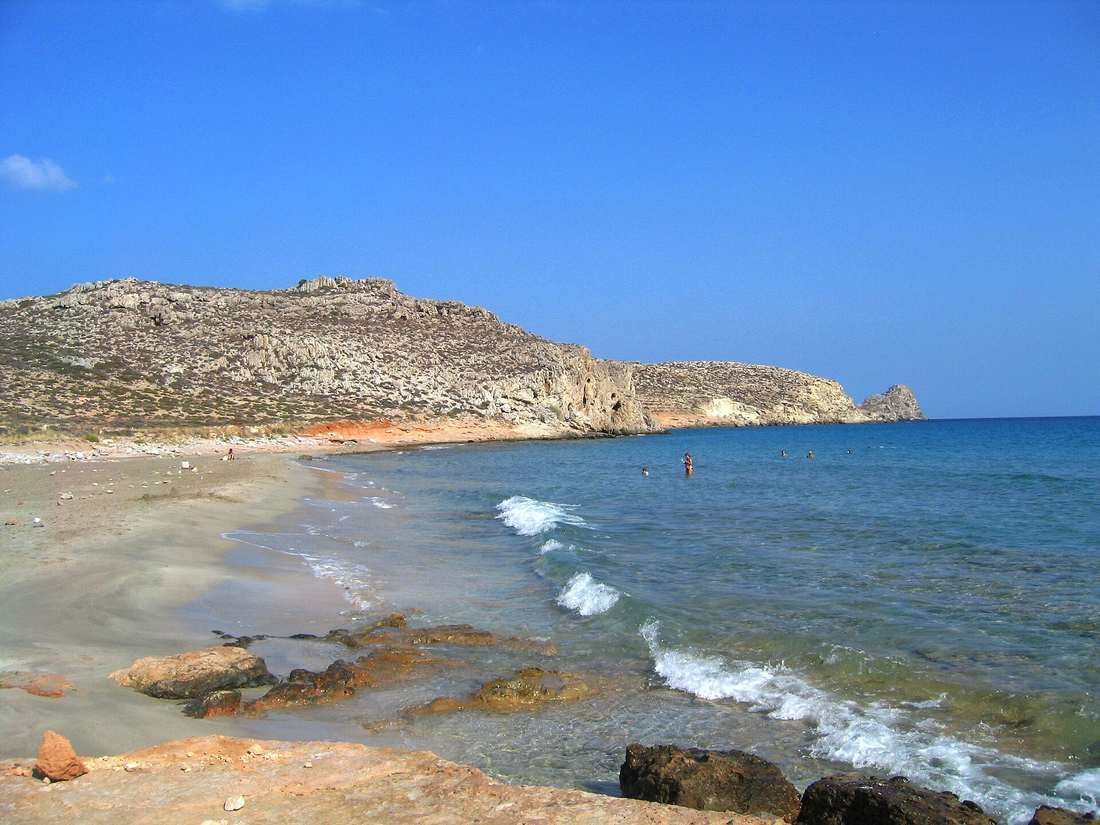
Xerokambos is a remote scatter of beaches and a tiny settlement at the far south-eastern corner of Crete, in the Lasithi region beyond Zakros and the mountain village of Ziros. Long stretches of soft pale sand and clear, shallow turquoise water back onto low dunes, tamarisk and old salt pans, and the coast stays undeveloped even at the height of summer. A short row of tavernas, rooms and studios serves visitors, with no resorts and no nightlife. This guide covers how to reach the coast, what the beaches hold, where to swim and snorkel, and how Xerokambos fits a slow eastern itinerary with My Greece Tours.
The sections below cover the route in over the mountains from Ziros, the character of the pale-sand beaches and turquoise shallows, the offshore islets that make snorkelling worthwhile, the salt pans and dunes behind the shore, and the tavernas and rooms that serve this quiet corner. Read each part alongside our wider Crete travel guide to see where this far south-eastern edge sits against the busier north-coast resorts and the eastern towns. Xerokambos rewards travellers who want empty sand and a slow pace at the eastern edge of the island.
Where is Xerokambos in Crete and how do you reach it?
Xerokambos lies at the far south-eastern corner of Crete, in the Lasithi region beyond Zakros and the mountain village of Ziros. A winding road over the mountains from Ziros reaches it, and a rough coastal track climbs in from Zakros.
The settlement sits at the eastern edge of the island, past the town of Sitia and the deep gorge and palace at Zakros. Drivers take the winding mountain road that drops down from Ziros to the coast, a route of tight bends and open highland views that ends at the scatter of beaches below. A second, rougher approach runs as a coastal track from Zakros, unsealed in stretches and slow going, which suits a sturdy vehicle rather than a low hire car. Both routes share one effect: the distance and the climb keep the crowds away and leave the sand quiet.
Sitia, the nearest town of any size, gives the base for supplies, fuel and road connections before the final leg. Stock up there and set out early for the drive down to Sitia and the corner beyond it.
The drive is the reason Xerokambos stays undeveloped. No coach road, no resort strip and no airport shuttle reach this corner, so day-trippers rarely bother and the beaches never fill. Plan fuel and water before the last stretch, because the settlement holds only a short row of tavernas and small shops rather than a full town. The mountain descent from Ziros is the smoother of the two options and the one most self-drivers take in a low hire car. Allow extra time for the tight bends and for stops at the open highland viewpoints along the way down.
Travellers building a slow eastern loop can fold this run into a wider plan of things to do in Crete that trades headline sights for empty coast and open road.
What are the beaches at Xerokambos like?
The beaches are long stretches of soft pale sand and clear, shallow turquoise water, backed by low dunes, tamarisk and old salt pans. They stay undeveloped and uncrowded through July and August, with no resorts, no clubs and no nightlife.
Xerokambos is not one beach but a scatter of them along the south-eastern shore. Soft pale sand runs in long stretches, and the water shelves gently into clear turquoise shallows that suit unhurried swimming. Low dunes and tamarisk trees back the sand, giving natural shade and a wild, unplanted edge rather than rows of sunbeds and bars. Old salt pans sit behind parts of the shore, a reminder of the small-scale coastal life that shaped this corner. The lack of building is the defining trait: no hotel blocks crowd the front, and the beaches stay open and quiet through July and August.
Families and independent travellers who reach it find open room to spread out along the wide sand. These beaches rank among the wider set of Crete beaches that reward the long drive with open space.
The undeveloped feel is what returning visitors come back for. Sand meets water without a promenade, and the horizon holds low islets rather than resort towers. Shade comes from the tamarisk line and the dunes, so bring water and cover for the middle of the day, since services thin out fast once the tavernas close. The calm, shallow water makes the main strands easy for children and steady swimmers, and quieter coves spread along the coast for those who walk a little further. The pale sand and clear shallows give the corner its postcard look without the crowds that follow such colour elsewhere.
Xerokambos belongs on any list of hidden gems in Crete, the sort of quiet place reached by effort rather than by signposts.
Is Xerokambos good for snorkelling and swimming?
Xerokambos suits both snorkelling and quiet swimming. Small offshore islets and clear, shallow turquoise water make for good snorkelling, and the gently shelving sand gives calm, easy conditions for swimmers of any level along the main strands.
The clear water is the draw for snorkellers. Small islets sit just off the coast, and the shallow, transparent sea around them lets swimmers follow the rocky edges and sandy bottom with a mask. The main beaches shelve gently, so entry is easy and the calm surface holds through most summer days, away from the swell that hits more exposed shores. Bring your own gear, because there are no dive shops or rental huts along this quiet front. The pale sand reflects light up through the water and keeps visibility high in the shallows. Swimmers who prefer open space rather than a busy bay will find room here.
The setting sits within reach of the wider east-coast run north to Vai beach and its famous palm grove.
Quiet swimming is the everyday pleasure here. The gently shelving sand and turquoise shallows make the main strands safe and easy, and the absence of jet-skis and beach clubs keeps the water calm and the noise low. Early and late in the day the light on the pale sand and clear sea is at its best, and the beaches are close to empty. Pack shade, water and food for a full day, since the taverna line is short and the sun is strong on this southern coast. The offshore islets give snorkellers a focus and swimmers a horizon to aim for.
Travellers planning where to base themselves for this eastern coast can weigh their options in our guide to where to stay in Crete.
What lies behind the beaches at Xerokambos?
Behind the sand sit low dunes, lines of tamarisk trees and old salt pans, part of the undeveloped edge that gives the corner its wild look. Simple tavernas, rooms and studios serve visitors, with no resorts, clubs or nightlife.
The land behind the shore tells the corner’s story. Low dunes rise straight off the sand, held together by tamarisk trees whose canopy gives the only natural shade along much of the front. Old salt pans lie inland of parts of the coast, shallow rectangular basins that once let seawater evaporate to leave salt, a small-scale trade that shaped the settlement long before tourism. The pans and dunes stay undeveloped, so the view inland is scrub, rock and low hills rather than building. The scatter of tavernas, rooms and studios clusters near the beaches without forming a resort strip.
The whole setting sits at the mountainous eastern tip, well past the towns and within a long day’s reach of the northern coast around Agios Nikolaos.
The undeveloped hinterland is the reason the corner feels timeless. No coach parks, no supermarkets and no clubs break the line of dunes and salt pans, and the settlement keeps the pace of a working coast rather than a holiday one. Walkers can trace the edges of the pans and follow the tamarisk line between beaches, watching for the birdlife that the shallow water draws. The rooms and studios on offer are simple and few, run by families rather than chains, which fits the slow character of the place. The salt pans, dunes and tamarisk together give Xerokambos a landscape found on few other Cretan beaches.
It stands as one of the last truly quiet coasts on the island, a reward for the long road in over the mountains.
Why does Crete’s far south-east stay so quiet?
Crete’s far south-eastern corner stays quiet because the only access is a winding mountain road from Ziros or a rough coastal track from Zakros. The distance and the climb keep coaches and day-trippers away, leaving the beaches undeveloped through summer.
Geography does the work of keeping Xerokambos empty. The corner sits beyond Zakros and the mountain village of Ziros, at the far south-eastern edge, past the last towns and main roads of eastern Crete. Reaching it means either the twisting descent from Ziros or the unsealed coastal track from Zakros, and neither carries the coach traffic that fills the north-coast resorts. No airport, no port and no resort chain has built here, so the marketing machine that fills busier beaches never turned its attention this way. The result is long sand that stays open even in August. Visitors who make the effort trade convenience for space and calm.
The corner pairs naturally with the eastern highland and gorge country of Zakros and Ziros further inland. On the plateau nearby, the Venetian ghost village of Voila stands silent among its ruined lanes.
The quiet is a choice the landscape enforces rather than a policy. Steep mountains wall the corner off from the rest of the island, and the roads in stay slow and narrow by design of the terrain. That barrier keeps the salt pans, dunes and pale sand free of the building that reshaped the northern shore. Travellers who want empty coast and a slow pace find it here at the eastern tip, and the tiny settlement asks little of them beyond patience on the drive. The absence of nightlife and resorts is the point, not a gap waiting to be filled.
Xerokambos stands as a favourite of independent travellers precisely because the mountains and the tracks keep the crowds on the far side of the island.
Frequently Asked Questions
How do you get to Xerokambos?
Xerokambos sits at the far south-eastern corner of Crete, in the Lasithi region beyond Zakros and the mountain village of Ziros. Two routes reach it. The first is a winding mountain road that drops from Ziros down to the coast, the smoother option and the one most self-drivers take, with tight bends and open highland views along the way. The second is a rough coastal track from Zakros, unsealed in parts and slow going, better suited to a sturdy vehicle than a low hire car. The nearest town of any size is Sitia, which serves as the practical base for fuel, supplies and connections before the final leg.
No coach road, resort shuttle or airport link reaches this corner, which is why it stays so quiet. Plan fuel and water before the last stretch, since the settlement holds only a short row of tavernas and small shops rather than a full town with services.
Is Xerokambos suitable for families?
Xerokambos suits families who want a calm beach day rather than resort facilities. The main beaches shelve gently into clear, shallow turquoise water, which makes swimming easy and safe for children, and the long stretches of soft pale sand leave open room to spread out even in peak summer. Low dunes and lines of tamarisk trees give natural shade, though bringing water, food and cover for the middle of the day is wise, because the taverna line is short and the southern sun is strong. There are no clubs, no water parks and no jet-skis, so the water stays calm and the noise stays low.
Families reach it by the winding mountain road from Ziros, which is the smoother of the two approaches and easier on a low hire car than the rough coastal track from Zakros. Pack for a full day at the quiet beach, because the settlement runs on simple family tavernas and a short row of shops rather than full resort services along the shore.
What else is worth seeing near Xerokambos?
The eastern corner around Xerokambos holds four sights within a manageable drive. Zakros, just to the north, has a Minoan palace and the dramatic Gorge of the Dead that walkers follow down to the sea. The mountain village of Ziros sits on the road in, giving highland views over the far east of the island. Sitia, the nearest town, offers a harbour, a Venetian fort and the practical services the coast itself lacks. Further north along the east coast lies the famous palm grove and sand at Vai. Xerokambos itself keeps to its beaches, salt pans and dunes rather than monuments, so it works best as the quiet counterpoint to those busier stops on a slow eastern itinerary.
Travellers building that loop can line up the coast from Sitia in the east to the west and choose which shores to string together on the long drive around this remote corner of the island.