
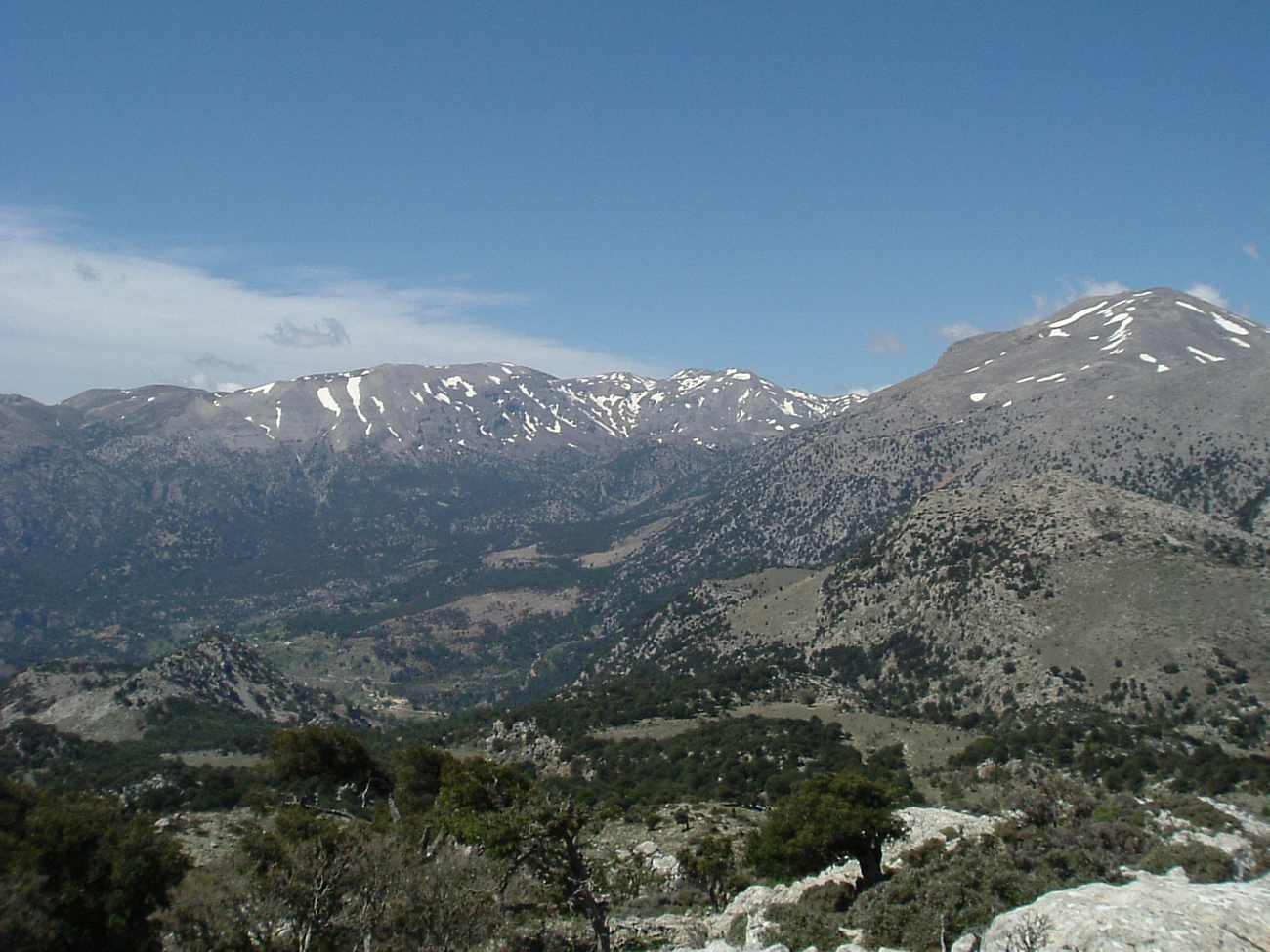
The Dikti mountains form the great highland range of eastern Crete, a high limestone massif also called the Dikti massif or Lasithiotika Ori. The range spans the Lasithi and Heraklion regions and rises to the peak of Spathi at about two thousand one hundred and forty-eight metres. Dikti cradles the fertile, ring-shaped Lasithi Plateau, feeds springs and gorges, and holds the Dikteon Cave, the mythical birthplace of Zeus, above the plateau village of Psychro. Stone shepherds’ villages, terraces, oak woodland and old kalderimi paths cover its slopes. Walkers reach the range to climb Spathi and follow its plateau and gorge routes. Plan your eastern highland journey with My Greece Tours.
This guide sets out where the Dikti mountains stand, how high the range climbs, what the Lasithi Plateau and the Dikteon Cave add to the massif, and how walkers cross the slopes on the E4 trail. The sections below cover the geography of the range, the ascent of Spathi, the plateau it encircles, the myth-bound cave at Psychro, and how Dikti compares with the other two Cretan ranges. Read it alongside the wider Crete travel guide to place this eastern wilderness of caves, plateaus and peaks within the whole island.
Where are the Dikti mountains in Crete?
The Dikti mountains stand in eastern Crete, a high limestone massif spanning the Lasithi and Heraklion regions. The range cradles the ring-shaped Lasithi Plateau and rises to Spathi at about two thousand one hundred and forty-eight metres above the surrounding lowlands.
The Dikti mountains rise across eastern Crete as a compact limestone massif that carries the alternative names Dikti massif and Lasithiotika Ori. The range straddles the boundary of the Lasithi and Heraklion regions, so its slopes fall towards both administrative sides of the island. Its heart is the fertile, ring-shaped Lasithi Plateau, a high enclosed basin held on every side by the peaks of the massif. Springs rise on the slopes and feed the gorges that cut down towards the coast. Stone shepherds’ villages, dry-stone terraces and old kalderimi mule paths mark the flanks, records of a farming and grazing life that shaped the range over long centuries of settlement.
The limestone channels water underground and returns it as springs on the lower slopes. Explore the wider things to do in Crete to set Dikti in context.
The massif sits inland from the busy north coast, reached by mountain roads that climb from Heraklion and from the Lasithi towns below. Oak woodland covers parts of the lower slopes, giving way to bare limestone and rock higher up. The peak of Spathi crowns the range at about two thousand one hundred and forty-eight metres, the high point of eastern Crete. From the ridges the land drops on one side towards the enclosed plateau and on the other towards the gorges and the sea. Walkers, shepherds and pilgrims have crossed these heights for generations, and the old paths still link the plateau villages with the summits and the caves of the massif.
The enclosed basin below the peaks gathers the spring water that keeps its floor green. The Lasithi Plateau forms the natural base for reaching the range.
How high is Spathi, the peak of the Dikti mountains in Crete?
Spathi crowns the Dikti mountains at about two thousand one hundred and forty-eight metres, the high point of eastern Crete. The peak draws serious walkers, who climb it on long ascents from the Lasithi Plateau and the surrounding villages of the massif.
Spathi is the summit of the Dikti massif, rising to about two thousand one hundred and forty-eight metres above sea level. The peak marks the roof of eastern Crete, standing clear above the ridges and the enclosed plateau below. Its ascent counts among the serious mountain walks on the island, a long climb over bare limestone that rewards the effort with wide views across the eastern part of Crete. Walkers set out from the Lasithi Plateau and its ring of villages, following old paths and shepherds’ tracks up towards the ridge. The route crosses grazing land, terraces and rock before it reaches the exposed upper slopes.
Anyone planning the climb treats it as a full mountain day and reads the guidance on hiking in Crete in advance.
The climb of Spathi belongs to a wider network of routes across the Dikti mountains. Gorge walks cut down from the heights towards the coast, and plateau paths ring the fertile basin at the centre of the massif. The long E4 trail, the European long-distance path, crosses the range and links Dikti with the rest of the Cretan mountain chain. Shepherds’ villages, oak woodland and old kalderimi paths give the walking country its character, mixing farmed slopes with bare summits. The exposed limestone and the height of the range mean weather and daylight matter on any ascent.
Timing the visit well forms part of the planning, and the summer months open the highest routes across the massif while the plateau villages below serve walkers with rooms, water and mountain hospitality through the walking season.
What is the Lasithi Plateau within the Dikti massif?
The Lasithi Plateau is the fertile, ring-shaped basin cradled at the heart of the Dikti massif. The mountains enclose it, springs feed its farmland, and its ring of stone villages forms the base for walkers heading into the range.
The Lasithi Plateau lies enclosed at the centre of the Dikti mountains, a high, fertile basin held in a near-perfect ring by the surrounding peaks. The massif feeds it with springs and channels the water that makes its floor good farming ground. A circle of stone villages rings the plateau, linked by roads and by the old kalderimi paths that climb from the fields towards the heights. The enclosed shape of the basin gives it a distinct climate and a farming life set apart from the coast. Terraces, orchards and grazing land cover the floor and the lower slopes above it.
The plateau serves as the natural gateway to the whole range, and travellers use it to reach both the summits and the caves of the massif.
Above the plateau village of Psychro stands the Dikteon Cave, one of the best-known sites of the range and a focus for visitors to the basin. The plateau also opens onto the walking routes that climb towards Spathi and cross the massif on the E4 trail. Its ring of villages offers a base of rooms, tavernas and mountain hospitality far from the north-coast resorts. Travellers who reach Lasithi often pair the plateau with quieter corners of the island, and the plateau itself ranks among the hidden gems in Crete. The ring of villages keeps the tavernas, workshops and churches that carry the farming culture of the basin.
The plateau joins farmland, folk tradition and myth in one enclosed upland world, ringed by the peaks and paths of Dikti and reached by roads that climb from the towns below.
Why is the Dikteon Cave in the Dikti mountains famous?
The Dikteon Cave stands above the plateau village of Psychro in the Dikti mountains and holds fame as the mythical birthplace of Zeus. Legend places the infant god’s hiding here, and the cave draws visitors to the heart of the massif.
The Dikteon Cave lies in the slopes of the Dikti mountains above Psychro, one of the ring of villages on the Lasithi Plateau. Greek legend names it the birthplace of Zeus, the site where the infant god was hidden and raised, and that story has drawn travellers to the cave for a very long time. The cave descends into the mountain in a series of chambers, and its setting above the enclosed plateau ties the myth firmly to the geography of the massif. Its fame rests on this legend as much as on the geology, and it stands among the reasons the range holds a place in the wider story of Crete.
Pilgrims and visitors reach it on the paths that climb from Psychro up into the mountain.
The cave sits within easy reach of the plateau villages, so travellers pair it with a circuit of the basin and, for the strong, with the ascent of Spathi. The Dikti massif holds the cave apart from the great show caves elsewhere on the island, giving eastern Crete its own famed site of myth and rock. The range compares with the central massif of Psiloritis, which carries its own cave legends of the god’s upbringing on the far side of the island. The chambers of the Dikteon Cave descend into the mountain. The cave joins the plateau, the peaks and the old paths into a single upland world where farming life, walking country and ancient story meet.
It remains the most celebrated single feature of the Dikti mountains and a fixed point of any visit to the Lasithi highlands.
How do the Dikti mountains compare with the other Cretan ranges?
The Dikti mountains stand apart from Psiloritis in central Crete and the White Mountains in the west, forming the great highland range of the east. Together the three massifs give the island its spine of caves, plateaus and high limestone peaks.
Crete carries three great mountain ranges along its length, and the Dikti massif is the eastern one. Psiloritis rises in the centre of the island and reaches the highest summit on Crete, while the White Mountains dominate the west with their own high peaks and gorges. Dikti holds the east, giving that part of the island its own highland wilderness of caves, plateaus and peaks, distinct from the two ranges to the west. Each massif has its enclosed uplands, its walking routes and its legends, yet the three keep separate identities and separate mountain worlds. The peaks feed the springs and gorges that run down to the north and south coasts.
The long E4 trail threads through all of them, linking the ranges into one traverse across the island for walkers who take on the full path.
What sets Dikti apart is its enclosed Lasithi Plateau, its peak of Spathi and its myth-bound cave above Psychro, features that belong to the eastern massif alone. The White Mountains in the far west offer a larger, wilder range of gorges and summits for their part of the island. Travellers who tour the whole of Crete often take in more than one massif, moving from the White Mountains through Psiloritis to Dikti as they cross from west to east. The three ranges frame the coasts, feed the springs and gorges, and hold the caves and plateaus that give the island its mountain character across its length.
Dikti completes that chain at the eastern edge of Crete with its enclosed plateau, its myth-bound cave and its high summit.
Frequently Asked Questions
Can you hike the Dikti mountains without a guide?
Walkers cross the Dikti mountains on marked routes and on the long E4 trail, which threads through the massif and links it with the rest of the Cretan mountain chain. Plateau paths ring the Lasithi basin and offer gentler walking, while the ascent of Spathi to about two thousand one hundred and forty-eight metres counts as a serious mountain day over bare limestone. Old kalderimi paths and shepherds’ tracks connect the plateau villages with the summits and the caves, and the stone villages give a base of rooms and tavernas. Weather, daylight and the height of the range demand proper planning, water and footwear on the higher routes.
Match the walk to your own fitness and mountain experience before setting out onto the ridges. The plateau circuits suit most visitors, while the summit push belongs to experienced hillwalkers ready for a full day on the exposed upper ground of the massif.
What is there to see around the Dikti mountains?
The Dikti mountains hold the fertile, ring-shaped Lasithi Plateau at their heart, encircled by stone villages, terraces and orchards fed by the springs of the massif. Above the plateau village of Psychro stands the Dikteon Cave, the mythical birthplace of Zeus and the most celebrated single feature of the range. The peak of Spathi crowns the massif at about two thousand one hundred and forty-eight metres, drawing walkers to the roof of eastern Crete. Oak woodland, old kalderimi paths and gorges spread across the slopes, and the long E4 trail crosses the range. The plateau ranks among the quietest upland corners of the island, offering farming villages, terraced fields and mountain hospitality far from the coast.
Travellers pair the cave, the plateau circuit and, for the strong, the summit into an upland trip that joins myth, farming life and high mountain scenery in the eastern part of the island far from the coast.
How do the Dikti mountains fit into a Crete trip?
The Dikti mountains give a Crete trip its eastern highland day, set inland from the north-coast resorts and reached by mountain roads that climb from Heraklion and the Lasithi towns. The Lasithi Plateau makes the natural base, with its ring of stone villages, its farmland and the Dikteon Cave above Psychro, all within an easy circuit. Strong walkers add the ascent of Spathi or a gorge route, while others keep to the plateau paths and the cave. The massif stands apart from Psiloritis in the centre and the White Mountains in the west, so a full island tour can take in more than one range.
Height and weather shape the mountain days, so travellers time the visit with care and keep the highest routes for the settled summer months on the exposed upper slopes. Dikti rounds out a Crete journey with caves, plateaus and peaks at the eastern edge of the island.