
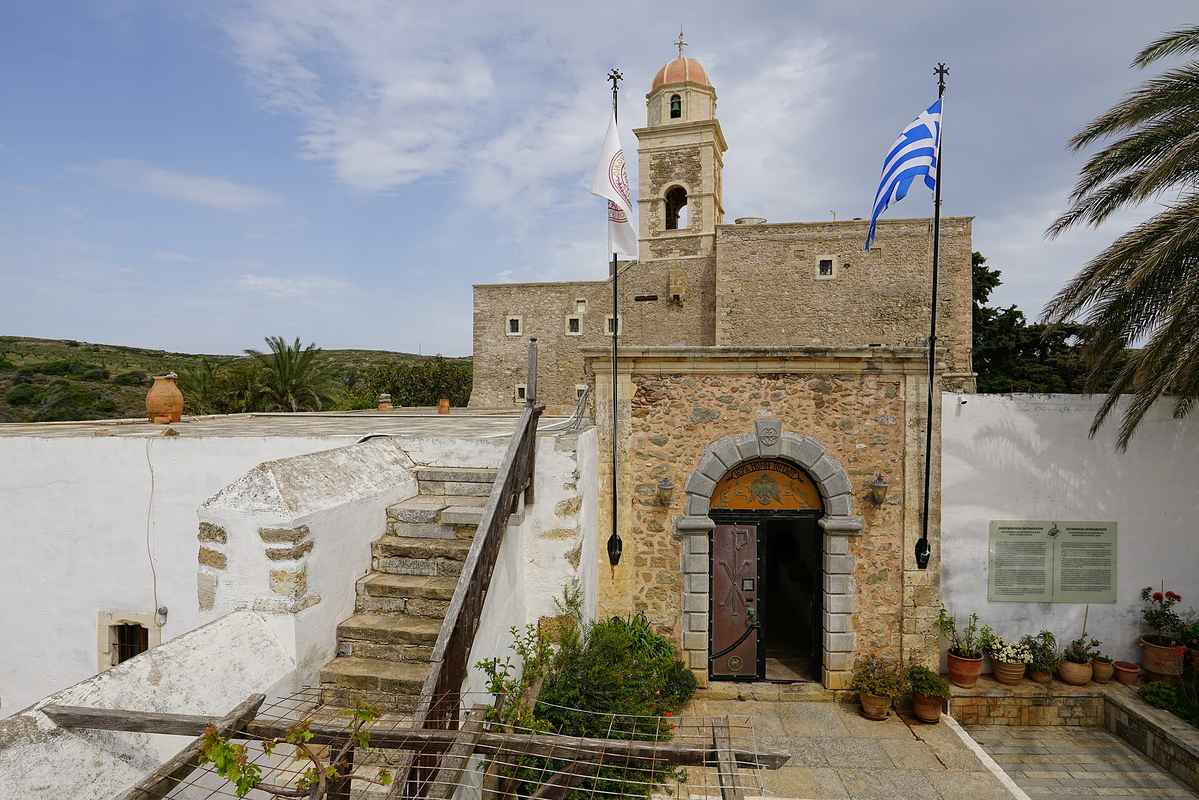
Moni Toplou rises from the arid landscape of eastern Crete like a fortress, its thick defensive walls concealing centuries of spiritual devotion and resistance. The monastery takes its name from the Turkish word for cannon, a testament to the artillery that once defended these sacred grounds in the Lasithi region. Visitors journey here to witness the celebrated icon ‘Lord, Thou Art Great’ by Ioannis Kornaros, explore a remarkable museum of religious art, and taste organic olive oil and wine produced on the monastic estate. This fortified sanctuary near Sitia offers an authentic glimpse into Cretan heritage with My Greece Tours.
The monastery stands on the road leading to the famous palm-fringed sands of Vai, making it an ideal stop for travelers exploring the island’s remote eastern reaches. Its position near the ancient ruins of Itanos adds archaeological significance to spiritual importance. The sections below cover the monastery’s defensive architecture, its treasured artworks, the productive estate, its role in Cretan resistance movements, and practical visitor information. This destination represents one of the most historically significant religious sites detailed in our comprehensive Crete travel guide.
What Makes Toplou Monastery’s Architecture Unique in Crete?
The monastery’s fortress-like design features towering stone walls and defensive battlements that protected monks and treasures during centuries of occupation. The Turkish name Toplou, meaning cannon, reflects the artillery mounted here for protection.
The architectural character of Moni Toplou immediately distinguishes it from other religious sites across the island. Massive stone walls rise to impressive heights, creating an imposing perimeter that served both spiritual and defensive purposes throughout turbulent historical periods. The entrance itself resembles a fortress gate rather than a typical monastic portal, with thick wooden doors reinforced with iron and narrow openings designed to repel attackers. The central courtyard reveals a more serene atmosphere, with arcaded walkways surrounding the katholikon church and cells where monks lived in contemplative seclusion. Bell towers punctuate the skyline, their proportions harmonizing military strength with religious grace.
This combination of sacred space and military architecture makes Toplou one of the most distinctive things to do in Crete for visitors interested in Byzantine defensive design.
The monastery’s strategic location in the far eastern reaches of Lasithi provided natural advantages for surveillance and defense. Positioned on elevated ground, the complex commanded views across the surrounding countryside toward the coast, allowing early warning of approaching threats from sea or land. The thickness of the outer walls exceeds two meters in places, sufficient to withstand cannon fire and siege attempts during the Ottoman period. Interior spaces include storage chambers for provisions, enabling the community to endure prolonged isolation during conflicts. The architectural plan reflects centuries of modifications, with original Byzantine foundations expanded during Venetian rule and further fortified under Ottoman pressure.
Water cisterns carved into bedrock ensured self-sufficiency, while the compact layout maximized defensive efficiency without sacrificing the contemplative atmosphere essential to monastic life in this remote corner of the island. On the coast below, the ancient ruins of Itanos stand among quiet coves beside the palm grove.
What Treasures Does the Toplou Monastery Museum Hold?
The museum houses the celebrated icon ‘Lord, Thou Art Great’ painted by Ioannis Kornaros, considered a masterpiece of Cretan religious art. Collections include Byzantine icons, copperplate engravings, ecclesiastical vestments, and illuminated manuscripts spanning centuries of devotional creativity.
The icon ‘Lord, Thou Art Great’ by Ioannis Kornaros represents the pinnacle of Cretan iconographic tradition, executed during the eighteenth century when the island’s artistic schools flourished under challenging political circumstances. This large panel depicts the creation narrative through intricate miniature scenes surrounding a central image of Christ Pantocrator, each vignette rendered with extraordinary detail and theological sophistication. The composition demonstrates the synthesis of Byzantine conventions with Renaissance influences that characterized Cretan painting, creating a visual theology accessible to illiterate faithful while rewarding scholarly contemplation. Gold leaf highlights catch candlelight, animating the sacred figures with an otherworldly luminosity.
The icon survived periods when religious art faced destruction, protected within these fortress walls near Sitia while other treasures perished across the Mediterranean world.
Beyond the Kornaros masterpiece, the museum preserves an extensive collection documenting eastern Cretan spiritual life across centuries. Byzantine icons from the fourteenth through nineteenth centuries reveal evolving artistic styles and devotional emphases, with particular strength in representations of local saints and miracle-working images. Copperplate engravings imported from Venice and other European centers demonstrate the monastery’s international connections and intellectual curiosity. Illuminated liturgical manuscripts display the calligraphic skills of generations of monastic scribes, their decorated initials and marginal illustrations transforming sacred texts into visual poetry. Ecclesiastical vestments embroidered with gold thread, silver reliquaries, and carved wooden furnishings complete the collection. The museum experience ranks among the hidden gems in Crete for those seeking authentic encounters with Byzantine heritage.
How Does Toplou Monastery Produce Its Organic Products?
The monastic estate cultivates extensive olive groves and vineyards using organic agricultural methods that respect traditional Cretan practices. The community produces premium olive oil and wine, sold to visitors and distributed commercially, funding ongoing restoration and charitable works.
The agricultural lands surrounding Moni Toplou extend across thousands of acres in the arid eastern landscape, where monks have cultivated olives and grapes for centuries. Modern organic certification formalizes traditional practices that always avoided chemical interventions, relying instead on crop rotation, natural pest management, and careful water conservation suited to the semi-desert climate. Ancient olive trees with gnarled trunks and silvery leaves produce fruit pressed into extra virgin oil celebrated for its low acidity and distinctive peppery finish. The estate maintains its own modern pressing facilities where fruit harvested by hand undergoes cold extraction within hours, preserving maximum flavor and nutritional properties.
Visitors traveling from Vai beach often stop to purchase bottles directly from the monastery shop, supporting the community while acquiring products of exceptional quality unavailable in standard commercial channels.
Viticulture at Toplou focuses on indigenous Cretan grape varieties adapted to intense sun, strong winds, and minimal rainfall that characterize this exposed eastern region. Vidiano, Vilana, and Thrapsathiri whites complement Kotsifali and Mandilari reds, all cultivated without synthetic fertilizers or pesticides in accordance with organic principles. The winery produces both sacramental wines for liturgical use and commercial bottlings that have earned recognition in international competitions. Fermentation occurs in temperature-controlled stainless steel tanks, though some premium selections age in French oak barrels to develop complexity. The monastic business model demonstrates how religious communities can achieve financial sustainability while maintaining spiritual priorities, with profits funding icon restoration, building maintenance, and social services.
The agricultural operation provides employment for local families, strengthening economic ties between the monastery and surrounding villages throughout the year.
What Role Did Toplou Play in Cretan Resistance History?
Throughout Ottoman occupation and World War Two, the monastery served as a center of resistance, sheltering fighters and coordinating opposition movements. Monks faced execution for harboring partisans, cementing Toplou’s reputation as a symbol of Cretan defiance against foreign domination.
The fortress architecture that defines Moni Toplou proved essential during centuries of resistance against occupying powers. During the Ottoman period, the monastery provided sanctuary for rebels organizing uprisings against Turkish rule, its thick walls and remote location offering protection from retaliation. Monks risked their lives smuggling weapons, hiding fugitives, and maintaining communication networks that coordinated resistance across eastern regions. Ottoman authorities repeatedly besieged the complex, attempting to suppress its role as a center of Greek national consciousness and Orthodox identity. The community endured confiscation of lands, imprisonment of abbots, and periodic massacres, yet the monastery survived as a living symbol of Cretan determination to preserve cultural and religious autonomy.
This heritage of resistance parallels the history of Arkadi Monastery in central regions, though Toplou’s eastern isolation made its defiance particularly audacious and costly.
During World War Two, the monastery again became a resistance hub when German forces occupied the island. Monks sheltered Allied soldiers evading capture after the Battle of Crete, operated clandestine radio equipment communicating with Cairo, and stored weapons for partisan units operating in the mountains. The abbot and two monks faced execution by firing squad when Germans discovered the monastery’s involvement in resistance activities, their martyrdom commemorated in memorial plaques visitors see today. The community paid an enormous price for its principles, yet never wavered in supporting the struggle against occupation. This tradition of courage under oppression resonates deeply with Cretan identity, making Toplou a pilgrimage site for those honoring the island’s resistance heritage.
The monastery stands as tangible evidence that spiritual communities can exercise profound political influence when moral conviction demands action against injustice.
How Can Visitors Best Experience Toplou Monastery in Eastern Crete?
The monastery welcomes visitors daily except during specific religious observances, with modest dress required. Plan two hours to explore the church, museum, and shop, ideally combining your visit with nearby Vai beach and Itanos archaeological site for a full day.
Reaching Moni Toplou requires traveling along the coastal road that connects Sitia with the famous palm forest beach, a journey of approximately twenty kilometers through dramatic arid landscapes dotted with windmills and scattered villages. The monastery appears suddenly as the road climbs inland, its fortified silhouette commanding the surrounding plateau. Visitors should arrive during morning or late afternoon hours to avoid midday heat, particularly during summer months when temperatures soar and shade becomes precious. The entrance fee includes access to the museum and church, with guided tours available in multiple languages during peak season. Photography is permitted in courtyard areas but restricted inside the katholikon and museum to protect delicate artworks from light damage.
The best time to visit Crete for experiencing Toplou extends from April through October, when the monastery maintains extended hours and all facilities operate fully.
Combining Toplou with nearby attractions creates a rewarding day exploring the far eastern region. The ancient city of Itanos lies just kilometers away, its Hellenistic and Roman ruins scattered along a beautiful coastline where three beaches offer swimming opportunities. Vai beach with its unique palm forest sits fifteen minutes beyond the monastery, providing a striking contrast between the austere monastic environment and the tropical landscape. Visitors should allocate sufficient time for the museum, where the Kornaros icon and copperplate collection deserve unhurried contemplation. The monastery shop sells organic olive oil, wine, honey, and religious items, with proceeds supporting the community.
Modest clothing is mandatory, meaning covered shoulders and knees for both men and women, with scarves available at the entrance for those unprepared. The experience offers profound insights into how faith, art, agriculture, and resistance intertwine in Cretan culture across centuries of challenge and survival.
Frequently Asked Questions
What does the name Toplou mean and why was the monastery called this?
The name Toplou derives from the Turkish word for cannon, reflecting the artillery that defended the monastery during the Ottoman occupation of Crete. The fortress-like complex mounted cannons on its walls and towers to repel attacks from pirates, bandits, and military forces attempting to seize its treasures or punish its role in resistance movements. The Turkish nickname gradually replaced the monastery’s formal dedication to Panagia Akrotiriani and Saint John the Theologian, becoming the common designation even among Greek speakers. The name serves as a linguistic reminder of the centuries when Crete existed under Ottoman rule, from the mid-seventeenth century until union with Greece in the early twentieth century.
The survival of this Turkish designation reflects how occupation left permanent marks on Cretan vocabulary and place names, even for sites representing Orthodox resistance to Muslim authority. Visitors today use the name Toplou universally, with the original dedication known primarily to scholars and clergy familiar with the monastery’s complete ecclesiastical history.
Can visitors attend religious services at Toplou Monastery?
The monastery maintains an active liturgical schedule, with services held in the katholikon church according to the Orthodox calendar. Visitors are welcome to attend morning orthros and divine liturgy, typically beginning before dawn and concluding by mid-morning, as well as evening vespers services. The monastic community follows traditional Byzantine chant without instrumental accompaniment, creating an atmosphere of profound spiritual intensity within the incense-filled church. Major feast days attract pilgrims from across eastern Crete, with particularly significant celebrations on the feast of the Assumption in mid-August and the feast of Saint John the Theologian in late September. Attending services requires appropriate modest dress and respectful behavior, including standing throughout the liturgy as Orthodox tradition prescribes.
Photography and conversation are prohibited during worship, and visitors should arrive early to find space in the relatively small katholikon. The experience offers rare insight into living monastic practice continuing unbroken for centuries, connecting contemporary worshippers with the same prayers and rituals that sustained the community through occupation, resistance, and persecution across generations of Cretan history.
What is the historical connection between Toplou Monastery and the ancient site of Itanos?
The monastery stands on lands that once belonged to the ancient Greek city-state of Itanos, whose ruins lie just kilometers away along the coast. Itanos flourished during the Hellenistic and Roman periods as a prosperous port controlling trade routes between Crete and the eastern Mediterranean, with particular connections to Egypt and the Levant. Archaeological evidence suggests continuous habitation from Minoan times through the early Byzantine period, when the settlement gradually declined as populations moved inland for protection against pirate raids. The monastery likely emerged during the medieval period on former Itanos agricultural lands, inheriting olive groves and vineyards originally cultivated by the ancient city’s farmers.
Architectural fragments and inscriptions discovered in monastery walls indicate that builders recycled stone from Itanos ruins, creating physical continuity between pagan and Christian civilizations. The relationship between the two sites illustrates how Cretan landscapes layer millennia of human activity, with each era building upon and incorporating remnants of its predecessors. Visitors exploring both locations within a single day witness this remarkable historical continuity, from ancient temple foundations to fortified Christian monasticism.