
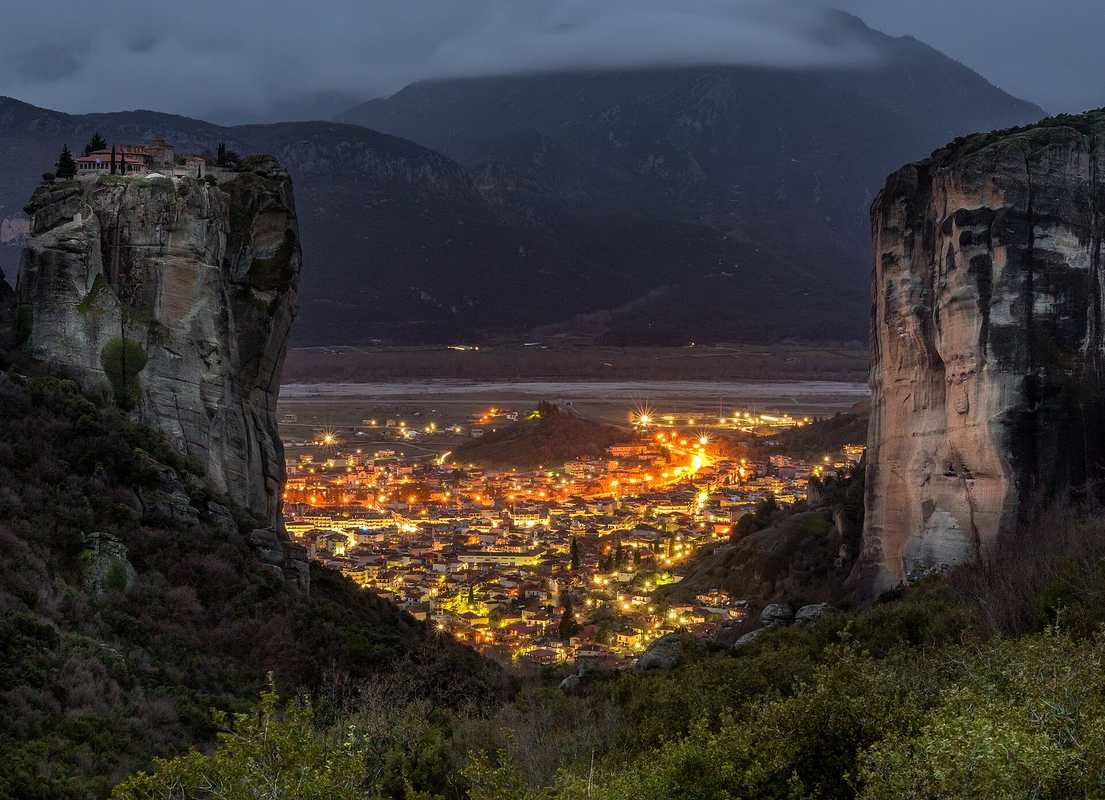
Kalabaka is the town that sits directly beneath the towering sandstone pillars of Meteora, in the Thessaly plain of central Greece. Sometimes written Kalampaka, it spreads across the flat ground where the plain meets the rock, so the monasteries rise roughly 1 to 2 kilometres above the last streets. The town is the natural base for the region: it holds the train station, the bus terminal, hotels, tavernas and the Byzantine Church of the Dormition of the Virgin. Almost every visitor to the monasteries begins here, whether they arrive by rail from Athens or Thessaloniki or by car. Plan your route with My Greece Tours.
Understanding Kalabaka makes the whole area easier to navigate, because the town controls access to the rocks above it. From the streets you can already see the monasteries perched on their columns, and the single road that climbs to them starts at the edge of town and passes through neighbouring Kastraki. Our Meteora travel guide sets Kalabaka in the wider picture of the pillars, the six active monasteries and the surrounding villages. The sections below cover where the town sits, how to reach it, what to see within its own streets, where to sleep and eat, and how it connects to the rocks.
Where is Kalabaka and how does it relate to Meteora?
Kalabaka lies in the Thessaly plain of central Greece, at the base of the Meteora rock pillars. The town sits on flat ground, and the sandstone columns rise about 1 to 2 kilometres directly above its northern edge.
Kalabaka occupies the point where the Thessaly plain ends and the Pindus foothills begin. The Meteora pillars stand immediately behind the town, so the transition from level streets to sheer rock happens within a short walk. This geography is the reason Kalabaka exists as a settlement: it grew as the service town beneath the monastic community above. The rock face shelters the northern side of town, and from most central streets you can look up and count the columns crowned with buildings. To reach the monasteries themselves you follow a single climbing road, and a full circuit of the six active houses is easier with organised Meteora tours that handle the driving between viewpoints.
The relationship between town and rock is close and practical. Kalabaka provides the beds, food, fuel and transport that the monasteries do not, while the pillars give the town its entire reason for tourism. Just to the northwest, the smaller village of Kastraki sits even nearer the base of the rocks and blends almost seamlessly into Kalabaka’s outskirts. Together the two settlements form the human edge of the Meteora landscape. Drivers approaching from Trikala often see them long before reaching the town because the columns are visible from the plain for kilometres. For a closer look at the neighbouring village and its own footpaths, see our page on Kastraki.
How do you get to Kalabaka from Athens or Thessaloniki?
Kalabaka sits on the Athens to Thessaloniki rail corridor via Palaeofarsalos, and it also has a bus terminal. Trains and coaches both terminate in town, and drivers use the national road network through Trikala.
The town’s train station is one of its defining features, because Kalabaka is the terminus of a branch line that connects to the main Athens to Thessaloniki route at Palaeofarsalos. This makes rail one of the simplest ways to arrive without a car, and the station sits within walking distance of the central square and its hotels. Coaches also serve the town through the KTEL bus network, linking Kalabaka to Trikala, the nearest larger city, and onward to the two big metropolitan hubs. Arriving travellers are already at the base of the rocks because both the station and the bus terminal are inside the town.
Many visitors combine the journey with a structured Meteora day trip from Athens that covers transport and the monastery circuit in one booking.
Driving to Kalabaka is straightforward on the modern road network. From Athens the route runs north on the motorway toward Lamia and Larissa, then west through Trikala into the Thessaly plain. From Thessaloniki the approach comes down from the north through Grevena or across via Larissa and Trikala. The final stretch into town is flat and well signposted, and parking is available near the centre, though the narrow lanes on the monastery road above town are tighter. The drive itself previews the destination because the pillars are visible from far out on the plain.
Once settled, most people spend a night or two in Kalabaka, and our guide to where to stay in Meteora compares the town with Kastraki for that decision.
What is there to see in Kalabaka town itself?
Kalabaka’s main monument is the Byzantine Church of the Dormition of the Virgin, north of the centre near the rocks. The town also offers a central square, tavernas, craft shops and constant close-up views of the pillars.
The Church of the Dormition of the Virgin is the oldest and most important building in Kalabaka. It stands at the northern edge of town, closest to the rock face, on foundations that reach back to early Byzantine centuries. Inside, it preserves wall paintings and a rare marble ambo, and its position gives visitors an early sense of the region’s long religious history before they climb to the monasteries. Beyond the church, the town centre is walkable and compact, built around a main square lined with cafes and tavernas. The streets carry a steady flow of visitors preparing for the ascent, and the rock walls loom over the rooftops.
The great cliff-top monasteries above town are covered on our page devoted to the Meteora monasteries.
Kalabaka works well as a place to slow down between rock visits. The shops along the central streets sell local honey, herbs, woven goods and religious icons, reflecting both the farming plain and the monastic tradition. Tavernas serve Thessalian cooking, and the evening light on the pillars draws people out to look upward from the squares. Walking from the station to the church and back through the centre takes little time, which suits travellers with a single afternoon before or after the monasteries because the town is small.
The best conditions for those views and for the climb depend on the season, and our notes on the best time to visit Meteora explain how the light and crowds shift through the year.
Where should you stay and eat in Kalabaka?
Kalabaka holds most of the region’s hotels, guesthouses and tavernas, concentrated around the central square and the streets below the rocks. Kastraki, just to the northwest, offers a quieter alternative closer to the cliff base.
Kalabaka carries the bulk of the accommodation, from small family guesthouses in the centre to larger properties on the approaches, as the largest settlement beneath Meteora. Staying in town puts the train station, the bus terminal, the church and the tavernas within walking distance, which suits travellers arriving without a car. Rooms on the northern side of town often face the pillars directly, so the rocks become the view from the window. The dining scene centres on Thessalian and grill cooking, with tavernas clustered around the main square and along the streets that feed it. For the choice between staying in the town centre or in the quieter village nearby, our guide to accommodation lays out the trade-offs.
Kastraki, effectively a suburb on Kalabaka’s northwestern edge, sits even closer to the base of the rocks and appeals to those who want a village atmosphere and a short walk to the trailheads. Many people split the difference by sleeping in Kalabaka for its transport links and eating an evening meal in either settlement. Moving between them on foot or by a brief drive is easy, and the choice is more about mood than distance because the two run together. Whichever you pick, the monasteries above are the reason for the visit, and organised excursions can collect guests from hotels in both places. See our dedicated page on Kastraki for a fuller comparison of the neighbouring village.
How does Kalabaka connect you to the Meteora monasteries above?
A single asphalt road climbs from Kalabaka and Kastraki up to the Meteora plateau, linking the six active monasteries. The town sits at the base, so every ascent to the rocks begins from its streets or those of Kastraki.
The climb from town to plateau is short in distance but dramatic in gain. The road leaves the northern edge of Kalabaka, passes through Kastraki, and then loops up the rock faces to reach the parking areas and paths that serve the monasteries. In good weather the ascent can be walked on marked footpaths that predate the road, giving fit visitors a route from the town square to the cliff tops. The sense of moving from ordinary town life into a monastic landscape is immediate because the base of the rocks is only 1 to 2 kilometres from the centre.
Guided excursions handle the driving and timing along this road, and our overview of Meteora tours is easy to reach if a tour has not already been used elsewhere in your planning.
For independent travellers, Kalabaka’s position makes self-guided visits practical. You can leave town in the morning, follow the loop road past the viewpoints, and stop at each of the open monasteries in turn, returning to the same base for the night. The monasteries keep their own opening days and dress codes, so checking those before setting out matters more than the short travel time. This close connection is exactly why the town developed as it did, and why it remains the anchor for any Meteora itinerary. To see how a full day on the rocks is usually structured from town, read our one day in Meteora itinerary, which walks through the monastery circuit from town.
Which footpaths climb from Kalabaka to the monasteries?
Old monk paths climb from Kalabaka to the Holy Trinity monastery and from Kastraki to the Great Meteoron and Varlaam. They pass the hermit caves in the rock faces and follow the gaps between the pillars, away from the asphalt loop road.
Monks and villagers moved between the monasteries on foot before the road was built. Their paths still run through the forest and the clefts in the rock. A walk on them shows the pillars from below. Guided hikes start in the morning, before the heat builds on the plain.
Hermits lived in the caves above Kastraki from the 11th century, before the first monasteries rose. Remains of their ledges and ladders are still visible on the cliffs. Guided walks reach the Meteora caves and hermitages on foot.
Until the 20th century the only way into the monasteries was by ladder or in a net hauled up by a winch. Steps cut into the rock now reach every house. The Meteora hiking routes end at these rock-cut steps below the monastery gates.
What is the Theopetra cave?
The Theopetra cave is a limestone cave on the road south of Kalabaka. People used it from about 130,000 years ago. A stone wall across part of its entrance, built about 23,000 years ago, ranks among the oldest known built structures in the world.
The cave opens in a limestone hill within sight of the Meteora rocks. Excavation found tools, hearths and animal bones in thick layers. The layers run from the Middle Palaeolithic to the Neolithic. Footprints of children survive in the cave floor.
Dating places the wall in the coldest phase of the last Ice Age. Archaeologists read it as a shelter against the cold wind. A path with railings leads into the main chamber, and a museum at the foot of the hill displays the finds.
Tours pair the cave with the monasteries on the same day. The cave also fits the second morning of a Meteora 2-day itinerary.
Which mountain resorts lie west of Trikala?
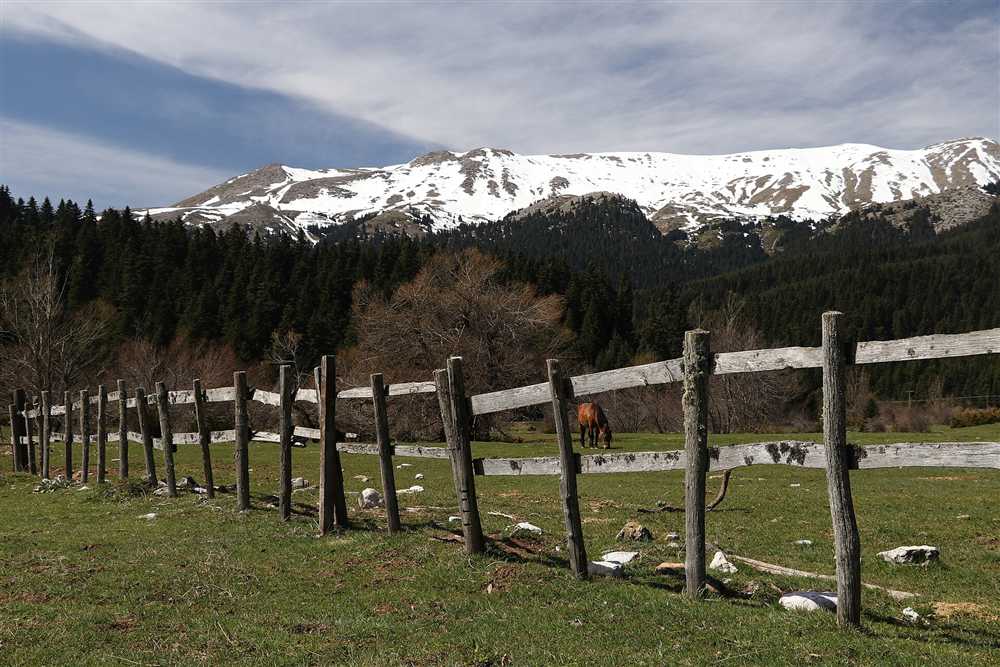
Elati and Pertouli are the mountain resorts of the Koziakas range, at 900 to 1,200 m in fir forest west of Trikala. Pertouli has a small ski centre, and the road beyond it drops into the Aspropotamos valley.
Elati is the first resort on the road from Trikala. Its stone guesthouses stand in fir forest, around a square of tavernas with views over the plain. Pertouli lies higher, around a wide green meadow ringed by fir trees. Horses graze the meadow in summer, and snow covers it in winter.
The forest around Pertouli belongs to the Aristotle University of Thessaloniki, which uses it for research and teaching. Its trails carry walkers, mountain bikers and riders. The ski centre above the meadow runs lifts for beginners and families from December to March, the same season as Meteora in winter.
Aspropotamos, the white river, is the local name for the upper Achelous. Stone villages, arched bridges and plane-shaded squares line the valley. The river runs clear over white stones, with pools for swimming in summer and tavernas serving trout.
What do Pyli and Porta Panagia hold?
Pyli holds the Byzantine church of Porta Panagia, built in 1283 with two mosaic icons, and the single-arch stone bridge that Saint Bessarion built over the Portaikos river in 1514. The monastery of Dousiko, founded by the same saint, stands above.
Pyli, meaning the gate, stands where the Portaikos leaves the Pindus gorge for the plain, about 20 km south-west of Trikala. John Doukas, the ruler of Thessaly, built Porta Panagia. Its mosaic icons show Christ and the Virgin, a rare feature in a village church.
A short walk upstream, the bridge crosses the river in one high arch. It carried the road into the mountains for centuries. Pyli lies on the road from Trikala to Elati and Pertouli, so tours stop there on the way into the Pindus.
What does Trikala town add to a Kalabaka stay?
Trikala, 22 km south-east of Kalabaka, adds a Byzantine fortress with a clock tower, the old Varousi quarter, the 16th-century Koursoum mosque attributed to Sinan, cafes along the Lithaios river and, in winter, the Mill of the Elves Christmas park.
Trikala is ancient Trikke, the home of the cult of Asclepius, the god of healing. Homer lists it among the Greek cities that sent ships to Troy. The modern town is flat and green, and residents get around by bicycle on its network of bike lanes.
The fortress walls date from the Byzantine and Ottoman periods, and the clock tower stands beside them. Varousi keeps the mansions and lanes of the 18th and 19th centuries. The Koursoum mosque below is one of the few works on Greek soil credited to Sinan, the chief architect of the Ottoman Empire.
The Mill of the Elves fills the late 19th-century Matsopoulos flour mill on the Lithaios from late November to early January. Lights, workshops, a Santa’s house and markets draw families from across Greece. The rest of the year the mill holds a museum of the milling industry.
Which food experiences run around Kalabaka?
Food around Kalabaka runs from the tsipouro houses of Trikala, where each small bottle brings a new plate of meze, to truffle hunts with trained dogs in the forests near Meteora, trout from the Pindus rivers and grilled lamb in Elati and Pertouli.
The tsipouradiko is the institution of Thessalian towns. Customers order tsipouro by the small bottle, and the kitchen sends a plate with each one. Grilled sausage and peppers, fried fish, beans and cheeses arrive round by round, and the kitchen chooses the order.
The forests around Meteora hold truffles. Local guides lead hunts with trained dogs, and the hunt ends with a meal cooked with the finds. The mountain villages add pies of greens and cheese, roast lamb and goat, wild mushrooms in autumn and trout from the streams. The tables of the town itself are listed in where to eat in Meteora.
Frequently Asked Questions
Is Kalabaka the same place as Meteora?
No. Meteora is the name of the rock formation and the monastic community that sits on top of the sandstone pillars, while Kalabaka is the town at the base of those rocks. The distinction matters when planning, because you sleep, eat and catch trains in Kalabaka but visit the monasteries up on the plateau above. The town is the gateway, roughly 1 to 2 kilometres from the foot of the columns, and the monasteries are the destination reached by the climbing road. People often use Meteora loosely to mean the whole area, including the town, but strictly speaking the two are separate. The neighbouring village of Kastraki also sits at the base and shares the same role.
For the full relationship between town, village and rocks, our Meteora coverage explains how they fit together and which sites belong to which.
Can you visit the Meteora monasteries as a day trip while based in Kalabaka?
Yes. Kalabaka is designed for exactly this, and a single well-planned day is enough to see several of the six active monasteries. The climb to the plateau takes only a short drive or a longer walk on marked paths, so you can start after breakfast and return in the evening because the town sits at the base of the rocks. The loop road connects the monasteries in sequence, making a circuit straightforward. Each house keeps its own opening days and a modest dress code, so check those before setting out rather than relying on travel time alone. Staying in Kalabaka gives you flexibility to split the visit across two mornings if you prefer a slower pace.
Our page on Meteora tours shows how guided options structure the same route, and the guide to where to stay in Meteora helps you pick a base.
When is the best time of year to base yourself in Kalabaka?
Spring and autumn are generally the most comfortable seasons in Kalabaka, when the Thessaly plain avoids both the strong summer heat and the colder, wetter winter days. In late spring the surrounding hills are green and the light on the pillars is clear, while autumn brings mild temperatures and thinner crowds after the summer peak. Summer remains popular and workable, but the plain can grow hot in the middle of the day, so early starts to the monasteries are wise. Winter is quieter and can be atmospheric, with mist wrapping the rocks, though some services and monastery hours shrink. You can base there in any season because kalabaka is a functioning town with year-round transport.
Our dedicated notes on the best time to visit Meteora break down the weather, light and crowd patterns month by month to help you choose.