
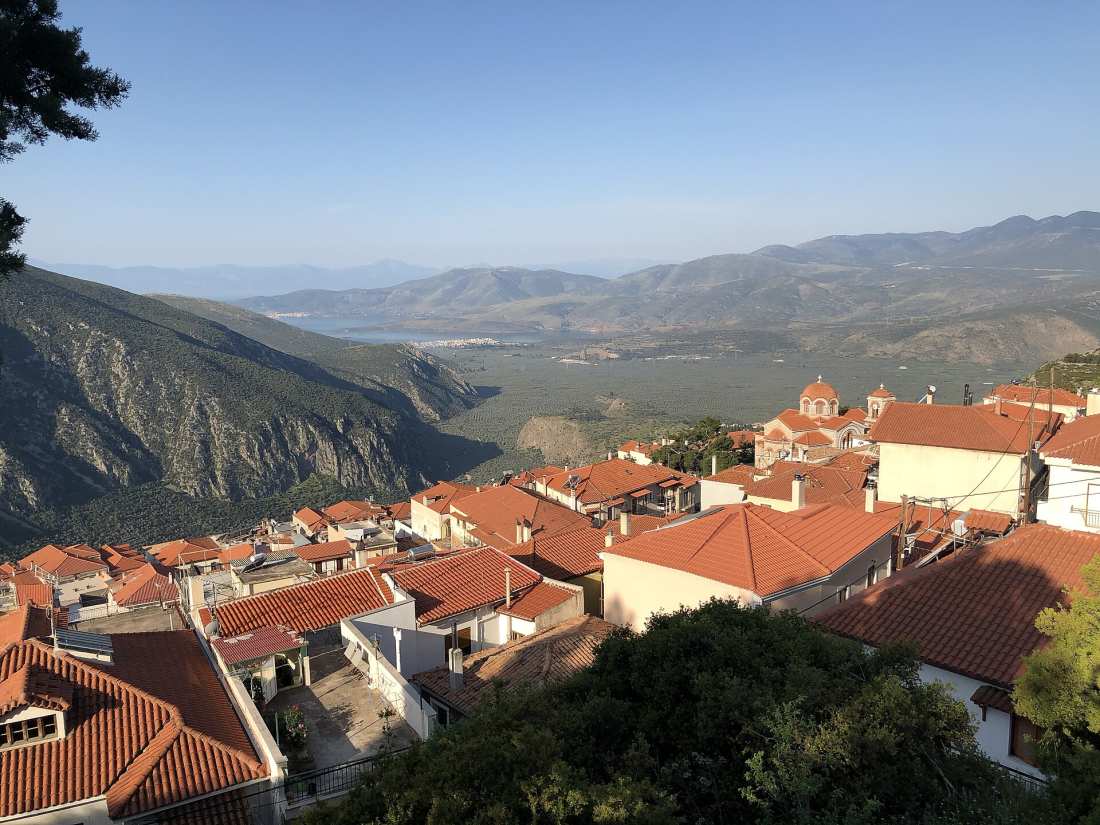
The village of Delphi is a small mountain town in central Greece, set on the steep slopes of Mount Parnassus a short walk from the famous archaeological site. Its two main streets follow the contour of the hillside, and from many of its balconies the land falls away in a sea of silver olive trees toward the town of Itea and the Gulf of Corinth. Warm, walkable and unhurried, the village serves as the natural base for anyone visiting the ancient sanctuary of Apollo, offering hotels, tavernas and long views in every direction. Many travellers reach it comfortably on a guided tour with My Greece Tours. Plan the whole trip with Greece Tours.
This page explains what the modern village is, how it came to sit where it does, and how to make the most of a stay. For the wider region, see our Delphi travel guide. The sections below cover what the village of Delphi is, why the modern village was relocated, what there is to see and do here, where the village sits and how you get there, and where visitors stay and eat.
What is the village of Delphi?
The village of Delphi is the small modern town beside the archaeological site, built on the steep flank of Mount Parnassus in central Greece. It houses the hotels, tavernas and shops that serve visitors and looks out over the olive valley toward the Gulf of Corinth.
The modern village of Delphi is a compact settlement of a few hundred residents, laid out along two roughly parallel streets that trace the mountainside. One street carries the main road through town; the other, a little lower, is lined with tavernas and guesthouses whose terraces hang over the valley. Between them run short, steep stairways that connect the levels, so a walk through the village is always a walk up or down. Stone and whitewash dominate, and geraniums spill from balconies. The scale is human and the pace is slow, which is exactly why so many travellers use it as a comfortable, characterful place to pause before or after visiting the ruins.
The village exists because of the ancient site next to it. Just to the east, along the mountain road, stands the sanctuary where pilgrims once consulted the oracle at the great Temple of Apollo at Delphi, and the modern town grew up to shelter, feed and guide the steady stream of visitors who come to see it. Nearly everything in the village points back toward that sanctuary — the road signs, the tour buses parked at the edge of town, the shop windows full of replica bronzes. Understanding why the village and the ruins sit so close together means looking at how the town came to be moved to its present terrace.
Why was the modern village of Delphi relocated?
The old village stood directly on top of the buried ancient sanctuary. To excavate the ruins, archaeologists needed the ground cleared, so the entire community was moved and rebuilt a short distance to the west on its present terrace, leaving the sacred precinct free to be uncovered.
For centuries a village called Kastri sat squarely over the ancient sanctuary of Apollo, its houses built among and on top of the marble that lay hidden beneath the soil. When a major excavation of the site was organised, the ruins lay beyond reach until crews removed the settlement above them. The solution was extraordinary in its scale: the whole village was expropriated, its residents compensated, and an entirely new town was laid out a short walk to the west, on the terrace where modern Delphi stands today. The old houses came down, the earth was cleared, and the sanctuary that had lain buried for so long began to emerge column by column.
The result is a village that is both very old in spirit and comparatively new in fabric. Its street plan and stone houses were designed together, which is why the modern town feels so tidily arranged along its two terraces. The relocation also explains the village’s greatest asset — its position. By moving just far enough west, the community left the sanctuary clear while keeping it within easy walking distance, so residents and visitors alike still live in sight of the ruins. That closeness shapes everything there is to see and do in the village today.
What is there to see and do in Delphi village?
In the village you can visit the archaeological museum, walk the short road to the ancient site, stroll the two main streets, and drink in the panoramic views over the olive valley. It also makes an easy base for tavernas, Mount Parnassus and nearby Arachova.
The headline attraction on the village’s doorstep is the Delphi Archaeological Museum, which sits at the eastern edge of town beside the entrance to the ruins. Inside are the treasures lifted from the sanctuary — the bronze Charioteer of Delphi, the twin kouros statues, carved friezes and votive offerings — arranged so that a visit to the museum and a visit to the site complement each other perfectly. A short, gentle walk along the road from the village brings you to the Sacred Way that climbs past the treasuries to the temple of Apollo, so most travellers pair the two in a single unhurried morning. Give yourself time for both; the museum makes far more sense once you have stood among the stones themselves.
Beyond the archaeology, the pleasure of the village is simply being in it. Stroll the two main streets, browse the small shops, and find a terrace where the whole olive valley opens beneath you toward Itea and the shimmer of the Gulf of Corinth — a view that turns golden at sunset. The village is also the gateway to Mount Parnassus, whose slopes rise straight behind the town and offer walking, clean mountain air and, in winter, snow. Fashionable Arachova lies a short drive east along the same ridge, adding stone-built charm and lively tavernas to a day out. Knowing exactly where the village sits helps you plan how to string these places together.
Where is Delphi village and how do you get there?
Delphi village lies in central Greece, on the southern slopes of Mount Parnassus high above the Gulf of Corinth. It is roughly a three-hour scenic drive from the capital and reachable by car or public bus, with the mountain resort of Arachova only a short distance to the east.
The village clings to the mountainside at a height that gives it cool summers and crisp, clear light, looking south over the deep olive-filled valley that runs down to the sea. The drive from the capital takes around three hours and is a pleasure in itself, threading through farmland, climbing into the folds of Mount Parnassus and finally sweeping onto the terrace where the town sits. As you approach from the east you first pass through Arachova, the handsome stone resort town on the same ridge, before the road curls the last few kilometres to Delphi. Many visitors break the journey there for coffee or lunch, making the two towns natural companions on any itinerary.
Getting to the village is straightforward. Self-drivers follow the main national road toward central Greece and then the mountain road, while regular intercity buses connect the capital directly to Delphi’s small bus stop in the heart of the village, so a car is not essential. Those who prefer not to drive the winding mountain roads often join an organised excursion, and a well-run Delphi day trip from Athens can deliver you to the ancient site and back with an expert guide and no logistics to manage. However you arrive, once you are in the village the next question is where to lay your head and where to dine.
Where do visitors stay and eat in Delphi village?
Stay in one of the village’s small family-run hotels or guesthouses, many with valley-view balconies, and eat at the tavernas along the lower street serving mountain and classic Greek dishes. Staying overnight rewards you with quiet evenings and an early, crowd-free start at the site.
Accommodation in Delphi is dominated by small, family-owned hotels and guesthouses rather than large resorts, and that is part of the charm. Many rooms face south, so you wake to that immense view of olive groves tumbling toward the Gulf of Corinth, and hosts are typically generous with breakfast, local tips and directions to the site. Because the village is compact you are never more than a few minutes’ walk from your bed to a taverna or to the road that leads to the ruins. Prices tend to be gentler than in the coastal resorts, and even in high season the mountain setting keeps evenings cool and calm — a welcome contrast to the heat of the lowlands.
For eating, the lower street is where you want to be, its terraces cantilevered over the valley so dinner comes with a sunset. Menus lean on hearty mountain cooking — slow-cooked meats, wild greens, local cheeses and honey — alongside the familiar Greek classics, all best washed down with a carafe of regional wine. The village makes a fine day trip if time is tight, but staying overnight is the real reward: the tour buses leave, the streets empty, and you can be among the first through the gates the next morning when the light is soft and the ruins are still. Plan your visit and tours through our Delphi travel guide.
What is the layout and architecture of Delphi village?
Delphi village stands on terraces cut into the steep southern slope of Mount Parnassus, a kilometre west of the ruins. Two parallel streets, Vasileon Pavlou and Frederikis, run along the contour, linked by stepped lanes and a central square.
The settlement is arranged along the hillside rather than across it. The upper street, Vasileon Pavlou, and the lower street, Frederikis, run one above the other on separate levels, connected by short flights of stone steps that drop from terrace to terrace. Between them sits the central square, Plateia, which holds the churches, the tavernas, the bus stop and the small shops that face the road to Amfissa. Houses press against the gradient in tight rows, their ground floors dug into the rock and their upper floors reaching toward the light, so that a rooftop on one street meets the pavement of the street above.
The building fabric mixes cut Parnassus stone with rendered concrete. Pitched roofs of red tile step down the slope in an ordered grid, and low stone walls hold each terrace in place. Balconies and cantilevered verandas hang off the south faces of the houses, projecting over the Pleistos ravine that falls away below the village.
- The gorge of the Pleistos river, its bed thick with silver-green olive trees.
- The olive plain of Amfissa, an unbroken sea of groves spreading toward Itea.
- The town of Itea and the northern shore of the Gulf of Corinth.
- The water of the gulf itself, with the Peloponnese mountains beyond it.
From those balconies the eye travels down the ravine, across the olive plain and out to the Gulf of Corinth in a single sweep. The orientation gives every south-facing house the same panorama, and the terraced plan means the street above never blocks the view of the street below.
What is the history of the modern village of Delphi?
Modern Delphi was founded when the old village of Kastri, which sat directly on the ancient sanctuary, was moved west to let the French School excavate the site. The relocated settlement took the name Delfoi from the sanctuary it replaced.
Kastri was a farming village built over the buried ruins, its houses standing on top of the temple terraces and its lanes crossing the Sacred Way. When the French School at Athens secured the concession to dig the sanctuary of Apollo, the entire population was resettled onto the neighbouring hillside to the west, and the old houses were cleared to open the ground beneath them. The move freed the whole terrace of the sanctuary for the excavation that uncovered the Temple of Apollo, the treasuries, the theatre and the stadium, the work now presented across the Delphi archaeological site.
The new village was laid out on its terraces and named after the oracle, carrying the ancient name Delphi forward to the living settlement. As the excavations exposed the monuments and the Delphi Archaeological Museum filled with the Charioteer, the Sphinx of Naxos and the twin kouroi, the village turned toward the visitors who came to see them. Guesthouses, tavernas and shops opened along Vasileon Pavlou and Frederikis, and Delphi grew into the base from which travellers reach both the sanctuary below and the ski slopes and trails of Parnassus above. The population lives on tourism, on the olive harvest of the plain beneath, and on the traffic that passes through on the road between Athens and the Ionian coast.
What day trips can you take from Delphi village?
Delphi village works as a base for short trips across Phocis and Boeotia: Arachova twenty minutes east, the monastery of Hosios Loukas past Distomo, the seafront at Galaxidi, the fishing port of Itea in the valley below, and the ski runs on Mount Parnassus.
- Arachova — twenty minutes east along the mountain road, a stone town on the slopes of Parnassus known for its woven rugs, its formaela cheese grilled at the tavernas, and its winter crowd.
- Hosios Loukas — the eleventh-century monastery beyond Distomo, a UNESCO World Heritage Site whose two churches hold gold-ground Byzantine mosaics and a crypt with wall paintings.
- Galaxidi — a captains’ town on the Corinthian Gulf, its harbour lined with neoclassical mansions built by shipowners and a maritime museum recording the sailing trade.
- Itea — the port directly below the village, set at the head of the gulf where the olive groves of the Amfissa plain meet the water.
- Parnassos Ski Centre — the pistes at Kelaria and Fterolakka on the upper mountain, reached through Arachova, open through the cold months.
The road east climbs to Arachova in under half an hour, and the town serves as the gateway to the ski centre higher up. Drivers reach Hosios Loukas by turning off toward Distomo and following the signed lane to the monastery gate, a route of roughly forty minutes from the village. Each of these places sits within an hour of Delphi, so a traveller bases in the village and returns to the same room at night.
Down in the valley the trips run in the opposite direction. The switchback road drops from the village to Itea on the shore, and Galaxidi lies a short distance west around the bay. Both face the Corinthian Gulf and the olive-covered slopes that carry the name “sea of olives,” a continuous grove stretching from Amfissa to the coast. The descent to the water and the climb back to the mountain village frame a single day of touring from one fixed base.
How do you plan a stay in Delphi village — seasons, festivals and practicalities?
Staying overnight in the village puts a traveller at the archaeological site gate at opening, ahead of the Athens coaches. The walk down runs about a kilometre, evenings stay cool even in summer, and buses connect the village with Athens each day.
The site sits a short distance east of the houses, and the walk from the village down to the entrance covers about a kilometre along the road. Guests who sleep in Delphi reach the Sacred Way and the museum as the gates open, and they move through the ruins before the day-trip buses arrive from Athens in the late morning. After the coaches leave in the afternoon the village returns to quiet, and the tavernas fill with people who stay the night rather than pass through.
The village sits high on the slope of Parnassus, so the evenings turn cool once the sun drops behind the mountain, even in the warm months. The shops along the main street sell local olive oil pressed in the Amfissa plain, the large green Amfissa olives, and Parnassus honey gathered on the mountain. Buses of the intercity network link Delphi with Athens and with Amfissa and Itea, so a traveller without a car reaches the village and uses it as a base for the surrounding towns.
What festivals and local life fill Delphi village?
Delphi village keeps the rhythm of a small Greek mountain community: name-day and saint’s feasts fill the churches and the square, Easter brings candlelit processions, and the tavernas turn out the olive oil, honey and grilled meats of Parnassus through the year.
The parish churches mark the calendar with their feast days, when the village gathers for the liturgy and the shared meal that follows. Easter draws the fullest observance, with the Good Friday procession of the Epitaphios through the two streets and the midnight resurrection service that lights the dark hillside with candles. Summer brings the panigyri, the open-air festival of food, wine and music that a Greek village holds on the day of its patron saint.
Daily life runs on the land and the road. Families work the olive groves of the Amfissa plain below, keep bees on the mountain for the thyme and fir honey, and run the guesthouses and tavernas that serve the visitors. The evening volta, the slow walk along the main street, fills the square once the day-trip coaches have gone, and the village settles into the quiet of a working mountain town after dark.
What is the weather and the best season to visit Delphi village?
Delphi village has a mountain Mediterranean climate: hot dry summers, mild winters with occasional snow at its altitude on Parnassus, and cool evenings year-round. Spring and autumn bring the most comfortable weather for the village and the archaeological site alike.
The village sits high enough on the slope of Parnassus that its air stays fresher than the coast and the plains. Summer days turn hot under a clear sky, yet the altitude and the mountain behind cool the evenings quickly once the sun drops. Winter carries cold nights and periodic snow, and the same weather that opens the ski centre above dusts the village roofs, while spring and autumn hold steady mild days ideal for walking the ruins.
Season shapes the visit. Spring covers the slopes and the Pleistos gorge in green and wildflowers; autumn clears the air for long views across the olive plain to the Gulf of Corinth. The shoulder seasons also thin the crowds at the sanctuary, so a stay in the village in April, May, September or October pairs the best weather with the quietest ruins.
Is Delphi village worth an overnight stay?
Delphi village rewards an overnight stay. Sleeping in the village gives a traveller the sanctuary at opening before the Athens coaches, the sunset over the olive plain and the gulf, a quiet dinner in the tavernas, and the mountain and its day trips within easy reach the next morning.
A day trip from Athens reaches the ruins in the crowded middle of the day and leaves before the light turns. An overnight reverses that: the visitor walks the Sacred Way in the cool early hours, returns to the village for the long golden evening on a balcony above the Pleistos, and eats where the day-trippers have gone. The second morning opens Arachova, the Corycian Cave, Galaxidi or the coast, all within an hour of the room. For anyone pairing the archaeological site with Mount Parnassus, the village is the base that turns a rushed stop into an unhurried stay.
Frequently Asked Questions
Is the village of Delphi worth staying in overnight?
For most travellers, yes — an overnight stay transforms the visit. The village is small and quiet once the day’s tour buses have gone, and its family-run hotels and guesthouses put you within a few minutes’ walk of both the tavernas and the road to the ancient sanctuary. The great advantage is timing: guests who sleep in the village can reach the ruins early, before the crowds and the midday heat arrive, when the light is soft and the sacred way is almost empty. Evenings bring their own reward, with terrace dinners over the olive valley and long, golden sunsets across the Gulf of Corinth. The mountain air stays cool even in high summer, prices are gentler than in the coastal resorts, and the village makes a natural base for exploring Mount Parnassus and nearby Arachova as well. If your schedule is tight a day trip still works, but a night in the village turns a quick stop into a proper experience of the place.
How far is the village from the ancient site of Delphi?
The village sits remarkably close to the ancient sanctuary — the two are essentially neighbours on the same mountain road. From the eastern edge of the village it is only a short, gentle walk of a few minutes to the museum and the entrance of the archaeological site, following the road as it curves along the slope of Mount Parnassus. This closeness is no accident: it is the direct result of the relocation that moved the old village a short distance west to let the ruins beneath it be excavated. Because everything is so compact, most visitors leave their car or coach at the edge of town and explore both the museum and the site on foot, then stroll back into the village for lunch. The proximity is one of the village’s greatest practical advantages, letting you visit the ruins in the cool of early morning and return easily whenever you like without needing to drive.
What is the best way to combine Delphi village with Arachova?
The two towns sit on the same mountain ridge only a short drive apart, which makes pairing them easy and rewarding. Arachova is a handsome stone-built resort town famous for its weaving, its cheese and its lively tavernas, and it lies just to the east of Delphi on the road toward the capital. A common approach is to base yourself in the village of Delphi for its unbeatable position beside the ancient site, then make a short excursion to Arachova for an afternoon or an evening meal, enjoying its steep streets and mountain views. Travellers arriving by car naturally pass through Arachova on the way in, so a coffee or lunch stop there fits the journey perfectly. Both towns share the slopes of Mount Parnassus, so in winter they double as gateways to the ski slopes above. Whether you stay in one and visit the other, or simply split a day between them, the short distance means you lose almost no time in transit and gain two very different mountain atmospheres.