
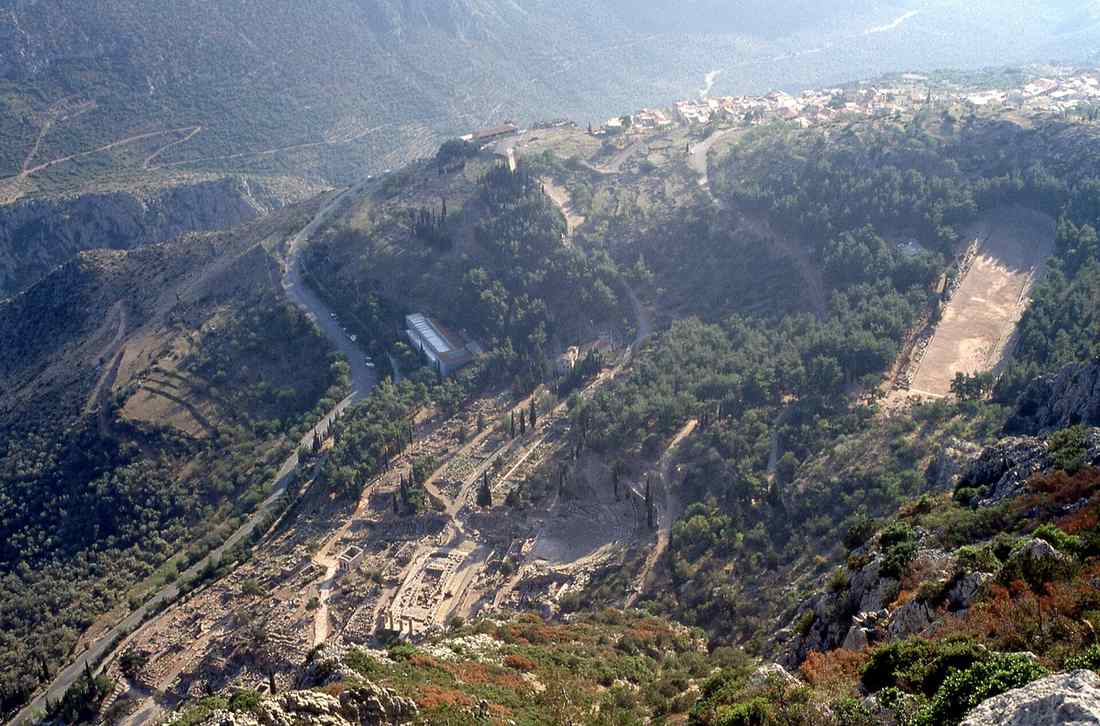
The ancient stadium of Delphi crowns the entire sanctuary, resting at the highest point of the archaeological site on the flank of Mount Parnassus. It is the best-preserved ancient stadium in Greece, a long stone arena where athletes competed in the Pythian Games held in honour of Apollo. Here you can still trace the tiered seating carved from local limestone, the narrow running track, and the stone sills that marked the starting line for the runners. Reaching it means climbing above the theatre and the temple, and the view over the valley of olive groves toward the sea rewards every step. Many travellers first meet this remarkable monument on a guided tour with My Greece Tours. Plan the whole trip with Greece Tours.
This page sits within our wider Delphi travel guide and focuses entirely on the stadium at the summit of the sanctuary. The sections below cover what the stadium of Delphi is, how it was built and what its features are, the athletic events that took place there, how it fits into the overall layout of Delphi, and how visitors reach and experience it today. Each answer is written to help you understand the monument before you climb to see it in person.
What is the ancient stadium of Delphi?
The ancient stadium of Delphi is the long stone arena at the highest point of the sanctuary, the best-preserved stadium in Greece. It hosted the running races and athletic contests of the Pythian Games, one of the four great Panhellenic festivals held in honour of Apollo.
The stadium of Delphi is a rectangular running arena set into a natural terrace at the very top of the sacred precinct, above the theatre and the Temple of Apollo. It was the venue for the athletic programme of the Pythian Games, a Panhellenic festival that drew competitors and spectators from across the Greek world. Because the site sits on the steep slope of Mount Parnassus, the builders used the mountain itself to support one long side of the seating, while the opposite side was banked up with earth and stone. This position at the summit gave the stadium a commanding sense of separation from the religious heart of the sanctuary below, marking it as the arena where mortal effort honoured the god.
What makes the stadium so valuable to visitors and scholars is its exceptional state of preservation. Unlike many ancient arenas that survive only as faint outlines, the Delphi stadium retains rows of stone seats, the clear line of its track, and the sockets of its starting mechanism. This completeness lets you read the space almost as an ancient spectator once did, imagining the crowd banked along the terraces. To understand why the arena looks the way it does, it helps to examine how it was actually built and what its main features are.
How was the stadium of Delphi built and what are its features?
The stadium has a long, narrow track of roughly 177 metres, framed by tiered stone seating that held around six and a half thousand spectators. Stone starting sills marked the runners’ line, and a monumental arched entrance led into the arena. The stone seats were a wealthy donor’s benefaction.
The running track measures roughly 177 metres in length, the standard distance for a single-length foot race in the Greek athletic world, laid out as a long and narrow rectangle. Along the northern side, tiered rows of stone seating rise against the mountain slope, while the southern side was supported by an artificial embankment. Together the terraces seated around six and a half thousand spectators, who looked down over the whole length of the course. At each end you can still see the stone sills set into the ground, grooved to give runners a firm foothold and to hold the posts of the starting gate. These practical details reveal how carefully the arena was engineered for fair and orderly competition.
The stone seats visible today were largely the gift of a generous benefactor whose wealth funded the reconstruction of the terraces in permanent limestone, replacing simpler earlier arrangements. On the northern side a small section of seating with backrests stood apart, most likely reserved for the judges and officials who presided over the contests. At the western end a monumental arched entrance, framed by piers that once carried statues, formed the ceremonial gateway through which athletes entered the arena before the crowd. This combination of durable stone seating, a measured track, and a dignified entrance shows a mature architectural tradition. With the structure understood, the next question is what athletic events actually filled this arena.
What athletic events took place at the stadium?
The stadium hosted the foot races of the Pythian Games, including the single-length stadion sprint, the two-length diaulos, and long-distance running, alongside other athletic contests. These events honoured Apollo, and victors were crowned with a wreath of laurel, the god’s sacred plant.
The athletic heart of the festival was the running programme, staged along the 177-metre track. The stadion was a single sprint down the length of the course, the diaulos doubled that distance by turning at the far end, and the dolichos was a long-distance race of many lengths that tested endurance rather than pure speed. Beyond running, the wider games included contests such as wrestling, boxing and the pentathlon, along with the musical and poetic competitions for which Delphi was uniquely famous. The full athletic and artistic calendar of the Pythian Games made the festival second in prestige only to the Olympic Games among the great Panhellenic gatherings.
Victory at Delphi carried enormous honour, and the prize itself was symbolic rather than material: a wreath of laurel cut from the sacred trees of the sanctuary, the plant most closely associated with Apollo. A champion returned home not with money but with lasting fame, often commemorated by statues and poems that celebrated the win. Because the games were held in Apollo’s honour, athletic effort here was bound tightly to worship, and the whole arena functioned as a stage where physical excellence became an offering to the god. Understanding these contests makes it easier to see how the stadium fits into the wider layout of the sacred site around it.
How does the stadium fit into the layout of Delphi?
The stadium sits at the highest point of Delphi, above the theatre and the Temple of Apollo, at the very top of the climbing Sacred Way. Visitors reach it last, after ascending through the whole sanctuary, so arriving feels like reaching the summit of the sacred mountain.
Delphi is built in ascending terraces up the steep hillside, and the visitor route follows the Sacred Way as it zigzags upward past treasuries and monuments. Above the winding path stands the Temple of Apollo, the religious core of the site, and higher still lies the theatre of Delphi, which looks out over the temple and the valley beyond. The stadium occupies the terrace above them all, so the journey through the sanctuary is quite literally a climb from the entrance to the summit. Standing beside the great Temple of Apollo at Delphi and then continuing upward, you feel the deliberate hierarchy of the layout drawing you toward the crowning arena.
This vertical arrangement was not accidental. Placing the stadium at the highest and most secluded point separated the athletic and festive world from the solemn heart of worship around the temple and oracle. The steep ascent also builds a sense of anticipation, so that reaching the level track after a long uphill walk feels like an arrival at the top of the world, with Mount Parnassus rising behind and the sea shimmering far below. The position rewards the effort of the climb with a panorama that few ancient arenas can match. Knowing where the stadium sits within the site helps you plan how to reach and experience it on your own visit.
How do visitors reach and experience the stadium today?
Visitors reach the stadium by walking uphill to the top of the archaeological site, above the theatre. The well-preserved seats and track are usually roped off but fully visible from the edge. The rewarding climb offers sweeping views, and pairs naturally with the theatre, temple and museum.
Reaching the stadium takes a steady uphill walk along the Sacred Way and beyond the theatre to the top terrace, so comfortable shoes and a little patience are worthwhile. The path is uneven in places and climbs steadily, which can feel demanding on a hot day, so carrying water and pacing yourself makes the ascent far more enjoyable. Once you arrive, the arena opens out before you with its long track, its tiers of stone seating and the remains of the arched entrance clearly on view. Many travellers include this climb as part of a Delphi day trip from Athens, arriving early to enjoy the site before the midday heat and the largest crowds.
To protect the fragile stone, the seating and track are usually roped off, but the barrier sits at the edge of the arena so the whole stadium remains fully visible and photographs beautifully. Take your time at the top to enjoy the view over the sea of olive trees toward the Gulf of Corinth, one of the finest panoramas in all of Greece. The stadium is best combined with the theatre just below it, the Temple of Apollo along the Sacred Way, and the site museum near the entrance, which together tell the complete story of the sanctuary. Plan your visit and tours through our Delphi travel guide.
What were the races and rules of the Delphic stadium?
The Delphic stadium hosted four foot races: the stadion sprint of one length, the diaulos of two lengths, the dolichos long-distance run, and the hoplitodromos in armour. Judges named agonothetai enforced the rules of the Pythian athletic programme.
The stadion covered a single length of the track and ranked as the oldest and most prestigious sprint. The diaulos doubled the distance, sending runners to a turning post and back. The dolichos multiplied the length many times over for the endurance runners, and the hoplitodromos closed the athletic slate with competitors racing in helmet and greaves, carrying a shield.
- Stadion — one length of the track, the founding sprint of the Pythian programme.
- Diaulos — two lengths, out to the turning post and back.
- Dolichos — the long-distance race over repeated lengths.
- Hoplitodromos — a race run in bronze armour with shield.
The agonothetai supervised the starting line, ruled on false starts, and imposed penalties for fouls. They answered to the Amphictyonic Council that governed the sanctuary and set the calendar of the Pythian Games, so the running events at Delphi carried the same authority as the athletic contests of Olympia and Nemea.
Who funded the stone seating and the monumental entrance?
The Athenian magnate and orator Herodes Atticus paid for the stone benches during the Roman imperial period, replacing the earlier earthen banks. A monumental arched entrance of three openings framed the western end of the running track.
Herodes Atticus ranked among the wealthiest benefactors of the Greek world in the second century AD, and his gift lined the sides of the stadium with cut limestone seating that raised the capacity to several thousand spectators. The same patron funded works at Athens, Olympia, and Corinth, and his name attaches to the stone tiers that survive on the northern slope at Delphi.
The triple-arched gateway stood at the west end and carried the spectators onto the track through three passages. Statue bases flanked the entrance, and the arches marked the formal threshold between the sacred way and the arena. The stadium sits above the theatre and the Temple of Apollo, the highest monument of the terraced site at Delphi.
What does the wine-ban inscription reveal?
An inscription carved into the stadium wall forbade carrying wine into the enclosure on penalty of a fine. The text marked the ground as consecrated to Apollo and recorded the sanctuary’s control over the conduct of athletes and spectators.
The letters cut directly into the retaining wall set the fine for anyone who brought wine past the boundary, and the payment fell due to the sanctuary treasury. The rule placed the stadium inside the sacred precinct of Apollo rather than in a secular arena, so the same religious law that governed the temple governed the running track.
The inscription joins the wider epigraphic record of Delphi that lists victors, sets contest regulations, and fixes the duties of officials. It confirms three facts about the stadium:
- The track lay within consecrated ground dedicated to Apollo.
- The Amphictyony fined violators and collected the sum for the sanctuary.
- The athletic events formed part of the religious festival, not a separate secular meeting.
How does the Delphic stadium compare with the stadium at Olympia?
The stadium at Olympia sits on flat ground beside the sanctuary of Zeus, while the Delphic stadium was cut into the steep upper terrace of Mount Parnassus. Olympia held the Olympic Games; Delphi held the Pythian Games, the second contest of the Panhellenic circuit.
Olympia’s track ran about 192 metres between its stone sills, the length that fixed the Greek stadion as a unit, and earth banks carried its crowd. The Delphic track measures roughly 177 metres and threads a narrow shelf high on Mount Parnassus, so its builders raised stone seating on the north side and buttressed the south to hold the run level against the slope.
The two stadiums shared the same programme of foot races and the same religious frame, each set inside a sacred precinct and governed by the officials of its games. The Pythian Games ranked directly below the Olympics in prestige, and a victory on either track carried a champion’s name across the Greek world.
Frequently Asked Questions
Why is the stadium of Delphi so well preserved?
The stadium of Delphi is the best-preserved ancient stadium in Greece largely because of its remote position at the top of the sanctuary on the slope of Mount Parnassus. Its location high above the temple meant it was less disturbed by later building, quarrying and reuse than monuments closer to the settlement below. The seating was cut and laid in durable local limestone, funded by a wealthy benefactor, and stone survives far better than the earthen banks used in many earlier arenas. Because the arena was carved into a natural terrace and shielded by the mountain, the rows of seats, the line of the track and the sockets of the starting sills have endured remarkably intact. Careful excavation and conservation have since stabilised the structure without over-restoring it, so what visitors see today is genuinely ancient stonework rather than heavy reconstruction. All of this combines to let you read the space almost exactly as an ancient spectator once did.
How long is the track at the stadium of Delphi?
The running track at the stadium of Delphi is roughly 177 metres long, laid out as a long, narrow rectangle between the two lines of starting sills. This distance corresponds to the classic length of the stadion, the single-length sprint that gave both the race and the arena their name across the Greek world. The exact length of a stadion varied slightly from one sanctuary to another, since it was traditionally reckoned in units related to the human foot, so the Delphi track differs a little from those at Olympia and elsewhere. Along this course athletes ran the single-length stadion, the double-length diaulos that turned at the far end, and the long-distance dolichos of many lengths. Stone sills set into the ground at each end are still clearly visible, grooved to give runners a firm foothold at the start. Standing at one end today, you can look straight down the full length of the ancient course.
Is the stadium worth the climb on a visit to Delphi?
For most visitors the stadium is well worth the extra climb to the top of the sanctuary. The ascent above the theatre is steady and can feel tiring on a hot day, but the reward is the best-preserved ancient stadium in Greece, complete with its stone seating, its measured track and the remains of its arched entrance. Reaching the highest terrace also delivers one of the most sweeping views on the whole site, out over the valley of olive trees toward the Gulf of Corinth, with Mount Parnassus rising behind you. Because the arena is usually roped off to protect the fragile stone, you view it from the edge rather than walking on the track, yet the entire space remains clearly visible and photographs beautifully. If you have the time and reasonable mobility, the walk gives a sense of completeness to the visit, letting you experience the sanctuary exactly as it was meant to be climbed, from the entrance all the way to the summit.