
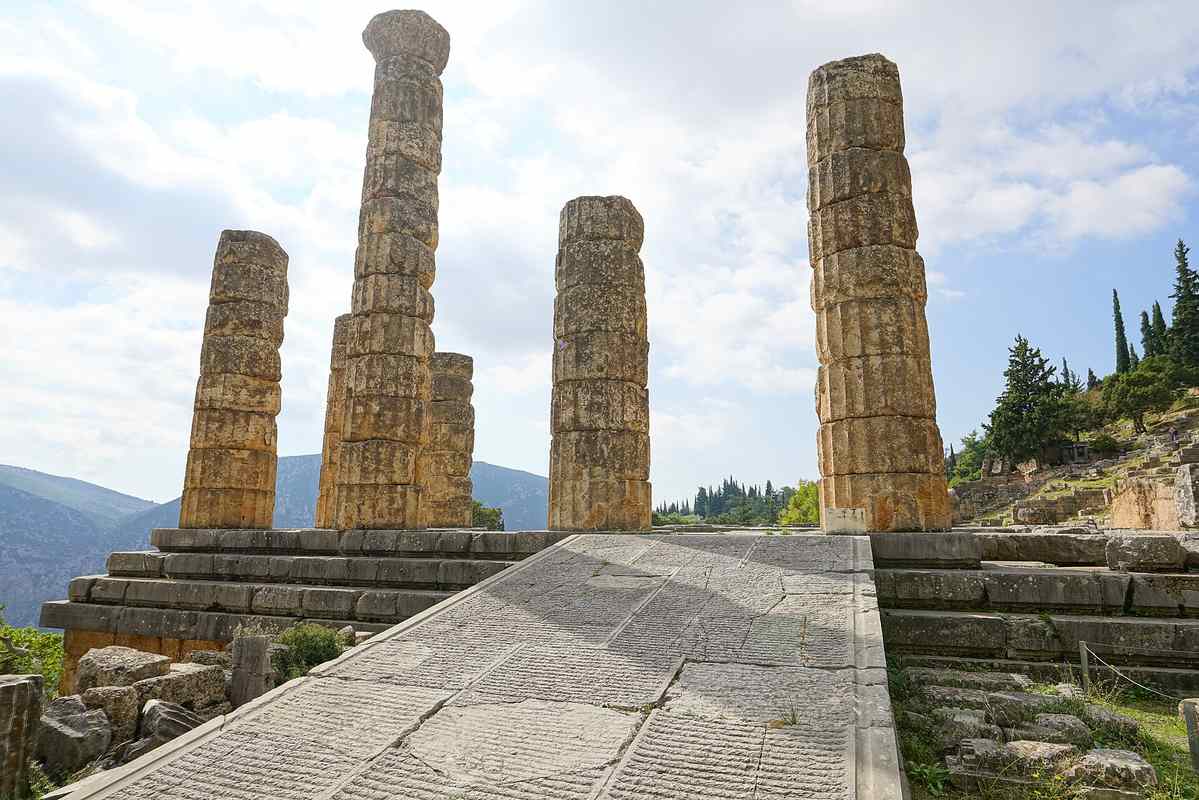
High on the slopes of Mount Parnassus, the Temple of Apollo at Delphi stood as the spiritual heart of the ancient Greek world. This great Doric temple housed the oracle, where the priestess known as the Pythia delivered the prophecies of the god Apollo to kings, cities, and ordinary pilgrims alike. For centuries people climbed the Sacred Way to reach it, seeking guidance on war, colonization, marriage, and fate. Though only its foundations and a row of re-erected columns survive today, the temple remains one of the most evocative ruins in Greece, framed by olive valleys and towering cliffs. You can walk this sanctuary in person on a guided tour with My Greece Tours. Plan the whole trip with Greece Tours.
Delphi rewards travelers who understand what they are seeing, and our Delphi travel guide puts the whole sanctuary in context before you arrive. The sections below cover what the Temple of Apollo was, how it was built and rebuilt over time, what stood inside it and within the adyton, what ultimately happened to it, and how visitors experience its ruins along the Sacred Way today.
What was the Temple of Apollo at Delphi?
The Temple of Apollo at Delphi was the central sanctuary building of ancient Delphi and the home of the famous oracle. Dedicated to the god Apollo, it housed the Pythia, whose prophecies made Delphi the most important religious center in the Greek world.
The Temple of Apollo was the beating heart of the entire Delphic sanctuary, the destination toward which every pilgrim, envoy, and ruler ultimately climbed. Greeks believed that Delphi marked the center of the world, and the temple was the place where mortals heard the will of Apollo himself. The god was worshipped here as the bringer of light, music, healing, and prophecy, and his presence was thought to fill the building during the months he resided at Delphi. Its authority reached across the Mediterranean, from mainland cities to distant colonies, all of whom sent gifts, treasuries, and questions to this single mountainside shrine.
What set the temple apart was the oracle it sheltered. Inside sat the Pythia, the priestess who spoke for the god, and the answers she gave shaped decisions of enormous consequence. The Oracle of Delphi guided colonists to new lands, counseled generals before battle, and settled disputes between rival states, lending the sanctuary a political weight no other temple matched. Wealth flowed in as thanks, and the surrounding grounds filled with monuments celebrating victories credited to Apollo’s advice. To understand the temple, then, is to understand a building that was as much a center of power as of worship, and the next section looks at how it was built and rebuilt.
How was the Temple of Apollo built and rebuilt over time?
The temple was rebuilt several times across antiquity. An early archaic temple burned down, was replaced by a grand structure funded partly by the Alcmaeonid family, and after damage was rebuilt again as the fourth-century-BC Doric temple whose columns visitors see today.
Delphi’s sacred building went through many lives. Tradition told of humble early shrines, and the first substantial stone temple rose in the archaic age, only to be consumed by fire. Its replacement was a magnificent Doric structure, and famously the exiled Athenian Alcmaeonid family helped finance a splendid marble facade, winning goodwill that served them well back home. That temple eventually suffered severe damage, and the Delphians raised funds from across the Greek world to build once more. The temple standing on the terrace today belongs to this later reconstruction of the fourth century BC, faithful in plan to its predecessors and set upon the same commanding platform above the valley.
Architecturally it was a classic Doric peripteral temple, its colonnade running six columns across the ends and fifteen along each flank, enclosing the inner chambers. The builders worked largely in local tufa and poros limestone, materials quarried from the region and often coated in fine stucco to imitate gleaming marble. Ramps and terracing anchored the huge structure to the steep hillside, an engineering feat in itself given the unstable, earthquake-prone ground of Parnassus. Sculpted pediments crowned its gables, and inscriptions and dedications covered its walls. Solid, imposing, and rebuilt with the pooled wealth of many cities, the temple was a shell built to shelter something far stranger, and the next section explores what lay inside and within the adyton.
What was inside the temple and the adyton?
Inside stood a cult statue of Apollo, an ever-burning sacred flame, and dedications, while the innermost adyton held the Pythia. There she sat on a tripod above a chasm beside the omphalos stone, entering a trance to deliver the god’s prophecies.
Beyond the outer colonnade lay the temple’s inner rooms, growing more sacred as one moved deeper. The main hall held a statue of Apollo and an altar with an eternal flame that was never allowed to go out, tended as a symbol of the god’s undying presence. Around it were treasures, offerings, and words of wisdom, for tradition held that maxims were inscribed near the entrance, most famously ‘know thyself’ and ‘nothing in excess.’ These short sayings distilled Greek ideals of self-awareness and moderation, greeting every visitor as a reminder that even at the seat of prophecy, human limits mattered as much as divine knowledge.
The most mysterious space was the adyton, the innermost sanctum forbidden to ordinary visitors. Here the Pythia took her place on a tripod set above a cleft in the rock, from which vapors were said to rise, and beside her stood the omphalos, a carved stone marking the navel of the world. Breathing the fumes and holding sprigs of laurel sacred to Apollo, she fell into a trance and spoke the god’s answers, which attendant priests shaped into replies for those who had come to ask. Whether a real chasm existed has long been debated, but its aura was undeniable, and the next section turns to what eventually became of this sanctuary.
What happened to the Temple of Apollo?
The temple declined as Delphi lost influence, was plundered for its riches in Roman times, and finally fell silent when pagan sanctuaries were closed in late antiquity. Earthquakes and rockfalls ruined it further, until modern excavations uncovered the remains seen today.
The temple’s long decline mirrored the shifting fortunes of the ancient world. As new powers rose and old rivalries faded, Delphi lost some of the political urgency that had made its oracle indispensable. Roman conquest brought both admiration and loss, for generals and emperors carried off statues and treasures to adorn distant cities, stripping the sanctuary of much of its accumulated wealth. Some rulers restored and honored it, but the trend was downward, and the once-crowded terraces grew quieter. Many travelers who come here first arrive on a Delphi day trip from Athens, retracing a route pilgrims once walked when the oracle still spoke.
The decisive blow came when the sanctuaries of the old gods were officially closed in late antiquity, ending the oracle for good and leaving the temple abandoned. Over the following centuries the unstable slopes of Parnassus did the rest, as earthquakes and rockfalls toppled columns and buried foundations under debris and soil. A village eventually grew over the ruins, hiding them almost completely. Only when systematic excavation cleared the site in the modern era did the temple’s platform, scattered blocks, and surviving columns come back to light, allowing the sanctuary’s plan to be understood again. The next section describes how visitors experience these remains today.
How do visitors see the Temple of Apollo today?
Visitors reach the temple by climbing the Sacred Way past the treasuries to its terrace, where re-erected Doric columns and the foundation platform survive above the olive valley. Most pair the ruins with the site museum for a fuller picture of ancient Delphi.
Seeing the temple today means walking the same processional route the ancients used. From the entrance the Sacred Way zigzags uphill, lined with the bases of monuments and the remains of treasuries once built by grateful cities to store their offerings. As you climb, the valley falls away below in a sea of silver-green olive trees stretching toward the distant gulf, while the great cliffs of Parnassus rise sharply behind. The path finally opens onto the broad terrace of the temple itself, where a row of standing Doric columns and the massive stone platform convey the scale of the building that once dominated this dramatic mountain shelf.
To make sense of what survives, most visitors pair the ruins with the nearby collection at the Delphi Archaeological Museum, where sculptures, offerings, and the famous bronze charioteer help reconstruct the sanctuary in its glory. Comfortable shoes are essential, since the ground is uneven and steep, and early or late visits reward you with softer light and thinner crowds. Allow at least a couple of hours to take in the temple, the theatre of Delphi, and the Delphi stadium above. Plan your visit and tours through our Delphi travel guide.
What did the Doric architecture of the Temple of Apollo look like?
The Temple of Apollo stood in the Doric order as a peripteral building, six columns across each end and fifteen along each flank, its peristyle wrapping a limestone core faced with Parian marble on the east front, measuring roughly 60 by 24 metres.
The hexastyle facade set six fluted Doric columns above a three-stepped crepidoma, and the flanks carried fifteen columns each, enclosing the cella in a continuous colonnade. Above the columns ran the entablature: a plain architrave, then a Doric frieze that alternated triglyphs with carved metopes, crowned by the horizontal and raking cornices that framed the pediments. An east ramp climbed from the terrace of the Delphi sanctuary to the temple platform, guiding the procession toward the front porch.
The building broke into distinct materials by zone:
- a foundation and core of local limestone quarried near the sanctuary;
- a Parian marble east facade that faced arriving pilgrims;
- fluted Doric columns with plain echinus-and-abacus capitals;
- an entablature of architrave, triglyph-and-metope frieze, and cornice;
- two gabled pediments over the east and west porches.
The proportions followed the mature Doric canon of the classical sanctuary: a low, wide stance, columns thickened at the base and tapering upward with entasis, and a rhythm of solid and void that carried the eye along the fifteen-column flank toward the omphalos precinct within.
Why did the Alcmaeonids rebuild the temple in Parian marble?
The Alcmaeonids, an aristocratic Athenian clan exiled by the Peisistratid tyrants, held the contract to rebuild the burned temple in limestone, then faced the east front in costly Parian marble at their own expense, winning gratitude at Delphi that hardened into political capital back in Athens.
Herodotus records that the Amphictyonic League let the rebuilding contract for a temple of poros limestone after fire destroyed the earlier structure. The Alcmaeonids, living in exile, took the commission and delivered more than the terms required, substituting gleaming Parian marble for limestone across the whole eastern facade. The gift announced the clan’s wealth and piety to every state that consulted the oracle.
The return on that generosity was concrete:
- the priesthood at Delphi favoured the clan in the words it gave to petitioners;
- the oracle pressed Sparta to expel the Peisistratids from Athens;
- the Alcmaeonids returned from exile as the tyranny fell;
- Cleisthenes of the clan went on to found the democratic reforms of Athens.
Herodotus states plainly that the Pythia urged every Spartan who came to consult her to free Athens, and that the Alcmaeonid marble facade lay behind that pressure. The rebuilt temple thus tied the fortunes of an Athenian house to the most authoritative religious voice in Greece, converting stone and marble into influence over the politics of a rival power.
What did the pediments and sculptures of the temple show?
The east pediment presented Apollo arriving at Delphi in a four-horse chariot flanked by Leto, Artemis and the Muses; the west pediment showed Dionysus among the Thyiad women; Athenian sculptors carved both, and acroteria crowned the gable peaks and corners.
Pausanias names the sculptors Praxias, a pupil of the Athenian Kalamis, and Androsthenes of Athens as the makers of the pedimental groups. The eastern gable, facing the rising sun and the incoming procession, framed Apollo’s epiphany in his chariot, the god of prophecy taking possession of his sanctuary. The western gable turned to Dionysus, the deity who held Delphi through the winter months while Apollo was absent among the Hyperboreans, surrounded by the dancing Thyiades.
The sculptural programme divided the year and the divine roster across the two ends:
- east: Apollo in his chariot with the Muses, Leto and Artemis;
- west: Dionysus with the Thyiades and the mysteries of the winter oracle;
- metopes and akroteria completing the roofline and gable corners;
- marble figures cut by named Athenian workshops.
Fragments recovered from the pediments now sit under the roof of the Delphi Archaeological Museum, where the surviving heads and torsos let visitors read the carving at close range. The pairing of Apollo and Dionysus on one temple declared the double rhythm of the cult: prophecy in the bright half of the year, ecstatic rite in the dark half.
What were the Delphic maxims inscribed on the temple?
The forecourt of the temple carried the Delphic maxims cut into the stone: “Know thyself”, “Nothing in excess”, and “Surety brings ruin”. Ancient tradition credited the Seven Sages of Greece with these sayings, and a mysterious letter E hung at Delphi that Plutarch tried to explain.
The three commands compressed the ethic of the sanctuary into a handful of words. “Know thyself” turned the pilgrim’s gaze inward before questioning the god; “Nothing in excess” set the Greek measure against pride and appetite; “Surety brings ruin” warned against standing pledge for another’s debt.
Ancient writers attributed the maxims to the Seven Sages, the archaic figures who set the tone of practical wisdom:
- Thales of Miletus;
- Solon of Athens;
- Chilon of Sparta;
- Pittacus of Mytilene;
- Bias of Priene;
- Cleobulus of Lindos;
- Periander of Corinth.
Alongside the maxims stood the enigma of the letter E, an epsilon fixed on the temple. Plutarch, a priest at Delphi, devoted an essay titled “On the E at Delphi” to the puzzle, running through the theory that E stood for the number five, for the conditional “if” of consultation, and for the Greek “thou art” addressed to the god. The sanctuary thus taught by inscription as well as by oracle, pressing self-knowledge and restraint on everyone who climbed the ramp.
How did the temple work as the seat of the oracle?
Inside the temple the priestess descended to the adyton, a sunken chamber below the main floor holding the omphalos stone and a bronze tripod; there the Pythia sat over a cleft, chewed laurel and drank spring water, and priests turned her utterances into hexameter verse.
The adyton sat at the western end of the cella, set below floor level so that petitioners looked down toward the sacred space. The omphalos, the carved stone that marked Delphi as the navel of the earth, stood in this precinct beside the tripod on which the Pythia took her seat. The full workings of the prophetic rite belong to the account of the Oracle of Delphi, but the temple’s plan made the mechanism physical.
The elements of the consultation gathered in the adyton:
- the omphalos, the navel-stone of the world;
- the tripod on which the Pythia sat;
- laurel leaves sacred to Apollo;
- water drawn from the Kassotis spring;
- the pneuma, a vapour rising from a cleft in the rock.
Ancient authors describe a pneuma, an exhalation from the earth, that put the Pythia into her prophetic state. Attendant priests received her words and cast them into dactylic hexameter, the metre of Homeric verse, before handing the response to the waiting consultant. The temple therefore housed a chain of transmission that ran from the earth, through the priestess, to formal poetry.
Which famous consultations took place at the Temple of Apollo?
Croesus of Lydia heard that a great empire would fall and destroyed his own; Athens received the “wooden walls” answer before Salamis; the god named Socrates the wisest of men; and colonists from across Greece sought Delphi’s sanction before founding new cities.
Herodotus records that Croesus, king of Lydia, asked whether to march against Persia and heard that in crossing the river Halys he would destroy a great empire. He read the promise as victory, attacked, and brought down his own realm instead. The answer became the archetype of Delphic ambiguity.
The temple’s most consequential response reached Athens on the eve of the Persian invasion:
- the Pythia told Athens that the “wooden walls” alone would stand;
- Themistocles read the wooden walls as the fleet;
- the Athenians met the Persians at sea and won at Salamis.
Plato reports through the Apology that Chaerephon asked the oracle whether any man was wiser than Socrates, and the Pythia answered that none was. Socrates spent his life testing that verdict. Beyond individuals, cities sent envoys before planting colonies: the founders of Cyrene in Libya acted on Delphic instruction, and the sanctuary’s endorsement travelled with settlers down the Sacred Way and out across the Mediterranean.
How did archaeologists uncover and re-erect the temple?
The French School at Athens ran the Great Excavation at Delphi, purchasing and clearing the village of Kastri that sat over the ruins, then conducting an anastylosis that raised six Doric columns on the south flank atop the surviving foundations and polygonal terrace wall.
The modern hamlet of Kastri covered the sanctuary until the residents relocated to a new settlement nearby, freeing the slope for systematic digging. The French archaeologists stripped centuries of soil and rubble from the terraces, exposing the temple platform, the treasuries and the theatre above them. The dig also lifted the bronze Charioteer of Delphi from the debris north of the temple.
The work left three phases visible on the ground today:
- the deep limestone foundations that carried the peristyle;
- the polygonal terrace wall that retained the temple platform;
- the six re-erected columns of the south flank, rebuilt by anastylosis from fallen drums.
Anastylosis restores a monument from its own scattered members, matching each column drum to its neighbour so that the standing colonnade uses ancient stone rather than replacement blocks. The six columns now anchor the eye on the south side, marking the scale of the vanished building. Inscribed base blocks, statue plinths and the retaining masonry along the terrace complete the record that the excavators recovered from beneath the old village.
What were the legendary earlier temples of Apollo at Delphi?
Pausanias records four temples that stood before the historical one: a hut woven from laurel branches carried from the vale of Tempe, a structure of beeswax and feathers, a bronze temple, and a first stone temple raised by the architects Trophonios and Agamedes.
The Greek tradition treated each temple as a stage in the sanctuary’s growth from a woodland cult site into a monumental precinct. The sequence runs:
- The laurel hut, built from branches brought down from the valley of Tempe in Thessaly, the plant sacred to Apollo.
- The temple of beeswax and feathers, which Apollo sent northward to the land of the Hyperboreans.
- The bronze temple, the work of Hephaestus in one telling, later swallowed by the earth.
- The first stone temple, credited to the legendary builders Trophonios and Agamedes.
The Homeric Hymn to Apollo gives the god himself the act of laying out the foundations, with the brothers Trophonios and Agamedes setting the stone course above them. Trophonios went on to receive his own oracular cult at Lebadeia in Boeotia, which tied the two Boeotian architects to prophecy as well as to construction. The four temples form a mythic prologue that the Greeks placed directly beneath the Doric building visitors read on the terrace.
How did the Romans treat the Temple of Apollo?
Rome plundered and patronised Delphi in turn. Sulla seized temple treasures to pay his legions, Nero carried off hundreds of bronze statues, Domitian financed a restoration recorded on the building itself, and Hadrian consulted the oracle and renewed its endowments.
The Roman record at Delphi divides between commanders who stripped the sanctuary for war and emperors who rebuilt and honoured it:
- Sulla removed treasures from the temple to fund his army during the campaigns against Mithridates.
- Nero, according to Pausanias, took five hundred bronze statues away from the precinct.
- Domitian paid for a restoration of the temple, a work commemorated in a surviving inscription on the structure.
- Hadrian consulted the oracle in person and confirmed the sanctuary’s privileges and revenues.
Imperial interest kept the oracle answering long after the Greek city-states that founded its fame had lost their power. The emperors who endowed Delphi treated it as a monument of Hellenic culture worth preserving, and their gifts sat beside the older Greek dedications on the sacred way. The temple that Domitian repaired is the same Alcmaeonid-era plan that stands today, which fixes the Roman phase as maintenance of an existing building rather than a fresh design.
What treasures and dedications were kept at the temple?
The temple held the golden tripod of Apollo and the offerings of Croesus, king of Lydia — gold and silver mixing bowls and a golden lion — while the sacred hearth kept an eternal flame burning at the heart of the sanctuary.
Herodotus lists the gifts that Croesus sent to Delphi before his war with Persia, and they set the standard for the wealth that accumulated inside and around the temple:
- A golden mixing bowl and a matching silver bowl, the silver one the work of Theodoros of Samos.
- A golden lion that stood on a stack of gold and white ingots.
- Gold and silver vessels, along with the jewellery and belts of his queen.
The golden tripod of Apollo stood as the emblem of the oracle itself, the seat on which the Pythia delivered the god’s responses. The eternal flame on the sacred hearth burned with laurel wood and never went out, tended as the living presence of the god within his house. The concentration of gold, silver and bronze turned Delphi into a treasury for the whole Greek world, and that same store of wealth marked the sanctuary as a target for Sulla, for the Phocians in the Sacred War, and for the raiders who followed.
How is the Temple of Apollo set into the Delphi landscape?
The temple stands on a levelled terrace on the south slope of Mount Parnassus, directly below the twin Phaedriades cliffs and above the deep gorge of the Pleistos river, its platform oriented along the contour of the mountain so the facade faces the valley.
The setting fixes the temple as the central node of a sanctuary that climbs the hillside. The sacred way winds up past the treasuries to reach the temple terrace, and above it the ground continues to rise. The theatre of Delphi sits immediately uphill, giving spectators a view straight down over the temple roofline to the gorge, and the stadium lies higher still on the topmost bench of the site.
Water and rock frame the terrace. The Castalian spring flows from the cleft between the two Phaedriades a short walk east, and pilgrims washed there before approaching the god. The grey limestone of the cliffs reflects the light onto the temple platform, and the drop into the Pleistos valley opens the view toward the olive plain and the Gulf of Corinth. The Greeks called Delphi the navel of the earth, and the temple’s terrace holds the point they marked with the omphalos stone.
How does the Temple of Apollo compare with other great Apollo temples?
Delphi’s Doric temple ranks as the senior sanctuary of Apollo, older in prestige than the mountain Doric temple of Apollo Epicurius at Bassae and grander in oracular authority than the vast Ionic temple of Apollo at Didyma in Asia Minor.
The three buildings mark out the range of Apollo’s architecture across the Greek world. The Temple of Apollo Epicurius at Bassae in Arcadia, the work attributed to Iktinos, hides an early Corinthian column and a continuous Ionic frieze inside a Doric shell high in the mountains. Didyma near Miletus rises as one of the largest temples the Greeks ever attempted, a forest of tall Ionic columns enclosing an open court with its own oracle of Apollo.
Against these, Delphi holds the first rank on grounds beyond size. It carried the Pythia and the tripod, the maxims of the sages, and the omphalos that fixed it as the centre of the earth. City-states across the Mediterranean sent embassies and treasuries here before founding colonies, which gave Delphi a reach no rival oracle matched. The building itself is a clean Doric hexastyle temple, plainer than Didyma and simpler than the interior at Bassae, and its authority rests on the oracle it housed rather than on architectural experiment.
What is the best way to experience the temple ruins on a visit?
Enter from the lower gate, climb the sacred way to the temple terrace, and stand at the east front where the six re-erected Doric columns rise. From there the full ground plan reads clearly, with the ramp, the pronaos and the line of the cella laid out on the platform.
Arrive early. Morning light strikes the terrace from the east and rakes across the column drums and the foundation blocks, and the air on the slope stays cool before the sun crosses the Phaedriades. The climb from the entrance to the temple gains height in a short distance, so allow unhurried time on the sacred way to read the treasury foundations and the inscribed base blocks on the way up.
Pair the ruins with the collection at the Delphi Archaeological Museum at the site entrance, where the surviving pediment sculptures, the metopes and the great bronze charioteer stand under cover. Reading the fragments in the museum and then tracing their original positions on the temple terrace joins the two halves of the monument. Walk on up to the theatre for the plan seen from above, and the temple, the gorge and the mountain resolve into a single frame.
What can you still read on the stones of the temple today?
The temple terrace and its retaining wall carry inscriptions cut into the stone: dedications by victorious cities, the accounts of the sanctuary’s rebuilding, and lists of the officials who governed Delphi, turning the ruin into a written archive of the ancient sanctuary.
The polygonal wall that retains the temple platform holds the densest concentration of carved text on the site. Its irregular limestone blocks were inscribed over generations with records of freed slaves dedicated to Apollo, each act of manumission registered as a contract under the god’s protection. Around the terrace, statue bases and offering plinths keep the names of the cities and individuals who set bronze and marble before the temple.
The building accounts survive as well, the ledgers that record the cost of the columns, the marble and the labour of the rebuilding, naming the contractors and the sums paid. Read together, the inscriptions on the temple terrace document the finance, the law and the politics of the sanctuary in the words the ancient Greeks cut for themselves.
Frequently Asked Questions
Can you still see the Temple of Apollo at Delphi?
Yes, the Temple of Apollo is one of the highlights of a visit to the Delphi archaeological site, though it survives as a ruin rather than a complete building. What remains is the great stone platform on which the temple stood and a partial row of re-erected Doric columns that give a strong sense of its original scale and commanding position. Scattered architectural blocks lie around the terrace, and information panels help explain the layout. To reach it, visitors follow the Sacred Way uphill from the site entrance, passing the treasuries and monuments along the route. The temple occupies a magnificent setting on a natural shelf of Mount Parnassus, looking out over a vast valley of olive trees. Standing among the columns, with the cliffs rising behind and the landscape spread below, remains a genuinely memorable experience even though the roof, walls, and cult interior are long gone.
What were the maxims written on the Temple of Apollo?
The Temple of Apollo was famously associated with short moral maxims said to have been inscribed at its entrance, the best known being ‘know thyself’ and ‘nothing in excess.’ These sayings captured central ideals of Greek thought: self-knowledge, humility before the gods, and moderation in all things. ‘Know thyself’ urged visitors to understand their own nature and their limits as mortals, a fitting reminder at a place where people came seeking to learn their fate. ‘Nothing in excess’ warned against arrogance and extremes of every kind, from ambition to indulgence. Ancient tradition linked these and other sayings to the legendary Seven Sages of Greece, wise figures whose wisdom was thought to be enshrined at the sanctuary. Together the maxims gave Delphi a philosophical dimension beyond prophecy, framing the oracle not only as a source of answers but as a place that taught pilgrims how to live wisely and within their bounds.
Why was the Temple of Apollo at Delphi so important?
The Temple of Apollo mattered because it housed the most influential oracle in the ancient Greek world, giving Delphi religious and political authority that reached far beyond its remote mountainside. People believed the site marked the center of the earth, and the god Apollo was thought to speak there through the Pythia, his priestess. Because her prophecies were consulted before founding colonies, waging wars, and making major decisions of state, the temple became a place where the fate of cities was effectively debated and decided. Rulers and communities sent lavish gifts, built treasuries, and erected monuments to win favor and display their piety, filling the sanctuary with wealth and art. This concentration of faith, prestige, and diplomacy made the Temple of Apollo a unifying point for the often-fractured Greek world. Even now, its ruins symbolize the ancient search for guidance and the enduring cultural importance of Delphi.