
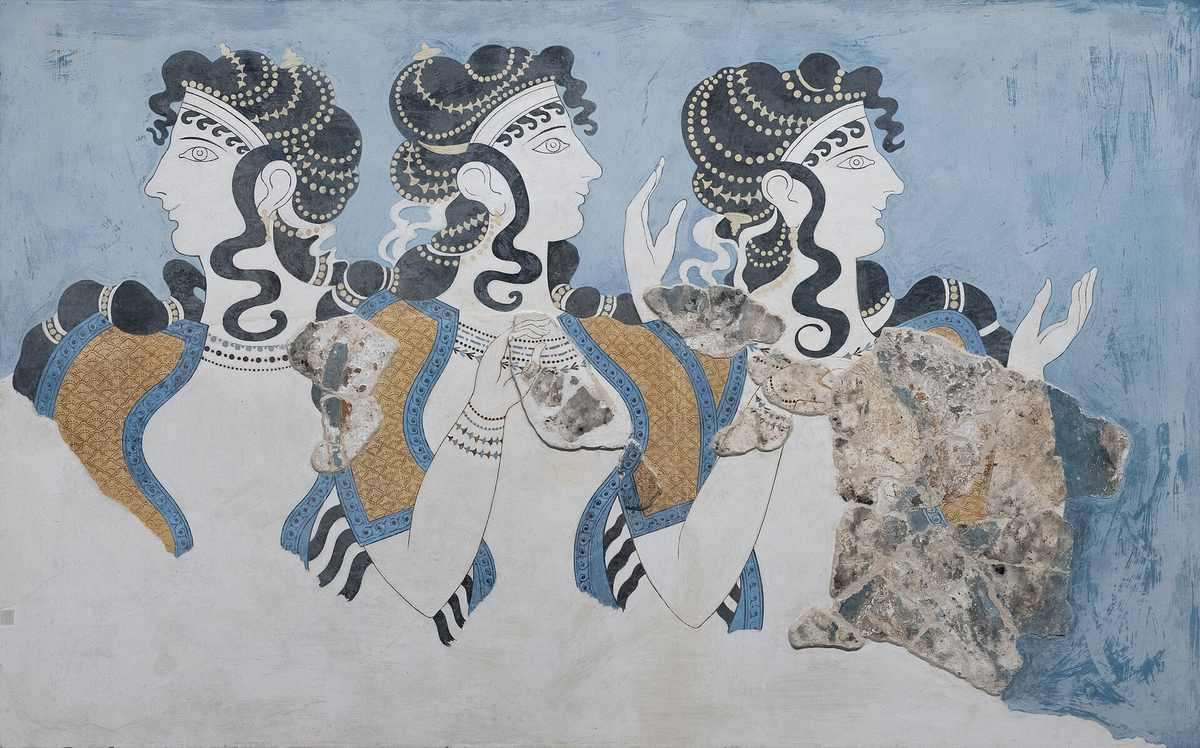
Minoan women held a strikingly prominent place in Minoan society, central to religion and vividly depicted in the frescoes of Knossos. Plan tickets and tours through My Greece Tours.
The status of women is a fascinating aspect of the world of the Palace of Knossos. The sections below cover the prominence of Minoan women, their role in religion, their depiction in art, their dress, daily life and what we know of their status.
What role did Minoan women play in society?
Minoan women appear to have held a prominent and respected place in society, far more visible than in many ancient cultures. They feature centrally in art and religion, often in the foreground of ceremony and public life, which sets the Minoans apart from their contemporaries.
One of the most striking aspects of Minoan civilisation is the prominent place that women seem to have held in society, far more visible and apparently respected than in many other ancient cultures of the time. This impression comes mainly from Minoan art and religion, where women feature centrally and conspicuously, often taking the foreground in scenes of ceremony, ritual and public life.
The prominence of women, together with the apparent centrality of a powerful goddess, has led some scholars to suggest that Minoan society was matriarchal or strongly goddess-centred. On that reading, women held significant religious and perhaps social authority. The exact extent of their power stays debated, and is hard to determine without written records, but their visibility in the surviving evidence is undeniable.
The contrast with neighbouring cultures makes the point sharply. In Egypt and the Near East, royal and divine men usually dominate the surviving art, while ordinary women appear at the margins. Minoan Crete reverses that balance, placing elegant, active women at the centre of its frescoes and shrines, which is why their apparent standing sets the civilisation apart. Our guide to Minoan religion covers the goddess who anchored their faith.
A note of caution belongs here. All of this evidence is visual and archaeological rather than written, so it shows how the Minoans chose to present women, not necessarily the full legal or economic reality of their lives. Even so, the consistent choice to feature women so centrally, across centuries and many sites, is itself significant, and marks a culture unusually comfortable placing the feminine at the heart of its public image.
What was the role of Minoan women in religion?
Minoan women appear central to religion, which seems to have focused on a powerful goddess and to have been served by priestesses. Female figures dominate religious art, and the snake goddess figurines from Knossos embody this deep tie between women and the sacred.
The role of women in Minoan religion appears to have been central, and it is the strongest evidence for their prominence. Minoan religion seems to have focused on one or more powerful female deities, the Minoan goddess or mother goddess, linked to nature and fertility. Female figures dominate religious art far more than male ones, pointing to a faith in which the feminine was paramount.
The famous faience snake goddess figurines from Knossos, whether they depict a deity or a priestess, embody this association of religious power with women, while frescoes show women apparently leading or presiding over ceremonies and rituals. This points to priestesses holding important religious roles and to women being closely tied to the sacred in Minoan culture.
The settings of that worship reinforce the pattern. Peak sanctuaries on mountaintops, cave shrines and household altars all yield female figurines and offerings, and scenes of women gathering flowers, dancing or raising their arms in adoration recur across the art. Religion, more than any other sphere, reveals the elevated place of Minoan women. Our guide to the Minoan snake goddess covers the figurines in detail.
A striking feature of this religion is how rarely powerful male gods appear. Where later Greek religion is dominated by Zeus and a company of gods, Minoan imagery centres on a goddess and her female attendants, with male figures often shown as smaller worshippers or as a subordinate young god. This imbalance is the core reason many scholars describe Minoan faith as goddess-centred and read the standing of real women from it. The gods of the men were few; the goddess and her servants held the centre of the shrine.
How are Minoan women depicted in art?
Minoan women are depicted prominently and elegantly, often in the foreground of frescoes, painted with pale skin by convention, in elaborate dress and hairstyles, and in active roles at ceremonies and gatherings. Famous examples include the Ladies in Blue and La Parisienne.
Minoan art depicts women frequently, prominently and with great elegance, which is itself telling about their status. In the frescoes of Knossos and other sites, women often appear in the foreground of important scenes, taking part in or presiding over ceremonies, processions and gatherings, sometimes shown as larger or more central than the men around them. By artistic convention, women were typically painted with pale or white skin and men with darker, reddish skin.
The female figures are rendered with elaborate, fashionable dress, tight open bodices and long flounced skirts, and with intricate hairstyles and jewellery, conveying refinement and high status. Famous examples include the Ladies in Blue, elegantly dressed court women, and the lively figure nicknamed La Parisienne for her stylish appearance and large, expressive eye.
The bull-leaping fresco adds another dimension, showing pale-skinned female figures taking part in the daring sport alongside men, which suggests women shared in even the most spectacular and dangerous Minoan rituals. Taken together, these depictions present women as sophisticated, active and important members of society. Our guide to the Knossos frescoes covers the wall paintings.
The Grandstand fresco from Knossos is especially revealing. It shows a great crowd at a public event, and among the seated rows women appear grouped together in the places of honour, painted in detail while the men are reduced to sketchy silhouettes. The choice to lavish attention on the women in such a scene reinforces the sense that they occupied a visible and valued position in the ceremonial life of the palace.
What did Minoan women wear?
Minoan women wore distinctive, elaborate clothing: long, tiered flounced skirts and tight bodices that were often open at the front, along with intricate hairstyles and jewellery. The snake goddess figurines record this fashionable attire in vivid detail.
The clothing of Minoan women is among the most distinctive and elaborate in the ancient world, and it is vividly recorded in the frescoes and figurines. Women are typically shown wearing long skirts made of tiered, horizontal flounces that fell to the ground in layers. These were paired with a tight-fitting bodice that cinched the waist and was frequently shown open at the front, a strikingly bold style.
This dress was completed with elaborate, carefully arranged hairstyles of curls and ringlets, and with jewellery such as necklaces, bracelets and hair ornaments. The snake goddess figurines from Knossos show this fashionable attire in detail, down to the patterned aprons and tall headdresses that marked out figures of importance.
The colours and patterns mattered too. Frescoes preserve skirts and bodices in bright blues, reds, yellows and elaborate woven bands, evidence of a skilled textile craft and a taste for display. The care evident in Minoan women’s dress reflects a refined, prosperous and style-conscious culture in which appearance and elegance mattered. Our guide to Minoan clothing covers dress in detail.
Dress also carried meaning beyond fashion. The bared breasts of the bodice, unusual to modern eyes, likely signalled fertility and status rather than mere display, and special garments such as the sacred knot and the flounced apron mark figures of religious importance. Read this way, Minoan women’s clothing worked as a visual language, distinguishing priestesses, goddesses and high-ranking women within the crowded, colourful world of the frescoes.
What was daily life like for Minoan women?
Minoan women likely took part in weaving, food production, craft and religious life, judging from the frescoes, figurines and the loom weights found in the palaces and towns. Their world combined household work with a visible public and ritual role.
Beyond ceremony, the archaeology hints at the everyday work of Minoan women. The palaces and settlements yield large numbers of loom weights and spindle whorls, pointing to textile production as a major activity, very likely carried out by women, that supplied both households and the wider trade in fine cloth. Weaving was skilled, valued labour, not a marginal chore.
Frescoes and seals also show women gathering saffron crocus flowers, a valuable crop used for dye, medicine and offering, which suggests organised female labour in the fields and workshops. The famous saffron-gatherer frescoes from Thera, part of the wider Minoan world, show girls and women harvesting the crocus and presenting it to a seated goddess, a vivid link between female work and female-centred worship.
Scenes of women carrying vessels, tending shrines and taking part in processions round out a picture of active participation in the economic and religious life of the community. Whether grinding grain, weaving cloth, gathering saffron or leading a rite, women appear busy and engaged rather than secluded, which fits the broader sense of a society that gave them a visible public role.
Family and household life left fewer clear traces, since Linear A cannot yet be read, but the prominence of the mother goddess and of nurturing imagery implies that motherhood and the household held high value. Combining domestic craft with a visible ritual role, Minoan women appear to have moved between home, workshop and shrine rather than being confined to any one of them.
The scale of textile work deserves emphasis. Later Linear B records from Mycenaean Knossos list large workforces of women assigned to spinning and weaving under palace control, and this system very likely grew out of Minoan practice. If so, Minoan women formed the backbone of one of Crete’s most valuable industries, producing the fine cloth that the palaces traded across the Aegean and beyond.
Craft ran wider than cloth. Seals, figurines and painted pottery suggest workshops where women may have taken part in fine handwork, and the making of ritual vessels and offerings tied craft to the shrines they served. Read together, weaving, farming, food preparation and cult work sketch a full and active female presence across the Minoan economy, not a life shut away from it. The evidence points to women woven through every layer of daily life on Bronze Age Crete.
What do we know about the status of Minoan women?
Minoan women were clearly prominent in religion and art, which suggests high status, but their exact social and political power is uncertain because no readable written records explain it. Ideas of a matriarchy remain a theory rather than a proven fact.
The prominence of Minoan women in religion and art strongly suggests they held a high and respected status, but the exact nature of their social and political power remains uncertain. As with so much about the Minoans, the lack of readable written records leaves the details dark. The script Linear A is still undeciphered, so we cannot know how society was organised, what legal or political rights women held, or how power was distributed.
The striking visibility of women has led to influential ideas that Minoan society was matriarchal, ruled or led by women, or at least strongly goddess-centred with women holding major religious authority. These ideas are appealing and possible, but they go beyond what the evidence can prove, and other scholars urge caution, noting that prominence in art and religion does not necessarily mean political dominance.
The prominence of Minoan women is one of the features that makes this civilisation feel so distinctive and, in some ways, so modern. We may never know exactly how much real power they held, but their visibility and apparent esteem are unmistakable, and they give the frescoes and figurines much of their lasting fascination. Bearing this in mind as you explore Knossos, and above all when you meet the snake goddess in the museum, adds a human dimension to the palace.
What is clear is that Minoan women were unusually visible and apparently esteemed, an intriguing feature of this remarkable civilisation. In a Bronze Age world where women are often invisible, the Minoans left us frescoes full of elegant, active, central female figures and a religion that seems to have placed a goddess and her priestesses at its heart. Our guide to the mysteries of the Palace of Knossos explores such open questions. Plan your visit and tours through our Palace of Knossos guide.
Frequently Asked Questions
What was the role of women in Minoan society?
Women appear to have held a strikingly prominent and respected place in Minoan society, far more visible than in many other ancient cultures, though the exact extent of their power is debated. The evidence comes mainly from Minoan art and religion. Women feature centrally and conspicuously in the frescoes, often in the foreground of ceremonies and gatherings, dressed elaborately and elegantly.
In religion, which seems to have focused on a powerful goddess and been served by priestesses, the feminine was paramount, as the famous snake goddess figurines from Knossos suggest. This prominence has led some scholars to propose that Minoan society was matriarchal or strongly goddess-centred, although this stays uncertain because no written records survive to confirm women’s social and political status.
Was Minoan society matriarchal?
Whether Minoan society was matriarchal is debated and unproven. The idea arises from the striking prominence of women in Minoan art and religion. Women feature centrally in the frescoes, often taking the foreground, and Minoan religion appears to have focused on a powerful goddess served by priestesses, with female figures dominating the imagery.
Prominence in art and religion does not necessarily prove political dominance, however, and the lack of readable written records means the true social and political power of Minoan women cannot be confirmed. Their high visibility is clear, but matriarchy remains a theory rather than an established fact, one of the many open questions about this civilisation.
What did Minoan women look like in the frescoes?
In the Minoan frescoes, women are depicted prominently and elegantly, with distinctive features and dress. By artistic convention they were painted with pale or white skin, in contrast to the darker, reddish skin of men. They wear elaborate clothing: long skirts of tiered horizontal flounces and tight bodices often shown open at the front, completed with carefully arranged hairstyles of curls and ringlets and with jewellery.
They appear in the foreground of important scenes, taking part in or presiding over ceremonies, processions and gatherings. Famous examples include the Ladies in Blue, elegantly dressed court women, and the lively figure nicknamed La Parisienne. These depictions present Minoan women as sophisticated, fashionable and important figures in their society.
Who is the Minoan snake goddess?
The Minoan snake goddess is the name given to faience figurines found at Knossos that show a woman in Minoan dress holding a snake in each raised hand. Whether she represents a goddess, a priestess or a worshipper is uncertain, but the snakes, linked to the earth, fertility and household protection, mark her as a powerful religious figure.
The figurines are among the most famous objects of Minoan art and now sit in the Heraklion Archaeological Museum. They capture the tie between women and the sacred that runs through Minoan religion, and for many visitors the snake goddess is the clearest single image of the elevated place Minoan women seem to have held.
Where can I see Minoan women depicted today?
The best place to see Minoan women is the Heraklion Archaeological Museum, which holds the original frescoes and figurines from Knossos and other Cretan sites. There the snake goddess figurines, the Ladies in Blue, La Parisienne and fragments of the great processional and grandstand scenes are displayed together, giving a concentrated view of how the Minoans portrayed women.
A visit to the palace of Knossos itself shows replicas of the frescoes in their architectural setting, so the two visits complement each other. Seeing the real objects in the museum and then the reconstructed rooms at the site lets you picture the elegant, active female figures within the spaces where they once presided.