
The Knossos frescoes are the vivid Minoan wall paintings of bull-leapers, dolphins and elegant figures, with the originals kept in the Heraklion museum. Plan tickets and tours through My Greece Tours.
The frescoes are among the treasures of the Palace of Knossos. The sections below cover what they are, the most famous scenes, how they were painted, whether they are original or copies, where to see the originals, how modern reconstruction shaped them and what they reveal about Minoan life.
What are the Knossos frescoes?
The Knossos frescoes are the brightly coloured Minoan wall paintings that once decorated the palace, depicting people, animals, nature and ceremonies in red, blue, yellow, white and black.
The Knossos frescoes are the vivid Minoan wall paintings that once covered the walls of the palace, and they rank among the masterpieces of Bronze Age Aegean art. Minoan painters applied pigment to wet lime plaster so the colour bonded with the wall as it dried. They depict a striking range of subjects: ceremonial processions, bull-leaping, elegantly dressed figures, dolphins and other animals, and stylised plants and landscapes, all rendered in bright colour.
Liveliness and naturalism make these paintings celebrated, a quality unusual for their age. The Minoan artists captured movement, grace and a love of nature, with flowing lines and a distinctive palette of red, blue, yellow, white and black. The frescoes give an unmatched window into the world of the Minoans, the elegant, sophisticated civilisation that built the palace. Our guide to the Minoan civilization at Knossos covers the wider culture.
The paintings decorated key spaces of the palace: corridors, light-wells, the Throne Room and the private royal apartments. Painters worked at architectural scale, filling entire walls with figures near life size and marine friezes that wrapped around whole rooms. This scale set the Knossos frescoes apart from the smaller painted objects of the age. The next section covers the most famous scenes among them.
What are the most famous Knossos frescoes?
The most famous Knossos frescoes include the Bull-Leaping fresco, the Prince of the Lilies, the Dolphin fresco, the Ladies in Blue and the figure nicknamed La Parisienne, icons of Minoan sport, nature and courtly life.
A handful of Knossos frescoes have become icons of Minoan art. The most famous is the Bull-Leaping fresco, sometimes called the Toreador fresco, which shows acrobats vaulting over the back of a charging bull, a daring ritual sport that captures the energy and skill prized by the Minoans. Equally celebrated is the Prince of the Lilies, a striding figure crowned with lilies and feathers, long seen as a symbol of the palace.
Other renowned scenes include the Dolphin fresco, a marine composition of dolphins and fish that decorated the Queen’s Megaron, the Ladies in Blue, depicting elegantly dressed court women, and the delicate female figure nicknamed La Parisienne for her stylish appearance. Together these works showcase the Minoan delight in sport, nature and courtly elegance. Our guide to the key features of Knossos Palace covers where they were found.
Two further works round out the set. The Procession fresco lined a long corridor with a file of figures carrying vessels and offerings toward a central figure, a scene read as ritual tribute. The Griffin fresco of the Throne Room set two painted griffins flanking the gypsum throne, framing the seat as a place of authority. These compositions place ceremony and rulership at the heart of the palace.
Each icon anchors a specific part of the palace, which is why the site visit rewards the visitor who knows the scenes. The Dolphin fresco belongs to the Queen’s Megaron in the residential quarter, the griffins define the Throne Room, and the Procession ran along the south corridor toward the central court. Guides use these paintings as landmarks when they walk the ruins, since each names its room. Our Knossos and Heraklion tour guide follows this route, and the next section covers how the paintings were made.
How were the Knossos frescoes painted?
The Knossos frescoes were painted in true buon fresco technique, with mineral pigments applied to wet lime plaster so the colour bonded chemically into the surface as it dried and set hard.
The Minoan painters used the buon fresco method, laying colour onto fresh, damp lime plaster. As the plaster dried, the pigment fused into the surface through a chemical reaction, making the colour part of the wall rather than a coat sitting on top. This bonding gave the paintings durability, which is why fragments survived buried for thousands of years and kept much of their brightness.
The palette came from natural minerals. Red came from iron oxides, yellow from ochre, black from carbon and white from lime. The blues stand out: painters used a manufactured pigment known as Egyptian blue, one of the first synthetic colours, ground and bound for wall use. This range of red, blue, yellow, white and black let artists render skin, sea, robes and animals with a clear, confident scheme.
Convention shaped the figures as much as pigment did. Painters drew profiles with a single frontal eye, marked men with reddish-brown skin and women with white, and used flat colour fields bounded by fluid outlines rather than shading. The rapid buon fresco method rewarded sure, quick brushwork, which gives the bull-leapers and dolphins their sense of motion.
A distinct Minoan form deepened the wall art further: the painted relief. Painters modelled figures in raised plaster and then coloured them, giving works such as the Prince of the Lilies a shallow three-dimensional depth on the wall. Some designs also repeated as decorative borders and running spirals, a Minoan motif that framed the figural scenes and tied a room together. This mix of true fresco, painted relief and patterned border shows a mature wall-painting craft. The next section covers whether the paintings on the walls today are original or copies.
Are the frescoes at Knossos original or copies?
The frescoes you see on the walls at the Knossos site are replicas, placed where the originals were found. The genuine paintings are kept in the Heraklion Archaeological Museum.
The frescoes on display at the Knossos site are replicas, reproductions placed in the positions where the original fragments were discovered. This protects the genuine, fragile Minoan paintings from the weather and from exposure on the open site, while still allowing visitors to picture how the palace walls once looked in their bright, decorated state.
The original frescoes, carefully conserved and reconstructed from surviving fragments, are kept and displayed in the Heraklion Archaeological Museum in the nearby city. Combining a visit to the palace with the museum is rewarding for this reason: at the site you see the architecture and the replicas in context, while at the museum you stand before the real masterpieces. Our Knossos and Heraklion tour guide covers visiting both.
The replicas serve a practical teaching purpose beyond protection. Placed on the very walls where fragments fell, they let visitors read each painting in its architectural setting: the Dolphin fresco above the Queen’s apartments, the griffins beside the throne, the Procession along its corridor. This context is lost in a museum gallery, where the originals hang isolated on neutral walls. Seeing both gives the fullest picture, and the next section covers where the originals are held.
Where can you see the original Knossos frescoes?
You can see the original Knossos frescoes in the Heraklion Archaeological Museum in the centre of Heraklion, a short distance from the palace. Its Minoan galleries display the genuine wall paintings reconstructed from fragments.
The original Knossos frescoes are displayed in the Heraklion Archaeological Museum, one of the most important museums in Greece, located in the centre of Heraklion only a short distance from the palace. Its world-class Minoan galleries house the genuine wall paintings, conserved and reconstructed from the surviving fragments, including the famous Bull-Leaping fresco, the Prince of the Lilies, the Dolphin fresco and other celebrated scenes.
Seeing the originals in the museum is a different experience from viewing the replicas on the palace walls, as it reveals the true quality, colour and detail of Minoan art up close. The museum and the site complement each other, so a discounted combined ticket covers both, and guided tours visit them together. For anyone moved by the frescoes at the site, the museum is essential. Our Knossos tickets guide covers the combined ticket.
The museum groups the paintings across dedicated Minoan galleries, where the fresco fragments are mounted at eye level with the reconstructed sections marked out. Standing close, you see the actual brushstrokes, the thickness of the plaster and the depth of the mineral colour that photographs flatten. Pairing the two visits in one day is straightforward, since the palace lies on the southern edge of the city, and the next section covers how the frescoes were reconstructed.
How were the Knossos frescoes reconstructed?
The Knossos frescoes were reconstructed from small surviving fragments by the Swiss artists Emile Gilliéron, father and son, working under Arthur Evans. The extent of their restoration is debated by scholars today.
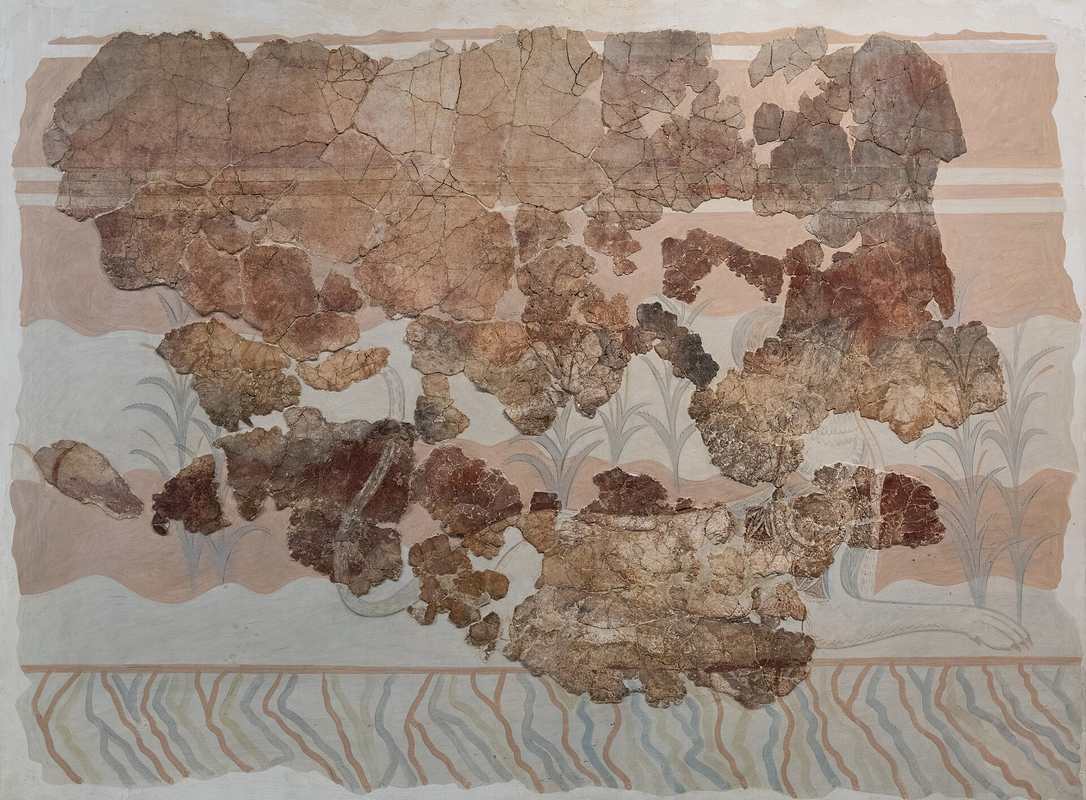
The frescoes as displayed today are heavily reconstructed. Most survived only as small plaster fragments recovered during the excavation of the palace, which began in the first years of the twentieth century. To turn scattered pieces into readable pictures, the excavator Arthur Evans commissioned the Swiss artists Emile Gilliéron the father and Emile Gilliéron the son, who assembled the fragments and painted in the missing areas.
The Gilliérons filled large gaps with informed guesswork, so scenes such as the Bull-Leaping fresco and the Prince of the Lilies contain far more modern paint than ancient plaster. Scholars debate how faithful these reconstructions are, since the restorers made choices about pose, colour and composition that shaped how the world pictures Minoan art. The very identity of the Prince of the Lilies, assembled from separate fragments, remains questioned.
This history matters for how visitors read the paintings. The genuine ancient portions are usually the darker, denser passages, while the paler, smoother areas are twentieth-century restoration. Museums now mark the reconstructed sections so viewers can tell old from new. Knowing this deepens rather than diminishes the encounter, since the surviving fragments still carry the Minoan hand.
The Gilliérons left a wider legacy beyond the palace walls. Father and son also produced watercolour copies and cast reproductions of Minoan works that entered museums across Europe and North America, spreading the visual style of Knossos worldwide. Their reconstructions defined the popular image of Minoan art for a century, an influence that makes the debate over their accuracy more than academic. Reading the marked panels in the Heraklion galleries lets the visitor weigh ancient fragment against modern fill for themselves. Our Knossos tickets guide covers the combined ticket that pairs the two sites. The next section covers what the frescoes reveal about Minoan life.
What do the Knossos frescoes tell us about Minoan life?
The Knossos frescoes reveal a sophisticated, nature-loving and apparently peaceful Minoan society, fond of sport, ceremony and elegant dress, with scenes of bull-leaping, processions, courtly figures and marine life.
The Knossos frescoes are one of our richest sources for understanding Minoan life, offering vivid glimpses of a sophisticated and apparently peaceful Bronze Age society. The recurring scenes of bull-leaping point to the importance of ritual sport and the symbolic power of the bull, while processions and gatherings indicate ceremony, religion and a structured court life centred on the palace.
The frescoes also reveal a culture with a deep love of nature and a taste for elegance. Dolphins, fish, birds, flowers and landscapes fill the walls, reflecting a people attuned to the natural world, while the finely dressed figures, with their flowing robes and jewellery, point to a refined, prosperous society that valued beauty and display. The art shows little warfare, contributing to the image of the Minoans as a peaceful, artistic civilisation. Plan your visit through our Palace of Knossos guide.
Read together, the subjects sketch a whole society. Marine friezes reflect a seafaring, trading power whose wealth flowed from the Aegean. Courtly scenes give women a prominent, richly dressed place, which points to their standing in Minoan society. The near-absence of battle, siege or captive scenes stands out against the war-filled art of neighbouring cultures, and it frames Knossos as a centre of ceremony and craft rather than conquest.
For all the fascination of the palace architecture, the frescoes give Knossos its human warmth. In their leaping acrobats, swimming dolphins and elegantly dressed figures, a civilisation that vanished thousands of years ago feels close, vivid and alive. To appreciate them fully, see both the replicas in their original settings at the site and the genuine masterpieces in the Heraklion museum, where their true colour and detail can be admired up close. Together they offer one of the most direct encounters with the Minoan world any visitor to Crete can have, well worth the combined ticket that links the two.
Frequently Asked Questions
Are the frescoes at Knossos real?
The frescoes you see on the walls at the Knossos site are replicas, not the originals. They are reproductions placed in the positions where the original fragments were discovered, done to protect the fragile genuine paintings from the weather on the open site while showing visitors how the palace walls once looked. The original Minoan frescoes, conserved and reconstructed from surviving fragments, are kept and displayed in the Heraklion Archaeological Museum in the nearby city. Combining the palace with the museum is rewarding for this reason: at the site you see the replicas in context, and at the museum you see the real masterpieces up close.
What is the most famous fresco at Knossos?
The most famous fresco at Knossos is the Bull-Leaping fresco, sometimes called the Toreador fresco, which depicts acrobats vaulting over the back of a charging bull. It captures the daring ritual sport and the symbolic importance of the bull in Minoan culture, and has become an icon of Bronze Age Aegean art. Other celebrated Knossos frescoes include the Prince of the Lilies, a striding figure crowned with lilies, the Dolphin fresco, the Ladies in Blue and the elegant figure nicknamed La Parisienne. The originals of these works are displayed in the Heraklion Archaeological Museum, while replicas are shown at the site.
Where are the original Knossos frescoes kept?
The original Knossos frescoes are kept and displayed in the Heraklion Archaeological Museum, in the centre of Heraklion a short distance from the palace. Its Minoan galleries house the genuine wall paintings, conserved and reconstructed from surviving fragments, including the Bull-Leaping fresco, the Prince of the Lilies, the Dolphin fresco and other famous scenes, along with the finest finds from the site. The frescoes on display at the Knossos site itself are replicas placed where the originals were found. Because the two complement each other, a discounted combined ticket covers both, and guided tours visit the palace and the museum together.
What colours did the Minoans use in the frescoes?
The Minoans painted the Knossos frescoes with a compact palette drawn from natural minerals: red from iron oxides, yellow from ochre, black from carbon and white from lime. Their blues came from Egyptian blue, one of the earliest manufactured pigments, ground and bound for use on plaster walls. Painters laid these colours as flat fields inside fluid outlines rather than blending or shading them, which gives the figures their clear, graphic look. By convention they painted male skin reddish-brown and female skin white, a distinction that helps identify figures in scenes such as the Bull-Leaping fresco and the Procession.
Who reconstructed the Knossos frescoes?
The Knossos frescoes were reconstructed by the Swiss artists Emile Gilliéron the father and Emile Gilliéron the son, working under the excavator Arthur Evans in the early twentieth century. Most paintings survived only as small plaster fragments, and the Gilliérons assembled them and painted in the missing areas to create readable scenes. Because they filled large gaps with informed reconstruction, works such as the Prince of the Lilies and the Bull-Leaping fresco contain a great deal of modern paint, and scholars debate how faithful the results are. Museums now mark the reconstructed sections so visitors can clearly distinguish the genuine ancient plaster from the twentieth-century restoration painted over the gaps.