
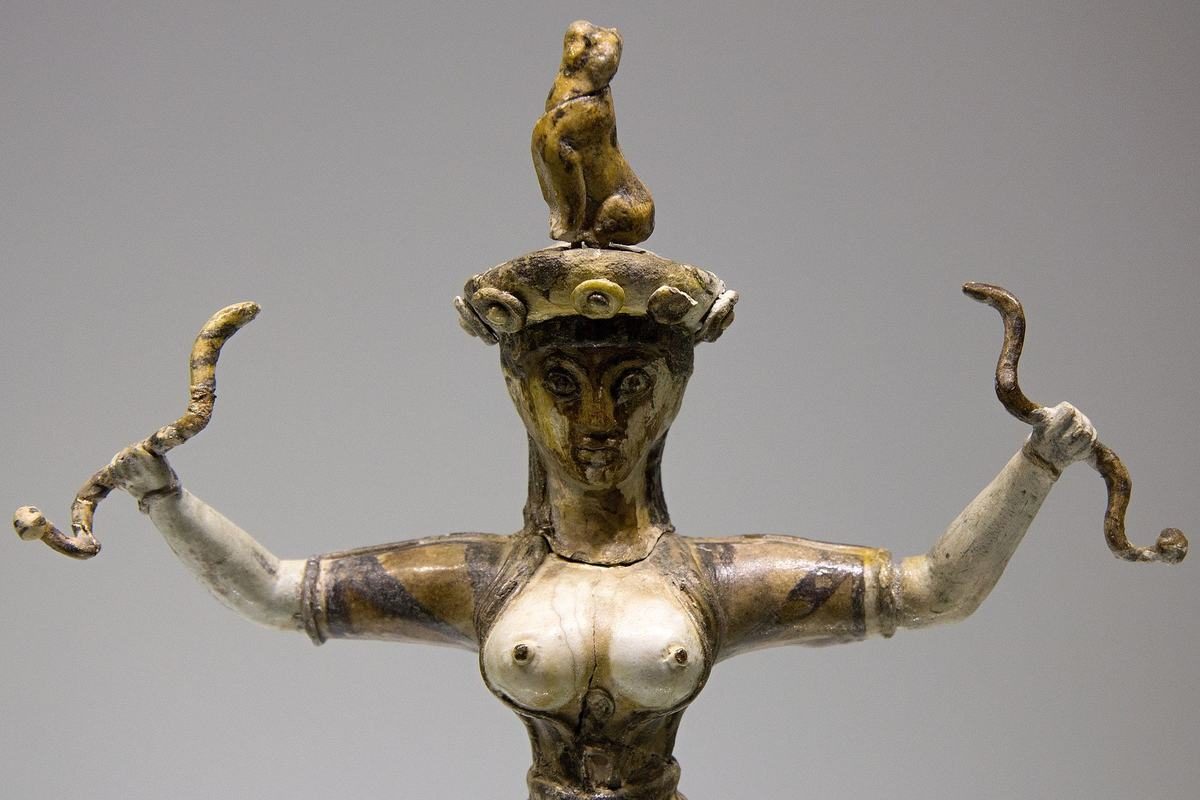
The Minoan snake goddess is the famous faience figurine from Knossos, a bare-breasted female holding snakes, a powerful image of Minoan religion. Plan tickets and tours through My Greece Tours.
The snake goddess is among the most iconic finds from the Palace of Knossos. The sections below cover what she is, what the snakes mean, whether she is a goddess or priestess, how the figures were reconstructed, the wider snake cult of Bronze Age Crete, and where to see her today.
What is the Minoan snake goddess?
The Minoan snake goddess is a pair of faience figurines found at Knossos, each a female in a flounced skirt and open bodice with snakes on her arms, dated to the Late Minoan I period.
Arthur Evans uncovered the two figurines in the palace at Knossos during his early excavations of the site. They lay inside stone-lined cists that Evans named the Temple Repositories, sunk into the floor of the palace shrine area. The figures belong to the Neopalatial phase of Minoan Crete, the Late Minoan I period, when the palace stood at the height of its wealth. Both women wear the distinctive Minoan dress: a long tiered skirt, a short apron, and a bodice that opens at the front to leave the breasts bare. The two figurines together form one of the most recognisable images of the Bronze Age Aegean.
The larger figure stands with snakes entwined along both arms, her hands gripping the creatures near her waist and shoulders. The smaller companion raises both arms and holds a snake outstretched in each hand, and a small feline, restored as a cat or a leopard, sits on top of her tall headdress. Their skirts fall in several stacked flounces, each tier defined by painted bands. Their headdresses rise into tall crowns. The whole composition reads as a formal, frontal presentation, arms and serpents arranged in a deliberate symmetry that signals ritual rather than casual portraiture.
Faience gives the figurines their surface and their fame. Faience is a glazed non-clay ceramic built from a paste of ground quartz, fired to produce a hard, colourful body with a glassy sheen. Minoan craftworkers used the material for beads, plaques, and small sacred objects, and the snake goddess figurines represent the technique at its most ambitious. The glaze carries much of the surviving colour, the painted bands of the skirt and the markings of the snakes. Seen up close, the pieces are small, no larger than a modern statuette, yet their detail and their glassy finish mark them as products of a highly skilled palace workshop.
Context of discovery matters as much as material. The figures came out of a shrine deposit alongside other ritual objects, sealed in the stone cists of the Temple Repositories. That setting, a dedicated sacred space within the palace, points strongly to a religious function rather than domestic decoration. Our guide to Minoan religion covers the wider faith of Bronze Age Crete, and the section below covers what the snakes themselves were meant to signify.
What do the snakes on the Minoan snake goddess mean?
The snakes symbolise renewal, fertility, and the chthonic underworld. A snake sheds its skin to emerge renewed and lives within the earth, so it stood for rebirth, the fertile soil, and protection of the household.
Snake symbolism across the ancient Mediterranean rests on three linked ideas, and the Minoan snake goddess draws on all of them. The first is renewal. A snake sheds its old skin and emerges shining and new, a visible image of regeneration that ancient cultures read as a sign of rebirth and the renewal of life. A figure who masters two such creatures, one held in each hand by the smaller figurine, presents herself as a mistress of that regenerative power. The snakes are not decorative additions but the central attribute that names the whole image.
The second idea is the earth and its fertility. Snakes live low to the ground, slip into cracks in the soil, and vanish into the underworld of the earth itself. For a farming society, that made the serpent a natural emblem of the fertile land and the crops that rise from it. Minoan religion appears centred on a female deity of nature and fertility, and a snake-handling figure fits that focus exactly, embodying the life-giving powers of the soil. The connection between the serpent and the fertile earth runs through the imagery of the figurines and the shrine context in which they were buried.
The third idea is the chthonic underworld and the protection of the home. Because the snake enters the ground, it was linked to the powers below the earth, to the dead, and to the guardian spirits of the house and its stores. Household snakes were treated as protectors in later Greek practice, and the roots of that belief reach back into the Bronze Age Aegean. A snake goddess or her priestess, then, guards the home and its fertility as much as she rules the wider forces of nature. These three strands, renewal, fertility, and the chthonic earth, together explain why the serpent became the defining attribute of this figure.
Scholars debate the precise weighting of these meanings, yet the link between the snakes and the powers of the earth is widely accepted. The evidence points to a deity or officiant tied to the cycles of life, death, and renewal rather than a simple decorative motif. Our guide to the mysteries of the Palace of Knossos covers such questions of Minoan belief, and the section below covers whether the figure is a goddess or a priestess.
Is the Minoan snake goddess a goddess or a priestess?
Scholars debate whether the figurines show an actual goddess or a priestess in ritual dress. One view sees a nature deity; another sees a human officiant handling sacred snakes; a third sees a household protective goddess.
The goddess reading treats the figures as images of the powerful Minoan female deity, the mistress of nature and animals who governs the fertile earth and its creatures. On this view the snakes are her attributes, marks of divine authority over the regenerative forces of the world, and the frontal, commanding pose expresses her rank. Supporters point to the shrine context, the ritual objects buried alongside the figures, and the wider pattern of Minoan art, which repeatedly shows a dominant female figure attended by animals. The goddess reading has anchored the modern name of the pieces and their place in debates over a Minoan Mother-Goddess.
The priestess reading treats the figures as human women in ceremonial dress performing a snake-handling rite. On this view the elaborate skirt, bared bodice, and tall headdress form a ritual costume rather than divine regalia, and the woman holds the snakes in service to the goddess rather than embodying divinity herself. Supporters note that Minoan art shows women in ritual roles and that snake handling could have been a real ceremony conducted within the palace shrine. The two readings need not be wholly separate, since a priestess in Minoan belief could act as the living embodiment of the goddess during the rite.
A third reading identifies the figure as a household or chthonic protective deity, a guardian of the home and its stores rather than a great cosmic goddess. This “Household Goddess” interpretation draws on the snake’s role as a protector of the house and on the discovery of snake-cult equipment in domestic and shrine settings across Crete. The three readings, deity of nature, ritual priestess, and household protector, each account for part of the evidence, and none can be proved from the figures alone.
No Minoan text survives to settle the question, because the Minoan script, Linear A, remains undeciphered. The matter rests on the images, the objects buried with them, and comparison with later Greek religion. Scholars continue to debate the reading, and that open question is part of the figures’ enduring pull. The section below covers how much of the familiar image is original and how much is modern reconstruction.
Was the Minoan snake goddess reconstructed?
Yes. Both figurines were found broken and were heavily restored after their discovery at Knossos. Restorers filled in missing heads, hats, and the cat on the headdress, so parts of the familiar image are conjectural.
The figures emerged from the Temple Repositories in fragments, not as the complete statuettes seen in the museum today. Evans employed skilled restorers, among them Halvor Bagge and the artist Émile Gilliéron, to piece the broken faience together and to supply the parts that were missing. That work turned scattered fragments into the coherent figures now on display, but it also introduced modern judgement into the finished image. Restoration of this kind was standard practice in the early twentieth century, and the snake goddess figures rank among its most famous products.
Several of the most memorable details are wholly or partly reconstructed. The head and the tall hat of one figure were restored, since the originals had not survived intact. The small feline perched on the headdress of the smaller figurine, restored as a cat or a leopard, is a reconstruction rather than a securely preserved original. Parts of the arms, the exact set of the hands, and the completeness of some snakes reflect the restorers’ choices as much as the surviving material. The finished pose that appears in every photograph is, in part, an early-twentieth-century interpretation of fragmentary evidence.
This restoration history is a key point of scholarly caution. It does not diminish the beauty or the importance of the figures, but it means that arguments built on fine details, the precise gesture, the identity of the animal on the crown, the exact arrangement of the snakes, must reckon with the possibility that those details were supplied by a restorer. The same caution applies to Evans’s wider rebuilding of Knossos, where reconstructed frescoes and reinforced walls shape the modern visitor’s impression of the palace. Our guide to Sir Arthur Evans and Knossos covers these reconstructions in detail, and the section below covers the wider snake cult that gives the figures their context.
How does the snake goddess fit the wider Minoan snake cult?
The Knossos figurines belong to a broader Cretan snake cult. Snake tubes and figurines found at Gournia, Kannia, and Koumasa show that serpent worship linked to the earth and the household spread across Bronze Age Crete.
The snake goddess is not an isolated masterpiece but the finest surviving expression of a religious practice found across Minoan Crete. Excavations at other sites have produced snake tubes, cylindrical clay stands modelled with serpents that were used in shrine ritual. The settlement at Gournia yielded such equipment from a small shrine, evidence that snake-linked worship reached ordinary towns and not only the great palace. These finds tie the Knossos figures to a living cult rather than to a single artist’s invention.
Further material comes from Kannia, near Gortyn in the south of the island, where a rural shrine produced figures and snake tubes connected to the same tradition. The early cemetery at Koumasa, in the Mesara plain, adds still older evidence for serpent imagery in Cretan religion, showing that the association reached back before the height of the palaces. Taken together, Gournia, Kannia, and Koumasa mark out a cult that spread across the island, from coastal towns to inland shrines to early tomb sites, all sharing the serpent as a sacred symbol of the earth and the household.
The link between snakes and the household runs through this material. Snake tubes and figurines cluster in shrines tied to domestic and communal ritual, which supports reading the serpent as a guardian of the home, its stores, and its fertility. This household dimension explains the third interpretation of the Knossos figures as a protective “Household Goddess” and roots that reading in real archaeological evidence rather than speculation. The cult objects across Crete give the two famous figurines a context of shared belief.
Later Greek religion preserves clear continuities from this Bronze Age tradition. Athena, the guardian of the citadel, was linked to a sacred snake kept on the Acropolis of Athens, a household and civic protector in serpent form. Asclepius, the healing god, carried a snake-entwined staff that survives as a symbol of medicine, drawing on the serpent’s link to renewal and the powers of the earth. The domestic snake, honoured as a protector of the house, persisted in Greek folk practice for centuries. These threads suggest that the meaning carried by the Minoan snake goddess outlived the palaces and fed into the religion of classical Greece. The section below covers where the original figures can be seen today.
Where can you see the Minoan snake goddess?
The original figurines are displayed in the Heraklion Archaeological Museum, in the Prehistoric collection. They rank among the star exhibits, a short distance from the palace at Knossos.
The Heraklion Archaeological Museum, in the centre of the city, holds the world’s finest collection of Minoan art, and the two snake goddess figurines stand among its most celebrated exhibits. They are shown in the Prehistoric galleries alongside other treasures of the Bronze Age, including painted pottery, seal stones, and the reconstructed frescoes of Knossos. Seeing the figures in person reveals the small scale and fine detail that photographs flatten, the stacked flounces of the skirts, the glassy faience glaze, and the tension of the snakes coiled along the arms.
The museum sits a short distance from the palace at Knossos, which lies just outside the city. The greatest treasures, the snake goddess among them, are kept in the museum rather than at the site, so a full Minoan visit pairs the ruins with the gallery. A discounted combined ticket covers both the palace and the museum, and guided tours frequently visit the two together in a single day. Standing before the figures completes the experience of the palace, since the objects buried in its shrine now sit a few kilometres away in the museum halls.
The snake goddess has become an icon far beyond the museum. She stands at the centre of modern debates over Minoan matriarchy and the idea of a great Mother-Goddess, and her image has been copied endlessly in replicas, jewellery, and Art Deco design since Evans first published the figures. That afterlife makes her a symbol of Minoan Crete in modern culture as much as an ancient artefact. Our guide to the Heraklion Archaeological Museum covers the wider collection, and you can plan the palace visit through our Palace of Knossos guide.
Few objects capture the Minoan world as sharply as the snake goddess. In her frontal pose, her tiered skirt, and the serpents held in her hands, she embodies a religion centred on the feminine and on the regenerative powers of the earth, and she remains among the most striking images to survive from any ancient civilisation. That scholars still debate whether she is a goddess, a priestess, or a household protector, and how much of her form is original, only deepens her hold on the imagination. Seeing the two figures in the Heraklion museum, small, intricate, and intense, ranks among the essential experiences of a Minoan journey and completes any visit to the ruins of Knossos.
Frequently Asked Questions
What is the Minoan snake goddess?
The Minoan snake goddess is a pair of faience figurines found by Arthur Evans in the Temple Repositories of the palace at Knossos, dated to the Late Minoan I period. Each figure is a woman in the Minoan style, wearing a long flounced skirt, a short apron, and an open bodice that leaves the breasts bare, with a tall headdress and snakes on her arms. Faience, a glazed non-clay ceramic made from quartz paste, gives the pieces their colour and glassy sheen. The figures came from a shrine deposit among ritual objects, which points to a sacred function. Today the originals are among the star exhibits of the Heraklion Archaeological Museum, and the image has come to symbolise Minoan religion and art.
What do the snakes symbolise on the Minoan snake goddess?
The snakes symbolise renewal, fertility, and the chthonic underworld, three linked ideas that made the serpent a central sacred emblem in the ancient Mediterranean. A snake sheds its skin to emerge renewed, an image of rebirth and regeneration. It lives within the earth, so it stood for the fertile soil and the crops that rise from it. It slips into the ground, so it was tied to the underworld and to the guardian spirits of the home. A figure mastering two snakes, one in each raised hand, presents herself as mistress of those powers. The imagery fits a Minoan religion that appears centred on a female deity of nature and fertility, and it connects the figures to the cycles of life, death, and renewal.
Is the snake goddess a goddess or a priestess?
Scholars debate whether the figurines show an actual goddess, a human priestess in ritual dress, or a household protective deity. The goddess reading treats them as the powerful Minoan mistress of nature and animals, with the snakes as her divine attributes. The priestess reading treats them as women performing a sacred snake-handling rite in ceremonial costume. A third reading identifies a household guardian tied to the protection of the home and its stores. The three views are not wholly separate, since a priestess could embody the goddess during the rite. No Minoan text survives to settle the matter, because the Linear A script remains undeciphered, so the question rests on the images and their shrine context.
Who discovered the Minoan snake goddess and where?
Arthur Evans discovered the figurines during his excavation of the palace at Knossos in the early twentieth century. They lay inside stone-lined cists that Evans named the Temple Repositories, sunk into the floor of the palace shrine area and sealed with other ritual objects. The find belongs to the Neopalatial phase of Minoan Crete, the Late Minoan I period, when the palace stood at its height. The context, a dedicated sacred space within the palace, is a central reason the figures are read as religious rather than decorative. The discovery formed part of Evans’s wider reconstruction of Knossos, which turned the site into the defining monument of Minoan civilisation and made the snake goddess one of its best-known symbols.
How much of the snake goddess is original and how much restored?
Both figurines were found broken and were heavily restored after their discovery, so parts of the familiar image are conjectural. Evans’s restorers, among them Halvor Bagge and Émile Gilliéron, pieced the fragments together and supplied missing elements. The head and tall hat of one figure were restored, and the small feline on the headdress of the smaller figurine, shown as a cat or a leopard, is a reconstruction rather than a securely preserved original. Parts of the arms, the set of the hands, and the completeness of some snakes reflect the restorers’ judgement. This history is a key point of scholarly caution: arguments built on fine detail must allow for the possibility that a restorer supplied the detail, just as with Evans’s wider rebuilding of Knossos.
Where can I see the Minoan snake goddess today?
The original figurines are displayed in the Heraklion Archaeological Museum, in the Prehistoric collection, where they rank among the star exhibits of the world’s finest Minoan holdings. The museum sits in the centre of Heraklion, a short distance from the palace at Knossos just outside the city. The greatest finds are kept in the museum rather than at the site, so a full Minoan visit pairs the ruins with the gallery, and a discounted combined ticket covers both. Guided tours often visit the two together in a single day. Seeing the figures in person reveals the small scale, the stacked flounces of the skirts, and the glassy faience that photographs cannot convey, and it completes any visit to the ruins of Knossos.