
Minoan pottery ranges from the delicate polychrome Kamares ware to lively marine designs and giant storage jars, prized across the ancient world. Plan tickets and tours through My Greece Tours.
Pottery fills the storerooms and museum collections tied to the Palace of Knossos. The sections below cover what Minoan pottery is known for, the famous Kamares ware, the marine and floral styles, how the pottery was made and how its styles changed, the shapes and ritual vessels, the great storage jars, where the pottery was traded and where to see the finest pieces.
What is Minoan pottery known for?
Minoan pottery is known for its beauty, technical skill and lively decoration, from the delicate polychrome Kamares ware to the naturalistic marine style with octopuses and sea creatures.
Minoan pottery is celebrated as some of the finest of the Bronze Age, admired for its elegant shapes, technical mastery and vivid, naturalistic decoration. The Minoan potters were highly skilled craftworkers who produced everything from delicate, eggshell-thin fine ware to massive storage vessels taller than a person. Their best pieces are works of art that reveal the sophistication and creativity of a civilisation centred on the palaces of Crete, and they show how ceramics served both daily life and luxury display. The range is remarkable, spanning plain domestic cups made in quantity and lavishly painted vessels reserved for the palace elite and for export to distant markets.
What stands out most is the decoration, which evolved over the centuries and reflects the Minoan love of nature and movement. Vessels were painted with swirling abstract patterns, spirals, plants and flowers, and above all the marine life of the sea around Crete. Octopuses, dolphins, shells and seaweed were rendered with a freedom and liveliness rare in ancient art, wrapping the whole surface of a pot rather than sitting in stiff panels. This sense of energy sets Minoan work apart from the more rigid geometric traditions of its neighbours, and it makes the pottery feel alive even after thousands of years in the ground.
Minoan pottery was prized far beyond Crete and traded across the Mediterranean, spreading the influence and prestige of the civilisation that made it. Fine painted vessels reached the Aegean islands and the Greek mainland, and the finest wares travelled to Egypt and the coasts of the eastern Mediterranean, where they were valued as luxury imports. Because it survives so well in the archaeological record, pottery is also the main way scholars date Minoan sites and trace the rise and fall of the palaces. Our guide to the Minoan civilization at Knossos covers the wider culture, and the next section covers Kamares ware.
What is Kamares ware?
Kamares ware is the finest Minoan fine pottery, made in the Old Palace period, with delicate, sometimes eggshell-thin walls decorated in white, red and orange on a dark background.
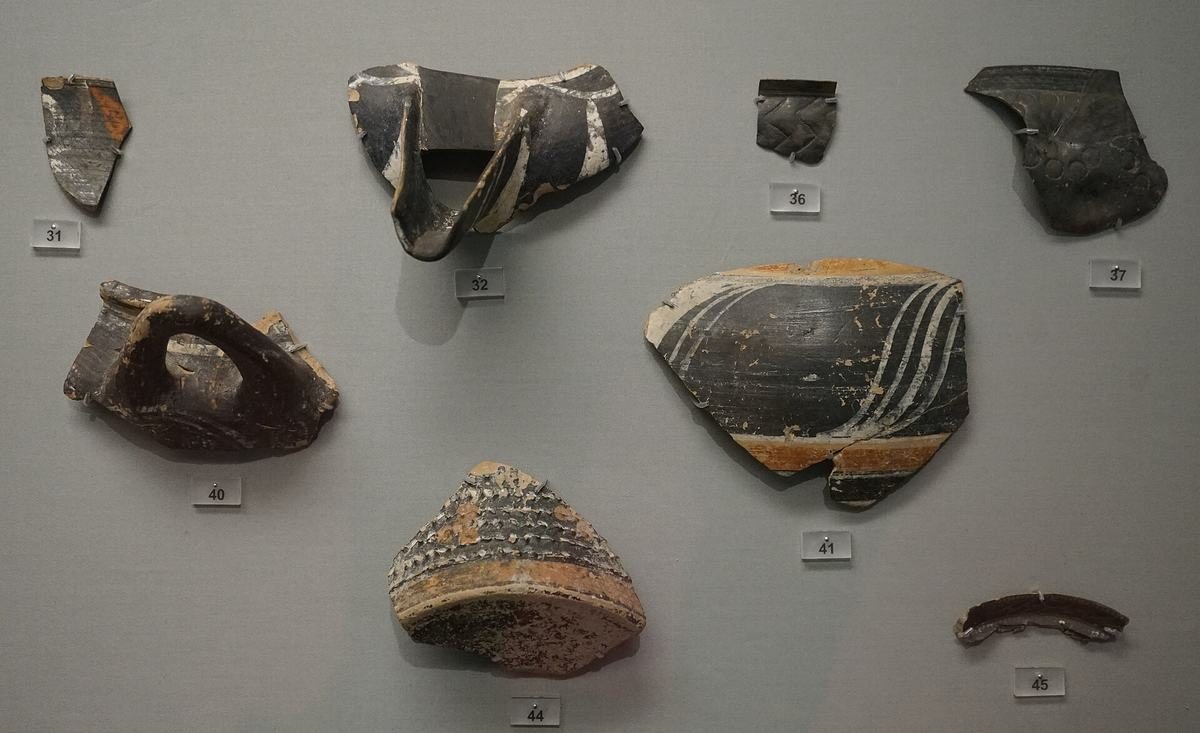
Kamares ware is the most celebrated Minoan fine pottery, produced in the Old Palace period, the Protopalatial phase of the earlier palaces, and it represents a peak of the potter’s art. Its finest examples have remarkably thin, delicate walls, so fine that they are often described as eggshell ware, and they show how far the Minoan potters had pushed their control of clay and firing. These luxury vessels were made for the palace tables and for high-status use, and their thinness alone was a display of skill that ordinary workshops could not match. Cups, bowls and jugs in this ware are among the most refined ceramics of the whole Bronze Age.
The decoration is a striking polychrome style, with designs painted in white, red and orange on a lustrous dark background, creating a rich and elegant contrast that catches the light. The motifs are typically a swirling, dynamic blend of abstract patterns, spirals and stylised floral and natural forms, full of movement and sophistication rather than stiff repetition. Painters filled the curved surface with rotating designs that seem to spin around the pot, matching the shapes to the vessel so that decoration and form work together. This confident, flowing style is one of the clearest expressions of the Minoan sense of rhythm and energy in the visual arts.
The ware takes its name from the Kamares cave on Mount Ida, a sacred mountain site where fine examples were first found and recognised as a distinct group. Kamares ware was a luxury product used in the palaces and exported abroad, reaching the Aegean and even Egypt, where its quality was clearly admired. Its wide distribution shows both the reach of Minoan trade in the Old Palace period and the prestige attached to the finest Cretan ceramics. Fine examples are displayed today in Heraklion. Our guide to the Heraklion Archaeological Museum covers the collection, and the next section covers the marine style.
What is the Minoan marine style?
The Minoan marine style is a Late Minoan pottery decoration covering vessels with lively scenes of sea life, especially octopuses with curling tentacles, along with dolphins, tritons, shells, coral and seaweed.
The marine style is one of the most distinctive and admired forms of Minoan pottery decoration, belonging to the Late Minoan period of the later palaces. In it, vessels are covered with lively, naturalistic depictions of the creatures of the sea, painted so that they seem to move across the surface of the pot. The most famous subject is the octopus, whose tentacles are shown curling and spreading dynamically around the whole vessel, wrapping the body in a way that turns the pot itself into a piece of the sea. Around it swim dolphins and fish, while shells, starfish, argonauts, tritons, coral and drifting seaweed fill the remaining space.
This style perfectly captures the Minoan love of nature and movement and their deep connection to the sea, which was the source of their wealth and power as a great seafaring and trading civilisation. Rather than framing the sea creatures in panels, the painters let them float freely over the curved surface, following its shape so that the whole pot reads as a single scene. The result feels immediate and alive, a quality that sets Minoan work apart from the more formal art of its neighbours. Marine-style flasks, jars and stirrup jars were prized both on Crete and abroad, and they carried this vivid imagery across the Aegean.
The famous octopus jars and flasks are masterpieces of the marine style, prized for the way the sea creature seems to grip and inhabit the vessel rather than simply decorate it. They are among the highlights of Minoan art and show the potters at the height of their confidence, working in the second millennium BC as the palaces flourished. The style also reflects the maritime economy that underpinned Minoan power, in which ships and the sea were central to daily life. Our guide to the Knossos frescoes covers the same love of nature in wall painting, and the next section covers the floral style.
What is the Minoan floral style?
The Minoan floral style is a Late Minoan pottery decoration painted with plants such as lilies, reeds, grasses and leafy sprays, developing alongside the marine style and sharing its naturalistic, flowing spirit.
The floral style is the land-based companion to the marine style, developing in the Late Minoan period and sharing its love of nature and movement. Where the marine style fills a vessel with the creatures of the sea, the floral style covers it with plants: lilies, reeds, grasses, ivy, crocuses and leafy sprays that arch and curl across the surface. The plants are painted in a lively, naturalistic way, spreading over the curved body of the pot much as the octopus does in marine-style work, so the two styles feel like two sides of the same artistic outlook. Together they show how completely the Minoan painters had absorbed the natural world into their decorative repertoire.
Floral-style vessels often use dark-on-light painting, with plant forms set against a pale ground, giving the designs a fresh and open feel that suits their subject. Reeds bending as if in a breeze and grasses growing up from the base of a jug are common, and they give the pots a sense of place, evoking the meadows and hillsides of Crete. This naturalism is one of the reasons Minoan pottery is admired so widely: the painters observed real plants and rendered their growth and rhythm rather than reducing them to rigid patterns. The style sits comfortably beside the marine work as part of the same flowering of Late Minoan ceramic art.
The floral and marine styles together mark the high point of naturalistic decoration on Minoan pottery, before later work grew more formal under mainland influence. Both styles were used on fine tableware and on export vessels, spreading Minoan taste around the Aegean and beyond. Seeing them side by side in a museum makes clear how consistent the Minoan love of nature was across land and sea. Our guide to the Minoan civilization at Knossos sets these styles in their cultural context, and the next section covers how the pottery was made.
How was Minoan pottery made?
Minoan pottery was shaped by hand and, in the palace period, on the potter’s wheel, using both coarse and fine clay fabrics, then coated with a slip, painted and fired in kilns to fix the colours.
Minoan pottery was made from local clays that potters prepared and worked into distinct fabrics, from coarse, gritty clay for heavy storage vessels to refined, well-levigated clay for delicate fine ware. In the earliest phases pots were built up by hand, using coiling and moulding, and this technique never entirely disappeared for large or simple vessels. The potter’s wheel came into wide use during the palace period and transformed the craft, allowing potters to throw thin, even, symmetrical shapes quickly and in quantity. The eggshell-thin walls of the finest Kamares cups depended on this control, and the wheel helped make possible both the elegance and the scale of Minoan output.
Once shaped, a vessel was usually coated with a slip, a fine liquid clay layer that gave a smooth surface for painting and could be burnished to a sheen. Decoration was applied with mineral-based paints that turned different colours in the kiln, allowing the dark grounds and white, red and orange designs of Kamares ware and the dark-on-light and light-on-dark schemes of later styles. Painters worked directly on the curved surface, matching their designs to the shape of the pot. The whole surface treatment, from slip to painted motif, was carefully judged so that decoration and form supported one another.
Firing was the crucial final stage, carried out in kilns that had to reach and hold the right temperature to harden the clay and fix the colours. Control of the firing atmosphere affected how the paints came out, and the consistent quality of Minoan wares shows that potters understood their kilns well. Large pithoi presented their own challenges, since such big vessels had to be built and fired without cracking. The combination of good clay, the wheel, careful painting and skilled firing is what gave Minoan pottery its lasting reputation. Our guide to the Knossos layout covers the workshops and storerooms of the palace, and the next section covers how the styles changed over time.
How did Minoan pottery styles change over time?
Minoan pottery moved from early dark-on-light decoration to the light-on-dark polychrome Kamares ware of the Old Palace period, then to the naturalistic marine and floral styles, and finally to the more formal Palace Style under mainland influence.
Minoan pottery changed markedly over the long span of the Bronze Age, and its styles are one of the main tools archaeologists use to divide the period into phases. In the earliest, Prepalatial phase, before the great palaces, decoration was often dark-on-light, with dark painted patterns set against the pale surface of the clay. Shapes were simpler and painting more restrained, though already the potters showed an interest in pattern and finish. This early work laid the technical foundations for the brilliant fine wares that followed once the first palaces concentrated wealth and skilled labour in a few centres.
The Old Palace period brought the polychrome Kamares ware, in which the scheme was reversed to light-on-dark, with white, red and orange designs painted over a dark ground. This was a high point of technical fine ware, with its eggshell walls and swirling abstract motifs. In the Late Minoan period that followed, the finest painters turned to the naturalistic marine and floral styles, covering vessels with octopuses, sea life, plants and flowers in a free, flowing manner. These naturalistic styles are often seen as the artistic climax of Minoan ceramics, expressing the culture’s love of nature at its most confident.
Towards the end of the palatial era, as Mycenaean influence from the Greek mainland grew stronger on Crete, pottery became more formal and stylised. The so-called Palace Style produced large, imposing amphorae decorated with more rigid, symmetrical versions of the older marine and floral motifs, grander in scale but less free in spirit. This shift in taste mirrors the wider political changes of the time, when mainland Greeks came to dominate Knossos. Following the sequence of styles is one of the most rewarding ways to read Minoan history through its objects. Our guide to the Minoan civilization at Knossos sets this in its historical frame, and the next section covers the shapes the potters made.
What shapes did Minoan potters make?
Minoan potters made a wide range of shapes, including drinking cups, jugs and ewers, stirrup jars, amphorae, ritual rhyta, the kernos and the plain conical cup produced in enormous numbers.
Minoan potters produced a broad repertoire of shapes suited to every use, from the table and the storeroom to the shrine. For drinking and serving there were cups, bowls, jugs and ewers, ranging from the exquisite eggshell cups of Kamares ware to sturdy everyday vessels. Among the most characteristic everyday forms is the conical cup, a simple, undecorated cup made in vast numbers and found in huge quantities on Minoan sites, apparently used and discarded almost like disposable ware. The sheer scale of conical cup production shows how organised and industrial Minoan pottery-making could be alongside its finer, more artistic output.
For storage and transport the potters made amphorae and the distinctive stirrup jar, a closed vessel with a false spout and a stirrup-shaped handle designed to carry liquids such as oil or wine without spilling. Stirrup jars were made in large numbers and widely exported, and they are among the shapes most often found beyond Crete, marking the reach of Minoan trade. At the largest end of the scale stood the pithoi, the giant storage jars of the palace magazines, while jugs and pouring vessels of many sizes handled everyday liquids. Each form was refined over generations to suit its function.
Alongside these practical vessels, the potters made specialised ritual shapes for use in religion and ceremony. The rhyton, a pouring vessel used in ritual, was made in striking forms, and the kernos, a vessel with multiple small cups joined together, was used for offerings. These ritual forms show that pottery served the spiritual as well as the practical side of Minoan life, and they are often among the most inventive shapes the potters produced. Together the full range of forms reflects a society in which ceramics touched almost every activity. Our guide to the Heraklion Archaeological Museum displays many of these shapes, and the next section looks more closely at the rhyton.
What is a rhyton?
A rhyton is a Minoan ritual pouring vessel, often shaped in striking forms, with the bull’s-head rhyton and the rock-crystal rhyton from Zakros among the most famous examples of Minoan craftsmanship.
A rhyton is a special pouring vessel used in Minoan ritual, made to hold and pour liquids in ceremonies rather than for ordinary dining. Rhyta usually have an opening at the top for filling and a small hole at the base or tip through which the liquid was released, so they were designed to pour offerings, perhaps of wine, oil, blood or water, in a controlled way. Their ceremonial role meant they were often made with unusual care and in memorable shapes, and they are among the objects that most vividly connect Minoan pottery to religion and ritual. Both ceramic and stone rhyta survive, showing that the form crossed materials as well as uses.
The most famous Minoan rhyta include the bull’s-head rhyton, carved in stone in the form of a bull’s head with inlaid eyes and horns, which reflects the central importance of the bull in Minoan religion and imagery. Another celebrated example is the rock-crystal rhyton from the palace of Zakros, painstakingly made from crystal with a beaded handle, one of the finest surviving pieces of Minoan craftsmanship in any material. These masterpieces show that the rhyton could be a vehicle for the highest artistry, made from precious materials for the most important rituals. They are among the treasures displayed in Heraklion.
Rhyta connect the study of Minoan pottery to the wider world of Minoan religion, in which the sea, nature and the bull all played a part. The care lavished on ritual vessels tells us how seriously the Minoans took their ceremonies, and how closely art and belief were bound together. Alongside the painted cups and jars, these ritual forms round out the picture of a civilisation for which fine objects served the sacred as well as the everyday. Our guide to the Knossos frescoes shows the same ritual and natural imagery in painting, and the next section covers the giant storage jars.
What are the giant storage jars at Knossos?
The giant storage jars at Knossos are the pithoi, huge ceramic vessels that lined the palace magazines, used to store olive oil, wine, grain and other goods, decorated with rope-relief bands.
Among the most memorable pottery at Knossos are the pithoi, the enormous ceramic storage jars that once filled the long storerooms, or magazines, of the palace and can still be seen at the site and in the museum. These massive vessels, often taller than a person and with a wide, bulging body, were used to store the palace’s wealth of commodities: olive oil, wine, grain, pulses and other produce, sometimes in great quantity. Set in rows within narrow corridors, they turned the palace into a vast warehouse as well as a residence and shrine. Their scale alone makes them some of the most impressive objects a visitor encounters at Knossos.
The pithoi are typically decorated with raised rope-like bands and ridges encircling the jar, a distinctive rope-relief pattern that was both decorative and practical. These bands echoed the ropes that would have been slung around such heavy vessels to move and secure them, and they strengthened the walls of the jar. Making and firing a pot of this size without it cracking was a real technical achievement, and the pithoi show the coarse-ware side of Minoan pottery at its most ambitious. Standing in rows in the magazines, they are among the clearest surviving signs of how the palace economy worked.
The rows of giant jars in the storerooms vividly illustrate the role of Knossos as a major economic and administrative centre that collected, stored and redistributed the resources of its territory. Produce gathered from the surrounding land was held in these jars and later given out, and clay tablets record the accounting that went with this system. They are a powerful reminder that the palace was a working hub, not only a ceremonial one, and that pottery underpinned the whole economy. Our guide to the Knossos layout covers the storerooms, and the next section covers where the pottery was traded.
Where was Minoan pottery traded?
Minoan pottery was traded widely across the Aegean and the eastern Mediterranean, reaching the Greek mainland and islands and travelling as far as Egypt and the coasts of the Levant.
Minoan pottery travelled far beyond Crete, carried by the ships that made the Minoans a great maritime power. Fine painted wares and useful transport vessels such as stirrup jars were exported across the Aegean, reaching the Cycladic islands and the Greek mainland, where Minoan taste strongly influenced local craft. The distinctive appearance of Kamares ware and, later, the marine and floral styles made Cretan pottery instantly recognisable, and its presence at foreign sites marks the spread of Minoan contact and prestige. Because pottery survives so well, these exported vessels are among the clearest evidence for the trade routes that linked the Bronze Age Mediterranean.
The reach of Minoan trade extended still further to the great civilisations of the eastern Mediterranean. Minoan and Cretan-style pottery has been found in Egypt, where fine wares were valued as luxury imports, and along the coasts of the Levant, showing that Cretan goods travelled to some of the wealthiest markets of the age. In return, raw materials and finished goods flowed back to Crete, and Egyptian and Near Eastern imports appear on Minoan sites. This two-way exchange helped make the palaces rich and connected Crete to a wider world of long-distance commerce.
Trade in pottery was bound up with trade in the goods the pots carried, such as the oil and wine stored in stirrup jars and pithoi, so ceramics are a guide to the movement of commodities as well as of art. The wide distribution of Minoan wares helps archaeologists reconstruct trade networks and the rise and fall of Cretan influence over time. It also explains why Minoan pottery is admired far beyond Crete today, as an art that once travelled the whole eastern Mediterranean. Our guide to the Minoan civilization at Knossos covers the seafaring economy, and the next section covers where to see the finest pottery.
Where can you see Minoan pottery?
You can see the finest Minoan pottery in the Heraklion Archaeological Museum, including superb Kamares ware and marine-style octopus vessels, while giant storage jars remain at the Knossos site.
The finest Minoan pottery is displayed in the Heraklion Archaeological Museum, in the centre of Heraklion a short distance from Knossos, which holds the greatest collection of Minoan ceramics in the world. Here you can admire superb examples of delicate Kamares ware, with its eggshell-thin walls and polychrome decoration, and masterpieces of the marine style, including the famous octopus vessels, alongside countless other pots, cups, ritual rhyta and floral-style jars. Seeing the different styles gathered in one place makes the development of Minoan pottery clear, from the earliest painted wares to the grand Palace Style amphorae of the later period.
At the Knossos site itself, the giant storage jars, the pithoi, can be seen in and around the storerooms, giving a sense of their scale in their original setting. Standing among the great jars where they once held the palace’s oil and grain is a very different experience from viewing a display case, and it connects the pottery to the working life of the palace. Seeing both the everyday and luxury pottery in the museum and the great jars at the palace gives a full picture of Minoan ceramics, from high art to practical storage. As with the frescoes, the museum is essential for appreciating the finest work.
For all the fame of the frescoes and the drama of the throne room, it is often the pottery that reveals the Minoans most intimately, from the breathtaking delicacy of an eggshell Kamares cup to the joyful energy of an octopus spreading across a jar. In these vessels, made for both daily use and luxury, you see a people of extraordinary skill and an irrepressible love of nature and the sea. Seeking out the finest examples in the Heraklion museum, and the great storage jars at the palace itself, adds a rich extra dimension to a visit. Our guide to the Heraklion Archaeological Museum covers the collection, and you can plan your visit and tours through our Palace of Knossos guide.
Frequently Asked Questions
What is Minoan pottery?
Minoan pottery is the ceramic ware of the Minoan civilisation of Bronze Age Crete. It is celebrated as some of the finest of its age for its elegant shapes, technical skill and vivid, naturalistic decoration. It ranges from delicate, eggshell-thin fine ware to massive storage jars taller than a person.
The most famous types include Kamares ware, a polychrome fine pottery painted in white, red and orange on a dark background with swirling abstract and floral designs. The later marine style covers vessels with lively scenes of octopuses, dolphins and sea life. Giant storage jars called pithoi filled the palace storerooms, and ritual vessels such as rhyta and the kernos served religion. Minoan pottery was traded across the Mediterranean, reaching Egypt and the Levant, and the finest pieces are displayed today in the Heraklion Archaeological Museum near Knossos.
What is Kamares ware pottery?
Kamares ware is the finest Minoan fine pottery, produced in the Old Palace period and representing a peak of the potter’s art. Its best examples have remarkably thin, delicate walls, sometimes called eggshell ware. They are decorated in a striking polychrome style, with designs painted in white, red and orange on a lustrous dark background.
The decoration is typically a swirling, dynamic blend of abstract patterns, spirals and stylised floral motifs, full of movement. The design seems to rotate around the curved surface of the pot. The ware takes its name from the Kamares cave on Mount Ida, a sacred site where fine examples were first found. It was a luxury product used in the palaces and exported abroad, reaching the Aegean and Egypt, and it demonstrates the technical and artistic brilliance of the Minoans. Fine examples are displayed in the Heraklion museum.
What is the Minoan marine style?
The Minoan marine style is a form of pottery decoration from the Late Minoan period. In it, vessels are covered with lively, naturalistic scenes of sea life. Its most famous subject is the octopus, whose tentacles are shown curling and spreading dynamically around the whole surface of the pot. Around the octopus swim dolphins and fish, while shells, starfish, argonauts, tritons, coral and drifting seaweed fill the remaining space.
The style expresses the Minoan love of nature and movement and their deep connection to the sea. The sea was the source of their wealth and power as a great seafaring and trading civilisation. Marine-style flasks, jars and stirrup jars were prized on Crete and widely exported. The famous octopus jars are among the highlights of Minoan art displayed in the Heraklion Archaeological Museum.
What were the giant jars at Knossos used for?
The giant jars at Knossos, called pithoi, were enormous ceramic storage vessels used to store the palace’s wealth of goods, including olive oil, wine, grain and pulses. Often taller than a person, with a wide bulging body, they lined the long storerooms, or magazines, of the palace in great rows. They are typically decorated with raised rope-like bands and ridges encircling the jar. This rope-relief pattern was both decorative and practical, echoing the ropes used to move such heavy vessels and helping to strengthen their walls.
The rows of giant jars illustrate the role of Knossos as a major economic and administrative centre. The palace collected, stored and redistributed the resources of its territory, so it was a working economic hub as well as a ceremonial one. Several pithoi can still be seen in and around the storerooms at the Knossos site today.