
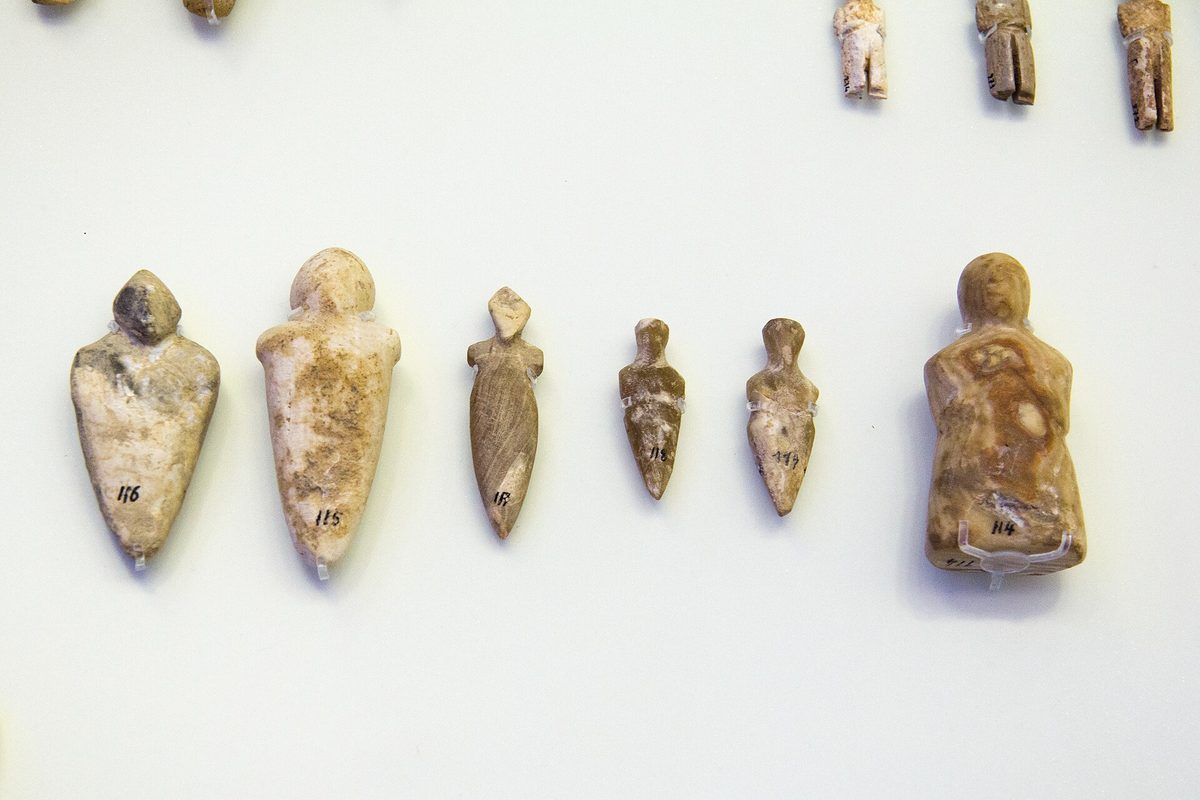
Minoan religion centred on a powerful goddess, the sacred bull and the double axe, with worship in palace shrines, peak sanctuaries and sacred caves. Plan tickets and tours through My Greece Tours.
Religion shaped life at the Palace of Knossos. The sections below cover what we know of Minoan religion, the goddess, the sacred bull and double axe, where the Minoans worshipped and what remains uncertain.
What do we know about Minoan religion?
Minoan religion is known mainly from art and archaeology rather than texts, so a great deal remains uncertain.
Minoan religion comes to us through art. No scriptures survive. Frescoes and objects speak. The picture stays partial.
Nature shaped the faith. Animals and plants recur. The seasons mattered. The divine filled the world.
A goddess dominates the evidence. Female figures abound. The deity held power. The worship centred on her.
Symbols carried meaning. The bull stood sacred. The double axe marked rites. The horns crowned shrines.
Our knowledge of Minoan religion is limited and indirect, because the Minoans left no readable religious texts, their script Linear A being undeciphered. Almost everything we understand comes from interpreting the art, the frescoes, figurines, seals and ritual objects, and from the shrines and sacred places uncovered by archaeology, so much of the picture is reconstructed and debated rather than known for certain.
From this evidence, Minoan religion was probably a nature-based faith deeply concerned with the natural world, fertility and the cycles of life. It probably centred on one or more powerful goddesses, used a set of recurring sacred symbols such as the bull, the double axe and the horns of consecration, and was practised in a variety of settings rather than in great temples. It was woven into the life of the palace at Knossos. Our guide to the Minoan civilization at Knossos covers the culture, and the next section covers the goddess.
Did the Minoans worship a goddess?
Yes, Minoan religion appears to have centred on a powerful female deity, often called the Minoan goddess or mother goddess, linked to nature and fertility.
A goddess dominates Minoan faith. Female figures abound in the art. The deity held power. The worship centred on her.
Nature and fertility defined her. She ruled the cycles of life. Animals attended her. The earth was hers.
The snake goddess embodies her. The figurine grips serpents. The faience shines. The image endures.
Priestesses likely served her. Women feature in the rites. The religion seems female-led. The role intrigues.
The most striking feature of Minoan religion as we understand it is the apparent centrality of a powerful female deity, often referred to as the Minoan goddess or mother goddess, associated with nature, fertility, animals and the cycles of life. Female figures dominate Minoan religious art far more than male ones, appearing on frescoes, seals and as figurines, which has led many scholars to see Minoan religion as goddess-centred.
The most famous representations are the faience snake goddess figurines found at Knossos, showing a female figure holding snakes, symbols often linked to the earth, regeneration and the underworld. Whether these depict a goddess, a priestess or both is debated, but they powerfully suggest a religion in which the feminine and the natural world were central, perhaps served by priestesses. This sets Minoan religion apart from most later ancient faiths. Our guide to the Minoan snake goddess covers the figurines, and the next section covers the sacred bull and double axe.
What were the sacred bull and double axe in Minoan religion?
The bull and the double axe, or labrys, were the most important sacred symbols of Minoan religion.
Two symbols ruled the faith. The bull embodied power. The double axe marked ritual. Both filled Knossos.
The bull stood supreme. It charged through the frescoes. Its horns crowned the shrines. Its power awed.
Bull-leaping honoured it. The acrobats vaulted the beast. The ritual served belief. The sport held meaning.
The labrys marked the sacred. The double axe recurred everywhere. It blessed the rites. The symbol endured.
Two symbols stand out above all in Minoan religion: the bull and the double axe. The bull was a powerful sacred animal representing strength, fertility and the divine, and its importance is seen everywhere at Knossos, in the bull-leaping frescoes and ritual, in the great sculpted stone horns of consecration that crowned parts of the palace, and in vessels shaped as bulls’ heads. The reverence for the bull also lies behind the later legend of the Minotaur.
The double axe, known by the name labrys, was an equally central sacred symbol, a ritual emblem that appears carved, painted and depicted throughout Knossos, on walls, pillars and objects, and which gave its name to the Hall of the Double Axes in the palace. Its exact meaning is uncertain, but it was clearly a potent religious sign, and the word labrys may even be linked to the word labyrinth. Together the bull and the double axe define the sacred imagery of the Minoans. Our guide to the labrys and the double axe covers the symbol, and the next section covers where the Minoans worshipped.
Where did the Minoans worship?
The Minoans worshipped not in great temples but at shrines within the palaces, on mountain peak sanctuaries, and in sacred caves.
The Minoans had no great temples. Shrines filled the palaces. Peaks held sanctuaries. Caves drew the devout.
Palace shrines served the court. Small rooms held the rites. Ritual objects gathered there. The sacred dwelled within.
Mountain peaks called worshippers. Open sanctuaries crowned the hills. Offerings were left there. The gods felt near.
Caves held deep rites. The earth opened to them. The dark drew the faithful. The sacred lay below.
Unlike most ancient civilisations, the Minoans did not build great free-standing temples to their gods. Instead, worship took place in a variety of settings. Within the palaces, including Knossos, there were shrines, pillar crypts and ritual spaces where ceremonies were held and sacred objects, such as the snake goddess figurines, were kept, so religion was closely bound up with the life and architecture of the palace.
Beyond the palaces, the Minoans worshipped at open-air peak sanctuaries on mountain tops, where offerings were made closer to the heavens, and in sacred caves, mysterious spaces in the earth associated with the divine and used for ritual across Crete. This variety of sacred places, from palace shrine to mountain peak to deep cave, reflects a religion attuned to the natural landscape and the relationship between the human, natural and divine worlds. Our guide to the key features of Knossos Palace covers the palace shrines, and the next section covers what remains uncertain.
What remains uncertain about Minoan religion?
Much about Minoan religion remains uncertain because no religious texts survive and the script is undeciphered.
Mystery shrouds Minoan religion. No texts explain it. The script stays unread. The picture stays partial.
The deities elude us. Their names are lost. Their number is unclear. The pantheon stays vague.
The rituals puzzle scholars. The art hints at them. The details escape us. The meanings shift.
Interpretation fills the gaps. Guesses shape the picture. Debate continues. The truth lies hidden.
Despite all that the art and archaeology reveal, a great deal about Minoan religion remains genuinely uncertain, and much of what is said about it is interpretation rather than established fact. The fundamental problem is the absence of readable religious texts: the Minoan script, Linear A, is undeciphered, so the Minoans cannot tell us in their own words what they believed, whom they worshipped or how.
A number of basic questions are therefore debated. We do not know the names of the Minoan deities, or even for certain how many there were or whether the central figure was a single great goddess. The precise nature of the rituals, the exact roles of priests and priestesses, the relationship between the goddess and the bull, and the meaning of symbols like the double axe all remain open. This uncertainty is part of what makes Minoan religion, and Knossos itself, so endlessly fascinating. Our guide to the mysteries of the Palace of Knossos explores these puzzles. Plan your visit and tours through our Palace of Knossos guide.
Ultimately, the religion of the Minoans remains one of the most tantalising aspects of their world, glimpsed through beautiful, enigmatic images that we cannot fully read. We can see the goddess and her snakes, the sacred bull and the double axe, the shrines, peaks and caves where worship took place, and sense a faith deeply attuned to nature and the powers of life and earth, yet the names of the gods, the words of the prayers and the meaning of the rituals are lost to us. This blend of vivid imagery and deep mystery is part of what makes Knossos so haunting, a place where an entire spiritual world is felt rather than fully known.
Frequently Asked Questions
What religion did the Minoans practise?
The Minoans practised a nature-based religion known mainly from art and archaeology, as no readable religious texts survive. It appears to have centred on a powerful female deity, often called the Minoan goddess or mother goddess, linked to nature and fertility and famously represented by the snake goddess figurines from Knossos. Sacred symbols included the bull, seen in bull-leaping and the horns of consecration, and the double axe, or labrys. Worship took place not in great temples but at shrines within the palaces, on mountain peak sanctuaries and in sacred caves. Because the script is undeciphered, a great deal about Minoan religion, including the names of the gods and the exact rituals, remains uncertain and debated.
Did the Minoans worship a snake goddess?
The famous snake goddess figurines from Knossos are among the most important objects of Minoan religion, showing a female figure holding snakes, but whether they depict a goddess, a priestess or both is debated. They strongly suggest that Minoan religion centred on a powerful female deity linked to nature, fertility and regeneration, with the snakes symbolising the earth and the underworld. Female figures dominate Minoan religious art, supporting the view of a goddess-centred, possibly priestess-led faith. However, because the Minoan script is undeciphered and no texts survive, we cannot be certain of the goddess’s name, her exact nature, or how many deities the Minoans worshipped. The snake goddess remains a powerful but partly mysterious image.
Where did the Minoans worship their gods?
The Minoans worshipped not in great free-standing temples but in a variety of settings. Within the palaces, including Knossos, there were shrines, pillar crypts and ritual spaces where ceremonies were held and sacred objects like the snake goddess figurines were kept, so religion was closely bound up with palace life. Beyond the palaces, the Minoans worshipped at open-air peak sanctuaries on mountain tops, where offerings were made closer to the heavens, and in sacred caves, mysterious spaces in the earth associated with the divine. This range of sacred places, from palace shrine to mountain peak to deep cave, reflects a religion deeply attuned to the natural landscape and the relationship between the human and divine worlds.