
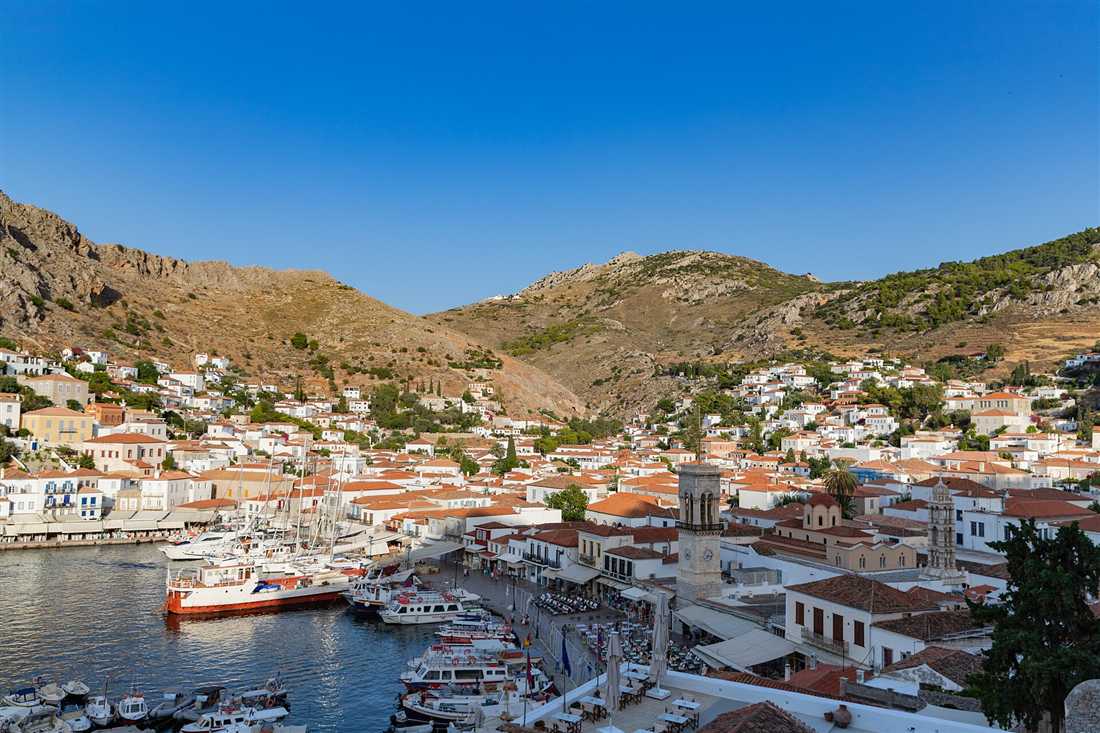
The 2-day Hydra and Poros tour leaves Athens for Hydra, spends the evening in Nafplio and crosses to Poros or Spetses on the second day. Tours across the rest of the country are listed on Greece Tours.
The sections below cover what the 2-day Hydra and Poros tour includes, how it compares with the one-day cruise, the artists and ship-owners of Hydra, the Sleeping Lady and the naval past of Poros, season and booking, with links into the Saronic islands tours pages. The tours shown are checked on GetYourGuide and Viator.
What is the 2-day Hydra and Poros tour?
Starting in Athens, the 2-day Hydra and Poros tour pairs Saronic island days with a mainland evening. Hydra fills day one, Nafplio hosts the evening, and Poros or Spetses fills day two. All three islands lie off the Peloponnese coast.
Hydra belongs to the Saronic Islands, a group named after the Saronic Gulf off Piraeus. The island covers about 50 square kilometres beside the Argolid peninsula of the Peloponnese. It sits between the Saronic and Argolic gulfs. On a 2-day Hydra and Poros tour, this first island lies 37 nautical miles (69 km) from Piraeus.
Poros lies 31 nautical miles (58 km) south of Piraeus. That makes it the nearest island to Athens on a 2-day Hydra and Poros tour. Hydra lies 6 nautical miles farther from Piraeus. Both islands sit close to the Peloponnese shore, within sight of the mainland mountains.
Nafplio, the evening stop on a 2-day Hydra and Poros tour, served as modern Greece’s first official capital. It held that role for seven years in the 19th century. The town stands on the Argolic Gulf as capital of the Argolis regional unit. Buses from Athens reach Nafplio in about two hours via Corinth and Argos.
Spetses replaces Poros on day two when that option is chosen. The island lies west of Hydra, across a strait from Kosta on the Peloponnese coast. Its municipality covers about 27 square kilometres, including three uninhabited islets. The ancient name, Pityussa, described an island covered in pine trees. The private Anargyrios and Korgialenios School stands on the island.
What does the 2-day Hydra and Poros tour include?
The listing for the 2-day Hydra and Poros tour fixes Hydra on day one. Nafplio takes the evening, and day two offers Poros or Spetses. Hotel, transport and meal terms need a check on the listing itself.
GetYourGuide lists the trip as “Athens: Hydra & Poros or Spetses 2-Day Island Hopping Tour”. On the 2-day Hydra and Poros tour, the day-two pick sets the second island. Spetses town is the only large settlement on its island. Its waterfront runs from the Dapia harbour to the Old Harbour.
Each day-two island on the 2-day Hydra and Poros tour has its own harbour town. Poros town climbs a hill above a long waterfront lined with cafes and boats. Spetses town spreads along the coast, with horse-drawn carriages in place of private cars. Both towns face the Peloponnese across narrow straits.
Three points on the listing need a check before departure. The first is the stay in Nafplio and whether a hotel room comes with the trip. The second is the transport between Athens, Hydra, Nafplio and the day-two island. The third is the meals, because the listing title names none.
On a 2-day Hydra and Poros tour, items missing from the inclusions list are separate costs. Site tickets belong in that check. Nafplio’s Venetian-era Palamidi fortress, for one, charges entry at its gate. Drinks and souvenirs bought on Hydra or the second island count as personal spending.
- Listed: departure from Athens
- Listed: day one on Hydra and the evening in Nafplio
- Listed: day two on Poros or Spetses
- To check: the hotel, the transport and the meals
- Separate unless listed: site tickets such as Palamidi
- Separate: personal spending ashore
How does it compare with the one-day Saronic cruise?
The one-day cruise covers Hydra, Poros and Aegina and returns to Piraeus the same evening. The 2-day Hydra and Poros tour drops Aegina and adds a night away. That night brings an evening in Nafplio on the Peloponnese mainland.
GetYourGuide lists the one-day option as “From Athens: Hydra, Poros, and Aegina Day Cruise with Lunch”. Aegina, the third island in that title, lies 27 km from Athens. Hydrofoils from Piraeus reach Aegina in about forty minutes. It ranks second in size among the Saronic Islands, after Salamina. Pistachio growing on Aegina dates to the 19th century.
The cruise fits three island stops into one day that ends at Piraeus. On the 2-day Hydra and Poros tour, Hydra is the only island on day one. Poros or Spetses then fills day two, with no third island added. Each island on the two-day route gets its own day, not a share of one.
Nafplio gives the 2-day Hydra and Poros tour a mainland town that the cruise route leaves out. Its harbour holds the Bourtzi, a fort set in the middle of the water. Above the town, Greek forces under Staikopoulos and Kolokotronis captured the Palamidi fortress in the 19th century.
- Nights away: one on the two-day tour, none on the cruise
- Islands: Hydra plus Poros or Spetses on the tour; Hydra, Poros and Aegina on the cruise
- Time ashore: one island per day on the tour; three stops in one day on the cruise
- Nafplio: an evening there on the tour; no Nafplio stop on the cruise
Compared with the 2-day Hydra and Poros tour, two shorter formats each cover a single island. A Hydra day trip from Athens centres on Hydra alone. A Poros day trip from Athens centres on Poros alone. Both end in Athens on the same day. For a longer route, the 8-day Argosaronic cruise stretches island hopping to eight days.

What drew Leonard Cohen and other artists to Hydra?
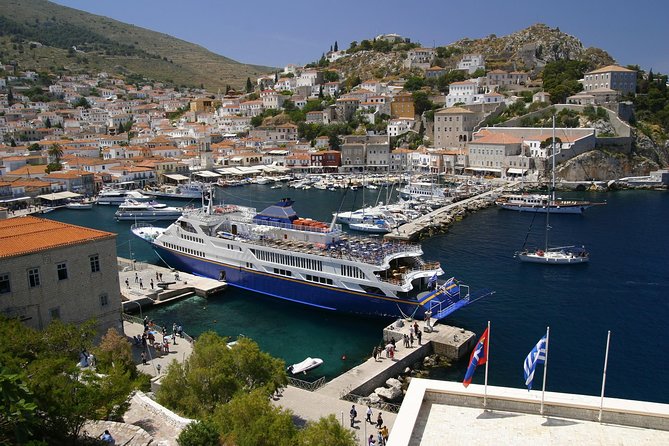
Hydra drew painters and writers in the 20th century as a cheap island home near Athens. Leonard Cohen bought a house on the island and wrote poems, novels and songs there. The 2-day Hydra and Poros tour spends its first day on Hydra.
The painter Nikos Hadjikyriakos-Ghika spent his boyhood summers on Hydra, where his mother’s family lived. He became the leading Greek cubist of the 20th century. He painted key works at his house on Hydra before and after the Second World War. Visitors on a 2-day Hydra and Poros tour see the island light that shaped those paintings.
Henry Miller came to Greece at the invitation of the novelist Lawrence Durrell. Durrell and the poet Giorgos Katsimbalis introduced him to Ghika, who hosted Miller on Hydra. Hydra appears in The Colossus of Maroussi, Miller’s book on his stay in Greece. Readers of that book find the same harbour on a 2-day Hydra and Poros tour.
The Australian writers Charmian Clift and George Johnston tried Kalymnos first, then settled on Hydra. Clift wrote Peel Me a Lotus about their island life. Johnston later won the Miles Franklin Award for his novel My Brother Jack. Clift met Leonard Cohen on Hydra, the island that opens a 2-day Hydra and Poros tour.
Cohen bought a whitewashed house on Hydra with an inheritance from his grandmother. He shared it with Marianne Ihlen, the muse of So Long, Marianne. From a window he saw a bird on a new telephone wire, and Bird on the Wire followed. There he wrote the novel The Favourite Game and the poems in Flowers for Hitler.
Guests on the 2-day Hydra and Poros tour can visit galleries, a house museum and an art school. Background on the harbour town sits on the Hydra island page. Travellers staying in the Argolid reach the same art scene on a Hydra day trip. These names keep the island’s art circle in view today.
- Athens School of Fine Arts: the Tombazis mansion on Hydra now serves as the school’s island annex.
- DESTE Foundation Project Space: collector Dakis Joannou’s foundation shows contemporary art each summer in a former slaughterhouse.
- Panagiotis Tetsis House: the Greek painter’s home on the island now runs as a museum.
- Hydrama Theatre and Arts Centre: the venue hosts a summer festival of performing arts.
- A Theatre for Dreamers: Polly Samson’s novel retells the island circle of Clift, Johnston and Cohen.

How did Hydra’s merchant fleet rise in the 18th and 19th centuries?
Arvanite sailors turned Hydra into a merchant power in the 18th century. Trade under the Russian flag and grain runs in the Napoleonic wars paid for its ships. Day one of the 2-day Hydra and Poros tour lands in their old port.
The first Arvanite settlers reached Hydra from Ermionida in the Peloponnese in the early 16th century. Refugees from Ottoman-Venetian wars followed, and a last Arvanite wave came in the early 18th century. Seafaring and trade began to grow in the 17th century. Guests on the 2-day Hydra and Poros tour walk through the town these settlers built.
The big change came in the mid-18th century, when Hydriots launched a 250-ton ship. Within 14 years, up to 50 Greek ships crowded the island’s anchorage. Ten years later, Hydra fitted out 100 vessels of its own. The harbour on a 2-day Hydra and Poros tour once sheltered this fleet.
The Treaty of Kuchuk Kainarji ended a Russo-Turkish war in the late 18th century. It let Orthodox Christian captains sail under the Russian flag and opened the route to the Black Sea. Hydriot shippers then traded their own cargoes, not just goods for others. Russian-flag profits helped pay for the stone houses seen on a 2-day Hydra and Poros tour.
The Napoleonic wars brought the next wave of wealth. Hydriot ships ran the British blockade to carry grain to France. Their routes also reached Spain and the Americas. Grain fortunes built the grey stone mansions above the harbour seen on a 2-day Hydra and Poros tour.
The new Greek state ended Hydra’s Ottoman-era privileges. Steamships cut costs in the 19th century, but Hydra’s owners stayed with sail. Sponge fishing then became the island’s main trade. Ferries and yachts now fill the berths seen on a 2-day Hydra and Poros tour.
- Crews: Arvanite seamen from Hydra formed the core of the Greek fleet in the War of Independence.
- Ships: Hydra’s merchant vessels were armed and turned into warships for the Greek cause.
- Andreas Miaoulis: this Hydra-born grain trader became admiral of the fleet in the early 19th century.
- Fireships: Miaoulis sent burning vessels into enemy warships and inflicted heavy losses on the Ottoman fleet.
- Psara: after Psara fell, his fleet halted the Ottoman advance at a heavy cost in fireships.
What are the Sleeping Lady and the Russian Bay of Poros?
The Sleeping Lady is a mountain outline west of Poros shaped like a sleeping woman. The Russian Bay holds the ruins of a Russian naval station on Kalaureia. Both frame Poros on day two of the 2-day Hydra and Poros tour.
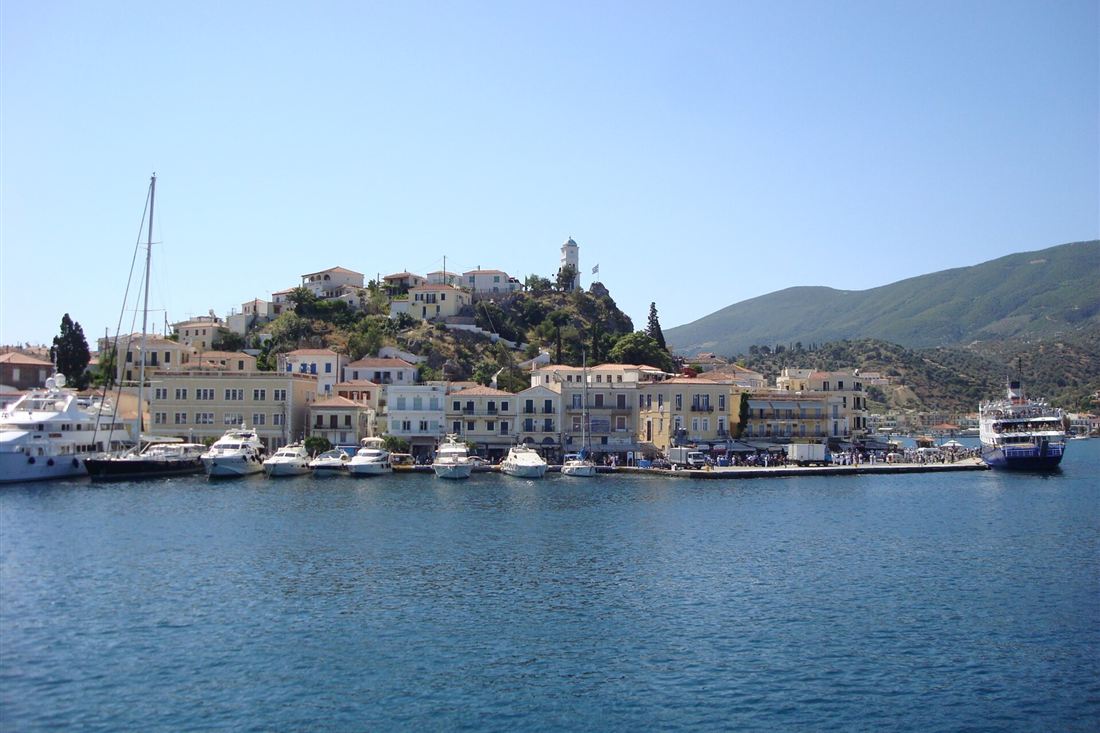
Locals call the outline Koimomeni, Greek for the sleeping woman. The shape is a mountain ridge on the Peloponnese coast, across the water from the island. From Poros town on the 2-day Hydra and Poros tour, the ridge looks like a woman asleep. At sunset the outline turns into a sharp, dark silhouette.
The island of Poros on the 2-day Hydra and Poros tour is two islands in one. Sphairia, the small southern part, holds the main town and its port. Kalaureia, the northern part, is by far the larger of the two. A narrow sea channel splits them, and a small bridge joins the halves.
For guests on the 2-day Hydra and Poros tour, the bay’s Greek name explains its history. Locals call it Rosiko Navstathmo, which means the Russian naval station. It is a wooded cove on Kalaureia, west of Poros harbour. Russian ships used it as a base in the years of the Greek War of Independence.
The station served the Russian squadron that stayed in Greek waters in the early 19th century. Its ships took on bread, water and stores in the sheltered cove. Russian sailors also kept workshops ashore for repairs. The cove lay close to Nafplio and Aegina, the seats of the young Greek state.
The base held warehouses for military supplies and ovens that baked hardtack for the crews. Hardtack is a hard, dry biscuit that keeps for months at sea. Guests on the 2-day Hydra and Poros tour find its carved stone ruins among the pines.
The main ruin has three narrow-fronted rectangular rooms. A second block of warehouses stands behind it. Just offshore lies Daskaleio, a tiny islet with a small church on its top. From the cove, a guest on the 2-day Hydra and Poros tour sees the church across the water.
- Land area of Sphairia and Kalaureia together: about 31 square kilometres
- Highest peak: Vigla, 358 metres, in the west-central part of the island
- Rock of Sphairia: volcanic
- Rock of Kalaureia: limestone and schist
- Russian Bay: a wooded cove on Kalaureia, west of Poros harbour
- Daskaleio: an islet with a chapel, just off the Russian Bay

Why did the first naval base of modern Greece stand on Poros?
Poros already held a Russian supply station, ready for a new fleet. Governor Ioannis Kapodistrias set up the first naval base of modern Greece there in the early 19th century. That base still shapes the Poros seen on the 2-day Hydra and Poros tour.
Kapodistrias was the first head of state of independent Greece. He requisitioned the Russian buildings at the edge of Poros town for the Greek war navy. Russia received a new plot of land in a nearby cove in exchange. On the 2-day Hydra and Poros tour, that swap explains why two navies left traces on one island.
The Poros base stayed the main station of the Greek navy for about half a century. In the late 19th century, the navy moved its main work to Salamis, near Piraeus. Salamis remains the chief base of the Hellenic Navy today. Poros, on day two of the 2-day Hydra and Poros tour, marks the first chapter of that story.
In the early 19th century, the ambassadors of Britain, France and Russia met Kapodistrias on Poros. Their talks, known as the Poros conference, set out proposals for the borders of the future Greek state. That state came into being two years later. These three powers had destroyed the Ottoman and Egyptian fleet at Navarino a year earlier.
Admiral Andreas Miaoulis, born on Hydra, sided with the political camp that opposed Kapodistrias. Three summers after the conference, he seized the fleet at Poros. He refused to hand it to the Russian Admiral Ricord, who acted for the government. When Ricord attacked Poros in mid-August, Miaoulis blew up the frigate Hellas.
The Hellas was the flagship of the Greek fleet. A shipyard in New York City built her under the first name Hope. Miaoulis destroyed two corvettes along with her. Kapodistrias himself was assassinated in the autumn of the same year. Visitors on the 2-day Hydra and Poros tour look out on the waters where she was lost.
The old base still serves the Hellenic Navy as a training centre for naval personnel. Greeks call it the Progymnastirio, where new recruits begin their service. Its grounds sit beside the channel between Sphairia and Kalaureia. A day trip to Poros or the 2-day Hydra and Poros tour reaches an island that trains sailors.
- Birthplace of Kapodistrias: the island of Corfu
- Earlier post of Kapodistrias: foreign minister of the Russian Empire
- Political camp of Kapodistrias: the Russian Party
- Political camp of Miaoulis: the English Party
- Earlier trade of Miaoulis: grain merchant and ship captain
- Rank of Miaoulis from the early war years: navarch, the admiral of the fleet
Which season suits the 2-day Hydra and Poros tour?
Late spring and early autumn suit the 2-day Hydra and Poros tour. The sea sits between 19 and 25°C, and monthly rain stays under 45 mm. July and August bring the warmest water, near 26°C, with strong meltemi winds.
Hydra has a hot semi-arid climate, with a yearly mean of 20.4°C and 393 mm of rain. July records just 1.0 mm of rain. December is the wettest month, with 62.7 mm.
- Spring: the sea climbs from 15.4°C in March to 19.2°C in late spring, with highs up to 25°C.
- Summer: the sea reaches 23.1°C in June and 26.1°C in August, with highs near 33°C.
- Autumn: the sea holds 25.3°C in September, while rain climbs to 60.9 mm by November.
- Winter: the sea cools to 15.3°C in February, and January highs stay near 15°C.
The meltemi blows from late spring to mid-September and reaches force 7 to 8. It peaks in the afternoon, though the Attic coast gives the Saronic Gulf partial shelter. Summer timetables run more high-speed crossings from Piraeus than winter timetables. Strong meltemi spells can stop those boats for a day.
Orthodox Easter moves each year but always falls in spring. On Hydra, the Good Friday epitaphios procession carries a flower-covered bier through the lanes. Easter weekend dates place the 2-day Hydra and Poros tour amid midnight Resurrection services and Sunday lamb roasts.
The Miaoulia festival fills Hydra in the last week of June. It honours Admiral Andreas Miaoulis and his naval battles in the 19th-century Greek War of Independence. A sea re-enactment of a burning Ottoman fleet closes the event, followed by fireworks. A 2-day Hydra and Poros tour booked for late June overlaps festival week.
How do you book and cancel the 2-day Hydra and Poros tour?
Book the 2-day Hydra and Poros tour on GetYourGuide. Pick a date, the group size and the day-two island, Poros or Spetses. Free cancellation runs up to 24 hours before the start on listings with that label.
The GetYourGuide listing books in five steps on the website or the app. Its full title is “Athens: Hydra & Poros or Spetses 2-Day Island Hopping Tour”. The island choice changes day two only, since day one covers Hydra and an evening in Nafplio.
- Open the listing and select a start date.
- Enter the number of travellers.
- Choose the day-two option: Poros or Spetses.
- Pay online and receive the voucher by email and in the app.
- Read the voucher for the Athens meeting point and start time.
A Spetses day trip from Nafplio covers Spetses on its own. That leaves day two of the 2-day Hydra and Poros tour free for Poros. Guests who want both islands pair the two bookings.
Free cancellation on the 2-day Hydra and Poros tour closes 24 hours before the voucher start time. Cancellations go through the booking in the GetYourGuide account page or app. A cancellation made before that cut-off returns the full payment to the original payment method. The voucher also lists the local operator’s phone number for questions on the day.
Frequently Asked Questions
How long does the tour last?
The listing runs over 2 days from Athens. Day one of the 2-day Hydra and Poros tour visits Hydra and closes with an evening in Nafplio. Day two goes to Poros or Spetses. The GetYourGuide voucher states the start time for day one.
Where does the tour start?
Athens is the starting city. The GetYourGuide booking page lists the exact meeting point before payment. After payment, the voucher for the 2-day Hydra and Poros tour repeats the spot and the start time. Guests bring that voucher to check-in on day one.
Where is the night spent?
The night of the 2-day Hydra and Poros tour is spent in Nafplio, on the Argolic Gulf. The hotel name and its location appear on the listing and on the voucher. Tavernas line the old-town streets below the fortress for the evening meal.
Does day two go to Poros or Spetses?
One of the two, set by the option picked at booking. Poros lies 31 nautical miles south of Piraeus. Spetses covers 27 km², has 3,748 residents and keeps private cars out of its town limits. Both options of the 2-day Hydra and Poros tour share the same Hydra day.
Do cars run on Hydra?
No. Hydra bans wheeled vehicles, including cars, motorbikes, scooters and bicycles. Rubbish trucks are the only motor vehicles on the island. Donkeys, mules, horses and water taxis carry people and bags. Guests on the 2-day Hydra and Poros tour cover Hydra town on foot.
How far is Hydra from Piraeus by sea?
Hydra lies about 37 nautical miles, or 69 km, from Piraeus by sea. High-speed hydrofoils and catamarans on the Saronic line also call at Poros and Spetses. From Metochi on the Peloponnese coast, a passenger boat crosses to Hydra harbour in about 20 minutes.
Can children join the tour?
Families check the age rules on the GetYourGuide listing before booking the 2-day Hydra and Poros tour. Hydra town rises from the harbour in steep stone steps, which suits children who walk well. On Spetses, horse-drawn carriages offer short rides through the town.