
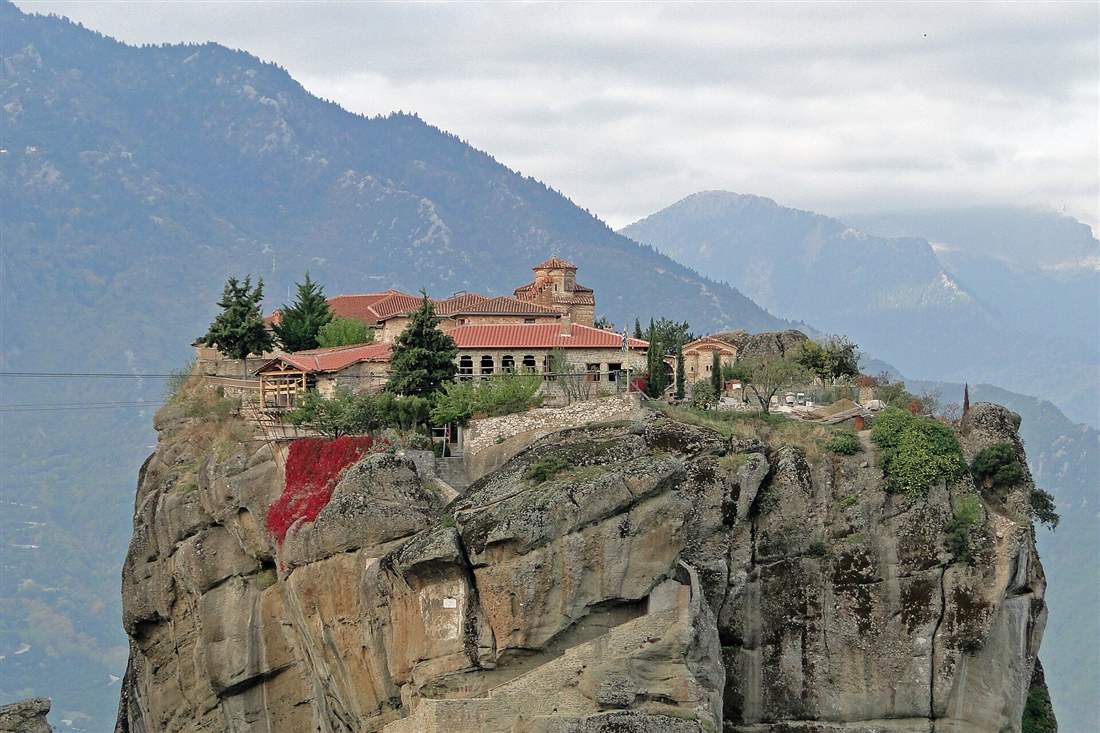
The 3-day Meteora trip from Thessaloniki joins tours of the rock monasteries, a museum visit and hotel nights near Kalambaka. Tours across the rest of the country are listed on Greece Tours.
The sections below cover what the Meteora trip from Thessaloniki includes, the comparison with a day trip, the Byzantine church of Kalambaka, Porta Panagia at Pyli, season and booking, with links into the Meteora from Thessaloniki pages. The tours shown are checked on GetYourGuide and Viator.
What is the 3-day Meteora trip from Thessaloniki?
This tour is a 3-day Meteora trip from Thessaloniki to the rock pillars of central Greece. It starts in Thessaloniki and lasts 3 days. Its goal is the six active monasteries on top of the rocks.
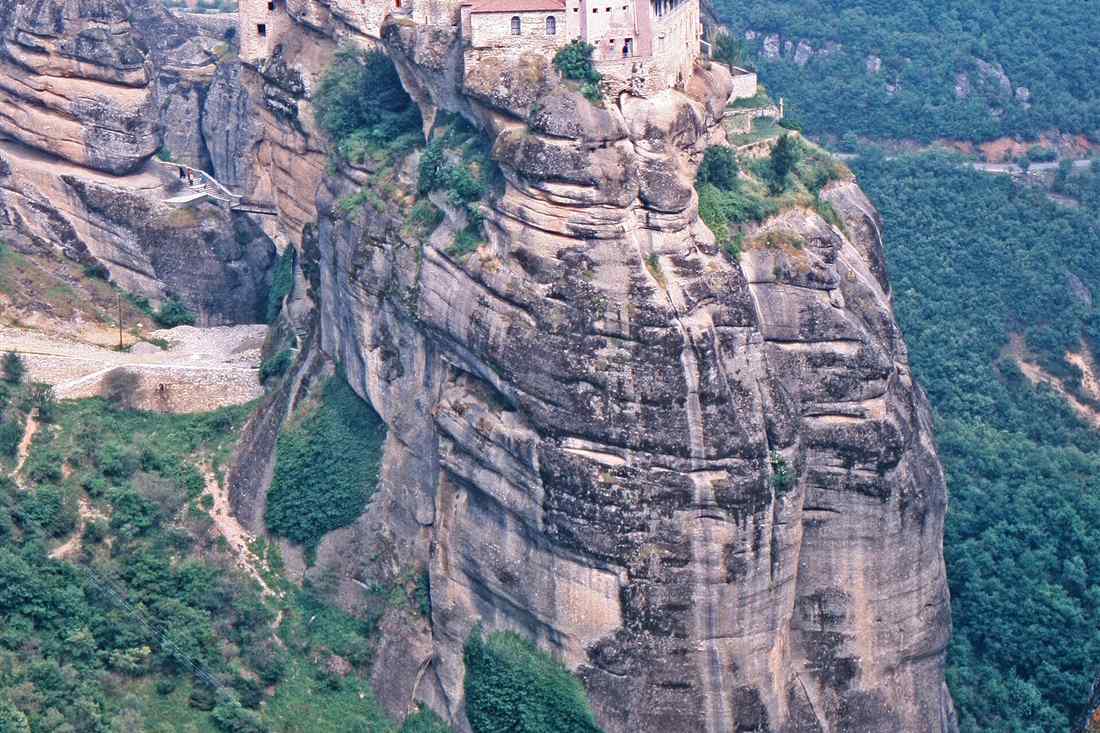
Meteora stands in the Trikala regional unit of Thessaly, at the northwest edge of the Thessalian plain. The Pindus mountains rise to the west, and the Pineios river runs along the valley below. Thessaloniki lies about 230 km to the northeast by road. On the 3-day Meteora trip from Thessaloniki, that road leaves Macedonia and enters Thessaly.
The name Meteora comes from the Greek word meteoros, meaning lofty or raised into the air. The English word meteor grows from the same root. The pillars are delta sandstone and conglomerate, pushed up about 60 million years ago. Weathering then split the stone into the towers seen on the 3-day Meteora trip from Thessaloniki.
Hermits lived in caves on the pillars by the 9th century. Monks built 24 monasteries on the summits from the 14th century, and 6 still stand. These are Great Meteoron, Varlaam, Rousanou, St Nicholas Anapafsas, Holy Trinity and St Stephen. St Stephen has housed nuns since the 20th century. A paved road now loops past all 6.
Great Meteoron sits 613 m above sea level, over 400 m above the Pineios valley. Athanasios the Meteorite founded it in the 14th century. Its main church is dedicated to the Transfiguration of Christ. Ahead of the 3-day Meteora trip from Thessaloniki, the Meteora monasteries page covers each one in turn.
UNESCO added Meteora to its World Heritage List in the late 20th century, under cultural and natural criteria. Mount Athos is the only other Greek site with that double status. Theophanes the Cretan painted the frescoes of St Nicholas Anapafsas in the 16th century. UNESCO cites the monastery frescoes as a key stage in post-Byzantine painting.
What does the 3-day Meteora trip from Thessaloniki include?
The title of this 3-day Meteora trip from Thessaloniki names three parts: tours, a museum and a hotel. Monastery entry fees, meals and an unlisted museum ticket sit outside those parts. Each needs its own budget line.
Each monastery asks men to wear long trousers and women to wear skirts below the knee. Sleeves cover the upper arms of every visitor, and wrap skirts wait at the entrances. Photography stops at the church doors inside each monastery. Those rules apply at every gate on the 3-day Meteora trip from Thessaloniki.
- Tours: sightseeing among the rock pillars and monasteries of Meteora.
- A museum: an indoor visit beside the outdoor time on the rocks.
- A hotel: overnight stays inside the 3 days, so no same-day drive back.
- Monastery entry fees: a separate ticket at each monastery gate.
- Museum ticket: an extra cost whenever the inclusions leave it out.
- Meals: lunches, dinners and drinks across the 3 days, unless the inclusions list them.
The title names a museum but not its theme, collection or town. Check the inclusions for its name before the 3-day Meteora trip from Thessaloniki sets off. Indoor rooms give a break from the open rock and its long stairways. Greek state museums close on New Year’s Day, Orthodox Easter Sunday and Christmas Day.
Kalambaka and Kastraki sit below the rocks seen on the 3-day Meteora trip from Thessaloniki. Kastraki lies about 2 km northwest of Kalambaka, with rocks on three sides. Both places hold family hotels and guesthouses within sight of the pillars. The page on where to stay in Meteora compares rooms in both.
Steps cut into the rock in the 20th century lead up to the monastery gates. Before the steps, monks rose in nets and on rope ladders. St Stephen is the exception today, reached over a short bridge from the road. Flat shoes with grip suit the rock steps met on the 3-day Meteora trip from Thessaloniki.
Tavernas in Kalambaka and Kastraki serve grilled meats, cheese pies and Greek salads. Thessaly lies inside the protected zone for feta, the brined cheese of sheep and goat milk. Monastery shops sell icons, books and candles near the church doors.
How does it compare with a Meteora day trip from Thessaloniki?
Against a day trip, the 3-day Meteora trip from Thessaloniki adds 2 days and hotel nights. The difference shows in sunset, monasteries reached and hours on the road. A day trip returns to Thessaloniki the same evening.
The Meteora day trip from Thessaloniki fits the rocks and the drive back into one date. That plan suits travellers with a single free day in northern Greece. The round trip adds up to about 460 km of road. The 3-day Meteora trip from Thessaloniki ends its first day at a hotel, not on the road home.
- Nights: hotel nights on the 3-day trip, against none on the day trip.
- Sunset: at the rocks on the 3-day trip; a day trip staying late drives 3 hours after dark.
- Monasteries reachable: time for all 6 over 3 days, against interiors of 2 or 3 on one date.
- Time on the road: close to 6 hours inside one day, against road hours spread over 3 days.
A night at Meteora places guests at the rocks for sunset and again for the next sunrise. Evening light turns the grey conglomerate of the pillars gold, then red. That evening and morning light falls outside a same-day return but inside the 3-day Meteora trip from Thessaloniki.
Each of the 6 monasteries keeps its own weekly closing day. A single date at the rocks can meet one or two closed doors. Over the 3-day Meteora trip from Thessaloniki, a monastery shut on one date can open on the next. Interior visits cover a church, a courtyard and viewpoints over the plain.
Marked walking trails cross the whole rock area. The paths join Kastraki and Kalambaka to the monastery summits. A hotel night at the rocks puts the trailheads within walking range at dawn. A same-day return leaves those paths for another visit.
A day trip spends close to 3 hours on the road before its first monastery gate. A guest who wakes at Meteora reaches the first open gate with no drive at all. The road time saved turns into extra hours at the gates and viewpoints.

What does Kalambaka’s Byzantine Church of the Dormition hold?
The Church of the Dormition holds a marble ambo rebuilt from reused pieces. Its frescoes span the late 11th to the 18th centuries. This basilica is a Byzantine sight near the rocks for anyone on a 3-day Meteora trip from Thessaloniki.
The church served as the cathedral of Stagoi, the Byzantine name of Kalambaka. Stagoi was a fortress town and a bishop’s see from the start of the 10th century. Of the town’s medieval monuments, only this church survives today. It stands below the massif that gives the 3-day Meteora trip from Thessaloniki its name.
The present church was long dated to the late 11th or early 12th century. That date rests on the first phase of its wall paintings. A newer dating places the building earlier, around the end of the 10th century. The older date falls in the Komnenos era. Extensive repairs followed in the late 16th century.
- Three aisles under a wooden roof, ending in three apses on the east side
- A central aisle that rises higher than the two side aisles
- Alternating piers and columns that divide the central aisle from the side aisles
- A tribelon, a triple-arched opening, between the inner narthex and the central aisle
- An outer narthex, added in a later building phase
Fragments of a mosaic floor lie under the present floor. The apse keeps a synthronon, the stepped bench where the clergy sat. These clues point to an early Christian basilica on the same foundations. The Byzantine builders kept its outline. Travellers on a 3-day Meteora trip from Thessaloniki who step inside stand within a late antique plan.
The marble ambo is a raised pulpit where the Gospel was read aloud. It has two staircases for the reader to climb. It was rebuilt from spolia, reused marble from older structures. Two-stair ambos belong to early Christian church design. On a 3-day Meteora trip from Thessaloniki, the ambo is the piece to seek out in the nave.
Pieces of an ancient Greek temple are built into the church walls. That temple is linked to the god Apollo. A Greek inscription on Kalambaka’s church of Saint John the Baptist names the ancient town of Aiginion. Both finds place an ancient Greek town here before Byzantine Stagoi.
The main church carries frescoes from two phases. The older layer, from the late 11th or early 12th century, survives in fragments. It sits at the east end of the south aisle. The narthex paintings date to the 18th century. Readers planning a 3-day Meteora trip from Thessaloniki can compare these fragments with the later work around them.
The larger part of the surviving frescoes dates to the late 16th century. The priest Kyriazis and the Cretan monk Neophytos painted them. Neophytos was a son of Theophanes the Cretan, a painter from Heraklion. Their work ties a 3-day Meteora trip from Thessaloniki to the wider story of Meteora frescoes.
Theophanes lived from the late 15th century to the mid-16th century. He painted in the style of the Cretan school. He spent much of his career as a monk on Mount Athos. His frescoes there cover churches at the Great Lavra and Stavronikita monasteries.
What is the Porta Panagia church at Pyli?
Porta Panagia is a 13th-century Byzantine church at Pyli, about 18 km west of Trikala. It keeps full-length mosaic icons of Christ and the Virgin. It stands at the mouth of the Portaikos gorge, within reach on a 3-day Meteora trip from Thessaloniki.
The church stands on the north bank of the Portaikos, opposite Pyli. Its old village was known in Byzantine times as Megalai Pylai, the Great Gates. Both names, Pyli and Porta, mean gate, after the pass into the Pindus mountains here. Pyli sits in the same Trikala regional unit as Meteora. Meteora is the goal of a 3-day Meteora trip from Thessaloniki.
Porta Panagia was the katholikon, or main church, of a monastery founded in the late 13th century. Its founder was the sebastokrator John I Doukas, ruler of Thessaly. He was an illegitimate son of Michael II Doukas, Despot of Epirus. That makes him a member of the Komnenos-Doukas line of Epirus. The monastery honoured the Unconquerable Virgin, Panagia Akatamachetos.
The monastery was stauropegic, meaning it reported directly to the Patriarch in Constantinople. Emperors Andronikos II and Andronikos III Palaiologos confirmed its lands and dependent estates. Saint Bessarion, later Metropolitan of Larissa, was born in this village. For anyone on a 3-day Meteora trip from Thessaloniki, these names link the monastery to Constantinople and Larissa.
The monastery closed under Ottoman rule. The Ottomans razed the old village in the early 19th century. Only the church of the monastery survives. Later in the 19th century it passed to the nearby Dousiko monastery but stayed the village parish church.
- A three-aisled basilica with a cross-shaped roof, its aisles divided by columns
- Roofs set at different heights over each part of the building
- Lower walls of large grey limestone blocks up to 2 m high, certain blocks set as crosses
- Upper walls in cloisonné masonry, each stone framed by brick
- Brick dentil bands, meanders and crosses across the outer walls
- Two- and three-lobed windows set in arched frames
- A domed exonarthex in cross-in-square form, added in the late 14th century
- Column remnants of an ancient temple outside the exonarthex
A fire in the mid-19th century destroyed the bulk of the carvings. The marble templon before the sanctuary is the original screen. Anastasios Orlandos restored it with small changes. Its capitals and top beam carry flat relief carving with traces of wax-mastic filling. Visitors on a 3-day Meteora trip from Thessaloniki can read 13th-century carving on this screen.
Full-length mosaic icons sit on both eastern piers. One shows Christ, the other the Virgin holding the Child. Their places reverse the standard Orthodox order. Anyone on a 3-day Meteora trip from Thessaloniki who enters finds John Doukas’s tomb by the south wall. A fresco above shows him as a monk, presented by an angel to the enthroned Virgin.
Saint Bessarion built the Ottoman-era stone bridge of Pyli in the early 16th century. Its single semicircular arch spans 29 m across the Portaikos. For over four centuries it was the only route from the Thessalian plain to the Pindus villages. A Kalambaka private tour adds more sights in this area to a 3-day Meteora trip from Thessaloniki.
Which season suits the 3-day Meteora trip from Thessaloniki?
Late spring and early autumn suit the 3-day Meteora trip from Thessaloniki. Both seasons bring mild days, long evening light and full monastery timetables. Summer brings strong heat on the Thessaly plain, and winter brings short days.
Thessaloniki has a dry, semi-arid climate with hot summers and cool winters. July days reach a mean high of 32.3 °C, and January days reach 10.6 °C. January nights fall to a mean low of 3.4 °C. Rain totals 449.6 mm a year. Snow falls on the city nearly every winter, and the cover melts within days.
Kalambaka sits at the foot of the Meteora rocks, about 20 km from Trikala. The Trikala area has a Mediterranean climate with a continental edge. Rain totals 644.7 mm a year, more than in Thessaloniki. Days and nights differ sharply, so a warm layer helps on early mornings at the rocks.
- Spring: April highs average 20.5 °C. Meteora sunset moves from about 19:55 in early April to 20:50 in late spring.
- Summer: July highs average 33.5 °C, and nights stay near 20 °C. Sunset comes at about 21:05 in late June.
- Autumn: October highs average 24.6 °C. Sunset falls from about 19:25 in late September to 17:40 after the clocks change.
- Winter: January highs average 10.7 °C, and nights drop to 1.8 °C. Sunset arrives at about 17:10 in December.
Monastery timetables tighten from 1 November to 31 March, which shapes a winter 3-day Meteora trip from Thessaloniki. Doors open between 09:00 and 10:00 and close between 14:00 and 17:00. Great Meteoron shuts on Tuesdays, Wednesdays and Thursdays. Snow caps the Pindus peaks to the west. Pack boots and gloves for a Meteora winter visit.
Families with children find late spring and early autumn easier for a 3-day Meteora trip from Thessaloniki. Midday shade is scarce on the monastery stairs in July and August. Read up on visiting Meteora with kids before picking dates. Hats, water and sun cream help on exposed paths in summer.

How do you book and cancel the Meteora trip from Thessaloniki?
Book the 3-day Meteora trip from Thessaloniki on GetYourGuide by picking a date and the number of travellers. The listing shows its cancellation terms on the booking page. Free cancellation runs up to 24 hours before the start where that label appears.
The booking widget on this page opens the live calendar for the 3-day Meteora trip from Thessaloniki. The listing shows what the package covers and what it leaves out. Dates without free places show as unavailable in the calendar. Read both lists before paying.
- Open the booking widget and pick a travel date from the calendar.
- Set the number of adults and children in the group.
- Read the inclusions, the meeting point and the cancellation terms.
- Enter the lead traveller’s name, email address and phone number.
- Pay online and save the confirmation email with the voucher.
To cancel a 3-day Meteora trip from Thessaloniki, open the booking in the GetYourGuide app or account. The refund follows the terms shown on the listing at the time of booking. Count the 24 hours back from the start time in Greek local time.
Save the voucher on a phone and print a copy for the 3-day Meteora trip from Thessaloniki. The voucher carries the booking reference used for any change or cancellation request. Keep the support contact from the confirmation email saved for questions during the trip.
Frequently Asked Questions
How long does the trip to Meteora last?
It lasts three days in total. A 3-day Meteora trip from Thessaloniki combines tours, a museum and a hotel stay in one package. Read the full day order on the listing before booking. Pack for three days of walking on stone paths.
Where does the trip start?
The trip starts in Thessaloniki, the second-largest city in Greece. The exact meeting point and start time appear on the booking page and on the voucher. Reach that point 15 minutes early on day one of the 3-day Meteora trip from Thessaloniki.
Is a hotel included in the trip?
Yes. The listing title names a hotel, so overnight stays come with the package. Check the listing for the hotel details and any meals before paying. Bring a passport or ID card, since Greek hotels record guest documents at check-in.
Which museum does the trip include?
The listing title names a museum visit without saying which one. Check the full itinerary on the booking page for the museum name and location. Do this before booking the 3-day Meteora trip from Thessaloniki if one museum matters to the group.
Are monastery entry fees included?
The listing does not name monastery entry fees among its inclusions. Each monastery charges its own entry fee at the gate. Carry cash in small notes for each gate on the 3-day Meteora trip from Thessaloniki. Read the inclusions on the booking page to confirm what the package covers.
What is the dress code at the monasteries?
Men wear long trousers, and shorts above the knee are refused at the gate. Women wear skirts below the knee and cover their upper arms. Sleeveless tops are refused for everyone. Skirts and shawls are lent or sold at the monastery entrances.
How far is Meteora from Thessaloniki?
Meteora lies about 230 km south-west of Thessaloniki by road. The rocks rise straight above Kalambaka, a small town on the north-west edge of the Thessaly plain. The Pineios river flows past the town on its way east to Larissa, the capital of Thessaly.
Does the trip suit families with children?
Yes, for children who climb stone steps without help. Great Meteoron sits at the top of about 300 steps. St Stephen’s is reached across a short bridge with no stair climb. Pack a baby carrier, not a stroller, for a 3-day Meteora trip from Thessaloniki.
What do travellers pack for the trip?
Pack flat shoes with grip, modest clothes for the monasteries and a warm layer for cool mornings. Cash in small notes covers the monastery gates. A power bank keeps phones charged for photos and the voucher on a 3-day Meteora trip from Thessaloniki.
Can travellers see sunrise at Meteora on the trip?
Yes. A hotel night near the rocks puts sunrise within reach. Viewpoints on the monastery road look out over the Thessaly plain. The listing’s day order shows whether an early start fits the 3-day Meteora trip from Thessaloniki.
How do travellers get from Kalambaka to the monasteries?
A paved road climbs from Kalambaka and Kastraki to the monastery gates. The road loops past all six active monasteries. Tours on the 3-day Meteora trip from Thessaloniki use it to reach each gate. Short stairways then lead from the car parks to the entrances.