
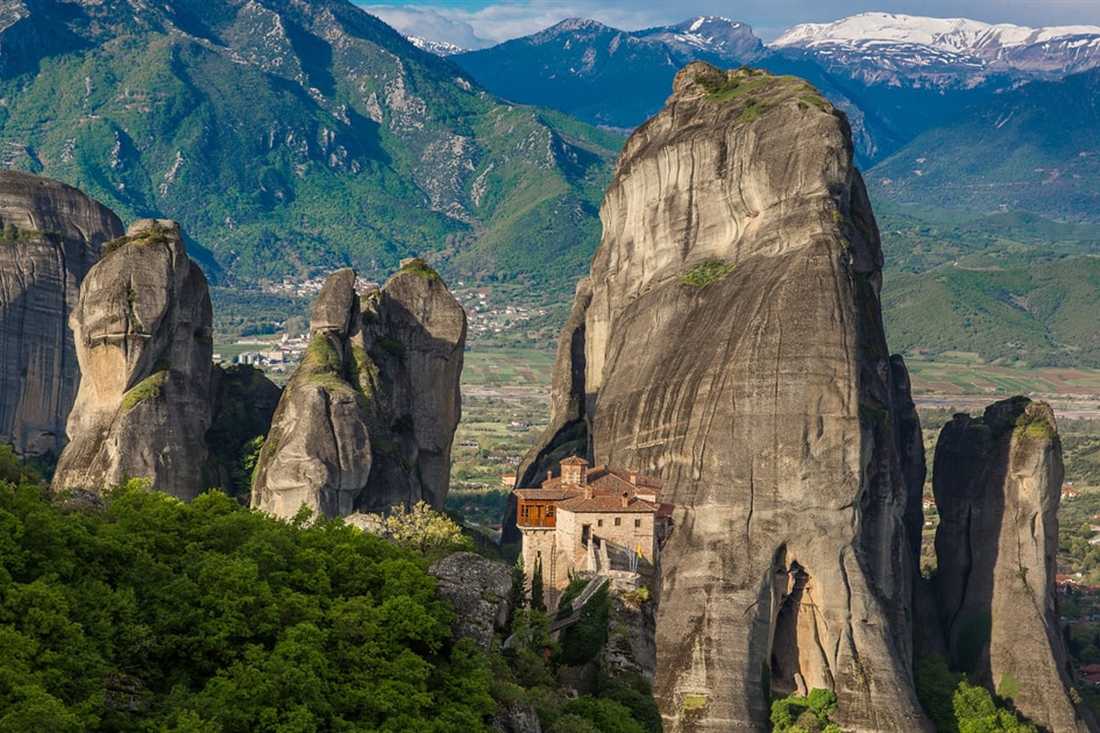
A Meteora day trip from Pieria is a guided coach excursion from the Olympic Riviera, past Mount Olympus and through the Vale of Tempe, to the rock-top monasteries of Meteora. Tours across the rest of the country are listed on Greece Tours.
The sections below cover the tours you can book, pickups, the route, Tempe, Olympus, the monasteries, the frescoes, closing days, lunch, dress code and booking, with links into the Meteora pages. The tours shown are checked on GetYourGuide.
What is a Meteora day trip from Pieria?
A Meteora day trip from Pieria is a full-day guided excursion from beach hotels on the Olympic Riviera. The coach travels south to the rock-top monasteries of Meteora near Kalambaka in Thessaly. It returns to the hotel the same day.
The journey begins below Mount Olympus along the coast. Travelers leave their hotel in the morning and head toward the Pindus mountains. This route connects the northern beaches with the central plains of Greece.
Visitors spend the middle hours exploring the area around Kalambaka. A single Meteora day trip from Pieria covers the entire distance in one continuous loop.
The return journey follows the same road north. Guests arrive back at their hotel by evening. This schedule keeps the whole experience within a single calendar day without requiring an overnight stay in Thessaly.
- Starts at beach hotels on the Olympic Riviera
- Travels south to the rock-top monasteries
- Returns to the original hotel the same day
- Covers the distance between the coast and Thessaly
Which Meteora day trips from Pieria can you book?
Two main options exist for a Meteora day trip from Pieria through online platforms. GetYourGuide lists a tour called “From Pieria Coast: Meteora Day Trip with Monasteries Visit.” The Greek Holidays agency sells a package named “Meteora monasteries from Pieria.”
The GetYourGuide option uses a coach that travels down the coast of the Olympic Riviera. Passengers see Mount Olympus from the vehicle windows before heading inland. The itinerary includes stops at the monasteries after the coastal drive.
The Greek Holidays package provides hotel pickup and return transport. An air-conditioned vehicle carries guests along the entire route. An official guide accompanies the group to explain the sights. This specific tour visits two monasteries during the day.
- GetYourGuide offers a coach tour with coastal views
- Greek Holidays provides an air-conditioned vehicle with an official guide
- The Greek Holidays itinerary includes visits to two monasteries
- Greek Holidays includes hotel pickup and return
Where do pickups start on the Pieria coast?
Pickups for a Meteora day trip from Pieria begin at hotels along the Olympic Riviera. This coastal strip sits directly below Mount Olympus. Paralia Katerinis serves as a primary reference point for these collection locations.
The Olympic Riviera stretches along the northern Aegean shore. Hotels here cater to visitors who want beach access combined with mountain views. Tour operators use this concentrated line of accommodations to organize efficient morning collections.
After booking, the agency sends a voucher to the traveler. This document contains the exact pickup point and the scheduled time. Guests wait outside their hotel or at a nearby set spot.
This system removes the need for personal transport to a departure hub. The coach moves from one hotel to the next along the coast. Once all passengers board, the vehicle turns south to begin the long drive toward Thessaly.
- Collection points are located at hotels along the Olympic Riviera
- Paralia Katerinis acts as a central reference area for pickups
- The booking voucher specifies the exact location and time
- The coach collects passengers sequentially along the coastal road
What route does a Meteora day trip from Pieria follow?
A Meteora day trip from Pieria follows a specific path south from the hotel. The coach heads along the coast of the Olympic Riviera with views of Mount Olympus. It then crosses farmland, rivers, valleys, and the Thessalian plain to reach Kalambaka.
The first leg of the journey stays close to the sea. Passengers look out the windows at the slopes of Mount Olympus rising above the shoreline. After this coastal section, the vehicle makes a short coffee break so travelers can stretch their legs.
The road then turns inland. The main route south runs through the Vale of Tempe, a gorge between Mount Olympus and Mount Ossa. The A1 motorway now uses tunnels to pass through this narrow space efficiently.
Beyond the gorge, the landscape opens up into wide agricultural areas. The coach passes Larissa before entering the flat expanse of the Thessalian plain. This long stretch of road continues until the vehicle reaches Kalambaka at the foot of the Pindus mountains.
The return journey reverses this path northward. The driver schedules another short coffee break on the way back to the coast. A Pieria Riviera day trip from Thessaloniki covers the same coastline.
- Heads south along the coast with views of Mount Olympus
- Stops for a short coffee break before turning inland
- Passes through tunnels in the Vale of Tempe gorge
- Crosses farmland, rivers, and the Thessalian plain
- Arrives at Kalambaka at the foot of the Pindus mountains
- Makes a second coffee break during the return drive
When does a Meteora day trip from Pieria run?
A Meteora day trip from Pieria operates during the warmer months of the year. The Greek Holidays tour runs from late spring until late October. Departures occur on every day of the week throughout this period.
The season covers the summer months on the Olympic Riviera, when the beach hotels are open. Late spring and autumn days bring milder heat for the monastery steps, while July and August are the hottest months on the plain.
Running seven days a week gives travelers flexibility when planning their holiday itinerary. A guest arriving on any date in that season finds a departure. This daily frequency removes the need to rearrange other activities around a limited timetable.
Travellers who want the mountain itself choose a Mount Olympus day trip from Thessaloniki.
What is the Vale of Tempe on the road south from Pieria?
The Vale of Tempe is a gorge in northern Thessaly between Mount Olympus and Mount Ossa. A Meteora day trip from Pieria passes through this narrow valley. The Pineios river flows through the ten-kilometre gorge to the Aegean Sea.
In places, the gorge narrows to about twenty-five metres across. The rock cliffs rise nearly five hundred metres above the water. This tight space makes the valley a dramatic sight for anyone travelling south.
The Tempe Pass serves as the main route from Larissa through the mountains to the coast. Today, the A1 motorway bypasses the old narrow road with tunnels.
Ancient armies used this pass to move troops. Greek forces gathered there to block the Persian king Xerxes in the fifth century BC. Roman armies forced their way through the pass in the second century BC.
- The gorge stretches about ten kilometres long.
- Mount Olympus stands to the north of the valley.
- Mount Ossa rises to the south of the river.
- The Byzantines called the pass Lykostomo, meaning the wolf’s throat.
The name Lykostomo shows how dangerous people thought this route was. High walls of rock left little room to escape an attack. A Meteora day trip from Pieria follows this same historic path safely today.
Which myths belong to the Vale of Tempe?
Ancient poets called the vale a favourite haunt of Apollo and the Muses. A temple of Apollo stood on the right bank of the Pineios river. These stories add rich history to a Meteora day trip from Pieria.
Workers cut laurel branches in this valley for the winners of the Pythian Games at Delphi. The laurel grew along the riverbanks near the temple. Athletes wore these leaves as crowns after winning their competitions.
One tale says Poseidon used his trident to cut the gorge through the solid rock. The sea god split the mountains so the river can reach the ocean. This myth explains the steep cliffs visitors see today.
Aristaeus, a son of Apollo, lived in the vale according to local legends. He taught people about farming and keeping bees. His story connects the landscape to early rural life in Greece.
- Apollo and the Muses spent time in the valley.
- Poseidon supposedly carved the gorge with his trident.
- Laurel for the Pythian Games came from the riverbanks.
- Aristaeus made his home among the rocks and trees.
These myths give the landscape a deeper meaning. Travellers on a Meteora day trip from Pieria ride through a place shaped by gods in ancient stories. Every cliff and river bend holds a piece of that past.
What is the shrine of Agia Paraskevi in Tempe?
Inside the gorge, a cave shrine and holy spring honour Saint Paraskevi. A footbridge crosses the Pineios river to reach it. A twentieth-century chapel stands beside the older cave site on a Meteora day trip from Pieria.
The footbridge spans the rushing water of the Pineios. Visitors walk across this bridge to enter the rocky area where the shrine sits.
The original worship site is a natural cave in the cliff face. A holy spring rises inside the rock chamber.
Beside the cave, a newer chapel was built in the twentieth century. It sits right against the tall stone walls of the gorge.
Travellers on a Meteora day trip from Pieria pass close to this spot in the motorway tunnels. The tours do not list a stop at the shrine.
What do you see of Mount Olympus from the Pieria coast?
Mount Olympus is the highest mountain in Greece, rising behind the Pieria coast. Its top peak, Mytikas, stands at about two thousand nine hundred and seventeen metres. The coach route gives clear views of the mountain heading south.
The massive shape of the mountain fills the western sky along the coast. As the road runs south, the angle of the peaks changes slowly. Travellers on a Meteora day trip from Pieria watch the rock faces shift during the drive.
In ancient myth, this mountain served as the home of the twelve gods. They ruled the world from its high ridges and deep valleys. The sheer height of Mytikas explains why people linked it to the sky.
Hikers explore the lower trails and forests of the mountain every year. Paths lead up through thick woods toward the bare rock of the summit. An organized Mount Olympus hike takes walkers into this rugged terrain.
- Mytikas reaches about two thousand nine hundred and seventeen metres high.
- The twelve gods lived on the mountain in myth.
- The coach travels south along the coast with the peaks in view.
- Dense forests cover the lower slopes of the mountain.
At the foot of Olympus lies Dion, the ancient sacred city of the Macedonians. The Dion tours page covers it. The flat land near the coast holds the ruins of this old settlement.
The scale of the mountain becomes clear from the coastal road. A Meteora day trip from Pieria starts with this giant landmark guiding the way south.
What is the Thessalian plain that the coach crosses?
After Tempe, the road passes Larissa, the main city of Thessaly. The route then crosses the flat Thessalian plain of farmland and rivers. This wide open space leads directly to Kalambaka on a Meteora day trip from Pieria.
Larissa acts as the central hub for the entire region. The road moves past the edges of this large city before reaching open fields.
The Thessalian plain stretches out as a vast area of flat farmland. Rivers cross the soil, feeding crops across the whole region. The ground stays level for a long distance in every direction.
This flat landscape contrasts sharply with the tight gorge of Tempe. The sudden change from narrow cliffs to open fields surprises travellers. The horizon opens up completely after the mountains fall away.
- Larissa serves as the main city of the Thessaly region.
- Rivers flow across the flat agricultural land.
- The Pindus mountains begin near the town of Kalambaka.
- Farmland covers the plain from one side to the other.
The road ends its crossing at Kalambaka, where the Pindus mountains begin. Tall rock pillars rise suddenly from the flat ground at this point. The transition from plain to vertical stone happens without warning.
The change in scenery keeps the journey interesting throughout the day. Mountains, gorges, cities, and fields follow one another. Each section of the route presents a completely different view of the Greek countryside.
What makes Meteora stand out among Greek sights?
A Meteora day trip from Pieria reveals tall sandstone and conglomerate pillars topped by Orthodox monasteries. These rocks rise between Kalambaka and the village of Kastraki in Thessaly. The name means “suspended in the air,” and it is a UNESCO World Heritage Site.
The landscape stands apart from other places in Greece. Tall stone columns rise straight up from the flat ground. Monks built their homes right on top of these narrow peaks. Visitors on a Meteora day trip from Pieria see this contrast immediately.
The rocks are made of sandstone and conglomerate. Water and wind shaped them over long periods of time. The result is a group of giant pillars that look like they hang in the sky. This explains the meaning behind the name.
- Sandstone and conglomerate form the tall pillars
- The rocks stand between Kalambaka and Kastraki
- The name translates to “suspended in the air”
- UNESCO lists the site as a World Heritage location
- Orthodox monasteries sit on top of the stone columns
Being a UNESCO World Heritage Site marks the area as globally important. The organization protects places with special natural or cultural value. A Meteora day trip from Pieria brings visitors directly into this protected zone. The pillars and the buildings together create a rare sight.
How did hermits first settle the rocks of Meteora?
Hermits lived in caves and cracks in the rocks from about the 9th to the 11th century. They sought quiet places for prayer high above the ground. A Meteora day trip from Pieria passes the areas where these early settlers stayed.
The first organized community was called Doupiani. These hermits gathered at the foot of the pillars near Kastraki. They met around the small chapel of the Panagia Doupiani. This chapel survives today in a rebuilt form. It gave the hermits a shared rule, a leader, and a fixed place of prayer.
Today, the old hermit cells are mostly closed to visitors for safety reasons. People on a Meteora day trip from Pieria view them from the road instead. Designated viewpoints also offer clear sightlines to the old caves. Walking trails pass near these historic spots as well.
Bringing binoculars helps visitors spot the details of the old cells. The cracks and small caves are high up on the rock faces. Without binoculars, the tiny openings blend into the stone. Exploring the history of the hermitages adds depth to the visit.
- Hermits occupied caves from the 9th to the 11th century
- The Doupiani community formed near Kastraki
- The Panagia Doupiani chapel served as their gathering place
- Old cells remain closed to protect visitor safety
- Binoculars help spot the high rock openings
Which monasteries do Pieria tours enter?
Monasteries were built from the 14th century, and about 24 stood at the peak in the 16th century. Today, six survive: Great Meteoron, Varlaam, Rousanou, St Stephen, Holy Trinity, and St Nicholas Anapafsas. A Meteora day trip from Pieria enters two of them.
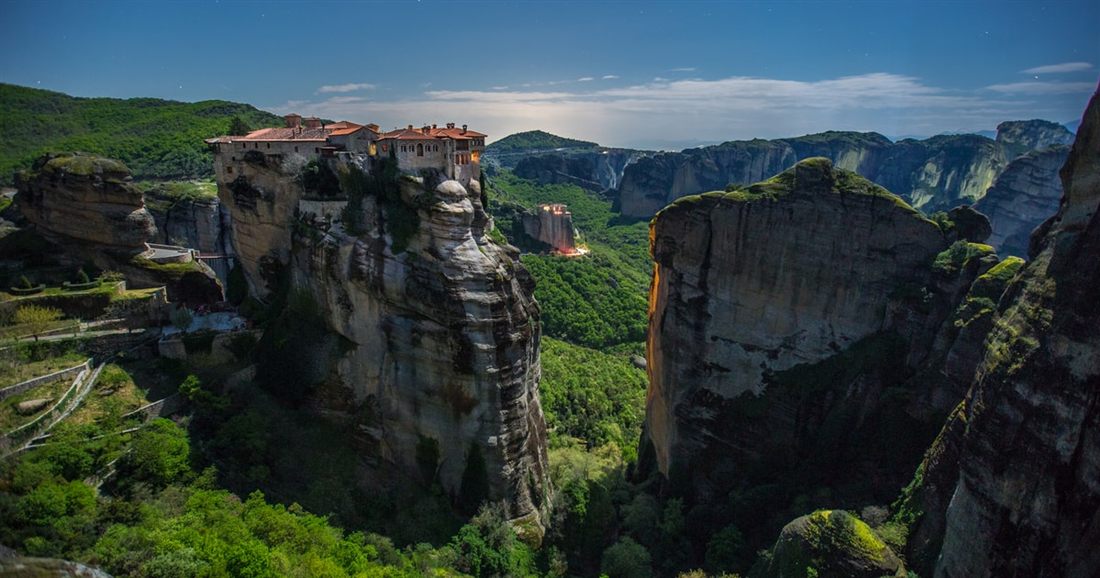
The Greek Holidays tour from Pieria includes entry to two monasteries with an official guide. The specific choice depends on which ones are open that day. The guide leads the group through the selected buildings. This structure keeps the schedule moving smoothly.
Six monasteries survive on the pillars today. Each one has its own history and layout. Visitors on a Meteora day trip from Pieria learn about the specific sites chosen for that day. The guide explains the facts about the buildings while walking through them.
The town of Kalambaka sits right below the monasteries. Looking up from the ground shows how steep the sandstone pillars really are. The scale of the construction becomes clear from this angle.
- Great Meteoron stands as one of the six survivors
- Varlaam sits on a separate tall pillar
- Rousanou rests on a lower rock formation
- St Stephen connects to the main road easily
- Holy Trinity occupies a steep isolated peak
- St Nicholas Anapafsas is one of the oldest survivors
How do monastery closing days change a Meteora day trip from Pieria?
Each monastery closes on a specific weekday during summer, so the schedule changes daily. A Tuesday trip skips the Great Meteoron, while a Friday trip skips Varlaam and St Nicholas Anapafsas. Planning a Meteora day trip from Pieria requires checking these closing days.
The summer closing schedule follows a strict pattern. Great Meteoron closes on Tuesdays. Varlaam and St Nicholas Anapafsas both close on Fridays. Rousanou shuts its doors on Wednesdays. Holy Trinity remains closed on Thursdays, and St Stephen does not open on Mondays.
Because of this rotation, the guide selects two open monasteries for the group. A Meteora day trip from Pieria scheduled for Tuesday visits different sites than one on Wednesday. The tour adapts to the calendar. This ensures the group always enters two active locations.
Church feast days and Holy Week alter the regular hours. On these dates, a monastery opens or closes outside its normal schedule. The guide tracks these religious calendar events. This information dictates the final route for the day.
- Great Meteoron stays closed every Tuesday in summer
- Varlaam and St Nicholas Anapafsas close on Fridays
- Rousanou does not accept visitors on Wednesdays
- Holy Trinity closes its doors on Thursdays
- St Stephen remains shut on Mondays
- Church feast days override the standard weekly schedule
Where do you eat lunch on a Meteora day trip from Pieria?
The tour provides free time for lunch in Kalambaka, the town at the foot of the rocks. Meals, drinks, and monastery entry tickets are not included in the price. A Meteora day trip from Pieria leaves food choices entirely up to the visitor.
Kalambaka serves as the base for meals during the visit. The town sits directly below the tall sandstone pillars. Restaurants and cafes line the streets near the center. Visitors step off the transport and walk to a table during the allotted free time.
Lunch costs fall outside the tour package. Drinks ordered at the table are paid separately as well. Entry fees for the monasteries require their own payment. Everyone on a Meteora day trip from Pieria handles these expenses individually during the stops.
The free time allows groups to split up and find seats quickly. Eating in Kalambaka places visitors right under the rock formations. Looking up from a cafe table shows the rock pillars. The break gives everyone time to rest before the return journey.
Which frescoes do the Meteora monasteries hold?
The main fresco cycles at Meteora are post-Byzantine paintings from the 16th century. They follow the style of the Cretan School. A Meteora day trip from Pieria enters two monasteries with a guide to see these works.
The Cretan School style uses gold and dark backgrounds. The figures are long and expressive. Story scenes appear in a clearly ordered layout on the walls. Visitors on a Meteora day trip from Pieria notice these details right away.
St Nicholas, Varlaam and the Great Meteoron make the strongest set for fresco lovers. Guests on a Meteora day trip from Pieria see one or two of these cycles during their visit. Each church holds its own painted programme.
- Gold and dark backgrounds define the Cretan School style
- Long expressive figures stand out against the painted walls
- Clearly ordered story scenes cover the interior surfaces
- Sixteenth-century painters created these post-Byzantine works
Who painted St Nicholas Anapafsas?
Theophanes the Cretan painted the main church of St Nicholas Anapafsas in the early 16th century. He is also recorded as Theophanes Strelitzas. His work defines a Meteora day trip from Pieria for visitors who study art.
The church of St Nicholas Anapafsas is small. Theophanes covered it from floor to vault with his cycle. Every surface holds a painted scene. This tight space makes the artwork feel close and immediate for every visitor.
A guide to the painted churches explains how Theophanes worked within the Cretan School tradition. His figures show clear outlines and strong expressions. Guests on a Meteora day trip from Pieria look up to see his work on the vaults.
The small size of the church keeps the cycle together in one view.
What does the church of Varlaam show?
Frangos Katelanos painted the main church of Varlaam around the middle of the 16th century. This church is called the church of All Saints. It features a wider programme that includes a Last Judgment scene.
The church of All Saints is larger than St Nicholas Anapafsas. Frangos Katelanos used this extra space for a broader set of scenes. The Last Judgment covers a wide wall. This large composition shows the end of time in clear detail.
Visitors taking a Meteora day trip from Pieria enter this larger space to study the mid-16th-century work. The scale of the church changes how the paintings read. Figures stand further apart. The story scenes spread across broad surfaces instead of tight corners.
The wider programme means more biblical events appear on the walls. Frangos Katelanos followed the Cretan School style. His figures have the same long shapes and expressive faces seen in other local churches. The dark backgrounds frame each scene clearly.
The Varlaam monastery holds this church as its central painted space. Guides point out the Last Judgment to groups arriving on a Meteora day trip from Pieria. The broad wall gives the painter room to place dozens of figures in order.
Which scenes fill the walls of a Meteora monastery church?
The typical layout puts Christ Pantocrator in the dome. The Dormition of the Virgin fills the west wall. Standing saints cover the lower walls. These rules guide what guests on a Meteora day trip from Pieria observe.
The twelve great feasts run in bands around the upper walls and vaults. These scenes tell the main stories of the Christian calendar. Painters placed them high up so visitors look upward while walking through the church.
The martyrdoms of saints fill the narthex. The narthex is the entrance hall before the main church. These scenes show the trials of holy figures.
In the larger churches, the Last Judgment takes up a broad wall. The main church of the Great Meteoron, dedicated to the Transfiguration, is also richly painted. Its walls follow the same ordered layout.
- Christ Pantocrator sits in the centre of the dome
- The Dormition of the Virgin rests on the west wall above the entrance
- The twelve great feasts form bands around the upper walls
- Martyrdoms of saints fill the entrance hall called the narthex
- Standing saints line the lower walls near the floor
This strict layout helps visitors on a Meteora day trip from Pieria read the walls. Once the pattern is clear, every church tells its story in the same order. The Cretan School painters followed these placement rules closely.
Can you take photos inside the monasteries?
Photography inside the main churches is not allowed, to protect the pigments. Flash is also banned. Staff enforce this rule at the church door for everyone joining a Meteora day trip from Pieria.
The pigments in the 16th-century frescoes react to bright light. Flash photography damages the colours over time. To keep the paintings safe, the monasteries limit cameras inside the main churches.
Visitors on a Meteora day trip from Pieria leave their cameras in their bags before crossing the threshold. Staff members stand at the entrance to remind guests of the rule.
The ban applies only to the interior of the main churches. Outside the buildings, photography follows different rules. Guests document the rock pillars and the exterior walls freely. Inside, the focus stays on looking directly at the painted surfaces.
Protecting the post-Byzantine art requires strict limits. Guides on a Meteora day trip from Pieria explain the ban before the group reaches the church. Understanding the reason helps visitors accept the rule without frustration.
- Staff members stand at the church door to check for cameras
- Flash devices damage the old pigments on the walls
- Exterior areas remain open for photography
What do you wear and bring on a Meteora day trip from Pieria?
A Meteora day trip from Pieria requires covered shoulders. Men wear long trousers, and women wear skirts below the knee. Bring water, snacks, sun protection, comfortable shoes, light layers, and cash for entry fees.
The monasteries enforce a strict dress code. Sleeveless tops are not allowed inside any building. Women need a skirt that falls below the knee. Staff lend wrap skirts at the entrances if visitors arrive without one. Men must wear long trousers.
Packing the right items makes a Meteora day trip from Pieria much smoother. Stone steps connect the sites, so comfortable shoes matter. Light layers help when temperatures change between the coast and the rocks. Sun protection is essential during warm months.
- Carry a bottle of water and a small snack
- Bring cash for monastery entrance fees
- Keep money ready for lunch and drinks
- Pack light layers for changing weather
- Wear sturdy shoes for uneven stone paths
Who suits a Meteora day trip from Pieria?
A Meteora day trip from Pieria suits beach guests on the Olympic Riviera who want a cultural day. It also suits history fans, photographers and families with older children who handle long coach rides.
Visitors staying on the coast spend their time by the sea. Taking a Meteora day trip from Pieria adds a different experience to the holiday. History and art fans find plenty to study inside the buildings. Photographers enjoy the tall rock formations.
Families with children join this journey when the kids handle a full day on a coach. People who find stairs hard still have an option. The monastery of St Stephen is reached by a flat footbridge instead of steep steps.
- Beach guests looking for a cultural break
- History and art enthusiasts
- Photographers seeking dramatic landscapes
- Families with children ready for a long ride
- Travelers needing flat access at St Stephen
Travellers who want more time at Meteora than a coach day allows look at a night in Kalambaka. A night there leaves room for the early light on the rocks and a walk past the hermit caves.
How does a Meteora day trip from Pieria compare with trips from Thessaloniki and Halkidiki?
A Meteora day trip from Pieria covers less distance than trips from Thessaloniki or Halkidiki. Pieria lies south of Thessaloniki on the road to Larissa.
From Thessaloniki, the town of Kalambaka sits about 216 kilometers away. A full-day bus trip booked through GetYourGuide lasts about 11 hours. Travelers starting further north spend more time on the road. Details for that route appear on the Meteora day trip from Thessaloniki page.
Departing from the peninsula adds even more driving time. The drive from Halkidiki takes 3.5 to 4.5 hours each way. Choosing a Meteora day trip from Pieria cuts down those hours. Visitors can read more about the Meteora day trip from Halkidiki to compare routes.
How do you book a Meteora day trip from Pieria?
To book a Meteora day trip from Pieria, use the GetYourGuide listing. The Greek Holidays agency also sells a guided package with hotel pickup.
GetYourGuide lists a specific option called “From Pieria Coast: Meteora Day Trip with Monasteries Visit”. The Greek Holidays agency sells a similar journey under the name “Meteora monasteries from Pieria”. Both platforms allow travelers to reserve a seat online before arriving in Greece.
The Greek Holidays package includes hotel pickup and return transport. Guests travel in an air-conditioned vehicle with an official guide. Drinks, food, tips, and monastery entrance fees remain extra. Visitors planning ahead check the details on monastery tickets before departure.
This tour operates from late spring until late October. It runs every single day of the week during that season. Free cancellation is available up to 24 hours before the scheduled departure time.
- Search GetYourGuide for the Pieria Coast listing
- Contact Greek Holidays for their guided package
- Confirm hotel pickup details with the agency
- Cancel for free up to 24 hours ahead
Frequently Asked Questions
Is hotel pickup included on a Meteora day trip from Pieria?
Yes, hotel pickup and return transport are included when booking through the Greek Holidays agency. Guests board an air-conditioned vehicle at their accommodation on the coast.
Are monastery tickets included?
No, monastery entrance fees are not part of the tour price. Travelers pay these fees in cash upon arrival at each site. Visitors need to carry enough money to cover the entry cost for every building they enter.
Is lunch included on a Meteora day trip from Pieria?
No, food and drinks are excluded from the tour package. Guests buy their own meals during the journey. The itinerary allows time for a meal stop, but travelers pay for everything they order out of pocket.
Does the tour stop in the Vale of Tempe?
No, the coach drives through the Tempe area on the motorway without stopping in the gorge. Tour listings mention coffee breaks, but not a visit to the valley itself.
Can you cancel a Meteora day trip from Pieria?
Yes, free cancellation is available up to 24 hours before the scheduled departure. Travelers who cancel in time receive a full refund with no penalty fee.
Does the trip run every day?
Yes, the trip runs every day of the week. The daily schedule covers the whole season, from late spring to late October. That gives visitors flexible dates.