
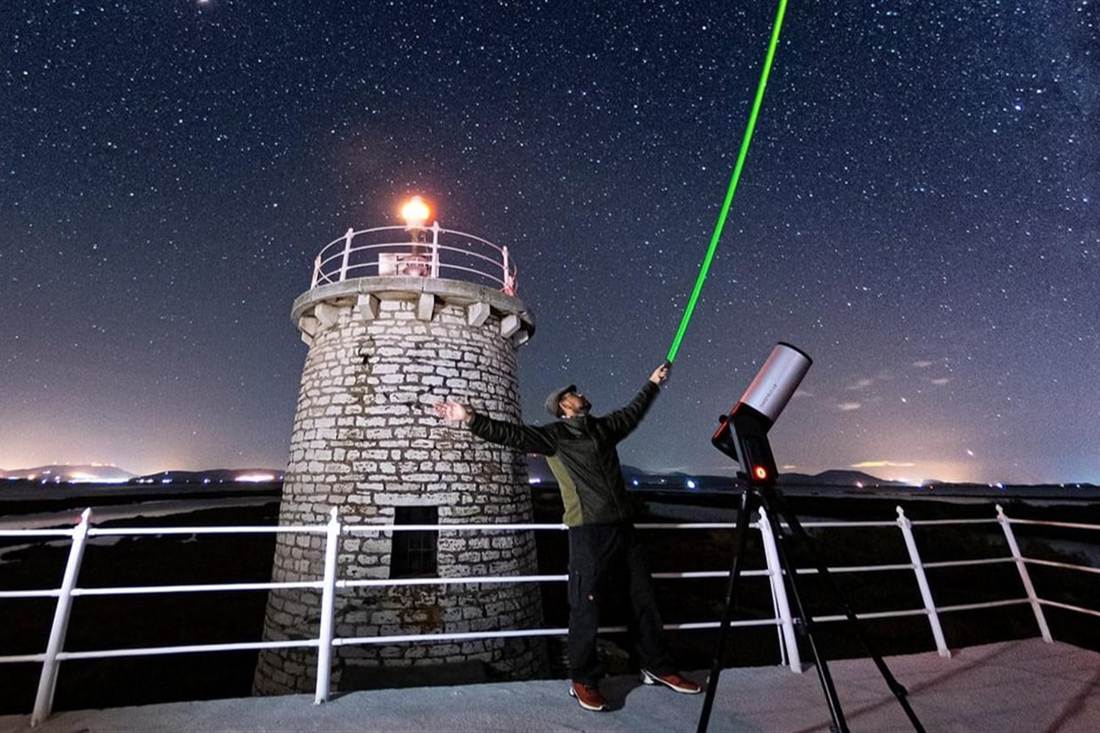
Parga stargazing is a guided night session on the coast of Epirus, where an astronomer points out the stars and sets up telescopes for a closer look at the Moon, the planets and deep space. Tours across the rest of the country are listed on Greece Tours.
The sections below cover the tours, the viewing spots, the dark skies, the guides, the steps, the telescopes, what you see, the myths of the constellations, timing, who it suits, inclusions, getting there and booking, with links into the Parga tours pages. The tours shown are checked on GetYourGuide and Viator.
What is Parga stargazing?
Parga stargazing is a guided tour of the night sky on Valtos beach, just west of Parga town. An astronomer points out stars with a green laser. Guests then look at the Moon, planets and far galaxies through telescopes.
Each Parga stargazing session lasts about two hours and is led in English. It blends science with storytelling, so each telescope target comes with a short story.
Guests also connect their phones to the main telescope by wireless link. They save live images of star clusters and nebulae, which are glowing clouds of gas and dust.
The night fits around daytime trips from Parga. Guests on an early Meteora sunrise tour can add Parga stargazing on another evening. Both outings run in the dark hours, one before dawn and one after dusk.
Which Parga stargazing tours can you book?
Two listings sell Parga stargazing nights. GetYourGuide offers Parga: Stargazing Tour with Astronomer Guide, and Viator offers Parga Stargazing and Telescopes All Around Epirus. Both meet at the same spot on Valtos beach and share one tour plan.
- GetYourGuide tour 1187031: two hours, a Unistellar eVscope, a green laser constellation tour and photos saved to phones.
- Viator product 317210P2: 90 to 120 minutes, run by Astro Tours Greece, with a minimum of four guests.
- Planetarium On The Go: the Epirus team whose own site lists Parga nights on Tuesdays.
- Ioannina nights: the same team’s Monday sessions at the Acropolis of Kastritsa.
Planetarium On The Go runs its own booking page under the Astro Tours name. Its Parga stargazing night follows the same two-hour plan and starts on the beach.
The team works mainly across Epirus, in north-western Greece. Its site also lists nights in Sivota and Preveza. Daytime outings around Preveza appear under Preveza tours.

Where does Parga stargazing take place?
Parga stargazing takes place on Valtos beach, west of the town and below the Venetian castle hill. The meeting point sits on the sand by the Tango beach club entrance. The telescope stands ready there.
Valtos is the largest beach of Parga, with a coastline of about 3 km. It lies about a 20-minute walk from the old town, over the castle path.
The beach area also goes by the name Chrisogiali. Its shore runs between the castle at one end and a small harbour at the other. Hotels, beach bars and tavernas line the sand.
- Valtos beach, Parga: Tuesday nights, by the Tango beach club.
- Acropolis of Kastritsa, Ioannina: Monday nights, above Lake Pamvotis.
- Sivota: a coastal spot listed by the same Epirus team.
- Preveza: a further spot on the team’s list of locations.
Kastritsa is an ancient hilltop site outside Ioannina with little light pollution. Its raised position helps faint objects stand out. The Acheron river trip from Parga is a separate daytime outing.
Why do the skies suit Parga stargazing?
Parga stargazing gains from dry, clear summers. The clearer part of the year runs from the end of late spring to about 21 September. In July, the sky is clear or only partly cloudy 95% of the time.
August brings only about 9 mm of rain across the whole month. Dry air means fewer clouds drift between the telescope and the stars on a Parga stargazing night.
Light pollution is the glow from street lamps and buildings that hides faint stars. Valtos has hotels and bars, so the beach is not fully dark. The eVscope is built to show deep sky objects even from towns.
The Bortle scale rates the darkness of a night sky in nine levels. Amateur astronomer John E. Bortle created it and printed it in Sky & Telescope magazine.
- Class 1: the darkest skies on Earth, where the Milky Way casts faint shadows.
- Class 3: a rural sky, where the Milky Way still shows its main shape.
- Class 4: a country-to-suburb sky, where the Milky Way fades near the horizon.
- Class 7: a greyish-white sky, where the Milky Way is hidden or nearly so.
- Class 9: an inner-city sky, where only the Moon and the brightest stars show.
Who leads Parga stargazing tours?
An astronomer leads every Parga stargazing tour, according to both listings. The Planetarium On The Go team runs the Parga nights on Valtos beach. It includes a veteran of the National Observatory of Athens and the founder of the Zagori Observatory.
- Nicolas Matsopoulos: astronomer at the National Observatory of Athens for 41 years.
- Konstantinos Sakkas: planetarium director and founder of the Zagori Observatory.
- Christos Sakkas: project manager and co-founder of Planetarium On The Go.
- Theofanis Matsopoulos: partner of the European Southern Observatory and maker of planetarium films.
Nicolas Matsopoulos holds degrees in shipbuilding, natural sciences, science communication and education. He ran the observatory’s visitor centre and guided about a quarter of a million visitors.
Konstantinos Sakkas trained as a civil engineer in Athens. He also founded the Ioannina Amateur Astronomy Association. He runs star parties, which are group sky-watching nights, for schools and public spaces.
Theofanis Matsopoulos photographs night landscapes and deep sky objects through telescopes at his private observatory. Deep sky objects are faint targets beyond the solar system, such as nebulae and galaxies.
What happens step by step on a Parga stargazing tour?
A Parga stargazing tour follows a set path. The astronomer meets you at the telescopes on Valtos beach. The Moon and planets come first. Then follow a laser tour for the naked eye and deep-sky views through the telescopes.
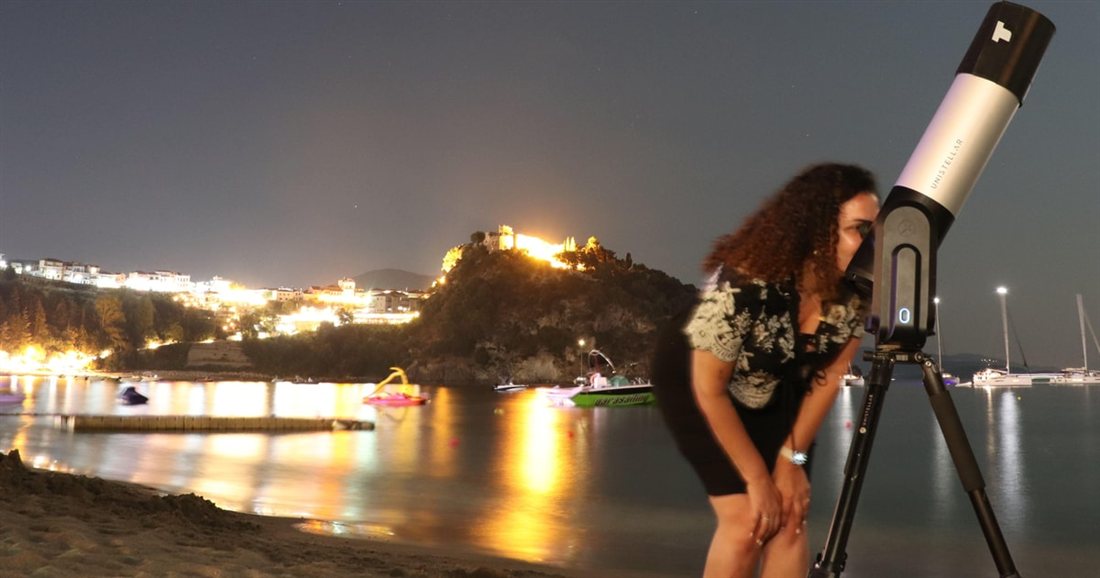
The astronomer waits beside a telescope set up on the sand at Valtos beach. Guests can ask questions about the Universe at any point. The talk blends science with storytelling under the stars.
Parga stargazing begins with the Moon and planets, if they are up that night. As the sky darkens, more stars appear. The guide then aims at bright stars and explains their different colours.
- A welcome at the telescopes on Valtos beach
- Close views of the Moon’s craters and the planets
- Bright stars and the life story of stars, from red giants to white dwarfs
- A green laser tour of the constellations and Polaris, the North Star
- A deep-sky tour that starts with a planetary nebula
The green laser works like a very long pointing finger. Its beam traces each star pattern, so everyone sees the same shape. The deep-sky tour, a look at objects far beyond the planets, closes each Parga stargazing night.
Which telescopes are used for Parga stargazing?
Parga stargazing uses two telescopes set up on the sand. An 8-inch Schmidt-Cassegrain, about 20 centimetres across, shows the Moon and planets. A Unistellar eVscope, a smart digital telescope, shows faint star clusters, nebulae and distant galaxies.
A Schmidt-Cassegrain uses two mirrors and a thin glass plate at the front. The mirrors fold the light back and forth inside a short tube. This gives strong zoom for craters on the Moon and the rings of Saturn.
The eVscope has a 114-millimetre mirror and a camera sensor in place of a second mirror. It takes a fresh picture every four seconds. Then it stacks them, laying each new picture over the last, so faint objects grow clearer.
On a Parga stargazing night, the eVscope links by Wi-Fi to up to nine phones. Guests save the live images straight to their own screens. At spots with no car access, the guide carries only the eVscope in a backpack.
What can you see during Parga stargazing?
Parga stargazing shows the Moon, Saturn, Jupiter and coloured stars. Telescopes add star clusters, nebulae and distant galaxies. The Milky Way stretches overhead as a pale band. What appears depends on the night and the season.
- The Moon: craters and ridges, seen up close
- Saturn: its rings, with a real 3D effect
- Jupiter: cloud belts and four large moons, Io, Europa, Ganymede and Callisto
- Bright stars: clear colour differences between one star and the next
- Planetary nebula: the glowing remains of a dying Sun-like star
- Galaxies: far-off star systems, including colliding pairs, each with hundreds of billions of stars
The Milky Way is the Sun’s home galaxy, seen from inside as a hazy band. In very dark skies, Cygnus the Swan helps viewers trace it overhead.
Targets change through the year and through each night. Planets join Parga stargazing only when they sit above the horizon. The guide picks objects to match that evening’s sky.
Which Greek myths come up during Parga stargazing?
Parga stargazing brings the constellations to life through ancient Greek myths. The summer sky over the Ionian coast holds Hercules, Lyra, Cygnus, Aquila and Scorpius. The guide links each star pattern to its story with the green laser.
- Hercules: the hero of the twelve labours, shown kneeling in struggle
- Lyra: the lyre of Orpheus, placed among the stars after his death
- Cygnus: the swan whose form Zeus took to visit Leda, queen of Sparta
- Aquila: the eagle of Zeus, which carried his thunderbolts
- Scorpius: the scorpion sent to kill Orion, the proud hunter
- Ophiuchus: Asclepius, the healer, holding a serpent
Orion the hunter rules winter skies and sinks as Scorpius rises. The two never share the sky, so the chase never ends. Antares, the red heart of the Scorpion, is a red giant near the end of its life.
Parga stargazing also covers how other cultures named the same stars. The tour presents constellation names as among the oldest surviving traces of human civilisation. The real places behind these tales appear on the page about top Greek mythology sites.
In myth, Orpheus walked into the underworld to bring back his wife. The Acheron near Parga was one of its rivers and now hosts rafting and kayaking trips.
When does Parga stargazing run, and which nights work well?
Parga stargazing with the Planetarium On The Go team takes place on Tuesdays. Start times follow the season: 21:30 in summer, 20:00 in spring and autumn, and 18:30 in winter. Dark, moonless and cloud-free nights give the clearest views.
Moonlight washes out faint stars, and a full Moon gives the poorest views of nebulae and galaxies. The darkest nights fall just before, during and soon after a new Moon. A full Moon still suits close views of the Moon itself and bright planets.
Clear air matters as much as the Moon. Cloud cover below 20 per cent still allows good viewing. On the Viator listing, each Parga stargazing session goes ahead with at least four guests.
A daytime boat trip from Parga to Paxos fits well before an evening under the stars. The same team also runs stargazing nights at Sivota, up the coast. Sivota is the base for the Blue Lagoon cruise and other Syvota tours.
Who suits Parga stargazing?
Parga stargazing suits beginners, families with children aged 6 and up, couples and groups of friends. The astronomer speaks English throughout. The beach site is not wheelchair accessible. The listings also mark it unsuitable for visually impaired guests.
No prior knowledge of astronomy is needed. The Viator listing sets the age range at 6 to 100. Children under 6 cannot join either listing.
Viator caps each group at 20 guests. A session runs only with at least 4 participants. Service animals are welcome on the Viator tour.
The Viator listing also marks Parga stargazing as unsuitable for people with mobility impairments. Couples who want a longer escape can add a private yacht day off Parga.
How long does Parga stargazing last, and what is included?
Parga stargazing lasts 2 hours on the GetYourGuide listing and 90 to 120 minutes on Viator. The fee covers an astronomer guide, telescope views, a green laser sky tour and photos saved to your own phone.
The Viator listing names one item outright: use of a Unistellar eVscope. This is a digital telescope that shows faint objects on a small screen.
- Guidance from an astronomer, in English
- Use of a Unistellar eVscope telescope
- The guided sky talk, with the laser pointer
- Images of the sky saved to your phone
Dinner is not part of the session. Restrooms are not provided on the beach either. Eat and use the facilities in town before you arrive.
How do you get to Parga stargazing, and what do you bring?
Parga stargazing meets on Valtos beach, west of Parga town, beside the entrance of the Tango beach club. The astronomer waits there beside the telescopes. Bring warm layers, a red torch and a charged phone.
Valtos lies over the castle hill from the harbour. The walk from town takes about 15 to 20 minutes. In summer a water taxi also runs from Parga harbour to Valtos.
The exact meeting time arrives by WhatsApp on the day, after 10:00. Visitors landing at Aktion airport, around 65 km away, can book Parga transfers. Guests staying on Corfu can scout the town first on a day trip from Corfu.
- Warm layers, since nights turn cold even in summer
- A dim red torch to protect your night vision
- A charged phone to save telescope images
- Water for 2 hours on the beach
White light from a phone screen resets dark-adapted eyes at once. During Parga stargazing, turn the brightness down or switch to a red night mode.
How do you book and cancel Parga stargazing?
Parga stargazing books online through GetYourGuide, Viator or the operator’s own site. All three allow free cancellation up to 24 hours before the start. Bad weather cancellations bring a full refund or a new date.
GetYourGuide offers a reserve now, pay later option, so nothing is paid at booking. Planetarium On The Go runs that listing and also takes free bookings on its own site.
Viator sells the Parga stargazing tour run by Astro Tours Greece. Its product code is 317210P2. Cancelling inside 24 hours brings no refund, and changes inside 24 hours are not accepted.
Clouds can cancel a session up to 10:00 on the day itself. If fewer than 4 guests sign up, Viator offers another date or a refund.
Frequently Asked Questions
Can you book a private Parga stargazing session?
Yes. Planetarium On The Go lists a private stargazing option beside its public nights. Its events are based mainly in Epirus. The team also travels to any location in Greece on invitation. For comparison, its private tour near Ioannina takes groups of 1 to 10 people.
Where else does the Parga stargazing team hold sessions?
The same operator runs public nights in Ioannina, Sivota and Preveza. Ioannina sessions meet at the Acropolis of Kastritsa, an ancient hilltop site. It looks over Lake Pamvotis and the city of Ioannina. Ioannina nights run on Mondays, and Sivota nights run on Thursdays.
What is the planetarium behind the operator’s name?
Planetarium On The Go also runs 360-degree full-dome shows inside a dome. Viewers sit in chairs for the show. By day, the telescopes outside show sunspots, which are dark patches on the Sun’s surface. Guests can even hold a piece of a meteorite that fell to Earth.
How long do your eyes take to adjust for Parga stargazing?
Full dark adaptation takes about 30 minutes. In that time, an eye pigment called rhodopsin rebuilds, and it helps you see in dim light. The biggest gain comes in the first five minutes. Red light barely affects rhodopsin. Fainter stars, galaxies and nebulae appear once the eyes fully adjust.
What pairs well with a day before Parga stargazing?
The path from Parga town to Valtos crosses the hill of the Venetian castle. The castle gives wide views over Valtos beach, so a stop on the walk sets the scene for the night. For a day at sea further south, book a dolphin watching cruise from Preveza.