
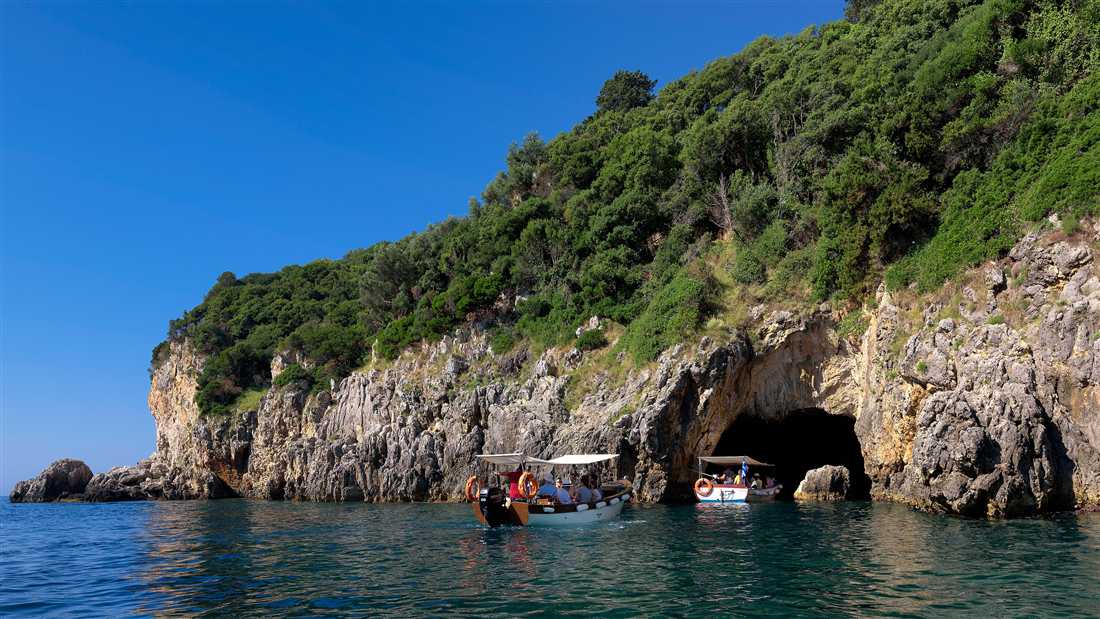
A Corfu cave tour is a boat trip to the sea caves of Corfu and its neighbours, from the Blue Eye cave at Paleokastritsa to the blue caves of Paxos and Antipaxos, with swim stops between the caves. Tours across the rest of the country are listed on Greece Tours.
The sections below cover the caves on the route, the tour formats, Paleokastritsa, the Paxos blue caves, the Sivota blue lagoon, the departure points, duration and inclusions, cruise passengers, the season, families and booking, with links into the Corfu pages. The tours shown are checked on GetYourGuide and Viator.
What is a Corfu cave tour?
A Corfu cave tour is a boat trip along the island’s west coast that enters sea caves cut into limestone and clay cliffs, with swim stops at beaches reachable only from the water. Trips run from two hours to a full day at Paxos.
The west coast of Corfu is limestone and clay, and the sea has cut into it for a long time. Boats enter caves where the roof closes overhead and the water turns from green to deep blue. Skippers slow near the entrances so passengers can photograph the rock walls and the water.
A Corfu cave tour differs from a plain beach cruise. The route is planned around the cave mouths, and the timing follows the swell and the wind. On a calm morning a skipper takes a small boat deep inside a cave. When the sea is up, the boat stays outside and the guide describes the rock.
Caves form where waves find a weak line in the cliff. The opening widens, the roof holds, and a tunnel appears. At Paleokastritsa the result is a group of named caves close together. At Paxos the same process has carved long caves with high entrances. Each coast gives a different ride.
Which sea caves does a Corfu cave tour reach?
A Corfu cave tour reaches the Paleokastritsa caves on the west coast, the cliffs and tunnels near Cape Drastis and Sidari in the north, the Paxos blue caves across the channel, and the sea caves around the Sivota islands on the mainland.
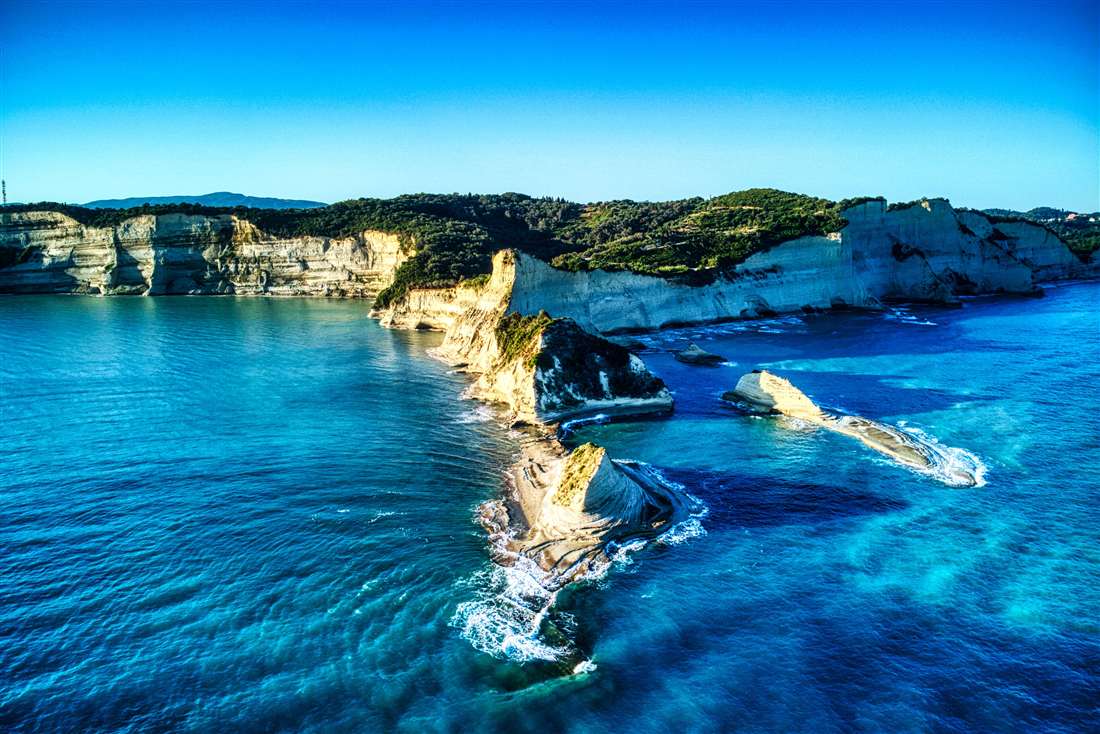
Paleokastritsa sits 24 kilometres from Corfu Town, a drive of 35 to 45 minutes. Its bays hold the Nausicaa cave, the Agios Nikolaos cave and the Blue Eye cave, and divers know a fourth, the Breathing cave, which has three dark chambers below the waterline. Boats reach all four from the harbour at Alipa.
In the north, the cliffs between Sidari and Cape Drastis form the Canal d’Amour, a channel of rock walls and narrow caverns. Cape Drastis is the white headland above Peroulades, about 35 kilometres from Corfu Town. It is too exposed for large excursion boats, so a private boat is the way in. The Sidari coast holds caves of its own.
Across the channel, Paxos lies 15 kilometres from the southern tip of Corfu, with Antipaxos 5 kilometres further southeast. Its west coast is steep white chalk worn at sea level into long caves. South again, the Sivota islands and the Blue Lagoon sit on the Greek mainland, opposite the southern tip of Corfu.
- The Blue Eye cave at Paleokastritsa, named for the patch of deep blue water inside
- The Nausicaa cave, tied to the story of Odysseus and the Phaeacian princess
- The Canal d’Amour caves and tunnels near Sidari
- The Ypapanti, Achai and Ortholithos caves on the west coast of Paxos
- The Papanikolis cave and the Blue Lagoon coves at Sivota
Which Corfu cave tour formats can you book?
You can book a Corfu cave tour as a two-hour small-boat ride from Paleokastritsa, a full-day cruise to Paxos and Antipaxos, a sunset cruise past the Sivota caves, a shore excursion with a boat ride, or a self-drive boat.
Small boats leave the Paleokastritsa coves for a loop of about 45 minutes, with a shared group of 6 to 12 passengers or a private charter. The Blue Eye Cave Tour on Viator runs two hours from Alipa Port and visits the Blue Eye cave, the Liapades beaches, Klimatia and Limni beach, with snorkelling gear and drinks on board.
Full-day cruises to Paxos and Antipaxos leave Corfu Town, Lefkimmi and Benitses. A GetYourGuide cruise with comfort sails on a deluxe vessel for 7 to 10 hours and stops first at the Paxos blue caves, then at Voutoumi beach on Antipaxos, then in Gaios for more than two hours. The longer a Corfu cave tour runs, the further south it travels.
Sunset cruises run south to the Sivota islands and last about nine hours. Shore excursions pair a boat ride into the Paleokastritsa caves with time in Corfu Old Town. A self-drive boat needs no licence, and the page on Corfu boat rental without a licence explains the handover. A full list of Corfu boat tours covers the rest.
- A shared small boat from Paleokastritsa, about 45 minutes to two hours
- A private speedboat or charter with a skipper for the day
- A full-day cruise to Paxos, Antipaxos and the blue caves
- A sunset cruise to the Sivota islands and the Blue Lagoon
- A shore excursion that adds a boat cave ride to an island tour
- A self-drive boat with no licence needed, or a sea kayak
What does a Corfu cave tour show at Paleokastritsa?
A Corfu cave tour at Paleokastritsa shows the Blue Eye cave, the Nausicaa cave, the Agios Nikolaos cave, the coves at Liapades, and Yali beach, with swim stops at Paradise beach and Kasteli along the way.
The Blue Eye cave takes its name from a patch of very blue water inside that looks like an eye. As the boat moves, the colour shifts from electric blue to green. The Nausicaa cave carries the story of the Phaeacian princess who found Odysseus. The Agios Nikolaos cave is named after a chapel above.
Liapades sits in the next bay north of Paleokastritsa. Limni beach, near Liapades, is a small double beach on a narrow strip of land joined to a rocky peninsula, and boats moor off it while passengers swim ashore. Yali beach, also written Giali, is the main swimming stop on the two-hour speedboat trips.
Paradise beach, which locals call Chomi, takes a 20-minute swim stop on the Paradise and Yali tour, and Yali beach takes 30 minutes. The Limni, Kasteli and sea caves trip runs three hours and gives Limni an hour and a half before a wooden boat carries the group through the caves. The Paleokastritsa guide covers the beaches in full.
How does a Corfu cave tour reach the Paxos blue caves?
A Corfu cave tour reaches the Paxos blue caves by crossing the channel south from Corfu Town, Lefkimmi or Benitses, then following the west coast of Paxos where the caves open above the waterline and the boat enters for photographs.
The crossing is the long part of the day. Boats leave the port of Corfu Town at 8.20 am, with boarding from 7.40 am, and a catamaran option from Benitses Marina cuts the sea time. The route passes the Old Town and the islet of Pontikonisi before the open water.
On the west coast of Paxos the cliffs are white chalk, worn at sea level into long caves. The boat slows and enters for photographs, then turns back to open water. The largest cave, Ypapanti, has an entrance about 20 metres high, and these west coast caves are a known habitat of the Mediterranean monk seal.
The day continues at Antipaxos, where the boat anchors off Mesovrika or Voutoumi beach for a swim of 50 to 70 minutes, then moors in the port of Gaios for about two hours ashore. A Paxos blue caves page holds the cave detail, and the Paxos day trip from Corfu guide covers the crossing times.


What does a Corfu cave tour to the Sivota blue lagoon include?
A Corfu cave tour to the Sivota blue lagoon includes the crossing to the mainland, a pass by the Papanikolis sea cave, a long swim stop in the Blue Lagoon, time at Bella Vraka beach and free time in Sivota village.
Boats sail south from Corfu along the coast, cross to the Greek mainland and reach the Sivota islands. The Papanikolis cave comes first, a large sea cave where a Greek submarine hid during the war. The boat slows so passengers can photograph the entrance, and the guide tells the story of the hideout.
The Blue Lagoon, also called Pischina, takes about an hour and 45 minutes of swimming. Bella Vraka beach follows, a sandbar between the islet of Mourtos and the mainland that you can wade across. Then Sivota village gives about an hour and 45 minutes on shore for the harbour and the tavernas.
Departures run from Benitses Marina at 8.30 am and Lefkimmi Port at 9.45 am, with returns at 4.30 pm and 6 pm. A nine-hour sunset version leaves Corfu Town in the afternoon and drifts through the Sivota caves as the light drops. The Sivota blue lagoon cruise page covers the beaches and the boat options.
- A boat pass by the Papanikolis sea cave, used as a submarine hideout in the war
- A swim stop of about one hour 45 minutes in the Blue Lagoon
- A stop at Bella Vraka, the sandbar beach you can wade across
- Free time of about one hour 45 minutes in Sivota village
- Lunch, drinks or a barbecue on a number of the departures

Where do Corfu cave tours depart from?
Corfu cave tours depart from Corfu Town’s old port and cruise terminal, from the small harbours at Paleokastritsa and Alipa, and from Benitses Marina, Lefkimmi Port and Kavos in the south. Sidari is the base for self-drive boats.
Corfu Town is the main start point for long cruises. The port sits under the Old Fortress, and the cruise terminal takes passengers from ships moored close by. Coaches collect from hotels across the island and drop guests at the port before the boat leaves, so a Corfu cave tour from the capital needs no driving.
Paleokastritsa is the base for short cave rides. Boats leave from Agios Spyridon beach, the main beach in the bay, and from the coves at Ampelaki and Alipa. A wooden boat covers the caves, while speedboats run the beaches and the swim stops along the same stretch of coast, within walking distance of the beach bars.
In the south, Benitses Marina and Lefkimmi Port serve the mainland cruises to Sivota and the Blue Lagoon, and Kavos serves the Paxos and Antipaxos trips with a sea cave visit. Sidari, in the north, is where self-drive boats and kayaks start for the Canal d’Amour and Cape Drastis. A departure from the south cuts the crossing to Paxos.

How long does a Corfu cave tour last, and what is included?
A Corfu cave tour lasts from 45 minutes on a small boat at Paleokastritsa to two or three hours for a speedboat trip, and up to nine or ten hours for a full-day cruise to Paxos or Sivota.
Short trips include the boat, a skipper, bottled water and snorkelling gear on the speedboats. The two-hour Blue Eye Cave Tour from Alipa Port adds coffee, drinks and a light meal. The three-hour Limni, Kasteli and sea caves trip uses a speedboat first and a wooden boat for the caves. The Corfu snorkelling guide lists the clearest spots.
Long cruises include the crossing, a live guide in English, German, French and Italian, and free time ashore. Towels, food and drinks come with a number of the cruises from Corfu Town and Lefkimmi, and hotel pickup and drop-off come with the full-day options from Corfu Town, Lefkimmi and Benitses.
Times shift with the weather and the number of stops. A skipper adds a swim stop when the sea is flat and drops one when the wind rises. Boats on day trips return before dark, and the sunset cruise reaches Corfu Town after the light has gone. Check the meeting time, because boarding closes before departure.
- A local skipper and crew, with a guide on the long cruises
- Bottled water, and drinks or a barbecue on the longer trips
- Snorkelling equipment on the speedboat departures
- Towels, food and lunch on the full-day cruises
- Hotel pickup and drop-off on the day trips
- Free time ashore in Gaios on Paxos or in Sivota village
Can cruise passengers join a Corfu cave tour from the port?
Cruise passengers can join a Corfu cave tour from the port, because ships dock at the Corfu cruise terminal a short drive from the old town and a 35 to 45 minute drive from Paleokastritsa. Operators plan the day around the ship’s schedule.
The Corfu Tour with Boat Cave Ride and Old Town runs four and a half hours from the cruise terminal. It includes pickup next to the ship, an air-conditioned vehicle, an English-speaking guide and a guarantee of return to the ship on time, with a full refund if the ship skips the port.
The itinerary gives about an hour at Paleokastritsa beach and an hour in Corfu Old Town. The boat ride into the caves is an optional extra, paid on the spot and run by a local boatman, and it follows the weather and the season. Guides meet passengers beside the gangway.
Book a ship-day tour rather than a private cruise. Timings for a Corfu cave tour have to fit the sailing time, and the operators who work with ships know the terminal, the traffic and the walk from the ship. A Corfu shore excursion page sets out the options for a port day.
Which months and sea conditions suit a Corfu cave tour?
A Corfu cave tour suits the months from April to October, when the Ionian is warm and the winds are light, and the calmest window of the day is the morning before the afternoon breeze builds.
The Blue Eye Cave Tour operates from 1 April to 1 November, daily from 10 am to 4 pm. Boat schedules on the island run from late spring through the summer to early October. In late spring the sea is cooler, the coast is quieter and the tavernas along the water are open.
Caves need flat water. A swell closes the entrances at Paxos and Cape Drastis, and a strong north-westerly wind makes the north coast unsafe for small boats. Skippers check the forecast in the morning and change the route or cancel the trip when the sea is up, so a Corfu cave tour is never promised on a rough day.
Midday heat is the other factor. Boats have shade or a cabin, and the sun is strongest from midday to 4 pm. Take water, a hat and sun cream, and swim before the wind picks up. For the clearest water and the shortest queues at the cave mouths, sail early in the day.
- April and late spring, with cool water, quiet coasts and shorter queues
- June to August, with the warmest sea, the longest days and the fullest boats
- September and early October, with warm water and lighter crowds
- Mornings, with the calmest sea and the clearest light inside the caves
- Afternoons, when breeze and swell build on the exposed north-west coast


Can families and non-swimmers join a Corfu cave tour?
Families and non-swimmers can join a Corfu cave tour, because the boats carry life vests, the cave passages are viewed from the deck, and children and adults who stay aboard see the same rock walls and blue water.
Swimming is optional on the cave trips. Life vests are carried for emergencies and are not swimming aids, so a passenger who is not a strong swimmer stays on the boat. The Limni, Kasteli and sea caves trip asks inexperienced swimmers to remain aboard or to bring their own float.
Short trips suit young children better than long crossings. Two hours from Alipa Port or two and a half hours from Ermones beach keeps the day small. The speedboat trips limit the group to nine passengers, and the Limni trip takes a maximum of 14 travellers, so a family Corfu cave tour stays calm and close to shore.
Certain departures carry warnings for back problems and for pregnancy, and the long cruises are not built for wheelchairs or scooters. Infants sit on a lap, and children stay with an adult. Choose a two-hour trip if the group has small children or older passengers, and keep the first outing short.
- Life vests carried on board for emergencies
- Swimming stops that are optional, with the boat as a base
- Small-group boats with a maximum of nine or 14 passengers
- Two-hour trips that suit young children and older passengers
- Departures listed with back-problem and pregnancy warnings
How do you book and cancel a Corfu cave tour?
You book a Corfu cave tour online in advance or at the harbour on the day, and you can cancel free of charge up to 24 hours before the start for a full refund on the main listings.
Book ahead in July and August. Small boats take 6 to 12 passengers, the semi-private cruises cap the group at nine, and private charters sell out first. Reservations open months before the season, and the Blue Eye Cave Tour books about a month ahead on average. A popular Corfu cave tour fills a week before departure.
The usual terms are simple. Cancel up to 24 hours before departure for a full refund, or reserve now and pay later. A weather cancellation brings a reschedule or a full refund, because the skipper decides whether the sea is safe for the boat and the group. Read the meeting point before you travel, because boats leave from different beaches.
Check what is included before paying. A boat ride that is an optional extra is paid to the boatman on the day, and a lunch or a barbecue is part of the ticket on the longer cruises. Take the printed voucher or the mobile ticket to the harbour, and arrive 20 minutes before the Corfu cave tour begins.
Frequently Asked Questions
Do I need to swim to enjoy a Corfu cave tour?
No. Cave passages are seen from the deck, and a passenger who stays aboard sees the same blue water and rock walls as the swimmers. Life vests are carried for emergencies only and are not swimming aids, so weak swimmers stay on the boat. The Limni, Kasteli and sea caves trip asks inexperienced swimmers to remain aboard or bring their own float.
Which Corfu cave tour fits a short visit?
A two-hour Corfu cave tour from Alipa Port or Ermones beach covers the caves, a beach swim and a return to the harbour before lunch. The two and a half hour semi-private cruise from Ermones adds Paradise beach and a 30-minute swim stop at Yali beach. Both suit a half day on the island.
Is a Corfu cave tour safe for children?
Yes, with care. Short trips suit families, and the boats carry life vests for emergencies. Children stay with an adult, and infants sit on a lap. Two-hour rides are easier than full-day crossings for young children. Crews watch the sea and keep the boat outside the caves when the swell is up.
What do I need to bring on a Corfu cave tour?
Take swimwear, a towel, a hat, sun cream and water. A light jacket helps on the return leg of the long cruises, and shoes with grip are useful on the beaches at Limni and Kasteli. Bring your mobile ticket or printed voucher, and a card for the optional boat ride on the shore excursion.