
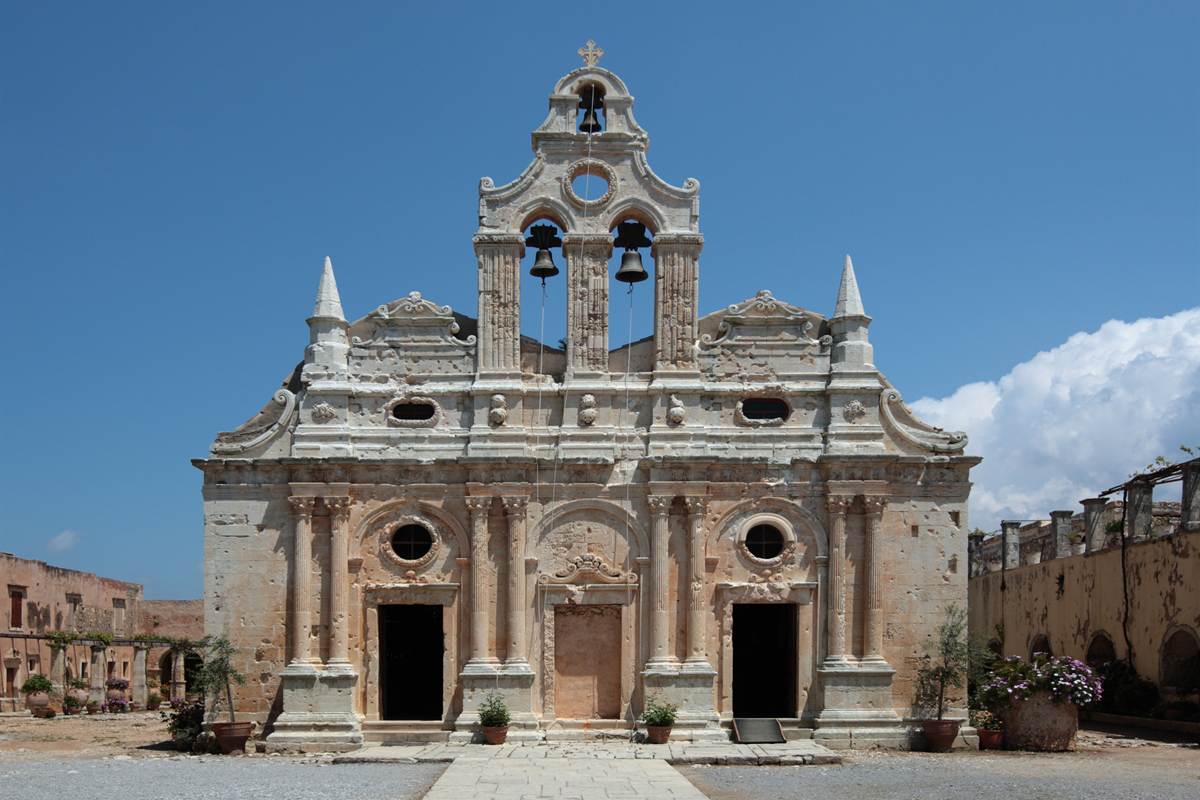
Arkadi Monastery tickets give entry to the Holy Monastery of Arkadi south-east of Rethymno in Crete, the fortified monastery of the 1866 revolt, with its church, refectory, cellars, gunpowder magazine, museum and art gallery. Tours across the rest of the country are listed on Greece Tours.
The sections below cover what the ticket opens, the church and the refectory, the museum and the gunpowder magazine, who issues the ticket, where to buy, e-tickets, reduced and free entry, the tours that include entry, the dress code, getting there, the time a visit needs and combining Rethymno, Margarites and Eleftherna, with links into the Arkadi Monastery pages. The tours shown are checked on GetYourGuide and Viator.
What are Arkadi Monastery tickets?
Arkadi Monastery tickets are the entry passes for the walled Holy Monastery of Arkadi, south-east of Rethymno in Crete. One ticket takes the holder into a working Orthodox house: its church, the rooms of the 1866 siege, its museum and its gallery.
The monastery is a fortified compound whose near-rectangular walls enclose about 5,200 square metres, and Arkadi Monastery tickets admit visitors to that enclosure. Seven monks live and serve inside, and daily services follow the Orthodox rites, so the entry opens a living religious house as well as a historic monument.
Arkadi Monastery tickets cover seven named spaces in one admission, and every one of them lies inside the walls. The octagonal memorial in a converted windmill, which holds the bones of the 1866 dead, stands outside the enclosure to the west and is not one of the seven.
What do Arkadi Monastery tickets open?
Arkadi Monastery tickets open seven spaces inside the walls: the main church, the refectory or dining hall, the cellars, the gunpowder magazine, the passage through the west gate, the museum collection and the art gallery upstairs, as the monastery’s booking page lists them.
- Main church: the katholikon, a two-aisled basilica.
- Refectory: the monks’ vaulted dining hall, north wing.
- Cellars: storerooms beside the gift shop, north wing.
- Gunpowder magazine: the store blown up in 1866.
- West gate passage: the way in through the main door.
- Museum: ground floor of the south-west wing.
- Art gallery: the floor above the museum.
The west gate is the main door of the walls, named Rethemniotiki or Haniotiki for facing Rethymno and Chania. Arkadi Monastery tickets take visitors through a door rebuilt in 1870 on the outline of the 1693 original, which fell in the assault of 1866; the lions, pediments and inscription of the old door were not remade.
The church stands in the middle of the central courtyard, known as the atrium, with monks’ cells and storerooms around its edge. The monastery’s website publishes a plan of the compound, which helps holders of Arkadi Monastery tickets find each of the seven spaces.
What do Arkadi Monastery tickets show at the church and the refectory?
At the church, Arkadi Monastery tickets show a two-aisled basilica dated 1587, its front lined with paired Corinthian columns; in the refectory, they show the vaulted dining hall of 1687, where bullets and swords of 1866 left scars in the wooden furniture.
The north aisle of the church honours the Transfiguration of Christ the Saviour, and the south aisle honours Saints Constantine and Helen, the first patrons of the monastery. An inscription at the foot of the bell tower records the year 1587. Arkadi Monastery tickets open the interior, where a cypress-wood iconostasis has stood since 1902.
The refectory fills part of the north wing as one vaulted room, 18.1 metres long and 4.8 metres wide, with its kitchens at the east end. An inscription under the door to its courtyard names the abbot Neophytos Drossas. In 1866, 36 defenders sheltered here and died once the attackers forced the door, and Arkadi Monastery tickets lead into that room.
What do Arkadi Monastery tickets show in the museum and the gunpowder magazine?
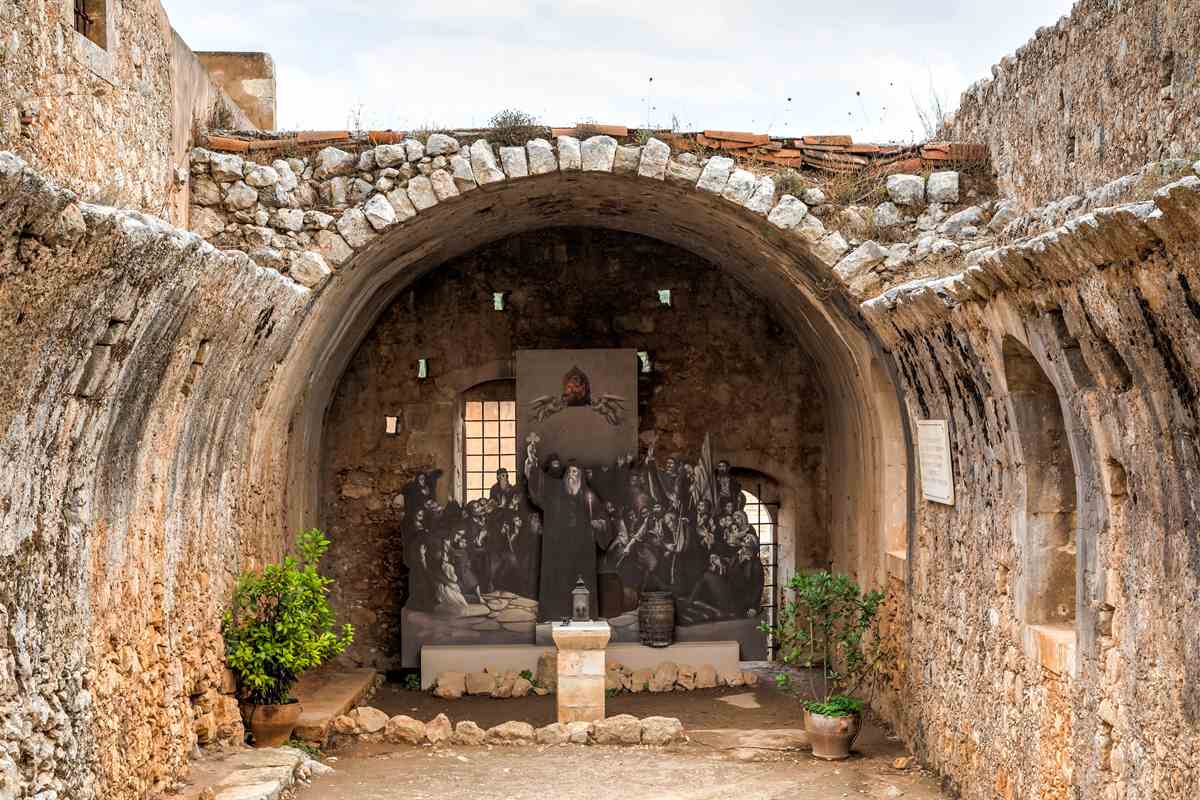
In the museum, Arkadi Monastery tickets show manuscripts, gold-embroidered vestments, post-Byzantine icons and weapons from the fight against Ottoman rule; in the gunpowder magazine, they show the ruined vault where the defenders fired the powder in 1866, with an artwork of the siege.
The museum fills the ground floor of the south-west wing with manuscripts from the 17th-century copying workshop and vestments stitched in gold and silver thread in the 18th century. Upstairs, Arkadi Monastery tickets open the art gallery, inaugurated in July 2017, whose exhibits include eight paintings by Popi Pavlakis and the restored wooden frame that held the historic flag of Arkadi.
The gunpowder magazine is an oblong vaulted store, 21 metres by 5.4 metres, and the 1866 blast spared only a small part of its vault at the west end. Since 2016, Arkadi Monastery tickets show it holding a sepia work by Ioannis Maravas, based on a painting by Theodoros Vryzakis: the abbot Gabriel with candle and cross, the defenders behind him, and angels bearing the Resurrection.
Who issues Arkadi Monastery tickets?
The Holy Monastery of Arkadi issues Arkadi Monastery tickets itself. Its official website links visitors to an online platform in the monastery’s own name, and its contact list gives the entrance and gift shop a telephone line apart from the monastery offices.
In its own English pages, Arkadi ranks as a Sacred Patriarchal and Stauropegic monastery, and it sits in the church district of the Metropolis of Rethymno and Avlopotamos. Arkadi Monastery tickets come from this working community, and its gallery holds paintings the monastery bought or received as gifts, five of them from the Museum of Modern Art of Crete and the Municipality of Rethymno.
The online platform runs on a subdomain of the monastery’s website and carries the label ePass beside the monastery’s Greek name. Greece’s Ministry of Culture lists the monastery and its museum on the Odysseus portal, yet the official route to Arkadi Monastery tickets runs through the monastery’s own website.
Where can you buy Arkadi Monastery tickets?
You buy Arkadi Monastery tickets from the monastery itself, either at its ticket desk on the day of your visit or in advance on its own ePass e-ticket platform, which the official website links from both its header and its footer.
The desk on site serves walk-in visitors and is the only counter for reduced and zero-value Arkadi Monastery tickets, as the e-ticket terms state. Guests on tours that leave entry out of the price also pay here, or book online before the day.
Online, Arkadi Monastery tickets come from etickets.arkadimonastery.gr, the monastery’s own platform, with pages in Greek, English and French. It sells general admission only, takes credit, debit or prepaid cards, and asks anyone who cannot finish a booking to contact the monastery.
How do Arkadi Monastery tickets work as e-tickets?
Arkadi Monastery tickets bought online are general admission e-tickets for a fixed date and arrival slot; a confirmation email delivers them, and you print each ticket or keep it on your phone, then show it for validation at the main entrance.
Booking Arkadi Monastery tickets on ePass means choosing a date from today onwards, the number of visitors and the language you speak, then entering your name, postal address, email and telephone and paying by card once you accept the terms. A success screen then shows your order code.
At the monastery, you show the e-ticket on paper or on screen at the main entrance, where it is validated, with no exchange at the desk. Each of the Arkadi Monastery tickets is valid only for its printed date and for one entry, and cannot be reused.
Check the ticket count, date and slot before paying: the slot fixes your entry time, and once inside there is no time limit. After purchase there are no refunds or changes unless force majeure stops access to the monastery, and lost, stolen or destroyed Arkadi Monastery tickets are not refunded.
Who gets reduced or free Arkadi Monastery tickets?
Children under 16 enter free, as the ePass booking screen states, while the terms grant reduced Arkadi Monastery tickets to Greek citizens and to schools, educational institutions and cultural associations; both kinds come only from the desk on site, never from the online platform.
The written terms also list minors up to 16 among the reduced groups. Discount and zero-value tickets are issued only at the museum ticket office, and the online form has no child or reduced category, so families sort out the children’s Arkadi Monastery tickets at the desk.
Certain dates are free for everyone: on Orthodox Good Friday and Easter Sunday, International Museum Day and Christmas Day, the ePass calendar shows a free admission notice instead of a booking button, so no Arkadi Monastery tickets are sold online. On Sundays, admission is free early in the morning.
Which tours include Arkadi Monastery tickets?
No tour checked here confirms Arkadi Monastery tickets in its price: the only listing that spells out entry, a half-day outing from Rethymno, keeps them out as an optional extra, so read each tour’s inclusions before you book a place.
That half-day outing collects guests from selected hotels for Melidoni Cave and the monastery, with a Margarites pottery demonstration on chosen options. Its listing covers a guide in English or German and the hotel pickup and return, but leaves monastery and cave entrance, food and drinks to the guest. The other GetYourGuide options leave entry unstated:
- a 10-hour group day from Rethymno with pickup, adding Melidoni, Margarites and an old olive oil mill;
- a small-group winter day of 7 to 8.5 hours, listed under Heraklion, with pickup and a guided stop in Rethymno;
- a 4-hour small-group e-bike ride from Rethymno with equipment supplied, guided in Greek or English;
- a private trip of 4 to 6 hours from Souda Bay with pickup, through the grounds and museum, plus Rethymno and Melidoni.
Every listing here offers free cancellation, and the half-day outing is tagged skip-the-line despite its unpaid entry, so that tag is no proof that Arkadi Monastery tickets are covered. Viator adds a private Heraklion day and a Rethymno departure, organised groups qualify for a free tour with a monk, and our Arkadi day trip from Rethymno page compares departures.
Which dress code and rules come with Arkadi Monastery tickets?
Arkadi Monastery tickets admit you to a working Orthodox monastery, so both men and women cover their shoulders and knees, remove hats in the church, keep their voices low and treat the monks, the services and the no-smoking rule with respect.
Arkadi follows the canons of the Orthodox Church as a working house of prayer and a place of pilgrimage, so the services come first: on Sundays the museum stays closed until the Divine Liturgy is over. Skip flash and posed photos during a service, and ask monks and worshippers before taking their picture.
Pack a light shawl or sarong for bare shoulders; in high season the entrance also keeps wraps for visitors who arrive without one. Inside the precinct, smoking and drones are banned, climbing walls or entering restricted areas is not allowed, pets stay out apart from guide dogs, and posted museum signs apply to every holder of Arkadi Monastery tickets.


How do you reach Arkadi to use your Arkadi Monastery tickets?
Reach Arkadi by car, taxi or KTEL bus from Rethymno, 23 km north-west of the monastery and 30 to 40 minutes away by road. From Chania or Heraklion, follow the north coast to Rethymno, then turn inland or change buses to use Arkadi Monastery tickets.
Drivers leave Rethymno on the signed road through Amnatos or Kyrianna, a fully paved climb to a plateau 500 metres up on the north-west side of Mount Ida. Parking is free beside the main gate but fills fast in high season, and toilets stand just outside the walls by the West Gate for visitors with Arkadi Monastery tickets.
From Chania, the E75 leads east to Rethymno and the same inland road; our Chania to Arkadi page details that drive and the bus change. From Heraklion, the drive runs west on the E75 for about 95 km and close to two hours. KTEL coaches link Rethymno with both cities about once an hour, every day.
From Rethymno’s KTEL station, just west of the town centre, the Arkadi line runs every day, with three buses from Monday to Friday and two on Saturday and Sunday, and the return trips keep the same pattern. Taxis cover the same road directly for visitors with Arkadi Monastery tickets who prefer not to drive.
How much time do Arkadi Monastery tickets need, and in which order?
Arkadi Monastery tickets need about one hour for the rooms and buildings, or 1.5 to 2 hours with the ossuary and the viewpoints. For the order, follow the monastery’s own plan, which numbers 16 points in a loop that starts at the West Gate.
The plan’s numbers lead along the north side first, then the east and south sides, before the church in the middle and the south-west corner by the gate, so walking them in sequence uses Arkadi Monastery tickets without doubling back:
- Points 1 to 7: West Gate, Hegoumen’s Quarters, the cypress tree, Historical Dining Room, Chapel of St Arkadios, cellars and gift shop.
- Points 8 to 12: East Gate, Powder Keg, the monks’ cells, which stay closed to visitors, the Messokoumia doorway and the Portali, the south entrance.
- Points 13 to 15: Main Church, museum and art gallery.
- Point 16: the ossuary, 60 metres beyond the walls.
Save point 16 for the way out, as it overlooks the gorges from the plateau and stretches a visit with Arkadi Monastery tickets past the first hour. In July and August, start the loop in the morning or the late afternoon to avoid the midday heat.
Can you combine Arkadi Monastery tickets with Rethymno, Margarites or Eleftherna?
Yes, Arkadi Monastery tickets fit into one day with all three, since Arkadi, Margarites and Eleftherna lie close together and Rethymno is 30 to 40 minutes away. The Fortezza and the Eleftherna sites sell their own state tickets, separate from the monastery’s.
Rethymno’s Fortezza, a Venetian citadel on Paleokastro hill, went up between 1573 and 1580; Greece’s culture ministry manages it and charges its own admission, and the Archaeological Museum of Rethymno fills the Ottoman ravelin at its main gate. Our Rethymno Fortezza page covers the citadel, and the old town adds the Rimondi fountain to a day with Arkadi Monastery tickets.
Margarites lies 27 km from Rethymno at 300 metres and is western Crete’s biggest pottery centre, where potters now mainly make souvenirs for visitors. Arkadi’s abbot of 1866, Gavriil Marinakis, came from the village, and its tavernas and coffee spots suit a break after Arkadi Monastery tickets; our Margarites guide covers the potters’ craft.
Ancient Eleftherna sits on a ridge of Mount Ida, north-east of the monastery, and the Ministry of Culture lists full and reduced tickets for its Orthi Petra cemetery and its museum, apart from Arkadi Monastery tickets. One KTEL bus a day continues past Arkadi to the Eleftherna museum and Margarites, and a return run stops at both before Rethymno.
Frequently Asked Questions
Do Arkadi Monastery tickets cover the gorge below the monastery?
No. Arkadi Monastery tickets open rooms inside the walls, while the plateau’s western edge drops into gorges that run between Tabakaria and Stavromenos, east of Rethymno. Those gorges carry hiking paths, varied plants and native wild flowers, and Amnatos, the nearest village, has tavernas for a meal after the walk.
Can visitors with limited mobility use Arkadi Monastery tickets?
Partly. The central courtyard is flat, with wide paths through the main areas, but the powder magazine, the museum, the refectory and the ossuary have uneven stone floors, steps or narrow passages. For holders of Arkadi Monastery tickets with reduced mobility, access beyond the courtyard is therefore limited.
Do Arkadi Monastery tickets include the old stables outside the walls?
No. The stables are not among the spaces that Arkadi Monastery tickets list, and they stand outside, about 50 metres from the West Gate. Abbot Neophytos Drossas built them in 1714, the Ottomans set two heavy cannons inside them in 1866, and marks of that battle still show on the staircase and the east-wall window jambs.
Do Arkadi Monastery tickets also cover Preveli Monastery?
No. Preveli, 37 km south of Rethymno, is a separate pair of monasteries, the lower Kato and the rear Piso; the main one is dedicated to St John the Theologian and keeps its own museum. A KTEL bus links Rethymno and Preveli every day, and its beach and palm forest give a coastal contrast to Arkadi Monastery tickets.