
Pella tickets give entry to the archaeological site of Pella, the capital of the ancient Macedonian kingdom and the birthplace of Alexander the Great, and to the Archaeological Museum of Pella just north of it. Tours across the rest of the country are listed on Greece Tours.
The sections below cover what each ticket opens, the site and its mosaics, the museum, the palace, where to buy, e-tickets, reduced and free entry, the tours that include entry, getting to Pella, the time a visit needs and combining Vergina, with links into the Pella day trip from Thessaloniki pages. The tours shown are checked on GetYourGuide and Viator.
What are Pella tickets?
Pella tickets are the entry tickets for ancient Pella, the royal capital of Macedon after Aigai, in Central Macedonia: one admits you to the archaeological site, one to the Archaeological Museum of Pella, while a combined ticket covers both and names the palace too.
Pella’s Ephorate of Antiquities looks after the site, the museum and the palace, and the official Hellenic Heritage store lists the Pella tickets under short names: “Visit Pella” for the excavated city, a museum ticket named after the museum itself, and “Visit Pella (Combined)” for the joint pass.
Each of the Pella tickets is personal: the store’s terms tie a ticket to one person and to the venues printed on it, and the visitor notes allow a single entry on the date and time chosen. Once you leave a venue, the same ticket no longer opens it.
Which sites do Pella tickets open?
Pella tickets open two paid venues, the archaeological site and the museum beside it, and each sells its own single ticket; the combined ticket joins them, and the Ministry of Culture’s museums service lists it as a package for the site, museum and palace.
The Ministry of Culture’s Odysseus portal keeps one ticket record for the archaeological site and another for the museum, and the official store follows the same split with two venue pages. A visitor who wants only the open city, or only the finds indoors, can therefore buy just one of the Pella tickets.
The combined Pella tickets appear on both venue pages. On the ground, the museum stands on the north side of the archaeological site, and the palace rises further north on a hill about 70 metres high, chosen to watch over the lagoon, the port and the farmland.
What do Pella tickets show at the archaeological site?
At the archaeological site, Pella tickets show the excavated core of the Macedonian capital: the agora at the centre of the city grid, wealthy houses built around peristyle courtyards, pottery workshops, public baths, two sanctuaries and part of the road that climbed to the palace.
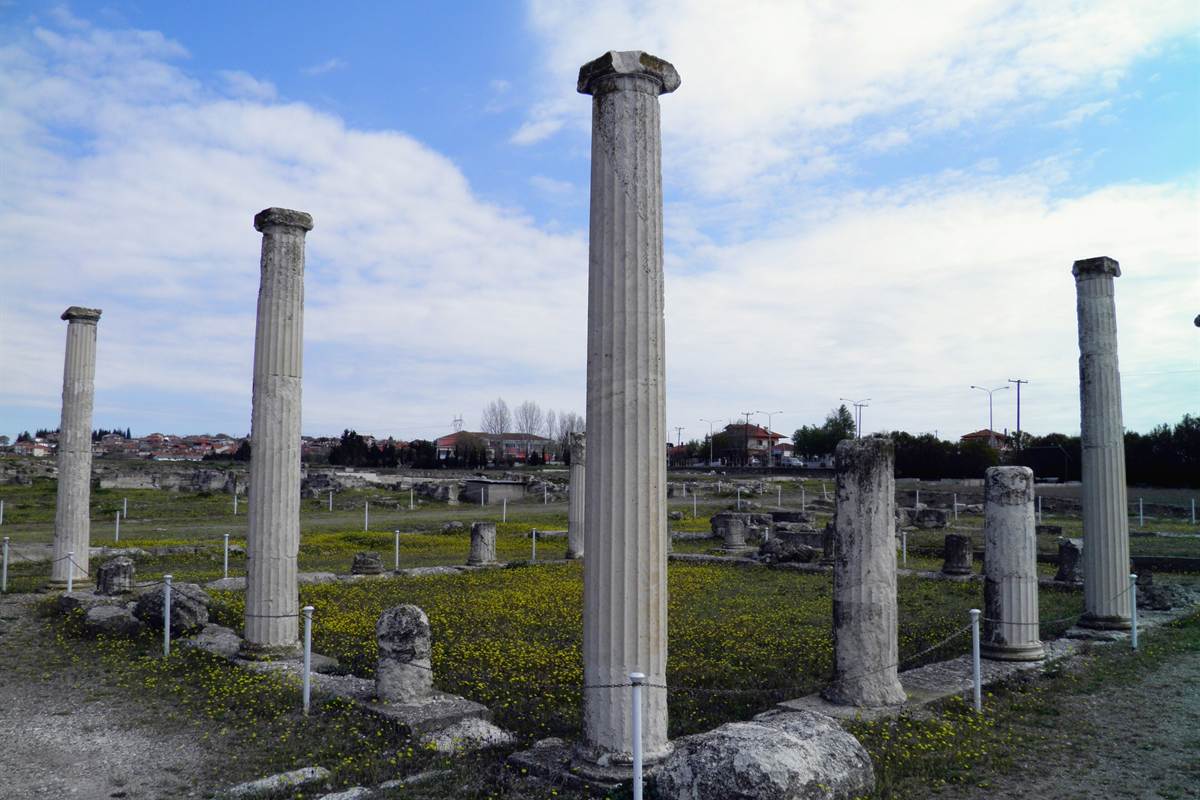
The agora, laid out under Cassander late in the 4th century BC, spans 260 by 238 metres over 10 city blocks, the largest square agora of the Greek world. Pella tickets lead across the foundations of its shops and workshops and along the southern portico, restored in work begun in 1998.
In the residential quarter, grand houses carry names that excavators gave them, such as the House of Dionysus and the House of Helen, with peristyle courtyards and mosaic floors on view. Pella tickets show the conserved walls and Ionic colonnade of the House of Dionysus and a column of the House of Helen raised again in 1976.
What do Pella tickets show in the Archaeological Museum of Pella?
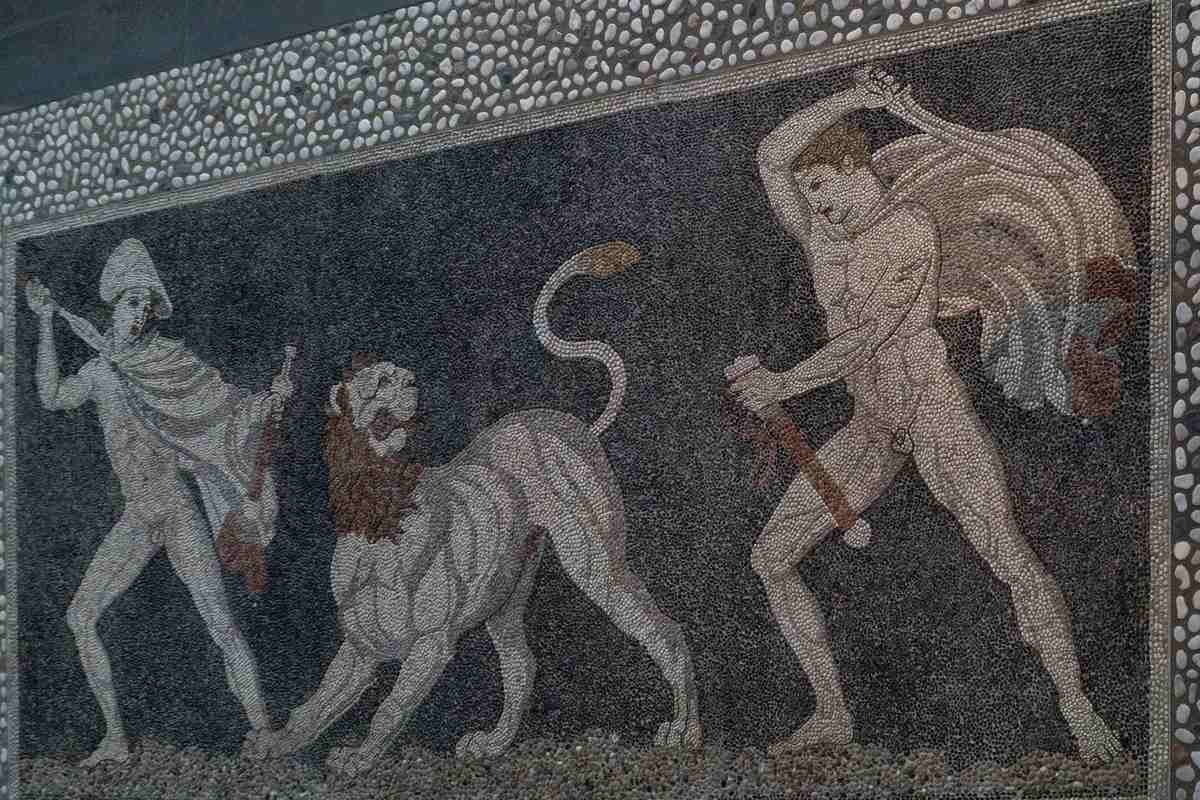
Inside the museum, Pella tickets show the finds from the excavations: a marble portrait of Alexander the Great, pebble mosaic floors from the wealthy houses, a painted wall 5 metres high and burial offerings from the cemeteries, arranged in five thematic sections.
First comes a roof tile stamped with the city’s name, the find that proved the ruins were Pella, then the marble head of Alexander and a statuette with the attributes of Pan. From a balcony above the ground floor, holders of Pella tickets overlook the mosaic floors and a reconstructed painted wall from a two-storey house.
The building opened in 2009 to a design by architect Kostas Skroumpellos, and its rectangular atrium recalls the peristyle courtyards of the houses outside. Past the entrance, Pella tickets lead through five sections, each built around one area of the excavations:
- Daily life: house mosaics, among them the lion hunt from the House of Dionysus.
- Public life: coins, inscriptions, sculpture, wine jars and figurines from the agora.
- Sanctuaries: finds from three sanctuaries, among them that of Darron, a local healing god.
- Cemeteries: Bronze Age to Hellenistic graves, with a sleeping Eros figurine from a child’s burial.
- Palace: the architecture of the royal complex and the life of Alexander.
Do Pella tickets include the palace of Pella?
Yes, the combined Pella tickets name the palace, yet the palace needs no paid entry at all: the Ministry of Culture and Hellenic Heritage both list free admission there, and the Ephorate admits visitors only at weekends, on Saturdays and Sundays.
The official store describes the combined Pella tickets as a visit to Pella that includes the Palace of Pella; the single site and museum tickets name only their own venue. The Ephorate opened the restored palace after its inauguration, with a new visitor reception building and a visitor path.
The opened area runs from the monumental entrance, a three-part propylon in a south front 160 metres long, to Building I, where an andron of 17.7 by 22 metres hosted councils and banquets, and on to the restored palaestra with its swimming pool.
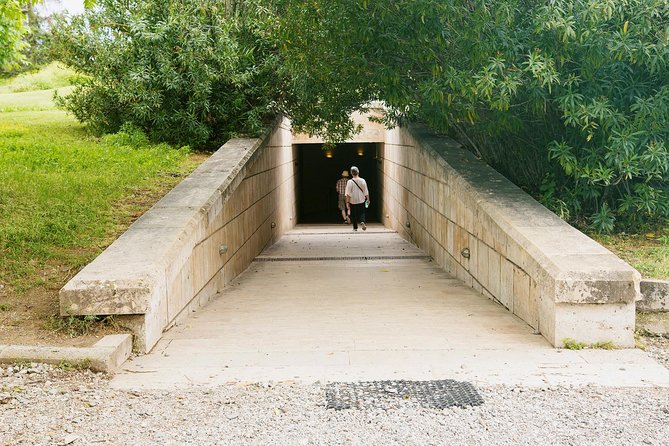
The propylon and Building I went up under Philip II, between 350 and 330 BC, and it was here that Alexander the Great was born. Centuries of stone robbing left the walls near foundation level, and a Doric capital from the palace is on show in the museum, which both the museum ticket and the combined Pella tickets open.
Where can you buy Pella tickets?
Pella tickets are on sale through Hellenic Heritage’s official store at tickets.hh.gr, which keeps one page for the site and one for the museum, and at the ticket counters in Pella; travel agencies in Greece or the EU buy through partner accounts.
The store splits Pella tickets across two venue pages. The Pella page sells a single entry to the archaeological site, the museum page sells a single entry to the Archaeological Museum of Pella, and both pages carry the same combined ticket, which joins the site and the museum and names a visit to the Palace of Pella as well.
Behind the store stands ODAP, the Hellenic Organization of Cultural Resources Development, which the Ministry of Culture supervises and which holds the exclusive right to issue admission tickets to state-run sites, Pella tickets included. Its terms reject tickets from any other seller, forbid exchange and resale, and threaten criminal and civil penalties for forged or unofficial copies.
How do Pella tickets work as e-tickets?
Pella tickets bought online are timed e-tickets: you pick a date and an entry slot, pay by card, receive a PDF attachment by e-mail, and show it on a phone screen or on paper for staff to scan at the entrance.
Pella tickets admit one person each, a single time, on the date and in the slot chosen at checkout, and the last entry falls 20 minutes before closing. A booked slot can move twice without charge until 2 hours before entry, using the Manage Tickets service, but nothing else changes after payment, and the store makes no refunds.
Combined Pella tickets add a step: the buyer sets an activation date, and the bundle then stays active for 24 hours from the first entry. Store buyers must be at least 18. Parties of over five members can book one adjusted group ticket issued to their leader, with member details open to change until 14 days before the visit.
Who gets reduced or free Pella tickets?
Pella tickets are free for EU nationals up to 25, for children from non-EU countries up to 18 and for visitors with disabilities, under the Ministry of Culture’s admission rules, while EU citizens over 65 and certain school escorts pay a 50% reduced rate.
Proof decides every case. A passport or ID card covers age and nationality, a disability card or certificate covers disability, and one companion also enters free when the rating reaches 67%. Greek jobseekers, refugees, journalists and ICOM or ICOMOS members qualify on their own documents. Holders of reduced or free Pella tickets who arrive without the right papers are turned away, with no exchange and no refund.
Half-rate Pella tickets apply to three groups. Greek and other EU nationals over 65 get the discount between 1 October and the start of June, on an ID card or passport; parents joining primary-school trips from the EU or the EEA also pay half, as do teachers escorting school, college or university groups from non-EU countries.
Nobody pays on the free days in the store’s terms: the first and third Sunday of every month between 1 November and 31 March, 28 October, 18 April for International Monuments Day, International Museum Day, the last weekend of September and 6 March, in memory of Melina Mercouri. Free Pella tickets on those dates come from the counters alone.
Which tours include Pella tickets?
Pella tickets come with a tour only when its inclusions say so: the GetYourGuide summaries for the Pella trips from Thessaloniki spell out stops, guiding, pickup and free cancellation but not admission, and one full-day coach trip also carries a skip-the-line label.
- Guided Pella site and museum visit of 4 to 5 hours, ending in green countryside, with a private option
- Small-group run of 5 hours with private pickup anywhere in Thessaloniki for the Aigai tombs and the Pella museum, wheelchair accessible
- Coach day of 8.5 hours covering Vergina and Pella, flagged skip-the-line
- Archaeologist-led day of 8.5 hours at Pella and Aigai, plus the royal tombs museum at Aigai
- Day of 9 hours linking Pella, the Edessa waterfalls and a Xinomavro wine tasting, with a meal and pickup
Every one of these lists English and free cancellation; booking closes 30 minutes before the start on the coach day and 10 hours before on the Edessa and wine trip. Compare them with the other excursions on our Thessaloniki day trips page before you buy Pella tickets on your own.
Viator’s listings that name Pella follow the same pattern from Thessaloniki: private tours of Pella and Vergina built around Alexander the Great, a day trip to both royal capitals, and a day tour with pickup that joins the Aigai tombs to the Pella museum. Read the inclusions on each before assuming Pella tickets are covered.
Do Pella tickets come with a guide or an audio guide?
No, Pella tickets cover entry alone: neither official ticket page offers a guide or an audio guide, the Ministry lists a printed guide among the museum’s services, and live guiding comes with booked tours like the archaeologist-led day trip or the guided Pella visit.
The audio route goes through the Hellenic Heritage Digital Guide, an app from the store’s operator with self-guided tours of 40 sites and museums in 8 languages, offline downloads and numbered stops with QR codes. Its list of examples runs from the Acropolis to Delphi, Festos and Ancient Olympia without naming Pella, so check the app before pairing it with Pella tickets, and pack headphones.
Licensed guides need no ticket of their own: tourist guides working in Greece enter free with their professional ID, and the store’s terms let certified guides set up a partner profile that issues them a free admission card. The museum also lists educational programmes, while the half-day Pella tour and the archaeologist-led trip add the commentary that plain Pella tickets lack.


How do you reach Pella to use your Pella tickets?
You reach Pella to use your Pella tickets by car, KTEL coach or taxi from Thessaloniki, about 40 km to the east: the drive takes 45 to 60 minutes on the EO2 national road, and the Giannitsa coach takes about an hour.
The car route leaves Thessaloniki by its western exit, joins the A2 motorway (Egnatia Odos) for 5 km and then follows EO2, the national road from Thessaloniki to Edessa. Turn off at the Pella exit; the ruins appear just before the village, and the museum lists a car park for visitors with Pella tickets. Beyond Pella, EO2 carries on through Giannitsa towards Edessa, where our Edessa tours begin.
KTEL coaches for Giannitsa leave the Macedonia Intercity Bus Station on the west side of Thessaloniki. Ask the driver for the ancient site: the coach drops holders of Pella tickets beside the main road, a 10-minute walk from the ruins. For the return, wave down the Thessaloniki coach at the same stop with small change ready, or ride the local bus from the village to Giannitsa.
A taxi covers the 45 km road trip from central Thessaloniki door to door; licensed cabs there are dark blue with a roof light, and Uber also runs in the city. Once there, Pella tickets lead to two places 1.3 km apart by road, the ruins and the museum: a walk of under 20 minutes on village streets that are not flat, or a short drive.
How much time do Pella tickets need, and in which order?
Pella tickets need 60 to 90 minutes for the whole archaeological site and about an hour for the museum, plus the 1.3 km between them. Start with the open-air ruins and finish in the museum, as the Ministry of Culture’s museums portal advises.
Pressed for time, holders of Pella tickets can limit the ruins to the highlights on the south side of the agora, a visit of 30 to 45 minutes. The full grid of streets, house blocks and agora is the longer option, and the museum hour covers its permanent exhibitions. Coach riders add the 10-minute walk from the main road.
The museum displays are built to talk to the excavated city in front of the building and expand on first impressions, so holders of Pella tickets see the ruins first. That order fits the coaches: the main-road stop lies near the ruins, and the village stop for the Giannitsa bus sits 0.4 km from the museum. On a Saturday or Sunday, the palace adds a third stop.
Can you combine Pella tickets with Vergina tickets?
Yes, Pella tickets combine with Vergina tickets on a single day, but you buy them separately: Pella tickets stop at Pella, and Aigai sells one ticket of its own for the six units of its Polycentric Museum at Vergina, 53 km away by car.
The pairing follows Macedon’s own story. In the late 5th century BC, King Archelaus shifted the royal seat from Aigai to Pella, and Aigai remained the burial ground of the kings. Pella tickets do not open any part of Aigai, and the Aigai ticket, valid for six units from the Royal Tombs to Saint Demetrius church at Palatitsia, does not open Pella; our Vergina tickets page lists them all.
The 53 km drive from the Pella museum to the Royal Tombs takes about 65 minutes: along EO2 towards Thessaloniki, then EO1 in the direction of Veria and road 5305 via Meliki. Pella tickets and the Aigai ticket both sell on the Hellenic Heritage store, on separate venue pages, so a two-capital day means two separate purchases.
Frequently Asked Questions
Can wheelchair users visit with Pella tickets?
Yes, for the museum: holders of Pella tickets with a disability find a parking area and a ramp linking it with the courtyard, lifts inside the building and an accessible toilet. Hellenic Heritage marks the open-air site as accessible too, though the streets of the modern village nearby are not flat.
On which days can you not use Pella tickets?
Pella tickets cannot be used on six dates, when both the site and the museum stay closed: 1 January, 25 March, Labour Day, Easter Sunday, 25 December and 26 December. Opening times also change on Good Friday and Holy Saturday, so call the museum or check its website before a visit on those days.
When is the best season to use Pella tickets?
Spring and autumn suit Pella tickets best, since the ruins are an open-air walk. Thessaloniki, 40 km east, averages highs of 19.7°C in April and 22.9°C in October, against 32.7°C in July. The sun stays strong around midday even in spring and autumn, so bring sunscreen, a hat and sunglasses.
Where can holders of Pella tickets eat or stay nearby?
Holders of Pella tickets can eat at the museum café or at restaurants in the village centre. Pella village has no professional lodging because of its size, only private rooms let through Airbnb, so visitors base themselves in Thessaloniki or in Giannitsa, 13 km west along EO2 and a 10 to 15 minute drive from the ruins.