
An Apostle Paul tour follows the places in Greece where Paul preached, from the Areopagus in Athens and the Bema of Ancient Corinth to Philippi, Kavala, Thessaloniki and Veria. Day tours leave Athens, Piraeus and Thessaloniki, and private tours visit Philippi from Kavala. Greece Tours lists the tours that start in Greece.
This page covers the route, what each stop shows, the tours from Athens and Thessaloniki, multi-day journeys, Crete, the Bible passages, timing, what to bring and how private and group tours differ. The tours below are checked on GetYourGuide and Viator.
What is an Apostle Paul tour in Greece?
An Apostle Paul tour in Greece is a guided trip that follows the route Paul the Apostle took through Macedonia and Achaia on his second missionary journey, around AD 49 to 52. Guides link each ruin to the matching chapter of the Acts of the Apostles.
The route comes from Acts chapters 16 to 18, which follow Paul, Silas and Timothy from the port of Troas in north-west Asia Minor to Corinth. At Troas, Paul saw a vision of a man of Macedonia pleading, “Come over to Macedonia and help us.” An Apostle Paul tour treats that crossing as the door through which the faith of Christ passed from Asia to Europe.
Paul’s letters give the route its depth. Of the 27 books in the New Testament, 13 name Paul as their author, and his letters to the Corinthians, the Philippians and the Thessalonians went to churches in cities on this route. An Apostle Paul tour links each letter to the ruins of the city that received it.
An Apostle Paul tour takes three forms in Greece: a walking tour in Athens, a day trip from Athens to Corinth, or a multi-day route that adds Berea, Thessalonica and Philippi in Macedonia. Guides combine biblical and historical interpretation, setting out the history and culture of the first century AD at each site.
Which places does an Apostle Paul tour visit in Greece?
An Apostle Paul tour visits the nine stops of Paul’s second missionary journey in Greece: Neapolis (Kavala), Philippi, Amphipolis, Apollonia, Thessalonica (Thessaloniki), Berea (Veria), Athens, Corinth and Cenchreae, the eastern port of Corinth where he set sail for Syria with Priscilla and Aquila.
- Neapolis, today’s Kavala: the harbour where Paul first landed in Greece.
- Philippi: a Roman colony on the route inland from the coast.
- Amphipolis and Apollonia: two cities on the Via Egnatia that Paul passed through on the way west.
- Thessalonica, today’s Thessaloniki: the city where Paul spoke in the synagogue on three successive sabbaths.
- Berea, today’s Veria: the town whose Jews Acts calls “more noble” for examining Paul’s teaching with care.
- Athens: the city where Paul preached in the Agora and spoke on the Areopagus.
- Corinth: the capital of the Roman province of Achaia and Paul’s base for 18 months.
- Cenchreae, today’s Kechries: the port on the Saronic Gulf where Paul had his hair cut to fulfil a vow.
An Apostle Paul tour in the north follows the Via Egnatia, the Roman road that ran over 800 km from the Hellespont to Dyrrhachium on the Adriatic. Paul, Silas and Timothy travelled it by land from Neapolis through Philippi, Amphipolis and Apollonia to Thessalonica, and the three stages west of Philippi measure 53, 48 and 60 km.
Acts sets the order of the stops on an Apostle Paul tour. Paul left Thessalonica for Berea by night, then left Berea for Athens after opponents from Thessalonica agitated the crowds there. He waited in Athens for Silas and Timothy, then moved on to Corinth, where both men rejoined him.
What does an Apostle Paul tour see on the Areopagus in Athens?
An Apostle Paul tour sees the Areopagus, the rocky Hill of Ares north-west of the Acropolis, where Paul addressed Athenians and Stoic and Epicurean philosophers in Acts 17. He quoted an altar inscribed TO AN UNKNOWN GOD and proclaimed that God to them.
The name comes from the Greek Areios Pagos, the Hill of Ares, where myth placed the trial of the war god by the other gods. The Areopagus Hill gave its name to the council that judged homicide, wounding and certain religious offences. An Apostle Paul tour links the scene to Socrates, since the charge that Paul proclaimed foreign gods echoes the charge of new gods brought against the philosopher.
On the rock, the guide retraces the fullest reported speech of Paul’s missionary career. Paul quoted Greek poets: “For in him we live and move and have our being” comes from the Cretica of Epimenides, and “For we are also his offspring” from Aratus or Cleanthes. An Apostle Paul tour closes the story with two converts: Dionysius, a member of the Areopagus, and a woman named Damaris.
A pedestrian route leads from the Acropolis to the hill on foot, and the top gives panoramic views of the city. From there, an Apostle Paul tour looks down on the Ancient Agora of Athens, the marketplace where Paul preached and argued daily. Under Byzantine rule, the hill carried a church and a monastery dedicated to Dionysius the Areopagite.
What does an Apostle Paul tour see in Ancient Corinth?
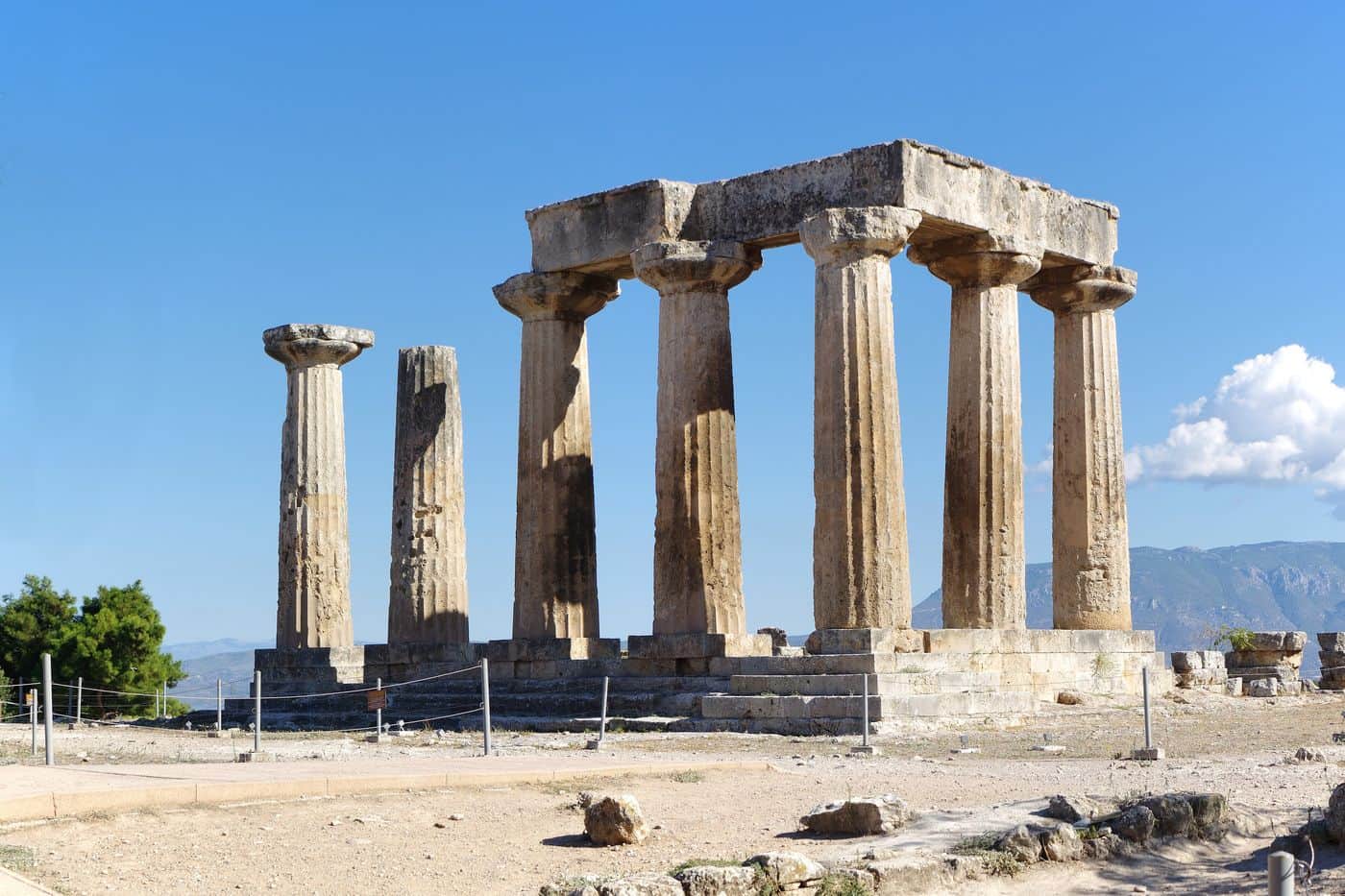
An Apostle Paul tour in Ancient Corinth sees the Bema, the judgment seat where Paul stood before the proconsul Gallio, and the forum of the city where he lived for 18 months and founded the church that received his letters to the Corinthians.
In Greek, bema means both platform and step, and the Corinth Bema later became a Church of the Apostle Paul. Gallio, brother of the writer Seneca, dismissed the charge against Paul. For an Apostle Paul tour, the spot carries weight: an inscription at Delphi dates Gallio’s term to AD 51 to 52, a key date for New Testament chronology.
The Ancient Corinth that Paul knew was a Roman colony, refounded by Julius Caesar in 44 BC after Rome destroyed it in 146 BC. Paul worked there as a tentmaker with Aquila and his wife Priscilla, who had come from Italy after Claudius ordered all Jews to leave Rome. An Apostle Paul tour connects the ruins to his letters: 1 Corinthians, written from Ephesus, and 2 Corinthians, written from Macedonia.
Outside the city, an Apostle Paul tour visits the Diolkos, a paved trackway of 6 to 8.5 km that carried ships overland across the Isthmus and stayed in service until the middle of the first century AD. The route closes at Cenchreae, the eastern port where Paul had his hair cut to fulfil a vow before sailing for Syria. Paul later commended Phoebe, a deacon of the church there.
Which Apostle Paul tours run from Athens to Corinth?
The Apostle Paul tours that run from Athens to Corinth are day trips of 6, 7.5 or 8 hours, each with pickup available. The fuller ones add the Corinth Canal, the Diolkos, Acrocorinth, the site museum and Cenchreae, the port where Paul sailed for Syria.
- The Apostle Paul’s Missionary Journey in Athens and Corinth: 8 hours, with both cities in one day.
- From Athens: Apostle Paul’s Footsteps Tour Athens and Corinth: 8 hours, from the Ancient Agora and the Areopagus to the Corinth Canal, the Diolkos, Ancient Corinth, Acrocorinth and Cenchreae.
- Private Biblical Ancient Corinth: St. Paul’s Journey: 8 hours, with a meal included.
- Paul’s Biblical and Ancient Corinth Half-Day Tour: 7.5 hours, starting at the Corinth Canal, with Kechries, the Step of Paul and Acrocorinth.
- Athens: St. Paul’s Corinth, Bema, Diolkos and Cenchreae Port: 6 hours, following Paul’s footsteps in order.
- Athens: Apostle Paul and the Letters to the Corinthians Biblical Tour: 6 hours, a day trip with an optional audio guide.
- Biblical Tour Follow St Paul’s Footsteps in Athens and Corinth: 6 hours, in English or Afrikaans, with wine and olive tasting.
On the road from Athens, an Apostle Paul tour stops at the Corinth Canal, a 6.4 km cut through the Isthmus completed in 1893. Nero broke ground on the same line in AD 67, and remnants of the Diolkos still lie beside the modern channel. Longer visits to the cut feature in our Corinth Canal tours.
Inclusions differ between operators. A meal comes included on two Apostle Paul tours: the private Ancient Corinth journey and the Bema, Diolkos and Cenchreae tour. Skip-the-line entry comes with the Letters to the Corinthians tour, the private Ancient Corinth journey and the half-day Corinth tour, which is also wheelchair accessible.
How long does an Apostle Paul tour from Athens take?
An Apostle Paul tour from Athens takes 3 to 5 hours as a walking tour of the Areopagus and the Ancient Agora, and 6 to 8 hours as a day trip to Corinth, which lies about 82 km from Athens on modern roads.
In Athens, the walking Apostle Paul tour lasts 3 hours: it visits the Areopagus and the Ancient Agora, explains the first Christians of Athens and is wheelchair accessible. A 5-hour Apostle Paul tour by a licensed Athens guide adds the Acropolis, with the Acropolis Museum as an option.
Day trips to Corinth last 6, 7.5 or 8 hours. The 8-hour Apostle Paul tour fits both cities into one day, adding the Ancient Agora and the Areopagus to the Corinth sites. An 11-day Apostle Paul tour from a pilgrim operator gives each city its own day instead: Ancient Corinth, the Diolkos and Cenchreae on one day, and the Acropolis and Mars Hill on the next.
Distances inside the Corinthia stay short on an Apostle Paul tour. Kechries, the site of ancient Cenchreae, lies about 8 km south-east of modern Corinth and 4 km south-west of Isthmia, at the eastern end of the Corinth Canal, so the canal stop and the port sit close together on the drive.
What does an Apostle Paul tour see in Philippi?
An Apostle Paul tour in Philippi sees the ruins where Paul first preached on European soil, the so-called prison of Paul and the baptistery of Lydia beside the river Zygaktis. The archaeological site is a UNESCO World Heritage Site a short drive from Kavala.
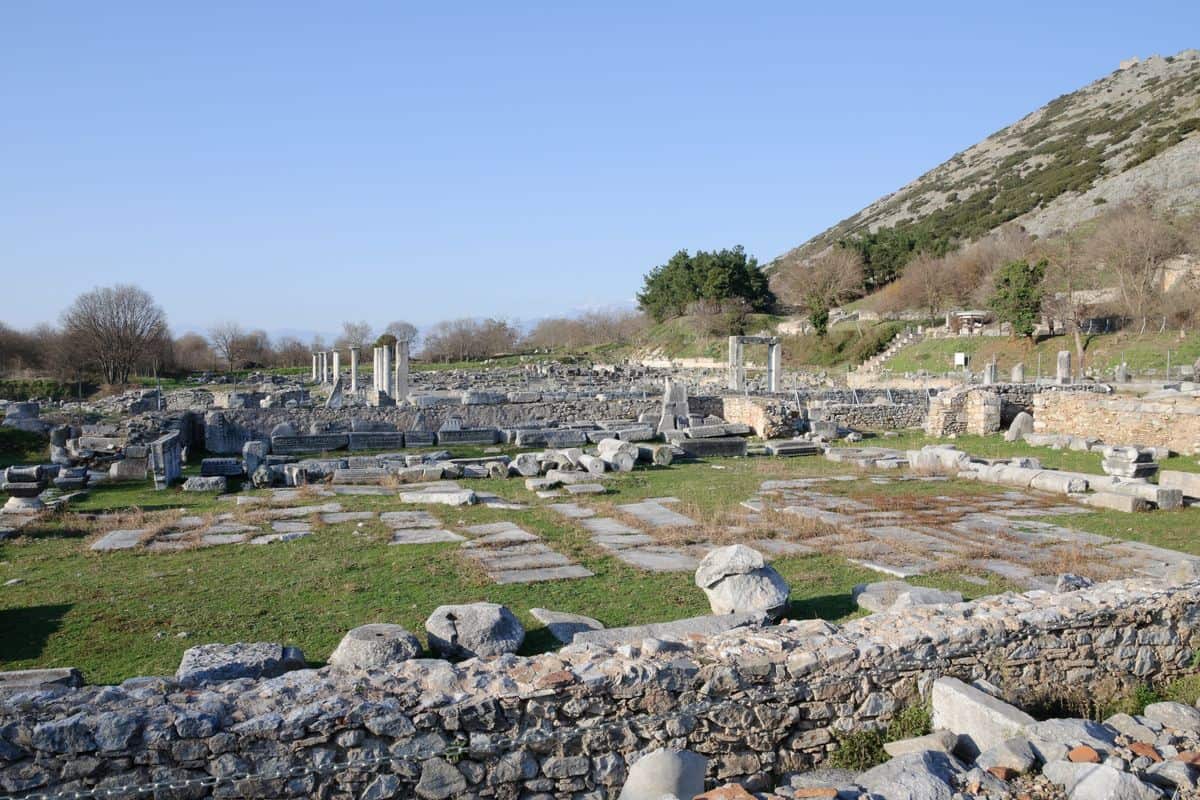
Acts 16 records that on the Sabbath Paul went outside the city gate to a riverside place of prayer and spoke to the women gathered there. Lydia, a seller of purple from Thyatira, today Akhisar in Turkey, was baptised with her household and hosted Paul. She is the first documented convert to Christianity in Europe and the central figure of any Apostle Paul tour in Philippi.
The Metropolis of Kavala built an open-air baptistery and an octagonal baptistery with mosaic and stained glass, the only such temple in Greece, at the village of Lydia on the river Zygaktis, where tradition places the baptism. The river is also known as the “Jordan river of Greece”. A 3.5-hour private Apostle Paul tour from Kavala covers the ruins and the Baptistery of Saint Lydia.
Acts 16 tells how Paul and Silas, accused of “disturbing the city”, were jailed and sang hymns, and Paul stayed inside during an earthquake; the jailer was then baptised with his household. A guided Apostle Paul tour pairs the so-called prison of Paul with the Roman forum, the theatre and the Basilica of Paul, named in a floor mosaic inscription. Our Philippi tours page compares the day trips.
What does an Apostle Paul tour see in Kavala?
An Apostle Paul tour in Kavala sees the harbour of ancient Neapolis, where Paul landed after sailing from Troas by way of Samothrace. From this port he walked the Via Egnatia to Philippi, so Kavala marks the first European soil Paul touched.
Neapolis, meaning “new city”, was founded by settlers from Thasos. Philip II of Macedon took it around 350 BC and used it as the harbour of Philippi, and it stayed a station on the Via Egnatia through the early Christian period. An Apostle Paul tour reads the story in the town’s names: Neapolis, then Christoupolis, “city of Christ”, and from the 16th century, Kavala.
Kavala is today the principal seaport of eastern Macedonia, on the Bay of Kavala facing Thasos and 160 km east of Thessaloniki. Its archaeological museum holds finds from Neapolis, and a Catholic church of Saint Paul occupies the old Lazarist monastery building. The Byzantine fortress and the 16th-century Kamares aqueduct round off the things to do in Kavala on an Apostle Paul tour.
The Sacred Path of Apostle Paul is a 5-hour private tour from Kavala for up to 6 passengers, with an optional audio guide. This Apostle Paul tour follows the apostle’s footsteps and the ancient archaeological sites, and the operator offers it in English, Greek, Bulgarian, Romanian and Turkish.
What does an Apostle Paul tour see in Thessaloniki?
An Apostle Paul tour in Thessaloniki sees the Upper Town where Paul taught, the Church of Saint Paul and Vlatadon Monastery, believed to stand on the site of Jason’s house. Paul preached in the synagogue on three Sabbaths and planted the first church.
An Apostle Paul tour follows Paul, Silas and Timothy into Thessalonica along the Via Egnatia, after Amphipolis and Apollonia. Founded around 315 BC by Cassander and named after Thessalonike, a half-sister of Alexander the Great, the city was the capital of the Roman province of Macedonia. Jason’s house sheltered the apostles until a mob dragged Jason before the politarchs, a title inscriptions confirm for Thessalonica.
In the Upper Town, Vlatadon Monastery dates from the 14th century and is one of 15 UNESCO-listed Paleochristian and Byzantine monuments of Thessaloniki, with views over the city, the Thermaic Gulf and Mount Olympus. An Apostle Paul tour also visits the Church of Saint Paul, built where Paul preached, within walking distance of the Saint Paul chapel and the Holy Spring of Saint Paul.
Paul later wrote to this church, and two of those letters entered the Bible as First and Second Thessalonians. First Thessalonians is widely held to be one of the first New Testament books written and the earliest surviving Christian text. An Apostle Paul tour can add the two-terraced Roman forum and the fifth-century basilica of Hagios Demetrios, the city’s patron saint.
What does an Apostle Paul tour see in Veria?
An Apostle Paul tour in Veria sees the Bema of Saint Paul, the raised platform where Paul is believed to have preached in ancient Berea. Acts 17 praises the Bereans, who received his message with eagerness and examined the Scriptures every day.
Veria, capital of Imathia, is the Beroea or Berea of Acts and, for an Apostle Paul tour, the third city of Paul’s mission in northern Greece. Paul and Silas were sent from Thessalonica by night and went to the synagogue. Jews, prominent Greek women and Greek men believed, until Jews from Thessalonica stirred up the crowds; Paul left for the coast and Athens, while Silas and Timothy stayed.
Alongside the Bema, also called the Altar, an Apostle Paul tour in Veria explores the ancient Agora and the old Jewish synagogue. The city’s 19th-century synagogue stands in Barbuta, the protected former Jewish neighbourhood. Veria also lists Sopater, a kinsman of Saint Paul, among its notable locals, and the Anastasis Church keeps frescoes from 1315.
Vergina, ancient Aegae, lies 12 km south-east of Veria; this UNESCO World Heritage Site holds the tomb of Philip II of Macedon, so an Apostle Paul tour here can join scripture with Macedonian royal history. The Byzantine Museum of Veroia and the Archaeological Museum of Veroia sit in the city itself. Compare the routes on our Veria tours page.
Which Apostle Paul tours run from Thessaloniki?
Apostle Paul tours from Thessaloniki run from a 2-hour guided city tour to private day trips of 8 to 10 hours. The day trips reach Philippi and Kavala, Veria, or Amphipolis and Philippi, with hotel, cruise-port or airport pickup in Thessaloniki.
In the city itself, a 2-hour guided Apostle Paul tour, the Apostle Paul’s story in Thessaloniki, covers Paul’s visits, his second mission in Greece and the historical context of his letters, in English. The private Footsteps of Apostle Paul trip runs 8 hours to Philippi and Kavala, with pickup, in English or Greek, for up to 15 people per booking.
A Thessaloniki operator of private biblical day tours sets each Apostle Paul tour by place and length, from a short city visit to full days that join Thessalonica and Berea. The list below shows its six biblical and heritage options, all private and all starting in Thessaloniki:
- Thessalonica biblical private tour: 3 hours
- Philippi private tour: 8 hours
- Biblical Berea private tour: 8 hours
- Amphipolis and Philippi private tour: 8 hours
- Saint Paul’s footsteps private tour: 10 hours
- Thessalonica and Berea biblical private tour: 10 hours
These private tours carry up to 6 guests in a minivan or 12 in a Mercedes Sprinter minibus, with pickup at Thessaloniki hotels, at the port for cruise passengers or at the airport, and licensed site guides on request. An Apostle Paul tour that adds Amphipolis follows Paul’s road west along the Via Egnatia, about 53 km from Philippi; our Amphipolis day trip from Thessaloniki covers that stop.
How does a multi-day Apostle Paul tour of Greece work?
A multi-day Apostle Paul tour of Greece runs as a guided coach circuit. A 10-day itinerary starts in Thessaloniki, visits Kavala and Philippi, moves south through Meteora and Delphi to Athens and Corinth, and books nine hotel nights on half board.
One 10-day Apostle Paul tour from an Athens-based Christian operator runs north to south. Guests are met at Thessaloniki airport, spend the first days in Macedonia, cross central Greece by coach to Athens and Corinth, and fly home from Athens airport. The day plan reads:
- Arrival and day 1: Thessaloniki, then Kavala and Philippi
- Day 2: Thessaloniki, Pella and Vergina
- Days 3 and 4: Dion, Kalambaka, Meteora and Delphi
- Days 5 and 6: Delphi, Athens and the Areopagus
- Day 7: Corinth, Cenchreae and Isthmia
- Day 8 and departure: a free day, then Athens airport
That Apostle Paul tour books 3 nights in Thessaloniki, 1 in Kalambaka, 1 in Delphi and 4 in Athens, all at 4- or 5-star hotels on half board, with nine breakfasts and nine dinners. Entrance fees, local taxes, a local Christian guide, airport transfers and air-conditioned coaches with on-board toilets are included; air tickets, tips and personal spending are not.
A faith-and-cruise Apostle Paul tour lists Thessaloniki, Kavala, Philippi, Meteora, Athens, Mars Hill and Corinth, and a 3-night cruise to Mykonos, Patmos and Santorini plus Ephesus in Turkey, with 19 meals and a group size of 37. Rome is its 3-night extension, while the 10-day plan offers Patmos and Ephesus as a 3-day cruise, and Olympia, Mycenae or Eleusis as extra days.



Where did the Apostle Paul land in Crete?
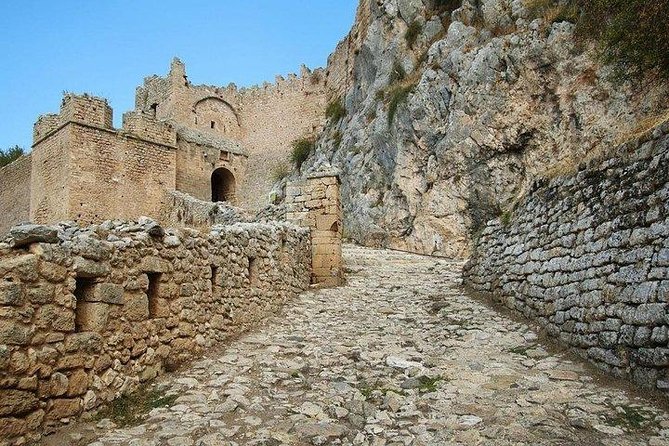
The Apostle Paul landed at Fair Havens, the port now called Kaloi Limenes or Kali Limenes, on the southern coast of Crete, while sailing to Rome as a Roman prisoner in Acts 27. An Apostle Paul tour of Crete centres on this small natural port.
Kaloi Limenes means “good harbours” or “fair havens”. The village lies 70 km south-west of Heraklion, close to Lentas and to the unexcavated remains of Lasea, a port of ancient Gortys, and Acts 27 names both Fair Havens and Lasea. For an Apostle Paul tour of the south coast, the Kali Limenes page covers the village itself.
Paul sailed under a centurion named Julius, with Aristarchus of Thessalonica beside him. Fair Havens was a small bay with a rocky beach, hard for a large ship to shelter in from winter storms, so the crew ignored Paul’s warning and left for Phoenix. A north-easter, the Euraquilo, then drove the ship and its 276 people to Malta in fourteen days.
On an Apostle Paul tour of the bay, look for the church named after the apostle, built in Byzantine times and restored in the 1960s, and the islet of Aghios Pavlos (Saint Paul) at the harbour entrance. The Epistle to Titus adds a second Crete link: Titus was left on the island to organise the church, and Eusebius names him its first bishop.
Which Bible passages does an Apostle Paul tour follow?
An Apostle Paul tour follows Acts 16 to 18, the chapters of the second missionary journey through Philippi, Thessalonica, Berea, Athens and Corinth, and Acts 27 for Crete. Guides also read the New Testament letters to the Philippians, Thessalonians, Corinthians and Titus.
The Acts of the Apostles is the fifth book of the New Testament and runs to 28 chapters. Its narrator joins the story as “we” in the passages of Acts 16 to 27, and tradition names him Luke the Evangelist, a doctor who travelled with Paul. That first-person voice runs through the stops of an Apostle Paul tour, from Neapolis to Fair Havens.
- Acts 16, verses 9–10: the vision of the man of Macedonia at Troas.
- Acts 16, verses 11–15: the voyage via Samothrace and Neapolis to Philippi, and Lydia of Thyatira.
- Acts 17, verses 1–9: three sabbaths in the synagogue of Thessalonica.
- Acts 17, verses 10–15: the Bereans, praised as “more noble”.
- Acts 17, verses 16–34: Paul in Athens, from the Agora to the Areopagus.
- Acts 18, verses 1–11: Corinth, Aquila and Priscilla, and Paul’s trade as a tentmaker.
The letters add a second layer. Of the 13 letters that bear Paul’s name, seven are widely accepted as his own, including Romans, 1 Corinthians, 2 Corinthians, Philippians and 1 Thessalonians, and commentators agree he dictated Romans during a three-month stay in Greece. An Apostle Paul tour reads 1 and 2 Thessalonians in Thessaloniki and the Corinthian letters among the ruins of Corinth.
Reading the text on site brings an Apostle Paul tour to life. A licensed Athens guide asks guests to bring a Bible and reads the passages of Paul’s visit at the places where the events took place, such as the sermon on Mars Hill in Acts 17, verses 22–31.
When is the best time for an Apostle Paul tour?
The best time for an Apostle Paul tour is spring or autumn. March, April and late October bring smaller crowds, while the middle of summer is very hot in Greece, so late spring and autumn keep walks on Mars Hill and at Corinth comfortable.
Athens has a hot-summer Mediterranean climate with a mean annual temperature of 19.2 °C, and it has been called the hottest city in mainland Europe. Temperatures of 47.5 °C and over have been reported in the metropolitan area. In summer, book an early-morning Apostle Paul tour to avoid the heat and large crowds.
One multi-day operator runs departures from March to November, but it drops Crete from its March departure because of seasonal daylight hours, while its departures from April to October keep the island. Plan an Apostle Paul tour that includes Fair Havens between April and October, and keep March for the quieter mainland sites.
Feast days add fixed dates. The Eastern Orthodox Church commemorates the Apostles Peter and Paul on 29 June and the Twelve Apostles on 30 June, and it remembers Paul with the Saints of Athens on 12 October. An Apostle Paul tour on 12 October joins that feast in autumn, a season that avoids the midsummer heat.
What do you need for an Apostle Paul tour?
For an Apostle Paul tour you need comfortable walking shoes, light clothing, a hat, sunscreen and water, a Bible for the readings at each site, entry tickets bought online in advance, and modest clothes for churches and monasteries that keep a dress code.
The sites lie outdoors, under the sun and on uneven ground, so the walk up to Mars Hill and across the Ancient Agora needs comfortable footwear, a hat and sunscreen. Carry your own water: inside archaeological sites only water is permitted, and food and soft drinks stay outside. Lightweight, breathable clothes keep a summer Apostle Paul tour comfortable.
Entry tickets are a separate step on a guided walk in Athens: guests buy them online in advance, and the guide sends instructions for the right ticket and time slot. Buy Acropolis tickets as soon as the Apostle Paul tour date is fixed, because timed entry slots sell out quickly in high season.
Certain churches and monasteries keep dress codes. At the Meteora monasteries, which multi-day Apostle Paul tours can include, women wear skirts below the knee and men wear trousers. Pack one such outfit for church visits, since a short stop at a local church or chapel in Athens joins a walking tour when time allows.
Is a private or a group Apostle Paul tour better?
A private Apostle Paul tour is better for families and church groups who want pickup, their own pace and time for Bible readings; a small-group tour suits travellers who want a shorter, shared outing. Both formats run from Athens and Piraeus.
Private listings carry your party alone. The luxury Corinth tour from Piraeus lasts 6 hours, the missionary journey through Athens and Corinth lasts 8 hours, and the Philippi and Kavala trip from Thessaloniki lasts 8 hours, each with pickup available and free cancellation. A private Apostle Paul tour takes bookings of up to 7 travellers on the Corinth listings and up to 15 on the Philippi trip.
Group formats stay small. The Apostle Paul e-trike tour in Athens is a 3-hour small-group ride to Mars Hill, the Ancient Agora and historic churches, with candle lighting and guides in English, Hebrew, Greek or Russian. The biblical Corinth tour from Piraeus runs as a private or group Apostle Paul tour of 7.5 hours, with wheelchair access.
Church groups that want hotels and meals handled pick a multi-day group package: one 11-day Footsteps of Paul tour includes four-star lodging, breakfast and dinner daily and modern transport, with quotes for custom groups of all sizes. Smaller parties hire a licensed guide privately for one or two days, read the Bible together at each site and tailor the Apostle Paul tour to their interests.
Frequently Asked Questions
Is an Apostle Paul tour suitable for travellers who are not religious?
Yes. An Apostle Paul tour mixes biblical and historical interpretation, from Athens in the 1st century AD to the meeting of Greek philosophy and Christianity, when Paul addressed Stoic and Epicurean philosophers on Mars Hill. Art lovers add the Holy Apostles church in Thessaloniki, one of fifteen UNESCO-listed monuments in the city, famed for Byzantine mosaics.
Can cruise passengers take an Apostle Paul tour from Piraeus?
Yes. Two Corinth listings start in Piraeus with pickup available: a private luxury Apostle Paul tour of 6 hours, and a biblical tour of 7.5 hours via the Corinth Canal and Kechries, the harbour of Aquila and Priscilla. Acts 17 points to Paul reaching Athens by sea through the Piraeus. See also the Athens shore excursion options.
Does an Apostle Paul tour include entry tickets?
Not always. The 5-hour biblical walking tour of Athens excludes entrance tickets, so guests buy their own, while one Corinth tour from Piraeus carries a skip-the-line label. Read the inclusions of each Apostle Paul tour before booking, and treat site tickets as a separate purchase unless the listing names them.
Can you see the Apostle Paul sites of Greece in one day?
No. One day covers Athens and Corinth, about 82 km apart on modern roads, as on the 8-hour missionary journey tour. Philippi and Kavala lie in Macedonia and need a separate 8-hour trip, such as a Philippi day trip from Thessaloniki, so the full route needs a multi-day Apostle Paul tour.