
Papigo canyoning is a guided descent of the Nefeli gorge beside the village of Papigo in Zagori, with rappelling down its waterfalls. The routes run as the Nefeli A section, the Nefeli B section and a waterfall rappelling trip. Greece Tours lists the trips that start in Zagori.
This page covers where the gorge lies, what each section involves, how long it takes, who can join, the equipment, the companies, the season, what to bring and what to do around Papigo in Zagori. The tours below are checked on GetYourGuide and Viator.
What is Papigo canyoning?
Papigo canyoning is a guided descent of the water-carved gorges beside Papigo in Zagori, Epirus, where groups rappel down waterfalls, jump into natural pools and ride natural water slides. Trips run mainly in the Nefeli gorge, below the Astraka towers of Tymphe.
Canyoning is the sport of travelling through canyons by walking, scrambling, climbing, jumping, abseiling and swimming. Papigo canyoning applies those techniques to the limestone gorges of Mount Tymphe, which glaciers and earthquakes have shaped over millions of years. Guides lead each group down the narrow canyons on ropes, from the first rappel to the exit path out of the gorge.
The Nefeli gorge keeps a continuous river flow throughout the year, so Papigo canyoning there is a wet descent from start to finish. An advanced route follows the Rogovos gorge, whose stream crosses both Papigo villages: an 800-metre wet canyon with 10 rappels, 3 water slides and a top rappel of 25 metres. Both belong to Zagori canyoning in the Vikos–Aoös National Park.
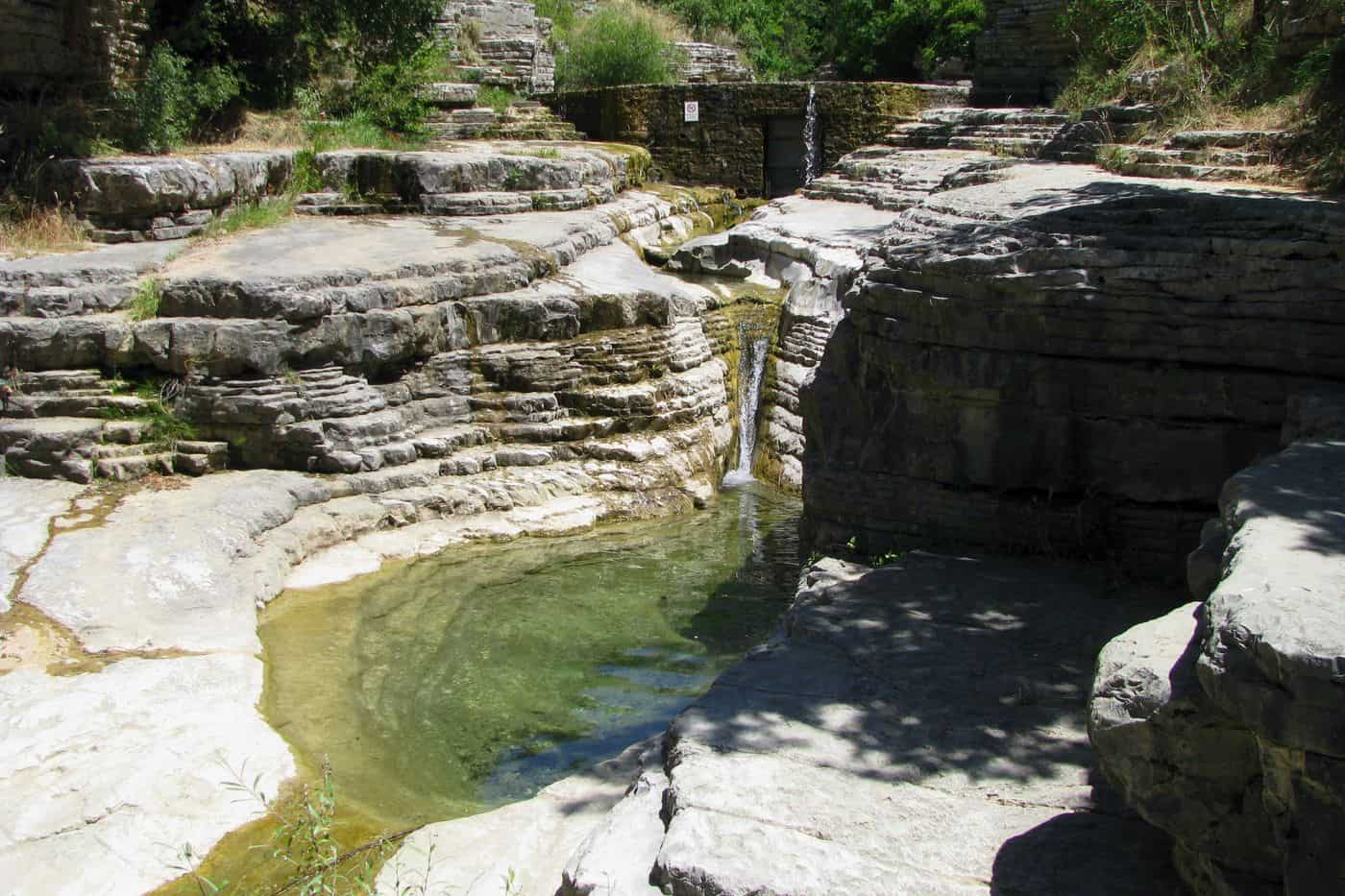
The Rogovos route also passes the rock pools that rank among the landscape attractions of Papigo. The Rogovos stream, running down Mount Tymphe, has formed a series of pools in the limestone, known as the Kolymbethres, the Greek term for baptismal fonts, or the Ovires of Rogovos. Natural pools carved by eroding stream beds are a unique feature of the Tymphe range.
Where is the Nefeli gorge for Papigo canyoning?
The Nefeli gorge for Papigo canyoning lies between Mikro Papigo and Megalo Papigo, about 60 km north of Ioannina, inside the Vikos–Aoös National Park in Zagori. It runs below the Astraka towers of Mount Tymphe and ends at the Voidomatis River.
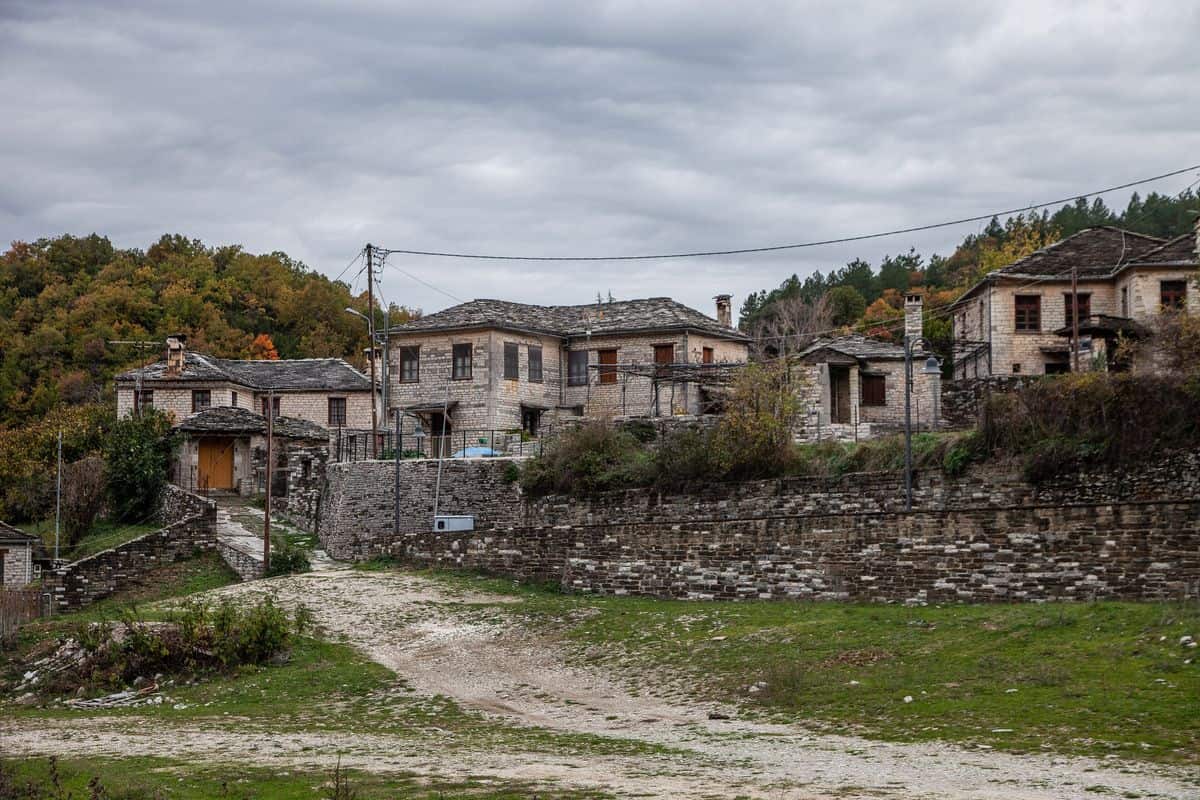
Papigo, also spelled Papingo or Papigko, is a pair of stone villages at the base of Mount Radovoli, part of the Tymphe massif. The springs behind Papigo canyoning in the Nefeli gorge begin under the Astraka and Tsouka peaks, and Astraka, at 2,436 metres, towers over the village. Water draining along the gorge feeds dense flora that covers a large part of it.
The Vikos–Aoös National Park was founded in 1973 and covers 12,600 hectares of mountains, rivers, canyons and forest. Papigo sits near the northern end of the Vikos Gorge, carved by the Voidomatis River, which also receives the Nefeli stream. Groups for Papigo canyoning meet in Papigo itself, so the descent slots into Papigo tours of the villages and trails.
What happens on the Nefeli A section of Papigo canyoning?
The Nefeli A section of Papigo canyoning is a family-friendly guided descent from Megalo Papigo through water-sculpted gorges, with rappels down waterfalls, jumps into pools and natural slides. The listed duration is 6 hours, and each group moves at its own pace.
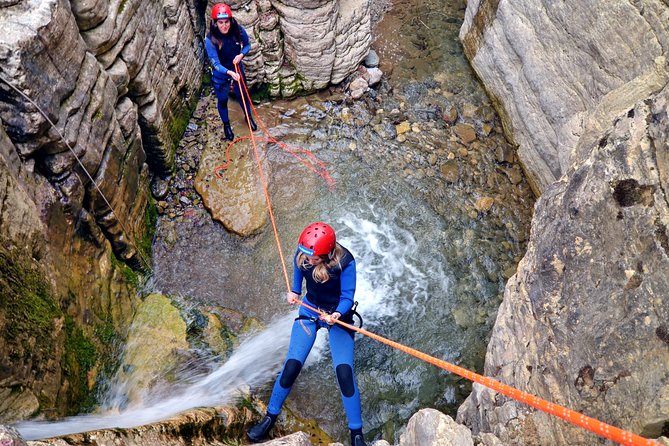
A Papigo canyoning day on the Nefeli route opens with about 30 minutes of preparation and training. A 15-minute walk then leads to the canyon entrance. Inside the gorge, the group rappels down the waterfalls on ropes, makes small jumps into natural pools and rides the natural water slides that the stream has carved into the rock.
The A section is built for families, and its listing takes groups of up to 20 people. A separate easy family route in the same gorge counts 4 waterfall rappels from 5 to 18 metres, small jumps and natural slides, then a 35-minute walk out, for a Papigo canyoning outing of 3.5 hours in total.
What is the Nefeli B section of Papigo canyoning?
The Nefeli B section of Papigo canyoning is the longer option in the same gorge: it adds 3 more rappels to the A section and runs for 7 hours from Megalo Papigo, for guests who want more action on ropes and waterfalls.
The B section keeps the family focus of the A section, and its listing calls it popular and suitable for families. The extra rappels stretch the Papigo canyoning day from 6 to 7 hours, the group cap stays at 20 people, and the start point is again Megalo Papigo, the larger of the two villages.
The full Nefeli descent, as listed by two operators, counts 8 waterfall rappels from 5 to 24 metres, plus small jumps and natural slides. It runs under the Astraka towers to the Voidomatis River and finishes with a 45-minute walk out of the gorge. That route sets a minimum age of 14 and suits Papigo canyoning guests who want the bigger drops.
Choose the A section for a shorter Papigo canyoning day and the B section for 3 extra rappels and a 7-hour outing. Both leave from Megalo Papigo, a village that draws hikers and mountaineers from around the world, so the day combines easily with Zagori tours of the wider region.

How long does Papigo canyoning take?
Papigo canyoning takes from 2 to 7 hours. The short kids and families route lasts 2 hours, easy routes run 3.5 to 4 hours, the full Nefeli descent takes 5 hours, and the Nefeli A and B sections run 6 and 7 hours.
The 5-hour Nefeli programme breaks down into about 30 minutes of preparation and training, a 15-minute walk to the entrance, 3.5 hours of Papigo canyoning inside the gorge and a 45-minute walk out. That breakdown comes from the full route with 8 waterfall rappels, where the time in the water is the longest block of the day.
Shorter Papigo canyoning trips cut the time in the water: the easy family route lasts 3.5 hours with a 35-minute exit walk, and a 4-hour Nefeli trip lists rappels of up to 14 metres. The advanced Rogovos route lasts 5 hours, with an approach walk of about 25 minutes, 3.5 hours in the water and an exit point about 40 minutes from the start.
Papigo canyoning trips start in the morning and finish in the afternoon, which leaves the rest of the day for the village or the drive back to Ioannina. Travellers based in the city can pair the descent with Ioannina tours on the days before or after it.
Who can do Papigo canyoning?
Papigo canyoning suits anyone who can swim, feels at ease with heights and has normal fitness. Minimum ages run from 5 years on the 2-hour kids and families route to 8 on the beginners route and 14 on the full Nefeli descent.
Operators set clear conditions for Papigo canyoning: normal physical and mental condition, normal body weight, the ability to swim, ease with heights and no alcohol or drugs before the start. Minors join with a parent or legal guardian, and the advanced Rogovos route accepts guests from 12 years old who have basic fitness and no fear of heights.
No previous experience is needed for Papigo canyoning. The Nefeli route is rated friendly for beginners, and even the advanced Rogovos route, with its 10 rappels, suits people with no earlier canyoning practice. On the full Nefeli route, guides speak Greek and English, and both the easy and the full Nefeli routes run with a minimum of 4 participants.
One booking site sorts Papigo canyoning offers by group type: families with kids, friends, individuals, groups and company teams. Families with children under 8 pick the routes open from 5 years, such as the 2-hour kids and families descent in the Nefeli canyon, while teenagers from 14 can join the full route with its 8 waterfalls.
What equipment does Papigo canyoning provide?
Papigo canyoning includes the full technical kit: a neoprene wetsuit, neoprene socks, a helmet, a harness and ropes. Certified guides lead the descents, and photos and videos of the day come with the trip at no extra cost on the Nefeli routes.
One Papigo operator states that it supplies all the necessary gear for the descent, and the operators of the Nefeli and Rogovos routes list the same core kit in their inclusions. The standard kit covers the following items for every guest in the group:
- Neoprene wetsuit and neoprene socks, which guard against hypothermia in the water
- Helmet, which protects against rockfall in the gorge
- Fully equipped harness and the ropes for each rappel
- Special canyoning backpack with a waterproof container
- Photos and videos shot on a GoPro camera
The wetsuit and the helmet answer known canyoning hazards. Hypothermia is a danger in any canyon that holds water, at any time of year, and the Nefeli stream flows all year round, so the wetsuit is standard on every Nefeli trip. Canyons are changing environments where falling rocks are not uncommon, which is why every Papigo canyoning guest wears a helmet.
Guides and cover complete the package. Papigo canyoning trips run with certified or accredited canyoning guides, the advanced Rogovos route sends two experienced guides with each group, and the easy Nefeli and Rogovos routes include civil liability insurance. Personal accident insurance is not part of the Rogovos package.
Which companies run Papigo canyoning?
Papigo canyoning is run by Papigo Adrenaline, Active Nature Epirus, Via Natura, the Ioannina team of Trekking Hellas and Hellas Canyon, a canyon specialist based in Volos. Online, GetYourGuide sells Nefeli gorge trips with free cancellation, and CheckYeti lists 6 canyoning tours under Papigo.
Papigo Adrenaline works inside the Pindus National Park with certified staff and local knowledge of the area. It runs canyoning, rafting, in-line rafting, trekking, via ferrata and touring ski. Its Papigo canyoning trip through the Papingo rock pools is graded moderate and comes with a transfer option.
Active Nature Epirus splits Papigo canyoning in the Nefeli canyon into 3 levels: a route for kids and families, a beginners route and a full route graded moderate. Via Natura runs its Zagori trips from a base at the Kleidonia Bridge and also guides rafting, horse riding, hiking and archery.
Trekking Hellas runs an advanced Papigo canyoning day in the Rogovos gorge. Hellas Canyon provides accredited guides. The Greek platform XtremeGreece lists Nefeli trips in Greek and English for groups of up to 20, with a meeting point at the central car park of Megalo Papigo.
What is the waterfall rappelling route of Papigo canyoning?
The waterfall rappelling route of Papigo canyoning is a chain of rappels, jumps and natural slides down the Nefeli gorge. The first rappel comes after a short walk of 10 to 15 minutes, and Hellas Canyon counts 8 waterfalls from 5 to 24 metres.
On the XtremeGreece programme, the path runs from the church of Megalo Papigo towards the Voidomatis springs. The first 3 rappels sit close together at about 4 to 7 metres each. The 4th drops 17 metres, and there the short version of Papigo canyoning turns back up a ladder to a 30-minute path.
Below the 17-metre drop, the full route adds 5 harder rappels set close together, the highest at 30 metres, and a 45-minute path leads back after the last one. On GetYourGuide, the Canyoning Nefeli, Rappelling Waterfalls trip runs in the same gorge, and another listing keeps its waterfalls to 14 metres.
Via Natura counts 4 rappels and 5 cliff jumps on its Papigo canyoning trip, with the largest rappel at 15 metres. Trekking Hellas runs a more demanding line in the Rogovos gorge, where the highest rappel reaches 25 metres.
When is the season for Papigo canyoning?
The main season for Papigo canyoning runs from late spring to October, the window Hellas Canyon and XtremeGreece name for their trips. XtremeGreece also runs from March to November on request when the weather allows, and Via Natura offers canyoning all year, weather permitting.
Papigo sits under Mount Tymphe, where the climate turns from Mediterranean to continental, with heavy snowfall in winter and considerable rainfall in the other seasons. Snow covers the mountain from autumn until late spring, and summer brings a dry spell of 2 to 3 months. Trekking Hellas runs its advanced Papigo canyoning route from April to October.
Weather decides each Papigo canyoning day. A severe thunderstorm can turn a calm canyon into a violent torrent in a short time, and Hellas Canyon refunds or credits any trip it cancels for weather. On GetYourGuide, the Nefeli trips stop taking bookings 6 to 16 hours before the start and carry free cancellation.
Cold water is the other seasonal factor. Hellas Canyon includes wetsuits in its canyoning kit, and Trekking Hellas supplies both a neoprene suit and neoprene socks.
What do you need to bring for Papigo canyoning?
For Papigo canyoning, bring a swimsuit worn under your clothes, closed sports or hiking shoes that can get wet, a second pair of shoes, dry underwear, a towel, a water bottle and sunscreen. The operator supplies the technical gear, including the wetsuit, harness and helmet.
- Swimsuit worn from the start
- Shorts or leggings for the walk-in
- Closed hiking or sports shoes with a non-slip sole
- A second pair of shoes and socks for after the gorge
- Towel, spare T-shirt and dry underwear
- Your own water bottle and an energy snack
- Sunscreen, a hair elastic and a cord for glasses
Shoes are the key item for Papigo canyoning. XtremeGreece bans sandals and all open shoes, and every guest needs closed hiking or sports shoes that will get wet in the gorge. Trekking Hellas and Via Natura both ask for a second pair, so your feet stay dry after the activity.
XtremeGreece trips add cold water, an energy snack and photos of the day, and Hellas Canyon adds a special backpack and a waterproof container. Trekking Hellas asks you to bring your own water bottle on Papigo canyoning trips, as part of its environmental policy to cut single-use plastic bottles.
How does Papigo canyoning compare with rafting on the Voidomatis?
Papigo canyoning takes you down a gorge on foot and on ropes, with rappels, jumps and swims, while rafting floats you down the Voidomatis in an inflatable raft. A Voidomatis rafting trip with Trekking Hellas lasts 3 hours, and canyoning also asks for ease with heights.
The Voidomatis is a 15-kilometre tributary of the Aoös that rises at Vikos and ends near Konitsa, and it ranks among the cleanest rivers in Europe. Its name means the eye of the ox. Voidomatis river rafting runs inside the Vikos–Aoös National Park, under stone bridges such as the Kledonas Bridge.
Papigo canyoning needs a capable swimmer who is at ease with heights, because guests rappel down waterfalls and jump into pools. Rafting keeps the group together in a multi-person raft driven by single-bladed paddles and steered from the stern, with no rappels involved.
The Nefeli canyon ends at the Voidomatis River, so Papigo canyoning and rafting share one valley and pair well on back-to-back days. Papigo Adrenaline, Via Natura and Trekking Hellas each run both rafting and canyoning, so one operator can handle the two bookings.
What else is there to do around Papigo after canyoning?
After Papigo canyoning, the village works as a base for the Vikos Gorge, the Drakolimni hike on Mount Tymphe, the Rogovos rock pools, the Zagori bridges and the via ferrata at Konitsa, the nearest town. The WWF runs an information centre in Papigo.
Papigo lies very near the northern end of the Vikos Gorge and draws hikers and mountaineers from around the world. Guinness lists the gorge as the one with the greatest depth to width ratio, and it reaches 990 metres deep near Monodendri, so a Vikos Gorge hike pairs well with Papigo canyoning.
A footpath climbs from the village across the sub-alpine plateaus of Mount Tymphe to Drakolimni, a glacial lake where alpine newts live and local tales tell of fighting dragons. The trek takes about 5 hours and passes the Astraka mountain hut, which opens from late spring to October.
Between the two Papigo villages, the Rogovos stream has carved limestone rock pools called the Ovires or Kolymbethres. More than 160 arched Zagori stone bridges were built across the region, largely in the 18th and 19th centuries, and the Konitsa via ferrata follows a fixed steel cable above the town where the Aoös meets the Voidomatis.
Frequently Asked Questions
Do you need experience for Papigo canyoning?
No experience is needed for Papigo canyoning on the standard Nefeli routes. Via Natura says its trip suits all levels, XtremeGreece lists the required experience as none, and Hellas Canyon calls its route friendly for beginners. Trekking Hellas states that even its advanced Rogovos gorge day suits guests with no prior experience.
Is Papigo canyoning safe?
Papigo canyoning is family friendly on the guided Nefeli sections, though the sport carries real hazards such as flash floods after storms and cold water. Hellas Canyon uses accredited guides and bars alcohol and drugs before the trip, while Trekking Hellas sends 2 experienced guides and carries civil liability insurance.
Can children do Papigo canyoning?
Yes, children can do Papigo canyoning from 5 years old on family routes. Via Natura and Active Nature Epirus both take children from 5, while XtremeGreece lists Nefeli trips from 8 years. Trekking Hellas sets 12 for its advanced route, and Hellas Canyon accepts guests from 14, with a parent or guardian for minors.
Do you need to swim for Papigo canyoning?
Yes, Papigo canyoning needs basic swimming, because guests jump into natural pools between the drops and swim in them. Hellas Canyon asks for a capable swimmer, and Trekking Hellas lists knowledge of swimming as a condition, along with basic fitness and no fear of heights.