
Marathon tours start in the town of Marathon in East Attica, about 40 km from Athens, on the plain where the Athenians fought the Persians. The routes cover the battlefield tombs, the Archaeological Museum of Marathon, the Marathon Run Museum, the route of the Athens Marathon and the ancient site of Rhamnous. Greece Tours lists the history tours and coastal trips that reach Marathon from Athens.
This page covers what Marathon tours see at the battlefield and in the museum, the marathon route, Rhamnous, Lake Marathon and the Schinias wetland, the coast and Cape Sounion, how visitors reach Marathon and which season suits each route. The tours below are checked on GetYourGuide and leave from Athens and Marathon.
What do Marathon tours cover?
Marathon tours cover the town of Marathon in East Attica, seat of the municipality of Marathon, about 40 km from Athens. The stops are the battlefield tombs, the Archaeological Museum of Marathon, the Marathon Run Museum and the ancient site of Rhamnous.
Marathon (Μαραθώνας) is a town in the East Attica regional unit, on the outskirts of Athens. It is a resort town and a farming centre, 33 m above sea level, on a plain between Mount Penteli and Mount Parnitha. The name comes from márathon, the Ancient Greek word for fennel, so Marathon means “a place full of fennel”.
The municipality of Marathon took its present form in the 2011 local government reform, which merged Grammatiko, Marathon, Nea Makri and Varnavas. The 2021 census counted 31,331 residents in the municipality, 10,063 in the municipal unit and 5,260 in the town. The municipal unit also includes Agios Panteleimonas, Kato Souli, Vranas, Avra, Vothon, Ano Souli and Schinias.
Marathon tours read the plain as the old Tetrapolis, the four ancient towns of Marathon, Probalinthus, Tricorythus and Oenoe. Homer names Marathon in the Odyssey, and Herodes Atticus was born here.
- Battlefield: the Tomb of the Athenians, the Tomb of the Plataeans and the victory column on the plain.
- Museums: the Archaeological Museum of Marathon at Vranas and the Marathon Run Museum in the town.
- Race route: the course of the modern marathon from the town to the Panathenaic Stadium in Athens.
- Rhamnous: the sanctuary of Nemesis and the fortress on the east coast of Attica.
Marathon tours that start and end in the capital fit these stops into a Marathon day trip from Athens.
What do Marathon tours see at the battlefield?
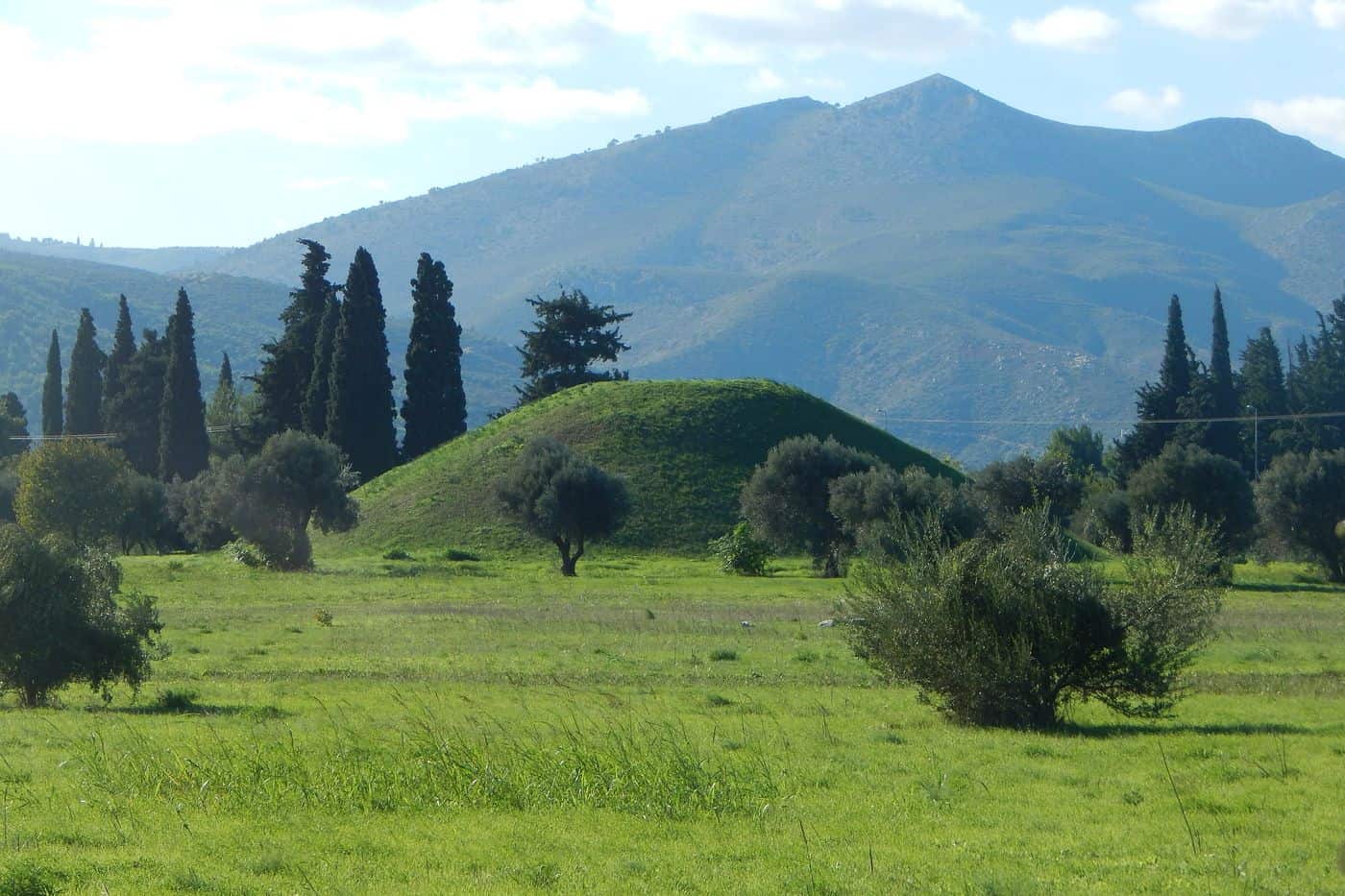
Marathon tours see the plain where Athens and Plataea defeated the Persian army in 490 BC. The battlefield holds the Tomb of the Athenians, called the Soros, the mound known as the Tomb of the Plataeans and a modern copy of the victory column.
The battle took place during the first Persian invasion of Greece. King Darius I sent a fleet under Datis and Artaphernes, and it landed in the bay near Marathon. The Athenians, joined by 1,000 hoplites from Plataea, blocked the two exits from the plain. General Miltiades strengthened both flanks, which wheeled inward and enveloped the Persians, and the Persian army broke towards its ships.
Herodotus records 6,400 Persian dead and 192 Athenian dead. The Athenian and Plataean dead were buried on the battlefield in two mounds. The Soros holds the ashes of the 192 Athenians, stands about 12 m tall and sits in a park with a marble stele. Dimitrios Philios excavated it in 1884, and Valerios Stais dug it again in 1890 and 1891.
The Plataean mound at Vranas is smaller, about 3 m tall, and holds 11 male burials from the early 5th century BC. The Athenians also set up a victory column on the plain; a modern replica of the same height has replaced the collapsed original. Marathon tours also reach the Athenian camp on a spur of Mount Agrieliki, where traces of its walls remain.
- Commanders: Miltiades and the war archon Callimachus for Athens, Datis and Artaphernes for Persia.
- Fallen leaders: Callimachus and the general Stesilaos died in the battle.
- Spartans: their army covered 220 km in three days and reached Marathon after the battle.
Marathon tours that close with a swim add Marathonas beach after the tombs.
What do Marathon tours see in the Archaeological Museum of Marathon?
Marathon tours see finds from the Battle of Marathon, prehistoric objects from the plain and statues from the Egyptian sanctuary at Brexiza. The museum opened in 1975 at Vranas and spreads over five rooms and a covered atrium, beside a Bronze Age cemetery.
Marathon tours begin outside, on the museum grounds. A roof protects a cemetery of tumuli from the Middle Bronze Age, dated 2000–1600 BC, and the site also includes the mound known as the Tomb of the Plataeans. The Early Helladic cemetery at Tsepi lies east of Kotroni hill in the same Vranas area; Spyridon Marinatos excavated it between 1970 and 1973.
Herodes Atticus, a native of Marathon, is credited with the sanctuary of the Egyptian gods at Brexiza, built around AD 160. It stands beside the Small Marsh of Brexiza, in today’s Nea Makri, on an artificial islet. It served Serapis, the Greek form of Osiris, with Isis and their son Horus. The complex also had a bath house and stayed in use until the 4th century. The site has been open to the public since 2001.
Inside, Marathon tours walk the five rooms from the Neolithic to the late Roman period.
- Room 1: finds from the Cave of Pan, 5300–3200 BC and later; the cave became a shrine of Pan in the Classical period.
- Room 2: clay objects, figurines, stone tools and vessels from the cemetery at Tsepi and the settlement at Boriza.
- Room 3: Geometric to Classical finds from the Tetrapolis, including vases with scenes from myth.
- Room 4: statues of Herodes Atticus and his wife.
- Room 5: statues of Egyptian gods from the sanctuary at Brexiza.
A Trophy Room holds part of the honorary column for the victory over the Persians. One ticket covers the museum and the archaeological site of Vrana, so Marathon tours visit both on one entry.
Which Marathon tours follow the route of the Athens Marathon?
Marathon tours that follow the race route start in the town of Marathon, pass the Tomb of the Athenians, run near the coast through Nea Makri and end at the Panathenaic Stadium in Athens, the finish of the 1896 Olympic marathon.
Marathon tours on the route retell the story of Pheidippides, an Athenian courier of the 5th century BC. Herodotus records his run from Athens to Sparta before the battle, about 240 km in two days. Lucian, writing much later, describes a run from Marathon to Athens, where the runner announced the victory and died. Robert Browning joined both versions in his poem of 1879.
Michel Bréal proposed a race from Marathon to Athens for the first modern Olympic Games. The Olympic race ran on 10 April 1896 over about 40 km, with 17 starters. Spyridon Louis, a water carrier from Marousi, won in 2:58:50 at the Panathenaic Stadium, the only Greek win in athletics at those Games. Marathon was also the start of both Olympic marathons in 2004.
The annual race named “Athens Marathon. The Authentic” has run from Marathon to Athens since 1972. The Marathon Flame is lit at the Tomb of the Battle of Marathon before each race. Marathon tours stop at the Marathon Run Museum, in the old primary school of the town, built in 1908 with a donation from Andreas Syngrou. Its collection holds more than 4,000 exhibits, including the original medal of Spyros Louis from 1896.
- Distance: 42.195 km today, against about 40 km in 1896.
- Climb: uphill from the 10 km mark to the 31 km mark.
- Finish: the Panathenaic Stadium, rebuilt in marble by Herodes Atticus by AD 144.
Marathon tours that trace the course end at the stadium, the only stadium in the world built entirely of marble.
What do Marathon tours see at Rhamnous?
Marathon tours see the sanctuary of Nemesis and the fortified acropolis of Rhamnous, an ancient deme on the coast above the Euboean Strait. The ruins lie northwest of Agia Marina, inside the municipality of Marathon, and form the best-preserved deme site in Attica.
Agia Marina sits at the head of its own bay, northeast of Marathon, and the site is close to Grammatiko, 5 km north of Marathon. In antiquity a road linked Rhamnous with Marathon, and grave monuments have come to light along it. The name comes from buckthorn, a prickly shrub that still grows on the site.
The sanctuary lies 600 m south of the town, on a platform held up by a wall of white marble. It holds two temples side by side. The small temple, of poros stone, served Themis and Nemesis. The large temple, begun around 460–450 BC, measured 22 m by 10 m, with 12 columns on each side. Its cella held a cult statue of Nemesis about 4 m high by Agorakritos, a pupil of Phidias.
The fortified acropolis crowns a hill about 28 m high and 230 by 270 m in area, with walls of local marble from Agia Marina. An Athenian garrison of ephebes, young men, watched the sea routes from it. Marathon tours see the principal gate on the narrow ridge, beside a south wall about 6 m high. The cult of Nemesis ended with a decree of the emperor Arcadius in AD 382.
- Inscription: the east architrave of the large temple names the deified Livia, wife of Augustus.
- Statue base: about 240 cm wide, with Nemesis presenting Helen to her mother Leda.
- Fortress: a little theatre, a gymnasium and a small sanctuary of Dionysos inside the walls.
- Harbours: two small harbours on either side of the acropolis, now silted up; Marathon tours see both from the acropolis.
What do Marathon tours see at Lake Marathon and the Schinias wetland?
Marathon tours see Lake Marathon, the reservoir held by a 54 m marble-clad dam 8 km west of the town, and the Schinias–Marathon National Park on the coast, with its stone pine forest, its wetland and the rowing centre of the 2004 Olympic Games.
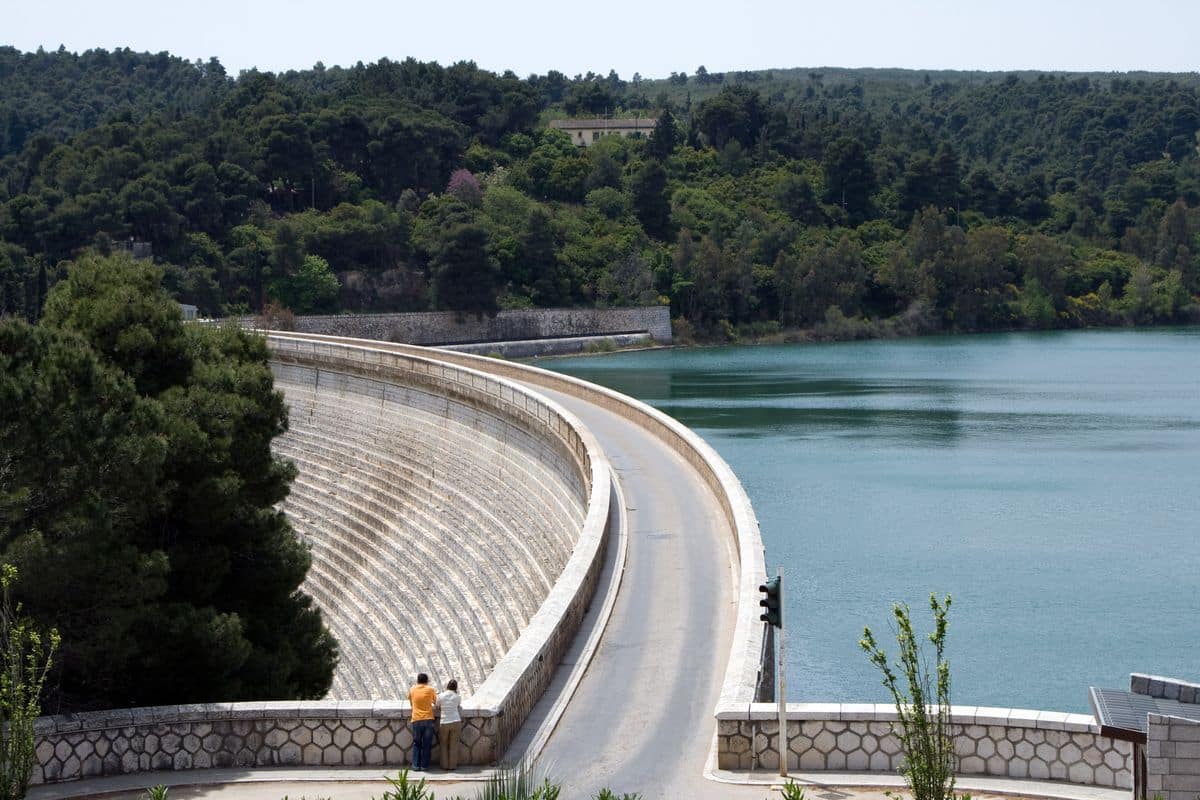
Lake Marathon formed behind the Marathon Dam, at the junction of the Charadros and Varnavas torrents, 45 km northeast of Athens. The reservoir covers 2.45 km², reaches a depth of 54 m and holds up to 41,000,000 m³. It was the main water supply of Athens from 1931 until 1959, when water from Lake Yliki arrived. The municipality describes it as the only artificial lake in Attica.
The Schinias–Marathon National Park lies about 40 km northeast of Athens and covers 13.84 km², sea zone included. It comprises the Koukounaria stone pine forest, the Great Marsh, the Kynosoura peninsula, the beach and the marine zone. Natura 2000 lists the site under code GR 3000003, with 19 habitat types. On Marathon tours, the pine forest stands out as one of the last coastal forests of Aleppo pine and stone pine left in Greece and the Mediterranean.
- Marathon Dam: the American firm ULEN built this 285 m long gravity dam between 1926 and 1929 and faced it with white Pentelic marble, the stone of the Parthenon.
- Treasury replica: a copy of the Athenian Treasury at Delphi stands at the foot of the dam, and its plaque honours a victory at Marathon over nature for the water of Athens.
- Makaria spring: two spring pools inside the park, fed all year from below, shelter eels, terrapins and the endangered endemic fish ntaska.
- Olympic rowing centre: the venue of the 2004 rowing and canoe sprint events covers 1.24 km², seats 14,000 spectators and ranks among only three FISA-approved training centres in the world, with Munich and Seville.
- Oinoe gorge: the municipality lists this gorge beside the stone pine forest and the Schinias wetland among the natural sights of Marathon.
Marathon tours to the rowing centre see a 2 km course that hosted the World Rowing Junior Championships in August 2003 and the European Rowing Championships in September 2008. Its construction occupied close to half of the wetland.
Which Marathon tours combine the coast and Cape Sounion?
Marathon tours combine Schinias beach and Nea Makri, 8 km south of Marathon, with the sanctuary of Artemis at Brauron on the South Euboean Gulf and with Cape Sounion, 69.5 km southeast of Athens, where the Temple of Poseidon stands almost 60 m above the sea.
Schinias ranks among the largest beaches in Attica, and its shore draws windsurfers. The municipality counts 12 km of sandy beach in the bay of Marathon. Nea Makri, on the Petalioi Gulf, was founded in 1924 by refugees from Makri and Livisi on the Lycian coast of Asia Minor. In summer, its population passes 55,000 to 60,000 residents.
Marathon tours reach Brauron on a small bay of the South Euboean Gulf, between Artemida to the north and Porto Rafti to the south, with Athens International Airport to the west. The cult of Artemis began there in the 8th century BC, and the temple rose in the 6th century BC. Young Athenian girls served the goddess as arktoi, she-bears, with sacred dances and races.
- Brauron stone bridge: the bridge over the Erasinos, about 9 m wide with a span of about 8 m, is the only known Classical bridge in Greece.
- Brauron museum: the Archaeological Museum of Brauron stands 330 m east-southeast of the sanctuary and holds vases, votive statuettes, children’s heads and votive reliefs.
- Temple of Poseidon: the Doric temple, built in 444–440 BC under Pericles, keeps 15 of its 34 columns, each 6.10 m high, in marble from Agrileza, 4 km to the north.
- Sounio national park: the woodland park around the cape dates from 1974 and has a core area of 750 hectares.
Marathon tours that end at the cape time the visit for the sunset over the Aegean, a sight sought by visitors from Athens since the early 19th century, as on the Cape Sounion sunset half-day trip to the Temple of Poseidon.
How do visitors reach Marathon for Marathon tours?
Marathon tours reach the town on Marathonos Avenue, the Greek National Road 83 from Athens to Rafina via Marathon. Nea Makri, 8 km to the south, lies 32 km from Athens and 12 km from the airport, and KTEL Attikis buses run the whole route.
The EO83 leaves the EO54 at Ampelokipoi in Athens, runs along Kifisias Avenue through Kifissia and Agios Stefanos to the Marathon Dam and Marathon, and meets the EO54 again west of Rafina. Drivers also reach Marathon from Attiki Odos, from Dionysou and Penteli avenues, and from Limnis Avenue off the Athens–Lamia National Road.
Athens International Airport lies about 20 km east of central Athens, or 30 km by road. Nea Makri sits 12 km from the airport via Marathonos Avenue and Attiki Odos, and KTEL Express buses link the airport with Rafina, 7 km south of Nea Makri. For Marathon tours by public transport:
- KTEL Attikis line: the Athens – Rafina – Nea Makri – Marathon buses also serve Grammatiko, Agia Marina, Souli and Schinias, and selected departures run via the coast.
- Athens terminus: by decision of the Attica Region, the line starts at the Nomismatokopeio metro station on Mesogeion Avenue.
- KTEL network: KTEL, founded in 1952, joins 62 regional bus companies and carries 80% of all passenger transport in Greece.
- OASA line 310: this Athens city bus line and KTEL buses on Marathonos Avenue serve Mati, the seaside settlement at the southern edge of the municipality.
Marathon tours fit into a list of day trip ideas from Athens, since the Schinias park and the Marathon Dam lie 40 to 45 km from the capital.
When do Marathon tours run best?
Marathon tours run best in June, September and October, when the Sounio station of the National Observatory of Athens records average highs of 24.9 to 29.9 °C and 40 mm of rain or less a month, and in November, the month of the Athens Marathon.
The larger part of Attica has a hot-summer Mediterranean climate, while Sounio has a hot semi-arid climate with hot, dry summers and mild, wetter winters. In July and August, average highs there reach 33.4 °C and 33.1 °C. The Lake Marathon basin receives 580 mm of rain a year on average.
Athens has been called the hottest city in mainland Europe, and Elefsina and Tatoi in Attica recorded 48.0 °C on 10 July 1977. In summer, visitors to the Schinias forest and beach exceed the capacity of both zones. Dates for Marathon tours:
- July and August: the Sounio station logs 1.6 mm and 2.5 mm of rain, with average lows of 24.5 °C in both months.
- October: the municipality stages the Marathon Half Marathon on a Sunday, with 21.1 km, 30 km, 5 km and 800 m children’s races.
- Second Sunday of November: the Athens Marathon starts in the town, and the International Marathon Symposium meets in Marathon the day before.
- December and January: rain at Sounio peaks at 110.3 mm in December, January brings 58.3 mm, and average highs fall to 16.8 °C and 14.8 °C.
Marathon tours on race weekend meet the crowds of the Athens Marathon, The Authentic, which drew a record 43,000 competitors in 2015, 16,000 of them on the full course.
Frequently Asked Questions
Which birds do Marathon tours spot in the Schinias wetland?
Marathon tours in the Schinias wetland meet purple herons, squacco herons, little egrets, little bitterns, glossy ibises and marsh harriers among 115 recorded bird species. At Lake Stomi, the low eastern end that floods with salt water by season, flamingos and black-winged stilts gather beside the rare orchid Orchis palustris.
Why do Marathon tours link Lake Marathon with earthquakes?
Marathon tours at the lake recall the earliest known case of earthquakes caused by the filling of a reservoir. Tremors began in 1931, two quakes above magnitude 5 struck in 1938, and every epicentre lay within 15 km of the reservoir. All but two came during rapid rises in its level.
Which monastery do Marathon tours visit above Nea Makri?
Marathon tours climb to the Monastery of the Annunciation and Saint Ephraim at Xylokeriza, on the eastern foothills of Penteli. In 1950 the nun Makaria Desypri found there the relics of Saint Ephraim, hanged by the Turks in 1426, and pilgrims from all over Greece now visit the convent.
How do Marathon tours connect with the port of Rafina?
Marathon tours reach Rafina, 7 km south of Nea Makri and 25 km east of central Athens. The Greek National Road 83 ends at a junction west of the town. Rafina lies east of Mount Pentelicus and serves as the second port of Athens after Piraeus, with ferries to southern Euboea and the Cyclades.