
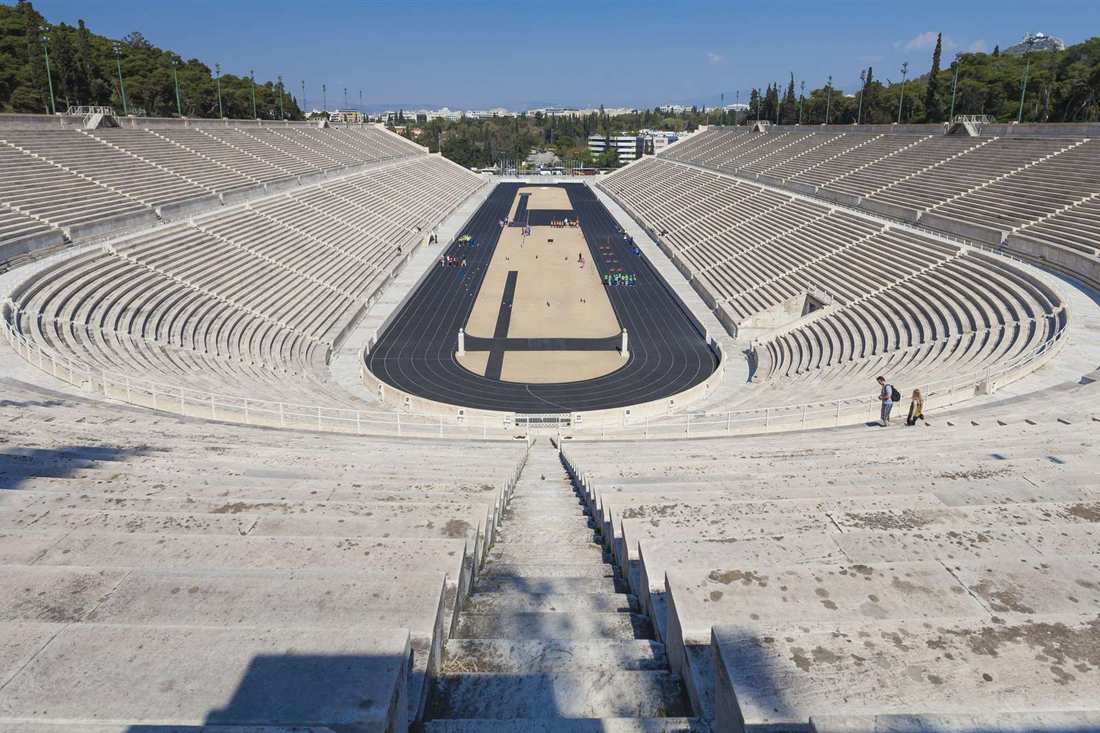
The Athens Classic Marathon runs 42.195 km, starting in Marathon and ending in the Panathenaic Stadium, and a 10 km and two 5 km races fill the same autumn weekend. The middle half of the course climbs, and the organiser sets an eight-hour limit for the full race.
Race week brings an expo in Palaio Faliro and a flame ceremony at the Marathon Tomb. Anyone adding sightseeing days to a race weekend can find the tours for each region on the Greece Tours homepage.
What are the Athens marathon events?
A full marathon of 42.195 km leads the Athens marathon events. A 10 km road race, two 5 km races and a 1.2 km kids race join it. All of them share one weekend in early November.
Wikipedia’s article on the Athens Classic Marathon calls it an annual road race held in Athens. It says the race normally falls on the second Sunday of November. So the Athens marathon events belong to autumn, well after the summer season.
The long race begins in the town of Marathon. It ends at the Panathenaic Stadium in the centre of Athens. The shorter races stay inside the city. A travel blog says the 5 km and 10 km courses pass the historic centre and its monuments.
Here is how the races line up, with who each one fits:
- Marathon Race – 42.195 km – trained runners ready for a long, hilly road day. A travel package also lists a power walking class on the same course.
- 10 km Road Race – 10 km – runners who want the Sunday race mood without the full distance.
- 5 km Road Race – 5 km – first-time racers and friends who travel with a runner.
- 5 km Universities Night Run – 5 km – a second short race. A weekend guide places it on the Saturday.
- Kids Race – 1.2 km – children, with the age limits set by the organiser.
The organiser of the Athens marathon events is SEGAS, the Hellenic Athletics Federation. The running site adds that the City of Athens and the Hellenic Olympic Committee support it. Wikipedia notes the race began as a joint project of the Greek tourist board and the athletics body.
The start town has its own sights, and you can see them on a quiet day before the crowds arrive. Our page on Marathon tours covers guided visits there. The Athens marathon events themselves need no tour, only an entry and a plan for race week.
What is the route of the Athens marathon events?
Runners in the Athens marathon events start in Marathon and cover 42.195 km to the Panathenaic Stadium. On the way, the course passes Nea Makri, Pikermi, Pallini, Gerakas and Agia Paraskevi before it reaches the city centre.
Wikipedia says the course of the Athens marathon events traces a path near the coast through Nea Makri. It also passes the tomb of the Athenian soldiers in the start town. A race listing site gives a kilometre-by-kilometre account, and the details below come from it.
The first 200 metres drop gently as runners leave the start venue. The opening 4 km run slightly downhill along Marathonos Avenue. Then the route turns onto Marathonomachon Street. It makes a loop of about 2.2 km around the Memorial of the Fallen, known as the Tomb.
From the 6th to the 10th kilometre, the Athens marathon events run flat through Nea Makri. Between the 11th and 17th kilometres, parts of the road rise. A steep drop follows, ending just before the Rafina junction. After that turn, the climb gets harder until the 20th kilometre.
Through Pikermi, gentle and steeper rises take turns up to the 25th kilometre. A long climb marks that point. The stretch through Pallini, at the 27th and 28th kilometres, rises too. Past Gerakas comes the hardest part of the Athens marathon events. It is the climb to the Stavros junction, between the 30th and 31st kilometres.
- After Stavros, a steep descent leads to the main square of Agia Paraskevi.
- Messogeion Avenue then crosses Chalandri and Cholargos, with flat and falling stretches.
- The clearest descent runs from the Ministry of National Defence to the Katechaki junction, at 37.5 km.
- Vasilissis Sofias Avenue brings runners past Eleftherias Park at the 40th kilometre, the last rest station.
Wikipedia adds that the route passes a statue of a runner in the city centre. The figure is known in Greek as O Dromeas. For the runners of the Athens marathon events, it is a sign that the finish is close.
At 41.2 km the course turns left onto Irodou Attikou Street. It passes the Presidential Palace and the National Garden. Near the statue of the Discus Thrower, runners turn towards the stadium. The listing site says the last 170 metres are run on a rubber track inside it.
The entrance and the finish line sit on the left side of the arena. For the story of the venue itself, read our guide to the Panathenaic Stadium. Wikipedia notes it was also the finish for the Olympic marathons in Athens.
How does race week of the Athens marathon events run?
Race week of the Athens marathon events starts with an expo in Palaio Faliro. A flame ceremony in the town of Marathon follows. The short races and the long Sunday races close the week.
The organiser’s week program puts the runners’ expo at the Tae Kwon Do Olympic Venue in Palaio Faliro. A weekend guide says the expo opens on the Wednesday and closes on the Saturday. A city events site calls it the largest sporting goods show in Greece.
For the Athens marathon events, entrants collect race packs at the Runners’ Center in the same venue. The program splits it by race. One desk serves the 5 km races and the kids race. Another serves the 10 km race and the marathon. So check which desk matches your entry before you queue.
The week program also lists Authentic Talks, an evening session at the expo venue. A running site says guest speakers lead these talks. For a visitor, they add a calm evening event to the Athens marathon events before the hard running begins.
On the Saturday of the Athens marathon events, the focus moves to the town of Marathon. The program lists an opening ceremony at the Marathon Tomb. The flame then travels to the historic start venue, where the cauldron is lit. Wikipedia says the idea comes from the tradition of the Olympic torch.
Wikipedia also records an International Marathon Symposium in the start town on the day before the race. The Association of International Marathons and Distance Races runs it. Back in the city, the program lists a race village across from the Panathenaic Stadium.
- Saturday: the 5 km Road Race and the Universities Night Run, according to a weekend guide.
- Kids race: a family travel blog says it runs around Syntagma Square and ends in the stadium.
- Sunday: the 10 km Road Race and the marathon, as a travel package lists them.
A travel package can add its own pre-race dinner on the Saturday. If you travel alone, plan your own meal for the night before the Athens marathon events.
Race morning belongs to the Sunday. The marathon field gathers in the start town for the long run back to Athens. A race travel site says both Sunday races finish in the Panathenaic Stadium. Keep the Saturday light, collect your pack early in the week and rest your legs.
How do you register for the Athens marathon events?
You enter the Athens marathon events online, on the official site of the organiser. The full race is open to runners aged 20 or older. Age counts from the year of birth. Places go fast, so sign up early.
A travel blog says that entries for the Athens marathon events are handled online through the race website. A news page for visitors adds that places go on a first-come, first-served basis. So it pays to watch for the opening day and sign up early.
Each race of the weekend has a field limit. A family travel blog notes that sign-up closes without warning once the limit for a race is full. The marathon committee caps the number of entries every year, says a second running site. Late deciders can miss out on the Athens marathon events this way.
The age rules differ by distance. A travel blog lists these minimum ages:
- Marathon: 20 years and over
- 10 km race: 15 years and over
- 5 km race: 12 years and over
In the Athens marathon events, the full race has a time limit of eight hours, says the organiser. A travel guide adds that there are cut-off points along the course too. Runners who fall behind can board the bus that follows the last runners and collects those who drop out. Or they can go on at their own risk.
The organiser does not ask for a medical certificate from any athlete. Everyone runs at their own risk. Even so, the race page advises a recent medical check and a full heart check-up for all ages. This advice applies to all the Athens marathon events, not only the long one.
Your bib is your ticket to the finish. Runners without a bib number are not allowed to finish, and the way into the stadium is blocked for them. A travel blog says race packs are not sent by post. Every runner collects one in person before race day.
Overseas runners have a second route in. Authorised sports travel agencies sell guaranteed places bundled with a travel package, says a travel blog. Every runner who finishes gets a medal, the organiser states. Plan the rest of the trip with our Athens vacation guide, so the race sits inside a full week.
How do you reach the start and the finish of the Athens marathon events?
Organiser buses carry marathon runners from central Athens to the start in Marathon town. They leave from six points in the city, and Syntagma has two of them. The finish sits about one kilometre from three metro stations.
The organiser of the Athens marathon events names its boarding points in a tips page for runners. Syngrou-Fix and Panepistimio on Line 2 are two of them. Syntagma has stops on Vasilissis Amalias Avenue and on Georgiou Avenue. Omonia is another point. A local news site adds Evangelismos and Katechaki to the list.
The buses run only in an early-morning window. After it closes, the organiser can no longer carry runners to the start. The last bus from Syngrou-Fix leaves earlier than the rest. A travel blog puts the ride at 45 to 60 minutes. So the morning of the Athens marathon events starts very early.
The organiser asks runners to board at once and to listen to the recorded instructions on the way. It also urges runners to use public transport, above all the metro, to reach the boarding points. A travel blog notes that the buses drive the race route in reverse.
Mornings at the start can feel cold. A travel blog suggests wearing extra layers on the bus. Put them in a bag with your name on it and leave it on the bus. The bus then returns to Athens. A travel guide notes that each entry includes a clothing bag.
Driving yourself to the Athens marathon events is possible but harder. A local news site says drivers face a walk of about 800 metres from the parking to the start. It also notes special lanes for athlete buses and emergency vehicles on race day.
The finish is easy to reach. The website of the Panathenaic Stadium says it lies about one kilometre from Syntagma, Akropoli and Evangelismos stations. Lines M2 and M3 serve these stops. Our Athens metro guide explains the lines and tickets for the Athens marathon events.
A running travel site says the 5 km and 10 km both start on Amalias Avenue. The start is in front of the Zappeion entrance. A family travel blog says the city centre is closed to cars, so the streets are easy to walk. A travel guide adds that roads reopen step by step once the runners pass.
Public transport can come free with your entry. A family travel blog says runners on the full entry level get a transport card. It covers all Athens public transport from three days before to two days after the race. That card makes the Athens marathon events simpler to reach for visitors.
What do the weather and the course profile mean for the Athens marathon events?
The long hill is the main challenge of the Athens marathon events. Uphill running fills the middle half of the course. Wikipedia puts it from about the tenth to the thirty-first kilometre. A climate site gives November a mean of 15.3 °C.
The same climate site calls November in Athens a very mild month. Its average low is 11.9 °C and its average high is 18.8 °C. Rain adds up to 60 mm, spread over 8 days. Pack for both ends of that range.
October is drier, in case the Athens marathon events fall early in autumn. Another climate website gives about 6 days of rain and 29 mm for that month. It reports around 208 hours of sunshine and mostly clear days. Wind speeds in October average about 2 metres per second, the same site says.
The climb is the big test. In the view of the encyclopedia, no other major city marathon asks runners to climb this hard. It also suggests the race is among the hardest major marathons. That rise lasts about 21 km, or half the full distance. The Athens marathon events reward runners who respect it.
After the climb, the road of the Athens marathon events eases. Wikipedia says the course runs lightly downhill towards the city once the steep rise ends. So the last stretch helps tired legs, but only if you have saved energy for it.
What does this mean for pacing? These plain rules help:
- Start the first 10 km, which are flatter, slower than goal pace.
- Run the climb by effort, not by the watch.
- Expect your splits to slow on the long rise in the middle of the course.
- Use the gentle descent to gain time near the end.
- Dress in layers for a cool start and a warmer finish.
Sun and cloud change from day to day in autumn. A climate site gives November about 5 hours of sunshine a day. Bring a cap and sunscreen in case the sky is clear. For month-by-month numbers before the Athens marathon events, read our Athens weather guide.
The eight-hour limit of the Athens marathon events gives walkers and slower runners room on the hills. Still, the cut-off points along the route matter. Plan a steady pace from the start, so the climb does not push you past them.
Where do runners stay and eat around the Athens marathon events?
Runners at the Athens marathon events gain real comfort by sleeping near the finish. Wikipedia places the Panathenaic Stadium in Pangrati, just east of the National Gardens and the Zappeion. A bed in this area means a short walk home after the race.
Wikipedia’s article on the stadium says it sits between two pine-covered hills, Ardettos and Agra. The homes of Pangrati spread out to its east. The National Gardens and the Zappeion Exhibition Hall lie to its west. So the finish stands on the edge of the old centre, not out in the suburbs.
For the Athens marathon events, Syntagma works as a second base. One listing for a half-day trip to Marathon meets its guests on Ermou Street at Syntagma. Its driver also picks people up in districts such as Kallithea, Nea Smyrni, Zografou and Glyfada. That list shows how the trip companies treat the centre as the main hub.
A small number of runners at the Athens marathon events think about sleeping at the start instead. The visitor guide of the City of Athens describes Marathon as a modest coastal town of about 8,000 residents. It has a small archaeological museum and an artificial lake. A town of that size has far fewer rooms than central Athens.
What about food? The plain rule from training holds: eat what your stomach already knows. Race week is no time to test a new dish for the first time.
After the Athens marathon events, the whole centre is open to you on foot. Districts are compared side by side on our page about where to stay in Athens, with notes for each area. Pick a room within walking distance of the stadium if your legs matter more to you than the view.
Which tours and workouts fit around the Athens marathon events?
Short city sessions suit the days before the Athens marathon events, and longer trips suit the days after. GetYourGuide listings range from a one-hour group run to a coastal tour of 7.5 hours. Stadium and Acropolis visits sit in between.
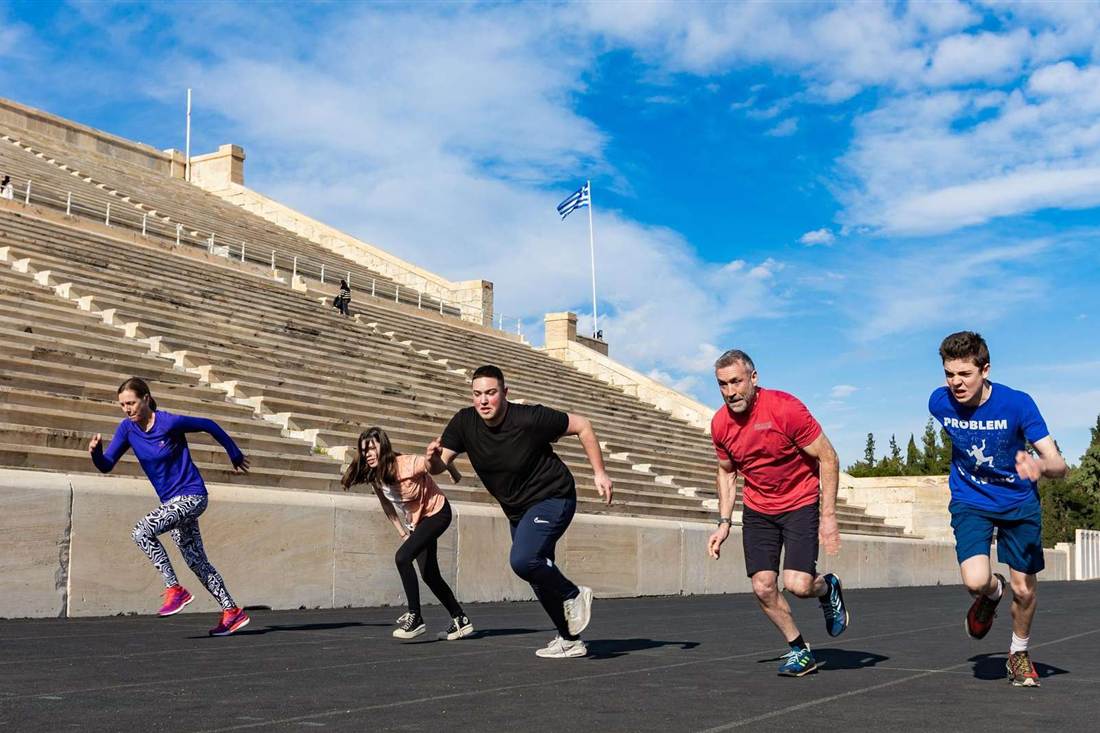
The listings show these formats, shortest first:
- Group run: one hour, small group, through central Athens.
- Olympic workout: two hours, with history, a gym session and a sprint in the stadium.
- Stadium visit: an average of one to two hours, according to GetYourGuide.
- Acropolis walk: two to three and a half hours, with skip-the-line entry.
- Private trip to Marathon: four hours, with pickup.
- Coast day: from the Temple of Poseidon to Vouliagmeni, 7.5 hours, small group.
The Olympic workout listing lasts two hours and starts in the morning. Its instructor speaks English. You tour the Zappeion, stretch in a historic gym from the nineteenth century, then race on the stadium track. The listing calls the session suitable for all ages. Free cancellation runs up to 24 hours ahead.
One reviewer of that workout noted that the entrance ticket to the stadium is not part of the deal. Plan the sprint two or three days before the Athens marathon events, or save it for the days after. Our page on the Athens Olympic Games workout covers the session in full.
A plain stadium visit asks less of your legs. The GetYourGuide page for the stadium lists three things to do. You can walk the track and climb the stands for city views. A little museum on site shows Olympic torches. Guided options include a two-hour entry with a private guide and a three-hour walk that adds city highlights.
A GetYourGuide category page for running lists a one-hour small-group run in Athens. A short run is a fit for arrival day, when the Athens marathon events are still days away.
The private half-day trip to Marathon runs for four hours in a private group. It includes pickup, an air-conditioned vehicle, bottled water and an English-speaking driver. Museum tickets come only with one booking option. The listing states plainly that no licensed guide joins the trip. Its stop at the museum lasts 30 minutes.
That trip also passes the dam and the lake and stops at the beach of Marathon. It lets you see the start town of the Athens marathon events without running a step. For the full day out, read our Marathon day trip from Athens.
The Acropolis suits the first easy days after the Athens marathon events. A guided walking tour on GetYourGuide lasts two to three and a half hours, with skip-the-line entry. Another listing caps its group at eight people. An early morning guided tour of the Acropolis and its museum also appears on the site.
Tired legs do well on a coach seat. One small-group tour runs for 7.5 hours from the Temple of Poseidon to Vouliagmeni on the coast. GetYourGuide also lists a half-day sunset trip to Cape Sounion. Both let you sit, look at the sea and rest after the Athens marathon events.
A food tour is a natural fit for a recovery evening after the Athens marathon events. Check the length, group size and language on the listing before you book.
How do spectators follow the Athens marathon events?
Fans watch the Athens marathon events from three kinds of spot. These are the start in Marathon, the road through the towns and the stadium stands. The organiser says entry to the stadium and to the opening ceremony at the Marathon Tomb is free for spectators.
The visitor guide of the City of Athens says locals and visitors line the streets of Marathon on race morning. They come to cheer the nervous runners at the starting line. The town is small, so the start feels close and personal.
During the Athens marathon events, crowds change from place to place along the road. A runner’s review on a race listing site says spectators line a large part of the route. Outside Athens, the road crosses open country, villages and towns. In the city it grows quieter. Messogeion Street has a small number of watchers until the American embassy area.
At the finish of the Athens marathon events, the rules are strict. The organiser allows only finishing runners and accredited staff onto the stadium track. Friends, family and coaches sit in the stands. The organiser asks them not to step onto the track, since that blocks runners leaving the stadium.
The finish area has a warm reputation. A travel blog describes thousands of people lining the route and a large crowd at the stadium. It adds that every runner who came in, walking or limping, got loud applause until the clock stopped.
Moving between spots takes planning. The organiser says all race routes are closed to vehicles. No vehicle of any kind is allowed on the race lanes, whoever drives it. Parallel lanes stay free for accredited vehicles such as ambulances and police cars.
So how do fans get around during the Athens marathon events? The organiser asks all spectators to use public transport. That means the metro and the buses that run outside the race routes, as its maps show. Look at those maps before race day and pick your spots in advance.
What about tracking a runner live? The organiser’s site is the place to check for any such tool. Agree on a meeting point with your runner before the start, outside the stadium track.
How do you choose between the Athens marathon events?
Pick by distance first, then by fitness, age and travel days. The full course is the hardest choice of the weekend. Shorter Athens marathon events suit younger runners, families and anyone who wants one fast race in the city.
The choice comes down to six plain questions. How far can you run? How well do you handle hills? Who comes with you? How long can you stay? Each answer points to one race. The list below ties every question to one fact from a source.
- Distance: the organiser’s age table names six races, from the full marathon down to two races over 1,200 m.
- Fitness: the Wikipedia article says the road rises without a break between kilometre 10 and kilometre 31.
- Time limit: the organiser’s marathon page sets a limit of eight hours to finish the full race.
- Season and weather: the Wikipedia article places the race in early November, on the second Sunday of the month.
- Who travels with you: the organiser lists a Kids Race over 1,200 m for pupils in grades 4 to 6.
- Days in Athens: the organiser’s table puts the 5 km on Saturday and the two longer races on Sunday.
Distance is the first filter for the Athens marathon events. A first-time racer can start with the 5 km road race. A runner with regular 10 km training runs can step up to the 10 km course. The organiser’s terms set the age limit for that race at 15 and older.
The full marathon has stricter rules. The organiser’s terms set its age limit at 20 and older. One tour seller page still states 18, so check the organiser’s own page first. The terms also say the races concern able-bodied runners. Athletes in racing or manual wheelchairs can take part once registered and known to the organising committee.
Fitness counts as much as distance in the Athens marathon events. The Wikipedia article ranks this long rise as the hardest climb among the major marathons. A tour seller page adds that the last 10 km runs downhill, a relief for tired legs. The eight-hour limit leaves room for a run-walk plan on the hills.
No fast time is needed to enter. A tour seller FAQ states that the race has no qualifying standard. That opens the Athens marathon events to newer runners who train for the distance. The hill still decides how the day feels, so train on long climbs at home.
Family plans shape the choice too. A Special Olympics Hellas race over 1,200 m is open to runners aged 9 and older. A 5 km Universities Night Run takes runners aged 17 and older. A group with mixed ages can split across the Athens marathon events and meet at the end.
The season sets the kit list for the Athens marathon events. Early November calls for a light layer at the start. Bring a dry top for the wait after the finish. Our guide to Athens in autumn covers the rest of the season, from sights to food.
Last, count your days in Athens. A runner in the Saturday 5 km keeps Sunday free to watch friends in the longer races. A full marathon runner needs a calm day before the start and a slow day after it. Short visits suit those recovery days better than long walks.
Plan the trip length around the Athens marathon events you enter. A 10 km runner can race on Sunday and sightsee later that day. A marathon runner gains from two or three free days after the race.
What do visitors ask about the Athens marathon events?
Visitors ask about the distance, the finish, shorter races, children, autumn heat and the stadium. Each answer comes from the organiser, Wikipedia, a travel site or a GetYourGuide page. All hold for the race in general terms.
Rules for the Athens marathon events change from one edition to the next. Age limits, start blocks and race days come from the organiser. Check its site before you book a flight or a room.
How long is the Athens Classic Marathon?
The full course measures 42.195 kilometres, or 26.2 miles, as the Wikipedia article states. It is the longest of the Athens marathon events. The course begins in the town of Marathon and runs to Athens.
Where does it finish?
The race finishes at the Panathenaic Stadium in Athens, which the Wikipedia article names as the finishing point. A GetYourGuide page on the stadium describes it as all-marble.
Is there a shorter race?
Yes. The Wikipedia article says the other runners compete in the 5 and 10 kilometre road races and a racewalking contest. These shorter Athens marathon events give a race-day finish without the full distance.
Can children run?
Yes. The organiser’s terms set the 1.2 km Kids’ Run for children aged 9 to 12. Young teenagers can enter the 5 km road race, which the organiser opens to runners aged 12 and older.
Is it hot in autumn?
Not hot, but mild. A Greek travel site gives Athens a November average of 14.5°C, with a maximum of 18.4°C. That makes the Athens marathon events a cool-weather race compared with a summer run in the city.
Can you see the stadium without running?
Yes. A GetYourGuide page on the stadium gives an average visit of one to two hours. It says you can walk the track, climb the stands and see Olympic torches in a small museum.