
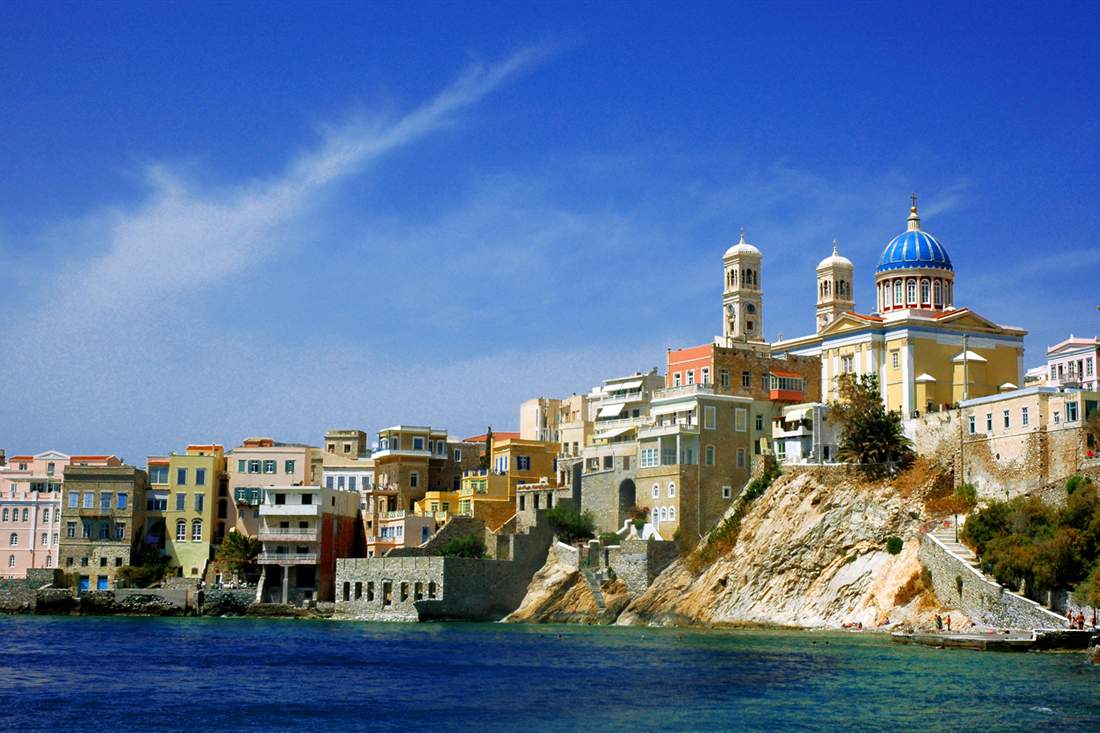
A Syros food tour is a guided walk of three to four hours through Ermoupoli with six to nine tasting stops, taking a group of four to twelve past the loukoumi workshops, the delicatessen counters and a taverna table, with the town’s history told between them. Plan the rest of the trip with Greece Tours.
This page covers the walk in full: where the route goes, what you taste and why San Michali and louza lead it, the loukoumi workshops, the price bands, how long it runs and how much you eat, the drinks, the dietary options, what the tour covers beyond food, and how to book a Syros food tour.
What is a Syros food tour?
A Syros food tour is a guided walk of three to four hours through Ermoupoli, covering six to nine tasting stops with a group of four to twelve, taking in loukoumi workshops, delicatessens, a taverna sit-down and the town’s trading history.
The format is fixed by the geography of the town. Ermoupoli was built as the commercial capital of the Cyclades after 1822, and its food trade still sits in the same streets: the marble-paved centre, the arcaded waterfront, and the stepped lanes climbing north. A guide leads the group between family shops that open at 09:00, sequencing the tastings so that cheese and cured meat arrive before sweets and spirits. The Syros food tour guides state this at the first stop.
Group size stays small because the tasting counters inside the delicatessens hold eight to ten people at once. Operators cap bookings at twelve and run a second departure rather than merge parties. Children aged six and above join at reduced rates on most walks, and vegetarian sequences replace the cured pork with fava, caper leaves and sun-dried tomato. Every Syros food tour works to that rule.
Between stops the guide narrates the shipyard at Neorio, the Apollon Theatre modelled on La Scala, and the Catholic and Orthodox settlements on the two hills. Each stop lasts fifteen to twenty-five minutes, seated where the shop has stools and standing where it does not. The final stop is a taverna table with three or four cooked plates. A Syros food tour is planned around it.
Unlike a restaurant meal, the walk supplies context: the guide names the producer, the ageing time, the village, and the price per kilo at the counter, so participants recognise the same products in the shops afterwards.
Where does the walk go in Ermoupoli?
The route runs from the marble town hall on the central square, along Chiou market street, into the port arcades, east into the Vaporia quarter beneath the Saint Nicholas dome, then onto the lower steps towards Ano Syros, covering 1.5 to 2.5 kilometres.
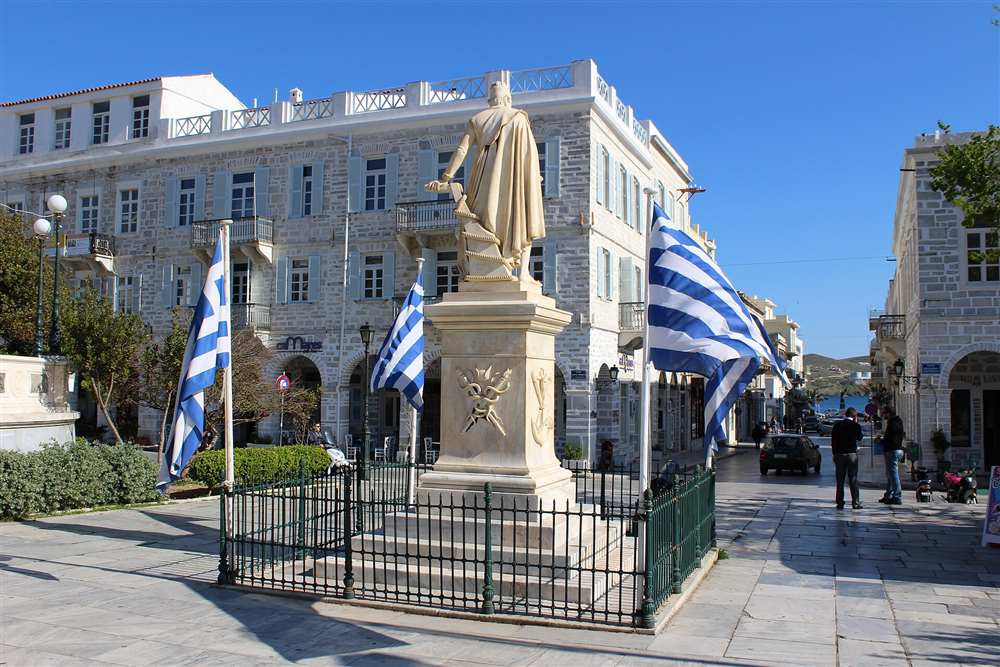
Departures gather at Miaouli Square, in front of the 1876 town hall designed by Ernst Ziller, where the marble paving measures roughly 100 metres across. From there the group turns into Chiou, the covered market street where butchers, bakers and grocers stand within 200 metres of each other. The pace is slow, near two kilometres per hour including stops. Every Syros food tour works to that rule.
The port arcades follow, running 400 metres along Akti Papagou and Akti Ethnikis Antistaseos, with ferry arrivals from Piraeus, Mykonos and Tinos passing behind the tables. Vaporia comes next: the shipowners’ quarter of neoclassical façades built directly above the sea, with the blue dome of Saint Nicholas over the rooftops and swimming platforms at Asteria beach below. A Syros food tour is planned around it.
The climb towards Ano Syros is partial. Most walks ascend forty to eighty steps to a terrace at roughly 60 metres elevation for the view over the harbour, then descend rather than continue the full 1.2 kilometres to the medieval settlement. Guides pause in the shade of the arcades and the plane trees between June and September, when midday temperatures reach 30 to 33 degrees. This is what a Syros food tour delivers on the street.
Footwear matters more than fitness: the marble underfoot turns slick after rain, and the stepped lanes are uneven.
What do you taste on a Syros food tour?
Tastings cover San Michali hard cow’s cheese, louza cured pork loin, Cycladic fava, sun-dried tomatoes, caper leaves, thyme honey, loukoumi in rose, mastic, bergamot and pistachio, halvadopita nougat wafers, and a small glass of rakomelo poured at the last stop.
The sequence moves from salt to sugar. A savoury plate opens the walk: cheese shaved thin, louza sliced almost transparent, olives from the Cyclades, and rusks rubbed with grated tomato. Fava from Santorini and Schinoussa arrives warm with capers and raw onion. Sun-dried tomatoes cured in July sunlight sit alongside thyme honey harvested from hives on the dry southern hills of the island. A Syros food tour is planned around it.
Louza is the counterpart to San Michali. Pork loin is salted, rubbed with pepper, cinnamon, savory and clove, cased and air-dried for four to eight weeks in the winter wind. Producers in Ano Syros and Kini supply the delicatessens on Chiou. The slices are cut at 1 millimetre and served without bread so the spice profile registers. This is what a Syros food tour delivers on the street.
Sweet stops close the sequence. Loukoumi squares dusted in icing sugar are tasted in at least two flavours, then halvadopita, the almond nougat pressed between two thin wafers, made in Ermoupoli since the 1830s. Local rusks, kopanisti-style spreads and Syros thyme honey drizzled over fresh mizithra appear on longer walks. The Syros food tour counters are set up for it.
The rakomelo, raki heated with honey, cinnamon and clove, is poured in 30 millilitre measures. On any thorough syros food tour the guide names each producer and the ageing period behind the counter, so the plate reads as a map of the island rather than a sampler.
What is San Michali cheese and why does it lead the tasting?
San Michali is a hard cow’s-milk cheese produced only on Syros, aged four to twelve months, holding its own protected designation of origin. Its sharp, nutty, peppery finish resets the palate, so guides serve it before the cured louza rather than after.
The cheese takes its name from the village of Ano Syros and the Saint Michael area on the island’s northern plateau, where cattle graze on thyme, sage and wild oregano. Milk from those herds carries the aromatic load into the curd. Wheels weigh six to ten kilos, the rind hardens to a deep straw colour, and the paste turns brittle and granular past the eight-month mark. This is what a Syros food tour delivers on the street.
Its protected status was granted under European appellation rules, restricting production to Syros and to raw cow’s milk. Output stays small, near 30 tonnes a year across the island’s dairies, which keeps the price at 20 to 28 euros per kilo at the Chiou counters and higher on the mainland. The Syros food tour counters are set up for it.
Guides open with San Michali cheese for a practical reason: the salt and the long finish coat the tongue and give the spiced pork a base to sit on. Reversing the order flattens the cheese. A four-month wheel is served first, then a ten- or twelve-month wheel, so the group registers what ageing does to texture and pepper. A Syros food tour sets off with this settled.
Grated over pasta it behaves like a Cycladic hard grating cheese; sliced thick it drinks well with Syros white wine and with ouzo from Piraeus.
What is loukoumi and where do the workshops sit?
Loukoumi is a soft starch-and-sugar confection cut into squares and dusted with icing sugar, made in Ermoupoli since the 1830s in rose, mastic, bergamot and pistachio. The family workshops stand within 300 metres of the port, near Miaouli Square and Chiou street.
Production began when refugees from Chios settled Ermoupoli and brought the recipe with them. Sugar, water, cornflour and lemon are cooked in copper cauldrons for two to four hours, poured into wooden trays lined with starch, rested overnight, then cut by hand and rolled in icing sugar. Rose water and mastic resin from Chios remain the two anchor flavours. The Syros food tour counters are set up for it.
The tour is taken behind the tasting counter where the trays cool and the cutting frames sit. Staff show the copper pans, the starch beds and the tin boxes printed with nineteenth-century Ermoupoli lithographs, which sell at 4 to 9 euros for 200 to 500 grams. Halvadopita is produced in the same rooms: almond nougat pressed between two circular wafers. A Syros food tour sets off with this settled.
Tastings run to three or four flavours per person. A guide explains why Syros loukoumi stays softer than the industrial version, tracing it to the shorter cooking and the absence of added gelatine. Each syros food tour times this stop for late morning, when a fresh tray is being cut and dusted. The Syros food tour timetable is built on it.
Workshops such as those on Akti Petrou Ralli and the shops around the town hall open from 09:00 to 21:00 between May and September, shortening hours in winter.
What does a Syros food tour cost?
A three to four hour walking tour with all tastings included runs 55 to 90 euros per person. Versions ending in a sit-down meal with wine cost 100 to 150 euros. A private group of four is priced at 250 to 450 euros.
The standard fare covers six to nine stops, every plate and glass, the guide for the full duration, and bottled water. Nothing at the tasting counters is charged separately. Purchases taken home, whether a tin of loukoumi or a 400 gram wedge of San Michali, sit outside the fare and are paid at the shop. A Syros food tour sets off with this settled.
The upper band, 100 to 150 euros, adds a seated meal of four to six plates at a taverna in Vaporia or on the Chiou side, with half a litre of wine per person. Those departures run four to four and a half hours and finish near 14:30 or 22:00 depending on the start. The Syros food tour timetable is built on it.
Private bookings are priced per group rather than per head. Four people pay 250 to 450 euros in total; each additional participant adds 45 to 70 euros up to a ceiling of ten. Private walks reorder the route around dietary requirements and allow a longer stop at the loukoumi workshop. That detail separates one Syros food tour from the next.
Payment is taken online at booking or in cash at the meeting point on the square. Gratuities are not built into the price of a syros food tour, and 5 to 10 euros per person is the observed range on the island.
How long is the walk and how much food arrives?
The walk lasts three to four hours across 1.5 to 2.5 kilometres of flat marble and stepped lanes, with six to nine stops. The volume of food replaces a full meal, so participants arrive hungry and skip the meal that follows.
Portions accumulate. Each savoury stop delivers 80 to 150 grams of food per person: cheese, cured loin, fava, rusks, olives and tomato. The taverna table adds three or four shared plates. Sweets close with four to six loukoumi squares and a wedge of halvadopita. Total intake across the route lands near 900 to 1,200 kilocalories. The Syros food tour timetable is built on it.
The pace is set at roughly two kilometres per hour including stops, which leaves time for photographs at the town hall steps, the Apollon Theatre façade and the Vaporia sea wall. Guides hold pauses of five to ten minutes in the arcades during July and August, when the marble reflects heat and midday readings reach 33 degrees. That detail separates one Syros food tour from the next.
Water is carried by the guide, one 500 millilitre bottle per person on morning departures and two in high summer. Toilets are available at the taverna stop and at the covered market. The stepped section towards Ano Syros involves forty to eighty steps with handrails on one side. It decides which Syros food tour to take.
Mobility limits are handled on request: a flat variant of the syros food tour removes the climb and keeps the route between the square, Chiou and the waterfront, holding total distance under 1.5 kilometres.
When do the tours run and how do you book?
Departures leave at 10:00 and 18:00 from April to October, with winter walks arranged on request. Groups hold four to twelve people. Booking three to five days ahead is required in July and August, and cancellation is free up to 24 hours before.
The morning slot suits the market: butchers, bakers and cheese counters on Chiou are stocked and busy between 10:00 and 12:30, and the loukoumi trays are cut mid-morning. The 18:00 departure trades the market bustle for cooler air, the evening promenade along the waterfront, and a taverna table at 21:00 when Ermoupoli kitchens fill. That detail separates one Syros food tour from the next.
Season shapes the plate. April and May bring fresh mizithra and wild greens; July and August bring sun-dried tomatoes and figs; September and October bring new-pressed oil and the first autumn honey. Winter walks run for groups of four or more, with louza at its peak after the December to February drying period. It decides which Syros food tour to take.
Ferries from Piraeus reach Ermoupoli in two hours by high-speed craft and four hours by conventional vessel, and Athens flights land at Syros airport in thirty-five minutes. Departures are timed so arrivals from the 07:00 Piraeus sailing make the 10:00 start. The Syros food tour price reflects it.
Reservations are made online with card payment or held with a deposit of 20 euros. Confirmations list the meeting point at the town hall steps. A syros food tour that fails to reach four participants is rescheduled or refunded in full.
What is louza and how do the curers of Syros make it?
Louza is pork loin rubbed with sea salt, black pepper, cinnamon and savory, packed into a natural casing and air-dried 40 to 60 days in the Cycladic wind, then sliced paper-thin beside San Michali cheese.
Butchers in Ermoupoli and Ano Syros start the cure in November and December, once the daytime temperature settles under 15C and the northerly wind blows dry rather than damp. Salt draws water from the loin across 48 hours. The pepper crust, savory and a dusting of cinnamon go on afterwards, and the cased meat hangs in an unheated room with the shutters open, losing close to a third of its weight. It decides which Syros food tour to take.
The Tinos version leans on red wine in the marinade and finishes darker and sweeter. Mykonos producers cut the loin thicker and press it flatter, giving a chewier bite. The Syros style stays lean, tight-grained and heavily scented with savory, which is why the knife work matters: a slice thick enough to fold is a slice too thick. Delicatessen counters on Chiou Street cut it to order at roughly 30 to 38 euros per kilo. The Syros food tour price reflects it.
A syros food tour pairs three or four slices with a wedge of San Michali, the island’s protected hard cheese aged 12 months and grated over pasta in local kitchens and eaten plain. A glass of dry Cycladic white cuts the fat. Guides explain the pig’s role in the household economy before refrigeration, when one animal slaughtered in December supplied a family until Easter through louza, pasterma and sausage cured in the same cold, dry air. A Syros food tour fills first on that count in August.
Why does Syros hold a food culture the other Cyclades do not?
Ermoupoli was the first capital of Greek shipping and its port bankrolled a bourgeois kitchen, while refugees from Chios and Psara brought loukoumi and halva. A year-round population of 22,000 keeps butchers, bakers and delicatessens trading through February.
The town was founded in the 1820s by islanders fleeing the massacres on Chios and Psara. They arrived with capital, trade contacts and recipes. Loukoumi, the rosewater and mastic confection boiled in copper pans and dusted with icing sugar, came from Chios and became the island’s export. Halvadopita, sesame nougat pressed between two thin wafers, followed. Both are still made in Ermoupoli workshops using pans set over open flame. The Syros food tour price reflects it.
Two kitchens developed in parallel. The Catholic community on the hill of Ano Syros observed different fast days from the Orthodox town below, so the vegetable, pulse and cheese repertoire diverged street by street. Lenten fava, chickpeas baked overnight in the baker’s oven, and cheese pies fried in olive oil all belong to that calendar. Guides on a syros food tour point out the two cathedrals facing each other across the ridge. A Syros food tour fills first on that count in August.
Scale explains the rest. Mykonos empties of residents in winter; Syros is the administrative capital of the South Aegean region, with courts, a hospital, a university department and a shipyard. That payroll supports shops that sell to residents rather than to visitors, which is why bakeries open at 06:30 in January and the fishmongers on the waterfront trade six mornings a week. The Syros food tour season turns on this.
Are dietary requirements handled on a syros food tour?
Vegetarian routes swap louza for fava, cheese pies and vegetable fritters. Vegan walks need 48 hours of notice because cheese anchors four stops. Gluten-free works at most counters, and nut allergies are flagged before the loukoumi and halvadopita tastings.
Vegetarians lose nothing in volume. The substitutions run to Santorini-style fava dressed with capers and raw onion, marathopita with fennel and dill, tomato fritters, wild greens boiled and lemoned, and San Michali served three ways. Operators confirm these swaps at the time of reservation and pay the tasting stops the same fee, so the price stays at the standard 65 to 85 euros per person for the three-hour walk. A Syros food tour fills first on that count in August.
Vegan requests are harder. Cheese carries four of the ten tastings, and the honey in rakomelo and in the sesame pastimadi rules those out. With two days’ notice, guides arrange olive oil rusks, ladera vegetables cooked in the morning, olives from Kalamata and Amfissa, and dark halva made from tahini and sugar rather than honey. The loukoumi is naturally vegan, since it contains only sugar, starch, rosewater and mastic. The Syros food tour season turns on this.
Gluten-free travellers eat the cured meat, the cheeses, the fava and the loukoumi without trouble; the pies, the halvadopita wafer and the bread are the exclusions. Nut allergies are the one requirement that reshapes the route, because almond and pistachio appear in loukoumi varieties, in halva and in the amygdalota sold at Ano Syros. Guides carry ingredient lists from each producer and confirm every batch at the counter. Walkers on a Syros food tour meet it in the first half hour.
Does the walk include a sit-down meal or only standing tastings?
The standard three-hour walk runs on standing tastings at eight to ten counters. The extended four-and-a-half-hour version finishes with a seated mezze table at a Vaporia or port taverna, adding 25 to 40 euros and wine or rakomelo.
Standing tastings keep the pace moving through the marble lanes between Miaouli Square, Chiou Street and the fish market. A bakery counter, a delicatessen, a loukoumi workshop, a cheese shop and a mezedopoleio each provide one plate. Groups eat on their feet or on a stool, which suits cruise passengers working to a 15:00 all-aboard and day-trippers holding an evening ferry ticket back to Piraeus. The Syros food tour season turns on this.
The seated finish changes the shape of the afternoon. A mezze table at a taverna in Vaporia, the neighbourhood of shipowners’ mansions built above the sea below Agios Nikolaos, brings grilled octopus, marathokeftedes, fried gavros, a Syros salad with San Michali and kopanisti, and bread for the plate. Half a litre of white wine per two people is standard, with rakomelo poured at the close. Walkers on a Syros food tour meet it in the first half hour.
Booking the longer version also opens the guide’s list of Syros restaurants for the evening, since the tasting walk deliberately avoids the kitchens travellers dine in later. The standard walk leaves the appetite around 70 per cent satisfied, which is the point: dinner at 21:00 remains realistic. The seated option replaces dinner outright for most participants and ends near 17:30. The Syros food tour route is set by it.
What drinks are poured along the route?
Dry Cycladic white from the island’s small vineyards, ouzo and tsipouro at delicatessen counters, rakomelo warmed with honey and cloves, Greek coffee brewed on hot sand at Miaouli Square, and bottled water carried by the guide for every participant.
Syros grows assyrtiko, monemvasia and mandilaria on terraces around Talanta and Chroussa, in plots measured in stremmata rather than hectares. Production stays under 30,000 bottles a year across the island’s producers, so the white poured on the walk rarely leaves the Cyclades. It arrives cold, high in acid and low in oak, which is precisely what louza and aged San Michali demand. Walkers on a Syros food tour meet it in the first half hour.
Ouzo appears at the mezedopoleio stops in 20cl carafes with ice and water on the side, cutting the aniseed to a cloudy white. Tsipouro from Tyrnavos and from Cretan stills stands beside it, poured neat at 40 per cent. Rakomelo, raki heated with thyme honey, cloves and a strip of cinnamon bark, closes the winter walks between November and March, served in small glass tumblers. The Syros food tour route is set by it.
Coffee marks the halfway point. Greek coffee brewed in a briki on hot sand, ordered metrios with one spoon of sugar, is drunk at a table on Miaouli Square facing Ernst Ziller’s town hall. A syros food tour allows 20 minutes there, long enough for the sediment to settle. Non-drinkers receive soumada, the almond cordial, or fresh lemonade at the same stops. A Syros food tour carries the water for it.
Who does a syros food tour suit best?
Couples, groups of two to twelve, day-trippers off the Athens ferry, cruise passengers on a six-hour call, families with children aged eight and over, and travellers who want Ermoupoli’s shipping history delivered alongside each plate.
Group size caps at twelve on scheduled departures and at six on private walks, which matters inside a delicatessen measuring four metres across. Private bookings run 240 to 400 euros for the group rather than per head, and start at a time the party chooses. Scheduled walks depart at 10:30 and 18:00 from April to October, and at 11:00 only between November and March. The Syros food tour route is set by it.
Ferry timings make the walk practical as a day trip. Blue Star and SeaJets services from Piraeus reach Ermoupoli in 2 hours 15 minutes on the fast craft and 3 hours 55 minutes on the conventional ship, docking a four-minute walk from the first tasting stop. Cruise calls at Ermoupoli last five to seven hours, which absorbs the three-hour route with time left for the Apollon theatre. A Syros food tour carries the water for it.
Children over eight handle the distance, roughly 2.2 kilometres of walking spread across three hours with ten stops. Under-eights find the standing time long. Operators charge half price for ages 8 to 12. Mobility is the real constraint: Ermoupoli is built on marble slabs, and the climb toward Ano Syros involves more than 800 steps, avoided on the level port variant. Operators confirm it by message when a Syros food tour is booked.
What does a syros food tour cover beyond the food itself?
The Apollon theatre modelled on La Scala, Ernst Ziller’s neoclassical town hall on Miaouli Square, the Neorio shipyards, the painted ceilings of the Vaporia mansions, and the stepped lanes climbing the medieval hill above the port.
The Apollon opened in 1864, seats 350 and copies the horseshoe plan of La Scala in Milan at reduced scale, with four tiers of boxes and a painted ceiling showing Mozart, Verdi, Rossini and Donizetti. Italian opera companies played Ermoupoli before Athens. Guides stop at the facade on Vardaka Square, three minutes from the loukoumi workshop, and explain how ticket revenue tracked freight rates in the port. A Syros food tour carries the water for it.
Ziller designed the town hall between 1876 and 1898. Its marble staircase, clock tower and 3,000 square metres of floor dwarf the civic needs of a town of 22,000, which is the historical point. Below it the Neorio yard has repaired hulls since 1861 and still docks vessels up to 200 metres. The rhythm of the port explains why the delicatessens stocked Chian mastic and Smyrna figs. Operators confirm it by message when a Syros food tour is booked.
The climb to Ano Syros covers the Catholic settlement founded in the thirteenth century under Venetian rule, with the church of Saint George at the summit and the taverna Lilis on the way up. In Vaporia, guides point out ceilings painted by itinerant Italian artists in shipowners’ drawing rooms, and the church of Agios Nikolaos with its blue domes above the swimming platforms. The Syros food tour guides state this at the first stop.
How does the walk fit into a day or two on the island, and what goes in the bag?
The 10:30 walk leaves the afternoon free for Galissas or Kini beach; the 18:00 walk ends before a 21:00 dinner. Bring flat shoes for marble and steps, a hat, water, an empty stomach and a bag for purchases.
A one-day plan works like this: arrive on the 07:00 fast ferry from Piraeus, join the morning syros food tour at 10:30, finish at 13:30, take the KTEL bus to Galissas, 9 kilometres west, or to Kini, 9.5 kilometres northwest, for swimming and a late fish lunch, then return for the 20:30 sailing. Bus fares run 1.90 to 2.30 euros each way. Operators confirm it by message when a Syros food tour is booked.
Two days allow the evening walk instead. Starting at 18:00 in June the light holds until 20:45, the shops on Chiou Street reopen after the afternoon closure at 17:30, and the route ends at the port in time for a table at 21:00. The second morning covers the Industrial Museum, the Vaporia swimming ledges and the ceramics workshops on the hill. The Syros food tour guides state this at the first stop.
Footwear decides comfort. Ermoupoli’s streets are laid in polished marble that turns slick after rain, and the Ano Syros ascent runs to more than 800 steps. Shoes with grip and no heel are the correct choice. From June to September a hat and 1.5 litres of water matter, since shade in Miaouli Square arrives only after 17:00. A folding bag carries the loukoumi, San Michali and louza bought on the way, all of which travel unrefrigerated for eight hours. Every Syros food tour works to that rule.
Frequently Asked Questions
What does a Syros food tour cost?
From 55 to 90 euros per person for the three to four hour walking tour with all the tastings, 100 to 150 euros for the versions that end with a sit-down meal and wine, and 250 to 450 euros for a private group of four.
What do you taste on a Syros food tour?
San Michali hard cow’s cheese, louza cured pork loin, loukoumi and halvadopita from the Ermoupoli workshops, Cycladic fava, sun-dried tomatoes, thyme honey and capers, with rakomelo poured at the end.
How long is a Syros food tour?
Three to four hours over 1.5 to 2.5 km of flat and stepped streets, with six to nine stops and enough food to replace a meal. Morning departures run at 10:00 and evening ones at 18:00.