
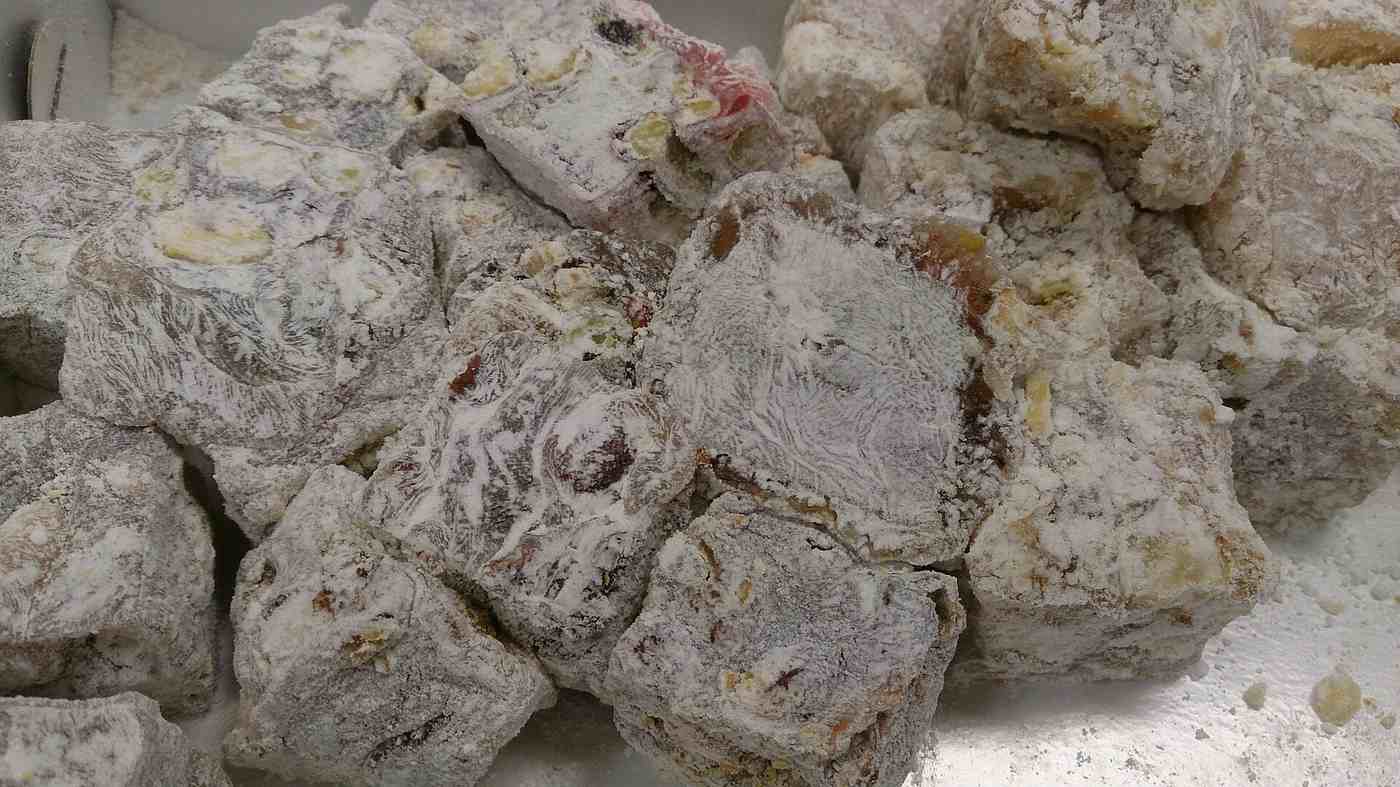
Syros loukoumi is the island’s signature confection, a soft, sugar-dusted sweet that made Ermoupoli famous across Greece from the 19th century onward. The gel of sugar and starch, scented with rose or mastic, travels home in ribboned boxes as the classic souvenir of the island. Plan the whole trip with Greece Tours.
The sweet arrived with refugees from Chios and the wider East who rebuilt their trade in the new port city. Their workshops still cluster near the harbour and Miaouli Square, turning out loukoumi alongside its nougat-like partner, halvadopita. This guide covers the sweet’s history, its ingredients, the making process, where to buy it, and how it fits Syros gastronomy beside San Michali cheese and louza.
What is Syros loukoumi and why is it the island’s signature sweet?
Syros loukoumi is a soft gel of sugar and starch, flavoured with rose, mastic, bergamot or pistachio and dusted with icing sugar. Made in Ermoupoli since the 19th century, it stands as the island’s best-known sweet and classic souvenir.
Loukoumi is the Greek name for the sweet the English-speaking world calls Turkish delight. On Syros the confection took on a local identity strong enough that the island’s name now travels with it across Greece. The base is simple: sugar and starch cooked slowly with water until the mixture sets into a soft, translucent gel. Makers cut the set sheet into small cubes and roll them in icing sugar or fine coconut. The result is chewy rather than hard, scented rather than heavily sweet, and eaten in small pieces. Visitors to Syros meet it the moment they step off the ferry, stacked in ribboned boxes in the harbour shops around the quay.
The sweet’s fame rests on the port capital of Ermoupoli, where the workshops have run for generations. Families passed the recipes down, guarding the exact proportions of sugar, starch and flavouring. The trade grew alongside the wider commerce of the 19th-century port, when Ermoupoli ranked among the busiest harbours in Greece. Loukoumi suited a merchant town: it kept well, packed neatly and made an easy gift for travellers boarding ships. Shops near the waterfront still sell it beside almond sweets and preserved fruits. The link between the sweet and the city is close enough that Greeks widely say Syros loukoumi as a single phrase, the way others name a place and its wine.
Flavour marks out the Syros version from plainer commercial loukoumi. Rose water gives the classic pink cubes their scent, while mastic from nearby Chios lends a resin-fresh note tied to the island’s roots. Bergamot, pistachio, almond and bitter orange fill the other trays in a workshop window. Coconut-rolled and sugar-dusted pieces sit side by side in the glass cases. The pieces stay soft because the starch gel holds moisture, unlike a boiled sweet. Locals eat loukoumi with a strong coffee, the sugar balancing the bitter cup. The pairing turns a small square of the sweet into a fixed part of the island’s daily rhythm rather than only a tourist buy.
Loukoumi also works as the island’s standard edible souvenir, sold in boxes tied with ribbon. Boxes range from a handful of pieces to a full kilo, mixed or single-flavour, priced to suit a quick gift. Travellers carry them home to Athens and beyond as proof of a Syros trip. Alongside loukoumi the same shops sell halvadopita, a nougat wafer that pairs with it as the island’s second sweet. Together the two form the core of the Syros sweet trade, both rooted in Ermoupoli. The medieval upper town of Ano Syros and the neoclassical harbour give the island its draw, and the sweet shops sit squarely on the visitor route between them.
How did loukoumi become a Syros speciality in Ermoupoli?
Refugees fleeing Chios and the East settled Ermoupoli in the 19th century and brought their confectionery skills with them. They developed loukoumi in the new port, and the sweet grew into a Syros speciality carried across Greece by the busy harbour trade.
Ermoupoli itself was built by refugees during the Greek War of Independence in the early 19th century. People fleeing the islands of Chios and Psara, hit hard in the fighting, gathered on the safe harbour of Syros and founded a new town. They named it Ermoupoli, the city of Hermes, god of commerce, and built it into a trading capital. The newcomers carried skills from the eastern Aegean, including the confectionery traditions of Chios. Among those traditions was loukoumi, already known across the Ottoman lands the refugees had left. The sweet found a permanent home in the growing port and spread from there through the wider Greek market over the decades.
Chios had long produced mastic, the aromatic resin that flavours one classic loukoumi. Refugees from that island understood how to work sugar and starch into the soft gel and how to scent it. In Ermoupoli they set up workshops close to the harbour, where imported sugar arrived by ship. The port’s role as a trade hub meant raw materials came in and finished sweets went out with ease. Demand rose as travellers and merchants passing through bought loukoumi to carry onward. The sweet’s long shelf life suited a shipping town, since a box survived a sea voyage intact. Production settled into family firms, a number of which trace their line back through the generations of the trade.
The 19th-century boom gave the sweet its wider fame across Greece. Ermoupoli was then among the leading ports of the young Greek state, ahead of Piraeus for a spell. Ships called from across the Mediterranean, and their passengers met loukoumi on the quay. The name of the island travelled with the boxes, fixing Syros loukoumi in the national memory. As the port later gave ground to Piraeus, the sweet trade stayed as a marker of the town’s old wealth. The workshops kept working through the decline, serving locals and the steady flow of summer visitors. The dual heritage of the island, part Orthodox and part Catholic, part Greek and part Western, shaped a culture open to such a border-crossing sweet.
The making know-how passed from one generation to the next inside the founding families. Recipes stayed close, with exact ratios of sugar to starch and the timing of the boil held as trade knowledge. Younger family members learned by working the copper pans and the cutting tables. This continuity kept the Ermoupoli loukoumi distinct from mass-produced versions sold elsewhere. The workshops near the port and up toward Ano Syros still run on the same methods. Their windows show the trays of coloured cubes that have drawn buyers for generations. The story of the sweet is, in effect, the story of the refugees who built the town and kept their eastern craft alive on the island.
What ingredients and flavours define Syros loukoumi?
Syros loukoumi rests on three basics: sugar, starch and water, cooked into a soft gel. Makers flavour it with rose, mastic, bergamot, pistachio, almond or bitter orange, then dust the cut cubes with icing sugar or shredded coconut.
Sugar and starch form the body of every loukoumi, giving it the chew and the translucent look. Cornflour or wheat starch thickens the boiling syrup until it sets firm enough to cut but stays soft to bite. Water carries the mixture through the long, slow cook that develops the texture. Certain makers add a little cream of tartar or lemon to control how the sugar behaves. The plain base tastes mainly of sweetness, so the flavouring does the real work of definition. A dusting of icing sugar or fine coconut on the outside stops the cubes sticking together in the box. These basic ingredients, handled with care, produce the whole range of Syros loukoumi on a shop shelf.
Rose is the signature flavour, colouring the classic cubes a pale pink and giving the scent most people picture. Rose water folded into the syrup carries the perfume without turning the sweet soapy when judged well. Mastic is the second defining note, the pine-fresh resin from Chios that ties the sweet to the refugees’ home island. Bergamot brings a citrus edge, while bitter orange and lemon give sharper, fruitier trays. Pistachio and almond add whole nuts set into the gel, so each cube carries a firm bite inside the soft body. Vanilla and plain sugar versions round out the milder end. The spread of flavours lets a single box hold half a dozen distinct tastes.
Colour follows flavour in the workshop window, so buyers read the trays at a glance. Pink marks rose, pale green often signals pistachio, and clear or white cubes carry mastic or plain sugar. Orange and yellow point to the citrus flavours of bergamot and bitter orange. The coating matters too: coconut-rolled pieces look snowy, while icing-sugar cubes stay glossy under the dusting. Makers keep the trays separate so the scents do not blend and the colours stay clean. This visual code helps travellers choose without tasting every kind first. Buying a mixed box near Ermoupoli‘s Miaouli Square is the simplest way to sample the full range of the island’s flavours in one go.
Quality shows in the balance of the ingredients rather than any single one. A good Syros loukoumi holds its shape yet yields softly, without the rubbery bounce of an over-starched batch. The flavour reads clean and light, not cloying, so a second cube still appeals. The dusting stays dry and even, a sign the gel set properly before cutting. Cheaper mass versions lean on artificial essence and heavier colour, which the island’s workshops avoid. Freshness counts, since loukoumi is best within weeks of the boil while the texture stays supple. Shops on Syros turn over their stock quickly in summer, so the boxes on the shelf are rarely old when the visitors arrive.
How is Syros loukoumi made in the Ermoupoli workshops?
Makers boil sugar, starch and water together, stirring the thickening syrup for hours until it reaches a soft set. They pour it onto shallow trays to cool overnight, cut the firm sheet into cubes, and roll each piece in icing sugar or coconut.
The process starts with sugar and water brought to a boil in a large pan, often copper. Makers stir in the starch slurry and keep the mixture moving so it does not catch or clump. The syrup thickens slowly over a low, steady heat across two or three hours of near-constant stirring. Timing and temperature decide the final texture, which is why the exact method stays a family secret. Toward the end the flavouring goes in: rose water, mastic, bergamot or a handful of nuts. The batch is ready when the gel coats the paddle and holds a soft, glossy body. The long, hands-on boil is the hardest and most skilled stage of the whole craft.
Pouring follows the cook, when the hot gel is spread onto shallow wooden or metal trays. Makers level it to an even depth, since the thickness sets the size of the finished cube. The trays then rest in a cool room to set, usually overnight, while the gel firms up. A dusting of starch or icing sugar on the tray stops the sheet sticking as it cools. Rushing this stage leaves the loukoumi too soft to cut cleanly, so the makers wait. By morning the sheet holds its shape and takes a knife without tearing. The overnight set is the quiet half of a process that swings between intense boiling and patient cooling on the island.
Cutting turns the set sheet into the familiar small squares. Workers score the surface into a grid, then slice down to free even cubes, traditionally by hand. The pieces come away soft and sticky, so each is rolled at once in icing sugar or fine coconut. This coating dries the surface, stops the cubes fusing, and gives the finished look. Off-cuts and edges go back into the next batch rather than to waste. The cut pieces then rest again briefly before they are weighed into boxes. Certain larger workshops now use a cutting frame for speed, though the coating and packing stay manual in the Ermoupoli workshops near the port.
Packing closes the process and shapes how the sweet reaches the buyer. Workers weigh the cubes into boxes, often lining them in neat rows by flavour and colour. A ribbon ties the classic gift box, a look bound to the sweet for generations. Boxes range from small samplers to full kilos, single-flavour or mixed. The same counters sell loose loukoumi by weight for locals buying a little at a time. Freshly finished stock moves fast in summer, so the boxes on the shelf near the port turn over within days. Watching the trays being cut and boxed through a workshop window has itself become part of a visit to Syros for countless travellers.
What is halvadopita and how does it accompany Syros loukoumi?
Halvadopita is a Syros nougat sandwiched between two thin wafers, made from honey, whipped egg white and almonds. It sits beside loukoumi as the island’s second signature sweet, sold in the same Ermoupoli shops and often bought in the same box.
Halvadopita takes its name from halva and pita, roughly the halva pie of the island. The filling is a soft, chewy nougat of honey, sugar and whipped egg white studded with almonds. Bakers press this nougat between two thin, round wafers, the kind used for communion bread. The wafer keeps the sticky nougat easy to hold and gives the sweet its flat, disc shape. Bitten into, it combines the crisp shell with the soft, nutty centre in one mouthful. The honey and almond flavour sits richer and less floral than the light scent of loukoumi. The two sweets contrast well, which is one reason the shops sell them side by side on Syros.
The sweet shares the loukoumi trade’s roots in the refugee confectionery of the port. Honey, almonds and egg white were staples of eastern Aegean sweets, and the wafer form travelled with them. Ermoupoli workshops added halvadopita to their trays as a partner to the loukoumi cubes. The two keep well and pack flat, so both suited the same gift and shipping trade. Buyers heading home from the harbour often took a box of each, and the pairing stuck. Today the same family shops make and sell both under one roof. The wafer disc and the sugar-dusted cube have become the twin emblems of the island’s sweet-making, recognised together across Greece for generations now.
Making halvadopita centres on the nougat, which is boiled honey and sugar beaten with egg white until pale and thick. Almonds, sometimes toasted, are folded through the warm mixture before it cools. Bakers spread the nougat over one wafer sheet, lay a second on top, and press the two together. Once set, the large sheet is cut into rounds or squares for sale. The wafer must stay crisp against the moist nougat, so timing and storage matter. The result is firmer and chewier than loukoumi, closer to a nougat bar than a soft gel. Skilled hands keep the nougat smooth and the almond spread even across every piece sold in Ermoupoli.
Halvadopita rounds out the island’s sweet identity beyond loukoumi alone. A visitor who buys only the soft cubes misses half the local tradition, so shops steer travellers to try both. The nougat wafer suits those who find loukoumi too soft or too floral for their taste. It also travels well as a gift, flat and sturdy in a box beside the ribboned loukoumi. Cafes serve slices of halvadopita with coffee just as they serve the cubes. Between them the two sweets cover the range of the island’s confectionery, one chewy and nutty, the other soft and scented. Together they define what a sweet from Syros means to the rest of Greece.
Where do you buy Syros loukoumi near Miaouli Square and the port?
Buyers find Syros loukoumi in the family sweet shops clustered along the Ermoupoli waterfront and the lanes around Miaouli Square. The workshops sit close to the ferry quay, so arriving and departing travellers pass the ribboned boxes on their way through.
The main cluster of loukoumi shops lines the harbour front of Ermoupoli, steps from where the ferries dock. Their windows face the quay, stacked with trays of coloured cubes and boxes tied in ribbon. A short walk inland reaches Miaouli Square, the marble heart of the town, ringed by more cafes and shops selling the sweet. The lanes between the square and the water hold a number of long-standing family workshops. Travellers with time before a ferry browse these shops as an easy last stop. The concentration near the port is deliberate, since the sweet has always been sold to people passing through. Signs in Greek and English point buyers toward the best-known makers.
A number of workshops both make and sell on the same premises, so buyers see the trade at work. The counter displays loose cubes by flavour, weighed out into paper or boxed to order. Staff let visitors taste a piece before choosing, which helps with the wide flavour range. Prices are set by weight, with a small mixed box costing a couple of euros and a full kilo more. Boxes come ready-tied for gifts, or loose loukoumi is bagged for eating on the spot. The same shops stack halvadopita, almond sweets and spoon preserves alongside the loukoumi. Buying direct from a workshop rather than a supermarket gives the fresher sweet and the fuller choice on Syros.
Timing a purchase near the departure helps, since loukoumi is best eaten fresh. Buyers heading for the evening ferry pick up a box on the way to the quay rather than days ahead. The harbour shops keep long hours in summer to catch both the arriving and leaving crowds. Away from the port, smaller shops in the back lanes and up toward Ano Syros sell to locals at similar prices. The medieval upper town has its own bakeries carrying the island sweets for visitors who climb there. Wherever the shop, the loukoumi comes from the same handful of Ermoupoli workshops. Checking the box for the maker’s name points to the traditional producers rather than resold stock.
Prices stay modest, which keeps loukoumi a practical gift rather than a luxury buy. A small sampler box runs a couple of euros, enough for a taste of assorted flavours. A full kilo, mixed or single, costs more but still sits within an easy souvenir budget. Halvadopita is priced by the piece or the sheet, similar in range to the loukoumi boxes. Paying by card is common in the larger harbour shops, though small back-lane makers may prefer cash. Buyers wanting the sweet to survive the trip home ask for a sealed or double-boxed pack. The low cost and long keeping make a box of Syros loukoumi the standard thing to carry off the island.
How does loukoumi fit into wider Syros gastronomy alongside San Michali and louza?
Loukoumi anchors the sweet side of Syros gastronomy, matched on the savoury side by San Michali, the island’s PDO hard cheese, and louza, a cured pork fillet. Together these products carry the island’s dual East-West food heritage onto the plate.
Syros gastronomy pairs the famous sweets with a set of savoury products just as tied to the island. San Michali is a hard, mature cheese from local cow’s milk, holding a protected designation of origin. Its sharp, peppery bite makes it a table cheese and a grating cheese for pasta. Louza is the island’s cured pork, a lean fillet rubbed with salt, pepper and spices, then air-dried. Thin slices of louza appear on meze plates beside the cheese and a glass of local wine. These savoury specialities share the loukoumi story: a craft passed down and tied to the name of Syros. A food tour of the island moves naturally from the cheese counter to the sweet shop.
The island’s dual heritage runs through its whole food culture, not only the sweets. Syros holds both a large Catholic community, based around Ano Syros, and the Orthodox majority of Ermoupoli below. This mix, along with the port’s old trade links, opened the island’s kitchen to eastern and western influences alike. Loukoumi and mastic point east to Chios and the old Ottoman lands. San Michali and the cured meats lean toward the Italian and wider Mediterranean side of the island’s past. The result is a food identity that crosses the usual borders, just as the town’s architecture blends Greek and neoclassical European styles. The sweet sits inside this wider picture rather than apart from it.
A visitor eating through Syros meets these products in a natural order across a day. Breakfast might bring local thyme honey, the same honey that binds the halvadopita nougat. A midday meze plate carries louza, San Michali and capers gathered on the dry hillsides. Fresh fish from the harbour fills the main course in the tavernas of Kini and the port. The meal closes with loukoumi and a coffee, or a slice of halvadopita, back in an Ermoupoli cafe. Each course ties to a named island product with its own small tradition. Building a day around them turns eating into a route through the island’s history as deeply as its kitchens.
The sweets and the savoury specialities together explain why food ranks high among reasons to visit Syros. Loukoumi and halvadopita give the island a sweet name known across Greece since the port’s rise. San Michali and louza give it a savoury reputation among cheese and cured-meat buyers. All four are sold within a short walk of the harbour and Miaouli Square. Travellers can assemble a full edible picture of the island in a single afternoon of shopping. Carrying home a box of loukoumi beside a wedge of cheese sums up the two sides of the island’s table. The confectionery, though, remains the first thing most people name when they think of the island.
Frequently Asked Questions
Is Syros loukoumi the same as Turkish delight?
Loukoumi is the Greek name for the sweet the English-speaking world calls Turkish delight, so the two are the same family of confection. Syros loukoumi is the island’s own version, developed in Ermoupoli by refugees from Chios and the East in the 19th century. It uses the same sugar-and-starch gel base but is prized for its flavours, notably rose and mastic, and its long family-workshop tradition near the port. Greeks often say Syros loukoumi as a single phrase, marking the island’s claim to the sweet.
What flavours of Syros loukoumi should I try?
Rose is the classic Syros loukoumi flavour, giving the pink cubes their scent, and mastic is the second signature, a pine-fresh resin from nearby Chios. Beyond these, workshops make bergamot, bitter orange, pistachio, almond and plain vanilla or sugar versions. A mixed box lets you sample a range at once, which is the usual way to start. Coconut-rolled and icing-sugar-dusted pieces sit side by side in the shop windows near Miaouli Square, colour-coded by flavour so you can pick by eye.
How long does Syros loukoumi keep?
Loukoumi keeps for a number of weeks to a couple of months when stored in a cool, dry place in its box. The sugar coating and the starch gel together slow it from drying out, which is why the sweet suited the old shipping trade. It is best within a couple of weeks of the boil, while the texture stays soft and supple. Keep the box closed and away from heat and damp, and eat it before the cubes harden at the edges. Refrigeration is not needed and can dry the sweet out.
What is halvadopita?
Halvadopita is the second signature sweet of Syros, a soft honey-and-almond nougat pressed between two thin communion-style wafers. The name means roughly halva pie. Its filling is boiled honey and sugar whipped with egg white and studded with almonds, giving a chewy, nutty bite firmer than loukoumi. Bakers cut the large wafer sheet into rounds or squares for sale. The Ermoupoli sweet shops sell it beside the loukoumi cubes, and most buyers take a box of each, since the pair defines the island’s confectionery.
Where can I buy loukoumi in Ermoupoli?
The family sweet shops along the Ermoupoli harbour front and the lanes around Miaouli Square are the main places to buy loukoumi. A number both make and sell on the premises, so you can taste before choosing and watch the trays being cut. The workshops sit close to the ferry quay, an easy last stop before a departure. Prices go by weight, from a couple-euro sampler box to a full kilo. The same counters stock halvadopita and other island sweets, so you can gather the full range in one visit.
How is Syros loukoumi served?
Loukoumi is served in small cubes with a strong Greek coffee, the sugar balancing the bitter cup as a traditional pairing. Locals eat it as an afternoon or after-meal sweet rather than in large amounts, taking a piece or two at a time. Cafes in Ermoupoli offer it alongside halvadopita as the island sweets. At home the ribboned box is opened for guests with coffee. Its soft, scented bite makes it a light close to a meal rather than a heavy dessert.