
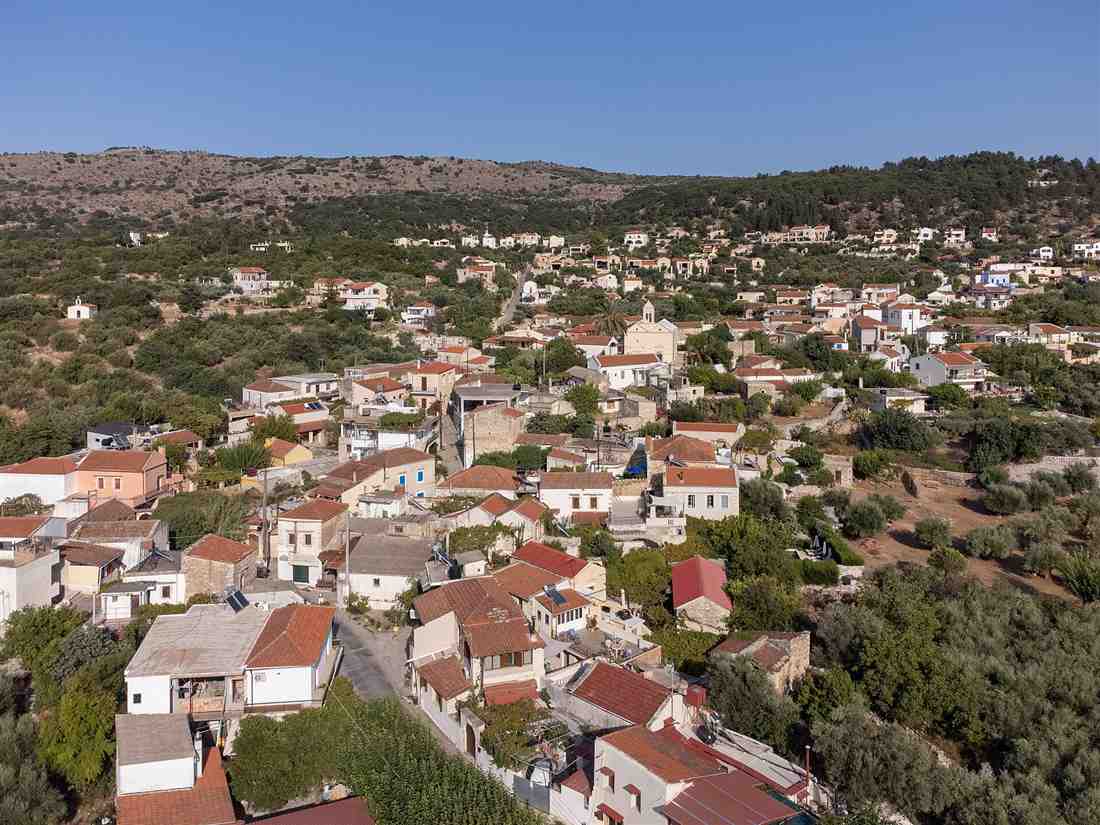
To get from Chania to Gavalochori, drive east on the E75/A90 national road to the Vamos and Apokoronas exit, then the local road to the village, about 22 kilometres in 25 to 30 minutes, reaching the preserved stone village on the hills above Almyrida. The trip from Chania to Gavalochori runs on the fast national road. Plan the whole trip with Greece Tours.
This guide covers the trip from Chania to Gavalochori in full: where it is, how to get there by car and by bus, the preserved stone village of arched doorways and cobbled lanes, the Folklore Museum, the ancient and Venetian wells and the needle-lace tradition, the beaches of Almyrida and Kalyves and the village of Vamos nearby, and whether this Apokoronas trip is worth it.
Where is Gavalochori and how far is it from Chania?
Gavalochori is a traditional stone village in the Apokoronas area of the Chania regional unit, 22 kilometres east of Chania town. It sits on the hills above Almyrida and the Drapano peninsula, a 25 to 30 minute drive from the centre of Chania.
Planning Chania to Gavalochori by the light and the heat makes the most of the visit. The trip from Chania to Gavalochori pairs well with the neighbouring stops on the same road. Every itinerary that includes Chania to Gavalochori gains an easy, scenic leg. The Chania to Gavalochori journey ends at a place that repays an unhurried stay. A car makes Chania to Gavalochori a simple leg of a west-Crete plan. The drive from Chania to Gavalochori is direct enough to slot into a wider day out. Gavalochori belongs to the Apokoronas municipality, the green district that stretches east of Chania town toward the Gulf of Souda and the Drapano headland. The village stands inland from the coast, raised on gentle hills that overlook olive groves, vineyards and the blue line of the sea below. From its lanes the ground drops toward Almyrida and Kalyves, the two coastal settlements that mark the shore of the peninsula.
The distance from Chania is fixed and short. Twenty-two kilometres separate the Venetian harbour of Chania from the stone doorways of Gavalochori, and the national road covers the bulk of that gap at speed. This puts the village inside the ring of easy half-day trips out of the city, close enough for a morning visit and a lunch, far enough to feel like open Cretan countryside rather than a suburb of the town.
Gavalochori anchors a cluster of Apokoronas villages that includes Vamos, Douliana, Kokkino Chorio and Aspro. The White Mountains rise to the south as a grey wall, the sea sits to the north, and the village occupies the fertile middle ground of terraces and groves. That position, between mountain and coast, gives Gavalochori its mild light and its steady supply of local olive oil, wine and raki.
Orientation is simple. Chania town, its Venetian harbour and its old quarter sit to the west; the Gulf of Souda and the naval port lie between the town and the peninsula; and Gavalochori rests on the far side of that bay, up on the Drapano hills. A traveller measures the trip in a single figure, 22 kilometres, and reaches open countryside within half an hour of leaving the harbour front.
How do you drive from Chania to Gavalochori?
Drive east from Chania on the E75/A90 national road, take the Vamos and Apokoronas exit, then follow the local road to Gavalochori. The route runs 22 kilometres and takes 25 to 30 minutes in normal traffic.
The Chania to Gavalochori journey ends at a place that repays an unhurried stay. A car makes Chania to Gavalochori a simple leg of a west-Crete plan. The drive from Chania to Gavalochori is direct enough to slot into a wider day out. For a first visit, the Chania to Gavalochori drive is the straightforward choice. The time from Chania to Gavalochori holds steady outside the peak-season traffic. Travellers who plan the trip from Chania to Gavalochori reach it comfortably in the times given. The drive starts on the E75/A90, the national road that runs the length of northern Crete and links Chania with Rethymno and Heraklion. From the eastern edge of Chania town the road climbs above Souda Bay and carries fast, open lanes past the port and the airport turn. Signs for Vamos and Apokoronas mark the exit that leaves the national road for the interior of the peninsula.
After the exit the local road narrows and starts to wind through the district. It threads between olive groves, past field walls and small chapels, with the sea appearing and vanishing on the left as the road bends. The final approach to Gavalochori drops onto quiet village lanes lined with stone houses, where the pace slows and the pavement gives way to cobbles at the old centre.
A rental car is the practical way to reach the village and the wider Apokoronas, since the surrounding hamlets, beaches and walking trails sit off the bus grid. Parking is straightforward at the edge of the village, and from there the settlement is walked on foot. Drivers coming from the west pass the whole northern coast on the way, which makes Gavalochori a natural stop on a loop of eastern Chania. For more ideas on pairing it with other stops, see these day trips from Chania.
How do you reach Gavalochori by bus?
The KTEL Apokoronas line from Chania serves Gavalochori on set daily departures. The bus leaves from the central KTEL station in Chania and runs east into the peninsula, stopping at the village on its scheduled times.
For a first visit, the Chania to Gavalochori drive is the straightforward choice. The time from Chania to Gavalochori holds steady outside the peak-season traffic. Travellers who plan the trip from Chania to Gavalochori reach it comfortably in the times given. The distance from Chania to Gavalochori is covered on a single, well-built road. Fitting Chania to Gavalochori into a morning leaves the afternoon free. The route from Chania to Gavalochori is signed and simple to follow. KTEL is the regional bus company of Chania, and its Apokoronas services fan out east from the main station on Kydonias Street in the town centre. The Gavalochori route follows the same national road that private drivers take, exits toward Vamos and Apokoronas, and turns off to the village on fixed departures through the day. Tickets are bought at the station counter or from the driver.
The bus suits a traveller without a car who wants to reach the village, walk its lanes, visit the museum and eat at a taverna before the return service. Departure times are set and spaced through the day rather than running on a dense urban frequency, so a visitor plans the outward and return legs against the printed timetable to avoid a long wait at the stop. Checking the current KTEL Chania schedule before setting out fixes the day against the fixed departures.
For the coast below and the trails that link the Apokoronas hamlets, the bus reaches the main village but not the scattered beaches, wells and paths beyond it. A traveller who wants Almyrida, Kalyves, the Drapano viewpoints and the walking network in one visit is served better by a rental car, which turns the fixed timetable into an open schedule and opens the whole district rather than a single stop.
What is Gavalochori like as a village?
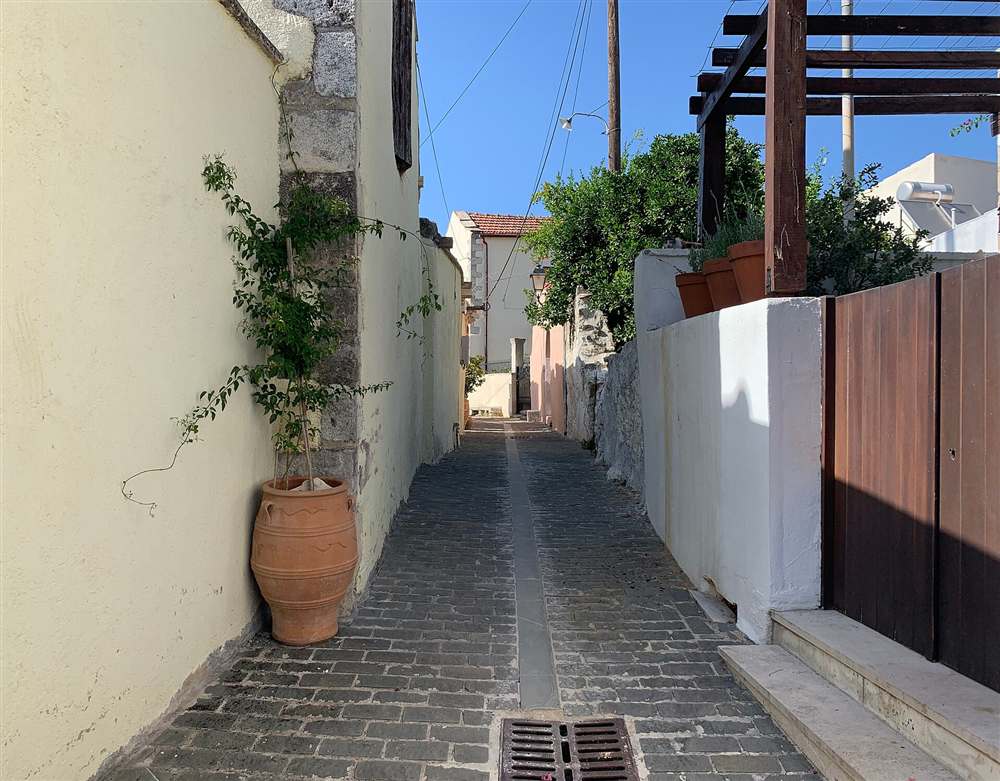
Gavalochori is a preserved settlement of stone houses, arched doorways, cobbled lanes and old cafes. It is a lived-in, unhurried village set among olive groves and vineyards, away from the coast, with tavernas serving Cretan food, local wine and raki.
The distance from Chania to Gavalochori is covered on a single, well-built road. Fitting Chania to Gavalochori into a morning leaves the afternoon free. The route from Chania to Gavalochori is signed and simple to follow. Setting out early on the Chania to Gavalochori run beats both the heat and the crowds. The road from Chania to Gavalochori is paved and well built the whole way. Anyone weighing the journey from Chania to Gavalochori finds the distance short by Cretan standards. The character of Gavalochori is written in its stone. Houses are built of honey-coloured local rock, their fa\u00e7ades broken by arched Venetian doorways and shuttered windows, and the lanes between them are laid in worn cobbles rather than tarmac. Vines shade the courtyards, bougainvillea climbs the walls, and the plateia at the heart of the village gathers a handful of old cafes under plane trees where residents sit over coffee and raki.
This is a working village, not a resort. Olive groves and vineyards press up to the edge of the houses, and the surrounding land still yields the oil, grapes and greens that fill the tavernas. The rhythm is slow: shops open and close on their own hours, the church bell marks the day, and the streets stay quiet between the lunch and evening tables. That everyday texture is the draw for travellers who want the real Apokoronas rather than a coastal strip.
The village stays alive through the year rather than shutting after a season, since residents live and farm here rather than renting to visitors alone. Eating in Gavalochori means Cretan cooking made from the fields beside it. Tavernas set out lamb and goat, wild greens, dakos, snails, cheese and slow-cooked dishes, poured alongside village wine and the clear raki that closes every Cretan meal. The tables spread onto the cobbles under the trees, and a long lunch here is the centre of a visit rather than a break in it. The village pairs naturally with a base in Chania for travellers touring the west of the island.
What are the Folklore Museum, the Venetian wells and the lace tradition?
Gavalochori holds the Folklore Museum in a restored stone house, showing the crafts, tools and history of the Apokoronas. The village is known for its silk and needle-lace tradition, the kopaneli, and ancient and Venetian wells, the kamares, are cut into the rock at its edge.
The road from Chania to Gavalochori is paved and well built the whole way. Anyone weighing the journey from Chania to Gavalochori finds the distance short by Cretan standards. The Chania to Gavalochori route rewards an early start in the summer months. Drivers on the Chania to Gavalochori route follow the main road out of the city. The short run from Chania to Gavalochori keeps it within easy reach of the city. The Gavalochori Folklore Museum occupies a restored stone house in the village and gathers the material life of the Apokoronas under one roof. Its rooms display farming and household tools, looms, costumes, photographs and everyday objects that trace how the district lived and worked across generations. The building itself, with its arches and thick walls, is part of the exhibit, a preserved example of the domestic architecture that lines the surrounding lanes.
The village carries a distinctive craft, the kopaneli needle lace, worked from silk in a technique passed down through the women of Gavalochori. Silk production and fine needle-lace made the village a name in Cretan handwork, and examples of the craft are shown and kept alive in the museum and the community. This lace tradition sets Gavalochori apart from the farming villages nearby and gives its history a thread that runs beyond the fields.
At the edge of the settlement, the kamares, ancient and Venetian wells, are cut straight into the living rock, arched stone chambers that gathered and held water for the village through the dry Cretan summers. A Roman-era rock-cut tomb complex lies nearby, carved into the same stone landscape. Together the wells, the tombs, the museum and the lace turn a short walk through Gavalochori into a compact reading of the Apokoronas across Roman, Venetian and modern Cretan time.
What is nearby \u2014 Almyrida, Vamos and the Apokoronas?
The beaches of Almyrida and Kalyves lie on the coast below Gavalochori, with the village of Vamos, the Drapano peninsula and the White Mountains foothills close by. The wider Apokoronas villages are linked to Gavalochori by walking trails through the groves.
Drivers on the Chania to Gavalochori route follow the main road out of the city. The short run from Chania to Gavalochori keeps it within easy reach of the city. The Chania to Gavalochori trip suits a half-day paired with a second nearby stop. The Chania to Gavalochori trip is one of the more rewarding short runs from the city. On a map, Chania to Gavalochori traces a clear line east of the city. Almyrida sits on the shore directly below the village, a sheltered bay with shallow water, a sandy and pebbled beach and a line of tavernas along the front. Kalyves, the next settlement west, spreads a longer strand behind a river mouth and an old fort. Both are a short drop down the hill from Gavalochori, which makes the pairing of a morning in the stone village and an afternoon on the coast a natural single trip.
Inland, Vamos serves as the administrative heart of the Apokoronas, a restored stone village of its own with cafes, shops and a strong tradition of agrotourism. The Drapano peninsula reaches north from Gavalochori toward the sea, its clifftop hamlets of Kokkino Chorio and Kefalas giving wide views over Souda Bay and the White Mountains. Those mountains, the Lefka Ori, rise as the grey southern horizon of every view from the district.
Walking trails knit the Apokoronas together, running between Gavalochori, Douliana, Vamos and the coast through olive groves, terraces and old field paths. A walker moves from stone village to stone village on foot, passing chapels, wells and vineyards on the way, with the sea below and the peaks above. This network of short, connected routes turns the area into walking country and gives Gavalochori a role as a base rather than a single stop.
Is the trip worth it, and when is the best time to go?
The trip is worth it for travellers who want a genuine, unhurried Cretan village 22 kilometres from Chania, with stone architecture, a folklore museum, a living lace craft and Cretan tavernas. Spring and autumn bring mild weather and quiet lanes; summer pairs the village with the beaches below.
The Chania to Gavalochori trip is one of the more rewarding short runs from the city. On a map, Chania to Gavalochori traces a clear line east of the city. The Chania to Gavalochori drive rewards the effort with the sight at the end of it. Planning Chania to Gavalochori by the light and the heat makes the most of the visit. The trip from Chania to Gavalochori pairs well with the neighbouring stops on the same road. Gavalochori rewards the visitor who values texture over spectacle. It offers no crowds and no resort strip, but a preserved stone settlement with real depth: the museum, the kamares wells, the Roman tombs, the needle-lace heritage and the everyday life of an Apokoronas village at work. For a traveller who wants to understand rural Crete rather than photograph a coastline, the 25 to 30 minute drive out of Chania returns far more than the distance suggests.
Spring and autumn are the finest windows. In spring the hills turn green, wildflowers fill the terraces and the walking trails between the villages are cool and clear. Autumn brings the grape and olive harvest, warm light and tavernas serving the new pressings, with the summer visitors gone and the lanes returned to the residents. Both seasons keep the temperatures mild for walking the cobbles and the paths.
Summer pairs Gavalochori with the water. The stone village stays cooler than the shore under its plane trees, and the beaches of Almyrida and Kalyves sit minutes downhill for the afternoon. A day that starts with the museum and a long taverna lunch in the village and ends on the sand below is the way to take the Apokoronas in the heat. In every season the short distance from Chania and the density of things to see and eat make Gavalochori a trip that earns its place on a west-Crete itinerary.
Frequently Asked Questions
How do you get from Chania to Gavalochori?
From Chania to Gavalochori, drive east on the E75/A90 national road to the Vamos and Apokoronas exit, then the local road to the village, 22 kilometres in 25 to 30 minutes. The KTEL Apokoronas bus from Chania serves Gavalochori on set departures; a car suits the village and the region.
How far is Gavalochori from Chania?
Gavalochori lies 22 kilometres east of Chania, in the Apokoronas area of the Chania regional unit, on the hills above Almyrida and the Drapano peninsula. The drive from Chania to Gavalochori takes 25 to 30 minutes.
Is the trip from Chania to Gavalochori worth it?
The trip from Chania to Gavalochori rewards visitors with a preserved stone village, a Folklore Museum, ancient and Venetian wells and a living lace tradition, with the beaches of the Apokoronas below. The short distance makes it an easy cultural half-day.