
To get from Chania to Vai, drive east on the E75/A90 national road through Rethymno, Heraklion and past Agios Nikolaos to Sitia, then north-east to the palm beach, about 285 kilometres in 4 to 4.5 hours, reaching the largest natural palm grove in Europe. The trip from Chania to Vai is one of the longest on the island. Plan the whole trip with Greece Tours.
This guide covers the trip from Chania to Vai in full: where it is, how to drive it, the long KTEL bus corridor, the palm-forest beach and its golden sand, the protected reserve of Cretan date palms, the facilities, parking and crowds and the headland viewpoint, the Toplou monastery, Itanos and Sitia nearby, and whether this far north-east trip is worth it or better as an eastern base.
Where is Vai and how far is it from Chania?
Vai sits on the far north-east tip of Crete, in the Lasithi regional unit near Palekastro and the town of Sitia, 285 kilometres east of Chania. It ranks among the farthest points on the whole island from the western city.
The Chania to Vai drive rewards the effort with the sight at the end of it. The Chania to Vai trip is one of the more memorable runs on the island. The run from Chania to Vai rewards an early start in the summer months. The Chania to Vai route is best driven with a full tank and an early start. The road from Chania to Vai is paved and signed the whole way. The route from Chania to Vai follows the main road for the fast section. The distance from Chania to Vai is covered on well-built roads. The time from Chania to Vai holds steady outside the peak-season traffic. The drive from Chania to Vai is a set piece of an east-Crete plan. Crete stretches 260 kilometres from its western capes to its eastern ones, and Chania and Vai occupy opposite ends of that span. Chania anchors the north-west coast, a Venetian harbour city backed by the White Mountains. Vai marks the north-eastern extremity, past Agios Nikolaos, past Sitia, out where the coastline turns toward Cape Sidero and the Karpathos Sea. The two places belong to different regional units: Chania to the Chania unit in the west, Vai to the Lasithi unit in the east. Between them lie the Rethymno and Heraklion units and the full width of the island.
The distance of 285 kilometres by road exceeds the straight-line span because the route hugs the north coast and detours inland through the mountains east of Agios Nikolaos. A traveller crosses four regional units in a single direction, passing Rethymno at the 60-kilometre mark, Heraklion near the 140-kilometre mark, Agios Nikolaos near the 210-kilometre mark, and Sitia near the 260-kilometre mark before the final push to the palm beach. This is the longest single-destination day trip a visitor undertakes from the western city, and the geography sets the tone for everything that follows: an early start, a full day of movement, and a reward at the end that stands apart from any other beach on Crete.
To put the distance in Cretan terms, Vai sits farther from Chania than Chania sits from its own western capes and the Elafonisi lagoon. A driver measures the trip not in beach-hopping terms but in cross-island terms, the same order of effort as crossing from one end of a small country to the other. The road passes through every climate zone of the north coast, from the green foothills west of Rethymno to the arid, sun-bleached hills of the far east, where the vegetation thins to olive, thyme and rock. That transition in landscape is itself part of the journey and signals the approach to the island’s driest, remotest corner where the palm grove hides.
Because Vai lies so far east, travellers who reach it treat it as the eastern anchor of a wider Lasithi loop rather than a quick dip and a drive home. The palm beach pairs naturally with Sitia, Toplou Monastery and the ancient site of Itanos, all within a short radius. Understanding the raw distance first is what makes the rest of the planning honest. For a shortlist of closer options and the wider set of day trips from Chania, the contrast in driving time is stark: Vai asks more of a visitor than almost any other target on the island.
How do you drive from Chania to Vai?
Drive east on the E75/A90 national road through Rethymno and Heraklion to the Agios Nikolaos area, then take the coast road on to Sitia, then turn north-east to Vai. The route runs 285 kilometres and takes 4 to 4.5 hours of driving.
Every east-Crete itinerary that includes Chania to Vai gains a memorable leg. Planning Chania to Vai by the light and the heat makes the most of the visit. On a map, Chania to Vai traces a long line across the island. The Chania to Vai trip suits a base at the eastern end over a day return. Drivers on the Chania to Vai route follow the national road out of the city. Anyone weighing the journey from Chania to Vai sees the distance clearly on the map. Setting out early on the Chania to Vai run beats both the heat and the crowds. Fitting Chania to Vai into a full day leaves room for one nearby stop. Travellers who plan the trip from Chania to Vai reach it within the times given. The first two-thirds of the journey follow the Northern Road Axis of Crete, the E75 signed also as the A90, a fast two-lane-plus highway that links the island’s four coastal cities. From Chania the road climbs and dips along the coast to Rethymno in 45 minutes, then continues to Heraklion in a further 75 minutes. This stretch carries the heaviest traffic on Crete, and the surface stays wide, engineered and predictable. Petrol stations, service areas and exits for beach towns line the route, so a driver refuels and rests without leaving the corridor.
East of Heraklion the highway narrows as it bends inland and climbs toward the Lasithi plateau’s northern edge, reaching the Agios Nikolaos area near the 210-kilometre mark. Here the national road effectively ends its fast character. The final legs to Sitia and then to Vai are two-lane roads that twist over headlands, drop into bays and switchback across dry hills. The 70-kilometre run from Agios Nikolaos to Sitia demands 75 minutes on its own because of the curves above the Gulf of Mirabello and the climb over the Thripti foothills. Speeds fall, and the scenery turns wild and empty, with sea on one side and terraced slopes on the other.
From Sitia the last 24 kilometres to Vai head north-east through Palekastro, past olive groves and greenhouse plots, then onto a narrow lane that ends at the palm-beach car park. This final stretch takes 30 minutes. A driver leaving Chania at 07:00 reaches Vai near 11:30, allowing time on the sand before the return. The total distance of 285 kilometres and the 4 to 4.5-hour driving time make a same-day round trip a 9-hour minimum behind the wheel, which is why an overnight in Sitia or Agios Nikolaos turns the punishing dash into a relaxed two-day plan. Fuel for the round trip runs to 45 litres in a compact car, and the road carries no motorway toll on Crete.
Drivers starting from the old town base their timing on the harbour district of Chania and its morning traffic, which thickens on the ring road until 09:00. Clearing the city before 08:00 shaves 20 minutes off the outbound leg. The road signs point first to Rethymno and Heraklion, then to Agios Nikolaos and Sitia, and finally to Vai itself, which appears on brown tourist signage from Palekastro onward. Navigation stays simple: one long eastward line, then a short northward hook at the very end.
How do you get from Chania to Vai by KTEL bus?
No direct bus links Chania to Vai. Ride the coastal KTEL from Chania to Heraklion, change for the Heraklion-to-Sitia service, then board the seasonal Sitia-to-Vai bus that runs in high summer. The chain fills a full travel day in each direction.
The drive from Chania to Vai is a set piece of an east-Crete plan. The Chania to Vai journey ends at a place that repays the distance. The trip from Chania to Vai pairs with the sights around it on the same route. The Chania to Vai drive rewards the effort with the sight at the end of it. The Chania to Vai trip is one of the more memorable runs on the island. The run from Chania to Vai rewards an early start in the summer months. The Chania to Vai route is best driven with a full tank and an early start. The road from Chania to Vai is paved and signed the whole way. The route from Chania to Vai follows the main road for the fast section. The public network on Crete splits into two companies: KTEL Chania-Rethymno covers the west, and KTEL Heraklion-Lasithi covers the east, with Heraklion as the hinge between them. A traveller without a car strings three legs together. The first leg, Chania to Heraklion, runs every 30 to 60 minutes through the day on the fast coastal line and takes 2 hours 45 minutes. Buses depart the central Chania KTEL station near the market and terminate at Heraklion’s Bus Station A by the port.
The second leg, Heraklion to Sitia, departs from that same Bus Station A. The eastern KTEL runs this route 5 to 6 times a day, and the ride lasts 3 hours because it threads the same twisting coast road east of Agios Nikolaos that slows drivers. The bus halts at Agios Nikolaos and Ierapetra-junction stops along the way. Arriving in Sitia, a traveller stands 24 kilometres short of Vai with the hardest connection still ahead.
The third leg is the seasonal Sitia-to-Vai shuttle, which operates in the high-summer months of the tourist season and pauses in the cold half of the year. When it runs, it departs Sitia 2 to 3 times daily, stops at Palekastro, and reaches the palm beach in 40 minutes. The gaps between these shuttles are wide, so a bus traveller studies the printed KTEL timetable before setting out and confirms the return departure the moment the outbound one drops them at the sand. Missing the last Vai-to-Sitia bus of the afternoon strands a visitor far from any hotel.
Counting the three legs, waiting time at Heraklion and Sitia, and the walk between platforms, the one-way public journey consumes 8 to 9 hours. A same-day return by bus is not realistic; the schedules force an overnight in Sitia. For this reason the bus suits travellers building a slow eastern-Crete itinerary who stay a night or two in Sitia and use it as a base for Vai, Toplou and Itanos. Those on a tight schedule out of Chania hire a car or join an organised coach that runs the whole route in one managed day. Fares stay low on KTEL: the Chania-Heraklion ticket costs 15 to 16 euros, the Heraklion-Sitia ticket 15 to 16 euros, and the Sitia-Vai shuttle 2 to 3 euros more, so the full public fare undercuts a rental plus fuel for a solo traveller.
What is the Vai palm beach?
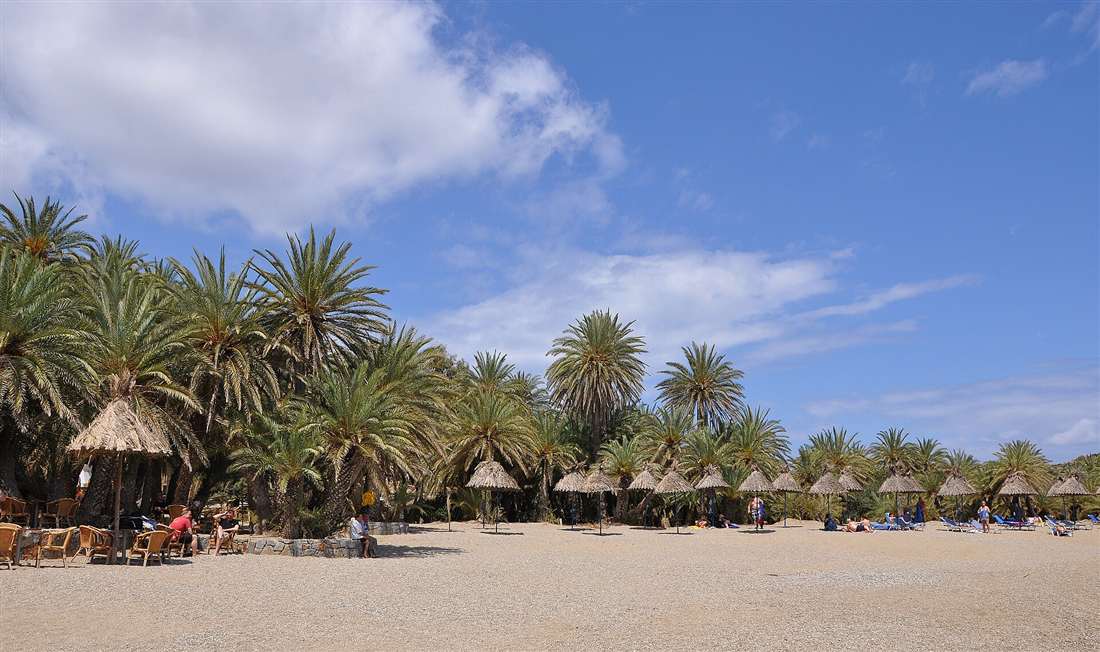
Vai is a curve of golden sand backed by the largest natural palm grove in Europe, thousands of Cretan date palms growing behind the beach where turquoise water shelves gently into the Karpathos Sea. The forest gives the shore a subtropical look found nowhere else on the continent.
Travellers who plan the trip from Chania to Vai reach it within the times given. For a first visit, the Chania to Vai drive is the straightforward choice. A car makes Chania to Vai a flexible leg of a wider Crete plan. Every east-Crete itinerary that includes Chania to Vai gains a memorable leg. Planning Chania to Vai by the light and the heat makes the most of the visit. On a map, Chania to Vai traces a long line across the island. The Chania to Vai trip suits a base at the eastern end over a day return. Drivers on the Chania to Vai route follow the national road out of the city. Anyone weighing the journey from Chania to Vai sees the distance clearly on the map. The beach itself forms a shallow arc 200 metres wide, framed by two low rocky headlands. Its sand is pale gold and coarse, warmed by full southern light through the middle of the day. The water reads as banded turquoise near the shore and deep blue further out, clear enough to show the sandy bottom 4 metres down. The gentle gradient lets a bather wade far before the seabed drops, which makes the shallows safe for children and calm swimmers alike. Behind the sand rises the wall of palms that gives Vai its fame, a dense green mass unlike the pines, olives and tamarisks that shade every other Cretan beach.
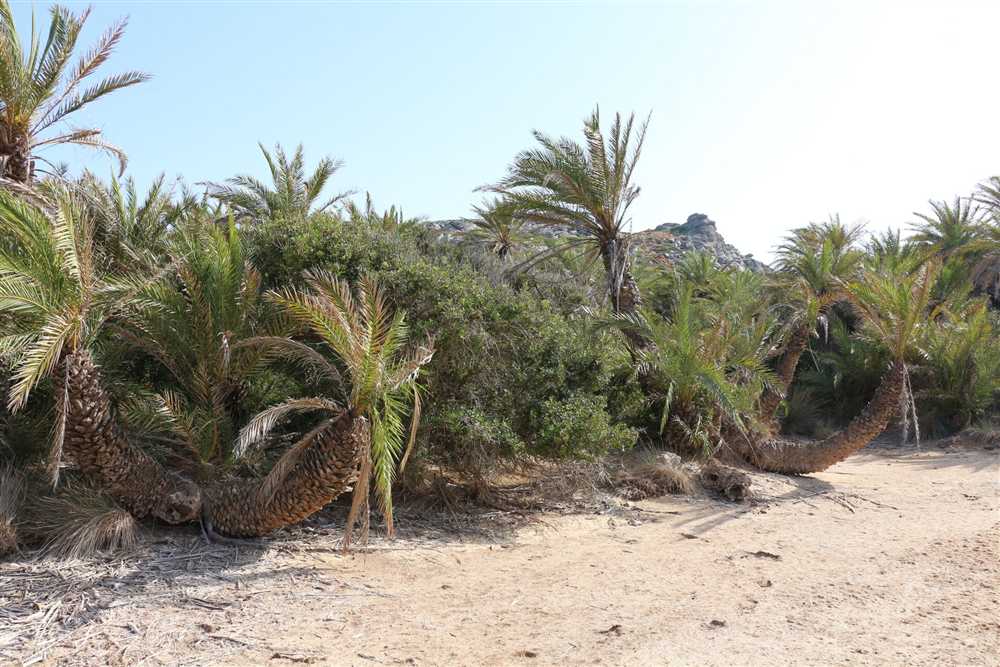
The palms are Phoenix theophrasti, the Cretan date palm, a species native to the eastern Mediterranean and named for the ancient botanist Theophrastus. Thousands of individual trees crowd the small valley that opens onto the beach, their fronds meeting overhead to form a true forest rather than a scattered stand. Local legend once credited Egyptian or Phoenician sailors with planting date stones here, but the grove is wild and indigenous, a relic population that survived in this warm, sheltered pocket of the island’s driest corner. The dates the trees bear are small and fibrous, food for wildlife rather than a crop.
The forest also shelters a distinct micro-habitat. The dense canopy holds moisture and cool air in a corner of Crete that bakes under summer sun, and the shade supports insects, reptiles and birds that the open scrubland beyond it does not. Water from a small seasonal stream feeds the palm roots through the dry months, which is why the grove clings to this exact valley and nowhere else on the parched cape. This tight link between water, shade and species is what makes the reserve fragile and worth the protection wrapped over it.
The setting reads as tropical, and photographs of Vai circulate worldwide as an image of exotic Greece, which is what draws the crowds across the long eastern distance. The combination is specific and rare: a protected palm forest, a sheltered golden cove, and clean shelving water, all packed into one small bay at the island’s edge. That singularity is the entire reason a traveller drives 285 kilometres from Chania rather than stopping at one of the hundred fine beaches closer to the western city. Vai offers a landscape the rest of Crete does not hold.
What is the palm forest and the protected reserve at Vai?
The palm forest is a protected nature reserve of Phoenix theophrasti, the largest natural palm grove in Europe. A fence and a raised boardwalk keep visitors off the fragile ground, and camping and fires are banned outright to guard the grove from damage.
The route from Chania to Vai follows the main road for the fast section. The distance from Chania to Vai is covered on well-built roads. The time from Chania to Vai holds steady outside the peak-season traffic. The drive from Chania to Vai is a set piece of an east-Crete plan. The Chania to Vai journey ends at a place that repays the distance. The trip from Chania to Vai pairs with the sights around it on the same route. The Chania to Vai drive rewards the effort with the sight at the end of it. The Chania to Vai trip is one of the more memorable runs on the island. The run from Chania to Vai rewards an early start in the summer months. The reserve status exists because the grove is a fragile, slow-growing ecosystem that fire, trampling and root compaction destroy faster than the palms regenerate. Cretan date palms grow at a crawl, adding little height in a decade, and a seedling needs years of undisturbed shade to establish. Foot traffic through the understorey kills young shoots and hardens the soil, so authorities fenced the grove and routed people along its edge instead of through its heart. The forest is a designated protected area within the wider Natura conservation network that covers the Cape Sidero peninsula.
To let visitors see the palms without harming them, a wooden boardwalk runs along the inland fringe of the beach where sand meets forest. Walkers follow this raised path, read the interpretive signs about the species and its history, and photograph the grove through the fence line without setting foot among the trunks. The barrier is not decorative: it marks the line between the organised beach in front and the strict reserve behind. Stepping over it damages the very thing the long journey came to see.
The prohibitions are firm and posted at the entrance. Camping is banned, so no tents pitch under the palms as they did in the decades before protection, when free-campers left fire scars and litter that scarred the grove. Open fires are banned outright, a rule the tinder-dry fronds and summer heat make non-negotiable. Collecting fronds, dates or seedlings is forbidden, and dogs stay leashed away from the reserve. These measures reversed real degradation: the grove had thinned and blackened under unmanaged tourism before the fence, boardwalk and warden regime restored it. A visitor who respects the boundary sees a forest steadily recovering, denser and greener with each passing season, which is the point of the whole apparatus.
What are the beach facilities, parking, crowds and viewpoint at Vai?
Vai is an organised beach with sunbeds, umbrellas, a taverna, showers and a lifeguard. An entrance parking fee applies at the car park, high-summer crowds fill the sand by midday, and a headland viewpoint delivers the classic view down over the palm forest and cove.
Setting out early on the Chania to Vai run beats both the heat and the crowds. Fitting Chania to Vai into a full day leaves room for one nearby stop. Travellers who plan the trip from Chania to Vai reach it within the times given. For a first visit, the Chania to Vai drive is the straightforward choice. A car makes Chania to Vai a flexible leg of a wider Crete plan. Every east-Crete itinerary that includes Chania to Vai gains a memorable leg. Planning Chania to Vai by the light and the heat makes the most of the visit. On a map, Chania to Vai traces a long line across the island. The service side of Vai is fully developed despite the reserve behind it. Rows of sunbeds and straw umbrellas cover the front of the sand for hire by the day, freshwater showers rinse off salt, and a taverna and snack bar sit at the back of the beach serving cold drinks, coffee, grilled dishes and ice cream. Toilets stand near the car park, and a lifeguard watches the swimming zone through the busy hours. The gentle, clean, shelving water combined with these facilities makes Vai an easy beach to spend a full day on once a traveller arrives, which offsets the effort of getting there.
Parking sits in a paved lot behind the beach, and an entrance parking fee applies per vehicle for the day. The lot fills fast: on a July or August morning it reaches capacity by 11:00, after which arriving cars queue or park along the approach lane and walk in. Going early is the single best piece of advice for Vai. A visitor who reaches the car park by 10:00 finds a space, claims a stretch of sand near the water, and enjoys the cove before the coach tours and the midday rush arrive. By 13:00 in peak season the beach is dense with people, the sunbed rows are full, and the taverna queue lengthens.
The crowds are the trade-off for the fame. Vai draws day-trippers from across eastern Crete, coach excursions from the resorts, and the summer flow of independent travellers, all funnelled into one small 200-metre cove. High summer packs it; the shoulder weeks of late spring and early autumn thin the numbers sharply while the water stays warm. For solitude, an early arrival or a shoulder-season visit transforms the experience from a crowded scene into a quiet one.
On the southern headland a short path climbs to a viewpoint that frames the whole scene from above: the arc of gold sand, the turquoise shallows, and the dark green mass of the palm forest filling the valley behind. This elevated angle produces the postcard image of Vai and rewards the five-minute walk up. Standing there, a visitor grasps the full shape of the reserve and the cove in one sweep, which the beach-level view never quite shows. Reaching the viewpoint before the crowds arrive, in the soft early light, gives the finest picture of the day.
Practical extras round out a comfortable stay. The taverna takes cash and card, drinking water and cold drinks stay stocked through the day, and shade comes from the hired umbrellas rather than natural trees, since the fenced palm forest is off-limits. A visitor packs a hat, water and reef-safe sun cream for the shadeless sand, and stows valuables while swimming, as the beach fills with strangers at peak. Changing rooms and toilets sit by the car park, and a small kiosk sells beach kit. These services mean a traveller who arrives early with parking secured settles in for a full, self-contained day without leaving the cove.
What sights near Vai are worth combining \u2014 Toplou, Itanos and Sitia?
Cluster Vai with the fortified Toplou Monastery inland, the ancient site of Itanos and its quiet beaches just north, the port town of Sitia to the south-west, and the remote beach of Xerokambos further south. Together they turn one long drive into a full eastern-Crete circuit.
The Chania to Vai route is best driven with a full tank and an early start. The road from Chania to Vai is paved and signed the whole way. The route from Chania to Vai follows the main road for the fast section. The distance from Chania to Vai is covered on well-built roads. The time from Chania to Vai holds steady outside the peak-season traffic. The drive from Chania to Vai is a set piece of an east-Crete plan. The Chania to Vai journey ends at a place that repays the distance. The trip from Chania to Vai pairs with the sights around it on the same route. Toplou Monastery stands 8 kilometres inland from Vai on the road in from Sitia, a fortified sixteenth-century complex built like a fortress against the pirates who once raided this exposed coast. Its tall stone walls, single defended gate and slit windows mark it as a stronghold as much as a place of worship. Inside, a museum of icons and engravings, a working church, and an estate that presses its own olive oil and wine reward a 45-minute stop. The monastery makes the natural first halt on the way to the beach, breaking the drive and adding depth to the day.
Itanos lies 2 kilometres north of Vai along a dirt-and-tarmac track, the ruins of an ancient Greek and Roman harbour city spread across two low hills above the sea. Broken walls, an early Christian basilica floor and scattered column drums tell of a port that traded across the eastern Mediterranean for centuries. The three beaches beside Itanos are wild, unorganised coves of sand and pebble with no sunbeds and no crowds, the exact opposite of Vai a short walk away. A traveller tired of the packed palm beach walks north to Itanos for empty sand and archaeology in one quiet corner.
Sitia, 24 kilometres south-west, is the practical anchor of the whole region, a working port town of 9,000 people with a Venetian fort, a long waterfront of tavernas, a beach, hotels, banks, a hospital and the eastern KTEL hub. It is the last real town before the empty north-east cape, so travellers base overnight stays here, refuel, provision and eat. Sitia’s own beach and harbour make a relaxed evening after a hot day at Vai, and its restaurants serve the local specialities of eastern Crete, from sitaka cheese to the region’s dark honey.
Xerokambos, 30 kilometres south of Sitia at the island’s south-east corner, closes the circuit for those with more time: a string of undeveloped white-sand and turquoise bays that feel like Vai without the palms or the crowds. The whole cluster \u2014 Toplou, Itanos, Sitia, Xerokambos and the palm-lined coast between them \u2014 rewards a two-day plan far more than a single dash. A traveller who drives 285 kilometres from Chania to touch Vai and turn straight back sees one beach; one who stays a night in Sitia sees the entire wild eastern end of Crete.
Is the long trip from Chania to Vai worth it, and when is the time to go?
The trip is worth it for travellers who want Europe’s only natural palm-forest beach and treat the drive as a two-day eastern-Crete journey rather than a same-day dash. Go in late spring or early autumn, and arrive early, to meet warm water without the peak-summer crush.
The Chania to Vai trip suits a base at the eastern end over a day return. Drivers on the Chania to Vai route follow the national road out of the city. Anyone weighing the journey from Chania to Vai sees the distance clearly on the map. Setting out early on the Chania to Vai run beats both the heat and the crowds. Fitting Chania to Vai into a full day leaves room for one nearby stop. Travellers who plan the trip from Chania to Vai reach it within the times given. For a first visit, the Chania to Vai drive is the straightforward choice. A car makes Chania to Vai a flexible leg of a wider Crete plan. The honest verdict turns on how a visitor frames the distance. As a single-day return from Chania, 9 hours behind the wheel for a short spell on a crowded beach is a hard bargain that leaves the driver tired and the cove seen only at its busiest. As the eastern leg of a two-day or three-day loop \u2014 a night in Sitia, mornings at Vai and Itanos, an afternoon at Toplou, an evening on the Sitia waterfront \u2014 the same distance becomes a proper journey to the wildest end of Crete, and Vai earns its fame in that context. The palm forest, the protected reserve, the shelving turquoise water and the headland viewpoint hold up against the effort when the effort is spread across two days instead of crammed into one.
Timing decides the quality of the visit as much as the plan does. The high-summer months bring the warmest water and the fullest services, and also the thickest crowds, the fastest-filling car park and the strongest heat on the shadeless drive. The shoulder weeks of late spring and early autumn deliver the sweet spot: sea temperatures warm enough for long swims, the taverna and sunbeds open, the seasonal Sitia-to-Vai bus still running in the earlier shoulder, and the beach holding a fraction of the peak numbers. The cold half of the year strips the crowds entirely but closes the beach services and pauses the shuttle bus, leaving a quiet grove and a bare cove for walkers rather than swimmers.
Within any day, the early hours are the prize. Reaching Vai before 10:30 secures parking, sand by the water, the viewpoint in soft light and the cove before the coaches, while the same beach after 13:00 in peak season is a packed scene. A traveller who combines the right season with an early arrival and a two-day frame gets the version of Vai that justifies the 285 kilometres: a warm, clean, gently shelving cove backed by the last wild palm forest in Europe, seen in quiet light with the whole eastern coast still to explore. Planned that way, the longest day trip on Crete becomes one of its finest.
Frequently Asked Questions
How do you get from Chania to Vai?
From Chania to Vai, drive east on the E75/A90 national road through Rethymno and Heraklion to the Agios Nikolaos area, then the coast road to Sitia and north-east to Vai, 285 kilometres in 4 to 4.5 hours. By bus, take the KTEL Chania to Heraklion, Heraklion to Sitia, then the seasonal Sitia-to-Vai bus.
How far is Vai from Chania?
Vai lies 285 kilometres east of Chania, on the far north-east tip of Crete in the Lasithi regional unit near Sitia. It is one of the farthest points from Chania on the island, a drive of 4 to 4.5 hours.
Is the trip from Chania to Vai worth it?
The trip from Chania to Vai rewards visitors with the largest natural palm forest in Europe behind a curve of golden sand and turquoise sea. The 285-kilometre distance makes Vai a far-eastern base near Sitia rather than a day trip from Chania.