
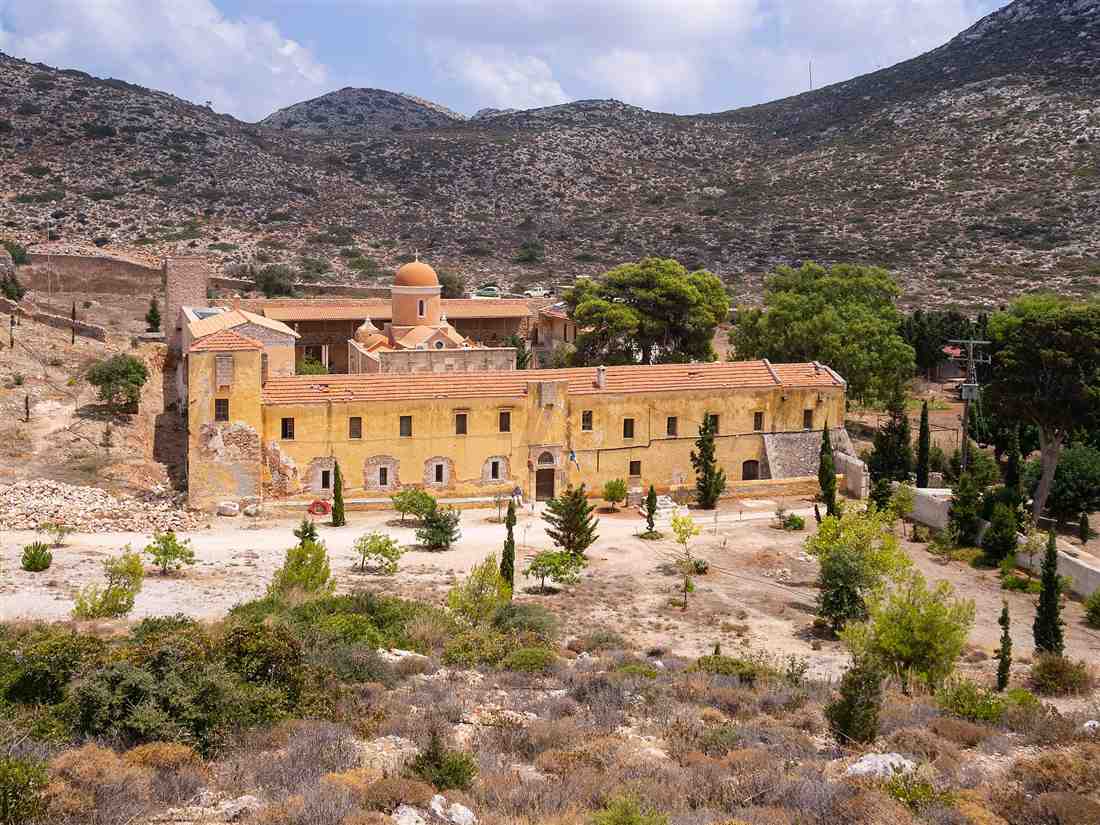
To get from Chania to the Gouverneto Monastery, drive north-east onto the Akrotiri peninsula, past the airport and the Agia Triada monastery, then up the rough final road, about 19 kilometres in 25 to 30 minutes, reaching the fortified monastery high on the cape. The trip from Chania to Gouverneto needs a car. Plan the whole trip with Greece Tours.
This guide covers the trip from Chania to Gouverneto in full: where it is, how to drive it, why there is no bus, the fortress-form Venetian-era monastery, the strenuous stone-path hike down to the cave of Saint John the Hermit, the ruined Katholiko monastery carved into the gorge, the Katholiko gorge to the sea, the opening hours and what to bring, and whether this Akrotiri trip is worth it.
Where is Gouverneto Monastery and how far is it from Chania?
Gouverneto Monastery, Moni Gouvernetou or Our Lady of the Angels, stands high on the north end of the Akrotiri peninsula in the Chania regional unit of west Crete. It sits 19 kilometres north-east of Chania town, a 25 to 30 minute drive.
The Chania to Gouverneto drive rewards the effort with the sight at the end of it. Planning Chania to Gouverneto by the light and the heat makes the most of the visit. The trip from Chania to Gouverneto pairs well with the neighbouring stops on the same road. Every itinerary that includes Chania to Gouverneto gains an easy, scenic leg. The Chania to Gouverneto journey ends at a place that repays an unhurried stay. A car makes Chania to Gouverneto a simple leg of a west-Crete plan. The drive from Chania to Gouverneto is direct enough to slot into a wider day out. The Akrotiri peninsula is the blunt headland that closes the Bay of Souda to the north-east of Chania. Gouverneto occupies the wild, rock-bare tip of that headland, far from the towns and the coast roads, at the head of the ground that falls away toward the open Cretan Sea. The monastery holds a high, exposed position on the limestone plateau, with the sea visible past the ridges and the ravines cutting down toward the water below it. This is the least-inhabited corner of the peninsula, a landscape of thorn, stone terraces and stunted holm oak, and the monastery is the last built thing on the road before the wilderness begins.
The distance of 19 kilometres from the centre of Chania sounds short, and the first stretch is fast. The last part is slow. Gouverneto sits 4 kilometres beyond the larger Agia Triada monastery, and that final 4 kilometres climbs a rough, narrow single-track road across open rock. The straight-line distance understates the drive time because the surface and the gradient force a crawl over the closing kilometres. A visitor sets aside 25 to 30 minutes each way and treats the last section as the part that governs the clock.
Because the monastery marks the road’s end and the trailhead for the gorge that drops to the sea, its position is the whole point of the trip. Gouverneto is the gateway to the oldest religious ground on Crete and to a walking route that ends at the water. Its remoteness from Chania is what preserves the silence and the raw scenery that reward the effort of reaching it.
How do you drive from Chania to Gouverneto?
Drive north-east out of Chania onto the Akrotiri peninsula, pass the airport, continue to the Agia Triada monastery, then take the rough narrow road up to Gouverneto. The route runs 19 kilometres and takes 25 to 30 minutes.
Every itinerary that includes Chania to Gouverneto gains an easy, scenic leg. The Chania to Gouverneto journey ends at a place that repays an unhurried stay. A car makes Chania to Gouverneto a simple leg of a west-Crete plan. The drive from Chania to Gouverneto is direct enough to slot into a wider day out. For a first visit, the Chania to Gouverneto drive is the straightforward choice. The time from Chania to Gouverneto holds steady outside the peak-season traffic. Travellers who plan the trip from Chania to Gouverneto reach it comfortably in the times given. Leave Chania on the road that climbs onto Akrotiri, the signed route toward the airport and the peninsula villages. This first leg is proper asphalt: it lifts you out of the coastal plain, past the residential edges of Chania, past turnings for Kounoupidiana and the university, and on toward Chania International Airport, which shares the plateau. Keep to the signs for the monasteries rather than the airport terminal itself. The road narrows as the built-up ground thins out and the plateau opens into rock, olive terraces and low scrub.
Past the airport ground the route drops toward the Agia Triada monastery, a large ochre-walled complex set among cypress and olive groves. Agia Triada is the natural staging point: it is 4 kilometres short of Gouverneto and stands on good road. Beyond it the tarmac gives way to the hard part. The final 4 kilometres to Gouverneto is a rough, narrow track that climbs across bare limestone, with loose surface, tight bends and no room to pass another vehicle in places. Take it slow, use low gears on the climb, and pull into the wider spots to let oncoming cars through.
A standard hire car handles the road with care and patience; the surface is rough rather than impassable. Park at the flat ground outside the monastery gate, where the road ends. There is no fuel, no shop and no water source on the peninsula tip, so fill the tank and stock up in Chania before setting out. The total of 19 kilometres from the town centre reads as a quick hop, but the closing climb is the slow, careful heart of the drive, and it sets the 25 to 30 minute figure.
Drivers pairing Gouverneto with the rest of the peninsula fold in Agia Triada on the way and the beach at Stavros afterward, which turns the run into a compact loop. For a wider set of ideas that build on this route, the guide to day trips from Chania lays out how Akrotiri fits alongside the other outings from the town.
Is there a bus from Chania to Gouverneto?
No bus serves Gouverneto. The public network does not reach the monastery or the rough road leading to it. A private car or a taxi is the way to arrive, and the last 4 kilometres rule out any scheduled service.
The drive from Chania to Gouverneto is direct enough to slot into a wider day out. For a first visit, the Chania to Gouverneto drive is the straightforward choice. The time from Chania to Gouverneto holds steady outside the peak-season traffic. Travellers who plan the trip from Chania to Gouverneto reach it comfortably in the times given. The distance from Chania to Gouverneto is covered on a single, well-built road. Fitting Chania to Gouverneto into a morning leaves the afternoon free. The route from Chania to Gouverneto is signed and simple to follow. The Chania regional bus lines run to the peninsula’s inhabited edges and to the airport, but they stop well short of the monastery tip. The final road to Gouverneto is a narrow, rough single-track climb across open rock, unsuited to a coach or a service bus, so no timetable extends to the gate. A traveller counting on public transport reaches the plateau and no further, with a long uphill walk across exposed ground still ahead. That gap is why the trip is framed around private wheels.
A hire car is the flexible answer. It lets a visitor set the pace, start early before the heat, carry water and gear for the gorge walk, and string Gouverneto together with Agia Triada and Stavros in one outing. The rough final kilometres demand a driver ready to crawl over loose surface, but a normal car manages it. Return the car to the flat ground at the gate, where the tarmac and the road both end.
A taxi from Chania is the alternative for those without a car. Agree the fare and the return arrangement before leaving town, because there is no passing traffic and no rank at the monastery to hail a ride back. A driver waits at the gate while you tour the monastery, or fixes a pickup time for later. Anyone planning the long descent to Katholiko and the sea builds the 2 to 3 hour walk into that pickup window, so the taxi is not left idling for half a day. An organised tour with its own transport is the third route, handing the driving and the timing to someone who knows the road.
What is the Gouverneto Monastery?
Gouverneto is one of the oldest working monasteries on Crete, raised in the Venetian era in the form of a fortress. It is a square fortified block with corner bastions, grotesque carved faces on the church fa\u00e7ade, an inner courtyard and monks’ cells.
Travellers who plan the trip from Chania to Gouverneto reach it comfortably in the times given. The distance from Chania to Gouverneto is covered on a single, well-built road. Fitting Chania to Gouverneto into a morning leaves the afternoon free. The route from Chania to Gouverneto is signed and simple to follow. Setting out early on the Chania to Gouverneto run beats both the heat and the crowds. The road from Chania to Gouverneto is paved and well built the whole way. Anyone weighing the journey from Chania to Gouverneto finds the distance short by Cretan standards. The building reads as a stronghold before it reads as a church. Its plan is a compact square, ringed by thick defensive walls, with heavy bastions anchoring the corners against raiders from the sea. This fortress form belongs to the Venetian era, when the exposed north coast of Akrotiri stood open to pirate landings, and the monks built to withstand attack as much as to pray. Behind the outer wall the layout turns inward: a quiet central courtyard, the church at its heart, and ranges of cells and workrooms wrapped around the edge, all closed off from the wild ground outside.
The church fa\u00e7ade carries the detail that visitors remember. Around its doorway sit strange carved heads and grotesque faces worked into the stone, a decorative flourish rare on a Cretan monastery and a mark of the Venetian craftsmen who shaped it. The stonework blends the fortified severity of the outside with this ornamented entrance, so the church face rewards a slow look. Inside, the two-aisled church holds icons and the dark, incense-worn calm of a place in continuous use.
Gouverneto remains a living monastery, home to a small community of monks who keep the offices and tend the buildings. Its age places it among the earliest foundations still active on the island, and its ties run downhill to older, ruined sanctuaries in the gorge below. A visitor treats the ground as a working religious house rather than a museum: quiet voices, modest dress and respect for the routine of the community. The monastery opens for limited hours and closes for part of the day, so the visit is timed to fit the gate’s schedule.
What is the hike to the hermit cave, Katholiko monastery and the gorge?
A stone path descends from Gouverneto into the ravine. It passes the cave of Saint John the Hermit, reaches the ruined Katholiko Monastery carved into the gorge walls, and runs down the Katholiko gorge to the sea. The round walk is strenuous, on rock, 2 to 3 hours.
The route from Chania to Gouverneto is signed and simple to follow. Setting out early on the Chania to Gouverneto run beats both the heat and the crowds. The road from Chania to Gouverneto is paved and well built the whole way. Anyone weighing the journey from Chania to Gouverneto finds the distance short by Cretan standards. The Chania to Gouverneto route rewards an early start in the summer months. Drivers on the Chania to Gouverneto route follow the main road out of the city. The short run from Chania to Gouverneto keeps it within easy reach of the city. The route begins at the monastery and drops straight into wild ground. From the gate a paved and stepped stone path leads down over the lip of the plateau into a rocky ravine, losing height fast across bare, sun-struck limestone. A short way down stands the cave of Saint John the Hermit, the Arkoudospilios or “bear cave”, named for a great stalagmite inside it shaped like a crouching bear. The cavern served as a place of worship and retreat, and a small chapel sits within the rock. The cave is the first landmark and a natural first pause on the descent.
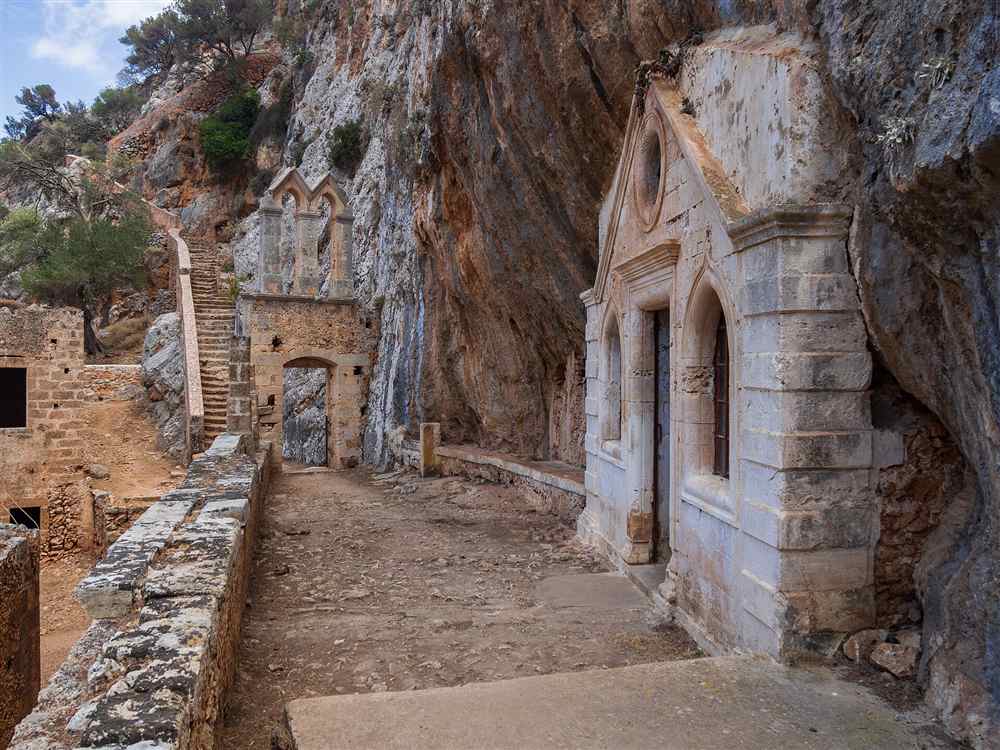
Below the cave the path pushes deeper and reaches the ruins of Katholiko, the abandoned monastery built into the sheer walls of the gorge. Katholiko is the oldest monastery on Crete, cut and carved into the living rock long ago and left empty after raids drove the community up to the safer, fortified Gouverneto. A stone bridge spans the ravine beside the ruins, and cells, cisterns and the old church shell cling to the cliff. The place is silent, shadowed and strange, sunk far below the plateau, and it stands as the goal of the walk for those who come.
Past Katholiko the gorge narrows and continues down to the Cretan Sea, ending at a rocky inlet where the ravine meets the water. The full descent from the monastery to the sea and back is a serious undertaking on rough rock and loose stone, with no shade for much of the way. Count 2 to 3 hours for the round trip to Katholiko and back, and understand that the return is a hard, sustained climb up the same stone path in full heat. Sturdy shoes with grip, plenty of water and an early start are the price of the walk, and the reward is the oldest sacred ground on the island reached on foot through a landscape that has barely changed.
What do you need to know for visiting Gouverneto \u2014 hours, dress and what to bring?
Gouverneto opens for limited hours and closes for part of the day, so check the schedule before setting out and start early. Modest dress covering shoulders and knees is required. Bring water, sturdy shoes and sun cover for the exposed ground and the gorge walk.
The Chania to Gouverneto route rewards an early start in the summer months. Drivers on the Chania to Gouverneto route follow the main road out of the city. The short run from Chania to Gouverneto keeps it within easy reach of the city. The Chania to Gouverneto trip suits a half-day paired with a second nearby stop. The Chania to Gouverneto trip is one of the more rewarding short runs from the city. On a map, Chania to Gouverneto traces a clear line east of the city. Timing decides the whole visit. The monastery admits visitors during set morning and afternoon windows and shuts its gate through the middle of the day, so a traveller confirms the current opening hours before leaving Chania and plans the drive to land inside an open window. An early start pays twice over: it clears the gate before the closure and puts the strenuous gorge walk into the cooler part of the morning rather than the fierce afternoon heat. Arriving late risks a locked gate and a walk done in the worst of the sun.
Dress is the second rule. As a living monastery, Gouverneto requires modest clothing from every visitor: shoulders and knees covered, no beach wear, no bare midriffs. Both men and women meet this standard at the gate. A light layer packed in the bag covers the requirement without cooking the walker on the descent. Quiet conduct, respect for the monks’ routine and no intrusive photography inside the church round out the etiquette of the place.
Pack for a hot, exposed, waterless site. Carry more water than the walk seems to demand, wear sturdy shoes with real grip for the rock path, and bring a hat, sunglasses and sunscreen against the open glare. There is no shop, no caf\u00e9 and no water source at the monastery tip, so everything comes with you from town. Combine the trip with the sights strung along the peninsula: the large Agia Triada monastery sits 4 kilometres back down the road and rewards a stop, and the sheltered sandy beach at Stavros lies a short drive to the north-west, a cool reward after the climb out of the gorge.
Is the trip to Gouverneto worth it, and when to go?
Gouverneto rewards the effort: a fortress monastery, the oldest sacred sites on Crete, and a dramatic gorge walk to the sea, all in silence far from the crowds. Go in the cool of morning, in spring or autumn, on a clear dry day.
The Chania to Gouverneto trip suits a half-day paired with a second nearby stop. The Chania to Gouverneto trip is one of the more rewarding short runs from the city. On a map, Chania to Gouverneto traces a clear line east of the city. The Chania to Gouverneto drive rewards the effort with the sight at the end of it. Planning Chania to Gouverneto by the light and the heat makes the most of the visit. The trip from Chania to Gouverneto pairs well with the neighbouring stops on the same road. The value of the trip rests on three things stacked in one place. First, the monastery itself, a rare fortress-form Venetian foundation with its carved grotesque faces and its living community. Second, the descent past the bear cave of Saint John the Hermit to the ruined, rock-cut Katholiko, the oldest monastery on the island, reached only on foot down a gorge that opens to the sea. Third, the setting: raw limestone, deep quiet and long views across the Cretan Sea, with almost none of the crowding that fills the beaches and towns. For a traveller who wants history, landscape and effort rewarded, the peninsula tip delivers all three in a half-day outing from town.
Season and time of day make or break the experience. Spring and autumn give warm, clear weather without the crushing heat of high summer, and spring adds wildflowers across the plateau. Summer works for those who commit to an early morning start and treat the midday closure and the fierce sun with respect. Winter brings cooler air and the chance of rain, and the gorge path turns slick and dangerous on wet rock, so a dry, settled day is the one to pick. Morning is the hour in every season: the gate is open, the light is soft, and the killing return climb out of the gorge is done before the heat peaks.
Set expectations to match the ground. This is not a drive-up viewpoint but a remote monastery at the end of a rough road, followed by a hard 2 to 3 hour walk on rock for anyone going down to Katholiko and the sea. Fit visitors who prepare with water, sturdy shoes and an early start find it one of the finest outings on Akrotiri. Those short on time or unwilling to face the climb still gain a great deal from the monastery, the cave and the head of the gorge without descending the whole way. Paired with Agia Triada below and the beach at Stavros nearby, Gouverneto turns a single road on the peninsula into a full, memorable day out of Chania.
Frequently Asked Questions
How do you get from Chania to Gouverneto Monastery?
From Chania to Gouverneto, drive north-east onto the Akrotiri peninsula, past the airport and the Agia Triada monastery, then up the rough final road, 19 kilometres in 25 to 30 minutes. There is no bus; a car or taxi is needed. Check the opening hours before setting out.
How far is Gouverneto from Chania?
The Gouverneto Monastery lies 19 kilometres north-east of Chania, high on the north Akrotiri peninsula in the Chania regional unit, 4 kilometres beyond Agia Triada. The drive from Chania to Gouverneto takes 25 to 30 minutes.
Is the trip from Chania to Gouverneto worth it?
The trip from Chania to Gouverneto rewards visitors with one of the oldest fortified monasteries on Crete and a dramatic hike to the hermit cave, the ruined Katholiko monastery in the gorge and the sea. The strenuous walk and limited hours are the trade-off.