
To get from Chania to Stalos, drive west on the old coastal national road or the E75/A90, about 7 kilometres in 12 to 15 minutes, reaching the first beach resort west of the city, before Agia Marina. The trip from Chania to Stalos is the shortest beach run on the coast. Plan the whole trip with Greece Tours.
This guide covers the trip from Chania to Stalos in full: where it is, how to get there by car and by bus, the two parts of the resort at Kato Stalos on the coast and Ano Stalos on the hill, the long sandy beach that merges into Agia Marina, the Chania old town a short drive east, and whether this very short west-of-Chania trip is worth it or a quiet resort base.
Where is Stalos and how far is it from Chania?
Stalos sits on the north-west coast of Crete, 7 kilometres west of Chania town in the Chania regional unit. It is the first beach resort west of the city, set on the coastal strip before Agia Marina, and the drive covers the distance in 12 to 15 minutes.
The Chania to Stalos journey ends at a place that repays an unhurried stay. Both the car and the bus make Chania to Stalos a simple leg of a west-Crete plan. The drive from Chania to Stalos is direct enough to slot into a wider day out. Stalos marks the point where the built-up edge of Chania gives way to the open resort coast that runs west toward Agia Marina, Platanias and Kolymbari. The town of Chania stands to the east, with its Venetian harbour, old town lanes and the wide urban beaches of Nea Chora and Agioi Apostoloi. Stalos faces north over the Cretan Sea, so the sun tracks across the water through the afternoon and drops behind the western headland at dusk. The White Mountains rise inland to the south, framing the resort against a high limestone backdrop.
The 7-kilometre gap between Chania and Stalos is short enough to treat the resort as an extension of the city and the city as an extension of the resort. A traveller staying in Stalos reaches the Chania old town in a quarter of an hour, and a traveller staying in Chania reaches the Stalos beach in the same time. The two settlements share one continuous coastal road, so the journey is direct, flat and easy to read on any map of the Chania coast.
Stalos divides into two clear parts joined by a hillside. Kato Stalos is the lower, seaside resort strung along the shore road, and Ano Stalos is the older village climbing the slope behind it. The regional unit of Chania anchors the whole of far-western Crete, and Stalos is one of the closest resort points to its capital, which makes it a practical base for a first visit to Chania and the coast that unfolds to its west.
How do you drive from Chania to Stalos?
Drive west from Chania town on the old coastal national road, or join the E75/A90 national road and exit at Stalos. The route covers 7 kilometres in 12 to 15 minutes, running parallel to the shore the whole way and dropping into Kato Stalos at the seafront.
For a first visit, the Chania to Stalos drive is the straightforward choice. The time from Chania to Stalos holds steady outside the peak-season traffic. Travellers who plan the trip from Chania to Stalos reach it comfortably in the times given. From the centre of Chania, head west past Nea Chora and the Agioi Apostoloi beaches onto the old coastal road that hugs the shoreline. This road threads through the western fringe of the city and delivers a direct line into Kato Stalos, passing tavernas, car-hire desks and beachfront hotels on the approach. Drivers who prefer speed over scenery join the E75/A90, the national road that carries traffic along the north coast of Crete, and leave it at the Stalos exit, dropping down to the resort in a couple of minutes.
The coastal road is the more scenic of the two lines, holding the sea in view for long stretches and giving a first sight of the Stalos beach before the descent. The national road is the faster line and the one to take when the coastal strip is busy in high summer, when the shore road fills with resort traffic between Chania and Agia Marina. Both meet at Stalos, so the choice is one of pace rather than destination.
Parking in Kato Stalos runs along the beach road and around the taverna clusters, with free roadside spaces outside the peak midday window. A car turns Stalos into a hub for the wider western coast: Agia Marina and Platanias lie a short hop further west, and the whole run of day trips from Chania \u2014 the Samaria Gorge, Elafonisi, Balos and the Akrotiri peninsula \u2014 opens up from the same road. Chania town, its harbour and its museums sit 7 kilometres back east, a return drive of the same 12 to 15 minutes.
How do you reach Stalos by bus?
Chania urban buses and KTEL coastal buses both run west to Stalos on frequent departures. The ride takes 15 to 20 minutes from the centre of Chania, and the same buses continue west along the coast to Agia Marina, Platanias and Kolymbari, so the resort sits on a well-served public route.
The distance from Chania to Stalos is covered on a single, well-built road. Fitting Chania to Stalos into a morning leaves the afternoon free for the coast. The route from Chania to Stalos runs the same way whether you drive or take the bus. The coastal bus corridor west of Chania is one of the busiest on Crete, because it links the city to a dense line of resorts along the shore. Buses leave from the central bus stops in Chania and the KTEL station, run west through the edge of the city, and call at Stalos on their way to the larger resort of Platanias and the village of Kolymbari beyond it. The stop at Stalos sits on the main coastal road, a short walk from the Kato Stalos beach and its tavernas.
Departures are dense through the day in summer, thinning in the evening and in the winter months, so an evening return to Chania rewards a check of the last service before setting out. The fare is low, paid to the driver or bought at the KTEL desk, and the ride west is flat and quick, tracing the same coastal line a car takes. For a traveller without a car, the bus turns Stalos into an easy half-day trip from the city: out in the morning for the beach, back in the afternoon or evening for the harbour and the old town.
The onward direction matters as much as the direct link. From Stalos the same westbound buses carry passengers to Agia Marina, with its long beach and the Thodorou islet offshore, and to Platanias, the liveliest resort on this coast. A traveller basing themselves in Stalos rides west for a change of beach or east into Chania for the city, all on one bus corridor, without needing to hire a car for the coastal hop.
What is Stalos like as a resort?
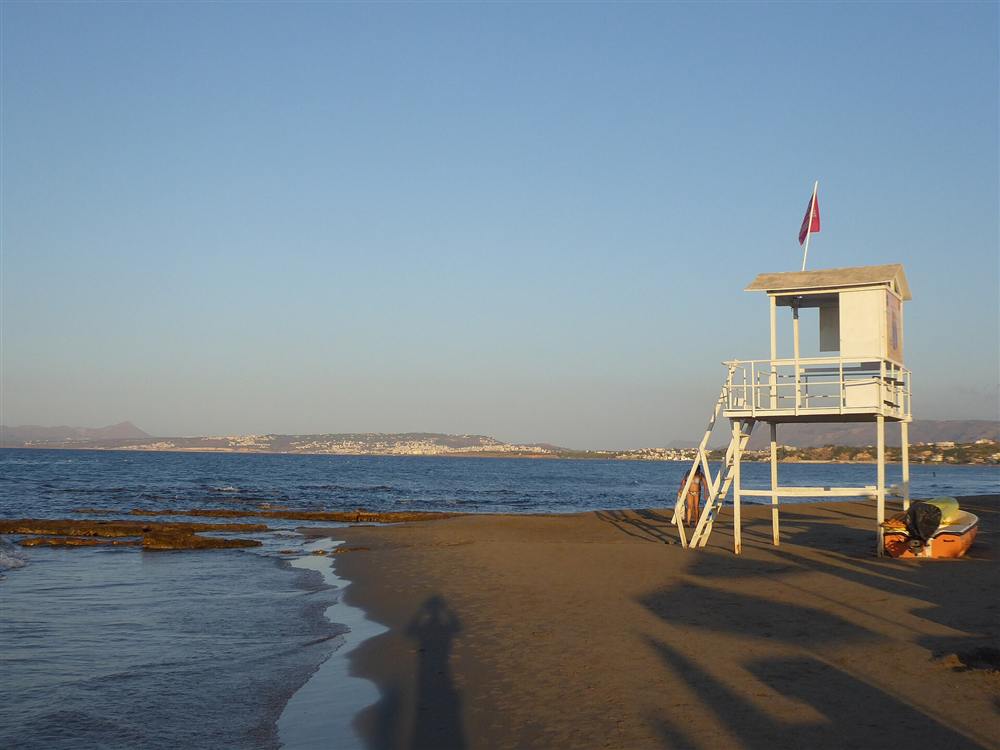
Stalos is a calm, family-oriented resort in two parts. Kato Stalos is the lower seaside strip with a long sandy beach, hotels, tavernas and watersports; Ano Stalos is the old village on the hillside above, with narrow lanes, stone houses and a view over the coast. It runs quieter than Platanias.
Setting out early on the Chania to Stalos run beats both the heat and the crowds. The road from Chania to Stalos is paved and well signed the whole way. Anyone weighing the journey from Chania to Stalos finds the distance short by Cretan standards. Kato Stalos is where the resort life gathers. The lower town stretches along the shore road, its beachfront lined with hotels, apartments, tavernas serving Cretan dishes and grilled fish, mini-markets, and watersports desks renting out kit on the sand. The pace is gentle: the beach draws families and couples rather than a party crowd, and the evenings settle into taverna dinners and seafront strolls rather than late clubs. This tone is the resort’s defining trait, and it separates Stalos from the busier nightlife of Platanias a few kilometres west.
Ano Stalos climbs the hillside directly behind the coast. The old village keeps its narrow lanes, stone houses and small church, and its elevation opens a wide view over the Kato Stalos beach, the bay and the sea beyond. A walk up into Ano Stalos trades the beach bustle for quiet residential streets and a slower Cretan village atmosphere, and the vantage point rewards the climb with a full sweep of the coastline toward Agia Marina and Chania. The two halves of Stalos give the resort a double character: sea life below, village life above.
The scale of Stalos keeps it intimate. This is not a high-rise resort strip; it is a low-built coastal settlement where the beach, the tavernas and the village sit within a short walk of one another. Families return for the shallow water and the easy pace, and the proximity to Chania \u2014 7 kilometres east \u2014 means the city’s restaurants, museums and harbour are within reach without giving up the calm of a smaller base. The resort works as a quiet home for a coastal holiday and as a launch point for the western beaches.
What is the beach of Stalos like?
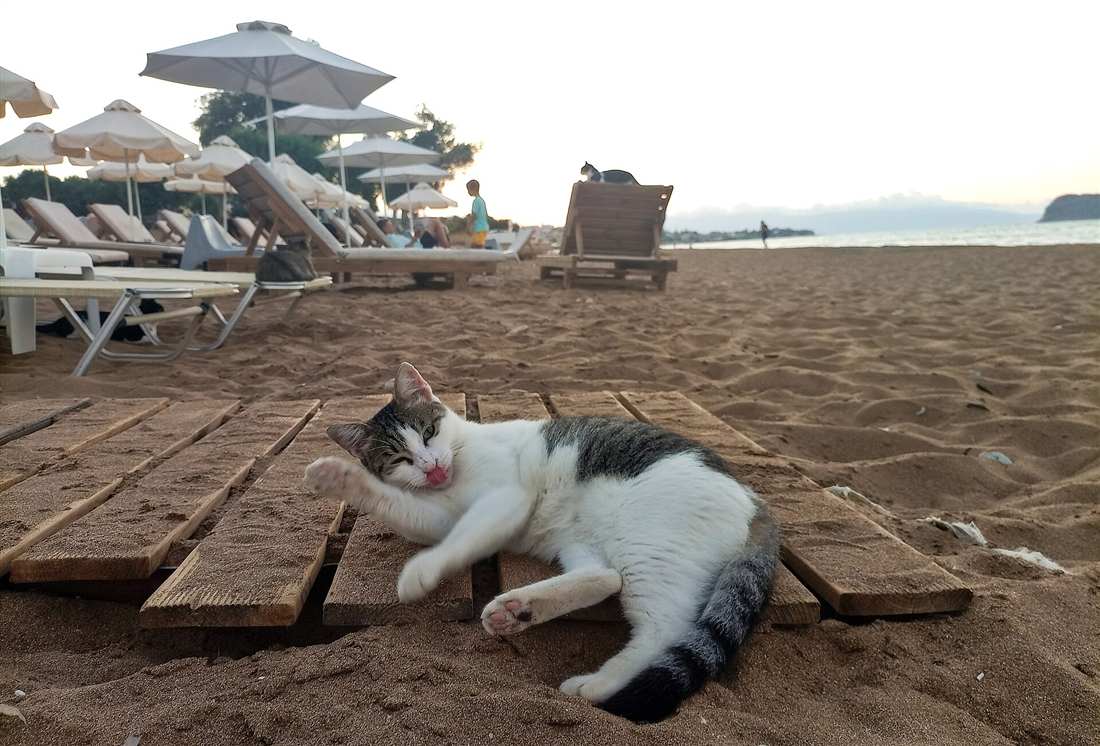
The Stalos beach is a long stretch of sand and fine shingle that shelves gently into calm, shallow water, lined with sunbeds and umbrellas. Its western end merges seamlessly into the Agia Marina beach, so the two form one continuous run of shore along this part of the Chania coast.
The Chania to Stalos route is served by frequent buses through the season. Drivers on the Chania to Stalos route follow the national road for the fast section. The short run from Chania to Stalos keeps the village within easy reach of the city. The beach is the heart of Kato Stalos. Its surface mixes soft sand with fine shingle, and the seabed slopes down slowly, which keeps the water shallow close to shore and makes it a safe place for children and hesitant swimmers. Sunbeds and umbrellas line the organised sections in front of the beach hotels and tavernas, with quieter open stretches between them for towels on the sand. Watersports desks operate through the summer, renting pedalos, canoes and other kit, and beachfront tavernas put food and drink within a few steps of the water.
The great feature of this shore is its length. The Stalos beach does not end at a headland; its western edge flows straight into the beach of Agia Marina, so a walker treads one unbroken line of sand from Stalos into the next resort. This continuity gives the beach room to breathe even in high summer, because the crowds spread along kilometres of coast rather than piling onto one enclosed bay. The north-facing aspect brings a light afternoon breeze off the sea, welcome in the heat of a Cretan July.
The water quality here is high, clear and clean, and the gentle shelf holds the calm through the morning before the afternoon breeze textures the surface. Sunset falls straight down the coast, over the sea and the western headland, giving the beach a long golden hour before the tavernas fill for dinner. For a resort beach 7 kilometres from a city, the Stalos shore delivers space, shallow water and a direct link to the neighbouring sands \u2014 the combination that keeps families returning season on season.
What is there to do near Stalos?
Agia Marina and its Thodorou islet lie a short distance west; the Chania old town and Venetian harbour sit 7 kilometres east; Platanias runs further west along the coast, and the wider Chania beaches spread on both sides. Stalos sits at the centre of this cluster, within a quarter-hour of each.
A car makes the Chania to Stalos trip flexible, but the bus covers it too. The Chania to Stalos trip is one of the more rewarding short runs from the city. On a map, Chania to Stalos traces a clear line that the road follows closely. West of Stalos, the beach flows into Agia Marina, a larger resort with a long organised shore and the distinctive Thodorou islet rising offshore \u2014 an uninhabited rock that shelters a wild-goat reserve and closes the view out to sea. Beyond Agia Marina the coast reaches Platanias, the liveliest resort on this stretch, with a busier beachfront, more restaurants and the animated evening scene that Stalos deliberately lacks. A short westbound drive or bus ride links all three, so a traveller in Stalos samples a different beach and a different mood each day.
East of Stalos the draw is the city. Chania’s old town wraps around a Venetian harbour lined with painted merchant houses, a lighthouse on the mole, narrow lanes of leather shops and tavernas, and the covered municipal market at its heart. The Maritime Museum, the archaeological collections and the harbourfront restaurants make an easy afternoon or evening from a Stalos base, reached in the same 12 to 15 minutes by car or 15 to 20 by bus. The urban beaches of Nea Chora and Agioi Apostoloi break the drive between the two.
The setting also opens the whole of western Crete. From the coastal road at Stalos, the famous excursions of the region are within reach: the Samaria Gorge and its long descent, the pink-sand lagoon of Elafonisi, the turquoise sweep of Balos and Gramvousa, and the monasteries and beaches of the Akrotiri peninsula. Stalos works as a quiet coastal base with the city, the neighbouring resorts and the great sights of the west all radiating out from one short stretch of the north-coast road.
Is the trip from Chania to Stalos worth it, and when to go?
The trip is worth it for travellers who want a calm, family-oriented beach base within a quarter-hour of Chania. Go from late May to early October for warm sea and full resort services, with June and September the best balance of heat, price and space on the sand.
The Chania to Stalos drive rewards the effort with the sights at the end of it. Planning Chania to Stalos by the light and the meals makes the most of the visit. The trip from Chania to Stalos pairs well with the neighbouring stops on the same road. The value of Stalos rests on its blend of quiet and access. It delivers a long sandy beach, shallow water and a gentle pace, and it keeps the city 7 kilometres away \u2014 near enough for dinner in the Venetian harbour and back the same night. A traveller who wants nightlife heads west to Platanias; a traveller who wants a base for the western sights stays in Stalos and drives out each morning; a family who wants easy days on soft sand finds exactly that. The short, direct route from Chania \u2014 car or bus, 12 to 20 minutes \u2014 is the low cost that unlocks all of it.
The season shapes the experience. From late May the sea warms enough for long swims, the tavernas and watersports desks open in full, and the days stretch toward the long light of midsummer. July and August bring the strongest heat, the fullest beaches and the busiest coastal road, so the national road earns its place over the shore route for the drive. June and September hold the sweet spot: warm water, open services, thinner crowds on the sand and easier parking in Kato Stalos. October keeps the sea swimmable while the resort winds down toward its quiet winter.
Timing within the day matters too. Mornings on the Stalos beach are calm and clear before the afternoon breeze rises, and late afternoon delivers the long golden light down the coast toward Agia Marina. A traveller who beaches in the morning, climbs to Ano Stalos for the hillside view at midday, and drives into Chania for the evening harbour uses the whole geography of the place in one day. For a coastal holiday that pairs a soft-sand resort with a Venetian city a quarter of an hour away, the short hop from Chania to Stalos repays the short drive in full.
Frequently Asked Questions
How do you get from Chania to Stalos?
From Chania to Stalos, drive west on the old coastal national road or the E75/A90, 7 kilometres in 12 to 15 minutes. The Chania urban and KTEL coastal buses run west to Stalos on frequent departures, a ride of 15 to 20 minutes, continuing to Agia Marina and Platanias.
How far is Stalos from Chania?
Stalos lies 7 kilometres west of Chania town on the north-west coast of Crete, the first resort west of the city before Agia Marina, in the Chania regional unit. The drive from Chania to Stalos takes 12 to 15 minutes.
Is the trip from Chania to Stalos worth it?
The trip from Chania to Stalos rewards visitors with a long sandy beach, calm family swimming and an old hill village, a short hop from the city and its old town. The very short distance makes Stalos an easy beach day out and a quiet base close to Chania.