
To get from Chania to Kalives, drive east on the E75/A90 national road to the Kalyves and Almyrida exit, then the local road down to the coast, about 19 kilometres in 25 to 30 minutes, reaching the working seaside village at the mouth of two rivers on the east side of Souda Bay in the Apokoronas. Plan the whole trip with Greece Tours.
This guide covers the trip from Chania to Kalives in full: where it is, how to get there by car and by KTEL bus, the river-mouth village and its long sandy beach, the ancient city of Aptera and the Castel Apicorno above, the beach resort of Almyrida and the Apokoronas villages nearby, and whether this short east-of-Chania trip is worth it or a base in itself.
Where is Kalives and how far is it from Chania?
Kalives, also spelled Kalyves, sits on the east side of Souda Bay in the Apokoronas area of the Chania regional unit, 19 kilometres east of Chania town. The drive covers that distance in 25 to 30 minutes on the national road.
Kalives is a seaside village built where two rivers, the Xydas and the Kiliaris, reach the sea. It faces west across Souda Bay, so the water in front of the village stays sheltered from the open Cretan Sea to the north. The village belongs to Apokoronas, the green, spring-fed district that stretches east from Chania toward the White Mountains and the Drapano peninsula. This position gives Kalives a settled, lived-in feel rather than the built-up density of the resorts closer to the city.
The 19-kilometre gap between Chania and Kalives runs almost entirely along the coast of Souda Bay. Souda itself, the deep natural harbour and naval base, lies between the two, and the road climbs over a low ridge before dropping down toward the Apokoronas shore. From the centre of Chania to the seafront of Kalives is a short, direct hop, which is why the village works both as a base for a longer stay and as one of the easy day trips from Chania.
Kalives holds a permanent population that lives and works through the whole calendar, not only in the warm months. Bakeries, a pharmacy, a health point, mini-markets and a fishing shelter all operate for residents first and visitors second. That base of daily life is the reason the village keeps its character: the tavernas serve the people who live on the street behind them as much as the travellers on the seafront.
How do you drive from Chania to Kalives?
Drive east out of Chania on the E75 / A90 national road along Souda Bay, stay on it past Souda for 15 kilometres, take the signed Kalyves and Almyrida exit, then follow the local road down to the coast. The full route is 19 kilometres and takes 25 to 30 minutes.
The national road is the fast, straightforward spine of the trip. From Chania you head east, pass the turn-offs for Souda port and the naval base, and continue on the divided highway as it runs above the southern shore of the bay. The road is wide, well surfaced and signposted in Greek and Latin script, so the Kalyves exit is easy to read at speed. After the exit a two-lane local road descends through olive groves and past the edge of the village of Kalyves toward the seafront and the beach.
Parking in Kalives is free and simple by the standards of the coast. There is space along the river mouth, behind the beach and on the streets that run back from the seafront. A car gives full reach over the whole area: the beach resort of Almyrida is 3 kilometres further east, the archaeological site of Aptera is a short climb to the west, and the inland villages of Vamos and Gavalochori are 10 to 12 kilometres up the slope. None of these connect to each other by frequent public transport, so a hire car turns Kalives from a single stop into the hub of a full day.
Driving times hold steady across the year because the route uses the national road for much of its length rather than village streets. The one stretch that slows is the descent from the exit into Kalives, where the road narrows and passes homes, shops and the school. Traffic through the village itself moves at walking pace along the seafront in the middle of summer, when tables spill toward the water and pedestrians cross freely between the beach and the tavernas.
How do you reach Kalives by bus?
The coastal KTEL line from Chania serves Kalyves directly on frequent daily departures, stopping in the village on its way to Almyrida and the Apokoronas coast. The ride from the Chania KTEL station takes 30 to 40 minutes and needs no change.
KTEL is the regional bus company for the Chania prefecture, and its Apokoronas coastal service is the public route that reaches Kalives. Buses leave from the central KTEL station in Chania, a short walk from the old town and the market, and run east along the same national road that cars use. The bus turns off at the Kalyves exit and drops down into the village, setting passengers down on the seafront within easy reach of the beach and the tavernas.
Tickets are bought at the station counter for the outbound leg and from the driver on the return, and the fare for the 19-kilometre trip is a small single-digit sum in euros. The timetable thins in the cold months and thickens through the warm season, when extra departures serve the beach traffic. For a traveller without a car, the bus makes Kalives a realistic half-day or full-day outing: step off in the village, spend the hours on the sand and at a taverna table, and catch a later service back to the city.
The limit of the bus is reach beyond the seafront. The village itself and the beach are served well, but the hilltop sites, the ancient city of Aptera and the inland villages sit off the coastal line and want a car, a taxi or a walk. A visitor who wants only the beach, the river mouth and a long lunch loses nothing by arriving on the bus; a visitor who wants Aptera and Almyrida in the same day gains from a car.
What is Kalives like as a village?
Kalives is a working seaside village at the mouth of two rivers, with a long sandy beach, a palm-lined seafront of tavernas and cafes, a small fishing shelter and a lived-in, non-package character. It functions as a real town first and a resort second.
The heart of the village is the seafront promenade, where palms line the road between the tavernas and the sand. Behind it, streets of houses, shops and small squares climb the low slope, and the two rivers cut through the settlement on their way to the sea. Fishing boats tie up in a small sheltered shelter at the river mouth, and their catch reaches the tavernas a few metres away. The result is a place that feels inhabited: children on bicycles, residents at the bakery, boats being painted, laundry on balconies above the shops.
Eating is the centre of a visit. The seafront tavernas serve Cretan cooking built on the day’s fish, local olive oil, village bread, greens from the hills and cheese from the Apokoronas dairies. Tables sit close enough to the water that the sea is part of the meal. Cafes and bars run the length of the promenade for coffee in the morning, frappe through the afternoon and raki after dinner. Prices stay below the levels of the packaged resorts because the trade is anchored by locals who eat here through the year.
The village keeps its scale. There is no high-rise strip, no dense wall of hotels and no closed all-inclusive compound cutting the shore off from the town. Accommodation is rooms, apartments and small family hotels folded into the streets. This is the quality that sets Kalives apart from the coast immediately east of Chania: it grew as a river-mouth town and stayed one, adding tourism onto its own life rather than replacing that life with tourism.
What are the beach and the rivers of Kalives like?
Kalives has a long sandy beach that shelves gently into calm, shallow water on the sheltered east side of Souda Bay. Fresh river water from the Xydas and the Kiliaris meets the sea along the shore, cooling the shallows and feeding a green fringe behind the sand.
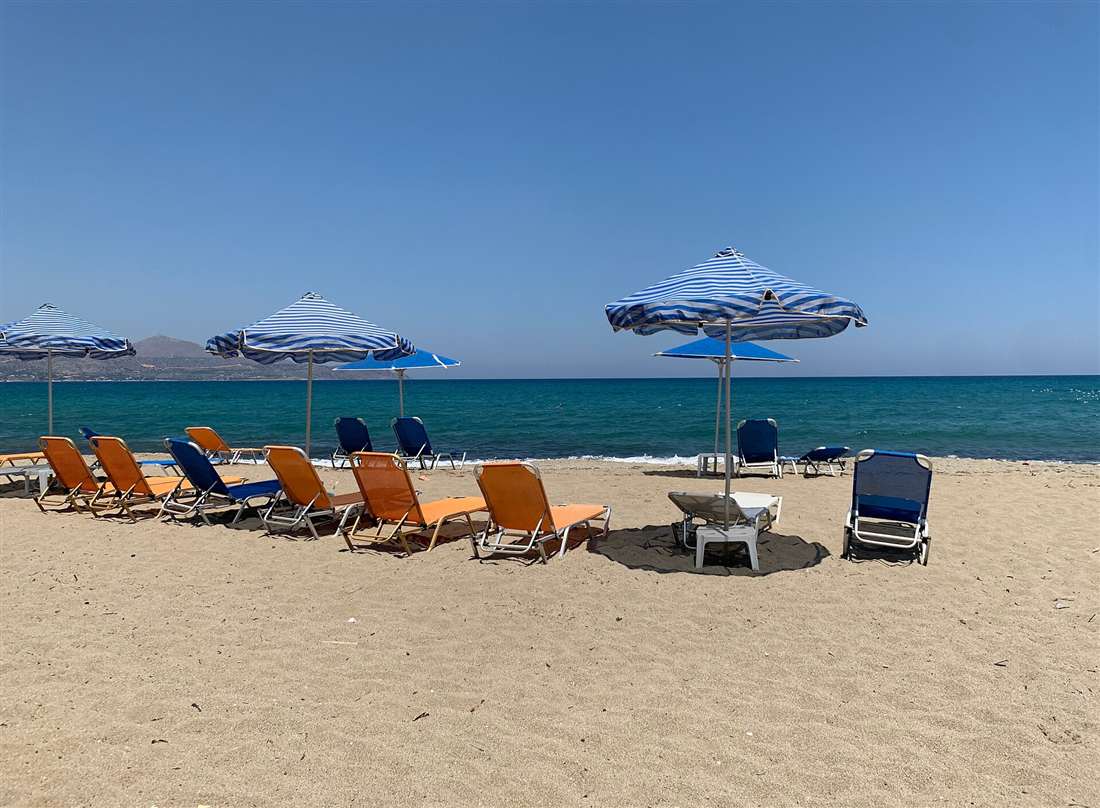
The main beach runs for close to a kilometre along the front of the village, a wide band of soft sand and fine pebble that slopes into the water at a shallow angle. Because Kalives faces into Souda Bay rather than the open sea, the water stays flat and protected on days when the north wind whips the exposed north coast into whitecaps. The gentle shelf and the calm surface make the beach steady for young children and unhurried swimmers, and blue flags have flown here for the water quality.
The two rivers give the beach its distinctive feature. The Xydas and the Kiliaris reach the sea at the edges of the village, and their fresh water mixes with the salt water along the shore. Where a river meets the sand the shallows run cooler and the colour shifts, and the riverbanks carry reeds, eucalyptus and palms that green the back of the beach. Ducks and small fish live in the lower reaches of the rivers, and the mix of fresh and salt water draws birds to the mouth.
Facilities sit close without crowding the sand. Sunbeds and umbrellas line part of the front, tavernas and cafes stand a few steps back across the promenade, and showers and parking serve the beach directly. The far ends of the strip stay open and quiet, so a walk of a few minutes trades the busy centre for empty sand. This combination of a serviced core and open ends lets the same beach suit a family with children and a couple wanting space in one visit.
What is there to see near Kalives at Aptera, Castel Apicorno, Almyrida and the Apokoronas?
Above Kalives stands the ruined Venetian fort of Castel Apicorno; west on the ridge lies the ancient city of Aptera with Roman cisterns and a Turkish fortress; 3 kilometres east is the beach resort of Almyrida; and inland rise the villages of Vamos and Gavalochori. Souda Bay carries deep naval history.
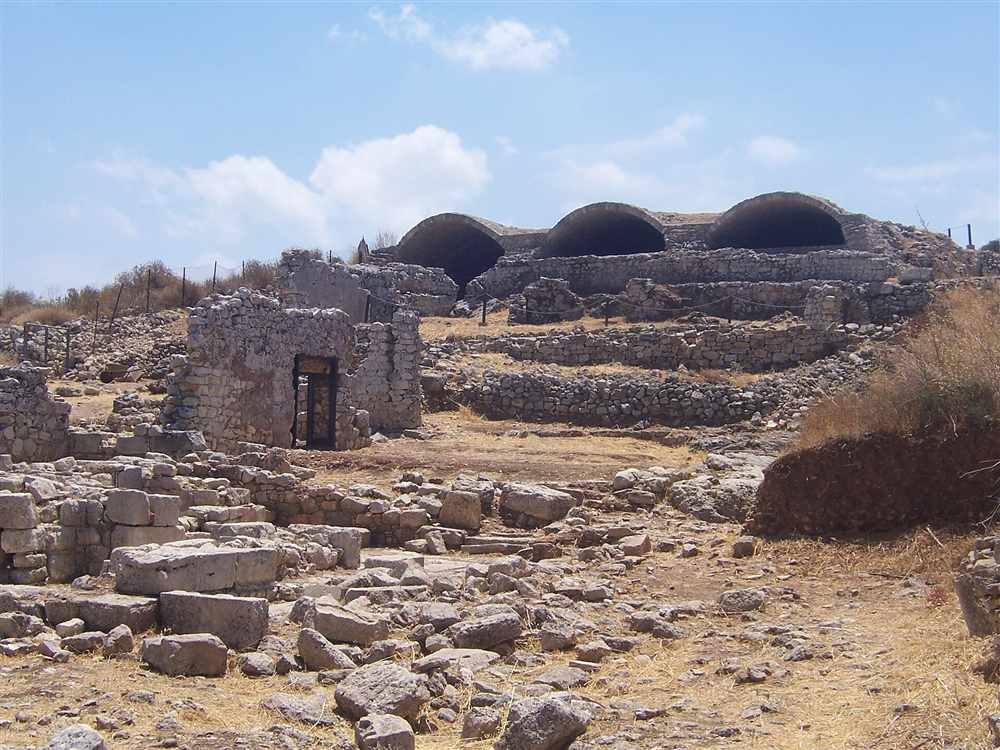
Castel Apicorno crowns the hill directly above the village. The Venetians built the fort to watch the bay and the Apokoronas plain, and its broken walls give a wide view over Kalives, the river mouths and the water of Souda Bay. It is a short climb from the village and an easy target for an hour on foot before or after the beach. The ancient city of Aptera sits on the flat-topped ridge to the west, between Kalives and Souda. Aptera was one of the strongest city-states of Crete, and the site holds vast vaulted Roman cisterns, a Greek theatre, temple foundations and, at its edge, a Turkish fortress that guarded the bay in Ottoman times. The ridge-top position delivers one of the finest views on the north coast, straight down over Souda Bay.
Almyrida lies 3 kilometres east along the coast, a smaller resort with its own sandy beaches, shallow water and a line of seafront tavernas that draw windsurfers and families. The walk or short drive between Kalives and Almyrida passes small coves and the remains of an early Christian basilica with a mosaic floor. Inland, the road climbs to Vamos, the historic capital of the Apokoronas district, with its restored stone houses and traditional cooperative, and to Gavalochori, a village known for its folklore museum, its silk needle-lace and its stone-built lanes and old wells. These hill villages trade the beach for shade, spring water and slow Cretan life.
Souda Bay itself frames the whole area with history. The deep, sheltered harbour has served as a naval base through the ages, and the Souda Bay War Cemetery on its shore holds the graves of Commonwealth soldiers from the Battle of Crete. The bay’s naval role, the ancient city on the ridge, the Venetian fort on the hill and the Ottoman fortress at Aptera stack four eras of defence into one short stretch of coast, all within a 10-kilometre reach of the Kalives seafront.
Is the trip from Chania to Kalives worth it, and when to go?
The trip is worth it for a traveller who wants a real Cretan seaside village 25 to 30 minutes from Chania, with a calm sandy beach, river mouths, honest tavernas and ancient and Venetian sites within a short reach. Late spring and early autumn give the best balance of warmth and quiet.
The value of Kalives is the combination it offers so close to the city. In one short drive a visitor reaches a sheltered swimming beach, a working fishing village, river mouths green with reeds and palms, and a set of sites, Aptera, Castel Apicorno, the Souda Bay cemetery, that pack real history into the surrounding hills. The village stays affordable and unpackaged, and the calm water of Souda Bay swims flat on days when the open coast is too rough. For a family, a couple or a solo traveller after a slower shore, the 19-kilometre trip returns far more than its length suggests.
Late spring brings warm water, green hills still fed by the winter rains, flowering riverbanks and beaches with room to spare. Early autumn holds the summer sea temperature into the quieter weeks after the peak, when the tavernas relax and the sand opens up. High summer delivers the fullest life on the seafront and the warmest swimming, at the cost of busier tables and fuller parking. The cold months turn Kalives into a purely local town, with the bay grey under the White Mountains and the tavernas serving the people who live there.
Time the day by the light and the meals. Reach Aptera or the Castel Apicorno hill in the cooler morning for the long views over Souda Bay, drop to the beach through the heat of midday, and settle at a seafront table as the sun drops behind the water to the west. A half-day covers the beach and a lunch; a full day folds in the ancient city, the Venetian fort, a swim, the resort of Almyrida and a hill village, turning a 19-kilometre run from Chania into a complete Apokoronas circuit.
The short hop keeps the options open. Kalives sits close enough to Chania for a half-day at the beach and close enough to Almyrida, Vamos and Gavalochori to string a wider Apokoronas loop into one outing. Park by the seafront, walk the sandy beach to the river mouth, and lunch at a taverna over the water. A base at Kalives or Almyrida opens the beaches, ancient Aptera and the stone villages of the Apokoronas without a long drive from the west.
Frequently Asked Questions
How do you get from Chania to Kalives?
From Chania to Kalives, drive east on the E75/A90 national road to the Kalyves and Almyrida exit, then the local road down to the coast, 19 kilometres in 25 to 30 minutes. The coastal KTEL bus from Chania serves Kalyves directly on frequent departures, a ride of 30 to 40 minutes.
How far is Kalives from Chania?
Kalives lies 19 kilometres east of Chania on the east side of Souda Bay, in the Apokoronas area of the Chania regional unit. The drive on the fast national road and the short descent to the coast takes 25 to 30 minutes.
Is the trip from Chania to Kalives worth it?
The trip from Chania to Kalives rewards visitors with a long sandy beach at a river mouth, a lived-in seaside village of tavernas, and the ancient city of Aptera on the ridge above, 25 minutes from the city. The short distance suits a day out and a relaxed Apokoronas base.