
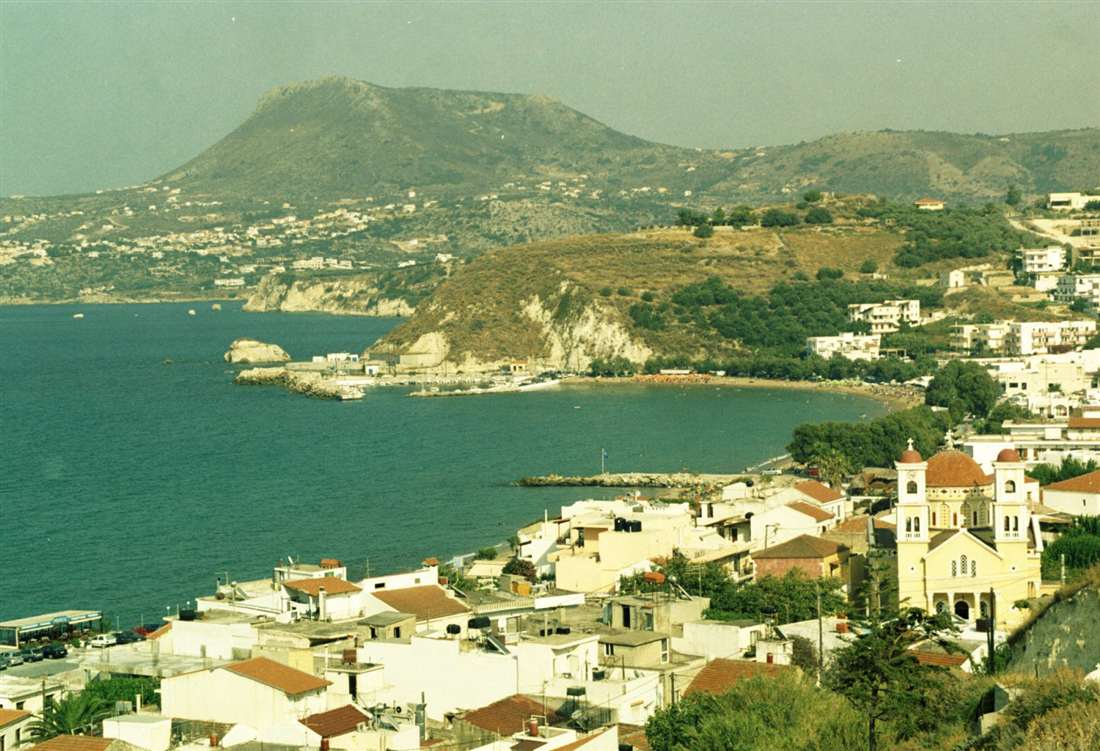
Kalyves is a lived-in beach village on the Apokoronas coast, about 19 kilometres east of Chania in Crete, with long sandy beaches, a river mouth full of ducks, and a real working-village feel next to Almyrida. Plan the whole trip with Greece Tours.
This guide covers Kalyves in full: what and where it is, the sandy beaches and the calm water, the Xydas and Kiliaris rivers, whether it suits families, the Venetian history, the village to walk, what there is to do, the seafront tavernas, where to stay, neighbouring Almyrida, the day trips to Kournas Lake and the Chania old town, how to get there, the best time, and whether Kalyves is worth visiting.
What is Kalyves in Crete?
Kalyves is a lived-in beach village on the Apokoronas coast of the Chania region, about 19 km east of Chania town. It sits at the mouth of two small rivers on Souda Bay, and it pairs long sandy beaches with a real working-village routine.
Kalyves belongs to the municipality of Apokoronas, the green, water-rich corner of western Crete that stretches from the eastern edge of Souda Bay up towards the White Mountains. The village faces north across the Cretan Sea, so its beaches catch the morning light and stay in view of the Akrotiri peninsula across the bay. Behind the shore, olive groves, citrus trees and market gardens climb the low hills, and the twin river mouths keep the ground green through the dry months when much of Crete turns to dust.
The village is not a resort built for a season. Kalyves keeps a permanent population, a working harbour for small fishing boats, a primary school, a health point, bakeries, butchers, greengrocers and a scatter of kafeneia where older residents drink Greek coffee through the afternoon. Holidaymakers and residents share the same seafront, the same tavernas and the same bakery queues, and that mix gives Kalyves its lived-in character. For a wider view of the region and its towns, the Chania guide sets out how Kalyves fits into western Crete.
Kalyves works as a base as much as a day-trip stop. From here the whole of Apokoronas opens up: the neighbouring resort of Almyrida a couple of kilometres east, the hill villages of Gavalochori and Vamos inland, the long stretches of sand at Georgioupoli further along the coast, and the city of Chania a short drive west. The village combines the calm of a genuine Cretan settlement with the beaches, tavernas and water sports of a coastal holiday spot, and that balance is the reason travellers return to it year after year.
The village earns its name from an old word for the shelters and huts that once stood on the coast, and the plain name fits the plain, honest character of the place. Kalyves does not trade on glamour. It offers clear water, soft sand, fresh food off the boat and out of the oven, and a slow pace set by the fishermen and farmers who live here. Travellers who want an authentic slice of Cretan coastal life, within reach of Chania’s sights and the Apokoronas hill villages, find in Kalyves exactly that: a village first and a beach spot second.
Where is Kalyves and how far is it from Chania?
Kalyves lies on the Apokoronas coast about 19 km east of Chania, reached by driving east through Souda and along the national road for roughly 25 minutes. Buses run between Chania and Kalyves through the day, and Chania airport sits about 25 km away.
The drive from Chania is direct. Head east out of the city, pass the naval port and ferry harbour at Souda, and follow the coastal national road towards Rethymno. A signed turn drops down off the main road towards the sea and into Kalyves, past the river bridge and onto the seafront. The road is fast and well surfaced, and the trip takes about 25 minutes by car without traffic. Chania International Airport on the Akrotiri peninsula is roughly 25 km away, close enough for a transfer of half an hour, and the port of Souda, where the overnight ferries from Piraeus dock, is about 12 km west.
Public buses connect Kalyves with Chania through the day. The regional KTEL service on the Chania to Rethymno and Apokoronas routes stops at the village, and the journey takes around 30 to 40 minutes depending on the stops. From the same seafront a short local hop links Kalyves with Almyrida, so travellers without a car reach the neighbouring beach in minutes. A hire car still gives the most freedom, because it unlocks the inland villages, the gorges and the beaches further east that no bus reaches directly.
Position is a large part of the appeal. Kalyves sits at the eastern shoulder of Souda Bay, the deep natural harbour that shelters the coast, and the village looks out across calm water rather than open sea. Distances to the main sights of the west stay short: the old Venetian harbour of Chania is 20 minutes away, the pink-sand lagoon of Elafonissi is about two hours to the south-west, and Rethymno lies roughly 40 minutes east along the same national road. Kalyves puts a traveller within easy reach of both ends of western Crete.
The turn off the national road is the moment the pace changes. The fast dual carriageway carries traffic between the cities, but the slip road down to Kalyves drops into a slower world of olive groves, river banks and a seafront that ends at the sand. Drivers coming from Rethymno or Heraklion in the east leave the motorway at the Kalyves and Almyrida exit; drivers from Chania and the airport in the west take the same coastal road through Souda. Either way the last stretch runs down towards the bay, and the White Mountains rise behind the village to fill the southern skyline.
What are the beaches at Kalyves?
Kalyves has a long sandy main beach that runs the length of the village, plus the sheltered coves of Kyani Akti and Maistrali at its edges. The sand is soft, the water shelves gently and stays shallow, and Souda Bay keeps the surface calm on most days.
The main beach stretches along the seafront in a broad arc, backed by tavernas, cafes and the village promenade. The sand is fine and pale, mixed with fine shingle at the waterline in places, and the shore drops away slowly so the water stays waist-deep a long way out. Sunbeds and umbrellas line the busier central stretch, while the ends of the bay open into quieter sand where towels replace loungers. A river mouth breaks the beach partway along, and the fresh water keeps a green fringe of reeds and tamarisk trees behind the sand.
East of the centre, Kyani Akti \u2014 the name means “blue coast” \u2014 is the organised stretch that families choose, with a gentle entry, clean water and a taverna set right above the sand. Maistrali beach sits nearby, named for the north-west wind, and it shares the same shallow, sheltered feel. Because Kalyves faces into Souda Bay rather than the open Cretan Sea, the water here stays flatter than on exposed coasts, and swimmers find calm conditions on days when other beaches churn with waves. The Chania beaches guide sets these sands beside the other shores of the region.
The beaches carry the practical touches that make a full day easy: showers, sunbed hire, beach bars serving frapp\u00e9 and cold drinks, and tavernas a few steps from the water for lunch straight off the sand. Tamarisk trees throw natural shade along parts of the shore for anyone who prefers to skip the umbrellas. Parking runs along the seafront and the side streets, and the flat, walkable layout means a family carries towels and bags from car to sand in a couple of minutes. For a first swim of the day the water is clear and calm, and the shallow shelf makes it a safe place for children to paddle.
Water sports operators set up along the organised stretches through the summer, hiring paddleboards, kayaks and pedalos and running lessons for windsurfing when the afternoon breeze fills in. The same north-west maistros wind that names one of the beaches gives sailors and surfers their afternoon fun while the mornings stay glassy for swimmers. Boat trips leave the shore for the coves along the coast and for snorkelling over the clear water off the headlands. Between swims, the beach bars pour cold drinks and the tavernas set out fresh fish, so a whole day passes on the sand without a reason to leave.
What is the river and the setting at Kalyves?
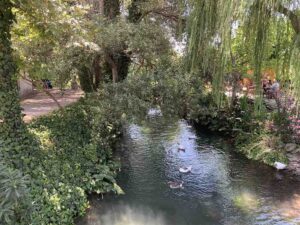
Two small rivers, the Xydas and the Kiliaris, reach the sea at Kalyves, meeting the bay at the edges of the village. Their fresh water feeds reeds, plane trees and gardens, draws ducks and terrapins to the banks, and a stone bridge carries the seafront over the flow.
The Kiliaris river rises in the White Mountains and runs down through Apokoronas to reach the sea at the western end of Kalyves, while the Xydas empties near the heart of the village. Where the rivers meet the beach, the salt and fresh water mix in shallow lagoons fringed with reeds and tamarisk. Ducks paddle in the calm river pools, terrapins bask on the mud banks, and small fish shelter in the reed beds. The bridge over the river gives walkers a spot to pause and watch the birdlife with the beach on one side and green riverbank on the other.
The rivers explain why Kalyves looks greener than most Cretan coastal villages. Water in the ground keeps the olive groves, citrus orchards and vegetable plots behind the beach lush through the summer, and plane trees and eucalyptus throw deep shade over the lanes near the water. The contrast is striking: a warm, sandy Mediterranean beach with a fresh-water wetland of ducks and reeds a few steps inland. That mix of habitats brings herons, egrets and kingfishers to the river mouths, so the setting rewards a slow walk with a camera as much as a swim.
The riverside setting also shapes the village layout. Bridges and footpaths cross the water, tavernas set their tables under the plane trees at the river’s edge, and the sound of running water follows a walker from the beach into the lanes. In the heat of midday the shaded riverbanks stay cool, and the green corridor draws residents and visitors alike for an evening stroll once the sun drops. The rivers give Kalyves a soft, watered landscape that feels distinct from the sun-baked shores further along the coast.
Is Kalyves good for families?
Kalyves suits families well. The main beach and Kyani Akti shelve gently into shallow, calm water that stays safe for young children, the flat village is easy to walk with pushchairs, and tavernas, bakeries and shops sit within a few steps of the sand.
The shallow, sheltered water is the first reason families choose Kalyves. Because the village faces into Souda Bay, the sea stays flat on most days and the sand shelves away slowly, so children paddle and swim close to shore without sudden drops or strong currents. Sunbeds, umbrellas, showers and beach bars line the organised stretches, and tamarisk trees give natural shade for babies and toddlers away from the midday sun. Parents watch from a taverna table or a lounger while children dig in the soft sand and paddle in the calm shallows.
Off the beach, the village keeps everything close and pram-friendly. The seafront is flat and paved, so a walk from beach to bakery to playground needs no steep hills or long distances. Bakeries turn out fresh bread, cheese pies and sweet pastries from early morning, greengrocers stack fruit for a picnic, and the tavernas serve straightforward Cretan cooking that pleases children as readily as adults. The river banks, with their ducks and terrapins, give a free morning’s entertainment, and the short hop to Almyrida adds a second beach for variety.
Kalyves also gives families a calm base rather than a party resort. Evenings are quiet, the pace is gentle, and the mix of residents and holidaymakers keeps the village feeling normal and safe. Water sports operators on the beach run lessons and hire equipment for older children, boat trips leave from the shore in summer, and the flat coast road makes an easy family cycle. The combination of safe swimming, easy walking and everyday amenities makes Kalyves a practical, low-stress choice for a holiday with children. Grandparents, parents and toddlers share the same shaded taverna table by the sand, and the whole family finds its pace within a few flat, walkable streets of the shore.
What is the history of Kalyves?
Kalyves grew around the Venetian castle of Apicorno, built above the coast to guard the eastern approach to Souda Bay. The name Apokoronas descends from that fortress, and the village carries layers of Venetian, Ottoman and older Cretan settlement beneath its modern seafront.
The Venetians, who ruled Crete for centuries, raised the castle of Apicorno on the height above Kalyves to control the road and the coast at the eastern edge of Souda Bay. The fortress gave its name to the whole surrounding district, Apokoronas, and it stood as a stronghold through the long contest for the island. Traces of the old defences and cisterns survive on the hillside above the village, and the position that made the site worth fortifying \u2014 a commanding view over the bay and the coast road \u2014 remains obvious to anyone who climbs above the beach.
Under Ottoman rule the coast and the villages of Apokoronas passed through repeated upheaval, and Kalyves shared in the revolts and reprisals that mark Crete’s path to union with Greece. The layered past shows in the built fabric: old stone houses with arched doorways, a scatter of churches and chapels, and street names and family names that reach back generations. The district around Kalyves holds Venetian bridges, Byzantine churches and abandoned settlements in the hills, and the modern village sits on ground worked and fought over for a very long time.
That depth of history sets Kalyves apart from a purpose-built resort. The village is a real Cretan settlement that added beach tourism to an existing life of farming, fishing and trade, rather than a place invented for holidaymakers. The result is a place where a morning on the sand pairs naturally with an afternoon exploring the fortress hill, the old churches and the Venetian remains that thread through Apokoronas. Kalyves rewards the traveller who looks beyond the beach for the history written into the landscape.
The wider Apokoronas district turns that history into a network of easy excursions. The stone-arched Venetian bridge and the folklore museum at Gavalochori, the elegant square and mansions of Vamos, the domed Byzantine churches with their faded frescoes, and the ruined settlements on the slopes above the coast all lie a short drive inland from Kalyves. The fortress hill above the village ties these threads together, because the same strategic ground the Venetians chose has watched over the bay through every era since. A visit to Kalyves opens onto one of the richest historical corners of western Crete.
What is Kalyves village like to walk around?
Kalyves is flat, compact and easy on foot. A paved seafront promenade runs the length of the beach past tavernas and cafes, and behind it narrow lanes hold bakeries, butchers, greengrocers and kafeneia, giving the village an everyday, working-Crete feel rather than a resort strip.
A walk begins on the seafront, where the promenade follows the sand past taverna terraces set right above the water. Tables spill onto the paving, fishing boats bob at the small jetty, and the view runs across Souda Bay to the Akrotiri hills. The flat, shaded path makes an easy evening stroll, busy with residents and visitors taking the volta before dinner. At the river end the promenade crosses the bridge, where ducks paddle below and plane trees throw shade over the water.
Step back from the shore and the village keeps its ordinary rhythm. Bakeries sell fresh bread, cheese pies and honey pastries from early, butchers and greengrocers supply the tavernas and the households, and small supermarkets and shops stock everything a self-catering stay needs. Kafeneia fill with older residents over Greek coffee and backgammon, the church bell marks the hours, and the whole scene runs at the unhurried pace of a real Cretan village. Prices stay closer to local levels than to resort mark-ups, and the welcome is genuine.
The compact layout makes Kalyves a pleasure to explore without a plan. Wander the lanes to find a stone chapel, a shaded courtyard or a hidden bakery; follow the river inland to the green banks; or climb the slope towards the old fortress for the view over the bay. Everything sits within a short flat walk, so a traveller leaves the car and moves through the village on foot for a whole day. For a taste of the coast next door, the neighbouring resort of Almyrida is a short walk or drive east along the shore.
Evening is the village at its best. As the heat drops, the seafront fills with residents and visitors on the volta, children chase along the sand, and the taverna terraces light up over the water. Fishing boats return to the jetty, the smell of grilled fish and fresh bread drifts along the promenade, and the sky over Souda Bay turns gold behind the Akrotiri hills. A slow dinner by the sea, a walk over the river bridge to watch the ducks settle, and a nightcap at a seafront bar round out a day in Kalyves, and the gentle rhythm draws travellers back to the same tables the following night.
What is there to do in Kalyves?
Kalyves fills a slow day with a long sandy beach, a river mouth to paddle, waterfront tavernas, a short seafront promenade, and the resort of Almyrida a two-kilometre stroll east along the coast road and coastal path.
The centre of village life is the main beach, a wide band of soft sand backed by tamarisk trees that throw shade over the sunbeds at midday. Families settle here for the whole day because the water shelves gently and the sea stays calm behind the headland. A line of sunbeds and umbrellas runs the length of the sand, and the shallow entry suits small children who wade out for metres before the water reaches their waists.
Behind the beach the Xydas river reaches the sea, and the reed-lined banks draw ducks, terrapins and herons. A footbridge crosses the water and links the beach to the village square, where caf\u00e9s put tables out under plane trees. The waterfront itself is a working parade of fish tavernas, bakeries and mini-markets, so a morning swim rolls into a long lunch without a drive.
Late afternoon belongs to the walk to Almyrida. The coastal route hugs the shore past Kalyves Beach and the smaller Kyani Akti cove, and it delivers walkers to the tavernas of the neighbouring village in half an hour. Watersports operators on the sand rent paddleboards, kayaks and pedaloes, and the flat morning sea rewards a paddle out to the headland for a view back over the bay to the White Mountains.
Where do you eat in Kalyves?
Kalyves eats on its seafront, where fish tavernas grill the morning catch metres from the water, family kitchens plate Cretan classics such as dakos, lamb and stuffed vegetables, and village bakeries turn out fresh bread, bougatsa and cheese pies from dawn.
The waterfront tavernas define the village table. Owners set tables at the edge of the sand and serve whole grilled fish, grilled octopus, fried calamari and prawn saganaki alongside a carafe of local ros\u00e9. The kitchens weigh the fish in front of guests and price it by the kilo, a Cretan habit that keeps the catch honest and the plate fresh. Sunset turns the seafront gold, and the tables fill from eight in the evening as the fishing boats rock in the tiny harbour.
Away from the fish, the Cretan repertoire runs deep. Tavernas plate dakos, the rusk topped with grated tomato, myzithra cheese and olive oil that opens most meals. Slow-cooked lamb, goat in tomato, gemista stuffed with rice and herbs, and boureki layered with courgette and potato fill the mains. Meals close with raki and a plate of fruit or spoon sweets, poured by the house rather than charged.
Mornings belong to the bakeries. The village ovens sell fresh sourdough, sesame-crusted koulouri, spinach and cheese pies, and bougatsa dusted with sugar and cinnamon. A takeaway coffee and a warm cheese pie eaten on the harbour wall is the standard Kalyves breakfast, and the mini-markets stock Cretan olive oil, thyme honey and mountain herbs to carry home.
What watersports and activities are at Kalyves?
Kalyves offers stand-up paddleboarding, kayaking, pedaloes and boat hire from the main beach, with the flat morning sea suiting beginners, while scuba diving centres at neighbouring Almyrida and Marathi run guided dives and courses on the wider Apokoronas coast.
The calm bay is the reason the watersports work. Sheltered by the headland, the sea stays glassy until the afternoon breeze arrives, so first-timers stand on a paddleboard within minutes and glide along the shoreline toward the river mouth. Operators on the sand hand out boards, single and double kayaks, and pedaloes by the hour, and the flat water lets a family paddle the length of the bay without a struggle.
Boat hire opens the coast beyond walking range. Small self-drive motorboats need no licence, and they carry a family to quiet coves east of Almyrida that the road misses, with a picnic and a snorkel at anchor. The clear water off the rocky points rewards a mask, and the sandy floor of the main bay stays visible to swimmers well offshore.
Diving centres a short drive along the coast at Almyrida and Marathi take beginners on discovery dives and certified divers to reefs, walls and caverns. The Apokoronas seabed drops to rock and posidonia meadow that shelter octopus, moray and bream. Guides run try-dives from the beach for newcomers and boat dives to deeper sites for the qualified, so the sport suits a first attempt and a logged diver alike.
Land activities fill the hours away from the water. Cycling routes climb the quiet lanes of Apokoronas past olive groves and stone hamlets, and hire shops in the village fit road and mountain bikes. Guided walks trace the coastal path and the inland trails toward Gavalochori and Vamos, and horse-riding stables in the hills behind the coast take riders through the groves at a walk. The flat seafront promenade suits an evening jog, and the beach volleyball nets on the main sand draw a game as the heat drops.
Where do you stay in Kalyves?
Kalyves stays in self-catering apartments and studios near the beach, family-run small hotels on the seafront, and stone villas with private pools in the hills of Apokoronas behind the village, a spread that suits couples, families and groups.
The village core holds walk-to-beach apartments and studios. These self-catering bases put a kitchenette, a balcony and a short stroll to the sand within reach, and they draw families who want a supermarket, a bakery and a taverna in the same five minutes. Small seafront hotels and guesthouses add breakfast and a pool without the scale of a resort complex, so the beach and the square stay a two-minute walk from the door.
The hills behind Kalyves hold the villas. Apokoronas is villa country, and the slopes around Gavalochori, Kokkino Chorio and Aspro deliver stone-built houses with private pools, olive groves and long views over the bay to the White Mountains. These bases suit groups and families who want space, a barbecue and a car, with the beach a ten-minute drive downhill and Chania half an hour west.
For a wider view of bases across the region, the guide to where to stay in Chania sets Kalyves against the old town, the western beaches and the Akrotiri peninsula. Kalyves earns its place as a calm, authentic beach base close to the city, midway between a lively resort and a quiet village retreat.
What is Almyrida next to Kalyves?
Almyrida is the resort village two kilometres east of Kalyves, reached by a short coastal walk or a five-minute drive. It carries a Blue Flag beach, a marina, a strip of seafront tavernas, and a windsurf and dive scene on the Apokoronas coast.
Almyrida sits at the next bay along the shore, and the two villages share the same sweep of coast. The walk between them follows the coastal path past Kalyves Beach and the Kyani Akti cove, a flat half-hour that families cover in an evening before dinner. The drive is a five-minute run on the coast road, with parking behind the beach at the village edge.
The Almyrida beachfront is livelier than Kalyves without turning into a strip. A Blue Flag stretch of sand and shingle fronts a promenade of tavernas, bars and shops, and a small marina shelters yachts and fishing boats at the eastern end. The shallow, sheltered water and steady afternoon breeze made the bay a windsurf and kite base, and boards launch from the sand while paddlers keep to the calm western corner.
Ancient roots sit beside the beach. A ruined early-Christian basilica with a mosaic floor stands a short walk from the sand, a marker of the settlement that traded from this coast in antiquity. The pairing of the two villages gives a Kalyves base the best of both: a quiet home beach and a livelier neighbour a stroll away.
The evening walk between the two beaches is a fixture of a Kalyves stay. Guests time it for the hour before dinner, when the light turns the White Mountains pink and the sea flattens to glass. The path passes fig trees, low stone walls and a chapel above the cove, and it delivers walkers straight to the Almyrida tavernas, where they eat and stroll back under the stars. The two villages together give a base the range of a resort with the calm of a village.
What day trips are near Kalyves?
Kalyves reaches Chania old town in half an hour, Kournas Lake in twenty-five minutes, the hill villages of Vamos and Gavalochori within ten, the Imbros Gorge in under an hour, and the market town of Vryses in fifteen, so a car opens the whole region.
Chania old town is the headline trip. The Venetian harbour, the lighthouse, the covered market and the maze of lanes behind the waterfront sit nineteen kilometres west, half an hour on the national road. A day there pairs a morning in the museums and the port with an afternoon on the harbour front, and the drive back to Kalyves for dinner is easy. The guide to day trips from Chania lays out the wider circuit of gorges, beaches and villages that a Kalyves base reaches.
Inland, Apokoronas rewards a slow morning. Vamos, the old regional capital, keeps stone houses, a co-operative and craft workshops. Gavalochori holds a folklore museum and a lane of silversmiths and lace-makers. Kokkino Chorio and Aspro deliver clifftop views over Souda Bay. Vryses, at the foot of the mountains, shades its river with plane trees and serves yoghurt with honey under the branches.
For walkers, the Imbros Gorge climbs into the Sfakia mountains under an hour south. The eight-kilometre route drops through a narrow limestone canyon to the Libyan Sea at Komitades, an easier walk than the Samaria Gorge and a full day from a Kalyves start.
The south coast rewards a longer run. Beyond the gorge, the fishing port of Loutro sits under the cliffs with no road in, reached by boat from Chora Sfakion, and the pink-tinged sand of Elafonisi lies on the far western tip for a full-day drive. Georgioupoli, twelve kilometres east, spreads a long river-fed beach and a chapel on a causeway out at sea. Each trip returns to the same quiet Kalyves seafront for dinner, so the village works as a still centre for a moving week.
What is Kournas Lake near Kalyves?
Kournas Lake is Crete’s only freshwater lake, a turquoise basin ringed by mountains twenty-five minutes east of Kalyves. Pedal boats circle the water, tavernas line the shore, and terrapins bask on the banks, making it a half-day family outing.
The lake sits in a bowl below the village of Kournas, near the coast town of Georgioupoli. Spring water feeds it, and the surface shifts through green and blue as the light moves and the depth changes with the season. A ring of reeds and a small sandy shore edge the water, and the White Mountains rise behind, so the setting reads more Alpine than Cretan.
Pedal boats and kayaks are the draw. Operators on the shore rent them by the hour, and a slow circuit of the lake passes the far bank where terrapins and small fish gather in the shallows. The water is fresh and cool, a change from the sea, and swimmers wade in from the sandy northern edge. Tavernas along the shore serve lunch on terraces that overlook the whole basin.
The drive from Kalyves runs east on the national road toward Georgioupoli, then a short climb inland to the lake, twenty-five minutes door to door. The trip pairs with the long sandy beach and river of Georgioupoli, a few kilometres north, for a full day that mixes fresh water, sea and a shaded village lunch.
How do you get to Kalyves from Chania and the airport?
Kalyves lies nineteen kilometres east of Chania, a twenty-five-minute drive on the national road. Chania airport on the Akrotiri peninsula sits twenty-two kilometres away, thirty minutes by car or transfer, and KTEL buses on the Chania\u2013Vamos line stop at the village turn.
The drive from Chania is direct. The E65 national road runs east from the city, and the Kalyves exit drops onto the coast road into the village in twenty-five minutes. From Chania airport on Akrotiri, the route crosses to the national road and heads east, thirty minutes and twenty-two kilometres to the seafront. Pre-booked transfers meet arrivals at the terminal, and taxis wait at the rank outside.
Public buses link the village to the city. KTEL runs the Chania\u2013Vamos and Chania\u2013Vryses services along the national road, and the buses stop at the Kalyves junction on the main road above the village, a short walk or a local hop down to the beach. The service runs through the day, and a single fare from Chania costs a few euros.
A hire car unlocks the region. The beach, the hill villages, Kournas Lake and the gorges all sit within an hour, and roadside parking near the Kalyves seafront is free outside the peak hours. Heraklion airport lies two hours east for arrivals on that side of the island. For orientation across the region, the Chania guide maps the roads, beaches and villages that a Kalyves base reaches.
When is the best time to visit Kalyves?
Kalyves peaks from June to September, when the sea warms to twenty-five degrees and the tavernas run full. May, early June and late September deliver warm swimming, thinner crowds and lower rates, the sweet spot for families and couples who want the beach without the July heat.
High summer brings the reliable weather. July and August hold dry days near thirty degrees, a calm morning sea and a steady afternoon breeze that cools the beach and feeds the windsurfers at Almyrida next door. The tavernas run at full tilt, the sunbeds fill by mid-morning, and the village square stays busy past midnight. Book beach apartments and villas ahead for these two months.
The shoulder months reward a flexible trip. May and early June green the hills with wildflowers, warm the sea to swimming temperature and keep the tavernas relaxed. Late September and early October hold the summer-warm water while the crowds thin, the light softens and rates drop from the peak. Walkers favour these months for the Imbros Gorge and the hill villages, where the midday heat eases.
Easter marks the start of the season in the village. The processions, the roasted lamb and the midnight fireworks draw the diaspora home, and the tavernas reopen their terraces for the warm spring evenings. It is the moment to catch Kalyves as a living Cretan village before the beach crowd arrives, with the hills at their greenest and the sea already warm enough for a brisk swim.
Winter turns Kalyves back into a working village. The seasonal beach bars close, the year-round tavernas and bakeries stay open for locals, and the White Mountains behind carry snow. Olive harvest runs through the cooler months, and the village keeps its rhythm without visitors, a quiet season for a long stay rather than a beach holiday.
Is Kalyves worth visiting?
Kalyves rewards the visitor who wants an authentic, calm Cretan beach base close to Chania. A long sandy beach, a river mouth, waterfront fish tavernas, a resort neighbour a stroll away, and the whole of Apokoronas within an hour make it a family favourite.
The village earns its verdict on balance. It keeps a real Cretan centre \u2014 a bakery, a butcher, a square under plane trees and fishing boats at the harbour \u2014 while it lays on a wide, shallow, family-safe beach and a parade of seafront tavernas. The mix delivers a working village with holiday comforts, nineteen kilometres from the Venetian harbour of Chania yet a world slower.
The setting seals it. Kalyves anchors the Apokoronas coast between the sea and the White Mountains, with Almyrida a two-kilometre walk east, Kournas Lake twenty-five minutes on, and the hill villages of Vamos and Gavalochori minutes uphill. A base here reaches beaches, gorges, a freshwater lake and a great old town on day trips, then returns each evening to a quiet seafront dinner.
For families, couples and slow travellers, Kalyves answers the brief. It trades the noise of a big resort for a genuine village table, keeps the beach and the amenities within a two-minute walk, and holds the whole of western Crete within reach of the car. Kalyves is worth visiting, and it rewards a base of a week over a passing afternoon.
Frequently Asked Questions
What is Kalyves in Crete?
Kalyves is a lived-in beach village on the Apokoronas coast about 19 kilometres east of Chania, next to Almyrida. Long sandy beaches, calm shallow water and two small rivers meeting the sea give it a relaxed, authentic Cretan feel rather than a built-up resort.
Is Kalyves good for families?
Kalyves suits families well. The main beach shelves gently into shallow, calm water backed by tavernas, the village stays walkable and unhurried, and the river mouth with its ducks and greenery adds a gentle spot for children away from the sand.
How far is Kalyves from Chania?
Kalyves lies about 19 kilometres east of Chania on the Apokoronas coast, a 25-minute drive past Souda. Chania International Airport sits about 25 kilometres west, a 30 to 40 minute transfer, and Almyrida is a short walk or drive along the coast.