
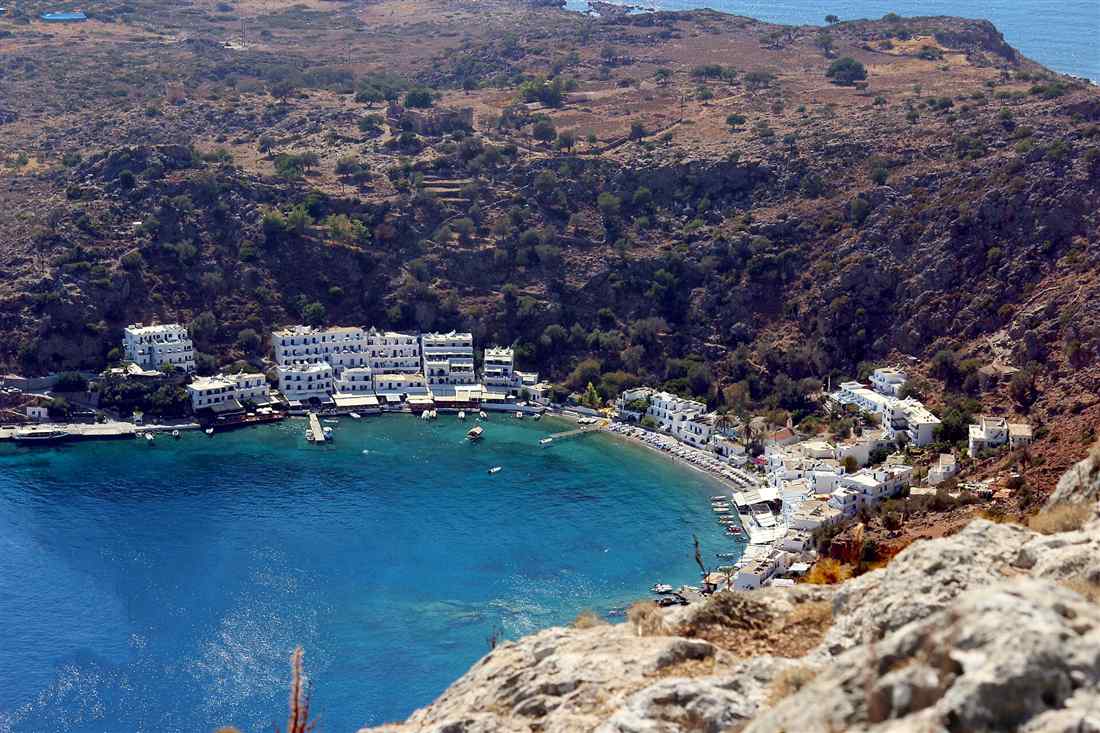
Loutro is a tiny, car-free village in a sheltered horseshoe bay on the Sfakia south coast of the Chania region of Crete, reached only by boat or on foot, its whitewashed tavernas and rooms strung along the calm blue Libyan Sea. Plan the whole trip with Greece Tours.
This guide covers Loutro in full: what and where it is, why it has no road, how to reach it by boat and on foot, the whitewashed village, the beaches of Sweetwater and Marmara, the swimming, the history of ancient Phoenix, the hikes to Anopoli and the Aradena Gorge, the boat trips to Agia Roumeli and Gavdos, the tavernas, where to stay, the best time, the day trip from Chora Sfakion, and whether Loutro is worth visiting among the day trips from Chania.
What is Loutro in Crete?
Loutro is a tiny white car-free village in a sheltered horseshoe bay on the Libyan Sea coast of Sfakia, southern Crete. It has no road. Boats and walkers reach it. Whitewashed tavernas and rooms line the water beneath bare limestone cliffs.
Loutro sits at the foot of the Lefka Ori, the White Mountains, on the south coast of the Chania regional unit. The village wraps around a natural harbour that faces east and south, so the mountain wall behind it blocks the fierce north wind that hammers the rest of Crete. The bay stays flat and glassy while the north coast churns. This shelter is the reason boats have anchored here for thousands of years, and the reason the modern village exists in exactly this spot.
The village is small and dense. A single stone-paved promenade runs along the shore, lined with a solid row of blue-shuttered, whitewashed buildings that hold family tavernas, rooms-to-let, a bakery, two small shops and a couple of bars. Behind that front row the ground rises straight into rock, so the settlement stacks a second and third tier of white cubes up the slope. There are no cars, no scooters and no roads inside the village. Supplies arrive by boat and travel the last stretch on foot or by handcart.
Loutro belongs to Sfakia, the wild mountainous province of south-west Crete famous for its independence, its shepherds and its rugged coastline. The wider Chania region that surrounds it holds the island’s grandest gorges, its old Venetian harbour town and its most dramatic beaches, and Loutro is one of the most distinctive corners of that whole territory. A reader planning a trip through the north-west starts with the Chania hub and then drops south over the mountains to reach this isolated bay.
Loutro exists as a place to slow down. There is no through-traffic, no bus stop and no beach club noise. Guests swim off the rocks and the small beach, eat grilled fish on the water, walk the coastal paths to neighbouring coves, and take the sunset over the Libyan Sea from a taverna chair. The village runs on the rhythm of the ferry timetable and the light. That enforced calm, born of the missing road, is the whole character of the place.
Where is Loutro and why has it no road?
Loutro sits on the south coast of Sfakia, in the Chania region of western Crete, between Chora Sfakion and Agia Roumeli. The Lefka Ori mountains rise straight from the shoreline here, leaving no shelf of flat ground for a road, so the village stays cut off from the island’s road network.
The village occupies a narrow ledge where a small peninsula and a headland form a protected pocket of the Libyan Sea. To the north the White Mountains climb to over two thousand metres within a few kilometres of the water. The coastline between Loutro and its neighbours is a wall of grey and gold limestone that plunges into deep blue sea with no coastal plain, no valley floor and no gentle gradient. Engineers never cut a road along it because the terrain refuses one: the cliffs drop sheer, the rock is loose, and every ravine ends in a vertical face above the waves.
This geography defines daily life. The nearest road ends at Chora Sfakion to the east and at Anopoli on the plateau high above. From Anopoli a steep footpath descends the cliff to Loutro, and from Chora Sfakion a coastal trail hugs the shore. Neither route admits a vehicle. The result is a settlement that stays permanently outside the reach of cars, delivery lorries and tour coaches, protected by the same mountains that isolate it.
The isolation is a feature, not a hardship. Because no road reaches Loutro, the village never grew a car park, a coastal highway or a strip of concrete hotels. It kept its scale, its quiet and its clean bay. The mountains that block the road also block the meltemi, the summer north wind, giving Loutro a calm sea when exposed beaches elsewhere on Crete turn rough. The place trades convenience for shelter and silence, and that trade is exactly what draws walkers, swimmers and returning regulars year after year.
Loutro also anchors one of the classic long-distance walking routes on the island. The European E4 path threads the south coast, linking the mouth of the Samaria Gorge at Agia Roumeli with Loutro and on to Chora Sfakion. Walkers finishing the great gorge continue east along the shore to sleep here, which ties the roadless village directly into the region’s most celebrated hike.
How do you get to Loutro?
You reach Loutro by boat or on foot. The main route is the ferry from Chora Sfakion, a fifteen-minute crossing. Ferries also arrive from Agia Roumeli and Sougia along the south coast. Walkers take the coastal path from Chora Sfakion or descend the cliff trail from Anopoli.
The ferry from Chora Sfakion is the standard arrival. Chora Sfakion is the end of the road that crosses the mountains from the north coast, and the small ferry runs the short hop west to Loutro through the day. The boat carries foot passengers and luggage only, and the crossing takes about fifteen minutes across the sheltered bay. Drivers leave their vehicle in the free car park at Chora Sfakion and step onto the ferry with their bags. This is the route for arrivals from Chania town, Rethymno and the airport.
The coastal ferry line also connects Loutro to the other south-coast villages. The same boats that serve Chora Sfakion continue west to Agia Roumeli, the exit of the Samaria Gorge, and on to Sougia and Paleochora. A walker who finishes the gorge at Agia Roumeli boards the ferry east and steps off at Loutro. This sea line, not a road, is the true transport spine of the whole Sfakia coast, and the printed timetable governs every movement along it.
Walking in is the alternative for those who prefer their own feet. From Chora Sfakion a marked coastal path, part of the E4, runs west to Loutro in roughly two hours, passing the famous Sweetwater beach on the way. From the mountain village of Anopoli a steep zig-zag descends the cliff to Loutro in a similar time. Both paths reward the effort with sea views the ferry passengers never see, and both deliver the walker straight onto the village promenade.
Getting to the starting point takes planning. Drivers from Chania town cross the island on the mountain road to Chora Sfakion, a drive of about two hours through Imbros and the high passes. Public buses run from Chania and Rethymno to Chora Sfakion timed to meet the afternoon ferry. Whichever way a traveller reaches the coast, the last leg into Loutro is always the same: water or a footpath, never a road.
Small water taxis fill the gaps in the scheduled service. Local boatmen run open craft between Loutro and the surrounding coves through the day, dropping swimmers at Marmara and Sweetwater and returning them to the village for dinner. A traveller who misses the last big ferry hires one of these boats for the short hop from Chora Sfakion. The water taxis also carry luggage, shopping and building supplies, which keeps the roadless village stocked and moving.
Is there any road access to Loutro?
No road reaches Loutro. No car, motorbike, taxi or coach arrives in the village. The closest a driver gets is the car park at Chora Sfakion to the east or the mountain village of Anopoli above, and from either point the final stretch is by ferry or on foot.
Drivers heading for Loutro end their journey at Chora Sfakion. The mountain road from the north coast finishes at this port, where a free public car park sits beside the harbour. Travellers park there, walk to the ferry jetty and cross to Loutro by boat. The car stays in Chora Sfakion for the length of the stay. This is the arrangement every guest and every supplier accepts, because the geography allows nothing else.
Anopoli offers the second parking option for walkers. This mountain village on the plateau above Loutro sits at the end of a paved road that climbs from Chora Sfakion. A driver parks in Anopoli, then walks down the steep cliff path to the coast. The descent takes about ninety minutes and the return climb is a hard uphill, so this route suits walkers rather than those carrying heavy luggage. The village itself, the historic capital of Sfakia, rewards the visit.
Inside Loutro the absence of vehicles is total. There is no road surface to drive on, no delivery van, no rubbish lorry and no ambulance road. Building materials, gas bottles, food crates and beer arrive by boat and move along the promenade by handcart and human muscle. Rubbish leaves the same way it came, by boat. This closed, wheel-free system keeps the village quiet and clean, and it is the direct consequence of a coastline that never accepted a road.
What is Loutro village like?
Loutro is a compact blue-and-white horseshoe of tavernas and rooms curled around a flat harbour beneath grey cliffs. Whitewashed walls, blue shutters and bougainvillea line one stone promenade. With no cars and no through-traffic, the village stays quiet, slow and turned entirely toward the sea.
The visual signature is the horseshoe. The buildings follow the curve of the bay in an unbroken white arc, two and three storeys high, their ground floors opening straight onto the waterfront with taverna tables set at the sea’s edge. Blue doors, blue shutters and blue chairs pick out the white, and climbing plants soften the walls. Fishing boats and pleasure craft ride at anchor in the clear water a few metres from the tables. At night the arc of lights reflects across the still bay.
Life in the village runs at walking pace. The single promenade is the only street, and it carries strolling guests, taverna waiters and the occasional handcart, nothing else. Children play at the water’s edge, swimmers step off the rocks straight into deep water, and the loudest sound is cutlery and conversation. Because the north wind never reaches the bay, evenings stay warm and calm, and diners linger over grilled fish and Sfakian wine long after dark.
Accommodation is family-run and modest in scale. Rooms sit above and behind the tavernas, most within a few steps of the water, and the same families that let the rooms cook the meals and run the boats. There are no large hotels, no swimming pools carved into the shore and no nightclubs. The village supports a bakery, two small general stores, a scatter of bars and a tiny chapel, and that is the whole of it. A stay here strips travel back to swimming, eating, walking and watching the light change on the sea.
The setting frames every moment. Behind the white houses the bare limestone of the Lefka Ori rises straight up, changing colour from white at midday to gold and rose at sunset. In front stretches the deep blue Libyan Sea, open all the way to Africa. This meeting of white village, grey mountain and blue water gives Loutro a stark, luminous beauty that photographs never fully capture and that keeps regulars returning to the same rooms every year.
The day follows a fixed rhythm set by the ferry and the sun. Morning brings the first boats, the bakery smell and swimmers on the rocks. Midday empties the promenade into the shade of the tavernas and the cool of the sea. The late afternoon fills the paths with walkers returning from Marmara and Sweetwater, and the evening turns every taverna chair toward the sunset over the Libyan Sea. There is no nightlife beyond a quiet drink at the water’s edge, and the village sleeps early under a sky thick with stars.
What are the beaches at and near Loutro?
Loutro has a small pebble beach in the village bay and three superb beaches within walking or boat distance: Marmara at the mouth of the Aradena Gorge, Glyka Nera or Sweetwater east toward Chora Sfakion, and Finix just west. Each pairs clear deep water with a dramatic cliff backdrop.
The village beach is the smallest of the group. A short strip of fine pebble and sand curves along the sheltered harbour, with sunbeds set out and the taverna tables a few steps behind. The water is shallow at the edge and drops to clear blue within a couple of metres, and the surrounding cliffs keep it calm even when the open sea beyond is ruffled. This is the beach for a swim between meals, right in the heart of the village.
Marmara, or Marble beach, lies to the west at the foot of the Aradena Gorge. Smooth white marble rocks, sea caves and turquoise water make it one of the most striking swimming spots on the south coast. Walkers reach it on the coastal path from Loutro in about forty minutes, and the little taxi-boats run there through the day. A taverna above the cove serves swimmers, and the marble caves give shade at midday.
Glyka Nera, Sweetwater beach, sits east of Loutro on the path toward Chora Sfakion. The name comes from cold fresh springs that bubble up through the pebbles at the shoreline, so digging a small hole in the beach releases drinkable water. The beach is a long strip of pale pebble below a sheer cliff, reached by the coastal footpath or by boat, and its deep, crystal water draws swimmers who prize its clarity. It ranks among the finest beaches of the entire Chania beaches coastline.
Finix, or Phoenix, lies a short walk west around the headland from Loutro. This quiet double bay carries the ancient harbour name of the district and holds a couple of tavernas and rooms of its own. Its beaches are pebble and rock, its water deep and clean, and its pace even slower than Loutro’s. Between the village strand, Marmara, Sweetwater and Finix, a guest based in Loutro swims a different beach every day of the week without needing a road or a car.
What is the water and swimming like at Loutro?
The water at Loutro is calm, clear and deep, sheltered by the mountains from the north wind. The horseshoe bay stays flat when open coasts turn rough, and swimmers step from rocks and small beaches straight into transparent blue. The neighbouring coves add cold springs and marble caves.
Shelter defines the swimming. Because the Lefka Ori block the meltemi, the summer north wind, the Loutro bay holds a mirror-flat surface through days when north-coast beaches close under white-capped waves. Swimmers cross open water to anchored boats, snorkel along the rocky edges and float in warm, still water that stays inviting from late morning to sunset. Parents bring small children to the shallow village beach knowing the sea rarely stirs.
Clarity is the second gift. The Libyan Sea here runs deep and clean, with no river silt and no crowds to cloud it. The bottom shows sharp through metres of water, from pale pebble to darker rock, and fish gather around the harbour walls and the marble caves at Marmara. Snorkellers explore the caves and overhangs west of the village, where light plays across the white marble underwater.
The surrounding coves vary the swimming. At Sweetwater beach cold freshwater springs seep up through the shingle and mix with the sea, so the water turns bracingly cool at the edge. At Marmara the marble sea caves give clear turquoise pools and shade. At Finix the deep water off the rocks suits strong swimmers. Every one of these spots opens off the coastal path or a short boat ride, so a swimmer based in Loutro tastes cold springs, marble caves and open blue all within a single stay, and always in water the mountains keep calm.
What is the history of Loutro?
Loutro stands on the site of ancient Phoenix, the sheltered harbour named in the biblical account of Saint Paul’s voyage. It served as the winter port of the city of Anopolis and later became the capital of Sfakia, holding Venetian and Ottoman-era forts and a role in the Cretan revolutions.
The bay’s history begins with its shelter. In antiquity the harbour bore the name Phoenix, and it acted as the sea gate of Anopolis, the important city on the plateau above. The Acts of the Apostles records Phoenix as a harbour of Crete that Paul’s ship aimed to reach for the winter, which fixes the bay in the written record of the ancient Mediterranean. Ruins of the ancient settlement and its temple lie on the Finix headland just west of the modern village.
Through the Venetian period the harbour kept its strategic weight. A small fortress guarded the anchorage, and the bay remained the maritime outlet for the fiercely independent province of Sfakia. Under Ottoman rule Loutro grew into the effective capital of the region, the seat from which the Sfakian chieftains organised their affairs, precisely because it stayed reachable from the sea yet defended by the mountains from any land assault.
The bay played its part in the Cretan struggles for freedom. During the great revolts against Ottoman rule the Sfakians used Loutro as a secret harbour, landing arms and men where no road led and no enemy column marched. A revolutionary assembly gathered here, and the ruined Venetian castle above the village and the small church on the shore date the settlement’s long service as a rebel port. The car-free isolation that shelters holidaymakers today once sheltered fighters. During the wars of the twentieth century the same hidden coast served as an evacuation point, where boats slipped in and out below the cliffs beyond the reach of any road.
The modern village grew directly onto these layers. The whitewashed tavernas stand beside the old chapel and beneath the crumbling fort, and the ancient name Phoenix survives in the neighbouring cove of Finix. Loutro carries its history lightly, but the same protected bay that drew ancient sailors, Venetian garrisons and Cretan rebels is the bay that now draws walkers and swimmers, unchanged in its essential shape by the passing of the centuries.
What is there to do in Loutro?
Loutro rewards slowness. You swim from the sheltered bay, ride taxi boats to hidden coves, walk the cliff paths to Sweetwater and Chora Sfakion, eat Sfakian food on the waterfront, and watch the sun drop behind the headland with a glass of raki.
The horseshoe bay forms the centre of village life. The water sits calm and clear against a shingle-and-pebble shore, and the swimming stays gentle even when the Libyan Sea runs rough further west. Sun loungers line the front below the tavernas, and a short walk east reaches the ruined Ottoman fort and the small chapel that mark the far edge of the settlement. The pace is the attraction: no cars, no scooters, no queue of coaches, only the sound of boat engines idling and cutlery on plates.
The active day starts with the coastal footpaths. West, the trail climbs over the rocks to Finix (Phoenix) and Marmara beach at the mouth of the Aradena Gorge; east, the path runs to Sweetwater beach and on to Chora Sfakion. Taxi boats shuttle swimmers to Glyka Nera (Sweetwater) and Marmara for those who skip the walk. The village suits a full itinerary of hiking and swimming, and it suits an itinerary of doing almost nothing at all. For a wider run of ideas across the region, the guide to day trips from Chania sets Loutro in context with the gorges, beaches and mountain villages of the west.
Evenings belong to the waterfront. Tables spill to the water’s edge, the fishing boats bob a few metres away, and the whitewashed houses catch the last gold light. The village empties of day trippers by early evening, and the overnight guests inherit a quiet, star-lit bay.
Snorkelling fills the middle of the day. The rocky headlands at each end of the bay shelter clear water over reef and sea grass, and the swim out from the shingle needs no boat. The ruined fort above the eastern point and the tiny chapel give an easy afternoon walk with a view back across the whole crescent, and the old cistern and Venetian-era remains scattered behind the front reward a slow poke around the lanes. Loutro packs a full day into a small footprint precisely because everything sits within a five-minute walk of the harbour.
What hikes start from Loutro?
Four routes leave the village: the coastal path east to Sweetwater beach and Chora Sfakion, the coastal path west to Marmara and the Aradena Gorge, the steep zig-zag climb to Anopoli on the plateau above, and the European long-distance E4 trail, which threads through Loutro along the south coast.
The Aradena Gorge is the headline walk. From Loutro the path runs west along the shore to Marmara beach at the gorge mouth, then turns inland and climbs between sheer limestone walls, past iron ladders bolted to the rock, up towards the abandoned village of Aradena and its high iron bridge. The full gorge takes a firm half-day, and walkers time the finish to catch a taxi boat back from Marmara rather than retrace the coast in the heat.
The climb to Anopoli rises from sea level to the plateau at roughly 600 metres on a stepped mountain path. It is a lung-testing ascent that repays the effort with a view back down over the whole bay and the open Libyan Sea. From Anopoli the road links to Aradena and its bridge, which turns the ascent into a loop for strong walkers who descend the gorge to the coast.
The E4 uses Loutro as a natural staging post, arriving from Agia Roumeli in the west and continuing east towards Chora Sfakion. Day walkers pick a single leg of it and let the boats carry them back. Sturdy footwear, an early start and two litres of water per person are the standing rules for every route, because shade is scarce and the south-coast sun is fierce.
The short walks matter as much as the long ones. The stroll west to Finix takes 20 minutes over easy rock and lands at a quiet pebble cove with a taverna and the remains of the ancient anchorage. From Finix the path pushes on to Marmara beach at the Aradena mouth in a further 20 minutes. These bite-size legs give a taste of the coast without the commitment of the gorge, and the taxi boats stand ready at each end to spare the walk back in the afternoon heat.
How do you walk from Loutro to Sweetwater beach and Chora Sfakion?
Follow the marked coastal path east out of the village. Glyka Nera (Sweetwater) beach sits about 40 minutes along the cliffs, and Chora Sfakion lies roughly 2 hours further, a total of around 2 hours 30 minutes on foot from Loutro.
The trail leaves the eastern end of the bay past the fort and climbs onto a narrow ledge cut into the cliff face. It is a clear, waymarked route, dry underfoot and exposed to the sun, with the sea directly below. The stretch to Sweetwater rises and dips across the rock before dropping to the beach, where freshwater springs seep up through the shingle at the waterline and give the cove its name. Swimmers cool off there before turning back or pressing on.
Beyond Sweetwater the path continues east, hugging the coast until it meets the road that drops into Chora Sfakion. The full traverse demands a head for heights on the ledge sections and steady footing on loose stone. Walkers who prefer a single direction ride the taxi boat one way and walk the other, most commonly walking out to Sweetwater in the cool morning and taking the boat home. From Chora Sfakion the onward buses and ferries connect back toward the north coast and the city; the Chania hub lays out those links for the return leg.
What boat trips run from Loutro?
Small taxi boats shuttle to Sweetwater and Marmara beaches on demand. The scheduled ferry links Loutro west to Agia Roumeli, the exit of the Samaria Gorge, and east to Chora Sfakion. Seasonal sailings reach Gavdos, the southernmost island of Europe, out across the Libyan Sea.
The taxi boats are the everyday transport. They depart the jetty through the day, carry swimmers to the coves that the footpaths reach only slowly, and return on a posted timetable pinned at the harbour. A short hop lands you on Glyka Nera or Marmara for a morning swim, and the boatman notes the pickup time before he pulls away. For beach days without the hike, this is the direct route to the clearest water on the coast.
The Anendyk ferry threads the whole south-west coast. Westbound it calls at Agia Roumeli, which puts Loutro on the standard Samaria Gorge circuit: walkers finish the gorge, board at Agia Roumeli, and step off at Loutro or Chora Sfakion. Eastbound it docks at Chora Sfakion for the bus network. Because no road reaches Loutro, this boat is the lifeline, and its timetable governs arrivals and departures for every visitor.
Gavdos sailings run in the warm months from Chora Sfakion and, on set days, connect through the coast. The crossing to the tiny island is a full-day commitment across open sea, a trip for travellers chasing the empty beaches and the southernmost point of the continent rather than a casual afternoon out.
The boats double as the luggage service. Rooms arrange for bags to travel by taxi boat between Loutro, Agia Roumeli and Chora Sfakion, which frees walkers to tackle the gorges unburdened and collect their packs at the far end. Check the posted timetable at the jetty on arrival and photograph it, because the schedule shifts with the season and the wind, and a strong southerly halts the small boats even when the main ferry sails. Planning each day around the boat times is the single habit that keeps a Loutro trip running smoothly.
Where do you eat in Loutro?
You eat on the waterfront. A line of family tavernas rings the bay, tables set at the water’s edge, plates built on Sfakian cooking: grilled fish off the local boats, slow-cooked lamb and goat, wild greens, and the sweet cheese pastry known as Sfakian pie drizzled with thyme honey.
The tavernas are the heart of the village economy, and the fish is the draw. Boats land the catch a few metres from the kitchen, and the day’s fish is grilled whole and priced by weight. Alongside it sit the mountain dishes of Sfakia: tender goat in lemon, lamb with stamnagathi greens, gigantes beans, and a plate of horta gathered from the hillsides. Portions are generous and the cooking is unhurried, matched to the pace of the place.
Sfakian pie is the regional signature. A paper-thin round of dough wraps soft myzithra cheese, fries in a dry pan until golden, and arrives dusted and threaded with local honey. It appears at breakfast and after dinner alike, sweet and savoury at once. A carafe of raki closes the meal, poured freely as the standard gesture of Sfakian hospitality. Prices track the effort of supplying a car-free village by boat, and the waterfront setting at sunset earns every euro.
Breakfast leans on the same larder. Thick strained yoghurt with honey and walnuts, fresh eggs, village bread and mountain herbs open the day on the terraces before the boats arrive. A handful of the tavernas double as the village shop, stocking bottled water, fruit and a few essentials for hikers loading up ahead of the gorge. Cash rules here: card machines depend on a signal that the mountains block, so travellers carry euros for meals, rooms and taxi boats alike.
Where do you stay in Loutro?
You stay in small, family-run rooms and studios set behind the waterfront and up the whitewashed lanes. No large hotels, resorts or apartment blocks exist in Loutro; the whole village runs on modest pensions and guesthouses, so booking ahead in the warm season is essential.
The accommodation matches the scale of the place. Rooms sit above and behind the tavernas, and the owners are the people who cook, clean and carry your bag from the jetty. Studios add a kitchenette and a balcony over the bay; the plainer rooms trade the view for a lower rate and a quieter lane. Air conditioning, a fridge and a sea-facing terrace are the features that separate the tiers, and the best water-view rooms fill first.
Because every bed, every crate of supplies and every builder arrives by boat, capacity is fixed and demand outstrips it through the peak. Reserve weeks in advance for a summer stay, and confirm the boat time so the owner meets you at the harbour. For a broader survey of bases across the region, from the old town to the south-coast villages, the guide to where to stay in Chania weighs Loutro against the alternatives and helps you decide whether to sleep on the bay or day-trip to it.
Is Loutro good for families or couples?
Loutro suits both. The car-free bay removes traffic entirely, so children roam the front in safety and swim in calm, shallow water, while couples get a quiet, romantic setting of whitewashed lanes, waterfront dinners and star-filled nights with no road noise at all.
For families, the absence of cars is the decisive feature. Toddlers walk the harbour without a hand held for danger, older children paddle and snorkel off the sheltered shore, and the taxi boats turn a beach day into an adventure. The single street is the promenade, the playground and the dining room in one, and parents relax in a way that a roadside resort never allows. The gentle bay water and the short, shaded coastal walks fit small legs and short attention spans.
For couples, Loutro trades nightlife for atmosphere. The reward is a sunset table at the water’s edge, a walk to an empty cove, and a village that goes silent after the day boats leave. There are no clubs and no crowds; the romance is in the quiet, the sea and the slow evenings. The same traits that make it safe for children make it peaceful for two, and the village earns its name as one of the calmest retreats on Crete.
How long do you stay in Loutro?
A day trip delivers the bay, a swim and a waterfront lunch. Two or three nights unlock the real village: the sunrise swims, the cliff-path hikes to the gorges, the taxi-boat beaches, and the quiet evenings after the day boats depart, which is when Loutro becomes itself.
The day trip is the common first taste. Boats from Chora Sfakion cross in under 20 minutes, drop visitors for a few hours on the front, and return in the afternoon. That window fits a swim, a meal and a stroll to the fort, and it sends most travellers away happy. It skips the transformation that comes at dusk, when the crowds leave and the overnight guests inherit a still, glowing bay.
Two or three nights is the sweet spot for a fuller stay. Two full days cover the Aradena Gorge, a taxi-boat morning at Sweetwater and Marmara, the climb toward Anopoli, and enough idle waterfront hours to let the pace sink in. A stay of that length turns Loutro from a photo stop into a proper unwinding, and it justifies the effort of arriving by boat with luggage. Longer than that suits walkers working the E4 and travellers who want to switch off entirely.
When is the best time to visit Loutro?
Late spring and early autumn are the prime windows. Through June, September and the first half of October the sea stays warm, the ferries run, the tavernas open and the walking temperatures turn comfortable, without the peak heat and full boats of July and August. Winter is quiet, with reduced boat schedules and shuttered rooms.
The shoulder months balance every factor. The Libyan Sea holds its warmth into October, the coastal paths are walkable before the summer furnace sets in, and the tavernas and rooms operate at a relaxed pace with space to spare. Wildflowers line the gorges in spring, and the light softens in autumn. These are the months that reward hikers and swimmers alike, and the boats keep a full timetable through them.
High summer brings the hottest sea and the liveliest bay, but also the fullest rooms, the busiest day boats and midday heat that turns the exposed cliff paths punishing. Walk at dawn, swim through the afternoon, and book early. Winter strips the village back: the ferry runs a thin schedule tied to Chora Sfakion, most tavernas close, and Loutro reverts to a near-empty outpost of a handful of year-round residents. Match the visit to the running ferries, because no road bails you out if the boats stop.
How do you visit Loutro as a day trip?
Two routes work. Drive to Chora Sfakion and take the short ferry across, a crossing of under 20 minutes each way with regular sailings. Or fold Loutro into the Samaria Gorge circuit: walk the gorge to Agia Roumeli, then ride the coastal ferry east and step off at Loutro.
The Chora Sfakion route is the simplest. The drive from the north coast climbs over the mountains and drops to the south-coast port, where parking sits beside the harbour and the ferry timetable is posted at the quay. The crossing hugs the coast to Loutro, lands you on the front for a swim and a meal, and returns on a fixed afternoon sailing. Note the last boat before you wander off, because missing it strands you in a village with no road out.
The Samaria circuit stitches Loutro onto the region’s flagship walk. Hikers descend the gorge through the morning, reach Agia Roumeli on the coast by afternoon, and board the eastbound ferry. Loutro is the next major stop, a natural place to break the journey with a swim before continuing to Chora Sfakion and the bus home. Organised Samaria excursions from the city handle the logistics end to end, and independent walkers assemble the same links from the public ferry and bus timetables.
Is Loutro worth visiting?
Yes. Loutro ranks among the most peaceful places on Crete: a car-free crescent of whitewashed houses on a sheltered bay, reached only by boat or on foot, ringed by clear water, cliff-path hikes and honest Sfakian tavernas. It rewards travellers who value quiet over convenience.
The verdict rests on what Loutro removes. No cars, no coaches, no resort sprawl and no through road strip away the noise that crowds the rest of the coast, and what remains is a working fishing village that lives by the sea and the seasons. The bay swims are calm, the food is rooted in the mountains behind it, and the walks reach gorges and beaches that the road-bound visitor never sees. The effort of arriving by boat is the filter that keeps the crowds thin.
The trade-off is real and worth stating plainly: no nightlife, no supermarket run, no quick exit, and rooms that book out fast in summer. Travellers who want buzz and easy logistics head elsewhere. Travellers who want a still bay, a sunset table at the water’s edge, and mornings on the cliff paths find Loutro close to unbeatable. Weigh it against the wider west with the Chania guide, and for a village built entirely around slowness and the sea, the answer is a firm yes.
Frequently Asked Questions
What is Loutro in Crete?
Loutro is a small, car-free village in a sheltered horseshoe bay on the Sfakia south coast of Crete, reached only by boat or on foot. Whitewashed tavernas and rooms ring the calm blue bay, with beaches, hikes and the ancient harbour of Phoenix nearby.
How do you get to Loutro?
Loutro has no road. You reach it by the ferry from Chora Sfakion, by boat from Agia Roumeli or Sougia, or on the coastal cliff path. Drivers park at Chora Sfakion or Anopoli and continue by boat or on foot.
Is Loutro worth visiting?
Loutro ranks among the most peaceful places in Crete, a car-free bay of clear water, quiet tavernas and coastal walks. It rewards a day trip from Chora Sfakion, and two or three nights for travellers set on unwinding fully.