
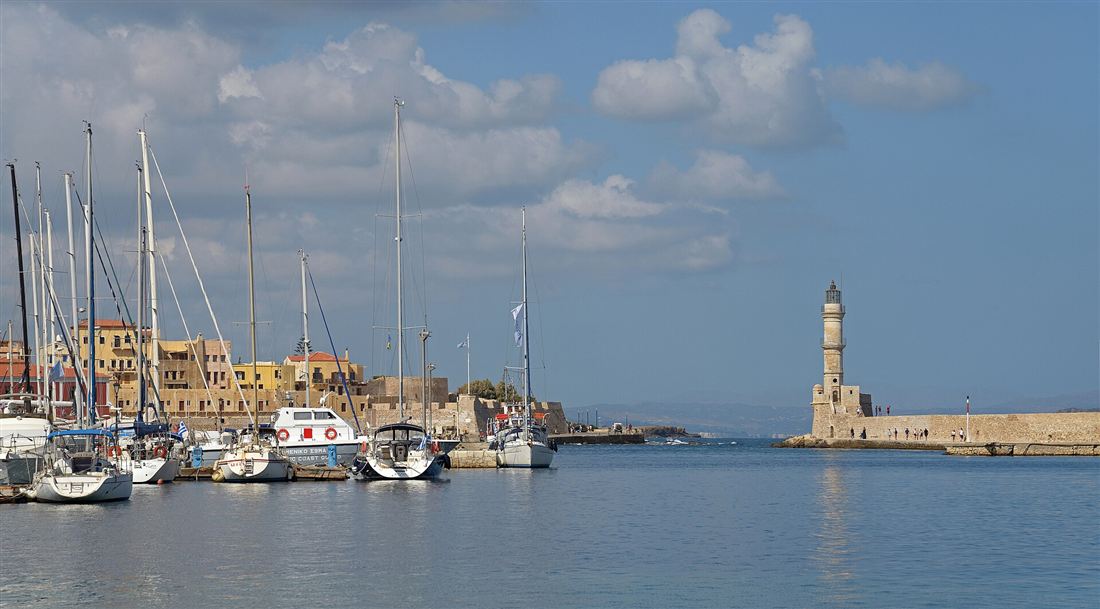
Yes, Chania is worth visiting: the finest old town in Crete wraps a Venetian harbour and Egyptian lighthouse, and the turquoise beaches of Balos and Elafonisi, the Samaria Gorge and the Cretan food sit within a day. Plan the whole trip with Greece Tours.
This guide answers whether Chania is worth visiting in full: what makes the town special, the old town, the beaches, the food, the history and the gorge, whether it suits couples and families, how it compares with Heraklion and Rethymno, whether one day is enough, the honest take on crowds, cost and the cobbles, the off-season, and the clear verdict, so you plan the timing and the stay with confidence.
Is Chania worth visiting?
Yes. Chania holds the finest old town in Crete, a Venetian harbour ringed by a stone lighthouse, blue-water beaches at Balos and Elafonisi, the Samaria Gorge on its doorstep, and a Cretan food culture built on olive oil, cheese and raki.
Chania sits on the north-west coast of Crete, the second city of the island after Heraklion. It combines a walkable historic core with a coastline that draws travellers from across Europe. The Venetian harbour anchors the visit, its arc of coloured houses and waterside tavernas leading to the domed lighthouse that closes the mole. Behind the waterfront, a dense grid of lanes carries Ottoman minarets, Venetian doorways and Byzantine walls in the same few hundred metres.
The reasons to come stack up beyond the old town. Within an hour of the city sit three of the most photographed beaches in Greece: the pink-tinged sand of Elafonisi, the lagoon shallows of Balos, and the long open sweep of Falassarna. The White Mountains rise to the south, and the Samaria Gorge cuts a 16-kilometre route through them to the Libyan Sea. Direct flights land at Chania International Airport, and ferries dock at Souda, so the city works as a base for a full Cretan holiday rather than a day stop. The full picture of the destination sits on the Chania guide, which maps the harbour, the beaches and the day trips into one plan.
The verdict holds across the seasons and the budgets. Spring paints the surrounding hills green and fills the gorges with water, high summer opens every beach and taverna, and autumn brings the grape harvest and the raki distilling. Ferries from Piraeus reach Souda overnight, and the E75 national road links Chania to Rethymno and Heraklion in under two hours, so the city slots into a wider Crete route. A traveller weighing the trip finds the reasons concrete rather than abstract: a UNESCO-recognised food culture, a harbour built by Venice, a national-park gorge, and a coast that ranks among the finest in the Mediterranean.
What makes Chania special?
Chania is special for its layered old town, where Venetian, Ottoman and Byzantine builders left their mark on the same streets, the lit stone lighthouse marks the harbour mouth, and the lanes stay lived-in with workshops, tavernas and homes rather than emptied for tourism.
The city carries four centuries of Venetian rule and two of Ottoman rule in its fabric. The harbour front dates to the Venetian period, the shipyards known as the Neoria still line the eastern quay, and the Firkas Fortress guards the western entrance. The Ottomans added minarets and the domed Mosque of the Janissaries, which stands on the waterfront as the oldest Ottoman building on the island. Byzantine and Roman walls sit beneath and behind the later work, so a single walk crosses three civilisations.
The lighthouse defines the skyline. It rises at the tip of the long breakwater, rebuilt in the Egyptian period of the nineteenth century into the shape travellers photograph today, and it lights the harbour after dark. What sets Chania apart from a museum town is that the centre still works. Leather craftsmen fill Skrydlof Street, the covered market trades cheese, herbs and honey under an iron roof, and families live above the shops in the Splantzia and Topanas quarters. The result is a historic core that breathes rather than performs.
Chania also earns its distinction from the meeting of mountain and sea in one frame. The Lefka Ori, the White Mountains, rise to 2,453 metres at Pachnes, and their snow-streaked wall stands behind the harbour into late spring. From the lighthouse mole a viewer takes in the Venetian arc, the Byzantine walls of Kastelli hill, and the peaks in a single turn. The covered market, built in the cruciform shape of a cathedral, gives the city a trading heart that the locals use daily. Between the built heritage, the mountain backdrop and the working streets, Chania stands apart from resort towns that carry none of these at once.
Is the Chania old town worth it?
Yes. The Chania old town rewards a full day and an evening: the Venetian harbour and lighthouse form its centre, the Topanas, Splantzia and Jewish quarters each carry a distinct character, and the narrow lanes stay atmospheric from the morning market to the harbour lights at night.
The harbour is the anchor. A stroll along the arc leads past the Mosque of the Janissaries to the long mole and the lighthouse, a round walk of about a kilometre with the sea on one side and tavernas on the other. Off the waterfront, the streets tighten. Topanas, the old Christian and Venetian quarter to the west, holds the grandest doorways and the Renieri Gate. Splantzia, the former Turkish quarter to the east, centres on a shaded plane-tree square and the church of Agios Nikolaos, which carries both a bell tower and a minaret from its two eras of worship.
The old town works at every hour. The covered market and the leather lane fill by mid-morning, the shaded courtyards cool the afternoon, and the harbour front turns golden at sunset before the lighthouse takes over. Detail on the quarters, the gates and the walking routes sits on the Chania old town guide. A visitor who gives the centre a night as well as a day sees the streets in their two best lights.
The scale suits walking. The whole historic core fits inside the line of the Venetian walls, a compact area crossed on foot in twenty minutes, so a visitor without a car reaches every landmark. The Etz Hayyim synagogue marks the former Jewish quarter of Evraiki near the harbour, the Grand Arsenal houses the Centre of Mediterranean Architecture, and the Renieri and Porta Retimiotta gates frame the western approach. Cars stay outside the pedestrian core, which keeps the lanes quiet enough to hear the sea and the workshops. Guesthouses fill restored Venetian mansions, so a traveller stays inside the story rather than at a modern edge of town.
Are the beaches near Chania worth visiting?
Yes. The Chania region holds three of the most striking beaches in Greece: Balos lagoon with its turquoise shallows, Elafonisi with its pink sand and cedar dunes, and Falassarna with its long west-facing sunset strand, alongside town beaches at Nea Chora and Agioi Apostoloi.
Balos sits at the north-west tip of Crete, a shallow lagoon of pale sand and clear water between the mainland and Gramvousa islet. Boats run from Kissamos harbour, and a rough road reaches a car park above the descent. Elafonisi lies on the south-west coast, a protected Natura reserve where crushed shell tints the sand pink and a sandbar links the shore to a low islet across ankle-deep water. Falassarna spreads along the west coast with wide open sand and a clear line to the sunset over the Libyan horizon.
Closer to the city, the town beaches serve travellers without a hire car. Nea Chora sits a ten-minute walk west of the old harbour, backed by fish tavernas, and Agioi Apostoloi and Kalathas lie a short bus ride along the Akrotiri coast. The mix means a first-time visitor reaches golden sand on foot and the postcard lagoons within a two-hour drive. The Chania beaches guide ranks the coast and sets out the access for each one.
The coastline stretches the definition of a beach holiday. Seitan Limania knifes a narrow blue inlet into the Akrotiri cliffs east of the city, Stavros holds the round cove filmed for the ending of Zorba the Greek beneath its bare mountain, and Kedrodasos keeps a wild cedar shore next to Elafonisi. Daily boats from the old harbour and from Kissamos serve Balos and Gramvousa together, so a visitor pairs the lagoon with the pirate fortress on the islet in one outing. The water stays clear and shelving, which suits families, and the western beaches face the sunset over open sea. The variety, from sheltered lagoon to open Atlantic-style surf at Falassarna, sets the region above single-beach destinations.
Is the food in Chania worth it?
Yes. Chania is a stronghold of Cretan cuisine: dakos rusks under grated tomato and mizithra cheese, wild greens and snails, lamb with staka, sea-fresh fish on the harbour, and raki poured to close every meal, all built on the island’s olive oil and mountain herbs.
The Cretan diet draws attention across the world for its reliance on olive oil, vegetables, pulses and greens, and Chania serves it at the source. Dakos leads the table, a barley rusk soaked in oil and topped with grated tomato and creamy mizithra. Boureki layers courgette, potato and cheese; gamopilafo is a wedding rice cooked in meat stock; and antikristo roasts lamb upright around an open fire. The covered market and the tavernas of Splantzia trade the raw ingredients and the cooked dishes within the same few streets.
Raki, the clear grape spirit the island distils after the harvest, ties the meal together. Hosts pour it to open and to close, and tavernas set it down with fruit or sweets at no charge. The harbour front carries the fish tavernas, the inland lanes hold the family kitchens, and Nea Chora lands the day’s catch a short walk from the old town. A traveller who eats where the locals eat leaves Chania with a fixed sense of why Cretan food earns its reputation.
The region backs its plate with named produce. Chania cultivates olive groves that press an oil recognised across Greece, the mountain villages of Sfakia bake the honey-and-cheese sfakiani pita on a griddle, and the dairies turn out graviera, mizithra and the sour staka that flavours the local pilaf. The covered market and the Saturday street markets sell wild horta greens, dittany from the Lefka Ori, and thyme honey from the high pastures. Sweet endings run to loukoumades drizzled with honey and to xerotigana, the coiled fried pastry served at feasts. Prices at a family taverna stay modest, and the raki arrives free, so the food case for Chania rests on quality and value together.
Is Chania worth visiting for history and culture?
Yes. Chania delivers Minoan, Roman, Venetian and Ottoman layers in one city, the Archaeological Museum and the Maritime Museum hold its story, and Eleftherios Venizelos, the statesman who reshaped modern Greece, was born and buried on the hill above the town.
The ground under Chania carries the Minoan settlement of Kydonia, and excavations at Kastelli hill above the harbour uncover Linear B tablets and Bronze Age streets. The Archaeological Museum gathers the finds, from Minoan seals to Roman mosaics, and the Maritime Museum of Crete inside the Firkas Fortress traces the island’s naval past and the Battle of Crete. The Venetian arsenals, the Etz Hayyim synagogue and the working mosque add the built record of the successive rulers.
Chania is also the home city of Eleftherios Venizelos, the prime minister who led Greece through the union of Crete with the nation and the expansion of its territory. His grave sits on the Akrotiri peninsula at Profitis Ilias, above a viewpoint over the whole bay, and his family house survives in the town. Between the museums, the monuments and the Venizelos sites, the city rewards a traveller who reads its past as well as its harbour.
The cultural calendar extends the interest beyond the monuments. Chania marks the Battle of Crete each spring with ceremonies on the Akrotiri airfield where the airborne assault landed, and the Souda Bay war cemetery holds the graves of Commonwealth soldiers on a lawn above the sea. The Akrotiri peninsula also carries the monasteries of Agia Triada, with its ochre Venetian church front, and Gouverneto, one of the oldest working monasteries on Crete. In the town, the Byzantine and Post-Byzantine Collection fills the restored church of San Salvatore, and the folklore museum on Halidon Street records Cretan weaving and daily life. The layers give a traveller a full week of history within the city and its immediate hinterland.
Is the Samaria Gorge and the nature worth the trip?
Yes. The Samaria Gorge cuts 16 kilometres through the White Mountains to the Libyan Sea, one of the longest gorges in Europe, and the range behind Chania holds the Imbros Gorge, the Omalos plateau and mountain villages that turn the region into a walker’s base.
Samaria runs from the Omalos plateau at 1,250 metres down to the coastal village of Agia Roumeli. The route passes the Iron Gates, a point where the walls narrow to three metres apart and rise hundreds of metres overhead, and it crosses the abandoned village of Samaria inside a national park that shelters the kri-kri wild goat. Walkers descend the full length and take a boat from Agia Roumeli to Sougia or Chora Sfakion, then a bus back to Chania, so the crossing works as a guided day trip from the city.
The nature reaches beyond the headline gorge. The Imbros Gorge offers a shorter, gentler walk to the Sfakia coast, the Omalos plateau opens high pasture ringed by peaks, and the villages of Sfakia guard a wild southern shoreline. The White Mountains hold snow into late spring and passable trails through the warm months, and the drive south from Chania climbs from citrus groves to alpine rock in under an hour. For a traveller who pairs the coast with the interior, the mountains behind Chania seal the case for the trip.
The southern coast rewards the descent. Agia Roumeli, Loutro and Chora Sfakion string along a shoreline the road never reaches, linked instead by the coastal ferry, so a walker finishes the gorge and reaches a car-free village by boat. The Aradena Gorge cuts a parallel ravine crossed by a high steel bridge that draws bungee jumpers, and the Elafonisi road threads inland gorges of its own on the way to the pink sand. Bus tours from Chania handle the Samaria logistics start to finish, from the pre-dawn transfer to Omalos to the evening return, which removes the transport puzzle for a first-time visitor. The pairing of a walkable national-park gorge with a boat-only coast gives the region a depth that a beach-only trip never reaches, and it settles the question of whether Chania earns the journey.
Is Chania worth visiting for couples?
Chania rewards couples with the Venetian harbour at sunset, candle-lit tavernas along the waterfront, and boutique hotels carved into stone mansions. The old town’s lantern-lit lanes, the lighthouse walk, and private sunset sails make it one of Crete’s romantic anchors.
The harbour front sets the scene. Couples walk the curved quay to the Egyptian lighthouse at the mouth of the port, a fifteen-minute stroll that ends with the whole waterfront glowing behind them. Restaurants line the arc of the harbour, and the tables closest to the water fill first at dusk. Waiters bring raki and a plate of fruit to close the meal, a Cretan courtesy that turns dinner into a slow evening.
The boutique hotels seal the appeal. Restored Venetian and Ottoman mansions in the old town hold suites with exposed stone walls, timber ceilings, and roof terraces that face the sea. These properties sit inside the pedestrian quarter, so a couple steps straight from the door into the lanes. For a full breakdown of districts and properties, the guide on where to stay in Chania maps the romantic quarters against the family-friendly beach suburbs.
Private sunset cruises leave the harbour each evening in the warm season. A wooden kaiki carries a couple past the lighthouse and along the coast, drops anchor in a quiet cove for a swim, and pours wine as the sun sinks behind the Rodopos peninsula. The combination of a stone-mansion room, a harbour dinner, and a boat under a pink sky is the reason couples return to Chania year after year.
Is Chania worth visiting with family?
Chania suits families through shallow sheltered beaches, short boat trips to lagoons, and a pedestrian old town free of traffic. Children paddle the calm water at Agioi Apostoloi, families ride the ferry to Balos, and the car-free lanes keep young explorers safe.
The beaches close to town are built for children. Agioi Apostoloi, west of the centre, breaks into small rocky coves with shallow, still water and a gentle shelf, so toddlers wade without a drop-off. Sunbeds, showers, and tavernas ring the sand, which keeps parents supplied through a long beach day. The town beach of Nea Chora sits a ten-minute walk from the harbour and holds the same calm shallows plus fish tavernas at its edge.
The boat trips turn a beach holiday into an adventure. The daily ferry to Balos lagoon and Gramvousa island crosses turquoise shallows that children wade for a hundred metres, and the pirate fortress on Gramvousa gives older kids a castle to climb. Elafonisi, reached by road or coach, spreads pink-tinted sand across a warm lagoon knee-deep for a long stretch, the safest swimming water on the island.
The old town itself is a playground without cars. Families wander the market hall, the harbour, and the maze of lanes with no traffic to watch. Ice-cream counters, a maritime museum with model ships, and the working boats along the quay hold a child’s attention between beach mornings. The compact scale means tired legs reach the hotel in minutes.
Is Chania better than Heraklion or Rethymno?
Chania wins on atmosphere with the finest old town in Crete, Heraklion wins on antiquities as the gateway to Knossos and the archaeological museum, and Rethymno lands between the two with a handsome old quarter and a longer town beach. The right base depends on the trip.
Chania holds the most beautiful and best-preserved old town on the island, a Venetian and Ottoman harbour quarter that outshines its rivals for evening atmosphere, boutique lodging, and access to the western beaches of Balos and Elafonisi. Travellers who rank scenery, food, and romance put Chania first. The trade-off is distance from Crete’s headline archaeology, which sits at the eastern end.
Heraklion is the practical counterweight. The island’s capital houses the Heraklion Archaeological Museum, the finest Minoan collection on earth, and sits five kilometres from the palace of Knossos. A traveller whose priority is Minoan civilisation bases in Heraklion, accepts a busier working city, and gains the two sites no other town matches. The airport connections through Heraklion also run wider.
Rethymno is the middle path. Its Venetian old town rivals Chania’s for charm at a smaller scale, its fortress crowns the headland, and a long sandy beach runs straight from the edge of the centre. Rethymno sits halfway along the north coast, an hour from both Chania and Heraklion, which makes it the natural base for a traveller who wants a taste of everything. The verdict for a first visit built on atmosphere and beaches: Chania. The Chania hub at Chania travel guide sets out the full case.
Is Chania worth visiting for a day trip?
Chania rewards a day trip through its old town, harbour, and market, and cruise passengers and cross-island visitors fill an afternoon well. The town earns a longer stay, because the beaches and the Samaria Gorge each demand a full day of their own.
A day visitor covers the essentials on foot. The Venetian harbour, the lighthouse walk, the covered market, the leather lane of Skridlof, and a harbour-front lunch fit inside four hours. Cruise ships dock at Souda, a short transfer from the old town, and coach excursions from Heraklion and Rethymno deliver day trippers straight to the harbour. The compact, walkable core makes Chania a rewarding half-day even inside a packed Crete itinerary.
The limits of a single day are real. The Samaria Gorge is a full-day expedition with an early coach and a late boat back, so it never fits a day trip that also sees the town. Balos and Elafonisi each swallow a whole day between the drive and the beach. A day tripper sees the harbour and the lanes; the traveller who stays adds the swims, the sunsets, and the mountain villages that turn Chania from a stop into a holiday.
How long is Chania worth visiting for?
Chania fills three to four days without strain: one day for the old town and harbour, one for a western beach at Balos or Elafonisi, and one for the Samaria Gorge or the mountain villages of the interior. A fourth day adds a second beach or a slow harbour morning.
Day one belongs to the town. The harbour, the lighthouse, the market, the museums, and a long dinner on the quay fill the hours with no need for a car. Day two heads west to Balos lagoon by boat or Elafonisi by road, the two beaches that draw travellers to this corner of Crete, each a full day between the journey and the water.
Day three climbs into the White Mountains. The Samaria Gorge takes the whole day, sixteen kilometres from the Omalos plateau down to the Libyan Sea at Agia Roumeli, followed by a ferry and coach return. A traveller who skips the hike drives instead to the hill villages of Theriso or the Akrotiri peninsula with its monasteries and clifftop views. A fourth day parks the car and lets the old town slow down. For the season-by-season case, the guide on the best time to visit Chania pins the ideal length to the month.
Is Chania too touristy or crowded?
Chania’s harbour front turns busy in July and August, when cruise arrivals and beach crowds pack the quay, yet the backstreets three lanes inland stay calm. The shoulder months of May, June, September, and October empty the crush while the weather holds.
The crowding concentrates in one place and one season. The curved harbour front, the single most photographed stretch of the town, fills through the peak weeks of high summer with diners, day trippers, and cruise passengers. Midday in August pushes the temperature toward the mid-thirties and the quay toward its limit. That congestion is honest, and a first-time visitor who expects a deserted fishing port in August meets reality instead.
The escape is a two-minute walk. Behind the harbour arc, the old town’s lattice of lanes, courtyards, and stepped alleys stays quiet even in peak week, because the day crowd never leaves the water. Spl\u00e1ntzia square, the Jewish quarter of Ovraiki, and the Topanas backstreets hold their calm through the busiest afternoon. Shift the visit to the shoulder months and the problem dissolves: warm sea, open tavernas, half the crowd, and lower prices across the board.
Is Chania worth visiting in the off-season?
Chania stays worth visiting through winter thanks to a mild Mediterranean climate, an old town emptied of crowds, and prices that drop sharply once the season ends. Daytime highs hold in the mid-teens, tavernas keep serving locals, and the harbour belongs to residents again.
The winter climate stays gentle. Chania’s coastal position keeps January and February daytime highs around fifteen degrees, warmer than most of mainland Europe, with bright spells between the rain that feeds the island’s greenery. The White Mountains carry snow on the peaks while the harbour stays mild, a contrast that puts a snow-capped range behind a coffee on the quay.
The off-season town runs at local pace. The market trades for residents rather than tour groups, backstreet tavernas serve the food Cretans eat at home, and the harbour front opens up for an unhurried walk. Room rates fall by half against the August peak, flights and ferries cost less, and the archaeological and maritime museums stay open. Winter suits a traveller who prizes the town, the food, and the atmosphere over beach swimming, since the sea turns cold and the gorge closes for the wet months.
Is Chania expensive to visit?
Chania costs less than Santorini or Mykonos and sits in the mid-range for Greece. Harbour-front tables carry a premium, yet backstreet tavernas, the covered market, and shoulder-season rates keep a good trip affordable across food, lodging, and transport.
The price map inside the town is clear. The waterfront charges for the view: a harbour-front dinner runs higher per head than the same plates two lanes inland. Step back into Spl\u00e1ntzia or the Topanas quarter and family-run tavernas pour house wine from the barrel and serve Cretan staples at prices locals accept. The covered market sells cheese, olives, honey, and bread for a picnic that costs a fraction of a sit-down meal.
Lodging and travel track the season more than the town. A Venetian-mansion boutique room commands a peak-summer rate, while the same room in May or October drops by a third or more. Studios and rooms in Nea Chora and the beach suburbs run cheaper than the old-town heart. Car hire, the western beaches, and the Samaria Gorge coach add up over a week, yet Chania delivers strong value against Greece’s marquee islands, where the same budget buys far less.
What are the downsides of visiting Chania?
Chania’s honest drawbacks are three: the harbour front crowds in peak summer, the best beaches at Balos and Elafonisi lie an hour or more away and eat a full day, and the old town’s cobbled lanes and steps challenge wheels and heels. Each has a clean answer.
The summer crowds are real and answered by timing. The quay packs out through July and August, so a visit in the shoulder months of May, June, September, or October, or a base in the quiet backstreets, sidesteps the crush while keeping the warmth. The heat that drives the midday congestion eases the same way, since spring and autumn hold the low thirties for the sea and the low twenties for the town.
The distance to the headline beaches is the second drawback. Balos and Elafonisi reward the journey, yet each demands a full day between the drive or the boat and the water, which leaves the town’s own Nea Chora and Agioi Apostoloi as the everyday swim. A rental car or a booked coach day solves the reach. The third downside is underfoot: the old town’s cobblestones, marble steps, and narrow lanes test wheeled luggage, prams, and smooth soles. Flat shoes and a hotel with a porter answer it, and the same cobbles are the reason the quarter looks the way it does.
So is Chania worth visiting? The verdict
Chania is worth visiting. It holds the most beautiful old town in Crete, a Venetian harbour built for sunsets, the pink-sand lagoons of Elafonisi and Balos, the Samaria Gorge on its doorstep, and Cretan food at its source. The doubts about crowds, beach distance, and cobbles all carry clean fixes.
The case stands on the town first. The lantern-lit lanes, the lighthouse quay, the covered market, and the stone-mansion hotels give Chania a density of atmosphere no other Cretan base matches. Around that core sit the western beaches that draw travellers across the island, a gorge that ranks among Europe’s great walks, and mountain villages a short drive inland. The food closes the argument, since Chania sits at the heart of the Cretan diet that feeds one of the longest-living populations on earth.
The honest caveats never undo the verdict. The harbour crowds in August, so a visitor picks the shoulder months. The best beaches take a day each, so a traveller stays three or four nights rather than passing through. The cobbles ask for flat shoes. None of that outweighs a town that couples, families, food travellers, and history seekers each find their own reason to love. Chania earns the trip, and it earns a return.
Frequently Asked Questions
Is Chania worth visiting?
Yes. Chania holds the most beautiful old town in Crete, a Venetian harbour crowned by an Egyptian lighthouse, backstreet tavernas and boutique hotels, with the Balos and Elafonisi beaches and the Samaria Gorge within a day trip. It rewards three to four days.
Is Chania worth visiting over Heraklion or Rethymno?
Chania wins for atmosphere, its old town and its western beaches. Heraklion suits travellers set on Knossos and the archaeological museum, and Rethymno sits between the two. For a first taste of Crete, Chania is the strongest base.
Is Chania too touristy?
The Chania harbour front fills in peak July and August, but the Topanas and Splantzia backstreets stay calm a lane away. A visit in May, June, September or October brings warm seas with far thinner crowds and lower prices.