
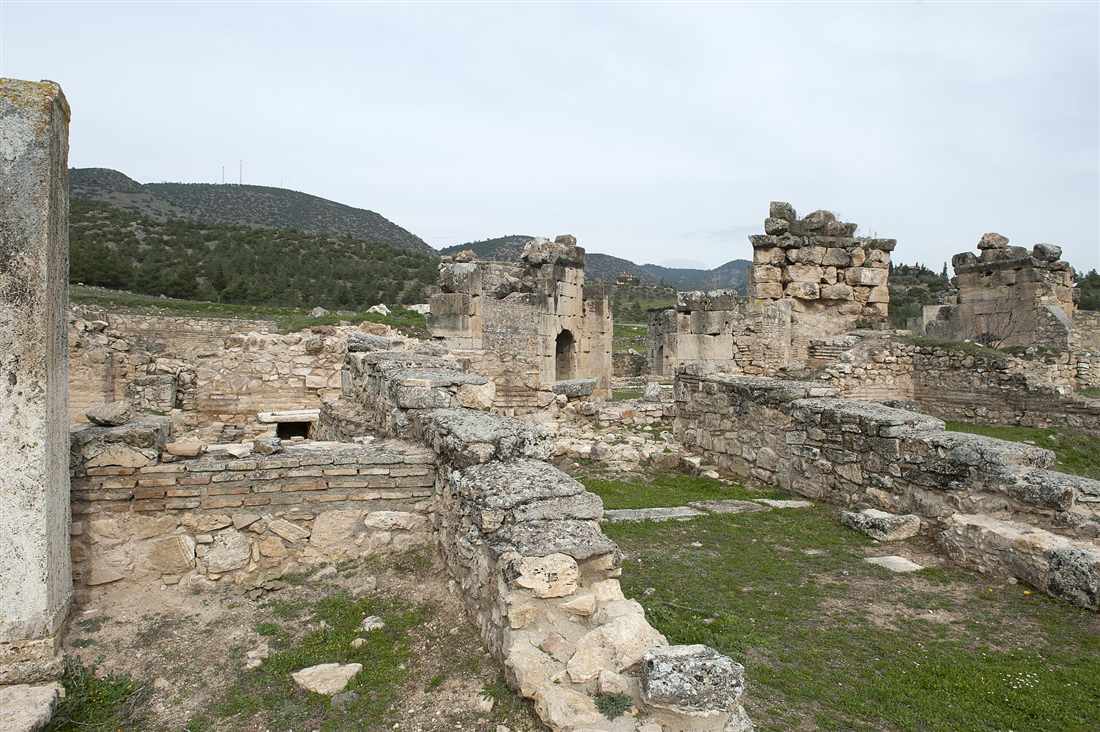
The Martyrium of St Philip is an octagonal memorial church on the hill above the theatre of Hierapolis at Pamukkale, raised in the fifth century AD to honour the apostle Philip, martyred in the city and drawing pilgrims to his shrine. Plan the whole trip with Greece Tours.
This guide covers the Martyrium of St Philip in full: what it is and where it stands, who the apostle Philip was, why he was martyred at Hierapolis, the meaning of the octagonal plan, the 28 pilgrim rooms, when it was built, the newly found tomb of Philip nearby, the pilgrim route and stairway, and how to walk up to the shrine above the necropolis today.
What is the Martyrium of St Philip?
The Martyrium of St Philip is an octagonal memorial church built on the hill above Hierapolis to honour the apostle Philip, martyred in the city. Its eight-sided central hall, ringed by pilgrim rooms, marks the place pilgrims venerated as sacred to the apostle.
The building crowns a limestone terrace on the north-eastern slope, set apart from the residential grid of Hierapolis and reached by a monumental stepped path. Archaeologists identify it as a martyrium, a church raised over or beside the resting place of a Christian witness who died for the faith. The structure combines a place of worship with a place of pilgrimage, drawing travellers who climbed from the Roman city below to pray at the shrine of one of the twelve apostles.
The plan is emphatic in its geometry. A central octagonal hall, close to twenty metres across, sits inside a square envelope. Around that square run ranges of small rooms that housed the pilgrims who came to sleep beside the holy place. The whole complex reads as a single designed unit, laid out to move crowds from the entrance, through the courtyards, into the radiating chapels, and up to the octagon at the heart of the site. Its ambition matches the fame of the man it commemorates.
The Martyrium anchors the Christian identity of Hierapolis. The Roman city prospered on its hot springs, its textile trade and its theatre, yet the shrine on the hill turned it into a destination for the faithful across Anatolia. Bishops, monks and lay pilgrims travelled to venerate Philip here, and the octagon became the visual sign of that devotion, standing above the theatre and the necropolis as the culminating monument of the city.
Modern study of the monument rests on the long Italian excavation of Hierapolis, which cleared the terrace, mapped the octagon and its surrounding rooms, and traced the stepped path that fed the crowds up the slope. The archaeologists read the site as a purpose-built pilgrimage machine, designed from the ground up to receive, house and channel worshippers toward the shrine of the apostle. Recent excavations on the same hill added a further piece, a church and a Roman tomb that the excavators connect directly to Philip, so the Martyrium now stands as the centrepiece of a wider sacred complex rather than a single isolated building.
Where is the Martyrium at Hierapolis-Pamukkale?
The Martyrium stands on a hill on the north-eastern edge of Hierapolis, above the great Roman theatre, at Pamukkale in south-western Turkey. A broad stepped path climbs from the theatre and the city wall to the terrace, so pilgrims ascended on foot to reach the shrine.
Hierapolis occupies the plateau above the white travertine terraces of Pamukkale, in the Denizli region of Turkey. The ancient city spreads across a gentle slope fed by thermal springs, with its colonnaded main street, baths, agora and theatre laid out on the lower and central ground. The Martyrium sits deliberately apart from this dense urban core, on higher, quieter ground to the north-east, where the hillside rises toward the plain and the mountains beyond.
The theatre marks the point of transition. From the upper part of the city, a route crosses the ancient wall and reaches a monumental staircase cut into the slope. This stepped path leads up to the flat terrace that carries the Martyrium and its surrounding rooms. The climb separates the sacred precinct from the everyday life of the streets below, so the ascent itself becomes part of the pilgrimage, a walk upward from the city of the living toward the shrine of the apostle.
The setting frames the monument against a wide landscape. From the terrace the view opens over the roofs of Hierapolis, across the travertine basins of Pamukkale, and out to the Lycus valley. The elevation gives the Martyrium prominence over the whole site, so a pilgrim arriving in the city saw the octagon crowning the hill. A short walk from the Martyrium, recent excavations uncovered a further church and the tomb structure now identified with the apostle, tightening the whole hilltop into a single sacred zone.
Reaching the site today follows the ancient logic of the ascent. Visitors enter Hierapolis through the Pamukkale gate, cross the travertine terraces and the archaeological park, and walk the length of the colonnaded street to the theatre. From there the marked route turns up the hillside and mounts the reconstructed steps to the terrace of the Martyrium. The walk repeats the pilgrim’s journey from the city of the springs to the shrine of the apostle, and it delivers the modern traveller to the same commanding platform that drew the faithful in the fifth century AD.
Who was Saint Philip the Apostle?
Saint Philip was one of the twelve apostles of Jesus, a native of Bethsaida in Galilee named in the gospel lists and in the Gospel of John. After the resurrection he preached the Christian message across Asia Minor, and tradition places his death and burial at Hierapolis.
The gospels present Philip as an early follower. The Gospel of John records his call beside the Sea of Galilee, his bringing of Nathanael to Jesus, his role at the feeding of the crowd, and his request at the last supper to be shown the Father. He appears in the apostle lists of Matthew, Mark and Luke, and in the Acts of the Apostles he is counted among the eleven who gathered after the ascension. These texts fix him firmly among the inner circle of the twelve.
After the events in Jerusalem, the tradition of the early church sends Philip north and west into Anatolia as a preacher. The apocryphal Acts of Philip narrate his missionary journeys, his confrontations with pagan cults, and his final ministry at Hierapolis in Phrygia. The city of the hot springs and the serpent-cult of the underworld shrine, the Plutonium, forms the backdrop to his preaching there. His work in the city drew converts and, in the account, provoked the hostility that led to his death.
Early Christian writers reinforce the Hierapolis connection. Papias, bishop of the city in the second century, and later authorities record that Philip lived and died there, alongside daughters remembered as prophetesses. Eusebius of Caesarea repeats the tradition in his church history, citing earlier voices who name Hierapolis as the apostle’s resting place. This chain of testimony made the city a natural focus of devotion and gave the Martyrium its reason to exist.
The tradition distinguishes the apostle from Philip the Evangelist, one of the seven deacons named in the Acts of the Apostles, who also had prophesying daughters. The early church at times merged the two figures, yet the memory attached to Hierapolis fixed on Philip the apostle as the city’s patron. Statues, inscriptions and the great shrine on the hill all name him as the apostle whose witness sanctified the place, and the pilgrims who climbed the stepped path came to venerate a member of the twelve, not a lesser namesake.
Why was Philip martyred at Hierapolis?
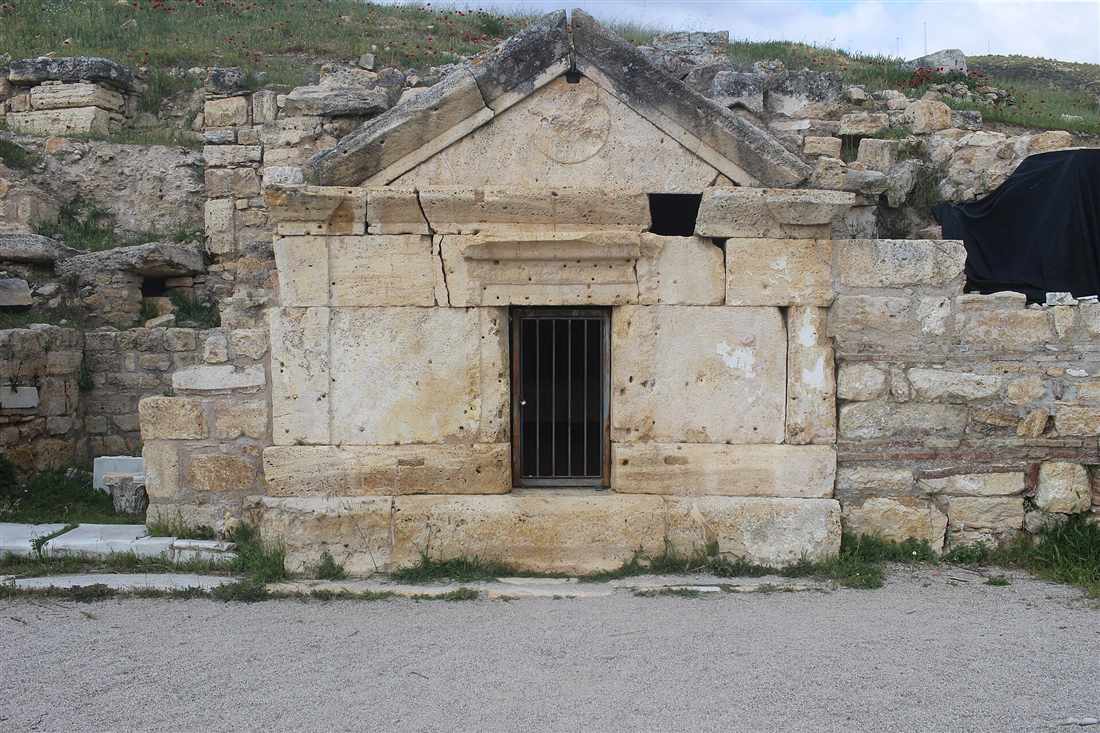
The tradition holds that Philip preached at Hierapolis against the pagan cults of the city and drew the anger of its authorities, who put him to death there. The apocryphal Acts of Philip and the testimony of early bishops record his martyrdom and burial in the city.
Hierapolis was a stronghold of pagan worship. Its Plutonium, a shrine to the underworld god beside a cave that breathed lethal vapours, drew priests and pilgrims to a cult of death and prophecy. Temples to Apollo and to the mother goddess stood in the city, and the thermal setting reinforced a sense of the sacred and the chthonic. Into this environment the apostle brought a rival message, and the Acts of Philip stage his mission as a direct assault on the serpent-cult that dominated the city’s religious life.
The narrative of the martyrdom describes the confrontation reaching a violent end. In the account, the local rulers seize the apostle and execute him, in a scene that echoes the crucifixion of Christ. The story fuses history and legend, yet its persistence across the manuscripts shows how strongly the early church tied Philip’s death to this precise place. The city where he challenged the underworld cult became the city where he gave his life.
The literary tradition rests on older testimony rather than on the apocryphal Acts alone. Papias, a native bishop of Hierapolis, transmitted memories of the apostle within living reach of the events. Polycrates of Ephesus, in a letter preserved by Eusebius, names Philip among the great lights of Asia who rest in the region, placing him at Hierapolis with his daughters. This convergence of local memory and wider testimony fixed the city as the site of the martyrdom and justified the raising of a great shrine on the hill.
The place of martyrdom shaped the topography of devotion. The church set the memorial on the hill, apart from the pagan monuments of the lower city, and marked the spot the tradition tied to the apostle’s death and burial. Recent excavations on the terrace revealed a first-century Roman tomb inside a later church beside the Martyrium, and the excavators read this structure as the grave venerated as Philip’s. The martyrdom account and the physical remains meet on the hill, so the whole precinct grew around the memory of the apostle’s end in the city.
What does the octagonal shape of the Martyrium mean?
The eight sides of the Martyrium carry the Christian symbolism of the number eight, the sign of eternity and resurrection. The eighth day stands beyond the seven days of creation as the day of the risen Christ, so the octagon frames the apostle’s tomb-shrine as a promise of eternal life.
Early Christian builders attached deep meaning to the octagon. The seven days of the week measured the created order, and the day after the sabbath, the day of resurrection, counted as the eighth. That eighth day pointed beyond time to the age of the resurrection, the life without end. An eight-sided plan therefore spoke of triumph over death, which made it the chosen form for baptisteries, where converts passed from death to new life, and for martyria, where the church honoured those who died in the faith.
At Hierapolis the octagon fits the meaning of the site with precision. The Martyrium commemorates an apostle put to death for his witness, and the building answers that death with the geometry of resurrection. The central octagonal hall gathers the whole design around a single point, drawing every radiating chapel and every approach inward to the heart of the shrine. The worshipper standing under the octagon stood inside a diagram of eternity built in stone and marble.
The form also governs how the crowd moved and prayed. The eight faces of the central hall opened to chapels and passages set around the square, so pilgrims processed around the octagon and paused at each side. The number ordered the ritual as much as the meaning, turning the walk through the building into a circuit of the sacred centre. Geometry, liturgy and doctrine met in the single figure of the eight-sided hall.
What were the 28 rooms around the Martyrium for?
The square around the central octagon carried ranges of twenty-eight rooms that lodged the pilgrims who travelled to the shrine. In these rooms the faithful slept beside the holy place, practising the rite of incubation in the hope of healing and prophetic dreams during their sleep.
The plan wraps the octagon in a square envelope, and along the sides of that square run rows of small chambers. These rooms, numbering twenty-eight, framed the courtyards and gave shelter to the crowds who climbed the stepped path. Pilgrimage to an apostle’s shrine drew travellers from across Anatolia, and the complex functioned as a hostel as much as a church, receiving visitors who stayed to pray, to keep vigil and to sleep within the sacred precinct.
Incubation shaped the purpose of the rooms. The practice of sleeping in a holy place to receive a cure or a message reached deep into the religious life of Anatolia, from the healing shrines of Asklepios to Christian sanctuaries that inherited the custom. At the Martyrium the pilgrim lay down near the tomb of the apostle in the expectation that healing or a prophetic dream arrived in sleep. The daughters of Philip, remembered as prophetesses at Hierapolis, tied the site to this tradition of divine communication.
The arrangement bound worship and lodging into one design. The rooms opened toward the courtyards and the central octagon, so the pilgrim moved from a place of rest to a place of prayer without leaving the precinct. The twenty-eight chambers gave the complex the scale to absorb a festival crowd on the apostle’s feast, when travellers filled the terrace, kept the night in the rooms, and gathered in the octagon at the heart of the shrine.
The layout of the rooms enforced a clear order of movement. Ranges of chambers ran along the outer faces of the square, opening onto the porticoed courtyards that framed the central hall, so a pilgrim passed from the entrance, through a court, into a lodging, and back out to the octagon in a single controlled circuit. The uniform size of the chambers points to a planned reception of large numbers, each traveller assigned a place within the precinct. The Martyrium thus operated as a self-contained sanctuary, holding worship, healing rite and shelter inside one enclosing wall on the hill above Hierapolis.
When was the Martyrium built?
The Martyrium rose in the fifth century AD, in the age when the cult of the martyrs and long-distance pilgrimage reached their height across the Christian East. Imperial patronage and the wealth of Hierapolis paid for the great octagonal shrine on the hill above the city.
The fifth century AD marks the era of the monumental martyrium. Across Asia Minor, Syria and the Aegean, the church raised vast pilgrimage complexes over the tombs of saints and apostles, drawing crowds to their feasts and their relics. The shrine of Saint Thecla at Seleucia, the pilgrimage church at Qalat Siman around the pillar of Symeon the Stylite, and the great sanctuaries of Ephesus all belong to this movement. The Martyrium of Philip stands among them as the apostle-shrine of Hierapolis.
The scale of the building points to powerful backing. An octagon close to twenty metres across, set inside a square of pilgrim rooms, on a terrace cut into the hillside and reached by a monumental staircase, demanded resources beyond a local congregation. Imperial and episcopal patronage stood behind such projects, and Hierapolis, prosperous from its textile trade and its thermal tourism, added the local wealth that a great shrine required. The city invested in the monument that made it a place of pilgrimage.
The Martyrium belongs to the moment when Hierapolis turned decisively Christian. The old cults of Apollo and the Plutonium faded, and the shrine of the apostle became the defining monument of the city’s sacred landscape. The building on the hill declared the new faith to every traveller who approached, and its fifth-century AD date sets it at the point where the Roman city of the springs became a Christian city of pilgrimage.
The construction fits the wider building programme that reshaped the city under Christian rule. Hierapolis raised cathedrals, a basilica within the Roman baths, and further churches across the plateau, and the Martyrium crowned this transformation as the flagship shrine. An earthquake damaged the complex in the seventh century AD, and the building never regained its former grandeur, which sets the period of its full glory in the fifth and sixth centuries AD, the peak of the pilgrimage to Saint Philip. Its ruins on the terrace still record that age of imperial faith and mass devotion.
What did the Martyrium look like?
The Martyrium presented a central octagonal hall roofed in timber, ringed by radiating chapels set into a square, faced with marble and paved in stone. Courtyards and ranges of pilgrim rooms enclosed the octagon, so the whole formed a compact, monumental precinct crowning the hill.
The heart of the design was the eight-sided central hall, close to twenty metres across, rising under a pyramidal timber roof rather than a masonry dome. The lightness of a wooden roof let the builders span the wide octagon without the mass a stone vault demanded, and it gave the interior a tall, open crown above the worshippers. Eight great arches framed the sides of the hall and opened to the spaces set around it, so the octagon read as a centre gathering the whole plan to itself.
Around the octagon, radiating chapels and passages filled the corners of the square envelope. Each side of the central hall opened to a rectangular room, and diagonal chapels sat at the angles, giving the interior a rhythm of alternating spaces as the pilgrim moved around the circuit. The rooms carried altars and places of prayer, dividing the crowd among the smaller chapels while the octagon held the focus of the shrine. Marble revetment sheathed the walls, and stone paving ran across the floors, so the interior gleamed with the finish the church reserved for its great monuments.
Fragments recovered on the terrace fill out the picture of the finish. Carved marble screens, column shafts, capitals and inscribed slabs lay across the ruins, testifying to a rich decorative programme worthy of an apostle’s shrine. The doorways carried moulded frames, and the paving joined the chapels and the octagon in a continuous stone floor. The overall effect married a bold central geometry with a costly surface, so the interior impressed the pilgrim through both its plan and its materials.
Outside the core, courtyards and the ranges of pilgrim rooms completed the precinct. Entrances led through the surrounding structures into the open courts, and from the courts the worshipper passed into the octagon at the centre. The monumental stepped path delivered the crowd to the terrace, where the square block of the Martyrium stood as a single, unified mass. Set on its hill above the theatre and the travertine terraces of Pamukkale, the shrine crowned Hierapolis, its octagon visible from the city below as the sign of the apostle’s resting place.
Where was the tomb of St Philip found?
The tomb of St Philip sits inside a newly excavated church about forty metres from the octagonal martyrium, on the eastern slope above Hierapolis. Excavation director Francesco D’Andria identified the grave during recent excavations, matching its position to ancient pilgrim descriptions of the apostle’s shrine.
For decades scholars placed the apostle’s grave inside the octagon itself, treating the famous eight-sided building as both memorial and burial place. Recent excavations on the hillside overturned that assumption. A second, larger church emerged from the soil a short distance downhill, and within its structure the archaeologists exposed a Roman tomb reused as a Christian grave. The setting, the orientation and the surrounding architecture pointed to one conclusion: this church, not the octagon, marked the true resting place of Philip.
Francesco D’Andria, who directed the Italian mission at Hierapolis, announced the identification after tracing the sacred topography of the hill. The tomb stands at the heart of the church, framed by steps that allowed pilgrims to descend towards it. Its placement forty metres from the martyrium explains why the two monuments face each other across the slope, joined by a paved processional route. The discovery reset the map of the whole sanctuary and confirmed that the octagon honoured Philip while the neighbouring church held his body. Visitors reaching the ridge above modern Pamukkale now stand between the two structures at the centre of an apostolic cult.
The reused Roman tomb at the core of the church supplied the decisive clue. Its form, a chamber grave of the type cut across the hillsides of Hierapolis, matched the local burial tradition, and its adaptation into the axis of a Christian basilica signalled a grave held in the highest honour. Christians rarely built a church around an ordinary tomb; they built one around a relic. The convergence of the grave’s placement, the surrounding architecture and the ancient written record left the excavators in no doubt that the earth had returned the shrine that pilgrim accounts had long described.
What is the church of the tomb of Philip?
The church of the tomb is a three-aisled basilica built beside the octagonal martyrium to enclose and honour the apostle’s grave. A paved sacred way climbs between the two monuments, turning the whole hillside into a single processional complex centred on Philip’s burial.
The basilica follows the classic longitudinal plan of early Christian churches: a central nave flanked by two side aisles, separated by rows of columns, and terminating in a sanctuary at the eastern end. Its architects positioned the apostle’s tomb within the building so that worshippers moved through the aisles towards the grave, mirroring the movement of pilgrims through the martyrium above. The two structures work as a pair, one a memorial rotunda, the other a congregational church, bound together by their shared subject.
The sacred way that links them runs up the slope in dressed stone, wide enough for processions carrying lamps and relics on the saint’s feast. This road turned architecture into liturgy: the crowd walked from the tomb church to the martyrium and back, re-enacting the journey of veneration each year. The excavation of the basilica confirmed the ancient sources that described a burial church distinct from the octagon, and it recast Hierapolis as a planned pilgrimage landscape rather than a single isolated shrine. The complex ranks among the most complete apostolic sanctuaries surviving from the eastern Mediterranean, and it anchors the wider Christian story that runs through the ruins of Hierapolis.
What is the bread stamp and relics evidence for Philip’s tomb?
A bronze pilgrim seal found at Hierapolis depicts the octagonal martyrium of Philip, stamping the identification in metal. Together with clay tokens and the tomb’s own architecture, the seal proves that early Christians treated this precise spot as the apostle’s authenticated grave and shrine.
Pilgrims to major shrines carried away small souvenirs: clay tokens, stamped bread, ampullae of holy oil and metal seals that pressed an image of the sanctuary into wax or dough. At Hierapolis a bronze seal survives that shows the martyrium of Philip rendered as a distinctive eight-sided building crowned by the saint’s presence. The image on the seal matches the excavated octagon so closely that it fixes the monument’s identity beyond dispute. This is physical, portable evidence that the building on the hill was understood, in its own time, as the shrine of the apostle.
The bread stamps and tokens carried the sanctity of the tomb outward. A pilgrim who pressed bread with the shrine’s seal ate a blessing tied to Philip’s grave; a token worn as an amulet extended the saint’s protection far from the hill. Such objects turn up across the Christian Mediterranean and confirm the reach of the cult. Read alongside the reused Roman tomb inside the basilica and the octagon that the seal reproduces, this material record ties the written tradition of Philip’s martyrdom at Hierapolis to a specific, excavated place. The identification rests not on legend alone but on stone, bronze and clay recovered from the ground.
The value of the seal lies in its precision. It does not show a generic church but the particular eight-sided outline of Philip’s martyrium, a design so unusual that it functions as a signature. When an artefact reproduces a real building closely enough to be recognised, it fixes both the building’s identity and the object’s origin. The Hierapolis seal does exactly that, binding the portable relic culture of early Christianity to the architecture standing on the hill. It records what the shrine looked like to the people who made the pilgrimage, and it hands modern archaeology an image drawn from life.
Why did pilgrims come to the Martyrium of Philip?
Pilgrims climbed to the Martyrium of Philip to seek healing at the apostle’s tomb, to celebrate his annual festival, and to bathe in the sacred pool. They spent nights in the shrine’s chambers in the hope of a curing vision, a practice known as incubation.
The apostle’s grave drew the sick and the devout from across Asia Minor and beyond. Incubation lay at the heart of the cult: pilgrims lodged in the rooms surrounding the octagon, slept close to the holy place, and waited for the saint to appear in a dream and grant a cure. This Christian ritual grew directly out of the older healing traditions of the region, where Hierapolis had long been famous for its thermal springs and the medicinal power of its warm waters. The martyrium redirected that reputation towards the apostle.
The saint’s feast filled the sanctuary each year with processions, lamps and crowds moving between the tomb church and the martyrium along the sacred way. The monumental stairway carried this traffic up from the city, and the sacred pool offered ritual bathing that fused the healing waters of Pamukkale with the blessing of the apostle. Pilgrims arrived, worshipped, bathed, slept and departed carrying tokens stamped with the shrine. The whole hillside functioned as a machine for pilgrimage, its architecture shaped around the movement of the faithful from the gate to the grave and back down towards the terraces of white travertine.
The draw of an apostle set Hierapolis apart from ordinary healing shrines. Philip walked with Christ, and his grave promised access to a founder of the faith rather than to a local holy figure. That status pulled pilgrims from distant provinces and lifted the sanctuary into the first rank of eastern Christian destinations, alongside the great apostolic tombs of the age. The chambers around the octagon housed those who had travelled far and needed shelter through the night of incubation, and the scale of the stairway and pool measures the size of the crowds the cult expected. Faith, water and architecture worked together to make the hillside a place where the sick came to be healed and the devout came to be close to an apostle.
What is the monumental stairway and bridge to the Martyrium?
A monumental stairway climbs from the city up the eastern slope to the Martyrium of Philip, crossing a stream on an arched stone bridge and passing through a gate. This engineered pilgrim route channelled processions from the streets of Hierapolis directly to the apostle’s shrine.
The stairway is one of the most striking survivals of the whole complex. Cut in wide flights of dressed stone, it rises in a straight axis towards the martyrium, its scale matched to crowds rather than to a handful of visitors. The ascent was a deliberate act of devotion, a physical climb that mirrored the spiritual approach to the saint. The builders framed the route with structures that marked the pilgrim’s progress, so the journey up the hill unfolded as a sequence of thresholds.
Partway up, the route crosses a watercourse on an arched bridge built to carry the processional road over the stream that runs down the slope. Beyond the bridge a gate opens onto the final approach to the shrine. This staged sequence, road to bridge to gate to stairway to martyrium, gave the sanctuary a formal front and controlled the flow of the faithful on feast days. The engineering reflects the wealth and importance the cult attracted, and it shows that the shrine of Philip was planned as a monumental destination, its access as carefully designed as the octagon that crowned the hill.
The bridge deserves particular note. Spanning the stream with a single stone arch, it solved a practical problem, keeping the processional route dry and level, while adding a threshold moment to the ascent. Crossing water on the way to a holy place carries its own weight in ritual, and the pilgrims who passed over the arch left the ordinary city behind and entered the precinct of the saint. The gate beyond marked the boundary of sacred ground and regulated who entered and when. Taken together, the stairway, the bridge and the gate turned the climb into a controlled, dignified procession rather than a scramble up a hillside.
How was the Martyrium destroyed?
The Martyrium of Philip fell through the earthquakes that repeatedly struck Hierapolis and the gradual abandonment of the city. Seismic collapse brought down the octagon’s vaults and walls, and as the population dwindled the shrine lost its congregation and sank slowly into ruin and burial.
Hierapolis sits on an active fault line, and the same geology that fed its hot springs also shook its buildings apart across the centuries. Powerful earthquakes flattened much of the city more than once, toppling colonnades, cracking vaults and shattering roofs. The martyrium, built high on an exposed slope, took the force of these shocks. Its central octagon lost its covering, its radiating chambers cracked, and rubble spread across the terraces. Each successive quake left the structure weaker and harder to maintain.
Repair depended on a living pilgrimage economy, and that economy faded as the wider region declined and populations moved away. Once the crowds thinned, the resources to rebuild the shrine vanished, and the martyrium was left to the weather. Wind, rain and further tremors reduced the standing walls to their foundations, while windblown soil and slope-wash buried the tomb church and the sacred way. The sanctuary that had drawn pilgrims from across the Christian world passed out of memory and lay hidden under the hillside until archaeologists returned to lift the earth and read what remained.
Burial preserved as much as it hid. The soil that swallowed the shrine sealed its floors, thresholds and lower walls, protecting the plan of the octagon and the tomb church from stone robbers and further collapse. When the archaeologists cleared the slope, they recovered a footprint intact enough to reconstruct the whole processional landscape. The destruction of the martyrium was slow and undramatic, the work of geology and time rather than a single catastrophe, and it left behind a ruin coherent enough to tell its own story once the earth was removed.
What is there to see at the Martyrium today?
Today visitors see the excavated walls of the octagonal martyrium, the recently uncovered tomb church with the apostle’s grave, the monumental stairway climbing the slope, and a sweeping view over the white travertine terraces of Pamukkale spread out below the ridge.
The octagon survives as a clear ground plan: the eight-sided central space and the ring of radiating rooms stand to varying heights, their thresholds, floors and foundations exposed by excavation. Walking the outline, a visitor reads the geometry that made the martyrium famous and understands how pilgrims once moved through its chambers. Downhill, the tomb church presents its three aisles and the Roman tomb at its heart, the focus of the whole sanctuary and the reason the complex existed.
Between and around these monuments run the paved sacred way and the great stairway, tangible traces of the processions that once filled the hill. From the top of the ridge the panorama opens over the ancient city and out across the dazzling limestone shelves of Pamukkale, one of the finest vantage points on the whole archaeological site. Far fewer people make the climb to the martyrium than crowd the terraces below, so the ruins reward those who walk up with quiet and space. The setting joins the drama of the landscape to the weight of an apostolic shrine, and it rounds out any visit that also takes in the theatre and the vast Necropolis of Hierapolis.
How do you visit the Martyrium of St Philip?
To visit the Martyrium of St Philip, walk up from the Roman theatre towards the north-eastern slope, follow the path through the north gate, and climb the steep track to the ridge. The ascent takes fifteen to twenty minutes on foot from the theatre.
The martyrium stands apart from the main run of ruins, high above the theatre on the hillside east of the ancient street grid. From the theatre the route heads uphill, first on a made path and then on a steeper, rougher track that gains height quickly across open ground. The climb is short but demanding under the sun, so sturdy footwear, water and a hat make the difference. There is no shade on the slope, and the surface is stony, so the walk suits steady feet rather than sandals.
Reaching the top, the path arrives at the octagon and the tomb church, with the stairway and sacred way laid out around them. Allowing forty-five minutes to an hour on the ridge gives time to trace both monuments and take in the view. The martyrium pairs naturally with the long chain of tombs along the northern approach, the walkers who combine the shrine with the necropolis in one circuit, dropping back down towards the terraces afterwards. Starting early or late avoids the fiercest heat and the thickest crowds on the travertine below.
Why is the Martyrium of St Philip important?
The Martyrium of St Philip is the shrine of one of Christ’s twelve apostles, one of the great pilgrimage centres of the early Christian east, and a landmark of early Christian archaeology. It anchors the UNESCO World Heritage site of Hierapolis-Pamukkale as a monument of world importance.
Few places tie the New Testament so directly to standing archaeology. Philip belonged to the inner circle of the apostles, and Hierapolis preserved the memory of his martyrdom and burial on this hill. The excavation of the octagon, the tomb church and the pilgrim route transformed that tradition into evidence, giving historians a rare, physical record of how the earliest Christians honoured an apostle. The bronze seal, the tokens and the reused tomb link scripture, cult and stone in a single sanctuary.
The martyrium also marks a turning point in the study of early Christian architecture and pilgrimage. Its planned processional landscape, complete with stairway, bridge, sacred way and radiating chambers for incubation, shows how a healing cult built itself into the fabric of a Roman city. As part of the UNESCO World Heritage site that couples the ancient city with the travertine terraces, the shrine draws visitors who come for the springs and stay for the history. It stands as a monument to faith, engineering and memory alike, and it gives the whole hillside above Pamukkale a significance that reaches far beyond the borders of Turkey.
Frequently Asked Questions
What is the Martyrium of St Philip?
The Martyrium of St Philip is an octagonal fifth-century memorial church on the hill above Hierapolis, honouring the apostle Philip martyred in the city. Eight chapels ring the central hall, and 28 rooms once housed the pilgrims who came to be healed.
Where is the tomb of St Philip?
The tomb of St Philip lies in a three-aisled church about 40 metres from the octagonal martyrium, found in recent excavations by the director Francesco D’Andria. A bronze pilgrim seal depicting the martyrium confirmed the identification.
How do you visit the Martyrium of St Philip?
The Martyrium stands on the hill north-east of the Hierapolis theatre, reached by a steep stepped path and the pilgrim stairway from the city. The climb takes about 20 minutes and rewards with a view over Pamukkale.