
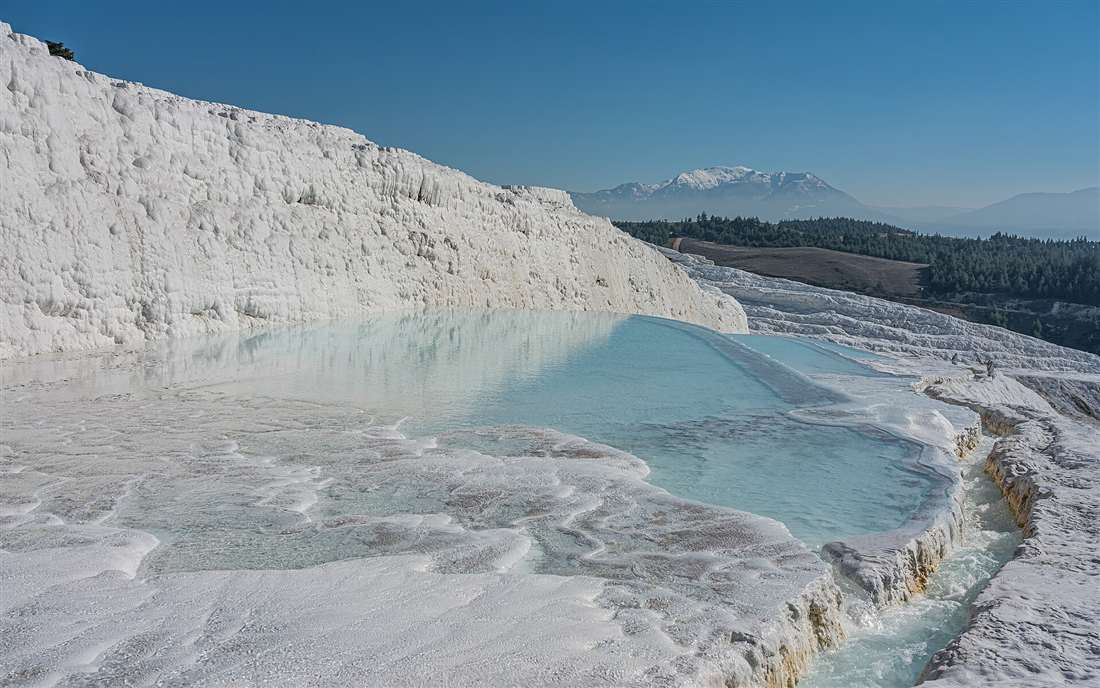
Pamukkale lies about 220 kilometres north-east of Marmaris, a three-and-a-half-hour drive over the mountains. A guided day tour with harbour or hotel pickup is the direct way to reach the travertines and Hierapolis, with the bus via Denizli and self-drive as the alternatives. Plan the whole trip with Greece Tours.
This guide covers getting to Pamukkale from Marmaris in full: the distance and journey time, the guided day tour, the bus, self-drive, whether the day trip is worth it, what a tour includes, the day-trip-versus-overnight choice, the best time to travel, the cost, and what you see on the mountain drive.
How do you get from Marmaris to Pamukkale?
Three routes connect Marmaris to Pamukkale, a distance of about 220 km to the north-east. A guided coach day tour handles the whole journey door to door, an intercity bus runs via Denizli, and self-drive follows the D550 and D585 highways in about 3.5 hours.
The guided day tour is the route most Marmaris visitors book. A coach collects passengers from hotels and the harbour before dawn, a licensed guide travels with the group, and the fare bundles the entrance fee to the travertines, the walk through Hierapolis, and a buffet lunch. The operator handles the driving, the parking, and the timing, so the traveller focuses on the site rather than the road.
Independent travellers choose between the intercity bus and a hire car. The bus links Marmaris otogar to Denizli otogar, where a free shuttle called the servis carries ticket holders the final 20 km to Pamukkale village. The hire car gives full control over departure time and stops, at the price of a long mountain drive in each direction. Each route delivers the same reward: the white calcium terraces and the ruined Roman spa city that sits above them.
What is the distance and journey time from Marmaris to Pamukkale?
Marmaris sits about 220 km south-west of Pamukkale, and the drive takes around 3.5 hours by direct highway. The route climbs north through the town of Mugla, crosses the pine-clad mountains of the interior, and drops towards the plain of Denizli where Pamukkale stands.
The first stretch out of Marmaris switchbacks up the wooded ridge that rings the bay, gaining height fast before levelling onto the plateau around Mugla, the provincial capital. From Mugla the D550 and D585 run north-east through farmland, olive groves, and cotton fields, past the towns of Yatagan and Tavas, until the road reaches the wide valley of the Menderes river. Denizli, a working city of textile mills, marks the last leg, with Pamukkale a further 20 km to the north.
The 3.5-hour figure describes clear, direct driving. A guided coach stretches the journey with a comfort stop and a slower mountain pace, so the outbound leg on a tour runs closer to 4 hours. Traffic through Mugla at peak hours and roadworks on the mountain sections add time, so planners build a margin into any self-drive schedule. The return covers the identical 220 km, which is why the tour day stretches so long from start to finish.
How does a guided day tour from Marmaris to Pamukkale work?
A guided tour starts before sunrise with a hotel or harbour pickup, loads the group onto an air-conditioned coach, and drives the 220 km north with a licensed guide on board. The price includes site entry, the walk across the travertines, Hierapolis, and a buffet lunch, and the full day runs 13 to 14 hours.
Pickup falls between 04:30 and 06:00 depending on the hotel’s position along the collection route, because the coach threads through Marmaris, Icmeler, and the resort strip before it heads for the mountains. Once the group is complete, the driver takes the highway north while the guide outlines the day, the geology of the terraces, and the history of the Roman spa. A mid-morning break at a roadside rest stop breaks the climb.
On arrival the guide leads the group barefoot up the calcium terraces, the rule that protects the soft white travertine, then through the gates of the ancient city above. Lunch is a buffet at a restaurant near the site. Free time follows for the Cleopatra Pool, the theatre, or the necropolis, before the coach turns south in the late afternoon. The return drops each passenger back at the pickup point, arriving in Marmaris around 19:00 to 20:00. The bundled entry ticket and guide remove the queuing and navigation that eat an independent traveller’s day.
How do you get from Marmaris to Pamukkale by bus?
Intercity coaches link Marmaris otogar to Denizli otogar in 4 to 5 hours, and a free connecting shuttle called the servis carries ticket holders the final 20 km to Pamukkale village. Fares run from around 300 to 500 Turkish lira each way, with departures through the day.
Bus companies such as Pamukkale, Kamil Koc, and Metro run the Marmaris-Denizli corridor from the main otogar on the edge of town. The coaches are air-conditioned, assign seats, and stop once at a highway service area. Denizli is the transport hub for the region, so the arrival board there lists frequent onward links. The intercity ticket entitles the holder to the servis minibus that shuttles between Denizli otogar and Pamukkale free of charge, timed to meet arriving coaches.
The bus route rewards the traveller who wants independence and a lower fare, at the cost of a longer total journey and self-guided navigation of the site. From Pamukkale village the entrance to the travertines is a short walk, and the town holds guesthouses, cafes, and ticket offices. A traveller who leaves Marmaris on an early coach reaches the terraces by early afternoon, walks the site, and returns the same evening, though the tight timing pushes most bus travellers towards an overnight stay in the village.
How do you self-drive from Marmaris to Pamukkale?
Self-driving from Marmaris to Pamukkale is direct: the 220 km route follows the D550 north through Mugla, then the D585 towards Denizli, and takes about 3.5 hours on paved highway. Car hire in Marmaris starts around 1,000 to 1,800 Turkish lira a day, and Pamukkale offers paid car parks near both entrances.
The road is a well-surfaced two and three-lane highway for its length, with a sustained mountain climb out of Marmaris and a series of bends across the ridge that demand steady attention. Signposting to Denizli and Pamukkale is clear at the major junctions. Fuel stations line the route through Yatagan and Tavas, and the drive presents no unpaved sections. A driver who leaves Marmaris at first light reaches Pamukkale mid-morning, ahead of the tour coaches.
Hire desks cluster around Marmaris harbour and the resort hotels, and a full tank plus the day rate covers the trip. Petrol for the 440 km round journey runs around 700 to 1,000 lira at pump prices. Two car parks serve the site, one at the lower south gate near the village and one at the upper north gate by the necropolis, each charging a modest daily fee. Driving suits travellers who want to set their own pace, add a stop in Mugla’s old town, or continue on to Ephesus or Aphrodisias afterwards.
Is a Pamukkale day trip from Marmaris worth it?
A Pamukkale day trip from Marmaris rewards the long hours on the road with one of Turkey’s defining sights: tiers of blinding white calcium pools stacked down a hillside, crowned by the ruins of a Roman spa city. The 13 to 14-hour day demands an early start, and the pay-off justifies it for first-time visitors.
The travertines form where warm mineral-rich springs spill over the cliff edge and deposit calcium carbonate, building shelf after shelf of pale terraces that hold shallow turquoise water. The effect reads like a frozen waterfall or a snowfield in high summer heat. Above the terraces stands Hierapolis, a spa town of the Roman world whose theatre, colonnaded street, and vast necropolis survive across the plateau. Pamukkale and Hierapolis share a single UNESCO World Heritage listing, and one ticket covers both.
The cost of the reward is time. The round trip swallows about 8 hours of driving, which leaves the middle of the day for the site itself. Travellers who prize slow mornings on the beach weigh that trade carefully, while those set on seeing the terraces accept the pre-dawn alarm as the price of admission. For a deeper account of the site, read the full Pamukkale guide before booking. The verdict for most Marmaris visitors is that the terraces earn their place near the top of the itinerary.
What does a Pamukkale tour from Marmaris include?
A standard Pamukkale tour from Marmaris bundles hotel or harbour pickup, return coach travel, a licensed guide, the site entrance fee, and a buffet lunch. The itinerary covers the travertine terraces and the ancient city of Hierapolis, and the swim in the Cleopatra Pool sits as a paid extra.
The entrance fee inside the price is the single ticket that admits the holder to both the terraces and the ruins above, which removes the queue at the gate. The guide walks the group across the white shelves, explains the geology and the myths, then leads the way through Hierapolis to the theatre carved into the hillside and the colonnaded main street. The Roman theatre seats an audience of thousands and keeps its stage wall and carved reliefs intact. For the ruins in full, the Hierapolis guide sets out every monument on the plateau.
Lunch is a buffet spread at a restaurant near the site, included in the headline fare, with drinks charged separately. The Antique Pool, known as the Cleopatra Pool, lets visitors swim among submerged marble columns fed by the same thermal springs, and the swim carries its own admission on top of the tour price. A traveller who wants the pool packs a swimsuit and a towel, and budgets the extra ticket. The tour ends with the return coach and the drop-off at the morning pickup point.
Is Pamukkale a day trip or an overnight from Marmaris?
A day trip fits Pamukkale into one packed 13 to 14-hour outing and returns to Marmaris the same night, while an overnight in Pamukkale village splits the driving, frees a full day at the site, and opens the terraces at sunrise before the coaches arrive. The choice turns on time and pace.
The day trip suits travellers on a fixed resort schedule who want to keep their Marmaris hotel and see the terraces without moving base. The trade-off is the length of the road: about 8 hours of driving compresses the visit into the middle hours, and the group moves to the coach’s timetable. It delivers the sight in a single day and asks nothing of the traveller beyond an early alarm and stamina.
The overnight rewards the traveller who wants the site quiet and the light low. A guesthouse in Pamukkale village puts the entrance minutes away, so the visitor walks up at dawn when the pools glow gold and the crowds thin. The extra day adds the Cleopatra Pool at leisure, the far end of the necropolis, and a sunset over the terraces. The cost is one night away from Marmaris and a room fee, from around 800 lira for a village guesthouse. Photographers and slow travellers lean towards the overnight; time-pressed beachgoers take the day trip.
When is the best time to travel from Marmaris to Pamukkale?
Spring and autumn deliver the best conditions for the Marmaris to Pamukkale trip, with mild air on the mountain road and comfortable heat on the exposed white terraces. An early departure beats the midday sun and the coach crowds, and it clears the site’s hottest, busiest window.
The spring and autumn months pair warm daylight with cool mornings, which makes the barefoot walk across the travertines pleasant rather than punishing. The terraces face full sun with no shade, and the white surface throws the light back, so high summer turns the midday walk fierce. A tour that leaves Marmaris before dawn reaches Pamukkale while the air stays kind and the pools hold their morning calm. From April into June, and again from September into late October, the interior holds mild afternoons and clear skies over the whole 220 km route.
Summer brings the peak of the resort season and the fullest coaches, and the terraces grow crowded from late morning onward. Winter cools the mountain drive and quietens the site, at the price of shorter daylight and a colder swim. Whatever the month, the early start is the constant: the first hours at Pamukkale reward the traveller with soft light, thinner crowds, and space to walk the shelves. The 3.5-hour drive means the alarm rings in the dark for any comfortable arrival.
How much does a Marmaris to Pamukkale trip cost?
A guided day tour from Marmaris to Pamukkale runs from around 1,500 to 2,500 Turkish lira per person, inclusive of coach, guide, entry, and lunch. The intercity bus costs 300 to 500 lira each way, and self-drive combines a car-hire day rate of 1,000 to 1,800 lira with fuel of 700 to 1,000 lira for the round trip.
The tour price is the all-in figure: it folds the fuel, the driver, the guide, the entrance ticket, and the buffet lunch into one payment, and it removes the separate site fee that independent travellers pay at the gate. Extras sit outside the headline number, the Cleopatra Pool swim and drinks at lunch chief among them. Group tours price lower per head than private cars with a personal guide, which command a premium for the flexibility.
The bus is the cheapest route in cash terms. Two fares of 300 to 500 lira cover the return coach, and the servis shuttle from Denizli to the village is free, but the site entrance ticket falls on the traveller directly on arrival. Self-drive costs sit between the two: the day rate and fuel add up, split across a car of two, three, or four passengers the per-head figure drops below the guided tour. The traveller weighs the convenience of the all-inclusive coach against the lower outlay and greater freedom of doing it alone.
Currency movement shifts the lira figures across a season, so a traveller confirms the fare at the point of booking rather than fixing on a headline sum. A private tour with a personal driver and guide runs from around 5,000 lira for a small group, and it buys door-to-door timing and stops on demand. Whichever route the traveller picks, the site entrance ticket, the Cleopatra Pool swim, and lunch drinks form the extras to weigh against the base fare of the trip.
What do you see on the drive from Marmaris to Pamukkale?
The drive from Marmaris to Pamukkale climbs through pine-forested mountains, crosses the plateau town of Mugla, and runs north-east across cotton fields and olive groves before reaching the textile city of Denizli below the terraces. The changing scenery marks the shift from coast to interior.
Out of Marmaris the road rises fast through dense Turkish pine on the ridge that walls off the bay, opening views back over the gulf before it crests onto the highland. Mugla spreads across the plateau soon after, a university city of white houses and red-tiled roofs with an Ottoman old quarter of narrow lanes and a covered market. Beyond Mugla the highway settles into farmland, where cotton, tobacco, and olive groves fill the broad valleys and low hills roll to the horizon.
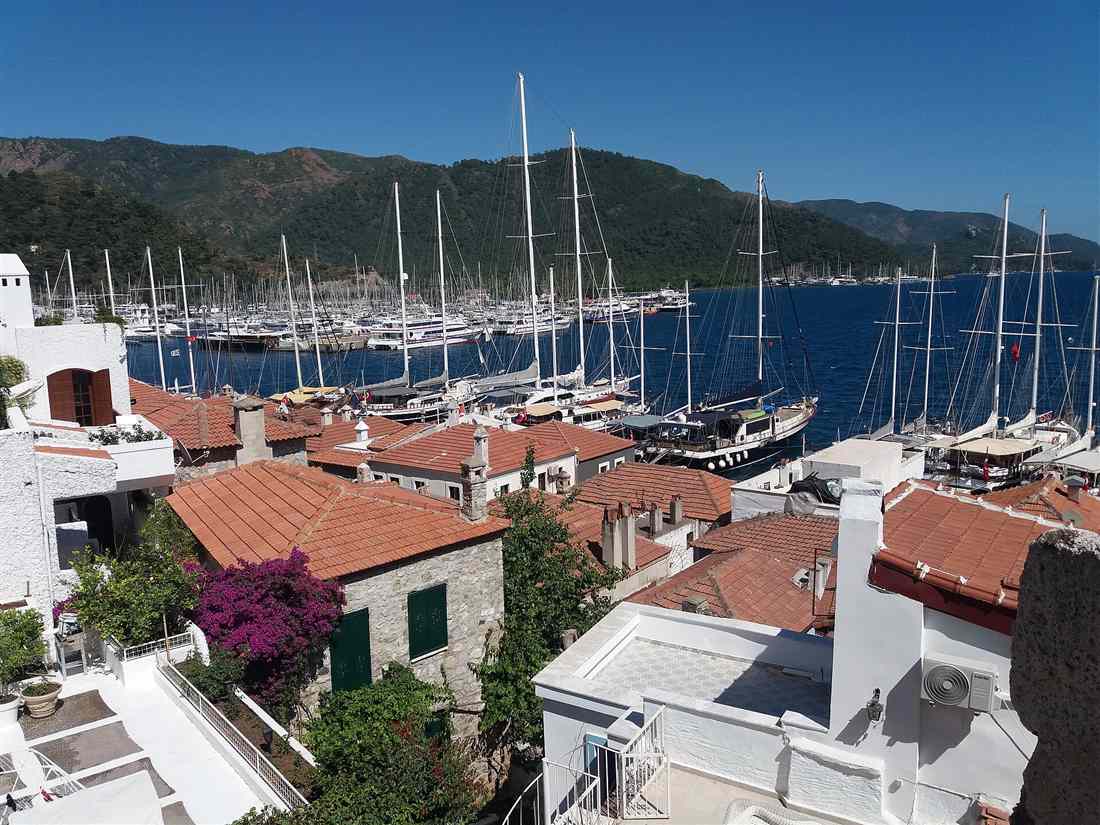
The final approach drops towards the plain of the Menderes river, the classical Meander whose looping course named the word. Denizli anchors the valley, a working city built on textiles and known across Turkey for its long-crowing roosters and its cotton mills. From Denizli the white scar of the travertines shows on the hillside to the north long before the coach reaches the gate, a pale streak against the green slope that announces the journey’s end. The route carries the traveller from the yacht-lined coast to the heart of the Aegean hinterland in a single morning.
How early do you need to leave Marmaris for Pamukkale?
Departure from Marmaris falls between 04:30 and 06:00 for a guided day tour, timed so the coach clears the mountain road and reaches Pamukkale by mid-morning. The 3.5-hour drive and the collection loop through the resort hotels push the alarm into the dark hours of the morning.
The early hour serves two ends. It puts the group on the terraces before the midday sun turns the white surface fierce, and it beats the wave of coaches that fills the site from late morning. A start at 05:00 lands the traveller at the gate around 09:00, which leaves the full central span of the day for the terraces, Hierapolis, and lunch before the afternoon return.
The pickup window widens because the coach threads a route through Marmaris centre, Icmeler, and the outlying resorts, and a hotel late on the loop boards up to 90 minutes after the first. Independent travellers on the bus face the same logic: the earliest intercity coach out of Marmaris otogar gives the best odds of a same-day return, while a late departure forces an overnight in the village. The pre-dawn start is the fixed cost of a Pamukkale day from the coast.
What do you wear and pack for the Marmaris to Pamukkale trip?
Light layers, a sun hat, high-factor sun cream, and a refillable water bottle handle the exposed terraces, and a swimsuit and towel cover the Cleopatra Pool. Visitors walk the travertines barefoot, so slip-on sandals or shoes that stow easily in a daypack suit the site.
The rule that forbids footwear on the white shelves protects the soft calcium from scuffing, so every visitor carries their shoes across the terraces in hand or in a bag. The surface underfoot ranges from smooth and warm to ridged and slick where water runs, so steady footing matters. A hat and sunglasses cut the glare that bounces off the white stone, and sun cream guards against the reflected heat that catches out the unprepared.
The plateau of Hierapolis adds a walk across open ground with little shade, so the water bottle earns its place, refilled at the site fountains. A swimsuit worn under clothing saves changing time at the Antique Pool, and a quick-dry towel packs small. Spring and autumn mornings start cool on the mountain, so a light layer over a shirt handles the coach and the early terrace before the day warms. Comfortable walking shoes carry the traveller through the ruins once the barefoot stretch ends.
What is the Cleopatra Pool at Pamukkale?
The Cleopatra Pool, named the Antique Pool, is a thermal spring where swimmers bathe among submerged marble columns and carved blocks that fell from the Roman spa in an ancient earthquake. The warm mineral water holds a steady temperature year round, and a separate ticket admits swimmers on top of the site entrance.
The pool sits at the heart of Hierapolis, fed by the same calcium-rich springs that build the terraces below. The scattered marble on the pool floor comes from a portico that toppled in antiquity, so a swimmer glides over fluted columns and cornice fragments in clear, fizzing water warmed by the earth. The mineral content leaves the skin soft, and the spa reputation that drew Roman visitors to the site endures in the modern bathing.
The swim carries its own admission, charged at the poolside separate from the tour price and the gate ticket, so a visitor set on the pool budgets the extra and packs a swimsuit and towel. A locker and changing area serve bathers. The pool draws a queue at peak hours, which strengthens the case for the early arrival, and the traveller who reaches Pamukkale first thing swims before the crowd builds.
What else is there to see near Pamukkale on a trip from Marmaris?
Beyond the terraces and Hierapolis, the region around Pamukkale holds the ancient cities of Aphrodisias and Laodicea, both within an hour’s drive. Aphrodisias preserves a stadium and a temple of Aphrodite, and Laodicea spreads its ruined streets across a plateau nearer Denizli.
Aphrodisias lies about 80 km south-west of Pamukkale, a marble city devoted to the goddess of love whose sculptors supplied the Roman world. Its stadium survives near intact, one of the largest of the classical age, alongside a temple, a theatre, and a museum of the carvings that made the city famous. A self-drive traveller with a spare day pairs it with Pamukkale, though a single coach tour rarely fits both.
Laodicea sits closer, about 10 km north of Pamukkale, a ruined city on the trade road with a stadium, twin theatres, and the remains of early churches. The village of Pamukkale itself offers thermal guesthouses, riverside cafes, and the low hill of the necropolis, the vast Roman cemetery whose tombs line the approach to Hierapolis. The traveller who stays overnight reaches these sites at leisure; the day-tripper focuses on the terraces and the spa city above them and saves the wider region for a return.
Is the Marmaris to Pamukkale drive difficult?
The Marmaris to Pamukkale drive is straightforward on paved two and three-lane highway, with one sustained mountain climb out of the coast that demands attention on the bends. Clear signage to Denizli and Pamukkale marks the junctions, and fuel stations line the 220 km route.
The testing stretch comes first, as the road switchbacks up the pine ridge that rings Marmaris bay, gaining height through a run of tight curves before it levels onto the Mugla plateau. A driver takes this section steady, keeps to the marked speed, and allows for coaches and lorries grinding up the grade. Beyond the ridge the highway settles into fast, open running across the farmland of the interior, where the driving grows easy and the miles pass quickly.
Turkish highway standards on this corridor match the route’s role as the main artery between the coast and Denizli. Overtaking lanes appear on the climbs, and the surface stays sound. A driver unused to the region plans a fuel stop at Yatagan or Tavas, keeps a margin for the mountain pace, and starts early to reach Pamukkale before the day heats. The drive rewards care rather than punishing it, and the scenery of pine forest and cotton plain makes the hours behind the wheel a part of the trip.
How long do you spend at Pamukkale on a day tour from Marmaris?
A day tour from Marmaris gives around 3 to 4 hours at Pamukkale, split between the travertine terraces, Hierapolis, and lunch. The 220 km drive in each direction sets the limit, so the central window of the day belongs to the site while the road fills the early and late hours.
The coach reaches the gate mid-morning and the guide leads the group straight onto the terraces while the light stays kind, then up to the ancient city on the plateau above. A visitor covers the white shelves, the theatre, and the colonnaded street inside the guided walk, with free time bracketed around the buffet lunch. The Cleopatra Pool swim draws on that free window, so a bather trades an hour of ruins for an hour in the water.
The pace runs brisk rather than rushed, and a traveller who wants long, unhurried hours at the site leans towards the overnight instead. For the day-tripper the allotted span covers the headline sights: the terraces that give Pamukkale its name, the theatre cut into the hill, and the spa city that drew the Roman world. The guide’s timetable keeps the group moving so the coach turns south by mid-afternoon, ahead of the long drive back to the coast.
Is Pamukkale suitable for children and families from Marmaris?
Pamukkale suits families, and the shallow warm pools on the terraces delight children who paddle in the mineral water. The length of the day sets the real test: the pre-dawn start and the 8 hours of round-trip driving stretch young travellers, so families weigh the overnight against the single long day.
The site itself welcomes children. The terrace pools hold ankle to knee-deep water at a warm, steady temperature, and the barefoot walk turns the visit into a wade rather than a trudge. The open plateau of Hierapolis gives space to roam, and the Cleopatra Pool lets stronger swimmers bathe among the sunken columns under supervision. The white landscape reads to a child as a snowfield in summer, which fixes the day in memory.
The strain falls on the journey. A dawn pickup and 3.5 hours each way test the patience of the young, and the coach ties the family to the group’s timetable. Families with small children lean towards an overnight in Pamukkale village, which halves each drive, opens the terraces at the quiet dawn hour, and removes the pressure of the return coach. A hire car adds the freedom to stop, feed, and rest on the family’s own schedule across the mountain road.
Frequently Asked Questions
How far is Pamukkale from Marmaris?
Pamukkale is about 220 kilometres north-east of Marmaris, a three-and-a-half-hour drive over the mountains via Mugla. A guided day tour covers the round trip with pickup, entry and lunch in a 13-to-14-hour day; the bus runs via Denizli.
Is a Pamukkale day trip from Marmaris worth it?
The Marmaris to Pamukkale day trip rewards the long mountain drive with the white travertine terraces, the ruins of Hierapolis and a swim option at Cleopatra”s Pool. An early guided tour makes the full day manageable.
How long does it take from Marmaris to Pamukkale?
The drive from Marmaris to Pamukkale takes about three and a half hours each way over the mountains via Mugla. A guided day tour starts before dawn and returns in the evening, a long but rewarding day.