
The best things to do in Selcuk cluster around Ephesus, 3 kilometres away: the ancient city, the Ephesus Museum, the Basilica of St John, the Temple of Artemis, the Isa Bey Mosque and Ayasuluk Castle, with Sirince village and Pamucak beach a short ride out. Plan the whole trip with Greece Tours.
This guide covers things to do in Selcuk in full: the ancient city of Ephesus, the Ephesus Archaeological Museum, the Basilica of St John, the Temple of Artemis, the Isa Bey Mosque, Ayasuluk Castle, the wine village of Sirince, Pamucak beach, the House of the Virgin Mary, the town market and storks, and how long to stay and get around.
What are the best things to do in Selçuk?
Selçuk packs the ruins of Ephesus, the Ephesus Archaeological Museum, the Basilica of St John, the Temple of Artemis, the Isa Bey Mosque, Ayasuluk Castle, Şirince village, Pamucak beach and a Saturday market into one compact base 3 km from the ancient city.
The town sits in İzmir Province on Turkey’s Aegean coast, at the foot of Ayasuluk Hill, and it wears the layers of three thousand years on its streets. A single afternoon takes in the marble avenues of Ephesus, the twin cult statues of Artemis in the museum, and the tomb of the Apostle John on the hill above the centre. The distances are short: the archaeological site lies a twenty-minute walk from the railway station, and the museum, the mosque and the temple field cluster within the town itself.
Beyond the headline monuments, Selçuk rewards a slower pace. Şirince rises 8 km east through olive terraces, Pamucak stretches its grey Aegean sand 7 km west, and the shrine on Bülbül Dağı climbs 7 km up the wooded slope south of the ruins. Storks nest on the Roman aqueduct pillars in the middle of town, the çöp şiş grills fill the evening air with charcoal smoke, and the Saturday market floods the side streets with figs, olives and Aydın produce. The list below sets out each of these in turn, with the distances, the entities and the practical detail that turn a stopover into two full days.
Selçuk earns its place on the Aegean itinerary because it concentrates in one district what other regions spread across a country. The town holds a Wonder of the Ancient World in the Temple of Artemis, the burial place of a Gospel author in the Basilica of St John, a Marian pilgrimage on the mountain, and the best-preserved classical city on the Turkish coast, and it links them with a railway station, a minibus hub and a walkable grid of guesthouses. A visitor who bases here trades the resort strips of Kuşadası, 20 km south, for a working country town where the monuments sit among the daily life of the market and the mosque.
The order of a first day matters. Start at Ephesus in the cool of the morning before the cruise groups arrive from the Kuşadası port, break for the museum when the sun climbs, and finish on Ayasuluk Hill in the late light when the basilica terrace looks west over the plain. A second day loosens: the olive-terrace village, the open beach, the forest shrine. Each entry below carries the compass bearing, the walking or driving time, and the sibling page that goes deeper, so the plan builds itself from the parts.
Why visit the ancient city of Ephesus from Selçuk?
Ephesus lies 3 km southwest of Selçuk centre and preserves the marble Library of Celsus, the 25,000-seat Great Theatre, the Curetes Street colonnade and the painted Terrace Houses, making it the largest Graeco-Roman city on the eastern Mediterranean open to visitors.
The Library of Celsus fronts the site with its two-storey marble façade, built in the second century AD as a tomb for the Roman senator Tiberius Julius Celsus Polemaeanus and once holding twelve thousand scrolls. Four statues in the niches personify Wisdom, Knowledge, Intelligence and Virtue. From the library, Marble Street runs to the Great Theatre, cut into the western slope of Mount Pion, where the Apostle Paul preached to the silversmiths and where summer concerts still fill the tiers.
The Terrace Houses on the south side of Curetes Street reward the extra ticket. These were the residences of the Ephesian elite, decorated with wall frescoes, marble panelling and mosaic floors, and roofed over now to protect the painted plaster. Ephesus served as the capital of the Roman province of Asia and as a harbour city on the Cayster estuary before the river silted the port and pushed the coastline 7 km west. Read the full monument-by-monument account on the dedicated Ephesus page before you set out, and pair the visit with a look at where the finds ended up in the town museum.
The site opens at two gates. The upper Magnesia gate sits on the Şirince road at the top of the ridge, and the lower gate stands nearest Selçuk on the harbour side. Entering at the upper gate and walking down spares the climb, delivering the Odeon, the civic agora, the Temple of Hadrian and the public latrines before the ground drops to the Library and the theatre. The marble Curetes Street runs the length of the descent, lined with column bases, honorific statues and the mosaic pavement of the shopfronts.
The Temple of Hadrian on Curetes Street carries a carved arch with a bust of the goddess Tyche and a frieze of the city’s founding myth, and the terracotta-and-marble Fountain of Trajan once held a colossal statue of the emperor. Near the theatre, the Arcadian Way, a colonnaded avenue lit by lamps in antiquity, ran straight to the vanished harbour. The stadium, the gymnasium and the double church of the Virgin Mary, where the Third Ecumenical Council met in the fifth century AD, spread across the flat ground beyond, so the full circuit fills two or three hours on foot.
What is in the Ephesus Archaeological Museum in Selçuk?
The Ephesus Archaeological Museum on Uğur Mumcu Sevgi Yolu holds the two marble cult statues of Artemis of Ephesus, the bronze and ivory finds lifted from the Terrace Houses, the head of Eros, the frieze of the Temple of Hadrian and gladiator gravestones, all recovered from the site 3 km away.
The Great Artemis and the Beautiful Artemis dominate the central hall, each carved with rows of egg-shaped protrusions across the chest, a zodiac collar, and tiers of animals down the body that mark her as the mother-goddess of the city. These statues stood in the Temple of Artemis, and the museum arranges them so the visitor circles both. Adjacent rooms display the domestic objects from the Terrace Houses: glass, bronze statuettes, the ivory frieze of a Roman military campaign, and the head of the boy-god Eros.
Further galleries gather the imperial portraits, the friezes of the Temple of Hadrian brought indoors for shelter, and the reliefs from the Parthian monument. A separate hall commemorates the gladiators of Ephesus with their carved gravestones, excavated from a cemetery east of the stadium. The museum threads the loose finds back into the buildings you walked through at the site, so the order of a Selçuk day runs ruins first, museum second. The full inventory and floor-by-floor guide sit on the Ephesus Archaeological Museum page.
The Austrian Archaeological Institute, which has dug at Ephesus since the late nineteenth century, supplied the excavated context for the display, and the museum arranges its rooms by find-spot rather than by material, so a single hall gathers everything from the Terrace Houses and another everything from the harbour. This grouping lets a visitor reconstruct a Roman household room by room: the bronze snake from a garden fountain, the ivory frieze from a study wall, the glass and bone gaming pieces from a triclinium floor.
The two Artemis statues repay a slow circuit. The rows of ovoid forms across the chest have been read as breasts, as bull testicles offered in sacrifice, and as amber gourds hung on the original wooden idol, and the museum labels lay out the debate without settling it. The zodiac necklace, the winged figures on the flanks and the bees on the base tie the goddess to fertility, the calendar and the city’s coinage, which struck the bee as its civic emblem. The museum charges a modest entry and closes one afternoon a week, so a check of the current hours precedes the walk over from the site.
Why visit the Basilica of St John?
The Basilica of St John crowns Ayasuluk Hill in the centre of Selçuk and marks the tomb of the Apostle John, built by the Emperor Justinian in the sixth century AD as a six-domed cross-plan church that ranked among the largest in the Byzantine world.
Christian tradition holds that John the Evangelist spent his final years in Ephesus and was buried on this hill, and a marble slab set into the nave floor marks the grave beneath the former central dome. The re-erected columns trace the outline of the cross plan, the baptistery survives to the north of the nave, and the monogram of Justinian and the Empress Theodora is carved on the capitals. The view from the terrace takes in the Isa Bey Mosque directly below, the single column of the Artemis temple on the plain, and the roofs of the town.
The basilica sits inside the same walled precinct as Ayasuluk Castle, so a single climb takes in both. The entrance is on St Jean Caddesi, a short walk uphill from the tourist office and the aqueduct. The scale is easy to underestimate from the road: the footprint measures 130 metres long, and reconstruction drawings at the gate show the six domes that once covered it. The full history and plan appear on the Basilica of St John page.
A wooden church stood over the grave first, and Justinian replaced it in stone to a design that echoed the Church of the Holy Apostles in Constantinople, laying out a Latin cross of five domes over the nave and arms with a sixth above the crossing. Brick piers carried the vaults, and the walls once glittered with mosaic and marble revetment, fragments of which survive on the columns. In the Middle Ages the church drew pilgrims who believed that a fine dust, the manna of St John, rose from the tomb each year on the saint’s feast day and healed the sick.
The Gate of Persecution, a fortified outer entrance to the precinct, took its name from a relief later carried off to an English collection, and it frames the approach from the town. Within the walls, the baptistery holds a cross-shaped immersion font sunk into the floor, and the treasury and chapel rooms flank the northern aisle. The Seljuk and Ottoman periods left the church in ruin, and the standing columns owe their re-erection to twentieth-century restorers who lifted the fallen shafts back onto their bases to trace the plan for visitors on the ground.
What is left of the Temple of Artemis at Selçuk?
One re-erected column stands in a marshy field on the southern edge of Selçuk, all that remains upright of the Temple of Artemis, a marble sanctuary counted among the Seven Wonders of the Ancient World and once four times the floor area of the Parthenon.
The temple rose in the sixth century BC under the Lydian king Croesus, burned on the night Alexander the Great was born, and was rebuilt on a grander scale with 127 Ionic columns each nearly twenty metres tall. Goths sacked it in the third century AD, and its marble was quarried for later buildings, including the Basilica of St John on the hill above and, tradition holds, the Hagia Sophia in Constantinople. The foundations were rediscovered by the engineer John Turtle Wood, who dug for years before striking the platform beneath the silt.
The site today is open, free to enter, and lies within sight of both the mosque and the basilica, so the three great phases of the town, pagan, Christian and Islamic, stand in one panorama. A stork nest caps the lone column, and information boards reconstruct the original elevation. The field floods after winter rain, which is why the single standing column rises from water for part of the year. The temple’s full story and the fate of its marbles run on the Temple of Artemis page.
The column that stands is a modern composite, assembled from drums found on the site and raised to a fraction of the original twenty-metre height, a marker rather than a survivor. Around it the excavated platform shows the stepped base, the altar to the west, and the pits where later builders quarried the marble for lime. The scale defeats the modern eye: the temple measured roughly 115 metres by 55 metres, larger than a football pitch, and its forest of Ionic columns supported a roof over an open central court that held the wooden cult statue.
The sanctuary drew pilgrims and traders from across the Greek world and served as a bank, holding deposits under the goddess’s protection. The Ephesian silversmiths who made shrines of Artemis rioted against the Apostle Paul in the theatre, an episode the Acts of the Apostles records, because his preaching threatened their trade. That collision of the old cult and the new faith plays out across the Selçuk skyline, where the temple field, the basilica and the mosque line up within a single kilometre of one another.
Why see the Isa Bey Mosque?
The Isa Bey Mosque stands below Ayasuluk Hill at the western edge of Selçuk, a fourteenth-century Aydinid mosque built for the emir Isa Bey with a broad courtyard, two aisles of columns reused from Ephesus, and an ornamented western façade of carved marble.
Completed under the beylik of Aydın before the Ottomans absorbed the region, the mosque marks the transition of the town from Byzantine to Turkish rule. Its architect drew on Syrian Umayyad models, giving it a rectangular courtyard rather than the domed Ottoman plan that came later. The prayer hall carries granite and marble columns lifted from the ruined ancient city and the harbour baths, and the mihrab and the surviving stalactite carving over the west portal show the workmanship of the Aydinid period.
The mosque remains in use, so a visit means quiet dress and shoes removed at the door, and the courtyard opens onto a view up to the basilica and castle. It sits on the direct path between the Temple of Artemis field and the hilltop precinct, which is why the standard walking route strings the three together in one loop. The detail on the patron, the architect and the carving appears on the Isa Bey Mosque page.
The inscription over the west portal names the architect as Ali, son of Müşeymeş of Damascus, and dates the building to the late fourteenth century, a marker that fixes it among the oldest mosques on the Turkish Aegean. The Syrian pedigree shows in the plan: a wide courtyard entered from the west, a prayer hall of two long aisles running parallel to the qibla wall, and a dome over the central bay carried on ancient columns. Two minarets once flanked the façade; the base of one survives beside the ornate marble doorway.
The reused material tells the story of the town’s decline and rebirth. Granite shafts of Egyptian stone, marble Corinthian capitals and blocks of dressed limestone came straight from the collapsing monuments of Ephesus and the silted harbour below, so a builder of the Aydinid court raised a Muslim house of prayer from the fabric of a pagan port. The stalactite carving of the portal, the geometric star patterns and the surviving faience tilework of the mihrab place the mosque at the height of the beylik’s craft, before the Ottoman conquest folded the region into the wider empire.
What is Ayasuluk Castle and the Selçuk fortress?
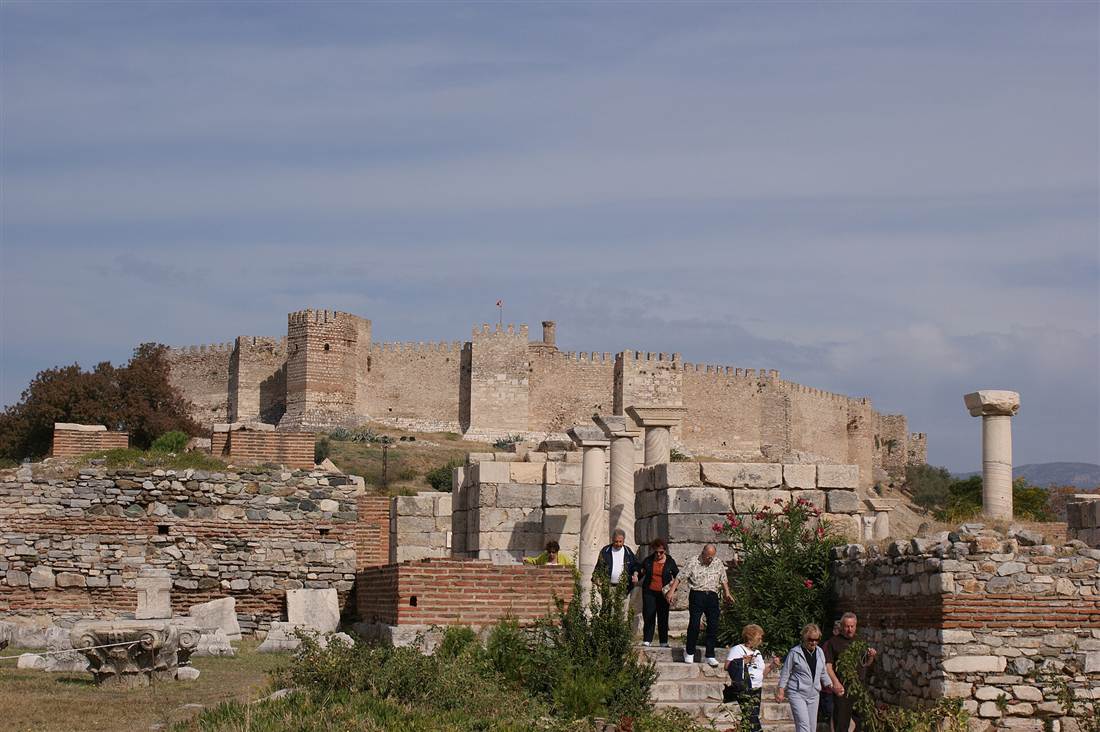
Ayasuluk Castle crowns the summit of Ayasuluk Hill above Selçuk, a citadel of Byzantine, Aydinid and Ottoman phases enclosed by fifteen towers and a curtain wall, sharing its walled precinct with the Basilica of St John and commanding the whole plain toward the coast.
The hill carries the oldest settlement of the district, with layers reaching back to the Bronze Age, and the name Ayasuluk derives from Hagios Theologos, the Greek title of St John the Divine. Byzantine builders raised the first fortress, the Aydinid emirs strengthened it, and the Ottomans held it after they took the region. Inside the walls stand the ruins of a small mosque, cisterns, and the foundations of houses from the medieval town that clustered on the summit.
The climb from the town centre takes fifteen minutes, and the single ticket to the basilica precinct covers the castle grounds. From the ramparts the view runs across the red roofs of Selçuk, the Temple of Artemis column on the flat, the aqueduct arches with their storks, and, on a clear day, the line of the Aegean beyond Pamucak. The gatehouse on the western wall carries reused Byzantine reliefs, and the tallest tower marks the highest point of the district.
Excavation on the summit has traced settlement back beyond the classical city on the plain, to a Bronze Age citadel that scholars identify with Apasa, the capital of the Arzawa kingdom named in Hittite records of the second millennium BC. That makes the hill, not the marble avenues below, the original nucleus of the site, the place the population returned to when the harbour city was abandoned and the coast retreated. The medieval town of Ayasuluk grew up inside and around these walls, and the castle guarded the road and the shrine of St John.
The curtain wall runs roughly 350 metres around the crown of the hill, and the fifteen towers punctuate it at intervals, square and rounded, their masonry a patchwork of Byzantine brick courses, Aydinid repairs and Ottoman rebuilds. Inside the enclosure, restorers have consolidated the small mosque, the cisterns that stored the summit’s water, and the footings of the vanished houses. The castle held a garrison into the early Ottoman centuries before the town slid down onto the plain and the fortress fell quiet, left as the crowning silhouette above Selçuk that it remains.
Why take a day trip to Şirince village?
Şirince perches on an olive-terraced hillside 8 km east of Selçuk, a former Greek village of white and ochre houses, family fruit-wine cellars, two nineteenth-century churches and a cobbled lane of stalls selling Aegean produce, reached by a fifteen-minute dolmuş from the town centre.
Greek Orthodox families built the village on the slopes above Ephesus and left in the population exchange of the early twentieth century, when Turks from the Balkans replaced them. The stone-and-timber houses climb the two facing hillsides, and the Church of St John the Baptist and the Church of Demetrios anchor the old core. The village makes fruit wines from local grapes, mulberry, peach, pomegranate and quince, poured from barrels in the cellars along the main lane.
The lane also carries stalls of olive oil, dried figs, herbs, soap and hand-loomed cloth, and the terraces around the village grow the olives that press into the local oil. Morning arrival beats the tour coaches, and the walk up through the vineyards on the eastern slope reaches viewpoints over the whole valley. The full village history, the churches and the wine cellars run on the Şirince village page. Pair the trip with an early Ephesus visit, since both share the eastbound road out of Selçuk.
The name Şirince means pretty in Turkish, a rebranding of an earlier name the Greek inhabitants used, and the village survives because the postwar authorities protected its houses as a heritage settlement rather than let them fall. The two-storey dwellings put stone at ground level and timber-framed, plastered upper floors above, painted white, cream and ochre, with wooden shutters and overhanging eaves. The lanes are stepped and steep, closed to cars in the core, so the visit is a walk from the car park at the entrance up through the tiers of houses.
The Church of St John the Baptist, restored and open to visitors, keeps its frescoes and carved wooden pulpit, and the roofless Church of Demetrios on the higher slope frames the valley through its empty windows. The fruit wines are the village signature, poured for tasting from the barrel, and the food stalls sell gözleme filled griddle bread, village breakfast spreads, and Aydın chestnuts and figs in season. A café terrace on the upper lane looks back down over the whole bowl of red roofs and green vines, the reason the village fills with day visitors from the coast by midday.
Is Pamucak beach worth visiting from Selçuk?
Pamucak beach unrolls a wide band of grey-gold Aegean sand 7 km west of Selçuk at the mouth of the Küçük Menderes river, an undeveloped shore backed by dunes and eucalyptus, reached in fifteen minutes by dolmuş or car for a swim after the ruins.
The beach marks where the silted harbour of Ephesus finally met the sea, the coastline the river built out over two thousand years. Unlike the resort strips further along the coast, Pamucak keeps a long open front with room to walk, and the shallow water suits families. A handful of beach cafés and a couple of hotels sit at the northern end, while the southern reach toward the river mouth stays empty.
The sand shelves gently, the afternoon breeze draws windsurfers, and the sunset over the water closes a Selçuk day facing west. The dolmuş from the town otogar drops beach-goers at the entrance road in high season; outside it, a taxi or hire car covers the flat 7 km in minutes. The full detail on the sand, the facilities and the river mouth appears on the Pamucak beach page.
The beach runs for roughly 4 km along the coast, one of the longest open strands on this stretch of the Aegean, and the planning restrictions that come with its position near the ancient harbour have kept high-rise development off the dunes. The result is a shore of tamarisk and eucalyptus behind the sand rather than a wall of hotels, with a horse-riding centre, a couple of beach clubs renting loungers, and long empty runs between them for a quiet swim.
The Küçük Menderes, the ancient Cayster, reaches the sea at the southern end, its silt the same load that buried the port of Ephesus and moved the coastline out over the centuries. Birdwatchers work the reed beds at the river mouth, where herons, egrets and, in migration, flamingos gather on the wetland. The water stays shallow far out, warms early in the season, and the flat sand suits a long walk at dawn before the ruins or a cooling swim in the heat of the afternoon.
What is the House of the Virgin Mary near Selçuk?
The House of the Virgin Mary stands on the wooded slope of Bülbül Dağı 7 km up from Ephesus, a small stone chapel over the ruins of a first-century dwelling honoured as the final home of Mary the mother of Jesus, and a pilgrimage site for Christians and Muslims alike.
Christian tradition holds that the Apostle John brought Mary to Ephesus and that she lived her last years on the mountain the Turks call Nightingale Hill. The building was identified in the nineteenth century following the visions of the German mystic Anne Catherine Emmerich, and excavation revealed a house of the right period beneath the chapel. Popes have visited the shrine, and the site holds mass for the Assumption in mid-August.
A spring below the chapel feeds three fountains, and pilgrims tie written petitions to a wall of cloth beside the path. The road climbs from the Ephesus upper gate through pine forest, so a car or a tour combines the ruins and the shrine in one loop. The site is quieter than the archaeological city and holds a hush that the marble avenues below lack. The full account of the visions, the excavation and the papal visits sits on the House of the Virgin Mary page.
The chapel is small, a single stone room with an apse holding a statue of the Virgin, entered by a short flight of steps and lit by candles. Lazarist priests from the mission at İzmir investigated the site after reading Emmerich’s descriptions, matched the ruined walls to her account, and reconstructed the upper courses on the ancient foundations, so the lower stonework dates to the early Christian centuries and the arches above to the restoration. The building sits at roughly 420 metres on the north face of Bülbül Dağı, the mountain the ancients called Solmissos.
The shrine holds a rare standing in both faiths. The Catholic Church recognises it as a place of pilgrimage without ruling on the tradition, three popes have prayed here, and Muslim visitors venerate Mary, whom the Quran honours as Meryem, at the same altar. The wall of tied petitions below the spring gathers thousands of knotted cloths and paper strips, and the wooded terrace looks out over the valley toward the sea. Entry carries a small fee that covers the road and the grounds, and the drive up from the ruins takes about ten minutes.
What is there to do in Selçuk town itself — market, food and storks?
Selçuk town centre delivers a Saturday farmers’ market, the arched Roman aqueduct topped with white storks’ nests, grill houses serving çöp şiş skewers, and streets of cafés between the station and Ayasuluk Hill, all within a ten-minute walk of one another.
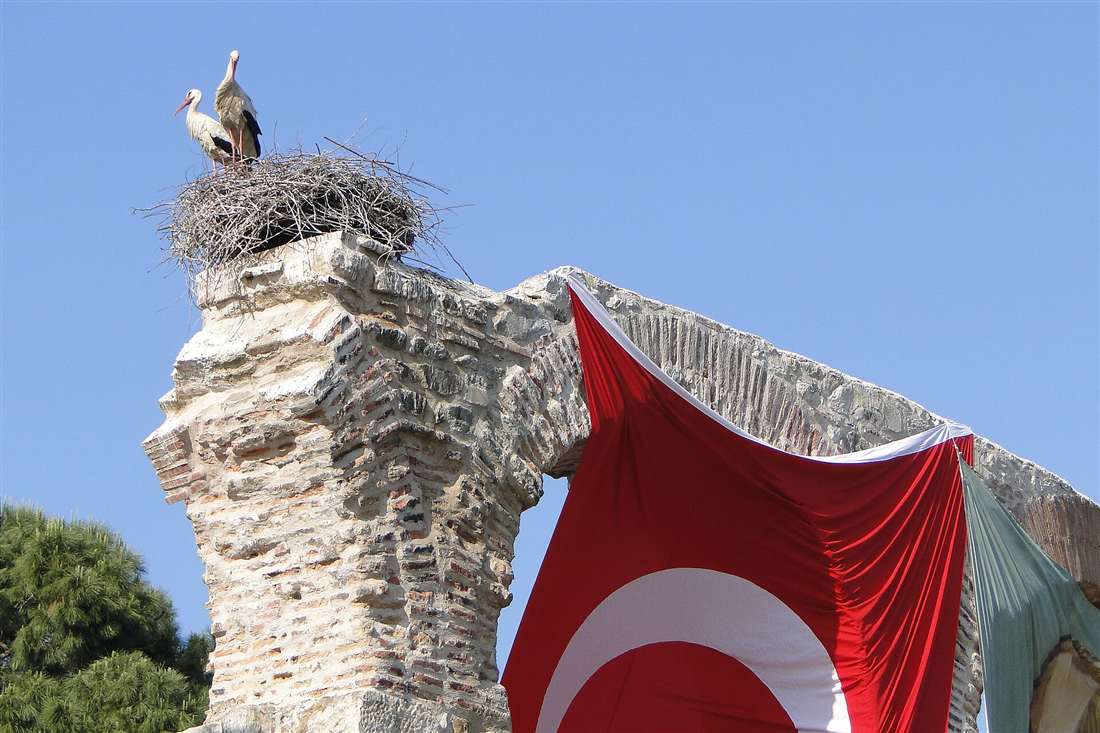
The Saturday market fills the streets around Cengiz Topel Caddesi with the produce of the Aydın plain: figs, olives, peppers, cheeses, honey and herbs, sold from trestle stalls by growers from the surrounding villages. A smaller market runs midweek. The aqueduct that once carried water to the ancient city marches through the middle of town in a row of brick-and-stone arches, and white storks build their bulky nests on the pillar tops through spring and summer, clattering their bills above the café tables.
The local speciality is çöp şiş, small cubes of marinated meat grilled on thin skewers over charcoal and served with flatbread, grilled tomato and pepper, a dish the town claims as its own. The cafés along the pedestrian streets pour Turkish coffee and tea beneath the plane trees, and the boutique guesthouses in the old quarter put visitors a short walk from every monument. For where to base yourself across the district, the where to stay near Ephesus page sets out the options in the town, in Şirince and on the coast.
The name çöp şiş means rubbish skewer, a reference to the thin wooden splinters the meat is threaded on, and the Selçuk version uses small hand-cut cubes of beef marinated in onion juice, tomato and oil, grilled fast over hot charcoal and rolled into lavaş bread with parsley and sumac onions. The grill houses cluster on the streets around the museum, and a portion runs to a stack of skewers rather than a single kebab. Aydın figs, artichokes and pine honey turn up on the same tables, the produce of the surrounding plain.
The storks are the town’s living emblem. White storks migrate north from Africa each spring and build their stick platforms on the tops of the Byzantine aqueduct pillars that stride down the middle of Selçuk, so the birds nest a few metres above the café awnings and the traffic. The aqueduct itself, a line of brick-and-stone arches, once fed water to the medieval town, and the storks have colonised it so thoroughly that the sound of their bill-clattering carries over the street. The pedestrianised centre around Namık Kemal and Siegburg streets gathers the tea gardens, the çöp şiş grills and the craft shops within a couple of blocks of the station.
How long do you spend in Selçuk and how do you get around?
Two days suit Selçuk: one for Ephesus, the museum and the town monuments, a second for Şirince, Pamucak and the House of the Virgin Mary. The walkable centre puts the museum, temple, mosque, basilica and castle on foot, while a dolmuş or taxi reaches the outlying sites.
The compact core means the Ephesus Archaeological Museum, the Temple of Artemis field, the Isa Bey Mosque, the Basilica of St John and Ayasuluk Castle string into a single walking loop of a morning, with the aqueduct and market on the return. Ephesus itself lies 3 km southwest, an easy walk down the tree-lined road, a short dolmuş ride, or a five-minute taxi to the lower gate. Enter at the lower Magnesia gate and walk downhill to the Library and theatre to save the climb.
The outlying trips run on the minibus network from the town otogar: dolmuş services climb the 8 km east to Şirince and cover the 7 km west to Pamucak in season, while the mountain road to the House of the Virgin Mary needs a taxi, a tour or a hire car. Selçuk sits on the İzmir–Aydın railway, with direct trains to İzmir in about ninety minutes, and İzmir Adnan Menderes Airport lies an hour north by road or rail. Base yourself in the town centre to walk to the monuments and ride out to the coast, the village and the shrine across two unhurried days.
Frequently Asked Questions
What are the top things to do in Selcuk?
The top things to do in Selcuk are the ancient city of Ephesus, the Ephesus Museum, the Basilica of St John, the Temple of Artemis and the Isa Bey Mosque, with Sirince village and Pamucak beach a short ride from the town.
How long do you need in Selcuk?
Two days suit Selcuk: one for the ancient city of Ephesus and the House of the Virgin Mary, and one for the museum, the Basilica of St John, the castle, the Isa Bey Mosque and a trip to Sirince or Pamucak.
Is Selcuk worth visiting beyond Ephesus?
Selcuk rewards a stay beyond Ephesus. The town holds the Ephesus Museum, the Basilica of St John, the Temple of Artemis, the Isa Bey Mosque and Ayasuluk Castle, and it is the base for Sirince and Pamucak beach.