
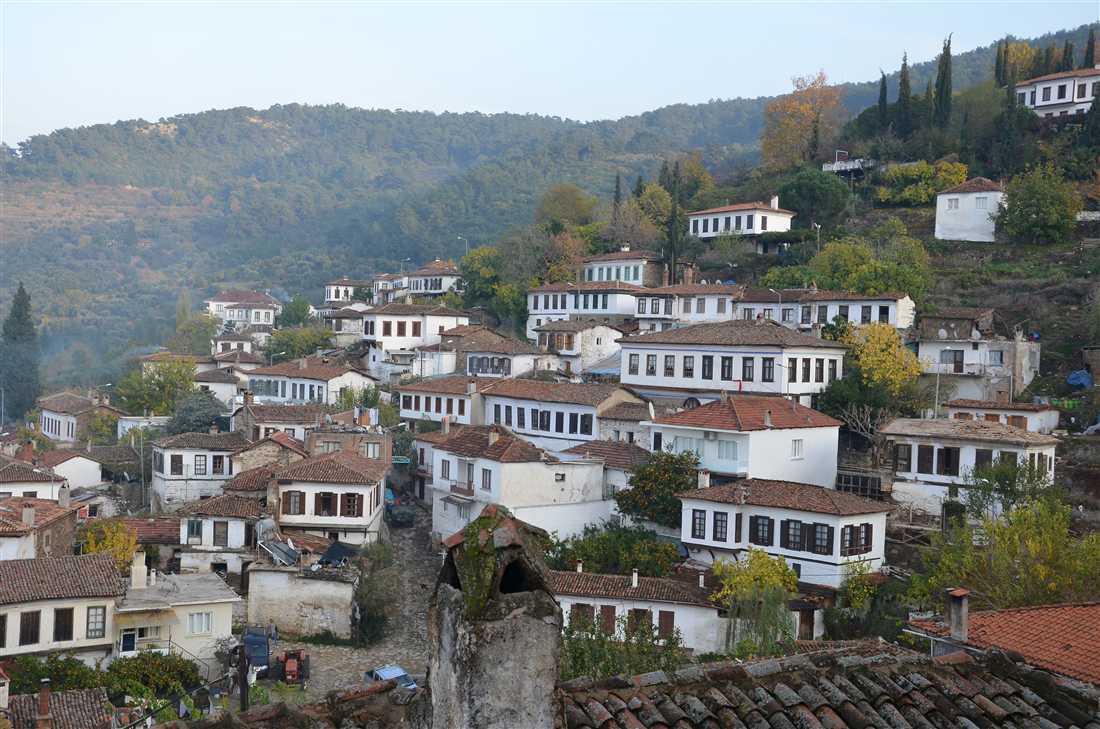
Sirince is a picturesque hillside village of stone-and-stucco houses about 8 kilometres above Selcuk near Ephesus, famous for its homemade fruit wines, its old Greek-village architecture and its terraced views over the vineyards and orchards. Plan the whole trip with Greece Tours.
This guide covers Sirince village in full: what it is and where it stands, how to get there, what it is famous for, its history as the Greek village of Kirkinca and the population exchange, the fruit wines, what to see and do, the local food, the doomsday story, the best time to visit, and how to combine it with Ephesus and Selcuk.
What is Sirince village?
Sirince is a picturesque hillside village of stone-and-stucco houses above Selcuk in Turkey’s Izmir Province, famous for its homemade fruit wines, its old Greek architecture and its terraced setting among vineyards, olive groves and peach orchards.
The village sits on the flanks of a fertile valley roughly eight kilometres east of Selcuk, tucked into the Aydin mountains at an elevation near 350 metres. White and ochre houses with red-tiled roofs and timber-framed upper storeys climb the two facing slopes, their windows and wooden balconies looking across a narrow ravine planted with fruit trees. The layout is dense and vertical: cobbled lanes twist upward between garden walls, stone stairways link one terrace of houses to the next, and the two nineteenth-century churches anchor the skyline at the top of each slope. The architecture is the reason Sirince reads as a Greek village transplanted into Anatolia, because that is precisely what it was before the twentieth century reshaped the region’s population.
Sirince belongs to the wider cultural region that links the Aegean coast of Turkey with the Greek islands and mainland, a shared world of olive oil, vine terraces and Orthodox stone churches. Visitors who plan a broader Aegean itinerary through Greece Tours encounter the same building traditions across the water, which makes the village a natural stop for travellers already crossing between the two countries. The stucco-over-stone houses, the deep-set doorways and the vine-shaded courtyards belong to a single Aegean vernacular that ignores the modern border.
Today around six hundred residents live in Sirince year-round, and the economy runs on three pillars: fruit-wine production, tourism and small-scale farming. The village escaped demolition and heavy modern rebuilding, so its historic fabric survives largely intact, and it now carries protected-heritage status that limits new construction and preserves the traditional silhouette. What draws the day-trippers, coach groups and independent travellers is a compact, walkable settlement where the wine cellars, the craft stalls, the breakfast terraces and the church viewpoints all sit within a few minutes of each other.
The name Sirince means “pleasant” or “pretty” in Turkish, a label applied after the population exchange replaced the earlier Greek name. That renaming captures the village’s modern identity: a scenic, atmospheric hill settlement whose appeal rests on preserved old houses, artisanal food and drink, and a relaxed pace that contrasts sharply with the crowds at the archaeological sites nearby. It functions as the gentle, human-scaled counterpart to the monumental ruins a short drive downhill.
Where is Sirince and how do you get there?
Sirince lies about eight kilometres east of Selcuk in the hills of Izmir Province, reached by dolmus minibus from Selcuk’s bus station, by taxi, by private car up a winding paved road, or on an organised tour from Selcuk, Kusadasi and Izmir.
Selcuk is the gateway. The town’s otogar (bus station) runs frequent dolmus minibuses up to Sirince throughout the day, a journey of roughly fifteen minutes that climbs steadily through orchard country to the village entrance. The dolmus is the cheapest route and drops passengers at the lower edge of Sirince, from where the lanes rise on foot. Departures are regular in daylight hours, thinning in the late afternoon, so travellers relying on the minibus plan the return before the last service.
Drivers reach the village on a well-surfaced but narrow and steeply switchbacked road that leaves Selcuk to the east. Parking sits at the village edge, because the historic core is pedestrianised and the lanes are too tight and too stepped for vehicles. From Kusadasi the drive runs about twenty-five kilometres and takes around forty minutes; from Izmir the distance is near eighty kilometres, close to a ninety-minute drive down the motorway to Selcuk and then up into the hills. Izmir’s Adnan Menderes Airport is the nearest air gateway, roughly an hour to the north.
Rail adds another option. Trains on the regional line link Izmir with Selcuk, and from Selcuk station a short taxi or dolmus hop completes the trip to the village. This combination suits travellers arriving from Izmir without a car. Getting up to the village itself, though, always ends with the same last leg on the hillside road, whether by taxi, minibus or private vehicle.
Organised excursions bundle the transport and remove the logistics:
- From Selcuk: half-day trips pair the village with the archaeological sites, a taxi or minibus handling the short uphill run.
- From Kusadasi: tours combine the cruise-port town with the village and the ancient city in one loop, a common shore-excursion format.
- From Izmir: full-day tours descend the coast to take in the ruins and the wine village together.
- By private transfer: a hired car with driver gives the most flexible timing and a door-to-door service up the switchbacks.
Because the village clusters at the top of a valley with no through-traffic, every arrival converges on the same walkable centre. The practical decision is less about which town to start from and more about whether to travel independently by dolmus or to fold the visit into a wider day that also covers the antiquities downhill.
What is Sirince famous for?
Sirince is famous above all for its homemade fruit wines, alongside its preserved Greek-village houses, its cold-pressed olive oil, its handmade crafts and textiles, and the relaxed hillside setting that makes it a scenic escape from the archaeological crowds nearby.
The fruit wines define the village’s reputation. Small family cellars and tasting shops line the lanes, pouring wines pressed not from grapes alone but from peach, pomegranate, blackberry, mulberry, quince, strawberry, cherry, melon and apple. Racks of coloured bottles fill every shopfront, and the free or low-cost tasting culture turns a walk through Sirince into a slow crawl of sampling. This artisanal, fruit-forward drinking tradition is the single thing most visitors associate with the name.
The architecture is the second draw. Sirince survives as one of the best-preserved examples of an Anatolian Greek village, its stucco-fronted stone houses, timber balconies and stepped lanes intact enough that the whole settlement reads as an open-air record of pre-exchange Aegean life. The protected heritage status keeps the fabric largely frozen, so the streetscape delivers the atmosphere of a vanished world rather than a reconstruction.
Beyond wine and buildings, the village trades on its produce and crafts:
- Olive oil: cold-pressed from the surrounding groves and sold direct from producer stalls.
- Dried fruit and preserves: figs, apricots, jams and fruit leathers spread across the market tables.
- Textiles and lace: handwoven scarves, cotton cloth and needle-lace worked by village women.
- Soaps and herbal goods: olive-oil soaps, dried herbs and natural sponges.
- Local honey and molasses: pekmez fruit syrups and comb honey from the valley.
The setting binds all of this together. Sirince offers terraces and courtyards with long views over the orchard valley, a cool hill breeze in the warm months, and a walkable centre free of traffic. That combination of tasting culture, historic streetscape, artisanal shopping and scenery is what has turned a small farming village into one of the most-visited destinations in the Selcuk hinterland, distinct from the monumental appeal of the ruins downhill because it sells atmosphere, flavour and craft rather than antiquity.
What is the history of Sirince?
Sirince was the Greek Orthodox village of Kirkinca until the early twentieth century, when its Greek population departed in the compulsory population exchange between Greece and Turkey and Turkish Muslim families arriving from the Thessaloniki region resettled the emptied houses.
Before the exchange the village was known as Kirkinca (also rendered Cirkince), a prosperous Greek-speaking Orthodox community that farmed the terraced slopes, pressed olive oil and made wine. The two large stone churches, the substantial two-storey houses and the dense masonry lanes all date from this Greek era and testify to the wealth the village drew from its vineyards and orchards. Kirkinca supplied labour and produce to the wider region and maintained schools and churches typical of a settled Anatolian Greek town.
The turning point was the compulsory exchange of populations agreed between the two states after the wider Greco-Turkish conflict. Under that agreement the Orthodox Christian inhabitants of the Anatolian coast were sent to Greece while Muslims from Greek territory moved the other way. Kirkinca’s Greek families left for Greece, and the abandoned houses were allotted to incoming Turkish Muslim families, a large share of them from the countryside around Thessaloniki. The newcomers took over the standing village largely as they found it, which is why the Greek-built fabric survived rather than being cleared and replaced.
The renaming to Sirince followed the resettlement. Accounts hold that the incoming residents first carried a dismissive name for the steep, awkward site and that authorities substituted “Sirince”, meaning pleasant or pretty, to give the village a favourable identity. Whatever the exact origin, the new name marked the break with the Kirkinca era and the start of the village’s Turkish chapter.
For decades afterward Sirince remained a quiet agricultural settlement, its economy resting on fruit, olives and wine. Its later transformation into a tourist destination rested on the very thing the exchange had left behind: an intact Greek-village streetscape. The preservation of that architecture, combined with the fruit-wine tradition the resettled community continued and expanded, turned a piece of difficult twentieth-century history into the village’s central attraction. Travellers walking the lanes today move through the physical inheritance of a community that no longer lives there, maintained by the descendants of the families who replaced it.
What are the fruit wines of Sirince?
Sirince’s fruit wines are homemade beverages fermented from local fruit rather than grapes alone, produced in small family cellars from peach, pomegranate, blackberry, mulberry, quince, strawberry, cherry, apple and melon, and poured for tasting across dozens of village shops.
The tradition grew out of the orchards that terrace the valley. Where classic winemaking relies on the grape, Sirince’s producers press and ferment whatever the surrounding slopes yield, turning peaches, berries and stone fruit into sweet, low-tannin wines with pronounced fruit character. The results range from pale, delicate peach and melon wines to deep, dark pomegranate and blackberry bottlings, and the sweetness level runs high compared with a dry grape wine, which suits the sampling-and-dessert role the drinks play for most visitors.
The fruits worked into wine across the village include:
- Peach and apricot — soft, golden and among the most popular pours.
- Pomegranate — deep red, tart-edged and a signature of the region.
- Blackberry and mulberry — dark, jammy and full-bodied.
- Quince and apple — pale, aromatic and lightly astringent.
- Strawberry, cherry and melon — bright, sweet and fragrant.
The tasting culture is central to the experience. Shopfronts stack rows of colourful bottles and set out small glasses for sampling, so a walk up the lanes becomes a sequence of tastes across different fruits and cellars. Producers pour freely or for a token charge, explaining which fruit went into each bottle and how sweet or dry it turned out. Alongside the wines, the same shops sell fruit vinegars, liqueurs and the syrupy fruit molasses called pekmez, extending the range beyond wine to the wider world of preserved fruit.
Quality varies because production is artisanal and unstandardised; these are village wines made in small batches, not industrial vintages, and part of the appeal is exactly that handmade, farmhouse character. Visitors buy bottles direct from the cellar that made them, sometimes watching the fermentation vessels through an open cellar door. Grape wine is produced too, tied to the local harvest, but the fruit wines are what set Sirince apart and what most travellers carry home. The drinks turn the village’s agricultural base into a tasting destination, making the orchard terraces edible and drinkable rather than merely scenic.
What is there to see and do in Sirince?
Sirince’s sights centre on its two nineteenth-century Greek churches, St John the Baptist and the Church of Dimitrios, joined by cobbled lanes, wine-tasting cellars, craft and produce market stalls, breakfast terraces, and hillside viewpoints over the orchard valley.
The churches are the historic anchors. St John the Baptist stands on the upper slope, a substantial stone basilica from the Greek era with a surviving interior of columns, painted decoration and a raised women’s gallery, restored and open to visitors as a monument to the pre-exchange community. The Church of Dimitrios, on the opposite rise, is the older and larger of the two, its shell and belfry commanding the skyline even where the interior has weathered. Together they frame the village between two summits and mark the Orthodox faith of the settlement that built Sirince.
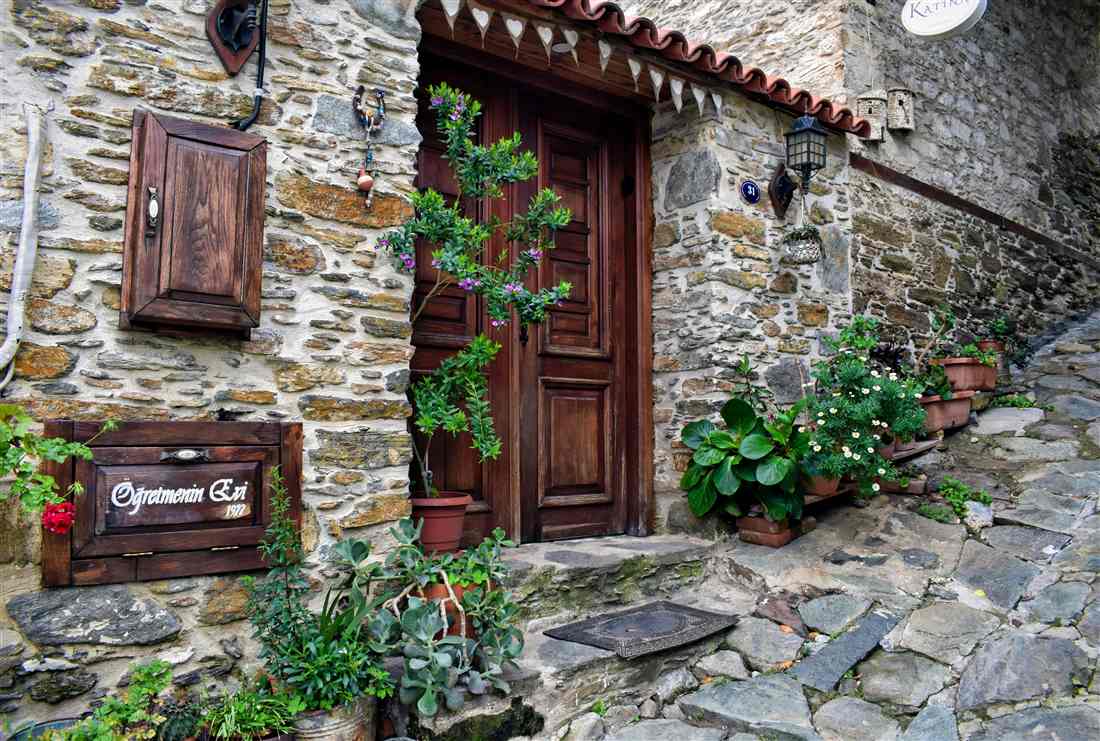
Between the churches the lanes themselves are the attraction. Wandering the stepped, cobbled streets past stucco houses, vine-draped courtyards and open cellar doors is the core activity, and the compact layout makes it easy to cover the whole village on foot in a couple of hours. The market threads through these lanes: stalls and shops selling fruit wine, olive oil, dried fruit, jams, honey, soaps, lace, scarves and trinkets, staffed by villagers who press samples on passers-by.
Things to do across a visit include:
- Tasting fruit wines at the cellars that line the main lanes.
- Visiting both churches for the architecture and the valley views from their terraces.
- Eating a long village breakfast on a terrace overlooking the orchards.
- Shopping the craft stalls for olive-oil soap, textiles and preserves.
- Climbing to the viewpoints where the two slopes of houses face each other across the ravine.
The viewpoints reward the climb. From the upper reaches near St John the Baptist the whole village spreads below, red roofs stacked against green terraces, with the orchard valley falling away toward Selcuk. Photographers work these angles in the softer light of morning and late afternoon. The pace throughout is unhurried; Sirince rewards lingering over a glass and a plate more than a checklist rush, and its pleasures are cumulative — the taste of a peach wine, the cool of a stone lane, the long view from a church terrace all adding to a single relaxed impression.
What food is Sirince known for?
Sirince is known for its lavish village breakfast, hand-rolled gozleme flatbreads, cold-pressed olive oil, local cheeses, dried fruit and preserves, and hearty home-style Anatolian dishes served on terraces and in family-run restaurants overlooking the valley.
The village breakfast is the standout meal. Koy kahvaltisi arrives as a spread of small plates: white and aged cheeses, olives, tomatoes and cucumbers, honey and clotted kaymak cream, butter, jams, fresh village bread, boiled or fried eggs, herb dips and glasses of tea. Served on a shaded terrace above the orchards, this drawn-out morning feast is a destination in its own right and pulls day-trippers up from the coast specifically to eat.
Gozleme is the village’s signature snack. Women roll thin dough by hand at open griddles and fill the flatbread with cheese, spinach, minced meat or potato before folding and toasting it, serving it hot with a glass of ayran. Watching the dough stretched and cooked at the roadside stalls is part of the appeal, and the fresh, savoury result is the classic thing to eat on a walk through the lanes.
The village’s food specialities include:
- Koy kahvaltisi — the multi-plate village breakfast with cheeses, honey and kaymak.
- Gozleme — hand-rolled stuffed flatbread cooked to order.
- Olive oil and olives — pressed and cured from the surrounding groves.
- Local cheeses — fresh white cheese and aged varieties from valley dairies.
- Dried fruit and jams — figs, apricots, quince paste and fruit preserves.
Beyond breakfast and gozleme the restaurants serve full Anatolian home cooking: slow-cooked meat and vegetable stews, stuffed vegetables, grilled meats, mezes and seasonal salads dressed in the local oil, rounded off with fruit and the ubiquitous fruit wine. Terraces stagger up the slopes so that most tables face out over the orchards, turning a meal into a view as much as a plate. The produce that fills these kitchens — the oil, the cheese, the fruit — comes from the same valley terraces that feed the wine cellars, so eating in Sirince is a direct taste of the surrounding land, and the local shops let visitors carry that produce home in the form of oil, honey, dried fruit and jars of preserves.
Why did Sirince become famous for the doomsday story?
Sirince became internationally famous when a widely circulated end-of-the-world prophecy tied to an ancient calendar named the village as a spiritual safe haven, drawing a surge of believers, curiosity-seekers and press coverage to the small hillside settlement.
The episode grew from a doomsday scare linked to the completion of a cycle in an old Mesoamerican calendar, a prediction that captured global attention as the supposed date approached. Amid the speculation, a claim spread that Sirince held a special positive energy and that its situation spared it from the predicted catastrophe. Explanations offered at the time linked the village to nearby religious tradition, including the belief that the Virgin Mary spent her final years in the hills above Ephesus, lending the location an aura of sanctuary.
The result was a rush of visitors. Where the village normally received a steady trickle of day-trippers, the run-up to the predicted date brought a swell of arrivals: spiritual pilgrims convinced of the safe-haven story, tourists chasing the spectacle, and journalists documenting the phenomenon. Accommodation filled, prices climbed, and local businesses met the demand with themed goods and a brisk trade in the very fruit wine the village was already known for. The tiny settlement briefly turned into a global news item.
The scale of the moment is captured in a few threads:
- The trigger — a calendar-cycle prophecy that gripped worldwide attention.
- The claim — that Sirince’s energy and sacred surroundings made it a refuge.
- The crowd — believers, sightseers and reporters converging on the lanes.
- The aftermath — the predicted end passed uneventfully and life resumed.
When the date came and went without incident, the crowds dispersed and the village returned to its normal rhythm. The lasting effect was reputational: the doomsday story pushed Sirince onto the international map far beyond the regional fame its wines had earned, and the name recognition outlived the prophecy that produced it. The episode remains a curious footnote that travellers recall, a moment when a quiet Anatolian wine village stood at the centre of a global end-times story and emerged, unsurprisingly, unharmed and better known.
When is the best time to visit Sirince?
The best time to visit Sirince is spring and autumn, when mild weather and thinner crowds make the hillside lanes comfortable, with midweek preferred over busy weekends and the late-summer-into-autumn grape and fruit harvest adding seasonal produce and energy.
Spring brings the valley into bloom. The orchards flower, the terraces green up, and daytime temperatures sit in a comfortable range for walking the stepped lanes and climbing to the churches. The light is soft, the surrounding hills are lush from the winter rains, and the tourist volume has not yet peaked, which makes this one of the two ideal windows for a visit. Wildflowers on the slopes and the freshness of the season reward travellers who come before the summer heat.
Autumn is the equal of spring and adds the harvest. As the summer heat breaks, the grape and fruit picking gets under way, cellars fill with the new pressing, and the produce stalls overflow with figs, grapes, pomegranates and freshly made syrups. The weather cools to a pleasant walking temperature, the crowds thin after the summer rush, and the village takes on a working, seasonal buzz that suits travellers who want to see the wine tradition in motion rather than merely tasted.
Timing considerations by season:
- Spring: mild, green and flowering, with moderate crowds — a prime window.
- Autumn: cooler after summer, thinner crowds and the fruit harvest — equally prime.
- Summer: hot and busiest, with the lanes crowded and shade at a premium.
- Winter: quiet and cool, atmospheric but with businesses at reduced hours.
The time of day and week matters as much as the season. Weekends and public holidays draw domestic day-trippers and coach groups, so the lanes tighten and the cellars fill; a midweek visit is calmer. Arriving early in the morning, ahead of the tour buses that climb up after the coast wakes, secures a quieter breakfast terrace and emptier streets for photographs. Whatever the month, the hill setting keeps Sirince a touch cooler than the coast below, a genuine advantage in the warm season and a reason the village has long served as a summer retreat from the heat of the plain.
How do you combine Sirince with Ephesus and Selcuk?
Sirince pairs naturally with a Selcuk day: travellers tour the ancient city of Ephesus, add the Basilica of St John and the Ephesus Museum in Selcuk, then drive eight kilometres uphill to the village for a late lunch, wine tasting and the valley views.
The geography makes the combination effortless. Selcuk sits at the centre of the cluster, with the ruins of Ephesus a short distance to the west and the wine village a short distance to the east. A single day covers all of it: the monumental marble streets, libraries and theatre of the ancient city in the cooler morning, the town’s museum and Byzantine basilica around midday, and the village in the softer afternoon light. The order works because the antiquities demand energy and shade-planning while the village rewards a slower, later pace built around eating and tasting.
A workable one-day itinerary runs:
- Morning: the ancient city of Ephesus, entered early before the heat and the coach crowds build.
- Late morning: the Basilica of St John on Ayasuluk Hill and the Temple of Artemis remains in Selcuk.
- Midday: the Ephesus Museum in Selcuk town for the finds lifted from the site.
- Afternoon: the drive up to Sirince for lunch, fruit-wine tasting and the church viewpoints.
Tour operators build exactly this pairing for coastal visitors. From the cruise port, an excursion covering Ephesus from Kusadasi commonly folds the village in as its relaxed final stop, turning a ruins-focused morning into a rounded day of history followed by food and wine. Travellers based further north choose Ephesus from Izmir, descending the coast for the same combination of ancient city and hill village. The village works as the decompression at the end of an intense archaeological day.
The logic of the pairing is contrast. Ephesus overwhelms with scale, marble and antiquity; Sirince restores with shade, flavour and a human-sized streetscape. Doing the ruins first and the village second lets travellers spend their freshest hours on the demanding site and their unwound afternoon over a long table with a glass of peach wine. The eight-kilometre hop between them is short enough that no time is lost in transit, which is why nearly every organised day trip in the district treats the ancient city and the wine village as a single, complementary outing rather than two separate destinations.
Is Sirince village worth visiting?
Sirince is worth visiting for its fruit wines, its preserved Greek-village character and its hillside views, offering a relaxed, atmospheric half-day that complements the archaeological heavyweights nearby and suits travellers who value food, scenery and a slow pace.
The case for going rests on three strengths. The fruit wines are a distinctive, taste-and-buy experience found in this concentration almost nowhere else, turning a walk through the lanes into a slow crawl of peach, pomegranate and blackberry samples. The architecture delivers a genuinely preserved Anatolian Greek streetscape, a rare surviving record of the pre-exchange Aegean world rather than a rebuilt facsimile. And the setting supplies long views, terraced orchards and a cool hill breeze that make lingering over a breakfast or a glass its own reward.
Set against that, the honest caveats are crowding and commerce. On weekends, holidays and midsummer the narrow lanes fill with coach groups, the tasting shops turn hard-selling, and the atmosphere tips toward a busy market. Travellers expecting an undiscovered hamlet find instead a well-established tourist village geared to day-trippers. The way to keep the magic is to come midweek, arrive early, and let the pace stay unhurried rather than treating the village as a checklist stop.
Sirince suits particular travellers best:
- Food and wine lovers drawn by the fruit-wine cellars and the village breakfast.
- History and architecture enthusiasts who value the intact Greek-village fabric.
- Photographers after the stacked red roofs, cobbled lanes and valley viewpoints.
- Ephesus visitors wanting a relaxed afternoon to round off a day at the ruins.
- Travellers seeking a slow pace over a rushed sightseeing agenda.
The verdict is a clear yes with a small condition. As a standalone attraction the village is pleasant rather than essential, but as the gentle counterpoint to a demanding morning at the ancient city it is close to ideal, and the eight-kilometre distance makes the pairing almost free of effort. Travellers who fold Sirince into a wider Selcuk day, come outside the peak crush, and give themselves time to taste, eat and look out over the orchards leave with the strongest impression: a scenic, flavourful, historically resonant hill village that earns its place on an Aegean itinerary.
Frequently Asked Questions
What is Sirince village famous for?
Sirince is famous for its homemade fruit wines, its old Greek-village houses of stone and white stucco, and its relaxed hillside setting above Selcuk. Tasting shops line the cobbled lanes, selling peach, pomegranate and blackberry wine.
Where is Sirince and how do you get there?
Sirince sits about 8 kilometres east of Selcuk in the hills, reached by dolmus minibus, taxi, hire car or an organised tour. Selcuk, the Kusadasi cruise port and Izmir all serve as bases for the short trip up.
How do you combine Sirince with Ephesus?
Sirince pairs with a morning at Ephesus and the Ephesus Museum in Selcuk, adding a hillside village lunch and wine tasting in the afternoon, a route run from the Kusadasi cruise port and from Izmir.