
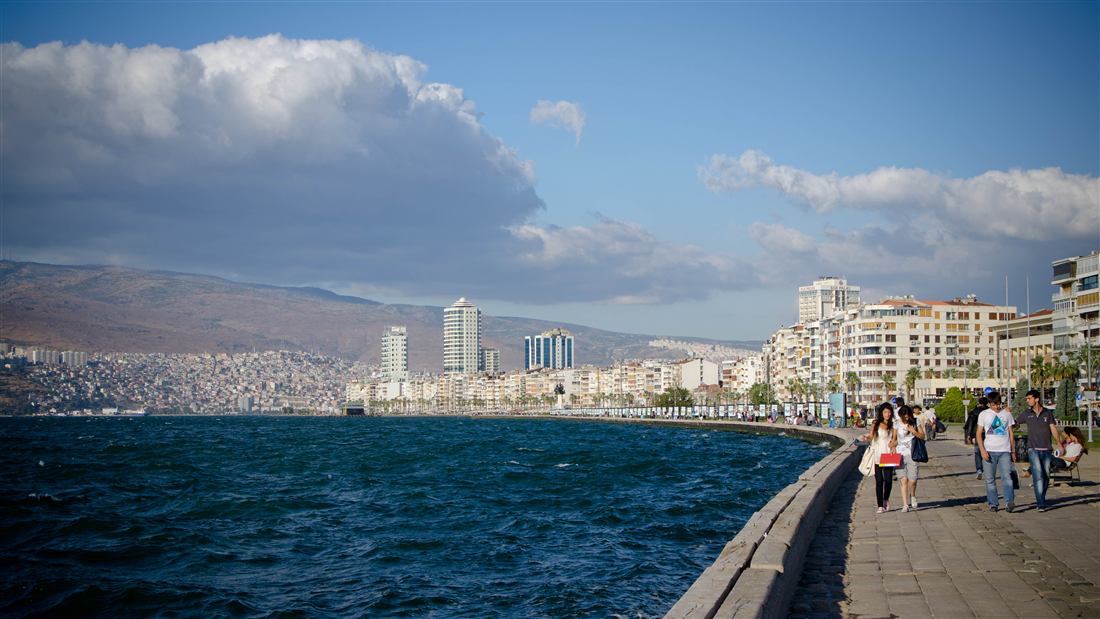
Ephesus from Izmir is an easy day trip: the ancient city near Selcuk lies about 80 kilometres south of Izmir, an hour by road or a suburban train ride, making Izmir the mainland base for visiting Ephesus. Plan the whole trip with Greece Tours.
This guide covers Ephesus from Izmir in full: how to get there and how far it is from the city and the airport, the transport options from private transfer to the Izban train and the bus, what a day tour includes, what you see at Ephesus, how long the day takes, combining Ephesus with Pamukkale and Sirince, the cost against the Kusadasi cruise-port route, and the best time to go.
How do you get to Ephesus from Izmir?
Ephesus sits beside Selçuk, about 80 kilometres south of Izmir, a one-hour drive on the O-31 and D550 highways. Private transfer, hire car, the İZBAN suburban train, and intercity bus each connect the city to the ruins directly.
Izmir is the natural mainland gateway to the ancient city. The metropolis anchors Turkey’s Aegean coast, and Ephesus lies a short hop to its south near the town of Selçuk. The drive tracks the coastal plain past Torbalı and Belevi, then swings into the fertile valley of the Küçük Menderes river, the ancient Cayster, where olive groves and peach orchards frame the road. The archaeological site opens at two gates: the Upper (Magnesia) Gate on the Selçuk–Aydın road and the Lower Gate near the House of the Virgin Mary turnoff.
The most direct road route leaves Izmir on the Aydın motorway, exits toward Selçuk, and reaches the parking area in roughly sixty minutes outside rush hour. Travellers organising a wider Aegean itinerary through Greece Tours pair the Turkish coast with the Greek islands that face it, since Samos and Chios lie within sight of this shoreline. The proximity makes Izmir a workable base for a single-day excursion that returns to the same hotel by evening.
Three practical starting points define the journey from the Izmir side:
- Izmir city centre — Konak, Alsancak, and Basmane hotels put you 80 kilometres from the site.
- Izmir Adnan Menderes Airport — 60 kilometres south of the ruins and closer than the centre, making it a smart transfer origin for arriving flights.
- Selçuk town — the gateway settlement 3 kilometres from the Upper Gate, home to the İZBAN station, the İsa Bey Mosque, and the Basilica of Saint John.
The self-contained ancient city rewards a half-day of walking, and the surrounding cluster of monuments turns the trip into a full day. Independent travellers reach the ruins by train and taxi; organised visitors ride a door-to-door coach or minibus with a licensed guide. Whichever mode you choose, the road distance stays short enough to leave Izmir after breakfast and stand before the Ephesus Library of Celsus well before the midday heat peaks.
Signage on the D550 marks the Efes and Selçuk exits clearly in Latin script, and fuel stations line the route at Torbalı and Belevi. The final approach passes the Belevi Mausoleum, a Hellenistic tomb second in scale only to the Halicarnassus Mausoleum, before the road drops toward the ruins. For drivers, the paved car parks at both gates hold coaches and cars, with a shuttle option in peak months that spares the walk between the two entrances. The route is straightforward, well maintained, and lit for the full stretch out of the metropolitan zone.
Izmir itself frames the journey with its own draws. The Kordon promenade at Alsancak lines the gulf with palm-shaded cafés, the Konak Clock Tower marks the historic core, and the Kemeraltı bazaar tunnels through Ottoman-era caravanserais. A traveller who bases in the city walks these sights on the evening before or after the ruins, turning a single Ephesus run into a two-sided stay that pairs a Roman metropolis with a living Aegean port. The distance to Selçuk stays short enough that neither half of that stay crowds the other.
How far is Ephesus from Izmir and from Izmir Airport?
Ephesus lies 80 kilometres from central Izmir, a drive of one hour, and 60 kilometres from Izmir Adnan Menderes Airport, roughly forty-five minutes. The airport sits between the city and the ruins, shortening any transfer that begins with a landing.
The geography works in the traveller’s favour. Adnan Menderes Airport stands at Gaziemir on the southern edge of Izmir, already 20 kilometres nearer to Selçuk than the downtown waterfront. A visitor who lands and heads straight to the ruins shaves a quarter of the distance off a trip that starts at a Konak hotel. This layout turns the airport into a favoured pickup point for pre-booked transfers, especially for guests continuing to Kuşadası or the Dilek Peninsula afterward.
The distance figures break down cleanly by origin:
- Izmir Konak / Alsancak waterfront — 80 km, 60 minutes by car on the D550/O-31.
- Izmir Adnan Menderes Airport (Gaziemir) — 60 km, 45 minutes on the D550 south.
- Izmir Basmane rail hub — 82 km by road, or a direct İZBAN train ride to Selçuk.
- Selçuk town centre to the Upper Gate — 3 km, a five-minute drive or a level twenty-minute walk.
Drive times stretch during the morning commute out of Izmir and on summer weekends, when Aegean beach traffic thickens the D550. A departure before eight in the morning clears the metropolitan bottleneck and holds the airport-to-ruins run near forty minutes. The road is dual-carriageway for most of the stretch, dropping to a single lane each way only on the final rural approach into Selçuk.
The airport’s position also reshapes the economics of a visit. Flights from Istanbul, Ankara, and a roster of European cities land at Adnan Menderes throughout the day, and a transfer collected at arrivals reaches the Upper Gate before the first cruise coaches roll in from the port of Kuşadası. For a traveller with a single day in the region and an evening flight out, the airport doubles as start and finish, with luggage stored at the terminal and the ruins slotted into the hours between. The Temple of Artemis stands on the direct line between Selçuk and the airport road, so its single re-erected column fits into the return leg without any detour.
Measured against rival gateways, Izmir’s distance is longer than Kuşadası’s 20 kilometres but far shorter than Bodrum’s 150 or Marmaris’s 190. The trade-off favours Izmir for travellers who want a real city as their base, with a full airport, a metro, a seafront promenade, and a bazaar, rather than a resort strip built around the harbour.
The airport itself connects Izmir to a wide flight map. Domestic services link Adnan Menderes to Istanbul’s two airports, Ankara, and Antalya through the day, while seasonal international routes reach London, Berlin, Amsterdam, and the Gulf. A visitor lands, clears the compact terminal, and stands at the İZBAN platform beneath the arrivals hall inside twenty minutes. That vertical link between the runway and the rail line is the detail that makes the airport the most efficient origin for an Ephesus day, ahead of the downtown hotels that add road distance without adding value to the ruins run.
What are the transport options from Izmir to Ephesus?
Five modes link Izmir to Ephesus: a private transfer or guided tour, a self-drive hire car, the İZBAN suburban train to Selçuk, an intercity bus or dolmuş, and a metered taxi. Each trades cost against convenience and flexibility.
The choice hinges on budget, group size, and appetite for logistics. A door-to-door tour removes every transfer worry and adds a guide who reads the stones for you. Independent travel by train and dolmuş costs a fraction of that but demands connections and a walk in the heat. The full menu of options runs as follows:
- Private transfer or guided tour — hotel or airport pickup, air-conditioned vehicle, licensed guide, and site tickets bundled into one price. Zero navigation, fixed timing.
- Hire car — collected at the airport or downtown, roughly one hour each way, full freedom to add Şirince, Meryemana, and the Artemis column. Parking at both gates.
- İZBAN suburban train — the electrified commuter line from Izmir to Selçuk, cheap, frequent, and immune to road traffic, followed by a short taxi to the gate.
- Intercity bus and dolmuş — coaches to Selçuk otogar from Izmir’s main terminal, then a shared minibus or taxi to the ruins.
- Metered taxi — a straight point-to-point ride, the priciest independent choice, useful for late departures or small groups splitting the fare.
The private transfer suits arriving flight passengers who value time over savings. A driver waits at arrivals, loads the luggage, and delivers the party to the Upper Gate inside forty-five minutes. Guided versions layer a walking commentary onto the same transport, turning transit into part of the experience rather than dead time on the highway.
Self-drive rewards travellers who want to control the clock. A hire car reaches the ruins at opening, moves on to the hilltop House of the Virgin Mary, drops into Şirince for lunch, and returns to Izmir by dusk, all on one tank of fuel. Turkish road signs use international symbols, and the D550 is a modern highway, so the drive stays low-stress. Fuel, tolls on the O-31 motorway, and the car-park fee are the running costs to budget.
Budget travellers lean on the İZBAN and the dolmuş network. The train runs from Izmir’s Alsancak and Basmane stations to Selçuk on a fixed timetable, and a Selçuk taxi covers the final 3 kilometres to the Upper Gate for a modest fare. The saving is real, the ride longer, and the reward a visit conducted on local rhythms rather than a coach schedule. Travellers weighing the boat-port alternative study the Ephesus from Kusadasi route, since the cruise harbour trims the drive to twenty minutes.
The intercity coach fills the gap for travellers without a rail connection at their hotel. Buses depart Izmir’s main otogar at Bornova on a frequent schedule, run the D550 south, and set down at the Selçuk bus station in the town centre. From there a dolmuş or taxi bridges the last 3 kilometres to the ruins. The coaches carry air conditioning and reclining seats, and the fare undercuts a private transfer by a wide margin, at the cost of the transfer to the otogar at the Izmir end and the last-mile hop at the Selçuk end.
Choosing among the five modes follows a simple logic. Arriving flight passengers with luggage and a fixed timetable book the private transfer. Independent explorers who want Şirince and Meryemana on their own clock hire a car. Solo budget travellers ride the İZBAN. Small groups splitting a fare weigh the taxi against the train, and coach travellers trade a little time for the lowest guided-free price. No mode locks a visitor out of the ruins; each sets a different balance of money, time, and control.
Does the İZBAN train run from Izmir to Ephesus?
Yes. The İZBAN electrified suburban line runs from Izmir to Selçuk on a fixed timetable, a ride of about ninety minutes, and a short taxi or twenty-minute walk covers the final three kilometres from Selçuk station to the Ephesus Upper Gate.
The İZBAN is Izmir’s commuter rail network, and its southern branch terminates at Selçuk, the town that guards the ruins. Trains depart from central stations at Alsancak and Basmane, run through Adnan Menderes Airport, and thread the coastal towns of Torbalı, Tepeköy, and Belevi before pulling into Selçuk. The service is electric, air-conditioned, and unaffected by the road traffic that clogs the D550 on summer mornings. A single fare loaded onto an İzmirimkart travel card costs a fraction of any road transfer.
The rail journey follows a clear sequence:
- Board at Alsancak or Basmane — buy or top up an İzmirimkart at the station machines.
- Transit stops — the train calls at the airport, letting fresh arrivals join without entering the city.
- Arrive Selçuk — the terminus station sits in the town centre, a five-minute walk from the otogar and the İsa Bey Mosque.
- Reach the ruins — a Selçuk taxi runs to the Upper Gate in five minutes, or a level footpath past the Artemis site takes twenty.
The airport stop turns the İZBAN into a seamless link for landing passengers. A traveller steps off a flight, descends to the platform beneath the terminal, and rides straight to Selçuk without ever setting foot in downtown Izmir. That routing suits day-trippers on a tight budget who treat Ephesus as the sole target of a Turkish stopover.
The walk from Selçuk to the Upper Gate passes the lone standing column of the Temple of Artemis, marshland where storks nest atop the ancient aqueduct arches, and the Byzantine ramparts of Ayasuluk Hill. Arriving on foot lets a visitor tick the Artemis column and the Basilica of Saint John before the ruins, weaving the outlying monuments into a single loop. The return train runs into the evening, so a full day inside the site fits the timetable without a rush for the last departure.
The trade-off is time and connection. The train demands a taxi or a walk at the far end and offers no commentary on the stones. A traveller who prizes a guide’s reading of the Terrace House frescoes and the Library facade books a guided tour instead. A traveller who prizes independence and a low fare rides the İZBAN, walks the final stretch, and keeps the whole day self-directed. The line delivers the ruins reliably; the choice rests on how much structure the visitor wants around the visit.
What does an Ephesus day tour from Izmir include?
A standard Ephesus day tour from Izmir bundles round-trip hotel or airport transfer, a licensed guide, entry to the ancient city, the hilltop House of the Virgin Mary, and the Temple of Artemis column. Upgraded versions add the covered Terrace Houses and lunch.
The classic full-day package is built around the archaeological site but strings the region’s headline monuments into one itinerary. A minibus or coach collects the party at their Izmir accommodation, drives south on the D550, and unloads at the Upper Gate. The guide leads a downhill walk through the marble streets, then the group reboards for the two satellite sites that frame a complete Ephesus day. The core inclusions run as follows:
- Round-trip transfer — air-conditioned vehicle, hotel or airport pickup, no navigation for the guest.
- Licensed guide — a certified tour leader who reads the inscriptions, the reliefs, and the city’s history on-site.
- Ephesus entry — the main archaeological zone, walked from the Upper Gate down to the Lower Gate.
- House of the Virgin Mary — the pilgrimage chapel on Bülbül Mountain, believed to hold the final home of Mary.
- Temple of Artemis — the marshy field with the single re-erected column of one of the Seven Wonders of the ancient world.
The House of the Virgin Mary sits high on the wooded slope of Bülbül Dağı, 7 kilometres from the ruins. Popes have visited the modest stone chapel, and a spring below the terrace draws pilgrims who tie wishes to a wall of cloth strips. The stop adds a spiritual counterpoint to the pagan grandeur of the marble city below and rounds out the tour’s mix of Roman, Christian, and Anatolian layers.
Premium tours add the Terrace Houses, the roofed complex of Roman residences whose mosaic floors and painted walls survive in extraordinary detail. Entry to this section carries a separate ticket, so its inclusion marks the difference between a budget and a deluxe package. A traveller who wants the frescoes, the marble-clad reception rooms, and the private-bath plumbing of the ancient elite confirms the Terrace Houses appear on the itinerary before booking.
Lunch policy varies by operator. Full-day tours halt at a Selçuk or Şirince restaurant for a set Turkish menu, with the meal either folded into the price or paid on the day. The guide flags whether the fee covers entry tickets, since the Ephesus ticket, the Terrace Houses supplement, and the museum are priced separately. A clear reading of the inclusions list prevents surprises at the gate, where the site charges its own admission if the tour excludes it. The best packages state every entry, the guide, the transfer, and the lunch in one line, leaving nothing to settle in cash on arrival.
Group size shapes the experience as much as the inclusions. A shared coach tour pools a party of thirty behind one guide and moves on a fixed schedule, while a private tour dedicates a driver and guide to a single family, adjusting the pace and the stops to the group. Private itineraries fold in the Selçuk Ephesus Museum, home to the two multi-breasted statues of Artemis lifted from the temple, or extend the day to the Basilica of Saint John, where the apostle’s tomb lies beneath the ruined nave on Ayasuluk Hill. The private format suits travellers who resist the coach cadence and want the region read at their own tempo.
What do you see at Ephesus on a tour from Izmir?
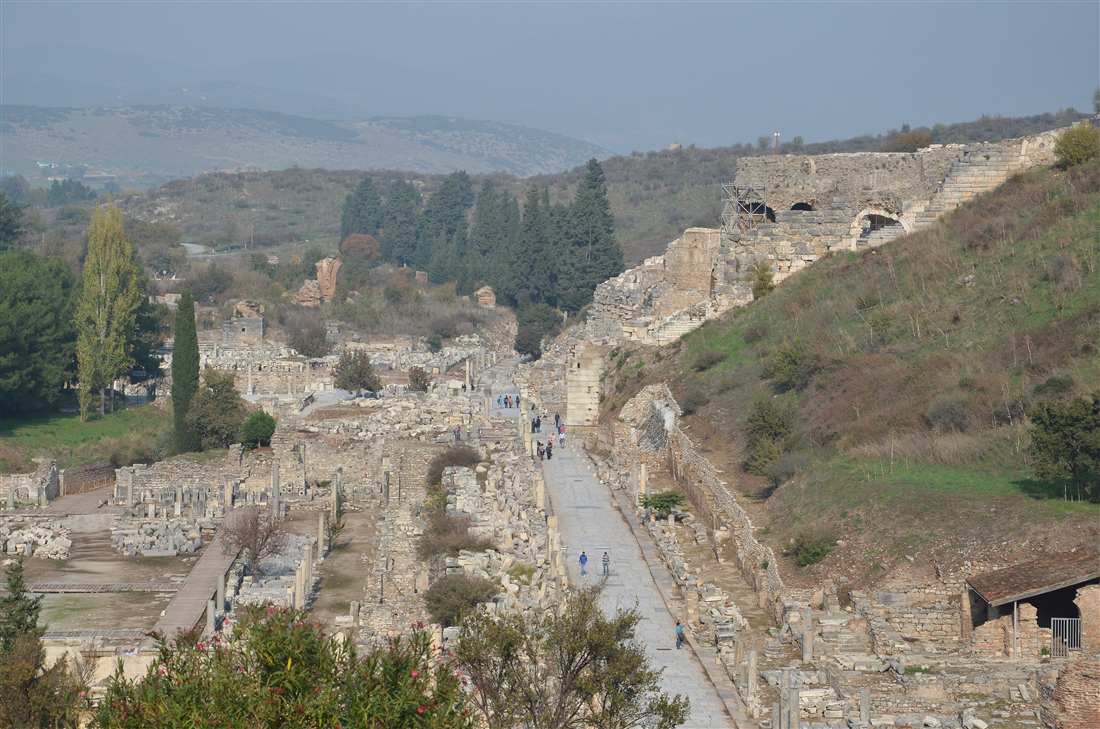
Ephesus reveals the Library of Celsus, the Great Theatre, Curetes Street, the frescoed Terrace Houses, and the Temple of Hadrian. The Roman city’s marble avenues, its agora, its public latrines, and its brothel survive along a downhill route between two gates.
The ancient city was the capital of Roman Asia, a port metropolis of a quarter-million residents before its harbour silted up. The excavated core preserves the civic heart of that world along a walkable spine. Entering at the Upper Gate, the route descends past the Odeon and the state agora before the great monuments begin. The headline structures, in the order a downhill walk meets them, are these:
- Temple of Hadrian — a Corinthian facade on Curetes Street with a relief of Medusa and the city-founding myth of Androklos.
- Terrace Houses — six roofed residential units of the Roman rich, floored in mosaic and walled in fresco.
- Library of Celsus — the two-storey marble facade that is the emblem of Ephesus, a tomb-library built for a Roman senator.
- Great Theatre — a 25,000-seat hillside auditorium where Saint Paul preached against the silversmiths of Artemis.
- Curetes Street — the marble-paved processional avenue lined with columns, statue bases, and shopfronts.
The Library of Celsus is the image every visitor carries away. Its restored facade rises in two tiers of paired columns, framing statues of the four virtues, and behind it lies the burial vault of Tiberius Julius Celsus Polemaeanus, the governor whose son raised the building. The structure faces the Gate of Augustus and the commercial agora, staging the drama of the lower city against the wooded slope.
Curetes Street forms the axis of the tour. The marble roadway runs downhill from the Hercules Gate to the Library, flanked by the Trajan Fountain, the public latrines with their communal marble seats, and the Scholastica Baths. Ruts worn by ancient cart wheels still score the paving, and mosaic sidewalks fronting the shops carry geometric patterns underfoot. The street channels the visitor past the civic showpieces in the sequence the Romans intended.
The Great Theatre closes the walk. Carved into the western flank of Mount Pion, its cavea held an audience the size of a modern stadium crowd, and its acoustics still carry a spoken voice from the stage to the top row. Beyond it, the colonnaded Arcadian Way once ran arrow-straight to the vanished harbour, lit at night in antiquity. The Terrace Houses, protected under a modern shelter, hold the finest surviving domestic art of the Roman east, their walls painted with theatrical masks, birds, and mythological scenes that colour the daily life of the city’s elite.
Smaller monuments punctuate the descent between the headliners. The Temple of Domitian marks the first imperial cult site of the city, the Memmius Monument honours a grandson of the dictator Sulla, and the Fountain of Trajan once framed a colossal statue of the emperor above a pool. The Gate of Mazeus and Mithridates, raised by two freed slaves for their patron Augustus, opens onto the commercial agora beside the Library. Each carries an inscription that fixes a name, a date, and a purpose, turning the walk into a reading of Roman civic patronage carved directly into the marble.
How long is the Ephesus day trip from Izmir?
The Ephesus day trip from Izmir runs eight to ten hours in full: one hour of driving each way and three to four hours on-site, plus the House of the Virgin Mary and the Artemis column. An early start beats the cruise crowds.
The clock breaks into transit and touring. The road legs consume two hours of the day combined, and the ruins themselves demand a minimum of two hours for a brisk walk, three to four for an unhurried one that includes the Terrace Houses. Add the two satellite stops and a lunch break, and the excursion fills a working day from a morning departure to a late-afternoon return. A representative timeline runs like this:
- 07:30 departure — pickup in Izmir, the D550 clear of commuter traffic.
- 08:30 Upper Gate — enter before the cruise coaches arrive from Kuşadası.
- 08:30–11:30 ancient city — the downhill walk, Terrace Houses, Library, and theatre.
- 12:00 House of the Virgin Mary — the hilltop chapel on Bülbül Mountain.
- 13:00 lunch and Artemis column — a Selçuk meal and the Seven Wonders site.
- 16:30 return to Izmir — back at the hotel or airport by late afternoon.
Timing is the single biggest lever on the quality of the visit. Cruise ships dock at Kuşadası through the morning, and their passengers flood the Lower Gate from around ten o’clock. A visitor who enters at opening walks the Library and the Curetes Street with room to photograph the facade before the tide arrives. The heat compounds the argument: the marble streets bake by midday in summer, when shade is scarce and the descent from the Upper Gate turns punishing under a high sun.
Entering at the Upper Gate and exiting at the Lower Gate turns the route into a continuous downhill walk rather than a climb. Guided tours arrange the coach to drop at the top and collect at the bottom, sparing the party the return uphill. Independent visitors on foot walk down and ride a Selçuk taxi back to the station, preserving the same one-way advantage.
The full-day length reflects the density of the region, not any inefficiency in the route. Ephesus alone rewards a morning, and the surrounding monuments — the Basilica of Saint John, the Ephesus Museum in Selçuk, the İsa Bey Mosque, and the Artemis field — each add a worthwhile half-hour. A traveller who wants only the marble city returns to Izmir by early afternoon; a traveller who wants the whole layered landscape of Roman, Christian, and Ottoman Selçuk fills the day to its edges and rides home at dusk.
Does Ephesus combine with Pamukkale or Şirince from Izmir?
Yes. Ephesus pairs with the travertine terraces of Pamukkale on a two-day tour from Izmir, and with the hillside wine village of Şirince and the House of the Virgin Mary inside a single day. The combinations turn one gateway into a multi-site base.
Izmir’s central position on the Aegean makes it a hub for stringing the region’s marquee sights together. Pamukkale, the calcite-white terraces and the Roman spa city of Hierapolis above them, lies three hours inland from Ephesus. The distance rules out a comfortable same-day round trip, so operators build a two-day tour with an overnight at Pamukkale or Denizli between the two sites. Şirince, by contrast, sits ten minutes above Selçuk and folds into the Ephesus day without adding an overnight. The combination menu runs as follows:
- Ephesus + House of the Virgin Mary — the standard single-day pairing, the ruins plus the Bülbül Mountain chapel.
- Ephesus + Şirince — the marble city in the morning, the fruit-wine village for lunch and a stroll among Ottoman houses.
- Ephesus + Pamukkale — a two-day tour, Ephesus on day one, the travertines and Hierapolis on day two.
- Ephesus + Temple of Artemis + Selçuk museum — a full archaeological day inside the Selçuk cluster.
Şirince is the effortless add-on. The village clings to a hillside 8 kilometres east of Selçuk, its stone-and-stucco houses built by Greek Orthodox settlers before the population exchange of the early twentieth century. Its cellars press fruit wines from peach, pomegranate, and mulberry, and its lanes sell olive oil, dried figs, and lace from doorway stalls. A tour that reaches Ephesus at opening finishes the ruins by lunch and climbs to Şirince for a village meal and an hour of wandering, all inside the same day and the same fuel tank.
Pamukkale demands more commitment. The terraces are a UNESCO site where thermal water has deposited dazzling white travertine basins down a hillside over millennia, and Hierapolis crowns the plateau with a theatre, a necropolis, and the antique pool where fallen columns lie beneath swimmers. The three-hour transfer from Ephesus makes a rushed single day punishing, so the two-day format lets a visitor walk the terraces at sunset and again at dawn, when the light turns the calcite gold and rose. Overnight stays cluster in Pamukkale village and Karahayıt.
The two-day format also unlocks Aphrodisias, the marble-carving city midway toward Pamukkale, whose stadium and sculpture school rank among Anatolia’s finest. Operators building a longer loop from Izmir chain Ephesus, Aphrodisias, and Pamukkale across three days, resting the party at Pamukkale between the archaeological days. The extra night converts a rushed dash into a measured circuit through the Meander valley, where each site adds a distinct layer to the region’s Greco-Roman record.
The House of the Virgin Mary threads through most combinations as the spiritual anchor. The chapel occupies a clearing on Bülbül Dağı where a nineteenth-century vision guided searchers to a ruin matching the visionary’s description. Pilgrims and secular visitors alike climb to the terrace, drink from the spring, and tie a wish to the cloth wall. Its inclusion costs little time — a twenty-minute drive from the ruins — and completes the region’s arc from pagan temple to Roman city to Christian shrine.
What does an Ephesus tour from Izmir cost, and how does it compare to going from Kuşadası?
An Ephesus day tour from Izmir runs from budget group rates to premium private prices, with the transfer, guide, and tickets driving the spread. Kuşadası tours cost less on transport thanks to the twenty-minute port drive, but Izmir wins as a real-city base.
Price hinges on three levers: whether the tour is a shared group or a private vehicle, whether entry tickets and lunch are bundled, and how far the transfer runs. Independent travel by train and dolmuş undercuts every guided rate, at the cost of navigation and commentary. The tiers stack up like this:
- Independent by train and taxi — the İZBAN fare plus a Selçuk taxi and the site ticket, the cheapest route by a wide margin.
- Shared group tour — a per-seat rate on a coach with a guide, tickets, and lunch bundled, the mid-range choice.
- Private tour — a dedicated vehicle and guide for one party, priced per group, the premium tier with full flexibility.
- Private airport transfer only — a driver and vehicle without a guide, for travellers who tour the ruins self-directed.
The Kuşadası comparison turns on geography. The cruise port sits 20 kilometres from Ephesus, a twenty-minute drive, against Izmir’s 80 kilometres and full hour. That shorter leg trims the transport cost of a Kuşadası tour and explains why cruise excursions favour the harbour town. Ships dock there for the day, and their shore trips ferry passengers to the Lower Gate on a tight schedule tied to the sailing time.
Izmir answers with the strengths of a metropolis. The city offers a full international airport, a metro and tram network, a two-thousand-year seafront at Konak, the Kemeraltı bazaar, and a depth of hotels and restaurants that a resort port lacks. A traveller who wants a base with an evening life beyond the harbour, and who arrives by air rather than by ship, finds Izmir the stronger home for a multi-day Aegean stay. The longer drive to Ephesus is the price of that urban depth.
Hidden costs separate the headline price from the real spend. The Ephesus ticket, the Terrace Houses supplement, the Selçuk museum fee, and the House of the Virgin Mary entry stack onto any independent visit, and parking, fuel, and motorway tolls load onto a hire car. A bundled group tour rolls these into one figure, which flatters the comparison against a train fare that looks cheaper until the tickets and taxi are added. Reading the full line-item cost, not the advertised rate, settles the true price of each route.
The verdict on cost splits by traveller type. A cruise passenger with a fixed day in port takes the Kuşadası tour, since the ship anchors there and the drive is shortest. A land traveller flying into the region bases in Izmir, rides the İZBAN or books a transfer, and treats Ephesus as one target among the city’s wider offering. The absolute ticket price of the ruins is identical from either gateway; the difference lies entirely in the transfer distance and the character of the base town. Izmir costs a little more in road time and delivers a genuine city in return.
When is the best time to visit Ephesus from Izmir, and is it worth it?
Spring and autumn are the best time to visit Ephesus from Izmir, with mild temperatures and thin crowds. An early-morning start beats the cruise coaches and the summer heat. The trip is emphatically worth it: Ephesus is the finest Roman city of the eastern Mediterranean.
The Aegean climate sets the calendar. April through early June and September through October deliver warm days without the furnace heat of high summer, when the shadeless marble streets bake past forty degrees. Winter brings rain and short days but near-empty ruins, and the wildflowers of early spring carpet the fields around the Artemis column. The seasonal breakdown runs as follows:
- Spring — April to June — mild warmth, wildflowers, storks nesting on the aqueduct, comfortable walking.
- Autumn — September and October — the summer heat broken, the sea still warm, light golden for photography.
- Summer — July and August — hot and crowded; enter at opening and carry water and sun cover.
- Winter — November to March — cool, quiet, occasional rain, the ruins almost private.
Time of day matters as much as time of year. The ruins open early, and the first hour belongs to those who arrive before the cruise ships disgorge their passengers at Kuşadası. A traveller who enters the Upper Gate at opening walks the Library of Celsus and the Curetes Street in near solitude, then descends ahead of the crowd that thickens the Lower Gate from mid-morning. That single hour transforms the visit from a shuffle through a throng into a walk through a living city.
Preparation sharpens the day. The site is a downhill kilometre of open marble with little shade, so a hat, water, and sturdy footwear are the essentials. The stone underfoot is worn smooth and slick after rain, and the Terrace Houses demand a separate ticket that rewards the outlay with the finest domestic frescoes in the Roman east. A guide, whether on a tour or hired at the gate, unlocks the inscriptions and the reliefs that a silent walk leaves unread.
Crowd rhythm follows the cruise calendar as much as the season. Days when two or three ships berth at Kuşadası flood the Lower Gate from mid-morning, while days with no dockings leave the ruins calm even in high summer. A traveller who checks the port schedule and picks a light day walks the Curetes Street and the theatre without the press of tour groups. Combined with an opening-hour entry, that timing delivers the marble city close to how it stood before mass tourism found it.
The verdict is unambiguous. Ephesus stands among the best-preserved classical cities anywhere, its Library facade an icon, its theatre a colossus, its streets a legible map of Roman urban life. Reached from Izmir, it anchors a day that layers the Temple of Artemis, the House of the Virgin Mary, and the wine village of Şirince onto the marble core. Izmir as a mainland base offers a real city to return to at night, a full airport for onward flights, and a launchpad for Pamukkale and the Greek islands offshore. The one-hour drive is a small toll for one of the ancient world’s supreme survivals, and the trip repays every kilometre of it.
Frequently Asked Questions
How far is Ephesus from Izmir?
Ephesus lies about 80 kilometres south of Izmir near Selcuk, an hour by car or private transfer. Izmir Adnan Menderes Airport sits between the two, about 60 kilometres from the site, shortening the drive for arrivals by air.
Can you take the train from Izmir to Ephesus?
The Izban suburban train runs from Izmir to Selcuk, the town beside Ephesus, in about ninety minutes. From Selcuk station a short taxi or a walk of under an hour reaches the archaeological site.
How long is the Ephesus day trip from Izmir?
An Ephesus day trip from Izmir fills a full day: an hour of driving each way plus three to four hours at the site, with time added for the House of the Virgin Mary and the Temple of Artemis on a guided tour.