
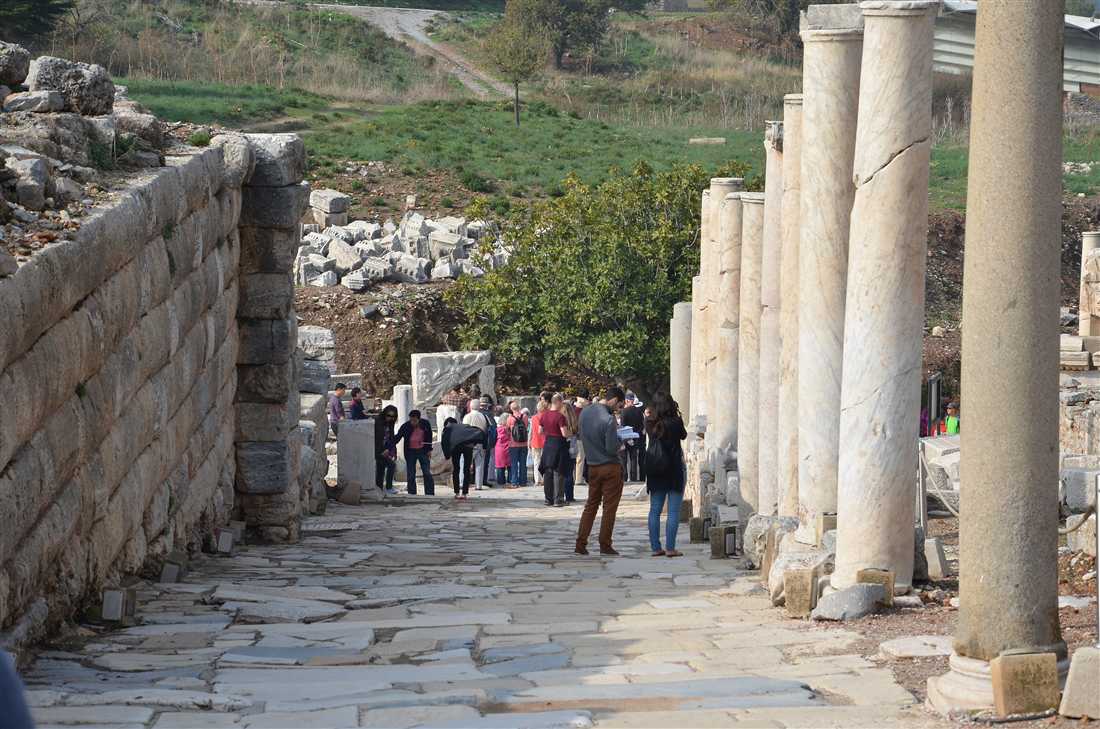
Curetes Street is the main marble-paved avenue of Ephesus, running downhill from the Hercules Gate to the Library of Celsus, lined with the temples, fountains and colonnades that make it the spine of the ancient city. Plan the whole trip with Greece Tours.
This guide covers Curetes Street in full: what it is and where it runs, why it is named for the Curetes priests, the monuments that line it, what the street was used for, its marble paving and mosaic sidewalks, its condition today, and how to walk it on a visit to Ephesus.
What is Curetes Street at Ephesus?
Curetes Street is the main marble-paved avenue of Ephesus, a monumental promenade running through the heart of the ancient city and lined with temples, fountains, baths, shops and honorific statues that record the wealth of the Roman metropolis of Asia.
The street forms the ceremonial spine of the excavated site, connecting the civic upper city with the commercial and religious lower city. Marble slabs pave the roadway, and colonnaded sidewalks flank it on both sides. Behind the columns stood rows of shops, and above the shops rose the facades of the grandest buildings in Ephesus. Visitors booking Greece and Turkey itineraries through Greece Tours reach it as the centrepiece of any walk through Ephesus.
Ephesus served as the capital of the Roman province of Asia and held the rank of one of the largest cities of the Mediterranean world during the Roman period, with a population near a quarter of a million. Curetes Street carried the traffic of that population past the Temple of Hadrian, the Fountain of Trajan and the Terrace Houses. Earthquakes in late antiquity shattered its colonnades, and the marble that survives today stands as excavated and re-erected sections. The street measures a corridor of memory: every statue base, inscribed pedestal and paving block records a name, a dedication or a gift to the city.
Where does Curetes Street run?
Curetes Street runs downhill through the centre of Ephesus, descending from the Hercules Gate at the upper city to the Library of Celsus and the Gate of Augustus at the lower city, following the natural valley between the two hills of Panayirdag and Bulbuldag.
The avenue begins at the Hercules Gate, a narrow monumental arch that marks the boundary of the civic centre. From there it drops along a gentle gradient, curving with the slope of the terrain. The descent measures roughly two hundred and ten metres before the street opens onto the plaza in front of the Library of Celsus, the most photographed facade in Ephesus.
The upper end connects to the State Agora, the Odeon and the Prytaneion, the political and religious offices of the city. The lower end joins the Marble Street and the Commercial Agora through the triple-arched Gate of Augustus. This layout gave the street a dual character: the upper stretch belonged to the world of magistrates and priests, and the lower stretch belonged to the world of merchants and crowds.
- Upper terminus: the Hercules Gate, beside the Memmius Monument and the State Agora
- Middle stretch: the Fountain of Trajan, the Temple of Hadrian and the Baths of Scholastica
- Lower terminus: the Library of Celsus square and the Gate of Augustus into the Commercial Agora
Why is it called the Street of the Curetes?
The street takes its name from the Curetes, a college of priests attached to the cult of Artemis of Ephesus, whose lists of members were inscribed on stone and displayed along the avenue, giving the road the title the Street of the Curetes.
The Curetes originated in Greek mythology as demigods who guarded the infant Zeus, clashing their shields to hide his cries from Cronos. Ephesus adapted the myth to its own foundation legend, in which the Curetes protected the goddess Leto during the birth of Artemis and Apollo in the sacred grove of Ortygia near the city. In gratitude the city established a priestly order bearing their name.
During the Roman period this college held annual festivals and rituals tied to the great sanctuary of Artemis. Their duties moved from the Temple of Artemis to the Prytaneion at the top of the street, and the priests recorded their annual membership on inscribed columns and plaques. Archaeologists recovered these Curetes inscriptions during excavation, and the names of the priests fixed the modern label for the road.
The street carried other historical names through antiquity, including designations tied to processional routes. Modern scholarship settled on Curetes Street because the epigraphic evidence found in situ ties the priests directly to this stretch of the marble avenue.
The role of the Curetes shifted across the imperial centuries. Their college gained members drawn from the ruling families of Ephesus, and a term as a Curete marked a step in the public career of a prominent citizen. The inscribed lists therefore double as a register of the civic aristocracy, naming the priests year by year and recording the offices they held. This union of religion and status explains why the priestly name attached itself so firmly to the grandest street in the city.
What monuments line Curetes Street?
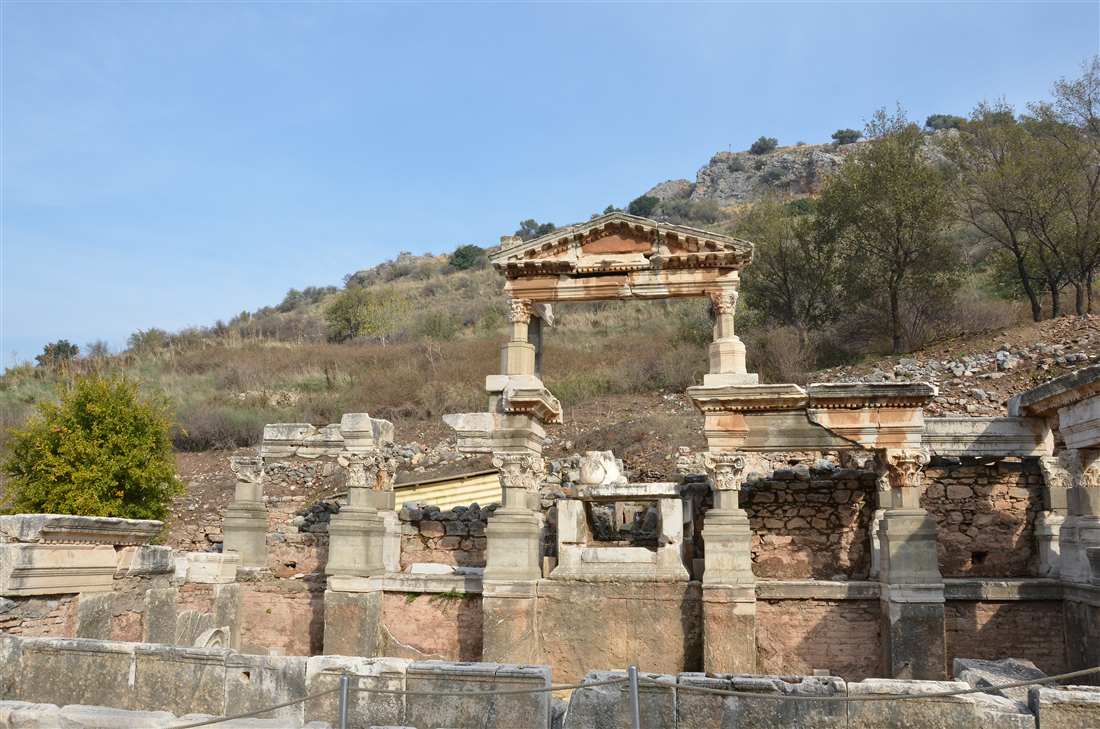
Curetes Street is bordered by an unbroken sequence of Roman monuments: the Hercules Gate, the Fountain of Trajan, the Temple of Hadrian, the Baths of Scholastica, the public latrines, the Terrace Houses and the shops behind the colonnades, forming the richest monumental corridor at Ephesus.
Each building marks a phase of imperial patronage. The Temple of Hadrian presents a small but exquisite facade with a Corinthian arch and a carved figure identified as the goddess Tyche. Opposite and above stretch the Terrace Houses, the multi-storey residences of the Ephesian elite, decorated with wall paintings and mosaic floors. The Fountain of Trajan once framed a colossal statue of the emperor, its foot resting on a globe.
- Hercules Gate — the arch carved with the hero wrapped in the Nemean lion skin
- Fountain of Trajan (Nymphaeum Traiani) — a two-storey water display honouring the emperor
- Temple of Hadrian — the ornate Corinthian facade with mythological friezes
- Baths of Scholastica — a large restored bathing complex funded by a Christian benefactress
- Public latrines — the communal marble toilets fed by the city aqueducts
- Terrace Houses — the frescoed hillside mansions of wealthy citizens
Between these landmarks stand statue bases and dedicatory columns, including the Memmius Monument near the Hercules Gate and the Octagon tomb, which marks the burial of a woman identified with Arsinoe IV of Egypt.
What was Curetes Street used for?
Curetes Street functioned as a processional route, a commercial promenade and a civic gallery: religious festivals passed along it, colonnaded shops traded beside it, and the city honoured benefactors with statues raised on inscribed bases the length of the avenue.
The processional role tied the street to the sanctuary of Artemis. Ritual parades of the Curetes priests, magistrates and citizens moved between the Prytaneion, the temples and the theatre. The road served as the stage for public ceremony, and its width and marble surface suited the movement of crowds during festival days.
The commercial role belonged to the covered sidewalks. Rows of shops sold food, cloth, pottery and goods brought through the harbour of Ephesus. Merchants worked under the shelter of the colonnades, protected from sun and rain by the roofs above the mosaic pavements. The lower end fed directly into the Commercial Agora, the main market square of the city.
The civic role appears in the density of honorific monuments. Ephesus rewarded emperors, governors, benefactors and priests with bronze and marble statues set on stone pedestals. The inscriptions recorded the achievements and gifts of each honoree, turning the avenue into a permanent public record. Dozens of these bases survive, stripped of their statues, yet still carrying the carved names and titles of the honoured citizens of Roman Asia.
What are the mosaics and paving of Curetes Street?
Curetes Street combines a roadway of large marble slabs down the centre with covered sidewalks paved in geometric mosaics, so that traffic moved on stone while pedestrians and shoppers walked on decorated floors laid in front of the colonnaded shops.
The central carriageway consists of rectangular marble blocks laid across the descending gradient. Centuries of foot traffic, cart wheels and rainwater wore grooves and a polished sheen into the surface. The slabs sit above the city drainage and water system, and inspection openings in the paving gave access to the pipes beneath.
The sidewalks form the artistic heart of the street. Craftsmen laid mosaic floors in front of the shop fronts using small tesserae in black, white and coloured stone. The patterns run to geometric designs: meanders, interlaced squares, chevrons and floral motifs. Sections of these mosaics survive in front of the Baths of Scholastica and along the northern side, restored and protected during modern conservation.
- Central roadway: large marble slabs, worn smooth, laid over the drainage channels
- Covered sidewalks: geometric tesserae mosaics fronting the shops
- Colonnades: reused columns of granite and marble supporting the sidewalk roofs
- Water features: channels and fountains fed by the aqueducts of Ephesus
The mixture of hard-wearing stone road and decorated pedestrian floor reflects the Roman standard for a monumental thoroughfare in a first-rank provincial capital.
What condition is Curetes Street in today?
Curetes Street survives as an excavated and partly re-erected avenue: the marble roadway lies open along its full length, rows of columns stand upright again, statue bases line the verges, and the descending stone shines worn and smooth underfoot.
Austrian archaeologists have excavated Ephesus since the late nineteenth century, and the clearing of Curetes Street exposed the paving, the shop foundations and the fallen colonnades. Conservators re-erected columns using original drums, marking modern repairs where fresh material replaced lost stone. The Temple of Hadrian facade seen today is a partial anastylosis, a reassembly of the genuine carved blocks with replica elements to hold the structure.
The street presents a clear architectural line to the visitor. Standing columns frame the view down to the Library of Celsus, and the empty statue pedestals carry their Greek and Latin inscriptions in the open air. Earthquake damage from late antiquity remains visible in the tumbled masonry stored along the edges.
- Fully excavated roadway from the Hercules Gate to the Library square
- Re-erected colonnades and the anastylosis of the Temple of Hadrian facade
- Inscribed statue bases retained in position along both sides
- Original friezes and reliefs moved to the Ephesus Museum in nearby Selcuk for protection
Weathering continues to threaten the exposed marble, and roped barriers and boardwalk sections guide foot traffic away from the most fragile mosaics and inscriptions.
How do you walk Curetes Street at Ephesus?
Walk Curetes Street by entering Ephesus through the Upper Gate and descending downhill along the marble avenue to the Library of Celsus, a one-way route on a gentle gradient that ends near the Lower Gate, reached from Kusadasi, Selcuk or a cruise call from Samos.
The downhill direction spares the legs and delivers the classic reveal of the Library facade at the foot of the street. Enter at the Magnesian Gate at the top of the site, pass the State Agora and Odeon, then reach the Hercules Gate that opens onto Curetes Street. The full walk down the avenue takes about twenty minutes at a steady pace, with stops at the Temple of Hadrian, the Terrace Houses and the Fountain of Trajan extending the visit to a couple of hours.
Access to Ephesus starts from the coastal towns of the region:
- From Kusadasi: a twenty-minute drive or shuttle to the Ephesus gates
- From Selcuk: a short taxi or bus ride to the Upper Gate
- From Samos in Greece: a ferry to Kusadasi, then transfer to Ephesus for a day trip
- From Izmir: about an hour by road to the archaeological site
Wear sturdy shoes for the polished marble, carry water and a hat for the exposed slope, and start early to walk the street before the midday crowds fill the descent to the Library of Celsus.
Frequently Asked Questions
What is Curetes Street at Ephesus?
Curetes Street is the main marble avenue of Ephesus, running downhill from the Hercules Gate to the Library of Celsus. It is lined with the Temple of Hadrian, the Fountain of Trajan, the Terrace Houses and colonnaded shops.
Why is it called the Street of the Curetes?
The street is named after the Curetes, a college of priests linked to the cult of Artemis at Ephesus. Their names and duties were recorded on inscriptions set up along the avenue.
How do you walk Curetes Street?
Enter Ephesus at the Upper Gate and walk downhill along Curetes Street to the Library of Celsus, an easy one-way descent. The route is reached from the Kusadasi cruise port or the Greek island of Samos.