
The Ephesus Archaeological Museum in Selcuk holds the finds lifted from Ephesus, from the two marble statues of Artemis to the frescoes and ivory of the Terrace Houses, one of the richest collections of Greek and Roman art in Turkey. Plan the whole trip with Greece Tours.
This guide covers the Ephesus Archaeological Museum in full: what it is and where it stands, the two Artemis statues, the Eros on a dolphin and the fountain sculptures, the bronze athlete, the emperor-cult hall, the Terrace Houses room, the gladiator finds, the Parthian Monument frieze, the coins and sculpture halls, the history of the collection, the tickets and hours, and how to visit.
What is the Ephesus Archaeological Museum?
The Ephesus Archaeological Museum is the state museum in Selçuk, Turkey, that holds the movable finds excavated from the ancient city of Ephesus and its sanctuaries. It ranks among the richest archaeological collections in Turkey, displaying sculpture, bronzes, frescoes, ivory, glass, coins and cult statues.
The museum concentrates the portable heritage of Ephesus in a single building a short walk from the ruins themselves. While the marble streets, the Library of Celsus and the Great Theatre remain on the archaeological site three kilometres to the west, the fragile and valuable objects that once filled those buildings moved into the Selçuk galleries for protection and study. The result is a collection that reads as a companion volume to the standing city: the statues that stood in the fountains, the reliefs that decorated the monuments, the household goods from the terraced mansions and the cult images from the great temples are gathered under one roof. Visitors planning wider itineraries through the eastern Mediterranean and the Aegean pair the museum with Greece Tours and cross-border routes, because the material culture of Ionia links directly to the Greek world across the water.
The collection grew out of the long Austrian and Turkish excavations at Ephesus, a project that turned over the soil of the Roman metropolis across generations of fieldwork. Every campaign added statues, inscriptions, mosaics and small finds, and the museum expanded its display space to absorb the flow. The Austrian Archaeological Institute carried the bulk of the early digging, and its finds established the museum’s core; Turkish institutions continued the work and directed the modern excavation of the residential quarters. The two traditions together produced the depth of holdings on display today.
The museum’s importance rests on the completeness of the story it tells. Rather than a scatter of unrelated antiquities, it presents an integrated portrait of one of the greatest cities of the Roman East — a metropolis of a quarter of a million people, the capital of the province of Asia, a harbour that funnelled trade between three continents, and the home of the goddess Artemis whose temple counted among the Seven Wonders of the ancient world. The galleries follow that portrait through cult, civic life, private luxury, imperial power and death.
The strengths that set the Ephesus museum apart include categories rarely assembled in one place:
- Two complete cult statues of Artemis of Ephesus, the egg-covered images from the town hall.
- The reconstructed bronze athlete, an over-life-size Roman scraper figure rebuilt from a thousand fragments.
- The colossal imperial statue from the Temple of the Sebastoi, evidence of the emperor cult.
- The ivory frieze and painted plaster from the Terrace Houses, the luxury quarter of the Roman elite.
- The tombstones and skeletal remains from the gladiator cemetery, a rare forensic record of the arena.
Because the finds come from a documented urban context, the museum functions as a research archive as much as a display. Scholars use the sculptures to reconstruct the appearance of fountains and monuments now reduced to foundations, and the inscriptions to trace the civic institutions of the city. For the traveller, the museum turns the abstract ruins of the archaeological park into faces, bodies and objects. A route through the site of Ephesus and a route through the museum answer each other: the empty niches on the streets find their statues in the halls, and the halls find their setting in the streets.
The museum sits within the modern town of Selçuk, itself built over the medieval and Byzantine successor to Ephesus. This proximity keeps the collection anchored to its landscape. The finds did not travel to a distant capital; they remained beside the ground that produced them, and the museum stands as the custodian of a continuous story of settlement stretching from the archaic Greek foundation to the Ottoman town.
Where is the Ephesus Museum and how is it laid out?
The Ephesus Archaeological Museum stands in the centre of Selçuk in İzmir Province, western Turkey, below the Basilica of Saint John and the Ayasuluk hill. It is organised into themed indoor halls arranged around a central courtyard garden, each hall grouping finds by their original context.
Selçuk lies about three kilometres east of the main entrance to the archaeological site, and the museum occupies a prominent position in the town’s core, within easy reach of the Basilica of Saint John, the Temple of Artemis field and the İsa Bey Mosque. The setting matters: the museum is not an isolated cultural building but one node in a dense cluster of monuments spanning the Greek, Roman, Byzantine and Ottoman periods, all within a short walk. A visitor moves in minutes from the egg-covered Artemis inside the galleries to the single re-erected column that marks the site of her vast temple outside.
The building’s layout guides visitors through a sequence of themed halls rather than a single chronological line. This context-based arrangement keeps finds together with the monuments they came from, so the fountain sculptures stand as a group, the imperial statues form their own hall, and the domestic finds from the mansions share a gallery. The organising principle is place-of-origin, which lets the museum reassemble scattered fragments into the ensembles they once formed.
The principal divisions of the museum include the following spaces:
- The Hall of Fountain Finds, gathering the reclining river gods, the Cupid on a dolphin and the Polyphemus group from the great civic fountains.
- The Hall of the Terrace Houses and small finds, displaying frescoes, glass, ivory, bronze figurines, medical instruments and everyday objects from the elite residences.
- The two-part cult display holding the Great Artemis and the Beautiful Artemis, presented as the culminating images of the collection.
- The Hall of Emperor Cult, built around the colossal statue from the Temple of the Sebastoi.
- The courtyard garden and portico, where sarcophagi, architectural fragments, inscriptions and larger stone monuments stand in the open air.
The central garden threads the indoor halls together and provides a display area for the heavy stone material that suits open-air presentation. Column capitals, funerary altars, sarcophagi lids, statue bases and inscribed blocks fill the courtyard and its shaded colonnade, letting visitors read the epigraphic record of the city — the honours voted to benefactors, the dedications to the goddess, the boundary and building texts — in the same space that holds the architectural anatomy of the ruined monuments.
The route through the halls builds toward the cult statues of Artemis as a deliberate climax. Because the goddess defined the identity of Ephesus, her images occupy the emotional centre of the museum, and the arrangement leads the visitor through fountains, houses, emperors and death before delivering the two great statues that explain why the city existed at all. The layout thus doubles as an argument: Ephesus was Artemis’s city first, and everything else — its trade, its politics, its luxury — grew in the shelter of her sanctuary.
Practical circulation through the museum is compact. The indoor halls are modest in footprint and densely hung, so the visitor experience is intense rather than sprawling. This concentration rewards slow looking, because a single hall carries more masterworks than most national museums display in a wing. The proximity to the ruins also shapes the visit: a coherent day pairs the archaeological site in the morning with the museum in the afternoon, when the standing city and its recovered contents illuminate each other and the walk between the two threads through the medieval town of Selçuk itself.
What are the two statues of Artemis in the museum?
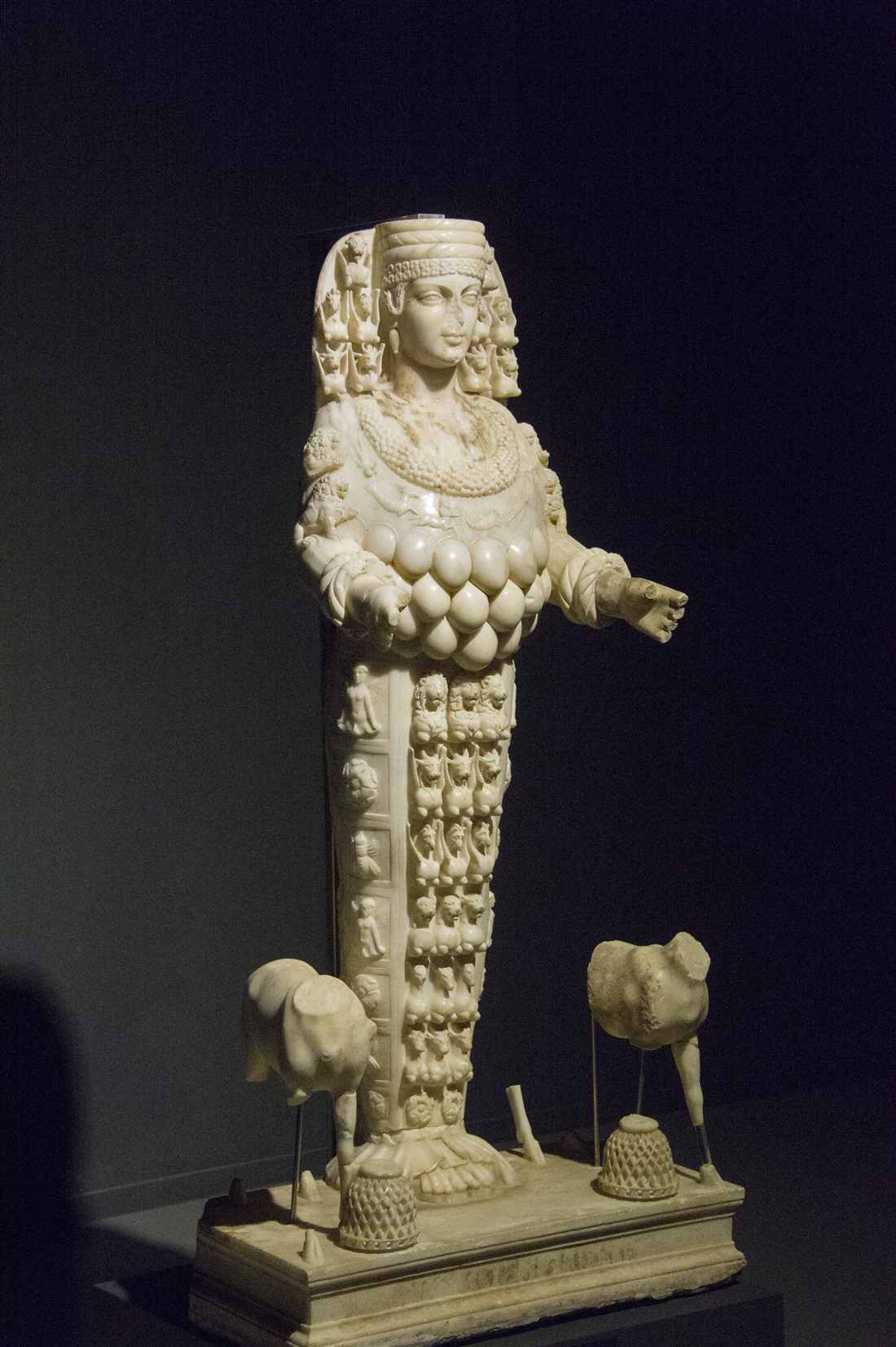
The two statues are the Great Artemis and the Beautiful Artemis, both marble cult images of Artemis of Ephesus recovered from the Prytaneion, the town hall of the city. Each shows the goddess in her distinctive form, her lower body a rigid pillar and her chest covered with rows of egg-shaped protuberances.
These two statues form the heart of the museum and the emblem of Ephesus itself. Both depict Artemis of Ephesus in the peculiar iconography that separated her from the huntress Artemis of the Greek mainland. Here the goddess stands frontal and immobile, her arms extended forward, her legs sheathed in a tapering column of ordered animal reliefs. Across her chest hang the rows of rounded objects that generate the goddess’s most-debated feature — read variously as breasts, bull testicles offered in sacrifice, gourds, or amber pendants, and understood by scholars as symbols of fertility and abundance whatever their literal source. The two images together preserve the appearance of the cult statue that stood in the great temple, the wooden original of which does not survive.
The Great Artemis is the larger and more imposing of the pair. Carved in marble at heroic scale, she presents the full apparatus of the Ephesian cult: the tiered chest ornaments, the columnar skirt divided into registers of lions, bulls, griffins, sphinxes, bees and rosettes, the elaborate necklaces and pectoral, and the tall crown or polos that once framed the head. The animal registers turn the statue into a cosmic diagram, the goddess presiding over the ordered ranks of the living world. This statue was found in the Prytaneion, buried in antiquity, and its recovery in the modern excavation restored the definitive image of the city’s patron deity.
The Beautiful Artemis, the second image, earns her name from the finer, more delicate finish of the carving. She repeats the same essential scheme — the frontal pose, the ornament-covered chest, the animal-banded skirt — but with a softer modelling of the face and a more refined execution of the drapery and decoration. The two statues, displayed together, let the visitor compare two treatments of one sacred type, and together they document how the Ephesians rendered their goddess across the workshops of the Roman period.
The iconographic elements that define both statues include:
- The polos crown, in the form of a temple or turreted headdress marking the goddess as the protector of the city.
- The nimbus or halo disc set behind the head, an emblem of divine radiance.
- The rows of ovoid protuberances across the chest, the signature attribute of Ephesian Artemis and a symbol of nourishment.
- The columnar skirt divided into horizontal bands of relief animals, arranging the natural world under the goddess’s command.
- The winged figures, garlands and rosettes distributed across the necklaces and pectoral.
Both statues came from the Prytaneion, the civic hearth-building where the sacred fire of the city burned and where the images of the state cult stood. Their burial in antiquity — laid down and covered rather than smashed — preserved them from the destruction that overtook so much pagan sculpture in late antiquity, and it is to that careful interment that the museum owes two of the most complete cult statues to survive from the Roman world.
The cult of Artemis defined Ephesus for more than a millennium, and the two statues stand as the direct descendants of the image housed in the Temple of Artemis, the colossal Ionic sanctuary that counted among the Seven Wonders. The temple is gone, reduced to a single re-erected column in a marshy field, but its goddess survives in Selçuk in these two marble bodies. For the visitor, the statues resolve the abstraction of the ruined Wonder into a face and a form, and they explain the pilgrim traffic, the silver-shrine trade and the civic pride that the sanctuary generated for the ancient city.
What is the statue of Eros with a dolphin, and the fountain sculptures?
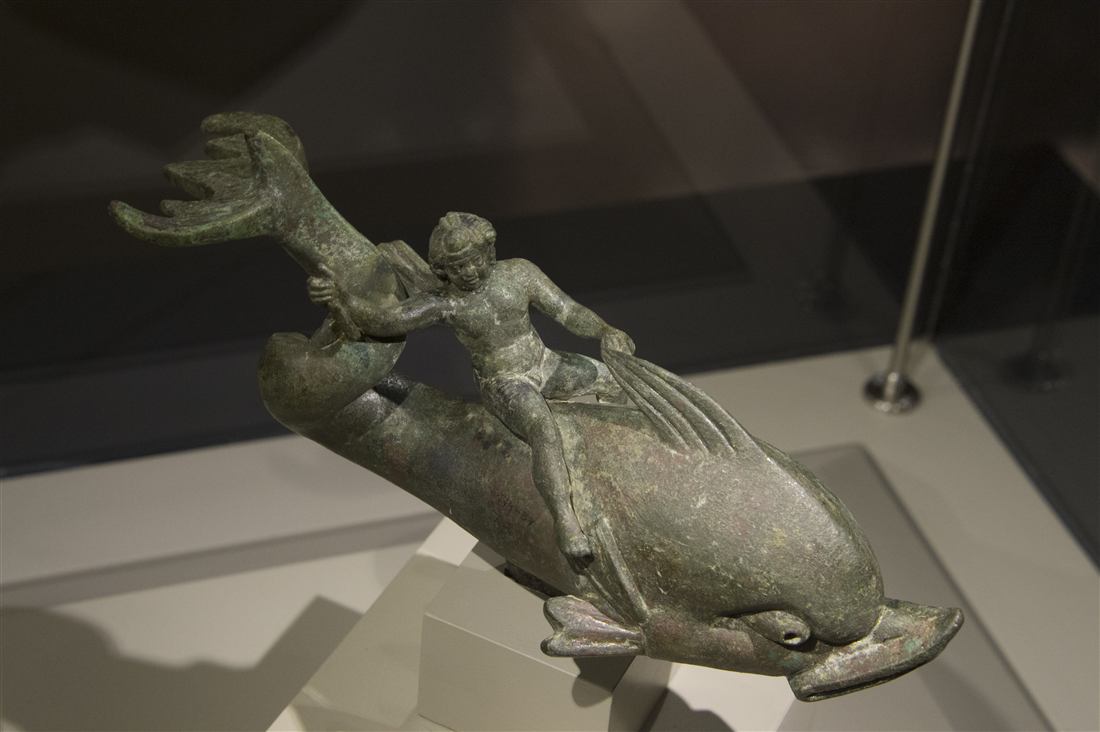
The statue of Eros with a dolphin, the Cupid riding a dolphin, is a marble group that once decorated a fountain of Ephesus. It stands among the museum’s fountain sculptures, which include reclining river gods, the Polyphemus and Odysseus group, and the statuary of the Fountain of Pollio and the Fountain of Trajan.
The Hall of Fountain Finds gathers the sculptural programmes that once animated the great public fountains of Ephesus. Roman fountains, or nymphaea, were monumental architectural facades set with basins, and their niches held marble statues chosen for their watery associations — river gods, sea creatures, nymphs and mythological scenes tied to water. When the fountains collapsed, their statues fell into the basins and the debris, and the excavation recovered them as coherent groups. The museum reassembles these programmes so the visitor grasps how sculpture and flowing water combined into civic spectacle.
The Cupid on a dolphin, the small marble Eros astride a leaping dolphin, is the most charming of these fountain figures. The winged boy-god rides the sea creature in a composition that suited a splashing basin, the dolphin’s arc echoing the fall of water. The group belongs to a repertoire of playful aquatic subjects that Roman patrons favoured for the pleasure gardens and fountains of their cities, and its survival gives the museum one of its most immediately appealing objects.
The Fountain of Pollio and the Fountain of Trajan supplied the museum with its most substantial fountain sculpture. The Fountain of Trajan, the grand nymphaeum on the Curetes Street of Ephesus, held a statue of the emperor Trajan standing over a globe, an image of world dominion presiding over the flowing water, along with a family of deities and personifications ranged in its two storeys of niches. The Fountain of Pollio, a monumental structure dedicated by a wealthy benefactor, carried the celebrated Polyphemus group.
The principal fountain sculptures displayed in the museum include:
- The Cupid riding a dolphin, the marble Eros group from a civic fountain.
- The reclining river gods, bearded male personifications of rivers leaning on overturned water jars, the classic ornament of a nymphaeum basin.
- The Polyphemus and the companions of Odysseus group from the Fountain of Pollio, depicting the blinding of the Cyclops.
- The statue of the emperor from the Fountain of Trajan, standing over a globe as master of the world.
- Tritons, nymphs and marine figures distributed across the fountain facades.
The reclining river gods form a recurring type in the collection. These bearded, muscular figures recline on one elbow, an inverted jar beneath the arm pouring an endless stream, personifying the rivers whose water the fountains distributed. In the arrangement of a nymphaeum they anchored the lowest register, at basin level, where the sculpted water and the real water met. Their presence in the museum lets the visitor read the iconographic logic of the Roman fountain: the rivers at the bottom, the deities and emperors above, the whole facade a hierarchy of the natural and political order.
The Polyphemus group is the dramatic centrepiece of the fountain sculpture. It renders the Homeric episode in which Odysseus and his crew blind the drunken Cyclops Polyphemus, a scene of violent action carved for the Fountain of Pollio. The theme — the triumph of human cunning over monstrous force — carried resonance in a fountain that dispensed the ordered blessing of water to the city. Set against the reclining river gods and the playful dolphin-rider, the group shows the range of the fountain repertoire, from the tender to the epic, and it completes the museum’s reconstruction of the sculptural theatre that once made the streets of Ephesus flow.
What is the bronze athlete (Apoxyomenos) of Ephesus?
The bronze athlete of Ephesus is an over-life-size Roman bronze statue of an Apoxyomenos, an athlete scraping the oil and dust from his body with a curved strigil after exercise. Reconstructed from more than a thousand fragments recovered in the modern excavation, it is one of the few large ancient bronzes to survive.
The bronze athlete is among the rarest treasures in the museum because ancient bronze statues survived in tiny numbers. Bronze was valuable, and across late antiquity and the medieval period the vast majority of ancient bronze figures were melted down for their metal. A large bronze that escaped the furnace is a prize of the highest order, and the Ephesus Apoxyomenos ranks among the important survivors. Its recovery — in fragments, buried and forgotten rather than reclaimed for scrap — spared it the fate of nearly every other bronze that once filled the city.
The Apoxyomenos, the “scraper,” is a canonical subject in Greek and Roman athletic sculpture. It depicts a nude male athlete cleaning himself after the palaestra, drawing a curved metal strigil down his oiled skin to remove the mixture of oil, sweat and sand that coated the body after exercise. The type descends from a famous statue attributed to the sculptor Lysippos, and Roman patrons prized copies and versions of it for the gymnasia and bath complexes of their cities. The Ephesus bronze belongs to this tradition, an athletic ideal set up in a public building devoted to the body.
The statue was found in fragments in the ruins of the Harbour Baths and Gymnasium of Ephesus, one of the great bath complexes of the city. The bronze had broken into hundreds of pieces, and the reconstruction that produced the standing figure now on display counts among the demanding restoration projects of the museum’s history. The reassembly of over a thousand fragments into a coherent over-life-size athlete restored to the collection a rare full-scale bronze and returned to view a masterwork of Roman metal casting.
The features that make the bronze athlete significant include:
- Its material, bronze, the medium that almost never survives at large scale from the ancient world.
- Its subject, the Apoxyomenos scraper type descending from the school of Lysippos.
- Its scale, over life-size, the format of a public honorific or decorative statue for a bath or gymnasium.
- Its find-spot, the Harbour Gymnasium, tying it to the athletic and bathing culture of Roman Ephesus.
- Its reconstruction from more than a thousand fragments, a landmark of the museum’s conservation record.
The find-spot roots the statue in the physical culture of the Roman city. The Harbour Baths and their associated palaestra formed one of the largest recreational complexes of Ephesus, a place where citizens exercised, bathed and socialised. A bronze Apoxyomenos in such a setting embodied the ideal the building served: the disciplined, oiled, self-tending athletic body. The statue was decoration and exhortation at once, a model of physical excellence set before the users of the baths.
For the museum, the bronze athlete carries a double weight. It demonstrates the sophistication of Roman bronze casting — the alloy, the lost-wax technique, the fine surface finish that a bronze permits and marble denies — and it stands as a monument to the recovery skills that reassembled it. Where a marble statue survives or does not, a bronze fragmented into a thousand pieces exists only through patient reconstruction, and the Ephesus athlete is one of the collection’s proofs that shattered ancient metal returns to form under expert hands.
What is the Hall of Emperor Cult and the Temple of Domitian finds?
The Hall of Emperor Cult displays the sculpture from the imperial temple of Ephesus, the Temple of the Sebastoi built for the Flavian emperors. Its centrepiece is a colossal statue, its surviving head and forearm identifying either Domitian or his brother Titus, evidence of the emperor worship that raised Ephesus to a provincial temple-warden.
The imperial cult stood at the centre of civic ambition in the Roman East, and no monument illustrates it in the museum more powerfully than the finds from the Temple of the Sebastoi, the great Flavian sanctuary of Ephesus. Cities of the province of Asia competed fiercely for the honour of building and maintaining a temple to the reigning emperor and his house, a status that carried the title of neokoros, or temple-warden. Ephesus won that title through the Temple of the Sebastoi, a vast terraced sanctuary on an artificial platform overlooking the State Agora, and the honour cemented the city’s primacy over its rivals Pergamon and Smyrna.
The temple housed a colossal cult statue of the emperor, and the surviving fragments dominate the hall. The head alone stands taller than a person, and the recovered forearm and hand belong to a figure that reached far beyond life-size when whole. The scale announced the more-than-human standing of the emperor, and the fragments preserve the imperious features and the crown of the deified ruler. The identity of the figure links to the Flavian dynasty: the temple honoured the house of Vespasian, and the statue represents Domitian, the emperor under whom the sanctuary reached completion, or his brother and predecessor Titus, whose name replaced Domitian’s after the latter’s condemnation.
The condemnation itself forms part of the monument’s story. After Domitian’s assassination the Roman Senate imposed the damnatio memoriae on him, the formal erasure of his name and image. Ephesus, which had built its imperial temple in his honour, rededicated the sanctuary to Vespasian and the wider Flavian house rather than lose its coveted neokoros status. The colossal statue and the temple survived by transferring their loyalty from the disgraced emperor to his rehabilitated relatives, and the museum’s fragments carry that political manoeuvre in their stone.
The Hall of Emperor Cult assembles the categories of imperial material:
- The colossal head of the Flavian emperor, over-life-size and crowned, the cult image of the Temple of the Sebastoi.
- The giant forearm and hand from the same statue, indicating the full colossal scale.
- Architectural fragments from the temple platform, columns and entablature blocks from the terraced sanctuary.
- Portrait heads and statues of other emperors and members of the imperial family honoured across the city.
- Inscriptions recording the neokoros title and the dedications of the imperial cult.
The imperial cult was not an empty formality but the framework of loyalty that bound the Greek cities of Asia to Roman power. Temples to the emperors, priesthoods, festivals, sacrifices and games organised civic life around the figure of the ruler, and the honour of a provincial imperial temple brought a city prestige, pilgrim traffic and political weight. Ephesus, already the seat of the Roman governor of Asia, added the neokoros title to its résumé and reinforced its claim to be the first city of the province.
The colossal statue completes the museum’s portrait of Ephesian power. Where the Artemis statues show the divine patron of the city and the fountain sculptures show its civic display, the imperial head shows the political reality that governed it — the presence of Rome, embodied in an emperor rendered at superhuman scale and worshipped in a temple that dominated the skyline of the upper city. The fragments in the hall, broken but immense, still convey the intended message: the emperor towered over the citizen, and the city that housed his temple towered over its neighbours.
What finds from the Terrace Houses are in the museum?
The finds from the Terrace Houses include wall frescoes, marble floor and wall revetment, glass vessels, bronze figurines, medical and cosmetic instruments, and an ivory frieze depicting a Roman military campaign. They come from the luxurious hillside mansions of the Ephesian elite, the best-preserved Roman residences in the eastern Mediterranean.
The Terrace Houses, the stepped blocks of elite residences built into the slope of Bülbül Dağı across from the Library of Celsus, rank among the archaeological glories of Ephesus. These were the homes of the city’s wealthiest families, decorated with painted walls, marble panelling, mosaic floors and fine furnishings, and preserved because the hillside collapsed and sealed the interiors. The excavation of the houses recovered a dense record of domestic luxury, and the most fragile and valuable of those finds — the objects that suffer in an open-air site — moved into the museum, where the Hall of the Terrace Houses reconstructs the private world of the Roman aristocracy.
The ivory frieze is the standout object among the domestic finds. Carved in low relief on strips of ivory, the frieze depicts scenes of a Roman military campaign, arranging soldiers, barbarians and combat across its length in a miniature narrative of imperial victory. Read by scholars as a representation of a campaign of the emperor Trajan against the Parthians or the Dacians, the frieze once decorated a piece of luxury furniture in one of the mansions, a portable monument to Roman power owned by a private family. Its survival gives the museum a rare example of large-scale ancient ivory carving.
The frescoes carry the visual world of the houses into the museum. Detached from the walls of the residences, panels of painted plaster preserve the architectural fantasies, figured scenes, garlands, theatrical masks and mythological vignettes that covered the rooms. Roman wall painting turned domestic space into an illusionistic theatre, opening walls onto imagined vistas and framing figures within painted architecture, and the Terrace House panels display the taste and wealth of patrons who commissioned the finest decorators for their homes.
The categories of Terrace House material in the museum include:
- Painted wall frescoes with figures, garlands, theatrical masks and architectural illusion.
- The ivory frieze depicting a Roman imperial military campaign, from a piece of luxury furniture.
- Glass vessels, from delicate perfume flasks to tableware, illustrating the Roman glass trade.
- Bronze statuettes, lamps, and figurines of household deities from domestic shrines.
- Medical, surgical and cosmetic instruments, spoons, probes and toilet articles of daily life.
The glass and small metalwork document the material comfort of the households. Ephesus was a harbour and trade emporium, and the glass vessels, bronze fittings, lamps and personal objects that filled the mansions reflect the reach of Roman commerce — glass from the workshops of the eastern Mediterranean, fine tableware, cosmetic tools of bronze and bone. The medical instruments in particular open a window onto Roman science and the body, the probes, scalpels and spatulas that a physician or a household used for surgery, medicine and grooming.
Together the Terrace House finds complete the social pyramid the museum builds. The cult statues serve the goddess, the imperial head serves the emperor, the fountain sculptures serve the public street — and the Terrace House gallery serves the private citizen, the wealthy Ephesian at home among his frescoes, his glass and his ivory. The mansions on the hillside preserve, more completely than almost any other Roman site, how the eastern elite lived behind their doors, and the museum holds the movable heart of that record.
What gladiator finds does the museum hold?
The museum holds the finds from the gladiator cemetery of Ephesus, a burial ground of arena fighters excavated on the eastern edge of the city. The material includes carved gladiator tombstones and the skeletal remains of the fighters, whose bones carry the wounds, healed injuries and diet that reconstruct the life and death of a Roman gladiator.
The gladiator cemetery of Ephesus is one of the most important discoveries of arena archaeology anywhere in the Roman world. On the eastern flank of the city, near the road toward the Temple of Artemis, the excavation uncovered a burial ground reserved for gladiators, marked with the carved tombstones that name and depict the dead fighters. The find is exceptional because it combines the epigraphic record — the stones that name the men and their fighting categories — with the physical record — the bones themselves, which forensic study reads for the truth of the arena.
The tombstones give the fighters names, faces and specialities. Roman gladiators fought in defined categories, each with its own armour and weapons, and the reliefs on the Ephesus stones depict the men in the equipment of their type — the heavily armed murmillo with his large shield and helmet, the retiarius with net and trident, the thraex with his curved sword and small shield, the provocator, the secutor. The inscriptions record names, the number of fights won, and the palm branches and wreaths of victory, turning the cemetery into a roster of the arena professionals who performed for the crowds of Ephesus.
The skeletal remains transform the display from monument to forensic dossier. The bones of the buried gladiators were studied by anthropologists, and the analysis of the injuries, the healed and unhealed wounds, the muscle attachments and the tooth chemistry rewrote assumptions about how gladiators lived, fought and died. The evidence overturned the popular image of chaotic slaughter and revealed instead a regulated combat sport with rules, referees, medical care and a specialised diet.
The gladiator finds document distinct dimensions of arena life:
- Carved tombstones naming the fighters and depicting them in the armour of their fighting category.
- Skeletal remains bearing weapon injuries, distinguishing lethal blows from survived wounds.
- Healed fractures and injuries treated by physicians, evidence of medical care between bouts.
- Bone chemistry indicating a diet heavy in grain and legumes, the “barley-eater” gladiator regimen.
- Evidence of the coup de grâce, the standardised killing blow delivered to a defeated fighter.
The forensic reading of the wounds proved the discipline of the arena. The injuries clustered in patterns consistent with the rules of combat rather than random violence: fighters received wounds from a limited set of weapon types, injuries had healed under medical treatment, and the fatal blows followed a standardised form, the defeated fighter dispatched by a squared strike to the throat or the back of the neck. This picture of regulated, refereed, medically supported combat replaced the older vision of indiscriminate massacre, and it rests on the bones from the Ephesus cemetery.
The diet evidence added a further correction. Chemical analysis of the bones showed a plant-heavy diet dominated by grain and pulses, matching ancient sources that nicknamed gladiators the “barley men.” The heavy vegetarian regimen built a layer of fat over the muscle, protection against the cuts and blows of combat that spared the vital organs and nerves beneath. The museum’s gladiator hall thus tells a story that unites stone and bone: the tombstones name the men and their trade, and their skeletons reveal the training, the medicine, the diet and the death that filled the years between the carving of a fighter’s first victory and the raising of his tomb.
What is the frieze of the Parthian Monument?
The frieze of the Parthian Monument is a great marble relief that once wrapped a large Roman altar or monument at Ephesus, celebrating the imperial house and its victory over Parthia. Its long sculpted panels are now divided between collections, with the main body in Vienna and further fragments held at Ephesus and elsewhere.
The Parthian Monument, sometimes called the Parthian Altar or the Great Antonine Altar, was one of the grandest sculptural commissions of Roman Ephesus. It took the form of a monumental structure — an altar or a facade — wrapped in a continuous relief frieze of exceptional length and quality, carved to glorify the reigning imperial dynasty and to commemorate the Roman campaigns against the Parthian Empire on the eastern frontier. The monument belonged to the age of the Antonine emperors, and its frieze counts among the important works of Roman imperial relief sculpture to survive from the province of Asia.
The frieze presents a layered programme of imperial imagery. Its panels combine scenes of the imperial family, personifications, deities and mythological figures with representations of the Parthian wars, arranging the reigning house within a cosmic and dynastic framework. The composition celebrates the adoption and succession of the imperial line, the apotheosis or deification of a deceased emperor, and the military triumph over Rome’s great eastern rival, weaving political propaganda into a rich mythological setting in the manner of the finest imperial monuments.
The frieze is famous partly for its dispersal across collections. The bulk of the relief left Ephesus during the early Austrian excavations and entered the Kunsthistorisches Museum in Vienna, where the long series of panels forms a centrepiece of the antiquities display. Further fragments of the frieze and the associated sculpture remained at Ephesus and entered the Selçuk museum, and additional pieces reached other collections. The monument survives therefore as a divided masterwork, its story reassembled across the holdings of more than one museum.
The features that distinguish the Parthian Monument frieze include:
- Its great length, a continuous relief series that wrapped a monumental altar or facade.
- Its dynastic programme, celebrating the succession and apotheosis of the Antonine imperial house.
- Its military theme, commemorating the Roman victory over the Parthian Empire.
- Its mythological framework, setting the emperors among gods, personifications and heroic figures.
- Its dispersal, with the principal panels in Vienna and further fragments at Ephesus and elsewhere.
The historical setting explains the monument’s ambition. The Parthian Empire was Rome’s most formidable eastern neighbour, and the campaigns waged against it under the Antonine emperors furnished a triumph worth commemorating in the first city of Asia. Ephesus, as the provincial capital and a centre of the imperial cult, was the natural place to raise a monument that fused victory abroad with loyalty to the dynasty at home, and the frieze translated the military and political message into the language of grand relief sculpture.
For the museum, the Parthian Monument fragments held in Selçuk carry a double significance. They preserve, on Ephesian soil, a portion of one of the great imperial reliefs of the Roman East, and they point beyond themselves to the larger ensemble abroad, a reminder of the long history of excavation and division that shaped where the finds of Ephesus now reside. The reunion of the monument in study, if not in one gallery, restores the reading of its imperial narrative, and the Selçuk panels hold their place in that reconstructed whole as the fragments that stayed home. The frieze closes the museum’s circuit of imperial display: the colossal Flavian head shows the emperor as a god in his temple, and the Parthian frieze shows the imperial house triumphant in war, the two together documenting how Ephesus wrote Roman power into marble across the centuries of its greatness and left that record for the museum to keep.
What coins, jewellery and small finds are in the museum?
The Ephesus Museum holds a dense numismatic and small-finds collection running from the Bronze Age to Byzantine centuries: electrum coins struck at nearby Sardis, gold and silver jewellery, engraved gemstones, glass unguentaria, bronze surgical tools, terracotta figurines and ivory plaques lifted from the city and its cemeteries.
The coin room traces the birth of struck money itself. Lydia, the kingdom whose capital Sardis sat a short ride inland, minted the world’s first coins in electrum, a natural gold-silver alloy panned from the Pactolus river. The museum displays these early lion-head staters beside the coinage that followed under the Greek city-states, the Persian daric, the tetradrachms of Alexander, and the civic bronze issues Ephesus struck in its own name showing the bee, the stag and the cult statue of Artemis. The bee and stag became the city’s monetary badge, stamped across centuries of local mintage, and the sequence on display reads as an unbroken ledger of who ruled Ionia.
Roman imperial coinage fills the next cases. Ephesus operated an active mint under the emperors, and the collection shows silver cistophori and bronze provincial issues carrying the portraits of Augustus, Hadrian, the Antonines and the Severans. The reverses name the city’s titles, its temples and its role as a neokoros, a guardian of the imperial cult. Byzantine gold solidi and copper folles close the numismatic timeline, their crosses and standing emperors marking the shift from pagan Ephesus to the Christian town that clustered around the tomb of Saint John on Ayasuluk hill.
The jewellery and personal-adornment cases hold objects worn by the living and buried with the dead:
- Gold earrings, finger rings and necklace elements set with garnet, carnelian and coloured glass.
- Engraved intaglios and cameos cut in semi-precious stone, showing deities, portraits and animals.
- Bronze and bone hairpins, mirrors, fibulae and belt fittings from graves across the necropolis.
- Ivory and bone plaques carved with figural scenes, used to decorate furniture and small boxes.
- Glass unguentaria and perfume bottles, iridescent from centuries in the soil, that once held scented oils.
Everyday and technical objects give the collection its texture. A set of Roman surgical and medical instruments in bronze speaks to the doctors who practised in a city famous for its healing sanctuaries. Terracotta lamps, stamped on the base with their makers’ names, light up the economics of a mass-produced trade good. Clay figurines of Artemis, Cybele, Eros and grotesque comic actors were sold to pilgrims and worshippers as votives and souvenirs. Weights, seals, styluses and spindle whorls round out the picture of workshops, markets and households.
The glass collection deserves its own pause. Ephesus lay on the trade routes that carried Syrian and Egyptian glass across the empire, and the cases hold blown vessels, moulded bowls, cameo fragments and the tiny tear-shaped unguentaria that accompanied the dead into their graves. Centuries in the ground weathered the surfaces into shifting iridescent films of blue, gold and violet, and the pieces record both the luxury imports of the rich and the mass-market wares of the ordinary household. Beside the glass sit the metal vessels — bronze jugs, ladles, strainers and lamp-stands — that furnished the dining rooms of the city’s merchants.
Bronze Age material anchors the deep end of the timeline. Finds from the mound of Ayasuluk and the wider region push habitation back to the second millennium before the Common Era, the era the Hittite archives name as Apasa, the seat of the Arzawa kingdom. Mycenaean pottery sherds and imported wares in the cases record the trade that linked the Aegean coast to the Greek mainland long before the classical city rose. This continuity, from Bronze Age citadel through Ionian polis and Roman metropolis to Byzantine hill town, is exactly what the small-finds rooms make legible.
Visitors who tour the excavated streets first and the museum second read these objects in context. The rings and lamps and coins came out of the same soil as the marble façades, and the collection returns the intimate scale of daily life that the monumental ruins strip away. A walk through the Terrace Houses pairs naturally with the small-finds rooms, because the mosaics and frescoes there belonged to the households whose jewellery and tableware fill these cases.
What are the highlights of the sculpture halls?
The sculpture halls hold a gallery of marble portrait heads — a rare likeness identified as Socrates, a stern priest, and a run of Roman emperors and empresses — set among carved sarcophagi, funerary stelae, mythological reliefs and the muscular fragments of statues that once lined the streets and public buildings of Ephesus.
Portraiture is the strength of these rooms. The head long identified as Socrates draws attention first: a bearded, snub-nosed likeness matching the philosopher’s famous description, carved in the tradition that fixed his features across the Greek and Roman world. Near it stands the head of a priest, brow furrowed, hair bound in a fillet, the face of a man who served the city’s cults. Roman imperial portraits fill the surrounding plinths, showing the careful court styles of successive dynasties, from the crisp Julio-Claudian idealism to the drilled curls and deep-set eyes of the Antonine and Severan emperors and their women.
The funerary sculpture carries equal weight. Marble sarcophagi cut with garlands, cupids, hunting scenes and mythological narratives line the walls, each a commission by a wealthy Ephesian family. Grave stelae show the dead reclining at banquets, clasping hands in farewell, or standing in the poses of heroes and huntsmen. These reliefs name their occupants, list their offices and preserve the language of memory that a great commercial city spent lavishly to secure.
Architectural and mythological sculpture rounds out the halls with pieces prised from the public monuments:
- Fragments of colossal statuary — a forearm, a head, a sandalled foot — from figures that towered over the civic centre.
- Relief panels of gods, muses and personifications lifted from temple friezes and monumental gates.
- Statues of Eros riding a dolphin, of Aphrodite, of togate magistrates and armoured emperors in heroic nudity.
- The reassembled elements of ornamental fountains and gate façades, their niches once filled with divine figures.
One of the most reproduced objects here is the small bronze and marble grouping of Eros with a dolphin, a tender counterpoint to the severe portrait heads. Beside the mythological pieces sit the fragments of the great honorific monuments that stood along the marble streets, close to structures the visitor already walked past, among them the Library of Celsus, whose façade statues of the Virtues are themselves famous copies of originals now protected indoors.
The display method rewards slow looking. Heads sit at eye level on plain plinths, lit to model the cutting of the marble, so the drill work in a beard or the polish on a cheek reads clearly. Labels attach names, findspots and dates to each piece, tying the sculpture to the exact building or grave it came from. The result is a study collection as much as a treasury: a visitor tracks how portrait style shifted from the Hellenistic dynasts through four centuries of Roman rule by walking a single row of faces.
These halls also record the reach of Ephesian workshops. The city sat on marble quarries and trained sculptors whose output supplied the whole province of Asia. Grave reliefs, statue bases and sarcophagi carved here travelled to other towns, and the styles set on this coast rippled across the eastern Mediterranean. The sculpture rooms therefore document not one city’s taste but a regional industry at its height, when Ephesus ranked among the largest and richest cities of the Roman East.
The Eros figures form a recurring motif across the halls. The god of love appears riding a dolphin, sleeping, drawing a bow and clustered on sarcophagus panels as a garland-bearer, and the repeated image tracks the affection Ephesian patrons held for the playful, tender end of the divine repertoire. Against these lighter pieces stand the severe togate statesmen and the armoured emperors, figures of authority carved to project the majesty of Rome over its richest eastern province. The contrast between the intimate and the imperial, held in adjacent rooms, gives the sculpture galleries their emotional range.
When was the Ephesus Museum built and how did the collection grow?
The Ephesus Museum opened in Selçuk in the mid-twentieth century, purpose-built to house finds from the long Austrian excavation of the ancient city. Its collection grew through decades of digging, a major building expansion, and the negotiated return of key sculptures that had earlier left Ottoman territory for foreign museums.
Systematic excavation at Ephesus began under British engineer John Turtle Wood, who hunted for the lost Temple of Artemis and located it in the marshes below Ayasuluk hill. Austrian archaeologists took over the site not long after and have worked it in near-continuous campaigns ever since, making Ephesus one of the longest-running excavation projects in the Mediterranean. The volume of marble, mosaic, coin and small find pulled from the streets, houses and temples demanded a local home, and the town of Selçuk built a dedicated museum to hold it rather than let the material scatter.
The founding building was modest, and the flood of new finds soon outgrew it. A later expansion added galleries, a courtyard garden and the climate-controlled rooms that now protect the ivory friezes and bronze statuary. The reorganisation grouped objects by theme and findspot rather than by material alone, so a visitor moves through the Terrace Houses finds, then the fountains, then the imperial cult, then the sanctuary of Artemis, tracing the city as a lived place.
The collection deepened through specific, datable discoveries on the site:
- The ivory frieze and household treasures excavated from the Terrace Houses, the residences of the wealthy on the slope above the marble street.
- The two great marble statues of Artemis of Ephesus, unearthed in the Prytaneion, the city’s civic hearth.
- The sculptural programme of the monumental fountains — the Pollio and Trajan nymphaea — reassembled indoors.
- The reliefs and altars of the Parthian Monument, a frieze celebrating Roman victory and imperial apotheosis.
A charged strand of the collection’s history is the material that left Ottoman soil. Early excavators shipped substantial finds abroad, and the reliefs of the Parthian Monument entered the imperial collections in Vienna, where they remain a centrepiece of the Ephesos Museum in the Hofburg. Turkey has pressed for the return of objects removed under the old permits, and the negotiation over the bronze statue of an athlete scraping himself — a superb Roman figure also held in Vienna — became a landmark case in the wider debate over excavated heritage. The Selçuk museum’s own displays, meanwhile, keep the flagship discoveries in the town beside the ruins that produced them.
The garden and courtyard grew alongside the indoor halls. Sarcophagi, column drums, statue bases, inscribed blocks and architectural fragments too large or too weatherproof for the galleries stand outdoors among the plantings, arranged so that visitors read the raw scale of the ancient city’s stonework in open air. This split between protected interior treasures and hardy exterior monuments is the shape the museum settled into after its expansion.
The excavation that feeds the museum has not stopped. Each campaign on the site adds objects to the store and, in turn, to the display cases, so the collection is a living record rather than a closed cabinet. The nearby Basilica of St John on Ayasuluk hill and the Temple of Artemis in the valley both feed finds and context into the same museum, binding the Byzantine, classical and archaic layers of Selçuk into one institution.
The museum’s growth mirrored the rise of Selçuk as a heritage town. As the excavations turned Ephesus into one of the most visited archaeological sites in the eastern Mediterranean, the demand for a museum that met international display standards pushed the successive refurbishments. Climate control, modern casework, thematic lighting and bilingual labelling replaced the crowded early arrangement, and the collection shifted from a storehouse of finds into a designed visitor experience. Each rebuild kept the flagship discoveries — the Artemis statues, the ivory frieze, the fountain sculpture — at the heart of the route while expanding the space around them.
How are the museum’s halls and galleries organised?
The museum runs as a sequence of themed halls: the Terrace Houses hall of domestic finds, the hall of fountain sculpture, the emperor-cult hall of colossal imperial statuary, and the climactic Artemis hall with its two great cult statues, all wrapped around a garden of sarcophagi, columns and inscribed stone.
The route starts with intimacy and builds to spectacle. The Terrace Houses hall gathers the objects of daily life from the hillside mansions above the marble street: fresco fragments, mosaic panels, glass, bronze tableware, cosmetic tools and the celebrated ivory frieze showing an emperor’s campaign. These rooms rebuild the private world of the Ephesian elite, and they read best after a walk through the Terrace Houses themselves, where the mosaics still lie in place under their protective shelter.
The fountains hall follows. Ephesus lined its avenues with monumental nymphaea, ornamental fountain façades whose niches held statues of gods, river deities and imperial figures. The museum reassembles the sculptural programme of these fountains — the reclining river god, the standing muses, the figure of a resting warrior — so the visitor grasps how water, marble and myth combined into civic display. Labels tie each figure to the exact fountain it adorned along the Curetes and Harbour streets.
The emperor-cult and portrait halls raise the scale sharply. Here stand the colossal fragments of imperial statues — the vast head and forearm of a figure identified with the Flavian dynasty — that once dominated the temple terrace where Ephesus worshipped the living emperor as a god. The room drives home the city’s status as a neokoros, a temple-warden of the imperial cult, a title it advertised on its coins and monuments.
The garden and outer courtyard hold the durable, large-scale material:
- Marble sarcophagi carved with garlands, hunts and mythological scenes.
- Column capitals, drums and architectural blocks from temples and public buildings.
- Inscribed statue bases and honorific stelae recording the city’s magistrates and benefactors.
- Reused Byzantine and later spolia that trace the site’s afterlife on Ayasuluk hill.
The Artemis hall is the destination the whole route builds toward. Two marble statues of Artemis of Ephesus stand here, each a egg-covered — or, by another reading, egg- or amulet-hung — figure of the great mother goddess whose sanctuary drew pilgrims from across the ancient world. The larger is the “Great Artemis,” the smaller the “Beautiful Artemis,” and between them they preserve the iconography of the cult image that stood in the Temple of Artemis, one of the Seven Wonders. The animals ringing the goddess’s body — lions, bulls, griffins, bees, stags — encode the wild and fertile world she governed.
A dedicated space presents the reliefs and altars associated with the imperial monuments and the sanctuary, tying the Artemis cult to the Roman religion that overlaid it. The organisation is deliberately narrative: a visitor walks from the household to the street fountain to the imperial temple to the goddess’s shrine, reassembling the layered religious and civic life of the city in the order the display designers intend. The garden bookends the indoor journey, sending visitors out among the open-air stone that mirrors the ruins waiting a short distance away.
Signage runs in Turkish and English throughout, and the flow is single-direction, so groups move without doubling back. The compact footprint keeps the whole sequence walkable in a single unhurried visit, and the thematic grouping means a visitor never has to guess which building a statue served — the hall itself names the context.
The Parthian Monument reliefs anchor the imperial-cult section with their frieze of battle, mourning and apotheosis. Carved to celebrate Roman victory and the deification of an emperor, the panels show combat between Romans and eastern enemies, personifications of conquered cities, and the rising of the dead ruler among the gods. The portion held in Selçuk works alongside the casts and photographs that reconstruct the whole monument, whose main run of reliefs entered the Vienna collection. Together the display teaches how Ephesus fused Greek artistic tradition with Roman political propaganda on a single grand structure.
How much are Ephesus Museum tickets and what are the opening hours?
The Ephesus Museum charges a separate low-band entry ticket, distinct from the ancient-city admission, and it sits inside the national Museum Pass that bundles multiple sites. Summer hours run long into the evening, and winter hours close in the late afternoon, with the ticket office shutting shortly before the doors.
The museum ticket is priced in a modest band, well below the fee for the archaeological site up the road, because the museum occupies a single compact building rather than a sprawling excavation. The two tickets are sold separately: entry to the ruins does not cover the museum, and the museum ticket does not cover the ruins. Buy the museum ticket at the door in Selçuk, or hold the national pass that admits you without a further transaction.
The Museum Pass — the multi-site card sold by the Turkish culture ministry — is the efficient route for anyone touring more than one monument. The regional and national versions of the pass bundle the Ephesus site, the Ephesus Museum, the Temple of Artemis area and other monuments across the Aegean coast into one prepaid card valid for a run of days. For a visitor pairing the museum with the ancient city and the Basilica of St John in a single trip, the pass removes the queue at each ticket window and lowers the combined cost.
Hours shift with the season, and the split follows the Turkish museum calendar:
- Summer season: doors open in the morning and stay open into the evening, giving a long window that suits visitors arriving after a morning at the ruins.
- Winter season: doors open in the morning and close in the late afternoon, a shorter window that rewards an earlier arrival.
- Ticket office: the last admission is timed shortly before closing, so arrive with a comfortable margin, not at the final minute.
- Public holidays: opening on the first morning of major religious holidays shifts, and the museum posts adjusted hours at the entrance.
Because prices and exact hours are revised by the ministry from season to season, confirm the current figures on the official ticketing channel before travel rather than relying on a printed guidebook. The bands hold steady — a low-cost single ticket, a bundled pass, a long summer window and a shorter winter one — even as the precise numbers move. Tour operators building a Selçuk day price the museum ticket into the package, so travellers on an escorted trip pass through without handling the ticket at all.
Payment at the door is by card or cash at the ticket booth, and the pass is scanned at a turnstile. Children below the ministry’s age threshold and eligible visitors enter free under the standard national rules, and the pass itself carries no per-site surcharge once purchased. The museum stays open through the midday hours, so it works as a cool, shaded stop during the hottest part of an Aegean summer afternoon when the exposed ruins bake.
The value equation favours the combined ticket. Set against the price of the ancient-city admission and the modest museum fee bought separately, the national pass pays for itself across a two- or three-monument day and stays valid for a run of days, which suits travellers basing themselves in Selçuk to work through the region’s sites at a relaxed pace. The pass also covers repeat entry within its validity window, so a visitor returns for a second, slower pass through the halls without a fresh charge at the door.
Independent travellers arriving from the coast on a cruise excursion, or joining a guided Ephesus from Kusadasi day, find the museum ticket already handled by the operator in most packages. Those exploring Selçuk on their own buy at the door in a minute, since the museum rarely carries the long entry queues that build at the main site gates in peak season.
How long do you need at the Ephesus Museum?
Plan one to two hours inside the Ephesus Museum. A focused visit to the highlights — the Artemis statues, the ivory frieze, the portrait heads and the fountain sculpture — takes about an hour, while a slower reading of every case and the garden fills a comfortable two.
The museum’s compact footprint sets the pace. Unlike the archaeological site, where a full circuit of the marble streets and the Terrace Houses eats up half a day, the museum concentrates its treasures into a handful of themed halls and a courtyard. A visitor moving with purpose reaches the Artemis hall, the emperor-cult room and the small-finds cases within an hour and leaves with the essentials firmly in mind.
Two hours suits the visitor who reads labels, studies the coin sequence, lingers over the portrait heads and walks the garden’s sarcophagi. The ivory frieze rewards close attention, the two Artemis statues invite a slow circuit to catch the animals carved around them, and the fountain sculpture makes fuller sense when matched against photographs of the streets the pieces came from. At that pace the collection unfolds as a narrative rather than a checklist.
The order of the day decides how the hour lands:
- Museum after the ruins: the statues and mosaics on display slot into the buildings the visitor just walked, and the hour reads as a summing-up.
- Museum before the ruins: the collection primes the eye, so the empty niches and stripped façades on the site register as the homes of the sculptures already seen.
- Museum at midday: the air-conditioned halls give shelter from the exposed heat of the archaeological zone in high summer.
- Museum as a standalone stop: worth an hour on its own for travellers passing through Selçuk without time for the full site.
Pairing the museum with the ancient city is the standard and most rewarding plan. The two sit a short distance apart in and beside Selçuk, and a full Ephesus day runs the ruins in the morning, breaks for lunch in town, and closes with the museum in the afternoon — or reverses the order to beat the site’s midday crowds. The Library of Celsus and the Terrace Houses on the site, and the statues that once furnished them in the museum, form two halves of one experience, and travellers who do both understand Ephesus in a way that either alone leaves incomplete.
Guided tours build the museum into a wider Selçuk itinerary that includes the Basilica of St John and the Temple of Artemis, budgeting roughly an hour for the museum within a full day. Independent visitors gain flexibility: a cruise passenger tight on time hits the highlights in forty-five minutes, while a traveller staying overnight in Selçuk returns for a second, slower pass. The museum absorbs both approaches without feeling rushed at the short end or thin at the long.
Facilities keep the visit smooth. A café or refreshment point, restrooms, a shop and shaded courtyard seating let visitors rest between halls, so the hour or two runs at an even pace rather than a forced march. The single-direction route means no backtracking, and the modest scale means a visitor never faces the fatigue that a vast national museum imposes.
How do you get to the Ephesus Museum?
The Ephesus Museum sits in the centre of Selçuk, a short walk from the Basilica of St John and the town’s train station. Visitors reach it from the ancient city a few kilometres away, from the Kusadasi cruise port by road, or from the Greek island of Samos by ferry.
The museum’s central location is its greatest convenience. It stands on the main street of Selçuk, within an easy walk of the town square, the weekly market, the restaurants and the transport hubs. From the foot of Ayasuluk hill and the Basilica of St John the museum is a stroll of a few minutes downhill into the centre, and from the Selçuk train station the walk is equally short, so rail travellers step off the platform and reach the collection on foot.
Reaching Selçuk from the ancient city is straightforward. The archaeological site’s lower gate lies a short distance outside town toward Kusadasi, and the museum sits at the other end of a walk, taxi ride or dolmuş minibus hop of a few kilometres. The dolmuş shuttles that link the site gates to Selçuk centre run through the day, and taxis wait at both gates. Visitors finishing the ruins therefore fold the museum into the same afternoon without arranging separate transport.
The wider approaches to Selçuk break down by point of origin:
- From Kusadasi and its cruise port: a road journey of roughly twenty kilometres by taxi, shuttle or organised excursion, the standard route for ship passengers.
- From Izmir and its Adnan Menderes airport: a drive or direct train down the coast, placing Selçuk within an hour and a bit of the region’s main air gateway.
- From the Greek island of Samos: a passenger ferry across the strait to Kusadasi, then the road transfer inland to Selçuk.
- By rail: regional trains link Selçuk to Izmir and the coastal towns, dropping travellers a short walk from the museum door.
Cruise passengers form a large share of the museum’s visitors. Ships dock at Kusadasi, and excursions run inland to Ephesus, with the museum folded into the fuller packages. A guided Ephesus from Kusadasi day handles the transfer, the tickets and the timing, delivering passengers to the site and the museum and returning them to the ship inside the port’s window. Independent cruisers hire a taxi at the port gate for the round trip.
The Samos connection opens the museum to travellers island-hopping the eastern Aegean. Daily ferries in season cross the narrow strait from Samos to Kusadasi, and from the Turkish port a short transfer reaches Selçuk. This route lets a visitor combine a Greek-island holiday with a day among the ruins and statues of Ephesus, stamping through the ferry border in the morning and returning by evening. The Basilica of St John above the museum makes an easy add-on for anyone arriving this way, since both stand on the same hill and street.
Parking sits near the centre for drivers, and the compact grid of Selçuk means the museum, the basilica, the Isa Bey Mosque and the Temple of Artemis all fall within a walkable radius. A visitor with a hire car leaves it once and covers the town’s monuments on foot, returning to the vehicle only for the run out to the ancient-city gates.
What do you combine with the Ephesus Museum in Selçuk?
Selçuk packs a cluster of monuments around the museum: the Basilica of St John on Ayasuluk hill, the lone surviving column of the Temple of Artemis in the valley, the elegant Isa Bey Mosque below the fortress, and the great ancient city of Ephesus a few kilometres out of town.
The Basilica of St John crowns the visit. Built over the traditional tomb of the apostle on Ayasuluk hill, the vast cruciform church once ranked among the largest in the Byzantine world, and its reconstructed columns, marble courtyards and the marked grave draw pilgrims and historians alike. From the hill the view sweeps across Selçuk, the plain of the Artemision and, in the distance, the ridge that hides the ancient city. The Basilica of St John and the museum sit a few minutes’ walk apart, and the two together bind the Christian and classical Ephesus into one afternoon.
The Temple of Artemis lies a short walk the other way, in the marshy valley below the hill. One reassembled column, topped by a stork’s nest, stands where one of the Seven Wonders of the ancient world once rose in a forest of marble. The scale is hard to picture from the single shaft, which is exactly why the two Artemis statues in the museum matter: the goddess who filled that temple survives in the halls a few streets away, and the two sites read as a single lost sanctuary reunited.
Selçuk’s monuments cluster within a compact walkable core:
- The Isa Bey Mosque, a fourteenth-century Seljuk-era masterpiece with a columned courtyard and reused ancient marble, below the Ayasuluk fortress.
- The Ayasuluk fortress itself, crowning the hill above the basilica with its Byzantine and Turkish walls.
- The Temple of Artemis column in the valley, a five-minute walk from the town centre.
- The Saturday market and the old town’s restaurants and cafés, for a lunch break between monuments.
The ancient city of Ephesus is the anchor of any Selçuk day. A few kilometres from the museum, the excavated metropolis unfolds along its marble streets past the Great Theatre, the Curetes Street, the Terrace Houses and the towering façade of the Library of Celsus. The site fills a morning or a full day, and the museum completes it by housing the statues and mosaics lifted from those very streets. Visitors who walk the empty niches of the site and then stand before the sculptures that filled them grasp the city as a whole.
The House of the Virgin Mary adds a further pilgrimage stop for those with a car or a tour. Set on Mount Koressos above the ancient city, the shrine marks the traditional final home of Mary and draws Christian and Muslim pilgrims to a modest stone chapel among the pines. It rounds out a Selçuk itinerary that spans the archaic sanctuary, the Roman metropolis, the Byzantine basilica and the living devotional sites of the region.
A well-built day threads these together on foot and by short transfer: the ruins in the cool morning, the museum and basilica in the town through the middle of the day, the Temple of Artemis column on the walk between, and the mosque and market to close. The monuments’ tight spacing means a visitor covers Ephesus’s whole timeline — Bronze Age to Ottoman — inside a single compact town and its neighbouring valley.
Is the Ephesus Archaeological Museum worth visiting?
Yes. The Ephesus Archaeological Museum is worth visiting because it completes the ancient-city experience: it houses the statues, mosaics, ivories and the two great Artemis figures lifted from the site, returning to the stripped ruins the art and intimacy that the excavated streets alone lack.
The case for the museum rests on completion. A visitor who walks the ruins sees magnificent architecture emptied of its contents — niches without statues, façades without figures, houses without their furnishings. The museum holds exactly what those spaces lost. The portrait heads once looked out from the public buildings, the fountain sculpture once poured water in the streets, the ivory frieze once decorated a Terrace House wall, and the Artemis statues once embodied the goddess of the vanished temple. Seeing site and museum together restores the city to something like its living form.
The quality of the individual objects justifies the hour on its own terms. The two Artemis statues rank among the most important surviving images of an ancient cult, carved in fine marble and hung with the animals and symbols of her worship. The ivory frieze is a rare survival of a fragile material at high artistic level. The portrait heads offer a compact course in four centuries of Roman likeness-making. Even without the ruins next door, this is a collection of genuine international standing packed into a walkable building.
The practical arguments reinforce the artistic ones:
- Compact and quick: the highlights take an hour, so the museum slots into any Ephesus day without stretching it.
- Central and easy: the town-centre location puts it within a short walk of the basilica, the mosque and the train station.
- Cool and sheltered: the indoor halls give respite from the exposed heat of the archaeological site.
- Low-cost and bundled: a modest ticket, or free entry on the Museum Pass alongside the other Selçuk monuments.
The verdict tilts firmly toward yes for any visitor already committed to the ruins. Skipping the museum leaves the trip half-finished: the traveller carries away photographs of grand but empty architecture and misses the faces, the goddess and the household treasures that give the stones meaning. An hour in the museum converts a walk through impressive rubble into an encounter with a whole civilisation. The pairing with the ancient city, the Terrace Houses and the Basilica of St John turns a single monument into a coherent day.
The one traveller for whom the museum ranks lower is the cruise passenger on the tightest schedule, forced to choose between another hour on the site and the museum’s halls. Even then, the Artemis statues and the ivory frieze reward the visitor who trades a final loop of the ruins for the collection that explains them. For everyone with a normal day in Selçuk, the museum is not an optional extra but the second half of the Ephesus story — the half where the statues come home.
The museum earns its place as the endpoint of a Selçuk itinerary. After the marble streets, the great library, the theatre and the terrace mansions, the collection gathers the movable treasures into a single narrative of household, street, temple and goddess. It sends the visitor away holding the whole city in mind, from the electrum coins of the archaic age to the Byzantine crosses of the Christian town, and that completeness is the reason the Ephesus Archaeological Museum belongs on every serious Ephesus visit.
Frequently Asked Questions
What is the Ephesus Archaeological Museum?
The Ephesus Archaeological Museum in Selcuk houses the movable finds from the ancient city of Ephesus, including the two cult statues of Artemis, fountain sculptures, the Terrace Houses frescoes and gladiator finds, in themed halls and a garden.
What are the must-see exhibits in the Ephesus Museum?
The two statues of Artemis of Ephesus, the Eros riding a dolphin, the reclining river gods of the fountains, the bronze athlete, the colossal head of the emperor cult, and the ivory frieze from the Terrace Houses rank as the museum’s masterpieces.
How do you visit the Ephesus Museum?
The museum stands in the centre of Selcuk, minutes from the Basilica of St John and the train station, on a separate ticket. It pairs with the ancient city, reached from the Kusadasi cruise port or the Greek island of Samos.