
The Pythia: Priestess of Delphi
The Pythia was the priestess of Apollo at Delphi, the mortal woman who delivered the oracles from inside the Temple of Apollo. Seated on a bronze tripod over a cleft in the rock, she spoke for the god, and kings, cities, and colonists across the Greek world obeyed her pronouncements as divine command. Plan the whole trip with Greece Tours.
This guide covers the Pythia, priestess of Delphi, in full: who she was and how a woman came to hold the office, how she delivered her prophecies from the tripod, the rituals of purification and sacrifice before a consultation, what caused her trance, the famous oracles she gave, her influence across the Greek world, her calendar and working life, the end of the oracle, and where to follow her story at Delphi today.
Who was the Pythia?
The Pythia was the high priestess of Apollo at Delphi, a mortal woman who spoke the god’s oracles from inside the Temple of Apollo. Kings, generals, and whole cities carried her pronouncements home as commands, which is why the ancient world named her its most powerful woman.
The Pythia held a single office at the sanctuary of Delphi, seated on a bronze tripod in the adyton, the innermost chamber of the temple on the slopes of Mount Parnassus. Greeks understood her voice as the voice of Apollo himself. When she answered a question, the answer stood as the word of the god of prophecy, and men treated it with the gravity of a divine order rather than the advice of a counsellor.
Her name comes from Pytho, the older name of Delphi, and from the Python, the serpent that Apollo killed to claim the site. Each woman who took the role set aside her personal name and became “the Pythia,” a title carried in turn by every priestess who served. The office outlasted every individual holder and continued for centuries, from the Archaic age through the Roman period, until the Christian emperors closed the sanctuary.
The reach of her authority explains her fame. Croesus of Lydia tested her before staking his kingdom on her reply. Sparta consulted her on laws and wars. Athens sent envoys before the Persian invasion and received the famous answer of the “wooden wall.” Colonists bound for Sicily, Italy, and the Black Sea asked her blessing before they sailed, and cities carved her responses into stone. A mortal woman thus shaped the decisions of the strongest powers of Greece.
How did a woman become the Pythia?
A woman became the Pythia by selection from the ordinary women of Delphi, not from a hereditary priestly caste. The office demanded a blameless life and lifelong dedication to Apollo. Early custom favoured a young woman, and later practice placed the role with older women of the town.
The Pythia rose from the population of Delphi itself. She came from farming families, poor households, and modest homes as readily as from prosperous ones, because the sanctuary drew its priestess on character rather than birth or wealth. This marks the office apart from most positions of power in the Greek world, where lineage and property decided who ruled and who served the great cults.
The requirements fixed on conduct and commitment rather than rank. A woman selected as the Pythia accepted the following conditions of the role:
- a blameless life, free of scandal, honoured by the community of Delphi
- dedication to Apollo for the remainder of her life, setting aside marriage and private household
- residence at the sanctuary and readiness to prophesy on the appointed consultation days
- submission to the ritual purifications that prepared her to speak for the god
Ancient writers record a shift in the age of the priestess. The early rule set a young woman on the tripod. After an incident in which a consultant seized a young Pythia, the sanctuary placed an older woman in the office, a matron past her youth, while she still dressed in the garments of a maiden as a mark of the role. Plutarch, who served as a priest at Delphi, describes the Pythia of his own service as a woman of plain upbringing and honest life, drawn from a farming family of the district.
Once chosen, the woman entered a life ordered around the temple calendar. She purified herself at the Castalian Spring, took her place in the ritual, and delivered the responses that envoys carried across the Greek world. The office ended only with her death, when the community of Delphi selected another woman to take up the tripod and the title.
What was the Pythia’s role in the sanctuary?
The Pythia was the mouthpiece of Apollo, the single voice through which the oracle of Delphi answered. A body of priests and holy officials supported her, but she alone spoke for the god, and her responses governed consultations by envoys, kings, and colonists.
At the centre of the sanctuary stood one prophetic voice, and it belonged to the Pythia. The temple staff arranged the queue of consultants, took the fees and sacrificial offerings, and framed the questions, yet none of them prophesied. The Pythia received each inquiry inside the adyton and gave the answer. The Greeks recognised no rival oracle-giver at Delphi standing beside her; the office concentrated the whole prophetic function in a single woman.
A structure of officials surrounded her work. The priests of Apollo, the prophetai and the hosioi, the holy ones of Delphi, managed the ritual, interpreted the responses, and recorded the exchanges. They supervised the sacrifices that opened each consultation and confirmed the omens that showed the god consented to speak that day. This division of labour gave the sanctuary its order: the priests administered, and the Pythia prophesied.
Her authority extended across the range of matters that Greeks brought to Delphi. Envoys of the cities asked about war, treaties, and the founding of new settlements. Kings and tyrants tested their plans against her replies. Colonists bound for distant coasts secured her sanction before they departed, and many new cities traced their charter to a Delphic response. Private individuals approached her over marriage, inheritance, illness, and the proper worship of the gods. In each case the reply carried the weight of Apollo’s own judgement.
The Pythia prophesied on set days, chiefly the seventh of the month sacred to Apollo, and in the busy seasons she took the tripod for successive sessions while the god remained present at Delphi. Consultants purified themselves, paid the pelanos offering, and sacrificed a goat that the priests examined for favourable signs. Only when the omens confirmed the god’s willingness did the Pythia descend into the adyton, take her seat, and deliver the response that the enquirer carried back to his city as the settled word of Apollo.
How did the Pythia deliver her prophecies?
The Pythia delivered Apollo’s answers seated on a bronze tripod inside the adyton, the sunken inner chamber of the Temple of Apollo, positioned over a cleft in the bedrock. She held a laurel branch, drank from a sacred spring, and spoke the god’s words, which the attending priests set into verse.
The adyton stood at the western end of the Temple of Apollo, a restricted recess screened from the main cella where inquirers waited. The tripod, a three-legged bronze stand crowned with a bowl, raised the priestess above the fissure in the floor. Ancient writers place the omphalos, the carved navel-stone marking the centre of the earth, in the same chamber, alongside the tomb of Dionysus and a golden statue of Apollo. The Pythia entered this space alone among the sacred objects.
Before she prophesied, the Pythia took up a sprig of laurel, the plant sacred to Apollo, and drank water drawn from the Kassotis, the spring that ran beneath the temple. Plutarch, a priest at Delphi in the first and second centuries after Christ, recorded these acts as the fixed preparation of the seat. She then answered the question put to her, sometimes in direct speech, sometimes in sounds that broke from ordinary syntax.
The prophetes, the male priests of the sanctuary, stood ready to receive her utterance. They rendered her words into hexameter verse and passed the finished response to the inquirer. This division of labour set the pattern of every consultation: the Pythia gave voice to Apollo, and the priests fixed that voice in a form the questioner carried home. The oracle’s fame for ambiguous replies traces to this two-stage act of speaking and shaping.
What rituals came before a consultation?
Every consultation opened with purification, sacrifice, and offering. The inquirer washed at the Castalian Spring, a goat was sprinkled with water and killed once it trembled, and the questioner paid the pelanos fee. Consultations fell on set days, and the order of approach followed rank, with promanteia granting priority.
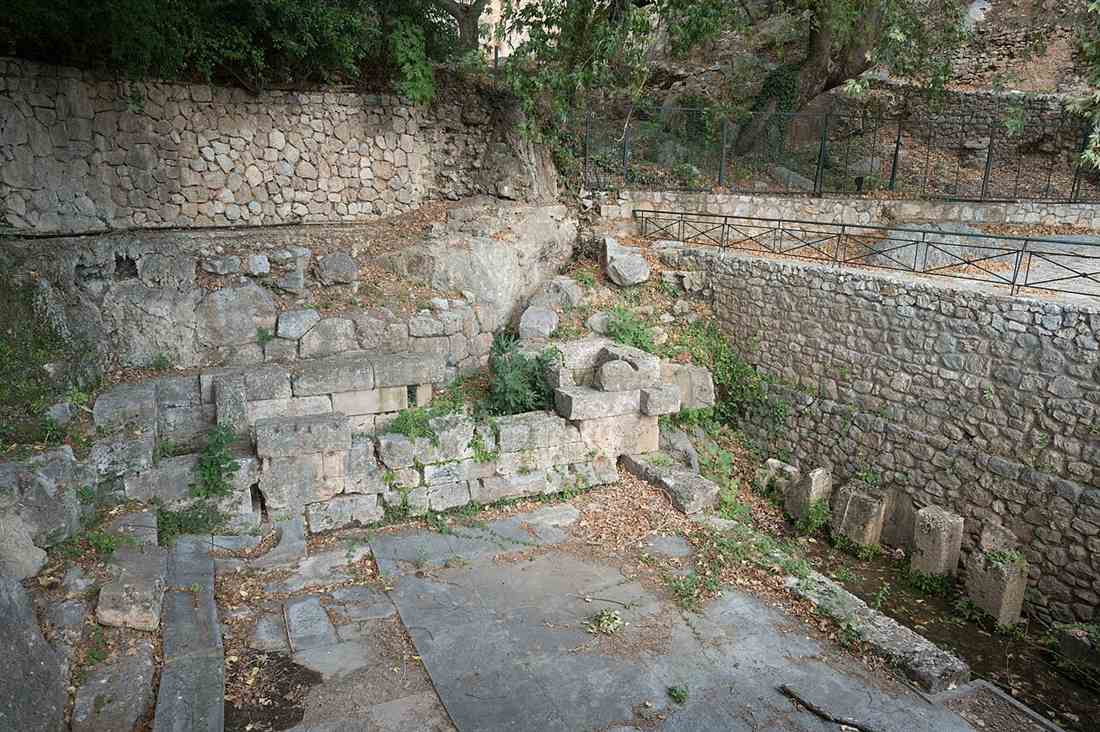
Purification came first. Pilgrims cleansed themselves at the Castalian Spring on the approach to the sanctuary, washing hair and hands before climbing the Sacred Way. The Pythia herself bathed in the same waters. This rite marked the passage from the ordinary world into the god’s precinct, and no inquirer approached the temple without it.
The sacrifice tested whether Apollo consented to speak. Priests sprinkled cold water over a goat and watched the animal: a shudder passing from the head through the whole body signalled a favourable day, and the goat was then killed on the great altar before the temple. A goat that stayed still cancelled the consultation. The steps of the approach ran in a fixed order:
- Payment of the pelanos, the ritual cake or cash offering set as the entry fee to the oracle.
- The preliminary sacrifice of the goat and the reading of its response to the water.
- A second sacrifice on the altar, its portions burned for the god.
- Entry to the temple in the order dictated by rank and by promanteia.
Time and precedence governed access. In the earliest phase the oracle spoke on one day a year; the sanctuary later opened for consultation on the seventh day of each month through the nine months of Apollo’s residence, the winter months belonging to Dionysus. Delphi granted promanteia, the right to consult ahead of others, to favoured cities and individuals as a mark of honour, so a delegation holding that privilege stepped in front of the queue. Lots decided the order among the rest, and the flow of pilgrims filed toward the adyton in sequence.
What caused the Pythia’s trance?
Ancient sources attribute the trance to a sweet vapour, the pneuma, rising from a chasm beneath the temple floor. Modern geology identifies intersecting faults under the sanctuary and traces of ethylene, a sweet gas, seeping through them. A separate theory credits chewed laurel. The accounts point to a real physical trigger.
The ancient explanation is consistent across the writers. Plutarch describes an exhalation, the pneuma, with a sweet smell like fragrant perfume, breathed up through the cleft over which the tripod sat. Diodorus Siculus tells of goats grazing at the spot falling into convulsions, which led herdsmen to the site and prompted the first prophecies. In this account the Pythia inhaled the vapour, entered an altered state, and voiced Apollo’s answers under its effect.
Geological survey of Delphi confirmed the physical setting the ancients named. Two faults cross beneath the Temple of Apollo, the Delphi fault running east to west and the Kerna fault running north to south, and their intersection lies under the adyton. The bituminous limestone of the region holds hydrocarbons, and movement along the faults releases gases through the fractured rock. Analysis of spring water and travertine at the site detected ethylene, methane, and ethane. Ethylene carries a sweet odour and, inhaled in a small enclosed space, produces a trance state marked by euphoria and disembodied speech, matching Plutarch’s description of the sweet-smelling pneuma.
A competing explanation points to the laurel. Some ancient reports state that the Pythia chewed leaves of the bay laurel and inhaled smoke from burning laurel and barley before she prophesied. Tests of laurel show the leaves carry no strong intoxicant, which weakens the leaf-chewing account on its own. The two lines of evidence converge rather than clash: the gaseous exhalation supplies the physical cause the ancient priests reported, the geology names the mechanism, and the laurel remains the ritual emblem of Apollo that framed the act. Together they describe a priestess induced into prophecy by the very ground of the sanctuary.
What famous prophecies did the Pythia give?
The Pythia delivered the most consequential oracles in Greek history: she told Croesus that attacking Persia destroyed a great empire, answered Athens with the “wooden walls,” named Socrates the wisest of men, and sanctioned the founders of colonies from Cyrene to Syracuse.
Croesus, king of Lydia, tested every famous oracle before he trusted Delphi with the greatest question of his reign. He asked whether to march against the rising power of Persia. The Pythia answered that if he crossed the river Halys he destroyed a great empire. Croesus read the words as a promise of Persian ruin, crossed the Halys, and lost. The empire the oracle named was his own. Herodotus records that Croesus, a prisoner of Cyrus, sent his chains to Delphi and demanded an accounting, and the priests replied that the god foretold the fall of an empire without naming which one.
Athens faced the advancing fleet of Xerxes with a starker oracle. The Pythia first gave a message of pure doom, then, pressed a second time, spoke of a “wooden wall” that alone stayed unbroken and safe. The Athenians divided over the meaning: some fixed on the thorn hedge of the old Acropolis, while Themistocles argued that the wooden wall named the ships. Athens trusted the fleet, evacuated the city, and broke the Persian navy in the straits of Salamis. The same oracle called Salamis “divine” and spoke of the deaths of the children of women, a line the victors read after the fact as the drowned enemy.
Two further oracles fixed the Pythia at the centre of Greek intellectual and colonial life. When Chaerephon asked whether any man surpassed Socrates in wisdom, the Pythia answered that no man was wiser. Socrates spent his life probing that verdict, and it anchored his defence at his trial. Across the archaic centuries the oracle also directed the great waves of settlement: the Pythia named Battus the founder of Cyrene in Libya, sent Archias of Corinth to plant Syracuse in Sicily, and confirmed the sites of colonies that carried Greek language and cult across the Mediterranean.
Why were the oracle’s answers so ambiguous, and how did that sustain its authority?
The Pythia’s answers carried double-edged phrasing that fit either outcome, so the burden of meaning fell on the consultant who interpreted them. This structure protected the oracle’s record through victory and defeat: a right reading proved the god, and a wrong one convicted the questioner.
The Croesus oracle shows the mechanism exactly. “Cross the Halys and destroy a great empire” names a real event with total confidence and leaves the empire unspecified. Croesus supplied the wrong identity from his own ambition, and the failure attached to him, not to Apollo. The “wooden walls” of Athens work the same way: the phrase points at a defence without fixing whether that defence was timber palisade or timber hull. Themistocles won the argument, and the correct interpretation became proof of divine foresight. Had Athens fallen at sea, the priests retained the hedge on the Acropolis as the wall the god truly meant.
The oracle’s authority rested on this transfer of responsibility. The consultant, not the priestess, chose the reading and staked his city on it. The god spoke plainly in the record; men erred in the hearing. Every ambiguous answer therefore held two futures in reserve, and whichever future arrived, the sanctuary produced a phrasing that matched it. Delphi survived centuries of dangerous questions because no single answer ever bound the god to one outcome that reality then contradicted.
Ambiguity also carried a plain political value. The Pythia advised kings, tyrants, and rival cities whose interests clashed, and a flat directive risked open blame when it failed. A layered oracle let the sanctuary guide a decision, credit the god for success, and deflect disaster onto the reader’s judgement. The reputation for infallibility grew precisely because the oracle never spoke in terms that a later event refuted. That reputation drew the next questioner, whose gift enriched the sanctuary, whose consultation deepened its influence, and whose trust renewed the cycle.
How influential was the Pythia across the Greek world?
The Pythia shaped the entire Greek world: cities founded no colony, opened no major war, and passed few great laws without first consulting Delphi. The sanctuary stood as the diplomatic and religious centre of Hellas, and grateful states lined its Sacred Way with treasuries of gold and marble.
Delphi answered questions that decided the shape of nations. Founders of colonies sought the god’s approval before a single ship sailed, and the oracle’s word turned a private venture into a sacred mission with divine backing. Lawgivers carried their constitutions to the Pythia: Sparta traced the Great Rhetra, the framework of its dual kingship and council, to a Delphic oracle delivered to Lycurgus. Cities on the edge of war asked the god’s sanction, and states in dispute accepted the sanctuary as an impartial ground where oaths held and truces bound.
The reach of the oracle rested on institutions as much as on prophecy. The sanctuary governed the Amphictyonic League, a council of surrounding peoples that administered the temple, policed the sacred land, and punished cities that seized it. It hosted the Pythian Games, the second of the four great panhellenic festivals, which drew athletes and musicians from every Greek state to compete under a sacred truce. Through league, games, and oracle together, Delphi bound scattered and quarrelsome cities into a shared religious order that recognised one common centre.
The treasuries along the Sacred Way measured that influence in stone. Cities built these small temple-shaped buildings to house the dedications they sent after victories and windfalls, and each one advertised the debt its state owed the god:
- The Athenians raised a marble treasury from the spoils of Marathon, its walls carved with the deeds of Theseus and Heracles.
- The Siphnians financed a lavish treasury from the gold and silver of their island mines, fronted by sculpted maidens in place of columns.
- The Sicyonians, Thebans, Corinthians, and Cnidians each planted their own treasury on the slope, turning the approach to the temple into a gallery of rival civic pride.
- Croesus of Lydia, before his fall, sent bowls of gold and silver and a golden lion so heavy that the priests weighed the dedication in talents.
The wealth flowed toward Delphi because the whole Greek world treated the Pythia’s chamber as the point where human decisions met divine judgement. Kings and citizens climbed the same road, paid the same sacrifices, and waited for the same voice. No other site concentrated so much religious trust and political weight in one place, and the priestess on her tripod stood at the heart of it, the single figure through whom Apollo addressed the affairs of every Greek state.
What was the calendar and working life of the Pythia?
The Pythia prophesied for nine months of the year, through spring, summer, and autumn, while Apollo dwelt at Delphi; the three winter months belonged to Dionysus, who ruled the sanctuary in the god’s absence and stilled the oracle’s voice.
Consultation followed Apollo’s own calendar. The Pythia gave oracles on the seventh day of each active month, the date Delphi kept as the god’s birthday, and the number seven attached to Apollo across the Greek world. For long stretches of Delphi’s history that single monthly day carried the entire demand of the Mediterranean, and pilgrims timed sea voyages and overland journeys to reach the sanctuary before it.
The pressure of that demand reshaped the schedule. As Delphi’s fame spread and delegations arrived from colonies, tyrants, and city-states, the sanctuary opened the oracle on a wider footing, adding consultation days so that suppliants who had crossed hundreds of miles did not wait weeks for a single answer. Precedence on any given day was fixed by the drawing of lots, though the privilege of promanteia, the right to consult first, was granted to favoured cities and individuals as a mark of honour.
Ancient accounts describe more than one Pythia serving during the busiest periods. The historian Plutarch, himself a priest at Delphi, records that in the sanctuary’s height three women held the office at once, two taking the prophetic seat in turn and a third held in reserve, so that the god’s voice never fell silent through exhaustion on a crowded consultation day.
The three winter months broke this rhythm entirely. When Apollo departed for the land of the Hyperboreans in the north, Dionysus took his place, and Delphi turned from prophecy to the rites of the wine god, whose tomb the sanctuary claimed to hold. The Pythia rested through this interval, and the priesthood marked the god’s return each spring with festivals that reopened the oracle for another cycle of nine months.
When did the Pythia and the oracle of Delphi come to an end?
The oracle declined under Roman rule as offerings and prestige fell away, and Christian emperors closed the sanctuaries of the old gods in the fourth century after Christ; tradition records a final oracle declaring that Apollo’s spring had run dry and his voice fallen silent.
The erosion began long before the end. Delphi suffered plunder under the late Roman republic, and its treasuries lost the gold and bronze that centuries of grateful cities had dedicated. The stream of consultations that once flowed from every corner of the Greek world thinned to a trickle, and the sanctuary that had advised kings and founded colonies survived on a diminished income and a fading reputation.
A brief revival came under emperors who admired the old religion and restored monuments across Greece, and travellers of the second century after Christ still climbed to Delphi and questioned the Pythia. Plutarch, writing in this later age, devoted whole treatises to the oracle and asked openly why its prophecies had grown fewer and its inspiration weaker than in the heroic past.
The decisive break came with the triumph of Christianity. Emperors of the fourth century after Christ outlawed sacrifice, stripped the temples of their revenues, and ordered the pagan sanctuaries shut. Delphi’s sacred fire went out, its priesthood dispersed, and the terrace that had drawn the ancient world for a thousand years stood abandoned to the mountainside.
Byzantine tradition preserves the sanctuary’s last words. An envoy sent by a late emperor to question the oracle received the reply that the hall had fallen, that Apollo no longer had a roof or a prophetic laurel, and that the speaking spring was quenched and its waters stilled. Whatever its true origin, the verse became the epitaph of Delphi, the moment the classical world remembered as the silencing of the Pythia.
Where can you follow the Pythia’s story at Delphi today?
Three places at Delphi carry the Pythia’s story: the terrace of the Temple of Apollo, where the adyton held her tripod; the Castalian Spring on the road below, where she purified herself; and the Delphi Archaeological Museum, which guards the objects and sculpture of her sanctuary.
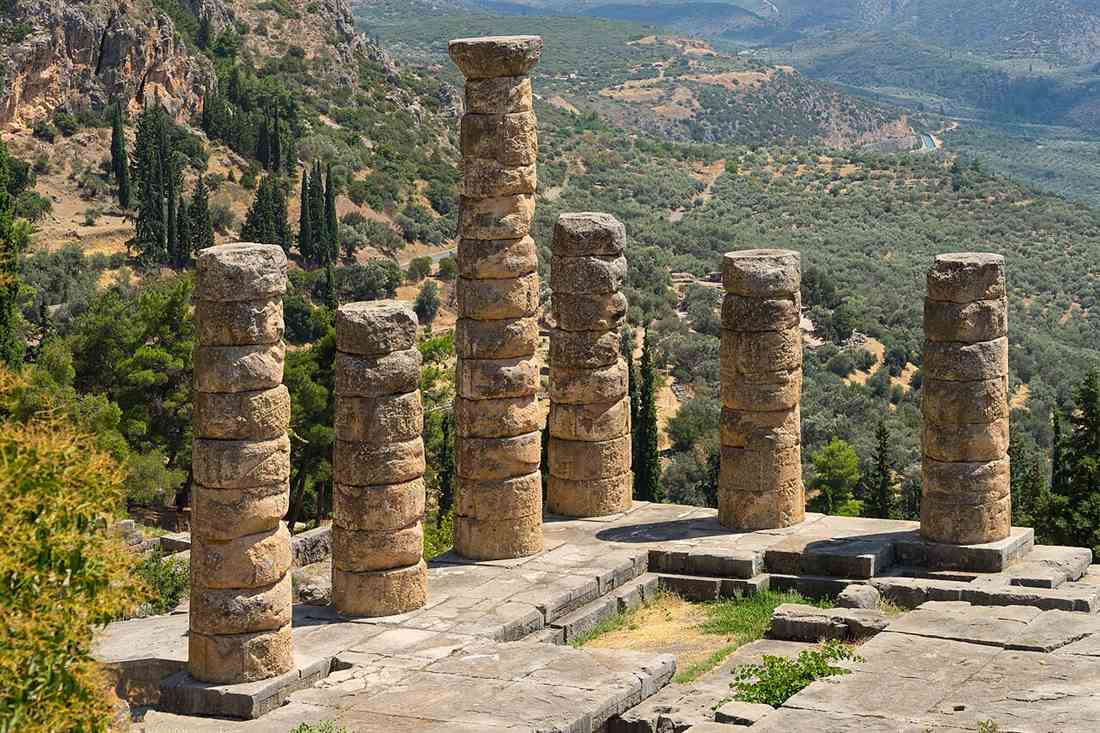
The Temple of Apollo stands at the heart of the site, reached by climbing the paved Sacred Way past the treasuries and the polygonal terrace wall. Six columns of the temple’s later rebuilding rise against the cliffs of Mount Parnassus, and the platform they crown once enclosed the adyton, the sunken inner chamber where the Pythia took her seat on the tripod above the sacred cleft. Standing on the terrace places a visitor at the exact spot from which the oracle spoke.
Below the temple, beside the modern road, the Castalian Spring still runs from the cleft between the two great rocks called the Phaedriades. This is the water in which the Pythia bathed and the pilgrims washed before approaching the god, and the carved niches and channels of its fountain remain cut into the rock. A short walk traces the ritual route the priestess and every suppliant followed on a consultation day.
The Delphi Archaeological Museum completes the story indoors. Its galleries hold the omphalos stone that marked Delphi as the centre of the earth, the bronze Charioteer, the twin kouroi, the sphinx of the Naxians, and the votive offerings that cities laid before the oracle. The finds gather into one building the wealth and art that the Pythia’s authority drew to the mountain across the centuries.
A single visit binds the three together in the order the ancients knew them:
- Purify at the Castalian Spring, as the Pythia and the pilgrims did before entering the sanctuary.
- Climb the Sacred Way to the Temple of Apollo and stand on the terrace above the vanished adyton.
- Cross to the museum to see the offerings, the omphalos, and the sculpture the oracle commanded.
Walked in this sequence, the ruins stop being scattered stones and become the working landscape of the oracle. Anyone weighing the trip from Athens will find the question of whether Delphi is worth visiting answered on the terrace itself, where the mountain, the temple, and the museum together trace the world in which the Pythia spoke for the god.
What is the difference between the Pythia, the oracle of Delphi, and the Sibyl?
The Pythia was the individual priestess who spoke for Apollo inside the temple; the oracle names both the prophetic institution at Delphi and the response it issued; the Sibyl was a separate legendary prophetess of early tradition, distinct from the Pythia.
The three terms name three different things, and writers across antiquity blurred them. The Pythia is a person: the woman who sat on the tripod, entered her trance, and delivered the words. Each Pythia held the office in turn, so “the Pythia” functions as a title rather than a single name, the way “the priest” names a role that many people fill across generations.
The oracle carries two meanings at once. It is the institution — the sanctuary of Apollo, its temple, its priests, and the whole procedure of consultation. It is also the answer itself: a questioner “received an oracle,” meaning the verse or statement handed back through the Pythia. Ancient authors switch between the two senses in the same passage, which is why the term reads as slippery.
The Sibyl stands apart from both. Early tradition placed a wandering prophetess at Delphi and tied her to a rock near the sanctuary, from which she chanted her own prophecies. She served the site’s memory as an independent figure, not as an officeholder of Apollo’s temple. The distinctions run this way:
- The Pythia — the serving priestess who voiced Apollo’s response on the tripod.
- The oracle — the sanctuary institution and the answer it delivered.
- The Sibyl — a legendary freelance prophetess linked to the Sibylline rock at Delphi.
Confusion follows from proximity. All three belong to the same slope of Mount Parnassus, all three deal in prophecy, and later readers folded the Sibyl’s mystique into the Pythia’s fame. Standing among the ruins, a visitor sees the temple terrace where the Pythia worked and the outcrop tradition assigned to the Sibyl within the same view, and the physical closeness explains why the words merged. The bronze Charioteer of Delphi survives from this sanctuary as one of its clearest witnesses.
How has the Pythia been portrayed in art and remembered since?
Ancient artists painted the veiled Pythia seated on the tripod over the chasm, and coins carried the same emblem; poets set her in tragedy, later writers described her rites, and the words “Pythian,” “Delphic,” and “oracle” carried her into modern speech as bywords for cryptic prophecy.
Painted pottery preserves the earliest images. Vase painters showed a robed woman on the high three-legged seat, a bowl or a branch in hand, the god or a questioner beside her. These scenes fixed the pose that later ages repeated: the priestess raised above the ground, veiled or crowned with laurel, delivering words from a place set apart. Struck coinage from the region carried the tripod as a badge of the sanctuary, so the emblem of the Pythia’s seat travelled through commerce as well as through art.
Literature kept her present in a different register. Greek tragedy opened scenes at Delphi and put the priestess on stage as the voice of the shrine, while historians and philosophers recorded consultations and argued over the source of her inspiration. Through these texts the figure of the entranced woman on the tripod reached readers who never climbed Parnassus, and each retelling renewed the image the vase painters first drew.
Language completed the transmission. “Pythian” attached to Apollo, to his games, and to prophecy itself; “Delphic” came to mark any statement that hides its meaning behind double sense; and “oracle” now names any source treated as an authority beyond question. The Pythia’s habit of answering in riddles turned her method into a common metaphor, so a “Delphic” reply signals ambiguity in ordinary speech far from any temple. Travellers who want to stand where the tradition began plan around the seasons, and the best time to visit Delphi guides that choice.
Frequently Asked Questions
Who was the Pythia of Delphi?
The Pythia was the high priestess of Apollo at Delphi, a mortal woman chosen from the town who spoke the god’s oracles from the tripod in the Temple of Apollo. Kings and cities treated her answers as divine command, which made her the most powerful woman of the ancient world.
How did the Pythia deliver her prophecies?
The Pythia sat on a bronze tripod in the adyton, the inner chamber of the Temple of Apollo, over a cleft in the rock. She held laurel, drank from a sacred spring, and spoke Apollo’s answers, which the attending priests shaped into verse.
What caused the Pythia’s trance?
Ancient writers describe a sweet vapour rising from a chasm beneath the temple. Modern geology found intersecting faults under the sanctuary and traces of ethylene, a sweet gas, seeping through the rock, matching the accounts of an intoxicating exhalation.