
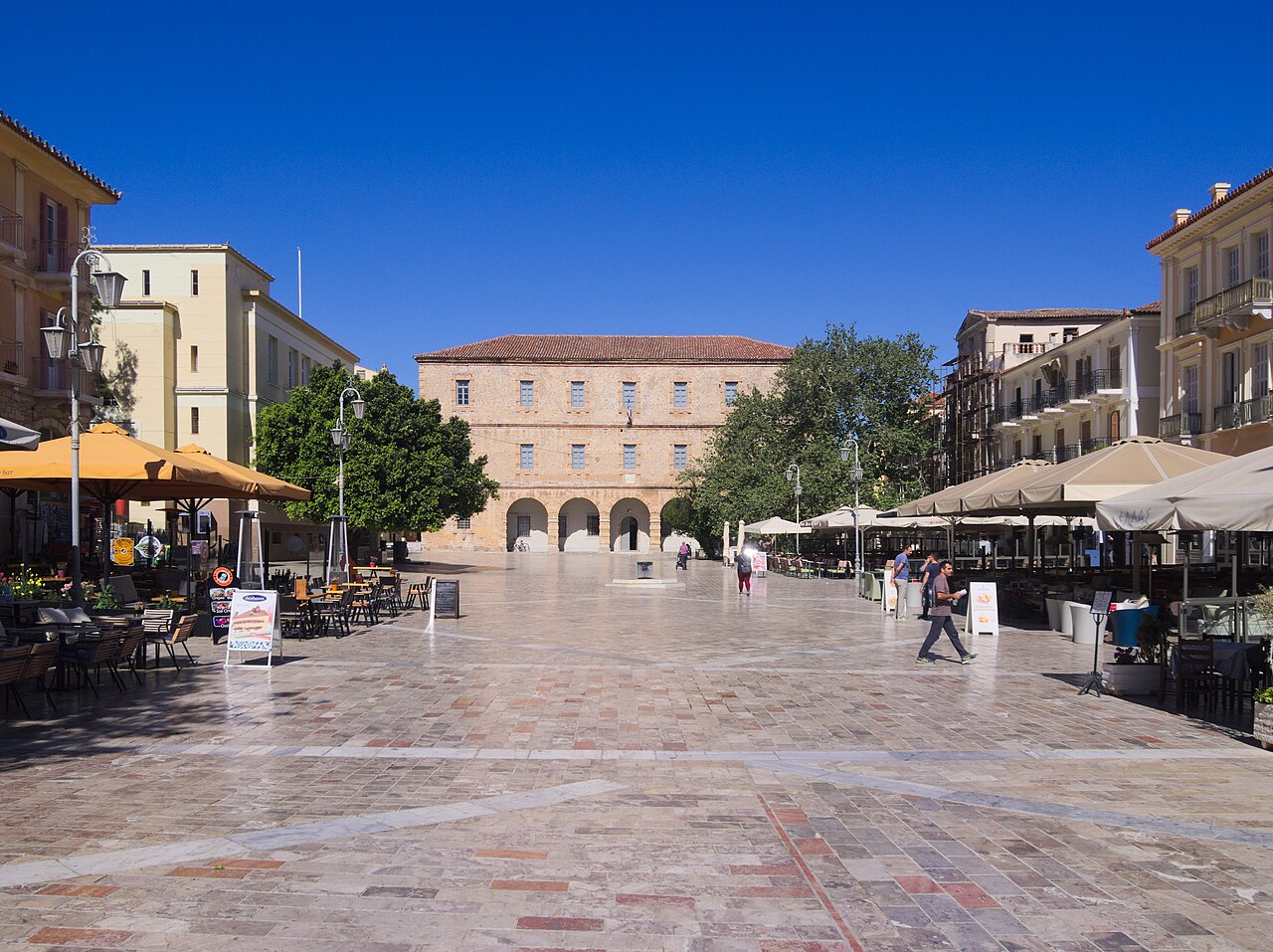
Syntagma Square is the grand marble-paved heart of Nafplio’s old town, the finest square in the Peloponnese and the natural first stop for almost every visitor. Ringed by the buildings of Greece’s first capital, from the Venetian barracks that hold the Archaeological Museum to the old Ottoman mosque known as the Trianon and, close by, the first Greek parliament, it is a history lesson in stone. Lined with cafes under the arcades and alive with strollers, street music and families in the evening, Syntagma Square is both the historic and the social centre of Nafplio.
This guide covers Syntagma Square in full: its history and changing names, the buildings around it, the museum and the Trianon, the cafes and the evening atmosphere, and how to visit. Read it beside the full Nafplio travel guide, the guide to Nafplio old town and the guide to the best things to do in Nafplio.
What is Syntagma Square in Nafplio?
Syntagma Square, or Constitution Square, is the grand central square of Nafplio’s old town, paved in marble and ringed by historic buildings. It holds the Archaeological Museum in the old Venetian barracks and the Trianon former mosque, with the first Greek parliament nearby, and it is the heart of the town.
It is the heart of the old town. The wide, marble-paved Syntagma Square is the centrepiece of Nafplio, the finest square in the Peloponnese, so it is the natural first stop for visitors and the social hub where the life of the town gathers.
It is ringed by history. Around the square stand the Venetian barracks that now house the Archaeological Museum, the Trianon that was once an Ottoman mosque, and the residences of the leaders of the young Greek state, so the square is a lesson in the town’s history.
It is the town’s living room. Lined with cafes under the arcades and busy with strollers in the evening, Syntagma Square is where Nafplio comes out to sit, meet and pass the time, so it is as much a social space as a historic monument, as the guide to Nafplio old town describes.
What is the history of Syntagma Square?
Syntagma Square has been the central square of Nafplio through Ottoman, Venetian and Greek rule. Once shaded by a great plane tree and known as Platanos Square, it was renamed Constitution Square, Syntagma, after the movement that won Greece its constitution, echoing the great square of the same name in Athens.
It was Platanos Square. The square was long known for a great plane tree, the platanos, that shaded its centre, so it was called Platanos Square, a gathering place through the Ottoman and early modern centuries of the town.
It carries Ottoman and royal names. During Ottoman rule the square lay at the heart of the town under the Turkish command, and after independence it was briefly named for the father of King Otto, so its changing names track the passing of Nafplio through different rulers.
It became Syntagma. The square took its present name, Syntagma or Constitution Square, after the popular movement that won Greece its constitution, echoing the great square of the same name in Athens, so its name ties Nafplio to the founding of the modern Greek state.
What buildings surround Syntagma Square?
Syntagma Square is surrounded by the buildings of Greece’s first capital: the Archaeological Museum in the Venetian barracks, the Trianon old mosque, the first Greek parliament nearby, the residences of Kapodistrias and Kolokotronis, and the arcaded buildings that now hold cafes and shops.
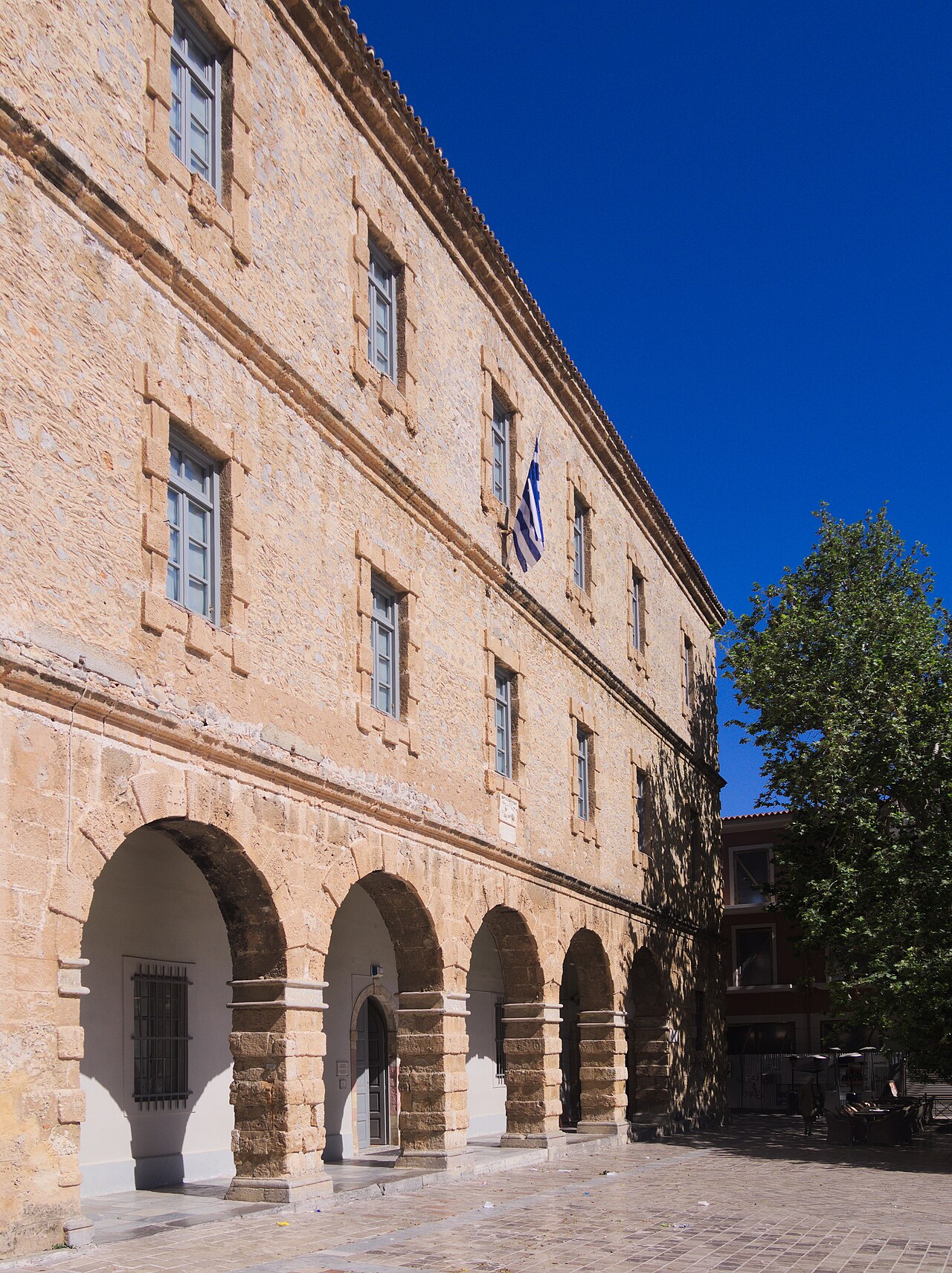
The Venetian barracks hold the museum. The grand stone building of the Venetian barracks on the square now houses the Archaeological Museum, so one of the finest Venetian buildings in the town frames the square and holds its greatest treasures.
The Trianon marks the Ottoman past. The domed Trianon, once an Ottoman mosque and one of the oldest to survive in Nafplio, stands on the square, so the Ottoman period is present alongside the Venetian and Greek buildings.
The founders’ houses ring it. The residences linked to Kapodistrias, the first governor, and Kolokotronis, the revolutionary hero, stand around the square, so it was the centre of the young Greek state, its buildings tied to the founding of modern Greece.
What is the Archaeological Museum on the square?
The Archaeological Museum of Nafplio stands on Syntagma Square in the handsome Venetian barracks, and displays finds from across the Argolid, including Mycenaean pottery, bronze armour and a boar’s-tusk helmet. It is one of the finest museums in the region, at the heart of the square.
It fills the Venetian barracks. The museum occupies the grand stone barracks on the square, so its setting is itself a monument, one of the finest Venetian buildings in Nafplio, framing the western side of Syntagma Square.
It holds Mycenaean treasures. Among its displays are finds from Mycenae and Tiryns, including bronze armour and a helmet made of boar’s tusks, so the museum is a rich complement to the ancient sites of the Argolid, a few steps from the cafes.
It is easy to combine. Because it stands on the main square, the museum is easily added to a walk through the old town, so it is a natural stop, bringing the deep past of the region to life at the heart of Nafplio.
What is the Trianon on Syntagma Square?
The Trianon is an elegant domed building on Syntagma Square, originally an Ottoman mosque and one of the oldest to survive in Nafplio. Over the centuries it has served as a mosque, a Catholic church and now a cultural and concert venue, a landmark of the square’s layered history.
It began as a mosque. The Trianon was built as an Ottoman mosque, believed to be one of the oldest surviving from the early period of Turkish rule, so it is a rare and important survival of the town’s Ottoman past on the main square.
It has changed with the town. Over the centuries the Trianon was converted from a mosque to a Catholic church and later to a concert and cultural venue, so its changing uses mirror the passing of Nafplio through Ottoman, Venetian and Greek hands.
It anchors the square. The domed building stands prominently on Syntagma Square, so it is one of the landmarks that give the square its historic character, easily seen on any walk through the old town.
What is Syntagma Square like in the evening?
Syntagma Square comes alive in the evening, when the marble-paved space fills with strollers, families and children, street vendors and often live music. The cafes under the arcades spill their tables into the square, so the evening is when Syntagma Square is at its liveliest and most enjoyable.
The town gathers there. In the cool of the evening the square fills with people taking the volta, the evening stroll, so Syntagma Square becomes the living room of the town, busy and welcoming as the day cools.
It is a place for families. Children play in the open marble space while adults sit at the cafes, and street vendors and sometimes live music add to the scene, so the square is a playground and a meeting place for young and old alike.
The cafes fill the edges. The cafes and tavernas under the arcades set out their tables around the square in the evening, so it is a fine place to sit over a coffee or a drink and watch the life of Nafplio pass, especially at sunset.
Where do you eat and drink on Syntagma Square?
You eat and drink on Syntagma Square at the cafes, ouzeries and tavernas set under the arcades and around the marble space. Best for a coffee, a drink or a meze with a view of the square, they put you at the heart of the old town, with the taverna street of Staikopoulou just steps away.
The cafes ring the square. Cafes and bars line the arcades of Syntagma Square, so it is the prime spot in the old town for a Greek coffee, a freddo or an evening drink, watching the life of the square from a shaded table.
Meze and tavernas are close. Ouzeries and tavernas on and around the square serve meze and Peloponnesian dishes, and the taverna-lined Staikopoulou street lies just steps away, so a meal is never far from the square.
It suits lingering. Because Greek cafe culture is about sitting for an hour or more, Syntagma Square is made for lingering over a coffee or a drink, so it is as much a place to relax and watch as to eat, as the guide to Nafplio food describes.
How do you get to Syntagma Square?
You reach Syntagma Square on foot, at the heart of the pedestrian old town of Nafplio, a few minutes from the waterfront, the bus terminal and the edge-of-town car parks. A lift from the square rises to Acronafplia, and the main streets of the old town all lead to it.
It is the centre of the old town. Syntagma Square sits at the heart of the pedestrian old town, so every walk through the quarter passes through it, reached on foot from the waterfront, the shops and the churches within a few minutes.
It is close to arrival points. The square lies a short walk from the bus terminal and the car parks at the edge of the old town, so visitors arriving by bus or car reach it easily on foot, the natural first point in the town.
It connects the sights. From Syntagma Square the main streets of the old town lead off, the lift rises to Acronafplia, and the Palamidi steps and the waterfront are a short walk away, so the square is the hub from which the sights of Nafplio radiate.
What events happen on Syntagma Square?
Syntagma Square hosts the public life of Nafplio: national celebrations and parades, cultural events and concerts, festive markets and gatherings, and the daily evening promenade. As the town’s main square, it is the setting for both official ceremonies and the everyday social life of the community.
It hosts national celebrations. On Greece’s national holidays the square is the setting for parades and ceremonies, so it plays its part in the civic life of the town, as befits the main square of the first capital of the modern state.
It stages culture and markets. Concerts, cultural events and festive markets are held on the square through the year, so it is a venue for the town’s cultural life as well as its history, especially in the warmer months and at the holidays.
It holds the daily promenade. Above all, the square hosts the daily evening promenade, when the town gathers to stroll, sit and meet, so its most important event is simply the everyday social life of Nafplio, played out on the marble each evening.
Who was Kalliopi Papalexopoulou of Syntagma Square?
Kalliopi Papalexopoulou was a heroine of nineteenth-century Nafplio whose house stood on Syntagma Square. From her balcony she gave a fiery speech urging the people of Nafplio to rise against the government, so she is remembered as a champion of liberty, and her house is one of the square’s historic buildings.
She spoke from her balcony. From the balcony of her house on Syntagma Square, Kalliopi Papalexopoulou addressed the people of Nafplio, urging them to revolt against the government of the day, so her speech became a famous moment in the town’s history.
She championed liberty. Remembered as a spirited defender of freedom and the constitution, Papalexopoulou stood among the notable figures of nineteenth-century Nafplio, so her name is tied to the town’s role in the political life of the young Greek state.
Her house marks the square. The building linked to her stands among the historic houses around Syntagma Square, so it adds another layer to the square’s story, one of the residences that made it the centre of the town’s public life.
What other squares are in Nafplio’s old town?
Besides Syntagma Square, Nafplio’s old town has smaller squares, including the square of Agios Georgios by the church, the Kapodistrias square with its statue, and little platies scattered through the lanes. Quieter and shaded, they complement the grand central square as gathering places of the quarter.
Agios Georgios has its own square. The church of Agios Georgios stands on its own square in the old town, quieter than Syntagma, so it offers a shaded, calmer corner with a historic church at its centre.
Kapodistrias has a square and statue. A square with a statue honours Ioannis Kapodistrias, the first governor of Greece, so the founder of the modern state is commemorated in the town he governed, adding to the historic squares of the quarter.
Little platies dot the lanes. Through the marble streets lie other small squares, quieter and often shaded by a tree or a cafe, so wandering the old town reveals a series of little platies, each with its own character, as the guide to Nafplio old town describes.
Frequently Asked Questions
Why is Syntagma Square important in Nafplio?
Syntagma Square is important as the historic and social heart of Nafplio, the grand central square of the old town and one of the most significant public spaces in the country. As Nafplio was the first capital of the modern Greek state, the buildings around the square are tied to the founding of the nation: the Archaeological Museum stands in the old Venetian barracks, the Trianon, an Ottoman mosque, marks the Turkish period, and the first Greek parliament, the Vouleftiko, sits nearby, with the residences of the first governor Kapodistrias and the revolutionary hero Kolokotronis close at hand. The square’s very name, Syntagma or Constitution Square, commemorates the movement that won Greece its constitution, echoing the great square of the same name in Athens. Beyond its history, the square is the living centre of the town, lined with cafes under the arcades and alive with strollers, families and music in the evening, so it is both a monument to the birth of modern Greece and the everyday gathering place of Nafplio.
What can you see at Syntagma Square?
At Syntagma Square you can see the grand marble-paved space itself, the finest square in the Peloponnese, ringed by the buildings of Greece’s first capital. On the square stands the Archaeological Museum of Nafplio, housed in the magnificent Venetian barracks and displaying Mycenaean pottery, bronze armour and a boar’s-tusk helmet from across the Argolid. The domed Trianon, once an Ottoman mosque and one of the oldest buildings to survive from the Turkish period, marks another corner, and the first Greek parliament, the Vouleftiko, lies close by, along with the residences linked to the first governor Kapodistrias and the hero Kolokotronis. The arcaded buildings around the square now hold cafes and shops. Beyond the monuments, the square is a place to sit at a cafe under the arcades, watch the life of the town, and enjoy the lively evening atmosphere of strollers, families, street vendors and music, so there is as much to experience as to see.
Why is it called Syntagma Square?
The square is called Syntagma Square, meaning Constitution Square, in memory of the movement that won Greece its constitution, exactly as the great central square of Athens bears the same name for the same reason. Before this, the square had other names: it was long known as Platanos Square after the great plane tree that once shaded its centre, and for a time it carried a royal name honouring the family of King Otto. When the Greek people demanded a constitution, the square, like its counterpart in Athens, was renamed Syntagma to commemorate that victory for constitutional government. The name therefore ties this square in the first capital of modern Greece directly to one of the founding moments of the nation, and it reflects the square’s role as the civic heart of Nafplio, where the political and public life of the young state was played out. Today the name endures on the marble-paved square at the centre of the old town.
Is Syntagma Square worth visiting?
Yes, Syntagma Square is well worth visiting, and it is the natural first stop and the heart of any visit to Nafplio. It is the grand central square of the old town, marble-paved and ringed by the historic buildings of Greece’s first capital, so it combines beauty with a remarkable concentration of history: the Archaeological Museum in the Venetian barracks, the Trianon old mosque, the first Greek parliament nearby, and the residences of the founders of the modern Greek state. Its name commemorates the winning of the Greek constitution. Beyond the monuments, the square is the social centre of the town, lined with cafes under the arcades and at its liveliest in the evening, when it fills with strollers, families, street vendors and music. Whether for its history, its architecture or simply for a coffee while watching the life of Nafplio, Syntagma Square is a place every visitor passes through and lingers in, so it is unmissable, and it anchors any walk through the beautiful old town.