
Chios holds far more than its famous mastic villages. Beyond the fortified south, the island is scattered with stone settlements that see few visitors: the shipowning twins of Kardamyla and Marmaro in the north, the hilltop village of Volissos in the west, the abandoned cliff village of Anavatos in the mountains, the fishing harbour of Langada, and the walled citrus estates of Kampos on the edge of the capital. Each belongs to a different corner of the island, and together they show a Chios that the day-trippers rarely reach. Plan the whole trip with Greece Tours.
This guide covers the villages of Chios beyond the mastichochoria, region by region: the north around Kardamyla, the west around Volissos, the mountain villages of Avgonyma and Anavatos, the fishing village of Langada, Vrontados and its rocket war, the Kampos estates, and the lesser-known fortress villages of the centre. It weighs which are worth the most time and how to tour them. Read it beside the guide to the Chios mastic villages and the full Chios travel guide.
What villages does Chios have beyond the mastic villages?
Beyond the mastic villages of the south, Chios has the shipowning villages of the north around Kardamyla, the hilltop village of Volissos in the west, the mountain villages of Avgonyma and Anavatos, the fishing village of Langada, Vrontados near the capital, and the Kampos estates.
The island divides into clear village regions. The mastichochoria occupy the south and are treated in their own guide. North of the capital lie the maritime villages of Kardamyla and its port of Marmaro, and the fishing harbour of Langada. West across the mountains stands Volissos with its castle, and in the central hills sit Avgonyma and the abandoned Anavatos.
Each region has its own character. The northern villages built their fortunes on shipping and keep the grand houses to prove it. The western and mountain villages are stone-built and remote, set among pine forest and terraced hills. The Kampos plain, just south of Chios Town, is different again: a landscape of walled merchant estates rather than a hilltop village.
These settlements reward a car and an unhurried pace. None is a resort, and most have a taverna or two, a church and a square rather than a tourist trade. Seeing them means driving the island’s winding roads between the coast and the mountains, and the reward is a Chios that feels lived-in rather than visited, quite apart from the fortified south.
What are the villages of northern Chios?
Northern Chios centres on Kardamyla and its port of Marmaro, the island’s shipowning heartland, along with the mountain villages of Pityous and Viki. The region is green and mountainous, with grand captains’ houses, quiet pebble beaches and a maritime tradition rivalling that of Oinousses.
Kardamyla is the capital of the north. It sits a little inland in a fertile valley, while its port of Marmaro lies on the bay below, and the two together produced a remarkable share of the Greek merchant marine’s captains and shipowners. The wealth shows in the neoclassical houses and the seafront mansions, and a monument to the Unknown Sailor stands on the shore.
The coast around it is quiet and green. Nagos, a short drive on, is a pebble cove fed by springs and shaded by plane trees, and Giosonas beside it is longer and emptier. The mountains behind hold smaller villages such as Pityous, with its Byzantine tower, and Viki, and the whole region stays cool and wooded when the south bakes.
Northern Chios sees few foreign visitors, which is its appeal. The villages run on their own rhythm, the tavernas cook for locals, and the beaches fill only with Greek families in August. Basing here suits travellers who want quiet and green landscapes over sightseeing, and it pairs naturally with the northern beaches covered in the guide to the best beaches in Chios.
What is Volissos and the west of Chios?
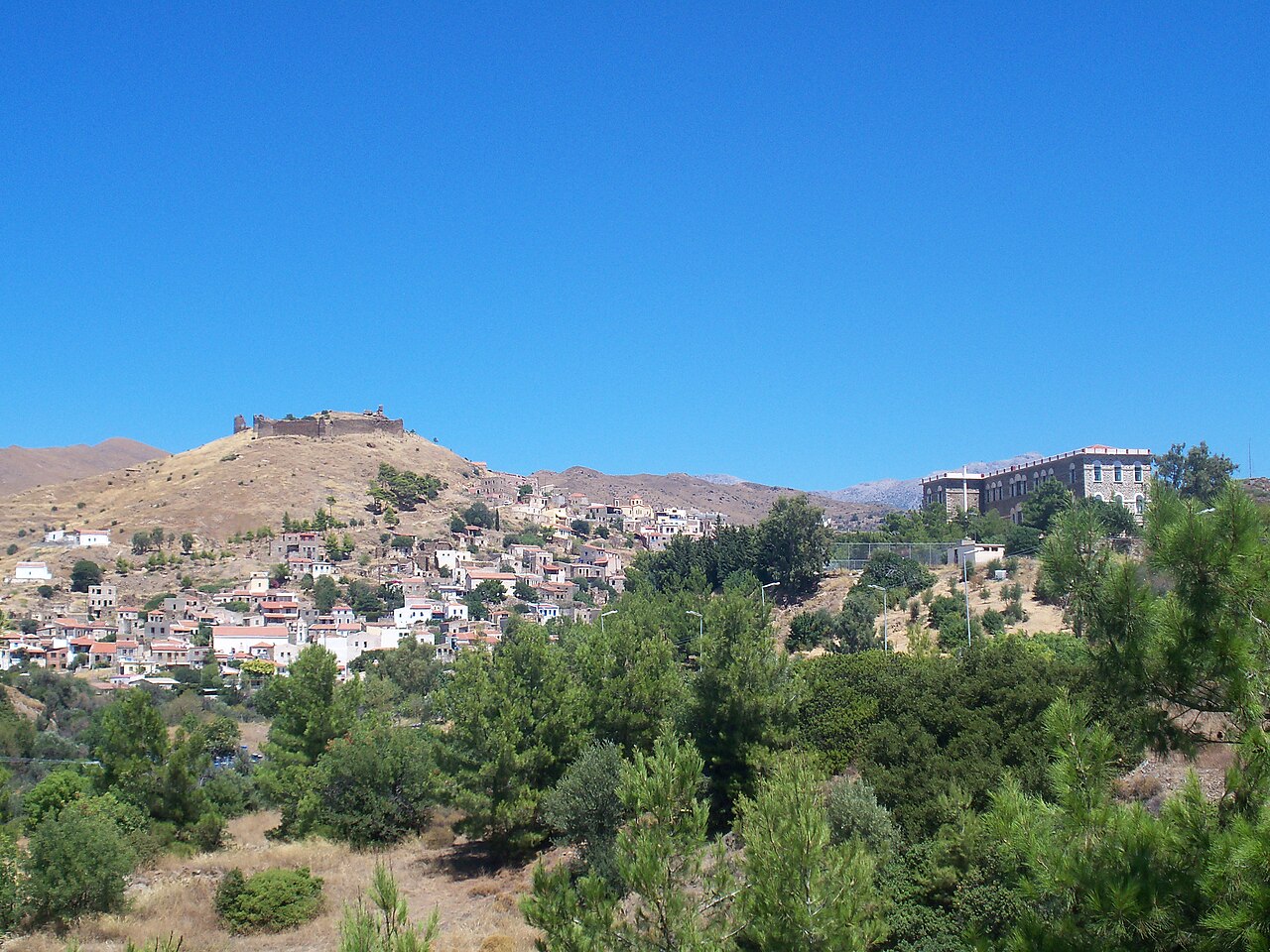
Volissos is the main village of western Chios, a settlement of stone houses climbing beneath a Byzantine-Genoese castle, linked by tradition to Homer. Below it lie the long sandy beaches of Managros and Limnia, and the west coast is the island’s most remote and undeveloped.
Volissos is the west’s stone showpiece. Its houses rise in tiers up a hillside crowned by a ruined castle of Byzantine origin later strengthened by the Genoese, and the restored traditional houses among its lanes have become some of the most atmospheric places to stay on Chios. An old tradition names the village as the birthplace of Homer, and the setting earns the legend.
The coast below is the reward for the long drive. Limnia, the small port a couple of kilometres down, has tavernas and fishing boats, and the beaches of Managros, Limnos and Lefkathia stretch long, sandy and undeveloped along the west shore. This is the emptiest coast on the island, and sunsets over the sea here are the finest on Chios.
The west takes commitment to reach. The roads across the island’s mountainous spine wind and climb, and Volissos sits about an hour and a half from the mastic villages of the far south, so the region rewards those who base themselves here or set aside a full day. For that effort it gives castle, village, empty beaches and the quietest corner of the island.
What is Avgonyma, the mountain village?
Avgonyma is a compact stone village in the central mountains of Chios, near the monastery of Nea Moni. Its grey stone houses cluster tightly on a ridge, it has been carefully restored, and its square holds tavernas known for good food and a view across the island.
Avgonyma is the prettiest of the mountain villages. Unlike the whitewashed Cyclades, it is built entirely of the local grey-brown stone, its houses packed around a small central square in a compact, defensible cluster on high ground. Careful restoration has kept its character, and it makes a natural stop on the drive between Chios Town and the west.
The village sits minutes from Nea Moni, the eleventh-century monastery whose Byzantine mosaics carry UNESCO World Heritage listing, so the two combine in a single mountain outing. From Avgonyma the road continues a short way to the cliff-edge ruin of Anavatos, making a compact circuit of the island’s central heights.
Avgonyma is also a place to eat. Its square tavernas draw people up from the coast for lunch and dinner, cooking goat, local cheese and mountain dishes with a view over the terraced hills to the sea. Pairing a meal here with the monastery of Nea Moni and the ghost village next door fills a rewarding half day.
What is Anavatos, the ghost village of Chios?
Anavatos is an abandoned medieval village on a steep cliff in the central mountains, often called the ghost village of Chios. Its stone houses climb in tiers to a ruined church at the summit, with sheer drops on three sides, and it stands empty and silent above the island’s interior.
Anavatos is the island’s most haunting place. Built for defence on a rock that falls away almost vertically on three sides, its grey houses merge with the cliff so completely that from a distance the village is hard to pick out from the stone itself. A single stepped path climbs through the empty lanes to the church at the top.
Its emptiness has a dark cause. The village was tied to the catastrophe of 1822, when the island’s population was destroyed or scattered in an Ottoman reprisal, and Anavatos never recovered, dwindling over the following century to the ruin seen today. Only a handful of people live in the lower village now, and the upper town stands wholly abandoned.
The visit is a walk and a view rather than a set of monuments. The climb through the ruined houses to the summit takes about an hour, and the reward is a sweeping view across the wooded interior to the sea. Anavatos combines naturally with Avgonyma and Nea Moni into a single mountain day, described in the guide to the best things to do in Chios.
What is Langada, the fishing village?
Langada is a small fishing harbour on the north-east coast of Chios, about fifteen kilometres from the capital, known for its seafront fish tavernas. The boats tie up in front of the tables, and the village fills on summer evenings with people driving out from Chios Town to eat.
Langada is the island’s favourite place to eat fish. Its horseshoe harbour is lined with tavernas that serve the day’s catch straight off the boats, and the setting, with the fishing fleet moored a few metres from the tables, is the draw as much as the food. On summer evenings the village fills from nine as the town drives out for dinner.
The village itself is small and workaday rather than picturesque, a working harbour rather than a resort. That is part of its appeal: the tavernas trade on the fish and the atmosphere, not on postcard looks, and the prices reflect a local clientele more than a tourist one. Squid, octopus and small grilled fish are the things to order.
Langada also makes a launching point for the sea. Sailing and boat trips up the north-east coast and across to Oinousses often call here, and the coves nearby give clear water for a swim. It sits on the coast road north towards Kardamyla, so it fits into a northern day, as the guide to day trips from Chios sets out.
What is Vrontados and Daskalopetra?
Vrontados is a coastal town just north of Chios Town, home to Daskalopetra, a rock platform above the sea traditionally called Homer’s teaching stone. It is also famous for the rocket war fought between two parish churches on Easter Saturday night.
Vrontados sits on the coast a few kilometres north of the capital, effectively its northern suburb, with a working waterfront and a seafaring history of its own. Its best-known site is Daskalopetra, the “teacher’s rock”, a carved stone platform above the water that tradition links to Homer teaching his pupils, though archaeologists identify it as an ancient sanctuary of Cybele.
The rocket war is the town’s great spectacle. On Easter Saturday night the congregations of two churches, Agios Markos and Panagia Erithiani, fire tens of thousands of homemade rockets across the valley at each other’s bell towers while the Resurrection service continues inside, and the churches board their windows in advance. Spectators watch from arranged vantage points.
Beyond these, Vrontados is a place to pass through rather than a sightseeing village, but its position makes it easy to combine with the capital. A stop at Daskalopetra at sunset, or a visit timed for Easter, adds a distinctive note to a stay in Chios Town, as the guide to Chios Town describes.
What are the Kampos estates?
Kampos is a plain of walled merchant estates immediately south of Chios Town, running towards the airport. Genoese and Greek families built mansions there among orchards of mandarin, orange and lemon, behind high ochre walls, and several estates now open as guesthouses or a citrus museum.
Kampos is a village of a very different kind: a landscape of walls rather than a hilltop cluster. From the fourteenth century onward, the wealthy landowning families of Chios built country mansions across this fertile plain, each set behind a high enclosure of ochre-red stone with an arched gateway, a courtyard, a stone cistern and an irrigation wheel drawing water for the citrus.
The estates still define the plain. Some remain private, others have been restored as atmospheric guesthouses, and one working estate houses the Citrus Museum, which records the growing, packing and export of the Kampos mandarins that were shipped across the Mediterranean. The scent of citrus blossom fills the walled lanes in spring.
Kampos is the easiest of the villages to reach, four to six kilometres from Chios Town on flat ground, which makes it ideal for a gentle walk or a cycle between the walls. It pairs a distinctive history with the quietest lanes on the island, and it suits an afternoon before or after the beach at nearby Karfas.
Which fortress villages sit beyond Pyrgi and Mesta?
Beyond the famous three, the south holds lesser-known fortress villages: Vessa, a well-preserved medieval settlement of arched stone lanes; Kalamoti, with the same defensive plan; and Armolia, the island’s pottery village below the castle of Apaliki.
Vessa is the quiet equal of Mesta. Built as a fortress settlement with the outer houses forming a defensive wall, it keeps the maze of narrow stone alleys and arched passages that define the mastichochoria, but it runs as an ordinary working village with almost no visitors. Walking its lanes gives the medieval atmosphere without the coaches.
Kalamoti shares the pattern. One of the larger southern villages, it too was laid out as a sealed fortress against pirates, and its old core preserves the covered passages and blank outer walls of its neighbours. It sits near the sandy beach of Komi, so a visit combines the fortified village with an afternoon swim.
Armolia adds a living craft. The village strings along the road into the south below the ruined Genoese castle of Apaliki, and its roadside workshops turn out the glazed ceramics that Chios has made for generations. Stopping there on the way to Pyrgi and Mesta adds a working trade to a day among the medieval villages described in the guide to the Chios mastic villages.
What are the villages of the central and eastern plain?
The central and eastern plain holds working villages such as Kataraktis with its waterfall, Nenita near the coast, Kalimasia, and the seaside settlement of Agia Ermioni. These are agricultural and fishing villages rather than sights, giving a picture of everyday Chios between the town and the south.
This band of the island, south of the capital and inland from the east coast, is its agricultural heart. Kataraktis, named for a small waterfall, sits above the sea with views across to the Turkish coast, and Nenita and Kalimasia are farming villages set among fields and olive groves that supply the island’s markets rather than its tourists.
The coast here has its own small settlements. Agia Ermioni is a fishing hamlet and beach near Karfas, with tavernas on a sheltered bay, and the resort beach of Karfas itself lies just north. These places serve the everyday life of the island, and their tavernas cook for residents and Greek holidaymakers.
None of these is a headline sight, and that is the point of including them. Driving through the central plain between the town and the mastic villages shows the ordinary Chios that supports the famous one, and a taverna lunch in Kataraktis or Kalimasia is a quieter experience than the tourist squares of the south.
Which Chios village makes the best base?
The best village base depends on the trip: Volissos and its restored stone houses for the remote west, a mastic village such as Mesta for the medieval south, Kardamyla for the green north, or the Kampos estates for history close to Chios Town and the airport.
Volissos suits travellers seeking seclusion. Its restored traditional houses, castle setting and nearby empty beaches make it the most atmospheric village stay on the island, at the cost of long drives to the south and the airport. It rewards those who want to settle into one quiet corner rather than tour constantly.
The mastic villages of the south, above all Mesta, offer the fullest village experience: stone guesthouses inside a living medieval fortress, a lively square and easy reach of the southern beaches and craft villages. Kardamyla and the north suit lovers of green landscapes and quiet coves, though the choice of accommodation there is smaller.
Kampos is the compromise base. Its restored estates put you in a historic setting a few kilometres from Chios Town, the airport and the beach at Karfas, which keeps transfers short while still offering character. The full comparison of bases, including the town and Karfas, sits in the guide on where to stay in Chios.
How do you tour the villages of Chios?
The villages are best toured by hire car in three loops: the south for the mastic and fortress villages, the central mountains for Avgonyma and Anavatos with Nea Moni, and the north and west for Kardamyla, Langada and Volissos. Each loop fills a day.
A car is close to essential. The villages sit far apart across mountainous country, and public buses reach only the main ones on a residents’ timetable, so seeing several in a day means driving. The roads are paved but wind and climb, and distances that look short on the map take longer than expected, so each region is a day rather than a quick detour.
The three loops organise the island neatly. The southern loop takes in Armolia, Pyrgi, Olympi, Mesta and the fortress villages of Vessa and Kalamoti with a beach ending. The mountain loop climbs to Avgonyma, Anavatos and Nea Moni. The northern loop runs the coast through Langada to Kardamyla, or crosses west to Volissos and the empty beaches.
Those without a car have alternatives. Organised coach tours and licensed taxi drivers run village circuits from Chios Town through the summer, covering the mastic villages and the mountains without the driving, as the guides to car rental in Chios and day trips from Chios explain. For the widest picture, though, a hire car and three unhurried days remain the best way.
When is the best time to visit the villages of Chios?
The best time to visit the villages is spring and autumn, from April to June and September to October, when the weather is mild for walking the stone lanes and the mountains, the citrus blossoms in Kampos, and the villages are open but uncrowded.
Spring is the finest season inland. The hills are green, wildflowers cover the terraces, the Kampos citrus is in blossom, and temperatures suit walking the lanes of Volissos or the climb through Anavatos without the summer heat. Easter falls in this window and brings the villages to life, above all the rocket war at Vrontados.
Autumn repeats the mild weather with warm seas, making it ideal for combining village visits with swimming off the northern and western beaches. September and October are quiet, the light is soft, and the tavernas of Langada and Avgonyma stay open while the summer crowds have gone.
High summer is hot for the inland villages, and midday walking in Anavatos or Volissos is hard work in July and August, though the evenings are lively and the beaches at their best. Winter is very quiet: Chios Town stays open year-round, but many village tavernas close, so the shoulder seasons remain the ideal time, as the wider guidance in the Chios travel guide confirms.
What is the history behind the Chios villages?
The villages of Chios were shaped by Genoese rule from 1346, the mastic trade, and the maritime wealth of the north. Many were built as fortified settlements against pirates, and the catastrophe of 1822 emptied or scattered whole communities, marking the island’s history to this day.
Genoa left the deepest mark. The Maona, a chartered company of Genoese merchants, held Chios for over two centuries from 1346 and ran it on the mastic trade, fortifying the southern villages, building the castles that crown Volissos and Apaliki, and laying out the walled estates of Kampos. The defensive plans of the fortress villages date from this age of piracy and profit.
The north built a different wealth. Kardamyla, Marmaro and Vrontados turned to the sea, producing generations of captains and shipowners whose fortunes raised the neoclassical mansions that still line their streets, a maritime tradition shared with nearby Oinousses. Their grand houses stand in contrast to the stone simplicity of the mountain villages.
The shadow over all of it is 1822. In that year an Ottoman reprisal for the island’s part in the Greek revolution killed or enslaved much of the population, an event Delacroix painted and Europe never forgot. Anavatos never recovered and stands abandoned; other villages rebuilt slowly, and the memory runs through the island’s churches, monuments and festivals.
Where do you eat in the Chios villages?
The villages are where Chios eats best. Langada and the northern harbours serve fish off the boats, Avgonyma and the mountain villages cook goat and local cheese on their squares, and the mastic villages of the south serve village dishes flavoured with mastiha in their central plazas.
Fish belongs to the coast villages. Langada is the island’s favourite, its harbour tavernas serving squid, octopus and the day’s catch a few metres from the moored boats, and Marmaro, Nagos and Limnia offer the same by the water. Prices reflect a local clientele, and the setting on the harbour is the point as much as the food.
The mountains cook meat and cheese. Avgonyma draws people up from the coast for goat, grilled mastelo and mountain dishes eaten on its stone square with a view to the sea, and the tavernas of Volissos and Kardamyla cook the same hearty country food. These are unhurried evening meals rather than quick lunches.
The south adds mastiha to the table. In Mesta and Pyrgi the square tavernas serve village cooking finished with the island’s resin in sweets, bread and liqueur, and the craft village of Armolia and the fortress villages nearby keep simple kitchens. The full picture of the island’s cooking sits in the guide to Chios food.
What festivals and traditions do the villages keep?
The villages of Chios keep lively traditions: the Easter rocket war at Vrontados, saints’-day panigyria with food, wine and music through the summer, the mastic harvest in the southern villages in late summer, and carnival in the weeks before Lent.
Easter is the island’s great festival, and the villages come alive for it. The rocket war at Vrontados on Easter Saturday night is the most spectacular event, but every village marks Holy Week with processions and feasts, and the tavernas fill with returning islanders. It is the most rewarding time to be among the villages, and the busiest.
Summer brings the panigyria. Each village celebrates its patron saint’s day with an open-air feast of food, local wine and music that outsiders are welcome to join, and these village festivals are among the most genuine experiences on Chios. Their dates fall through the summer, and asking locally is the way to find the next one.
The land marks its own calendar. The mastic harvest in the southern villages runs from late summer into autumn, a working tradition on UNESCO’s list of intangible cultural heritage, and carnival in the weeks before Lent brings costume events and parades. These rhythms give a reason to time a village visit, as the guide on the best things to do in Chios notes.
Which villages sit near the best beaches?
Several villages pair with fine beaches: Volissos with the western sands of Managros and Lefkathia, Kardamyla with the northern pebbles of Nagos and Giosonas, Emporios with the black volcanic Mavra Volia, and Kalamoti with the family beach of Komi.
The west combines village and empty sand. Volissos sits above Limnia and the long undeveloped beaches of Managros, Limnos and Lefkathia, the emptiest on the island, so a stay there mixes a hilltop stone village with west-coast swimming and the finest sunsets on Chios. The drive is long, but the coast is the reward.
The north pairs green villages with spring-fed coves. Kardamyla and Marmaro sit above Nagos, a pebble cove shaded by plane trees, and Giosonas beside it, both quiet even in August. These northern beaches see mostly Greek families, and the villages behind them stay cool and wooded.
The south links fortress villages to striking beaches. Emporios, below the fortified villages, backs the dramatic black volcanic pebbles of Mavra Volia, and Kalamoti sits near the sandy, shallow bay of Komi that suits families. Pairing a village morning with an afternoon swim is the natural way to plan a southern day, as the guide to the best beaches in Chios lays out.
What smaller villages are worth a detour?
Smaller villages reward a detour: Lithi with its fishing harbour and beach on the west coast, Elata and Sidirounta in the western hills, Trypes near Volissos, and Kambia in the far north. These see almost no visitors and show the island at its quietest.
Lithi is the pick of the west-coast detours. A hillside village above a small fishing harbour and a sandy beach, it has tavernas by the water at Paralia Lithiou that cook fresh fish, and it makes a natural lunch stop on the drive between Nea Moni and Volissos. The sunset over the bay is among the best on the island.
The western hills hide more. Elata and Sidirounta are small stone villages set among terraces and pine, quiet places to pause on the mountain roads, and Trypes near Volissos and the scattered hamlets of the north-west see scarcely a visitor from one week to the next. They offer nothing to tick off, only the atmosphere of an unspoilt island.
The far north has its own remote corners. Kambia and the villages beyond Kardamyla sit among the island’s wildest country, reached by winding roads that few tourists drive. For travellers who value emptiness and stone over sights, these detours are the real reward of a Chios village tour, well off the routes the coaches follow.
How many days do you need for the Chios villages?
Allow three days to see the villages of Chios properly: one for the mastic and fortress villages of the south, one for the central mountains of Avgonyma, Anavatos and Nea Moni, and one for the north and west around Kardamyla, Langada and Volissos.
Three days match the island’s three village regions. The south fills a day with the mastic villages, Armolia, Vessa and Kalamoti and a beach. The central mountains take a shorter day for Avgonyma, Anavatos and the monastery of Nea Moni. The north and west need a full day each way for the long drives to Kardamyla or Volissos.
A shorter visit means choosing. With only one day for villages, the southern loop delivers the most, combining the decorated and fortified villages with a striking beach. With two, adding the mountain circuit brings the ghost village and the monastery into reach, leaving the remote north and west for a return trip or a longer stay.
Basing well shortens the driving. Chios Town or Karfas puts the south and the mountains within an hour, while a stay in Volissos or a northern village trades easy transfers for immersion in one quiet corner. Spacing the driving days apart, rather than tackling the mountain roads on consecutive days, keeps a village tour a pleasure, as the guide on where to stay in Chios sets out.
What can you buy in the Chios villages?
The villages sell what the island makes: mastiha and its sweets and liqueur from the southern cooperative shops, glazed ceramics from Armolia, citrus preserves and juice from Kampos, thyme honey, dried figs and almonds, and vacuum-packed local cheeses to carry home.
The south sells mastiha at source. The growers’ cooperative keeps shops in Pyrgi and Mesta alongside the one in Chios Town, selling graded tears, chewing gum, liqueur, cosmetics and sweets at fixed prices, and buying there keeps both the provenance and the price clear. The mastic villages are the place to stock up on the island’s one irreplaceable product.
Armolia sells the island’s ceramics. Its roadside workshops turn out the glazed pottery Chios has made for generations, from plates and bowls to decorative pieces, and buying at the workshop supports a living craft. Kampos, on the edge of the capital, sells the citrus of its estates as preserves, spoon sweets and bottled juice.
Food travels from every region. Thyme honey, dried figs and almonds from the south, and vacuum-packed mastelo and sfela cheese from the northern dairies all survive the journey home, and the village tavernas and shops are cheaper than the town for them. The full list of what is worth carrying home sits in the guide to Chios food.
Are the Chios villages good for walking and hiking?
Yes. Chios has a network of old stone paths linking its villages, from the medieval routes around Mesta and the mastic villages to the mountain trails near Avgonyma, Anavatos and Volissos. The cool months of spring and autumn are best for walking them.
The south has the gentlest village walking. Marked paths link the mastichochoria and thread the mastic groves around Mesta, Pyrgi and Olympi, following the old routes the growers used, and they give an intimate view of the fortified villages and the terraced country between them. The walking is easy and the distances short.
The mountains offer more demanding routes. The climb through the ghost village of Anavatos, the paths around Avgonyma, and the old Fa-Lithi route down to the west coast near Lithi reward walkers with wide views and near-total solitude. These are stony mountain trails rather than gentle strolls, and they suit the cooler months.
Timing matters for walking. Spring covers the terraces in wildflowers and keeps the temperature comfortable, autumn brings warm seas for a swim at the end of a walk, and both avoid the summer heat that makes midday hiking hard. Stout shoes, water and an early start cover the essentials, as the wider guidance in the things to do in Chios guide sets out.
What churches and monasteries do the villages hold?
The villages hold some of the island’s finest religious sites: the eleventh-century monastery of Nea Moni near Avgonyma with its UNESCO mosaics, the frescoed church of Agioi Apostoloi in Pyrgi, and the ruined monasteries and Byzantine chapels scattered through the mountains and the north.
Nea Moni is the island’s great monument. Founded in the eleventh century under imperial patronage in the hills near Avgonyma, its church holds middle-Byzantine mosaics that rank among the finest in Greece and carry UNESCO World Heritage listing alongside Daphni and Hosios Loukas. The ossuary beside it records the massacre of 1822, and the site is the anchor of any mountain village day.
The villages keep smaller treasures. Pyrgi’s church of the Holy Apostles, a miniature of the great Byzantine churches, is covered inside with later frescoes, and the fortified villages each guard a central church that doubled as a refuge. In the north and west, Byzantine towers and ruined monasteries stand among the hills, marking an island long shaped by its monks.
These sites reward the traveller who looks beyond the architecture of the houses. Combining Nea Moni with Avgonyma and Anavatos makes a coherent mountain day of monastery, living village and ghost town, and the frescoed churches of the south add depth to a tour of the mastic villages, as the guide to Nea Moni describes.
Frequently Asked Questions
What are the most beautiful villages in Chios?
The most beautiful villages in Chios are Pyrgi, with its black-and-white carved xysta façades, and Mesta, the best-preserved medieval fortress village, both in the mastic-growing south. Beyond them, Volissos in the west is celebrated for its stone houses climbing beneath a Byzantine castle, Avgonyma in the central mountains for its compact grey-stone architecture, and the abandoned cliff village of Anavatos for its haunting setting. Each is beautiful in a different way: Pyrgi for its decoration, Mesta and Vessa for their intact medieval plans, Volissos and Avgonyma for their stone and their views, and Anavatos for its silent, ruined drama above the island’s interior. Seeing several of them shows how varied the island’s architecture is. Kardamyla and Marmaro in the north add the grand neoclassical houses of the shipowning families, and the walled estates of Kampos offer a beauty of a different kind, so a full tour of the island’s villages spans medieval fortresses, mountain stone, maritime mansions and citrus courtyards rather than a single look.
Which Chios villages are not mastic villages?
Many of the island’s finest villages lie outside the mastichochoria. In the north, Kardamyla and its port of Marmaro are shipowning villages with grand captains’ houses, and Langada is a fishing harbour known for its seafront tavernas. In the west, Volissos crowns a hill beneath a castle. In the central mountains, Avgonyma is a restored stone village and Anavatos an abandoned cliff settlement, both near the monastery of Nea Moni. Vrontados, just north of the capital, holds Homer’s teaching rock and the Easter rocket war, and the Kampos plain south of Chios Town is a landscape of walled citrus estates. These settlements give a fuller picture of Chios than the famous southern villages alone. Add the fortress villages of Vessa and Kalamoti and the craft village of Armolia in the south, and the working farming villages of Kataraktis, Nenita and Kalimasia in the central plain, and the island reveals dozens of settlements beyond the three that fill the guidebooks.
Can you visit Anavatos and Avgonyma together?
Yes, and they are usually seen together. Avgonyma and Anavatos sit close to one another in the central mountains of Chios, only a few kilometres apart on the same road, and both lie near the monastery of Nea Moni, so the three combine into a single mountain outing of half a day or a little more. A typical circuit climbs west from Chios Town to Nea Moni for its Byzantine mosaics, continues to Avgonyma for a walk through its stone lanes and lunch on its square, and finishes at Anavatos for the hour-long climb through the ghost village to the ruined church at the summit. A hire car makes the loop easy; the roads are paved but winding. Allowing half a day gives time for the mosaics at Nea Moni, a walk and lunch on the square at Avgonyma, and the climb through Anavatos to its summit church, and the same loop can be extended west to Lithi for a swim and a fish lunch by the sea before returning to Chios Town.
Do you need a car to see the villages of Chios?
For most visitors, yes. The villages are spread across the island’s mountainous terrain and lie far apart, and public buses reach only the larger ones on a timetable built for residents, with few afternoon and weekend services. Seeing several villages in a day, or reaching the remote west and north, is far easier with a hire car, and the island’s roads, while winding, are paved and lightly trafficked. Visitors without a car can still see the main mastic villages and the central mountains on organised coach excursions or licensed taxi tours that run from Chios Town in the summer season, but a car and a few unhurried days give the fullest access to the north, the west and the quieter fortress villages of the south. Scooters and quad bikes are rented in Chios Town and Karfas and suit short runs to the nearer villages, but the long mountain crossings to Volissos and the north are better left to a car.