
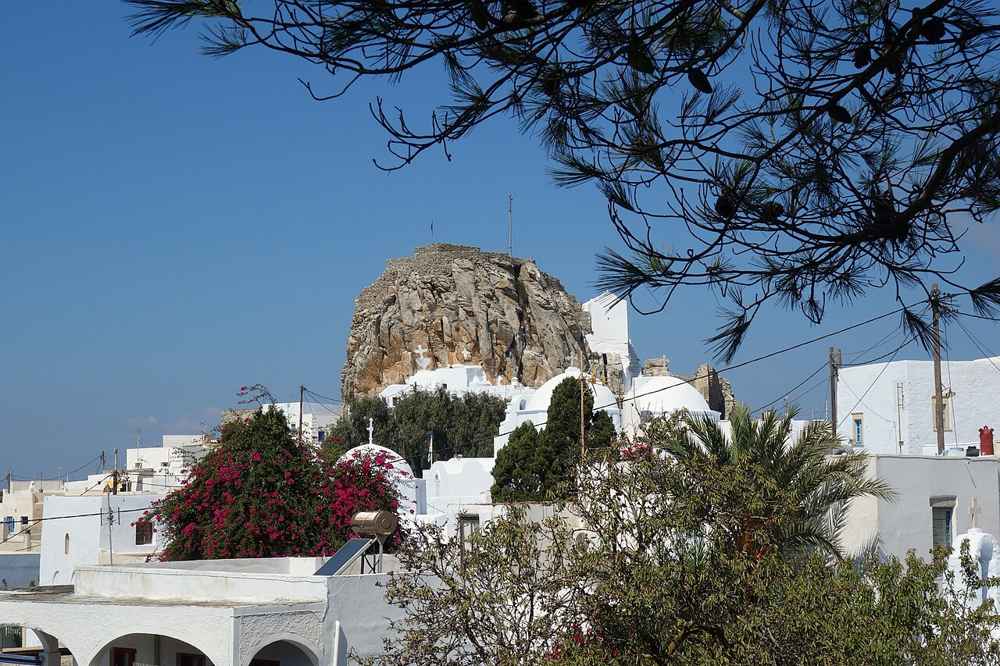
Chora is the capital of Amorgos, a classic Cycladic town set high on the island’s spine some four hundred metres above the sea. Safe from the pirates who once raided the coast. A car-free maze of whitewashed lanes, blue-domed churches and shaded squares, crowned by a ruined Venetian castle and ringed by old windmills. It is among the most beautiful capitals in the Cyclades and the cultural heart of the island. Plan the whole trip with Greece Tours.
This guide covers Chora in full: its whitewashed streets, the Venetian castle and the windmills. The Archaeological Museum in the Tower of Gavras, the churches, where to eat and drink. How to reach the town. Read it beside the wider Amorgos travel guide and the island’s things to do.
What is Chora, the capital of Amorgos?
Chora is the capital of Amorgos, a whitewashed Cycladic town high on the island’s ridge, around four hundred metres above the sea.
Amorgos town, universally known as Chora, sits high on the mountainous spine of the island, roughly midway between the two ports of Katapola and Aegiali. Built at altitude and set back from the coast. It was placed to be hidden from and defended against the pirates who plagued the medieval Aegean. It retains the tight, protective layout of that age.
The town is a classic of Cycladic architecture: a compact tangle of narrow marble-paved lanes. Whitewashed cube houses, small squares and a great number of tiny churches, all pedestrian and closed to cars. Above it rises a rock crowned by a ruined Venetian castle, and a line of old windmills stands on the ridge nearby.
Chora is the administrative and cultural heart of Amorgos, home to its museum, its main churches and a lively summer scene of cafes and tavernas. For visitors it is one of the essential sights of the island. A place to wander slowly. It combines naturally with the Hozoviotissa Monastery and Agia Anna beach, which lie just below.
What is the history of Chora in Amorgos?
Chora grew in the medieval era as a refuge from pirates, built high inland and crowned by a Venetian castle from the thirteenth century.
The story of Chora is written in its position. As pirate raids scourged the Aegean through the Middle Ages, the islanders abandoned exposed coastal sites and built their capital high on the inland ridge, hidden from the sea and easier to defend, a pattern followed across the Cyclades. The tight, maze-like plan of the town still reflects that need for protection.
The Kastro, on the rock at the heart of the town. The settlement grew around it as the island’s centre. Through the later Ottoman period Chora remained the capital, its churches, tower houses and lanes accumulating over the centuries into the town seen today.
That long history survives in the fabric of Chora: the Venetian castle and the Gavras Tower, the many old churches, and the whitewashed houses woven along the medieval lanes. Wandering the capital is a walk through the island’s past as much as its present, part of the wider story told in the guide to Amorgos.
What is Chora like to explore on foot?
Chora is a car-free maze of narrow marble lanes, whitewashed houses, arched passages and small squares, best explored slowly on foot.
Exploring Chora means wandering. The town is entirely pedestrian, its narrow marble-paved lanes twisting between whitewashed houses, under arches and up flights of steps. Opening without warning onto small squares shaded by trees where cafes and tavernas set out their tables. Getting a little lost is part of the pleasure, as every alley rewards with a church, a doorway or a view.
The architecture is pure Cyclades but with an Amorgian character: two-storey captains’ houses and simple cube dwellings. Brilliant white against the blue doors and domes, bougainvillea spilling over walls. Everywhere the small churches for which the town is famous. The lanes are cool and shaded even in high summer, a refuge from the heat of the coast.
Come in the early evening, when the light softens, the swifts wheel overhead and the town comes to life as locals and visitors fill the squares. A slow wander through Chora, ending with a drink in a square or a climb to the castle for sunset. Is one of the quiet highlights of a stay on Amorgos.
Why visit the Venetian castle in Chora?
The Venetian castle, or Kastro, is a ruined thirteenth-century fortress on a rock at the heart of Chora.
At the centre of Chora rises a steep rock crowned by the ruins of a Venetian castle, the Kastro, built in the thirteenth century when the Venetians controlled the island. Little of the fortress survives beyond its base and a small chapel. The rock itself, rising from the middle of the town, is the town’s landmark and its highest point.
The reward is the view. A short, slightly rough scramble up the rock leads to a terrace that looks out over the whitewashed roofs and churches of Chora. Across the mountainous interior and out to the surrounding sea, a sweeping panorama that takes in the whole setting of the capital. It is the classic spot for photographs and for sunset.
The climb is short but the path is uneven, so care and sensible shoes help, and the top can be breezy. Set at the heart of the town. The castle rock ties together a wander through Chora. Reaching its summit for the view is one of the essential things to do in the capital.
What are the windmills of Chora?
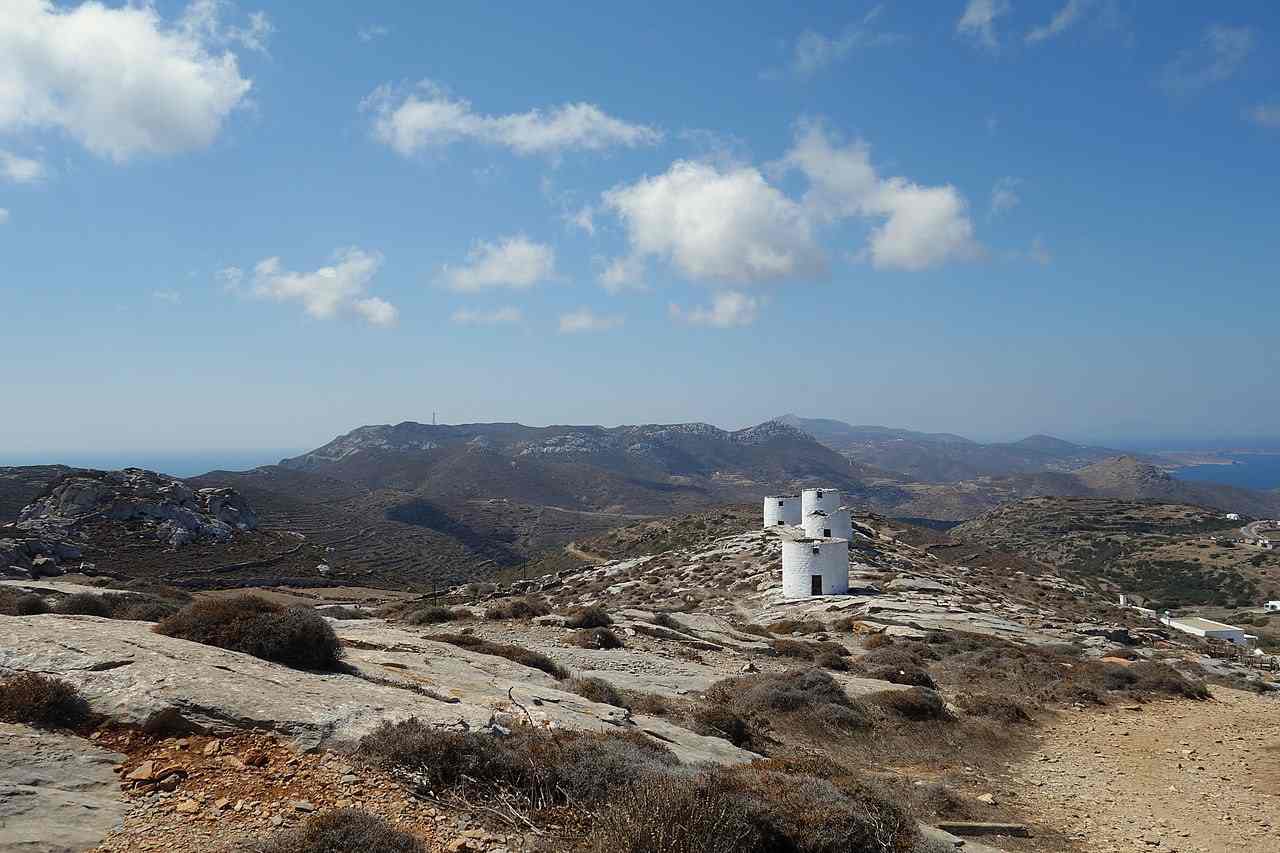
A line of old stone windmills stands on the ridge above Chora, in the Troullos area, arranged in a row along the hill.
On the windswept ridge at the edge of Chora, in the neighbourhood known as Troullos, stands a row of old stone windmills. Their round white towers lined along the hill where they caught the strong Aegean winds. For centuries they ground the island’s grain into flour, and a few retain their original mechanisms, relics of the self-sufficient rural life of old Amorgos.
The windmills are among the emblematic sights of Chora, their simple forms silhouetted against the sky and the sea. The exposed ridge on which they stand catches the full sweep of the wind and commands wide views over the island and the water. Which has made it one of the best-loved spots in the capital, especially toward the end of the day.
Walking out to the windmills at sunset, when the low light gilds the white towers and the sea beyond, is a ritual for visitors to Chora. The short stroll from the town centre to the ridge is an easy and rewarding one. Combining the historic mills with the finest evening view on this side of the island. A handful have been restored, and one occasionally opens to show the old grinding machinery within, a glimpse of the working life the ridge once supported.
What museums are there in Chora?
Chora’s Archaeological Museum is housed in the Tower of Gavras, a Venetian tower house in the town, and displays finds from the three ancient cities of Amorgos: Minoa, Arkesini and Aegiali.
The main museum of Chora is the Archaeological Museum, set in the Gavras Tower, a fine Venetian-era tower house in the heart of the town. Its collection gathers finds from across the island, above all from the excavations of the three ancient city-states of Amorgos. Minoa above Katapola, Arkesini in the south and Aegiali in the north, giving a picture of the island’s long antiquity.
The exhibits include sculpture, inscriptions, pottery and everyday objects from the classical and later eras, displayed in the atmospheric rooms of the old tower. For a small island, the museum offers a rewarding glimpse into a deep past, and it makes an easy, shaded stop on a wander through the capital.
Alongside the archaeology, Chora keeps small folklore and ecclesiastical collections that record the island’s traditional life and faith. Together they give the capital a cultural depth beyond its lanes and views, and they reward an hour or two between exploring the streets and climbing to the castle. Opening hours are limited and vary with the season, so it is worth checking locally before a visit.
What churches you see in Chora?
Chora is famous for its many small churches, said to number around forty.
Chora is a town of churches, said to hold around forty within its small compass. That a wander through the lanes is punctuated at every turn by a whitewashed chapel. A blue dome or a bell tower. This density of churches, many of them post-Byzantine, is one of the defining features of the capital and a mark of the island’s deep devotion.
Among the most notable are Kera-Leoussa, which holds a magnificent and venerated icon of the Virgin Mary, the Metropolis or cathedral of the town. The church of Agioi Pantes. All Saints, along with the twin church of the Metamorphosis, the Transfiguration, and other old chapels scattered through the streets, each with its own icons and character.
Many of the churches are small and simple. Sometimes open only for services or festivals. Their whitewashed forms and their setting in the lanes are part of the fabric of Chora. Seeking them out, and stepping into those that are open to see their icons, adds a quiet, contemplative thread to a visit to the capital.
Where you eat and drink in Chora?
Chora has some of the best tavernas and cafes on Amorgos, set in its squares and lanes.
The squares and lanes of Chora hold a fine choice of places to eat and drink, among the best on the island. Tavernas serve the traditional Amorgian dishes, patatato goat stew, fava, island cheeses and fresh vegetables. Along with meze and the local rakomelo, at tables set out under the trees in the small squares, ideal for a long evening meal.
For a drink, Chora has a cluster of atmospheric old cafes and bars, some housed in restored historic buildings. That have become institutions of the town. The cafe known as Loza is among the best known. Such places also hold the key to the castle for visitors who ask. They are gathering points for locals and travellers through the day and late into the night.
Eating and drinking in Chora is as much about the setting as the food, the whitewashed lanes, the shaded squares and the evening light. Lingering over a meal or a drink in the capital, watching the town go by, is one of the pleasures of a stay, and a taste of the island’s cuisine described in the wider guide to Amorgos. Tables in the small squares fill early on summer evenings, so arriving before the peak or reserving ahead helps secure the best spots under the trees.
How do you get to Chora in Amorgos?
Chora sits inland, high above the two ports. A local bus links it with Katapola and Aegiali times a day in summer, and taxis and hire cars also reach it.
Chora lies inland on the island’s ridge, roughly midway between the ferry ports of Katapola, about six kilometres away, and Aegiali in the north. The local bus links the capital with both ports and with Agia Anna beach times a day through the summer. The easy way to reach it without a car. Taxis are also available.
Visitors with a hire car or scooter drive up to Chora on the island’s main road. The town itself is entirely pedestrian, so vehicles are left in the car parks at its edge, from where you walk into the lanes. This car-free character is part of what preserves the town’s atmosphere and makes it such a pleasure to explore on foot.
It is central to a stay on Amorgos and easy to reach from either end of the island. For the ferries, the bus and getting around in more detail, see the wider Amorgos travel guide.
What is near Chora in Amorgos?
Chora sits just above the Hozoviotissa Monastery, on its cliff, and Agia Anna beach below it, both reached by a short drive or walk. The capital, the monastery and the beach together make the classic day out on Amorgos.
Chora’s position makes it the hub of the island’s central sights. Just below the town, on the coast, clings the emblematic Hozoviotissa Monastery. Reached by a footpath from the edge of Chora in about twenty minutes or by the short monastery road, an unmissable excursion from the capital.
Below the monastery lies Agia Anna, the pebbly cove of Big Blue fame. Ideal for a swim in dazzling clear water after a morning in the town and at the monastery. The three, the capital on its ridge, the monastery on its cliff and the beach below, form the essential central circuit of Amorgos.
Seeing them together in a single day gives the heart of the island, and Chora is the natural base and starting point. For the monastery and the beach in detail, see the guides to the Hozoviotissa Monastery and Amorgos beaches.
When is the best time to visit Chora?
Chora is rewarding from late spring to early autumn, when its cafes and tavernas are open and the evenings lively.
The capital is at its liveliest through the warm months of late spring to early autumn, when its squares fill in the evenings, the tavernas and cafes are all open. The town buzzes with visitors and locals alike. July and August are the busiest, though Chora, high on its ridge, stays cooler and calmer than the coast even at the peak.
The shoulder weeks of June and September are, for many, the sweetest time in Chora: warm and settled, with the town lively but uncrowded and prices lower. The cool, shaded lanes are a welcome refuge from the midday heat whatever the month, making the capital comfortable to explore even in high summer.
The town is at its most magical in the early evening and at sunset, when the light softens on the white walls and the crowds thin. Timing a visit for the end of the day rewards whatever the season. For the island-wide picture of weather and seasons, see the guide to the island. Whenever you come, an hour in Chora at dusk is the memory most visitors carry home.
Frequently Asked Questions
Is Chora in Amorgos worth visiting?
Yes. Chora is the capital of Amorgos and one of the most beautiful towns in the Cyclades, a car-free maze of whitewashed lanes. Small churches and squares crowned by a Venetian castle and ringed by old windmills. It rewards a slow wander, a climb to the castle for the view. A visit to the Archaeological Museum in the Tower of Gavras and an evening in its squares. It sits just above the Hozoviotissa Monastery and Agia Anna beach.
How do you get the key to the Venetian castle in Chora?
The path up the castle rock in Chora is usually open to climb for the view. Where a key is needed for a locked chapel or gate. It can often be borrowed from one of the town’s cafes, such as Loza, in exchange for leaving an identity document. Local cafes and tavernas are the place to ask, and the short scramble to the top rewards with the finest panorama over the capital and the sea.
How far is Chora from the ports of Amorgos?
Chora sits inland on the island’s ridge, about six kilometres from the port of Katapola and rather further from Aegiali in the north, roughly midway between the two. A local bus links the capital with both ports and with Agia Anna beach times a day in summer. Taxis and hire cars also make the short drive, though the town itself is car-free and vehicles are left at its edge.
Is Chora car-free?
Yes. Like many Cycladic capitals, Chora in Amorgos is entirely pedestrian, its narrow marble-paved lanes closed to cars. Visitors driving up leave their vehicle in the car parks at the edge of the town and walk into the maze of streets. This car-free character preserves the town’s calm, traditional atmosphere and makes it a pleasure to explore slowly on foot. Wandering between its churches, squares and the castle rock at its heart.